As Europe’s far right raises its head, the more violent things become. Some 30 migrant workers were injured in a shooting on a strawberry farm in Nea Manolada, Greece, after requesting salaries that had not been paid. Thanks to @ritorikaxalikia for the heads-up and the poster below.
Writes the BBC: “The Council of Europe – the main European human rights watchdog – issued a report this week detailing abuse against migrants in Greece. The report warned of a growing wave of racist violence, stating that “democracy is at risk”. It highlighted the role of the neo-Nazi Golden Dawn party.”
There’s a three-part story published on Suomen Kuvalehti with Perussuomalaiset (PS) MP Olli Immonen, who states why postmodern movies, or those that don’t strengthen Finnish national identity, shouldn’t be funded by the state. Immonen was elected the new president of Suomen Sisu, an extremist association that discourages white Finns from marrying foreigners.
Suomen Kuvalehti published a three-part dialogue between PS MP Olli Immonen and Kalle Kinnunen. Read (in Finnish) part 1, part 2 and part 3.
It’s not only disgraceful that politicians like Immonen can make a case for ”racial hygiene” in today’s Finland and promote an exclusive view of Finnish culture that excludes others from being treated as equals and with respect, but that his far right views have support from voters and the media.
What becomes clear in the three-part news interviews between Kalle Kinnunen and Immonen, is how much in the dark the PS MP is about the role of Finnish culture in the production of new Finnish movies.
Kinnunen asked Immonen what kinds of movies the PS MP considers postmodern and which of them undermine Finnish national pride.
”I throw the ball back in the court of the directors, scriptwriters and financiers and ask them if they have enough courage to break away from internationalism and multiculturalism and bring forth more Finnish culture in films.”
On Monday Migrant Tales questioned whether one of Finland’s anti-immigration hotheads, PS MP James Hirvisaari, knew what racism is. Hirvisaari claimed that he was a victim of racism because he was a member of the PS and was a devout Christian.
The same question now goes to Immonen: Does he have any idea what Finnish culture is?
It’s pretty clear from the dialogue between Immonen and Kinnunen that the PS MP from Oulu has a simplistic view of what he hinks is Finnish culture. For Immonen, Finnish culture is only a concept used by him to exclude those that don’t fit the outdated stereotype of the the blonde and blue-eyed Finn.
Disgraceful behavior that shames and is hurtful to Finland.
Abdirahim Husu Hussein, who is a Helsinki Center Party politician and hosts a popular radio talk show on YLE with Ali Jahangiri, his wife was the first to read a rude message written on their apartment door: “Binladen was here.”
If I’d read something similar on my door, I’d be pretty annoyed to say the least. Some people in our society still believe that they have the right to pry on people’s privacy and to insult their home in such a racist way.
Abdirahim Husu Hussein’s family found the following message written on their door this morning: “Binladen was here.” He published the news on his Facebook page.
“I’m not too worried about what happened but my wife was and she encouraged me to file a complaint to the police,” he told Migrant Tales. “I don’t want to give too much importance to what happened because that is what these people want, attention.”
Husu said that while similar types of messages have been written outside their apartment house before, it’s the first time that they have done it on their door.
It’s incredible how a few racists can effectively soil the good name of the Finns and Finland. If we are serious about defending our good name, we have to take a strong stand against racism and this type of harassment.
Migrant Tales wants to assure Husu and his loved ones that they’re not alone and that many people in this country are just as outraged by what happened as his family.
Migrant Tales aims to publish on the same day news that appears in the media. There was one opinion piece written on March 21 by Perussuomalaiset (PS) MP James Hirvisaari commemorating the International Day for the Elimination of Racial Discrimination that should have received our attention.
Our intention is not advertise James Hirvisaari, who was sentenced for ethnic agitation, but to show that PS MP is in the dark about racism.
Hirvisaari is not the only MP in the PS who doesn’t know what racism and discrimination are. There are many others like MP Reijo Tossavainen, who expressed ignorance of our Non-Discrimination Act by stating it was acceptable to hire people based on nationality.
One of the matters that the PS has done in Finland is bring out the darkest side of some Finns. These include: intolerance, racism, discrimination, provincialism, conservatism, sexism, anti-Russian nationalism to just name a few from a very long list.
Hirvisaari, who was sentenced in December 2011 for ethnic agitation, considered the International Day for the Elimination of Racial Discrimination to be a joke. Even so, his ignorance about racism reinforces the importance of that day.
He writes on a blog entry headlined “Anti-racism day” the following: “In spite of everything I must admit that I belong to that national group that is treated by those in particular [who claim to be] “tolerant” in a very racist (sic!) manner. I am for example a Perussuomalaiset [party member] and a devout Christian.”
Even if it’s clear that extremist anti-immigration groups want to rewrite and redefine history and concepts that reveal their intolerance, racism and far right credentials, are people like Hirvisaari ignorant or do they play on people’s ignorance – or are both of the above true?
I have been labelled by some members of the Perussuomalaiset (PS) of being a “racist” because I speak out against the anti-EU, anti-immigration and especially anti-Islam party. I explain to them that I never knew that the PS was an ethnic group. Christians aren’t an ethnic group either as Hirvisaari believes.
Despite all the bravado, ethnic sabre-rattling and provocations by extremist politicians like Hirvisaari and the PS in general, I wonder why none of their MPs have taken part in any debates on our blog.
That fact in itself is revealing. It shows that they only feel at home with people who think like them.
Atlantis, Eden ja Eldorado. Ihanneyhteiskuntien on uskottu perinteisesti sijaitsevan kadonneilla tai kaukaisilla saarilla. Siellä kaikille riittää tasapuolisesti töitä, vapaa-aikaa ja vaurautta. Realistit ovat aina tienneet, että mahdotonta ei kannata yrittää tavoitella. Mutta utopisteja on riitänyt maailman sivu, ja jotkut heistä ovat tarttuneet toimeen ja kulkeneet edellä. Jenni Stammeierin toimittama 8-osainen sarja käy läpi utopiayhteisöjen historiaa.
Osa 4/8 ma 22.4.2013 klo 12.15, uusinta su 28.4. klo 17.15
Uuden Suomen perustajat suuntaavat Amerikkaan
Venäläistämispaineiden alla Suomea ja suomalaisia suunniteltiin siirrettäväksi Amerikkaan. “Uudelle Suomelle” etsittiin 1800- ja 1900 -lukujen taitteessa paikkaa ensin USAsta ja Kuubasta. Etenkin suomenruotsalaiset kokivat olonsa ahtaiksi, ja monet oli jo karkoitettu maasta. Lopulta boheemi intellektuelli Arthur Thesleff löysi eksoottisen Argentiinan, joka houkutteli yli sata suomalaista liikkeelle. Joukko koostui pääosin suomenruotsalaisista kaupunkilaismiehistä, joita innoitti seikkailumieli. Matkaan lähdettiin myös rikastumistavoittein. Minkälaisen paratiisin eksotiikannälkäiset suomalaiset Argentiinan viidakosta löysivät? Asiantuntijoina professori Jussi Pakkasvirta, professori Marja Jalava sekä argentiinansuomalaisten tutkija Enrique Tessieri.
Abdulah, who has appeared in a number of postings on Migrant Tales, hasn’t yet rallied enough courage to speak without the veil of anonymity. Like many who are scorned in Finland because of their ethnic background, regaining one’s balance and healing the wounds inflicted by intolerance can be a long process.
“I have learned a lot from Migrant Tales,” he said. “One of the most important matters that has helped me is to accept who I am. It’s been an ongoing process.”
Accepting oneself can be easier said than done, especially for those that have been constantly reminded that their ethnic background is something they should be ashamed of, according to Abdulah.
He says before discovering Migrant Tales, he thought that there wasn’t a single forum in this country that cared about his situation.
“It was awful and I became paranoid every time I walked outside my home in public,” he continued. “All the chat forums that I followed overflowed with racism and hatred for who I am.”
Abdulah believes that the most racist forums in Finland are found on Iltalehti and Suomi24.
“[Tabloid] Ilta-Sanomat’s chat forum aren’t as bad as Iltalehti’s because they’ve cleaned up their act,” he said. “I haven’t visited Hommaforum. Maybe I should one day.”
Migrant Tales believes that visiting Hommaforum would be a waste of time for Abdulah.
Mediaseurantais another website that furthers what Hommaforum spreads but in a subtler fashion. While it attempts to give a balanced view of what is written about immigrants in the Finnish media, it’s a pro-Hommaforum site. This is apparent by the type of stories it publishes that attempt to show immigration, and espcially Muslims, to be a problem in Finland.
Abdulah has never heard of Mediaseuranta and considers Uusi Suomi to be a good online forum because it gives immigrants and visible minorities an opportunity to express their views.
Migrant Tales doesn’t totally agree with Abdulah.
Even if anti-racists publish blog entries on Uusi Suomi, the online publication is openly hostile, racist and a home for Finland’s anti-immigration community.
Uusi Suomi has tried to weed out openly racist writers from publishing on their site. Even so, the website is still a good breeding ground for spreading conservative, anti-EU, right-wing populist, anti-immigration, and especially anti-Muslim diatribe.
Moderation is poor and it’s unclear if the online publication conveniently turns a blind eye to some of its more racist and Islamophobic blog entries.
Comment: As the manhunt for one of the two suspects continues in Boston, what should our reaction be to the two Chechen killers? This blog entry written on the first anniversary of the horrific killings in Norway by Anders Breivik could shed light on that question.
____________________
What goes around comes around.
Exactly a year ago Anders Breivik carried out his mass killings, which ended up causing the death of 77 innocent victims. Have we learned anything from that tragic Saturday that shook the Nordic region and changed it permanently?
In order to answer that question, we’d have to travel back in time to see how things were prior to that day.
In Finland, the right-wing populist Perussuomalaiset (PS) had just won ahistoric election victory that enabled the party to increase the number of its MPs to 39 from 5 in 2007. While party leader Timo Soini played down anti-immigration sentiment as one important factor behind the PS’ election victory, others disagreed.
Before Breivik erupted on the stage, anti-immigration parties like the PS were the new political force to contend with in Finland. It seemed that nothing could stop them from adding new election victories in the future. The louder and cruder their anti-immigration and anti-EU stances were, the more supporters they’d rally to their cause.
In Norway, Denmark and Sweden, far-right populist anti-immigration parties had grown as well and were openly challenging traditional parties.
Everything changed, however, after July 22.
The first blow came in Norway to the Progress Party (FrP), which saw its support in the September municipal election plummet by 6.1 percentage points to 11.5%. In the same month, another anti-immigration party, theDanish People’s Party (DPP), suffered an election setback.
Since 2001, the Islamophobic DPP had supported minority right-wing government in exchange for tighter immigration policy.
In many respect, Breivik was a wake-up call that woke up for Finland and the Nordic region to the threat of intolerance and hate speech.
A recent supreme court ruling against Jussi Hall-aho is a case in point. The PS MP was not only fined for defaming a religion but for inciting ethnic hatred as well. The ruling wasn’t only a big blow to the PS but to the far-right Suomen Sisu wing of the party. Halla-aho was forced to resign as chairman of the administration committee, which, among other matters, sets immigration policy.
The presidential election was another important example of how Finland is distancing itself after 22/7 from the anti-immigration and populist rhetoric of parties like the PS.
Two conservative anti-EU candidates, Timo Soini of the PS and Paavo Väyrynen of the Center Party, lost to Green Party hopeful Pekka Haavisto in the first round of voting. Haavisto is openly gay and pro-EU.
The next test for the PS will come in the October municipal elections. If polls are anything to go by, the party will suffer another election setback.
In light of the above, can we claim that Breivik had had a direct impact on the popularity of the PS and other parties in the Nordic region that are anti-EU, anti-immigration and anti-Islam?
Your answer to that questions will probably reveal more than anything else your political views on immigration, Islam and cultural diversity.
But if we ask Norwegian Prime Minister Jens Stoltenberg, Norway had become after July 22 “more tolerant, [and] more careful not to judge people” by ethnic origin.
Even if Stoltenberg has shown leadership on how a wounded society should react to intolerance, it’s still unclear what impact Breivik will have on our societies. We are still healing from the wound and can matters return back to “normal” in Norway after Breivik?
If we set aside politics and try to understand the impact Breivik had on the region, one matter is certain: We are outraged by what happened but dread even more the possibility that it could happen again.
Competing for the anti-immigration thunder and rhetoric of parties like the PS, DPP, FrP and Sweden Democrats are far-right groups like the Finnish Defense League, which are copy-and-paste clones of the English Defense League.
Breivk scared the wits out of some of us and proved that anti-immigration and Counter-Jihad rhetoric can convert itself into a monster that has the ability to wreak terror and change our societies for good.
That I believe is the real message and threat of 22/7.
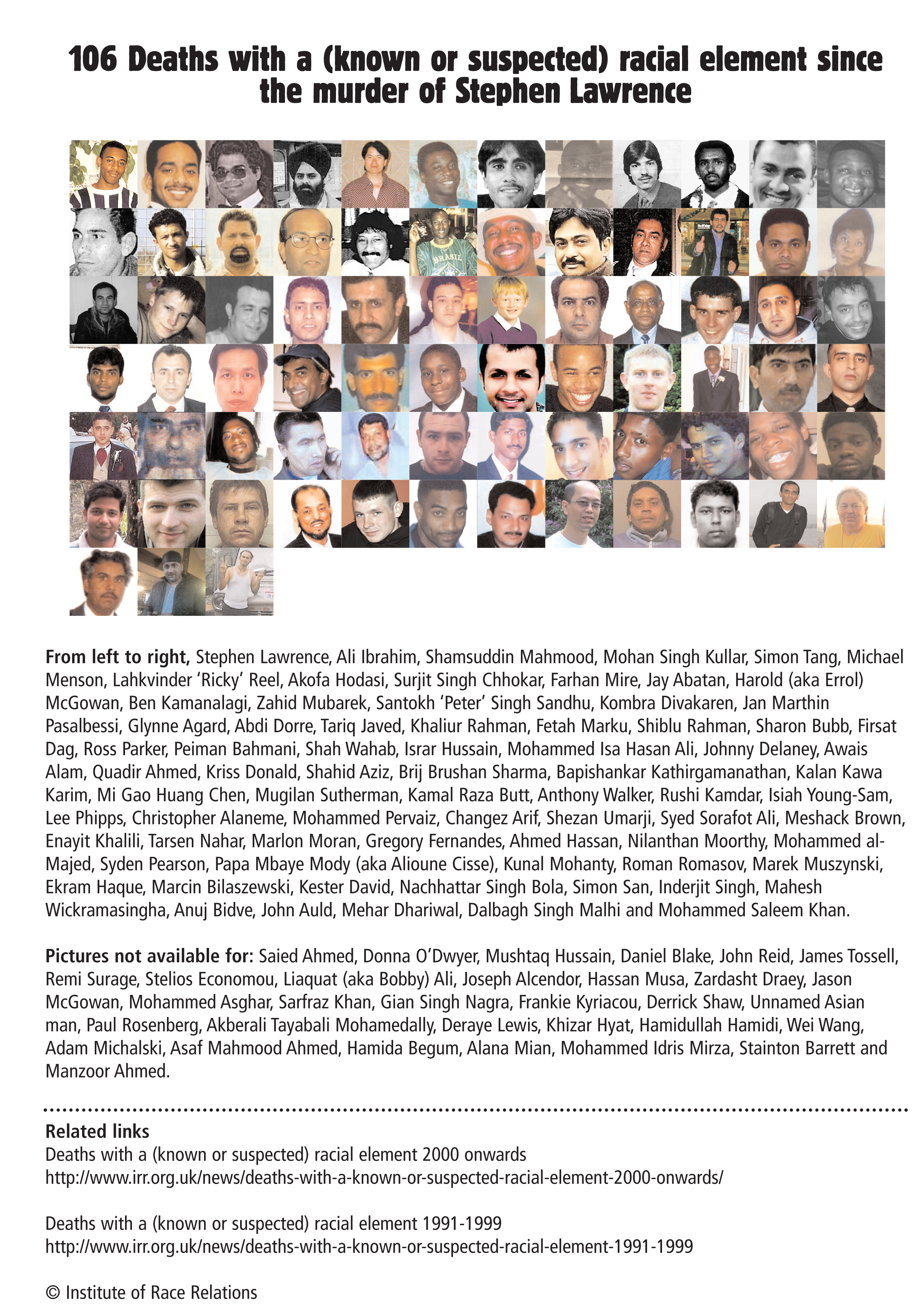
As the twentieth anniversary of the murder of Stephen Lawrence approaches, the Institute of Race Relations (IRR) examines racial violence since his death in 1993.
In the twenty years since the death of Stephen Lawrence, we can report that 106 people have lost their lives in (known or suspected) racist attacks – five per year on average, that black people are twenty-eight times more likely than white to be stopped and searched by the police (using Section 60 powers), that in 2009/10 black people were over three times more likely than white to be arrested, that black and those of mixed ethnicity are over twice as likely as whites to be unemployed, that three quarters of 7-year-old Pakistani and Bangladeshi children are living in poverty compared to one in four whites, and that those classifying themselves as ‘Other Black’ are six times more likely than average to be admitted as mental health inpatients.
Yet as a society we are in denial about racism. Because the 1999 Macpherson report (into Lawrence’s death and subsequent policing), for the first time, acknowledged institutional racism and the Race Relations Amendment Act followed in its wake, politicians regard the issue as over, declare our society ‘post-racial’. But the kind of mechanistic, box-ticking equality measures being implemented leave intact the laws which discriminate, the power of the media in fomenting hatred and – the levels of racial violence.
Worse, multiculturalism itself is now held responsible for racial tension; think-tanks redefine ‘the problem’ in terms of individual attitudes, identity and willingness to belong; and local anti-racist structures are being decimated. Said IRR researcher Dr Jon Burnett, ‘The twenty years since the unprovoked murder of Stephen Lawrence reveals not the end of racism, but the fact that it is deeply entrenched and infinitely adaptable. What we fear is that as austerity measures begin to bite and politicians compete over restricting immigration and benefits, the fall-out will inevitably be an increase in racism.’
Ongoing research by the Institute of Race Relations shows that racial violence does not impact on all communities equally. As racism is shaped by factors such as military intervention abroad and the resort to nativism in social policy as austerity measures bite, its nature changes, as does its manifestation in towns and cities undergoing swift demographic change. At a time of growing anti-foreigner rhetoric, it is newly arrived migrants, asylum seekers and those identified as visibly or culturally different, who are more likely to be the victims of racial attack. And, according to the Crime Survey for England and Wales, such attacks are running at the rate of 130,000 per year.
Tähän mennessä olen usein esitellyt itseni reippaasti Mikkeliin muuttaneeksi pieksämäkeläiseksi, koska kotikaupunki on ollut minulle tärkeä osa identiteettiäni.Paitsi että juuri nyt hävettää ihan saatanasti.
Pakolaisia ei voida ottaa, koska ne raukat alkoholisoituu ja hakkaa perheitään huostaanottotilanteisiin asti. Syntysuomalaiset perheethän ovat tietysti kuin suoraan OMOn tai Arielin mainoksista. Lapset leikkivät kivoja leikkejä, äidit pesevät pyykkiä ja isät ovat näkymättömissä, eli töissä, kaikilla suomalaisilla miehillähän on töitä.
Rakas kotikaupunki, nyt vittu oikeesti!
Se on kiva, että halutaan pitää yllä idyllisen maaseutukaupungin mainetta, varsinkin kun ollaan kärsitty parikymmentä vuotta Suomen väkivaltaisimman kaupungin ja muutenkin ankean mestan maineesta, mutta takapajuinen rasismi ei oikein sovi tuohon idylliin.
On eri asia sanoa, ettei ole rahaa tai resursseja, kuin todeta, että nämä pakolaiset ovat ongelmaihmisiä, jotka lähinnä riehuvat ja tuottavat kuluja ja pahaa mieltä.
Pakolaisuus ei ole kevyt, hetkessä tehty valinta, vaan pakon sanelema iso elämänmuutos. Koetut traumat aiheuttavat helposti mielenterveyden järkkymistä, mitä ei myöskään helpota uuden kotimaan torjuva ilmapiiri ja vaiettu, kuoliaaksi kielletty rasismi.
Maahanmuuttajille, erityisesti pakolaisille ei muutenkaan aina ole, tai osata kohdistaa oikeita mielenterveyspalveluita. Joko niitä ei osata vaatia, tai niiden toteuttaminen on hankalaa kielimuurin tai kulttuurierojen takia.
Uskallan väittää, ettei tasapainossa oleva ihminen ryyppää itseään hengiltä tai hakkaa perhettään sairaalakuntoon.
Ja sitten on tietysti nämä tyypit, joiden mielestä on kivaa, kun pizza ja kebab on niin halpaa ja että sitä saa ihan kulman takaa, mutta rapussa moikkaava outo tumma mies ja suomalaiseen suuhun vaikeasti sopivat nimet ovissa ovat aivan liikaa omalle mielenrauhalle.
Ihan vaan vinkkinä, jos Pieksämäki ei tahdo olla seuraavat pari vuosikymmentä “se rasistinen rautatiekaupunki Savossa”, niin nyt tartteis tehdä jotain ja aika livakkaan…