Migrant tales
Menu
  • #MakeRacismHistory “In Your Eyes”
  • About Migrant Tales
  • It’s all about Human Rights
  • Literary
  • Migrant Tales Media Monitoring
  • NoHateFinland.org
  • Tales from Europe
Menu

Month: March 2013

Is condemning racism really condemning racism? Suomen Sisu’s ‘vodka’ problem!

Posted on March 12, 2013 by Mark

I think it’s positive that Olli Immonen, PS member of parliament and new Chairman of Suomen Sisu, the Far Right grouping, so openly ‘condemns’ racism on the Suomen Sisu website, but sadly, the comment is open to some interpretation. The reason is that like PS, they condemn racism in one breath, and then choose to talk not about racism, but about ‘positive discrimination’ in the labour market, as if they were ever the same!

Not to take up the point about whether positive discrimination constitutes ‘racism’, it is in this context that Immonen’s statement becomes somewhat ambiguous. Indeed, it is true to say that today racism is universally regarded as a bad thing, and no-one sensible or sane would attempt to defend it in any blatant form. But the Far Right have not given up their scapegoating of immigrants or their manipulation of racism among voting populations – rather, they have tried to sanitise it and make it respectable. Indeed, while Immonen appears to make out he is a ‘liberal’ on the issue of racism, he certainly makes up for it in terms of quite blatant Islamaphobia. Why bother with racism when you can get good mileage and less political heat out of religious bigotry?

But that isn’t the end of the racism question for me in regard to Suomen Sisu, not by a long way, especially given their stated opposition to, for example, ethnic inter-marriage. It remains to be seen too, to what extent their extremism will remain visible after their obligatory website makeover, now that there is a new man in charge. Something still smells fishy!

One exposé several years ago by a Guardian journalist who infiltrated the British National Party revealed that the ‘old style’ racism still exists to be seen ‘on the inside’, even if somewhat coded, but that outwardly the message is nowadays very tightly controlled. Racial superiority has given way to a sense of moral and cultural superiority, built on the back of economic advantage. The constant linking of immigrants with crime, rape and extremism continues as before, but rather than being put forward as proof of racial inferiority, today it is put forward as proof of cultural inferiority and economic liability. Racial prejudice has in many ways given way to ethnic, economic and religious prejudice, which nevertheless still divides along racial lines. Racists have merely taken shelter today in mainstream cultural categories.

Yet any political party that puts immigration as the number one problem facing society, or even in the top ten, simply has no real concept of civil society or today’s political and social challenges. While immigration does bring problems, typically through being underfunded, and a visible change in demographics, it most certainly is not the main problem facing modern societies. Economic problems loom largest, from government debt to personal debt, job insecurity, capital flight, financial regulation, market bubbles, unaffordable housing, growing gaps between rich and poor, ageing populations, health care financing, health inequalities, the ‘greying’ of rural populations, achieving competitiveness in a global market while maintaining standards of living, regulation of ‘borderless’ markets, mortgaging the future, environmental sustainability, the rights of women, violence against women, human rights abuses, human trafficking, political and social freedoms, substance abuse problems etc; these are all issues both home and abroad that would naturally rank higher in my view than the ‘problem’ of immigration.

Of course, if you think you didn’t get a job because it went to an immigrant, then you may find reason to be personally aggrieved about immigration. If you seek identity and belonging through a narrow nationalist identity centred on monoculture illusions and a sense of endless despair about any cultural mixing,  then fear for the Islamisation of Europe will keep you awake at night. Identity politics is easy to follow and easy to campaign for. You simply follow your ‘team’ and then everything the other team does is wrong, the referee [the Establishment] is blind and the game is rigged against the natives! Hooliganism, intimidation and violence are defended as ‘boys will be boys’ or even as cultural self-defence. Oh, and importantly, our team is of course naturally the best! Go Suomi!

So as much as it seems useful for Immonen to condemn racism, I found the wording to be problematic. Given Suomen Sisu’s stated opposition to positive discrimination or ethnic quotas in employment policies, which was also a key point in the Nuiva Maalimanifesti compiled by PS’s politicians, we just don’t know what Immonen refers to when he condemns racism. Chances are that he condemns the Far Right’s interpretation of racism and not the racism by Finns against immigrants, institutional racism, public slurs of immigrants, second class citizenship of immigrants etc.

I might be wrong, of course, because on paper, it looks like a condemnation of racism, and that is what people ‘want to hear’ for these groups to gain mainstream respectability. But until I hear it in more specific terms, and not all that nonsense about positive discrimination being the worst evil of racism, then it sounds like the protestations of the alcoholic who tells you that they really have stopped drinking. But upon investigation, you find the stuff they are now drinking happens to smell like vodka, taste like vodka and have the intoxicating effects of vodka, but that you are expected to believe it really isn’t vodka because the label on the bottle clearly says it isn’t!

Who do death threats and hate speech intimidate?

Posted on March 12, 2013 by Migrant Tales

Finland’s largest daily Helsingin Sanomat asked twenty-three racism researchers if they had been harassed and received death threats. Sixteen researchers answered the questionnaire of which 14 responded affirmatively that they had received hate mail. 

This story by Helsingin Sanomat confirms the concern of other researchers at the University of Eastern Finland.

The first time I received death threats (two in one day) was in surprisingly in Finland in the early 1990s, when I wrote about the treatment that Somalis received at a refugee center in Mikkeli.

The death threats and harassment haven’t stopped since then but neither have I been intimidated by them to stop writing.

Some of anonymous mail I have received is quite amusing. One older man gave me a lesson on Finnish history and claimed that he would end his subscription to Savon Sanomat, where my column appeared.

The headline of the column was Maahanmuutto ei ole uhka, or Immigration isn’t a threat.

The letter sent to me had no signature or return address.

If a person has such strong feelings about a topic like immigration, why doesn’t he defend them publicly with his name?

Who do death threats and hate speech intimidate?

Nobody except those who send them.


Max Jakobson dies but his legacy and the cold war linger on

Posted on March 12, 2013 by Migrant Tales

This blog entry is dedicated to the late Donald Fields, Helsinki correspondent of the BBC, The Guardian and Politiken to 1988.  

I read with mixed thoughts about the death of Max Jakobson (1923-2013),  a diplomat who shaped Finland’s policy of neutrality during the cold war. While I am certain that he was an able diplomat, he was no friend of dissension or anyone who dared to question Helsinki’s sacrosanct foreign policy with Moscow. 

He didn’t hide his disdain for foreign correspondents as can be seen in the summer 1980 issue of Foreign Affairs: “…Finland is forever at the mercy of the itinerant columnist who after lunch and cocktails in Helsinki is ready to pronounce himself upon the fate of the Finnish people. A person visiting, say, London for the first time, who does not know English and has only a vague notion of the significance of Dunkirk or the role of Winston Churchill, would hardly be regarded as qualified to comment on the British scene today.”

Did cold war Finland have to treat the media with such contempt and overbearing censorship?

Future historians will shed light on that question.

Kuvankaappaus 2013-3-12 kello 0.31.46

Helsingin Sanomat writes about the death of Max Jakobson on Monday’s edition.

In the 1980s, people like Pekka Karhuvaara, Lasse Lehtinen, Matti Kohva, Ralf Friberg and others made sure that what you wrote about Helsinki-Moscow relations was to their liking and toed the official foreign policy line.

If you didn’t you were black listed, period.

The foreign ministry together with Finnfacts did everything possible to brighten Finland’s name by inviting foreign journalists to the country. They would pay their trips, stay, wine and dine them to win them over. Many, I’m certain, became good friends of this country after such freebies.

My first attempt to interview Jakobson was  in 1989 shortly after I started to work  for the Financial Times in Helsinki. First he accepted the interview but later canceled it.

I suspect the reason why Jakobson canceled the interview was because he had learned about my stand against the Soviet Union, Finnish foreign policy and especially those Soviet asylum seekers who were deported back to the former U.S.S.R.

I got my second chance when Christian Tyler of the Financial Times came to Finland to do a special  report on the eventual demise of the Soviet Union and its impact on Finland.  Tyler had an appointment with Jakobson and I tagged along.

This is what we wrote in The last wall in Europe, published in January 1991:

“Even Max Jakobson, the distinguished former diplomat and most eloquent apologist for Finland’s extreme post-war neutrality, agrees that the government has been traditionally inhospitable to immigrants and slow to respond to the turmoil around its borders. “The period of stagnation was not bad for Finland,” he said but he added: “There is nothing wrong with stagnation if you can do it on a high income level as we did.” Finland had no obligation to Soviet citizens, but rather an opportunity. “Our obligation is to look after our own interests.”

The foreign ministry wasn’t naturally happy with what we wrote. Tyler told me that he published in a separate story an interview with Jakobson, which was more favarable.

While the cold war is still too close to us to study objectively, I suspect that future researchers and historians will look at this period with mixed feelings. Even if we were able to build a successful Nordic welfare state after the armistice with Moscow in 1944, we were near-isolated form the world. Even if we lost hundreds of thousands of able workers who migrated to Sweden after World War 2, we kept our borders effectively closed to immigrants and the outside world.

No matter how much you tried to accept the foreign ministry’s and Jakobson’s view of Finland’s neutrality, it always boiled down to censorship and even greater doses of self-censorship. Thanks to Finland’s near-isolation, foreign investment was almost negligible thanks to the Restricting Act of 1939 (law 219/1939) and it was not until 1983, 65 years after independence, that Finland got its first Aliens Act.

What is the legacy that Jakobson and Finland’s cold war foreign policy left on Finland?

While both kept Finland from becoming a Warsaw Pact member, it came with a high price. The cost can be seen today in our attitudes and suspicion of foreigners, especially of Russians.

If we still believe that we are at war with Russia, how can we be an open society that aims to integrate newcomers?

If there is anything holding us back, it is the cold war legacy.


Is the far right a threat to Finland?

Posted on March 11, 2013 by Migrant Tales

Pia Growchoski asks an important question on her recent blog entry on Migrant Tales: Why is the national media so interested in far right groups and their resentful rhetoric? Why do we give space to Perussuomalaiset (PS) chairman Timo Soini’s blatant incompetence on our Facebook pages? Are we in denial about what these groups represent or just being entertained by them?

In many respects, far right politicians are like show wrestlers. We know about their antics but we don’t mind being fooled.

Soini is one politician who plays the show political game very well. He plays it so well that it took a year and ten months after the PS’ historic election victory of 2011 to be grilled on HARDtalk about racism in his party.

How many in Finland have done the same?

Kuvankaappaus 2013-3-11 kello 12.45.14

After some major adjustments and training, lots of far right politicians could make it as show wrestlers and even become as popular as Ric Flair. Source: Best of Ric Flair going nuts.

A good example of the public’s fascination with the far right in Finland is the media coverage that PS MP Olli Immonen got as the new president of the extremist Suomen Sisu association.

Some of the most outrageous matters that Immonen, who is a security guard by profession, has claimed is an inevitable so-called clash of cultures between “Christian” and “Muslim” Europe.

Sensible people understand that this is a lot of hogwash like 99.99% of what show wrestlers rant theatrically in front of television cameras.

Immonen writes on the Suomen Sisu website that it is a good matter that anti-immigration groups are not taking the law in their hands but organizing legally.

Then the show wrestler appears like from a jack-in-the-box bouncing from side to side: “I personally condemn racism and I don’t accept that any person is marginalized or favored in working life based of his ethnic background,” he continues. “Similarly, I condemn all forms of political violence be it from persons belonging to the left, center or right.”

Why would Immonen state such things?

If you want to see what people really think and represent, see what they deny.

Irrespective of the political theatrics, it would be a mistake to underestimate the influence and potential harm these types of groups can inflict on our society. That is why we must be vigilant and ready to confront and defeat them wherever they me be.

Today these far right groups are active in countries like Greece and Hungary.

In Finland they already have a beachhead.


Pia Grochowski: Shifting our focus

Posted on March 10, 2013 by Migrant Tales

By Pia Grochowski 

“My friends, love is better than anger. Hope is better than fear. Optimism is better than despair. So let us be loving, hopeful and optimistic. And we’ll change the world.”

These were the final words written by the late Canadian leader of the opposition, Jack Layton, just hours before his untimely death of cancer. I reflect upon these words with a desire in my heart to challenge the current status quo in Finland. While the words were part of a message towards all Canadians to carry us through period of darkness with the untimely passing of one of our leaders; these words have enormous relevance.  

I wish to question what appears to be, to me at least, too much coverage of the far right, racism, the perussuomalaiset. I question the tactics from many liberally minded people that discussions I have had always tend to fall down the path of concern for what the äärioikeus, or far right, said; many are rightfully shocked, disgusted, and concerned at the long-term implications of their dogma, their horrific ideas. Rather than despair in such statements, I feel we must look with optimism towards alternatives. To allow us to be channels wherein people with the capacity to change, with a vision for inclusion can get a voice. The more I read of äärioikeus, the more I realize how silly it all is. These individuals promote sensational ideas, which I believe will never be manifested, but can be framed in such a way that will shock and awe the public and sell newspapers. The more they are covered and discuss in the media, the more we are at risk of having them get the promotion we want. While criticizing their views, we must take care to provide a reasoned answer that defines out values and ideals with the means of seeing them through.

My plea in writing this is that we need to hear more visionary voices; we need to see more alternatives. Now is the time to act, now is the time to hope, and be optimistic. There are so many wonderful people in this country with great messages of diversity, great potential for change; why do we let a character like Soini win the walls of our facebook pages with his blatant incompetence, and subtle racism in a BBC interview. In the last presidential election an openly homosexual man, with a foreign partner came to the final round. This wouldn’t be possible without some desire of the people in this country accepting and supporting the very things the äärioikeus hopes to remove. I am becoming more inclined not let the äärioikeus use me as a channel for their voices, as I believe such spaces are better used by alternatives, reasoned voices that can offer real solutions rather than fear. I believe they have fed us with enough proof that they are no longer worth our time, our anger. I believe that we can deal with this problem; I believe that we can lead by example, we can provide ideas, we can solve problems, and we can do better.

Don’t get me wrong, covering racism is important, and some may, still, be unaware of the extent of it all; but we also need to reflect on giving more space to voices that have a vision for an inclusive, dynamic, progressive Finland. At times I worry that all these ideological extremes victimize immigrants. While focusing on all that frustrates us, all the problems, we also need to take time and focus on all that we can and will change. Love is better than anger.

Police apprehend suspected attacker of black VR worker of Kajaani, Finland

Posted on March 10, 2013 by Migrant Tales

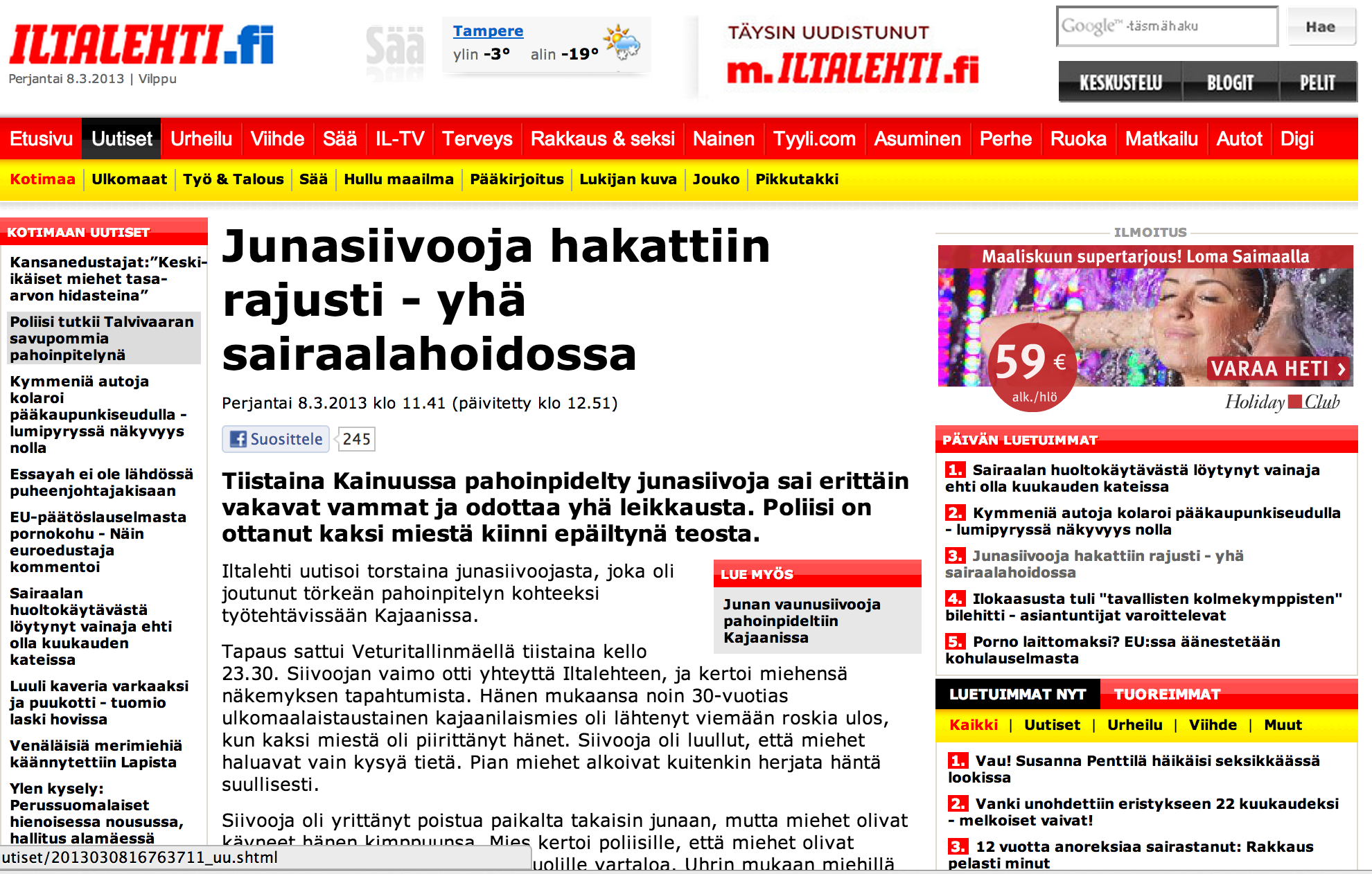
The police have apprehended the suspect who violently attacked on Tuesday a black train cleaner working for state railways, VR, reports Kainuun Sanomat. The suspect, who is a foreigner, admitted to the police of attacking the VR worker, who has returned home after being operated twice in hospital.  

Kuvankaappaus 2013-3-10 kello 9.21.00

Just because a person is a foreigner doesn’t mean he cannot commit a hate crime.  See what is happening in countries like Hungary, Slovakia and Greece, where racism and xenophobia have scapegoated visible immigrants, the Roma and Jews.

Moreover, the mere thought that people act like “cultural zombies” reveals your ignorance and prejudices, which are kept alive thanks to generalizations made of other groups.

Is the police treating what happened in Kajani as a hate crime? We still don’t know but they should if the victim was attacked because of his ethnic background.

Some Finns, who clump all foreigners in one group, believe that immigrants cannot house racist thoughts about other groups. This assertion could not be further from the truth. The same type of intolerance we find in some sectors of white Finnish society can be uncovered among some foreigners, who see themselves as white but may loathe blacks.

Our message to these people should be the same: racism, prejudice and intolerance are unacceptable in our society. Cross the line and you will have to deal with the law.

When we address a social ill like intolerance, the message must go to everyone in our society. Our aim must be zero tolerance.

Columbus brought destruction, resentment to America and future wars to Europe

Posted on March 9, 2013 by Migrant Tales

Imagine if the Internet existed when Christopher Columbus landed on Hispaniola in 1492 and we’d read about what ensued. Would our selective memory get the best of us and keep us in the dark for centuries about the systematic extermination of the Amerindians? Even if Bartolemé de las Casas (1484-1566), a historian and Dominican friar, wrote about these atrocities , we still teach children at our schools about a “great man” called Columbus.   

The most harrowing fact about the conquest of the Americas by Europeans is that nobody was sentenced for the genocide and mass destruction that took place there. All the spoils went to the victors.

Surprisingly some anti-immigration groups oddly compare the colonization of the Americas by Europeans to immigrants moving to Europe. This is wrong because immigrants bring a service and economic growth to a country instead of pillage and destroy it. Anti-immigration groups, who use this argument, have been watching too many Hollywood Westerns.

Image1_edited-1

Bartolomé de las Casas’ Brief account of the destruction of the Indies (Brevísima relación de la destruición de las Indias) was published in 1542.

Why is Columbus pictured as a hero when he brought so much destruction on Native Americans? Columbus proves that we can live with our collective heads stuck deeply in the ground for centuries.

When we read the history of the Americas, it’s usually from the white man’s perspective. Women, like Amerindians, don’t have much of a role or say in the history of that region.

Conversely, some may ask why the European media doesn’t bother to report enough about the prejudice, racism and plight of minorities in Europe. The Romany minority as a good example. The answer is simple: Our media is not controlled by minorities.

If a major Finnish daily writes about family reunification of refugees, for example, it will rarely write about the human tragedy that our tightened laws have caused on people who must live separated from their loved ones for years.

Even if De las Casas did a service by documenting the barbarity that he saw in the New World, he wasn’t against abolishing slavery.

Our reaction to intolerance, thanks to the Internet, must be faster today. We cannot wait for centuries to correct an injustice. As we challenge social ills more effectively, we reduce the likelihood of future wars and conflicts, which definitely have their roots in the fifteenth century, when Europeans started to colonize and pillage the New World.

What happened to Amerindians in the Americas is an example of the destruction that blind racism and greed can foster. Even if we don’t go around burning people at the steak as happened during de la Casas’ time, the white man has devised ingenious ways to destroy the self-esteem of minorities.

Malcolm X said it eloquently in the following quote: “Racism is like a Cadillac, they bring out a new model every year.”

The Indies were discovered in the year one thousand four hundred and ninety-two. Forty nine years have passed since the first settlers penetrated the land. The first, being the large and most happy isle called Hispaniola, perhaps the most densely populated place in the world.

There must be close to two hundred leagues of land on this island. And all the land so far discovered is a bee hive of people; it is though God crowded into these lands the great majority of mankind. And of all the infinite universe of humanity, these people are the most guideless, most devoid of wickedness and duplicity, the most obedient and faithful to their native masters, the Spanish Christians they serve. And because they are so weak and complacent, they are less able to endure heavy labor and soon die of no matter what malady, yet into this sheepfold, in to this land of meek outcasts, there came some Spaniards who immediately behaved like ravening wild beasts, wolves, tigers or lions that have been starved for many days, killing, terrorizing, afflicting, torturing and destroying the native peoples.

Doing all this with the strangest and most varied methods of cruelty never seen or heard of before, and to such a degree that this island of Hispaniola of once so populace, having a population I estimated to be more than three million, has now a population of barely 200 persons. Their reasons for killing and destroying such an infinite number of souls is that Christians have an ultimate aim is to acquire gold and to swell themselves with riches in a very brief time disproportionate to their merits.

It should be kept in mind that their insatiable greed and ambition, the greatest ever seen in the world, is the cause of their villainess. And also, those lands are rich and so felicitous that the native peoples, so meek and patient, so easy to subject, that all Spanish have no more consideration for them than beasts. No, for thank be to god, they have treated beasts with more respect; I should say instead like excrement on the public squares.

The Indian began to seek ways to throw the Christians out of their lands. They took up arms, but their weapons were very weak and little service in offence and still less in defense . The Christians with their horses and swords and pikes began to carry out massacres and strange cruelties against them. They attacked the towns and spared neither the children nor the aged nor the pregnant women nor women in childbed, not only stabbing them and dismembering them, but cutting them to pieces as if dealing with sheep in a slaughterhouse. They made some low wide gallows on which they hanged victims’ feet almost touched the ground, stringing their victims in lots of 13, in memory of our redeemer and twelve apostles, then set burning wood at their feet and thus burn them alive.

Source: Shubelmorgan

When tied to the stake, the cacique Hathaway, a very important noble, was told by a Franciscan friar about the god of the Christians and the articles of faith, and he was told what he could do in the brief time that remained to him in order to be saved and go to heaven.

The cacique Hatuey, who had never heard any of this before, was told he would go to inferno where if he not adopt the Christian faith, he would suffer eternal torment. Asked the Christian friar, if Christians all went to heaven, when told that they did, he said he would prefer to go to hell.*

Source: Bartolemé de la Casa´s Breif account of the devastation of the Indies (1542).

Hate crimes in Finland are shameful but reveal our meek response to intolerance

Posted on March 9, 2013 by Migrant Tales

Just like over a year ago, during Black February, when three Muslims died under violent circumstances in a span of about three weeks, Migrant Tales learned of a new tragedy in the city of Kaajani. A black man, who is a train cleaner for the state railways company VR, was violently attacked by two men on Tuesday, according to Iltalehti and Kainuun Sanomat. 

Irrespective of who are the suspects, these types of crimes are simply unacceptable in our country and should not only be condemned by law but by society as well.

It is incredible that such violence can still happen in our country due to a person’s ethnic background.

If we must search for the real culprit of this crime, it is the ever-growing intolerance we find Finland. This adverse climate for immigrants and visible minorities has been forged not only by the present economic situation, but by our lame stance against racism, social exclusion and prejudice.

One must look at the big picture when looking at cultural diversity and tolerance. What does it say about the state of our society when  Perussuomalaiset (PS)-spirited associations like Suomalaisuuden liitto, Vapaa kielivalinta associaiton, and the youth wing of the PS and National Coalition Party spearhead a petition to do away with mandatory Swedish?

It sadly reveals that some prominent groups in our society are ready to sacrifice other people’s civil rights to satisfy their hunger for greater intolerance. If these organizations ever got their way concerning the role of the Swedish language in Finland, they would continue to search for new “enemies” because their reason for being hinges on creating and attacking scapegoats.

Moreover, undermining diversity enables populist parties who loathe civil rights for their “enemies,” to drive home their political ideology more effectively. If I were a dictator, the first matter I’d eliminate is the opposition, or diversity. Adolf Hitler did this effectively with the Jews and other enemies of the state.  At the end of the day, there was no opposition.

What has happened before can happen again in Europe. The fact that Finland has few minorities and immigrants explains why intolerance is not only  accepted but encouraged by some circles. It explains why a party like the PS rose from semi-obscurity to become Finland’s third-biggest party in parliament in 2011.

It is surprising that the National Coalition Party’s youth wing  has gone to bed with far right associations like the Suomalaisuuden liitto on the language issue. Even so, it is an excellent example of the traditional party’s mixed view of intolerance in Finland. Thanks to their unclear stand on the issue, they have permitted anti-immigration parties like the PS to grow into major political players in this country.

We at Migrant Tales hope that the perpetrators are brought swiftly to justice and the victim a swift recovery. This may be better said than done because the injuries of the victim are apparently so serious that he can never return to work at VR.

Foreign train cleaner violently attacked in the Kainuu region of Finland

Posted on March 8, 2013 by Migrant Tales

A black train cleaner working for VR, the state-owned railways company, was violently attacked on Tuesday by two men in the city of Kajaani, located in the region of Kainuu, according to Iltalehti. The wounds the attackers inflicted on the man are so serious that he will be operated. 

Kuvankaappaus 2013-3-8 kello 21.58.22

Iltalehti repors that the wife of the victim told the tabloid that her husband was attacked on Tuesday at 11:30pm. According to her, her thirty-year-old husband took the trash out when two men surrounded  him. The black man thought that the two men were asking for directions but that is when they started to insult him in a racist manner.

Two Finnish suspects were detained by the police but released. The police is now looking for two foreigners.

Migrant Tales will report more on what happened when it gets more information from its own sources.


Is Finland in the anti-racism farm leagues?

Posted on March 8, 2013 by Migrant Tales

On a recent Migrant Tales blog entry we wrote about racist harassment and bullying at schools. For some parents, the problem is so serious at some schools that the only solution is to move to another city like Helsinki, where there are more visible minorities and immigrants.

logoSource: The Speak Out project.

Why are we still in the anti-racism farm league if we have to tools, resources  and competence to do much better?

The answer may not please everyone: Our prejudices are one factor holding back our full potential to challenge a social ill like racism. This is understandable considering that racism doesn’t affect us directly since we are white.

In many respects, our attitude towards intolerance is like our view of alcohol in our society. Alcohol is bad but we accept and even tolerate the social problems it brings with it.

Why should we be worried about racism and prejudice?

Because these social ills are contradictions that question the very values that our successful society is based on. Why do we want to return to a period when people in Finland were treated with scorn thirty to fifty years ago due to their social class? Those people who are treated in such a way are immigrants and visible minorities.

We must do better in Finland when it comes to challenging intolerance especially at our schools, which should be places where inclusion, acceptance and respect are promoted, not discouraged.

A high school physical education teacher back in Hollywood, California, told us a long time ago that when we compete we must strive for first place. If we aim for second or third place, we’ll most likely come in fourth or fifth, according to him. “Go for first place because most likely you’ll end up in second or third place,” he said.

Our approach to intolerance and racism should be the same: We should not only strive to neutralize it, but nip it in the bud.  Let’s go for gold when challenging intolerance.

If we don’t aim for zero tolerance, we permit intolerance to live another day at our schools and in our society.

Let’s launch a campaign with the following slogans at our schools: Say no to racist harassment and bullying. 

  • Previous
  • 1
  • 2
  • 3
  • 4
  • 5
  • Next
Read more about documentary film
Read more

Recent Posts

  • Finland’s tabloids Iltalehti and Ilta-Sanomat are the pits
  • Riikka Purra’s Dr Jekyll and Mr Hyde mask
  • Double standards
  • Perussuomalaiset: Uusi logo, sama vanha juttu
  • Taco Trump

Recent Comments

  1. Absolutely Socking: Racist Finnish Facebook group against human rights gets flooded with socks on Musta Barbaari’s mother and sister charged by the police in “ethnic profiling” case
  2. Ilkka Nuotio on Pekka Myrskylä: “Tilastot kertovat toista kuin poliittinen keskustelu”
  3. Genrih Soinkara on The war in Ukraine and the Russian-Finnish border crisis are showing Finland’s ugly side
  4. Ahti Tolvanen on Comment by Ahti Tolvanen on the Helsinki +50 conference
  5. Angel Barrientos on Angel Barrientos is one of the kind beacons of Finland’s Chilean community

Archives

  • June 2026
  • May 2026
  • April 2026
  • March 2026
  • February 2026
  • January 2026
  • December 2025
  • November 2025
  • October 2025
  • September 2025
  • August 2025
  • July 2025
  • June 2025
  • May 2025
  • April 2025
  • March 2025
  • February 2025
  • January 2025
  • December 2024
  • November 2024
  • October 2024
  • September 2024
  • August 2024
  • July 2024
  • June 2024
  • May 2024
  • April 2024
  • March 2024
  • February 2024
  • January 2024
  • December 2023
  • November 2023
  • October 2023
  • September 2023
  • August 2023
  • July 2023
  • June 2023
  • May 2023
  • April 2023
  • March 2023
  • February 2023
  • January 2023
  • December 2022
  • November 2022
  • October 2022
  • September 2022
  • August 2022
  • July 2022
  • June 2022
  • May 2022
  • April 2022
  • March 2022
  • February 2022
  • January 2022
  • December 2021
  • November 2021
  • October 2021
  • September 2021
  • August 2021
  • July 2021
  • June 2021
  • May 2021
  • April 2021
  • March 2021
  • February 2021
  • January 2021
  • December 2020
  • November 2020
  • October 2020
  • September 2020
  • August 2020
  • July 2020
  • June 2020
  • May 2020
  • April 2020
  • March 2020
  • February 2020
  • January 2020
  • December 2019
  • November 2019
  • October 2019
  • September 2019
  • August 2019
  • July 2019
  • June 2019
  • May 2019
  • April 2019
  • March 2019
  • February 2019
  • January 2019
  • December 2018
  • November 2018
  • October 2018
  • September 2018
  • August 2018
  • July 2018
  • June 2018
  • May 2018
  • April 2018
  • March 2018
  • February 2018
  • January 2018
  • December 2017
  • November 2017
  • October 2017
  • September 2017
  • August 2017
  • July 2017
  • June 2017
  • May 2017
  • April 2017
  • March 2017
  • February 2017
  • January 2017
  • December 2016
  • November 2016
  • October 2016
  • September 2016
  • August 2016
  • July 2016
  • June 2016
  • May 2016
  • April 2016
  • March 2016
  • February 2016
  • January 2016
  • December 2015
  • November 2015
  • October 2015
  • September 2015
  • August 2015
  • July 2015
  • June 2015
  • May 2015
  • April 2015
  • March 2015
  • February 2015
  • January 2015
  • December 2014
  • November 2014
  • October 2014
  • September 2014
  • August 2014
  • July 2014
  • June 2014
  • May 2014
  • April 2014
  • March 2014
  • February 2014
  • January 2014
  • December 2013
  • November 2013
  • October 2013
  • September 2013
  • August 2013
  • July 2013
  • June 2013
  • May 2013
  • April 2013
  • March 2013
  • February 2013
  • January 2013
  • December 2012
  • November 2012
  • October 2012
  • September 2012
  • August 2012
  • July 2012
  • June 2012
  • May 2012
  • April 2012
  • March 2012
  • February 2012
  • January 2012
  • December 2011
  • November 2011
  • October 2011
  • September 2011
  • August 2011
  • July 2011
  • June 2011
  • May 2011
  • April 2011
  • March 2011
  • February 2011
  • January 2011
  • December 2010
  • November 2010
  • October 2010
  • September 2010
  • August 2010
  • July 2010
  • June 2010
  • May 2010
  • April 2010
  • March 2010
  • February 2010
  • January 2010
  • December 2009
  • November 2009
  • October 2009
  • September 2009
  • August 2009
  • July 2009
  • December 2008
  • November 2008
  • October 2008
  • September 2008
  • August 2008
  • July 2008
  • June 2008
  • May 2008
  • April 2008
  • March 2008
  • February 2008
  • January 2008
  • November 2007
  • October 2007
  • September 2007
  • August 2007
  • July 2007
  • June 2007
  • May 2007

Categories

  • ?? Gia L?c
  • ????? ?????? ????? ???????? ?? ??????
  • ???????
  • @HerraAhmed
  • @mondepasrond
  • @nohatefinland
  • @oula_silver
  • @Varathas
  • A Pakistani family
  • äärioikeisto
  • Abbas Bahmanpour
  • Abdi Muhis
  • Abdirahim Hussein Mohamed
  • Abdirahim Husu Hussein
  • Abdirisak Mahamed
  • About Migrant Tales
  • activism
  • Adam Al-Sawad
  • Adel Abidin
  • Afrofinland
  • Ahmed IJ
  • Ahti Tolvanen
  • Aino Pennanen
  • Aisha Maniar
  • Alan Ali
  • Alan Anstead
  • Alejandro Díaz Ortiz
  • Alekey Bulavsev
  • Aleksander Hemon
  • Aleksanterinliitto
  • Aleksanterinliitto ry
  • Aleksanterinliitto ry:n hallitus
  • Alex Alex
  • Alex Mckie
  • Alexander Nix
  • Alexandra Ayse Albayrak
  • Alexis Neuberg
  • Ali Asaad Hasan Alzuhairi
  • Ali Hossein Mir Ali
  • Ali Rashid
  • Ali Sagal Abdikarim
  • Alina Tsui
  • Aline Müller
  • All categories
  • Aman Heidari
  • Amiirah Salleh-Hoddin & Jana Turk
  • Amin A. Alem
  • Amir Zuhairi
  • Amkelwa Mbekeni
  • Ana María Gutiérrez Sorainen
  • Anachoma
  • Anders Adlecreutz
  • Angeliina Koskinen
  • Anna De Mutiis
  • Anna María Gutiérrez Sorainen
  • Anna-Kaisa Kuusisto ja Jaakko Tuominen
  • Annastiina Kallius
  • Anneli Juise Friman Lindeman
  • Announcement
  • Anonymous
  • Antero Leitzinger
  • anti-black racism
  • Anti-Hate Crime Organisation Finland
  • Anudari Boldbaatar
  • Arshiya Nasser
  • Aspergers Syndrome
  • Asylum Corner
  • Asylum seeker 406
  • Athena Griffin and Joe Feagin
  • Autism
  • Avaaz.org
  • Awale Olad
  • Ayan Said Mohamed
  • AYY
  • Barachiel
  • Bashy Quraishy
  • Beatrice Kabutakapua
  • Beri Jamal
  • Beri Jamal and Enrique Tessieri
  • Bertolt Brecht
  • Boiata
  • Boodi Kabbani
  • Bruno Gronow
  • Carmen Pekkarinen
  • Çelen Oben and Sheila Riikonen
  • Chiara Costa-Virtanen
  • Chiara Costa-Virtanen
  • Chiara Sorbello
  • Christian Thibault
  • Christopher Wylie
  • Clara Dublanc
  • Dana
  • Daniel Malpica
  • Danilo Canguçu
  • David Papineau
  • David Schneider
  • Dexter He
  • Don Flynn
  • Dr Masoud Kamali
  • Dr. Faith Mkwesha
  • Dr. Theodoros Fouskas
  • Edna Chun
  • Eeva Kilpi
  • Emanuela Susheela
  • En castellano
  • ENAR
  • Enrique
  • Enrique Tessieri
  • Enrique Tessieri & Raghad Mchawh
  • Enrique Tessieri & Yahya Rouissi
  • Enrique Tessieri and Muhammed Shire
  • Enrique Tessieri and Sira Moksi
  • Enrique Tessieri and Tom Vandenbosch
  • Enrique Tessieri and Wael Che
  • Enrique Tessieri and Yahya Rouissi
  • Enrique Tessieri and Zimema Mhone
  • Epäluottamusmies
  • EU
  • Europe
  • European Islamophobia Report
  • European Islamophobia Report 2019,
  • European Union
  • Eve Kyntäjä
  • Ezequiel Caldeiro
  • Facebook
  • Fadumo Dayib
  • Faisa Kahiye
  • Farhad Manjoo
  • Fasismi
  • Finland
  • Fizza Qureshi
  • Flyktingar och asyl
  • Foreign Student
  • Fozia Mir-Ali
  • Frances Webber
  • Frida Selim
  • Gareth Rice
  • Ghyslain Vedeaux
  • Global Art Point
  • Great Replacement
  • Habiba Ali
  • Hami Bahadori
  • Hami Bahdori
  • Hamid
  • Hamid Alsaameere
  • Hamid Bahdori
  • Handshake
  • Harmit Athwal
  • Hassan Abdi Ali
  • Hassan Muhumud
  • Heikki Huttunen
  • Heikki Wilenius
  • Helsingin Sanomat
  • Henning van der Hoeven
  • Henrika Mälmsröm
  • Hser Hser
  • Hser Hser ja Mustafa Isman
  • Husein Muhammed
  • Hussain Kazemian
  • Hussain Kazmenian
  • Ibrahim Khan
  • Ida
  • Ignacio Pérez Pérez
  • Iise Ali Hassan
  • Ilari Kaila & Tuomas Kaila
  • Imam Ka
  • inside-an-airport
  • Institute of Race Relations
  • Iraqi asylum seeker
  • IRR European News Team
  • IRR News Team
  • Islamic Society of Norhern FInland
  • Islamic Society of Northern Finland
  • Islamophobia
  • Jacobinmag.com
  • Jallow Momodou
  • Jan Holmberg
  • Jane Elliott
  • Jani Mäkelä
  • Jari Luoto
  • Jari Taponen
  • Jegor Nazarov
  • Jenni Stammeier
  • Jenny Bourne
  • Jessie Daniels
  • Joe Davidow
  • Johannes Koski
  • John D. Foster
  • John Grayson
  • John Marriott
  • Jon Burnett
  • Jorma Härkönen
  • Jos Schuurmans
  • José León Toro Mejías
  • Josue Tumayine
  • Jouni Karnasaari
  • Juan Camilo
  • Jukka Eräkare
  • Julian Abagond
  • Julie Pascoet
  • Jussi Halla-aho
  • Jussi Hallla-aho
  • Jussi Jalonen
  • JusticeDemon
  • Kadar Gelle
  • Kaksoiskansalaisuus
  • Kansainvälinen Mikkeli
  • Kansainvälinen Mikkeli ry
  • Katherine Tonkiss
  • Kati Lepistö
  • Kati van der Hoeven-Lepistö
  • Katie Bell
  • Kättely
  • Kerstin Ögård
  • Keshia Fredua-Mensah & Jamie Schearer
  • Khadidiatou Sylla
  • Khadra Abdirazak Sugulle
  • Kiihotus kansanryhmää vastaan
  • Kirsi Crowley
  • Koko Hubara
  • Kristiina Toivikko
  • Kubra Amini
  • KuRI
  • La Colectiva
  • La incitación al odio
  • Laura Huhtasaari
  • Lauri Finér
  • Leif Hagert
  • Léo Custódio
  • Leo Honka
  • Leontios Christodoulou
  • Lessie Branch
  • Lex Gaudius
  • Leyes de Finlandia
  • Liikkukaa!
  • Linda Hyökki
  • Liz Fekete
  • M. Blanc
  • Maarit Snellman
  • Mahad Sheikh Musse
  • Maija Vilkkumaa
  • Malmin Kebab Pizzeria Port Arthur
  • Marcell Lorincz
  • Mari Aaltola
  • María Paz López
  • Maria Rittis Ikola
  • Maria Tjader
  • Marja-Liisa Tolvanen
  • Mark
  • Markku Heikkinen
  • Marshall Niles
  • Martin Al-Laji
  • Maryan Siyad
  • Matt Carr
  • Mauricio Farah Gebara
  • Media Monitoring Group of Finland
  • Micah J. Christian
  • Michael McEachrane
  • Michele Levoy
  • Michelle Kaila
  • Migrant Tales
  • Migrant Tales Literary
  • Migrantes News
  • Migrants' Rights Network
  • MigriLeaks
  • Mikko Kapanen
  • Miriam Attias and Camila Haavisto
  • Mohamed Adan
  • Mohammad Javid
  • Mohammad M.
  • Monikulttuurisuus
  • Monisha Bhatia and Victoria Canning
  • Mor Ndiaye
  • Muh'ed
  • Muhamed Abdimajed Murshid
  • Muhammed Shire
  • Muhammed Shire and Enrique Tessieri
  • Muhis Azizi
  • Musimenta Dansila
  • Muslimiviha
  • Musulmanes
  • Namir al-Azzawi
  • Natsismi
  • Neurodiversity
  • New Women Connectors
  • Nils Muižnieks
  • No Labels No Walls
  • Noel Dandes
  • Nuor Dawood
  • Omar Khan
  • Otavanmedia
  • Oula Silvennoinen
  • Paco Diop
  • Pakistani family
  • Pentti Stranius
  • Perussuomalaiset
  • perustuslaki
  • Petra Laiti
  • Petri Cederlöf
  • Pia Grochowski
  • Podcast-lukija Bea Bergholm
  • Pohjois – Suomen Islamilainen Yhdyskunta
  • Pohjois Suomen Islamilainen Yhyskunta
  • Polina Kopylova
  • Race Files
  • racism
  • Racism Review
  • Raghad Mchawh
  • Ranska
  • Rashid H. and Migrant Tales
  • Rasismi
  • Raul Perez
  • Rebecka Holm
  • Reem Abu-Hayyeh
  • Refugees
  • Reija Härkönen
  • Remiel
  • Reza Nasri
  • Richard Gresswell
  • Riikka Purra
  • Risto Laakkonen
  • Rita Chahda
  • Ritva Kondi
  • Robito Ibrahim
  • Roble Bashir
  • Rockhaya Sylla
  • Rodolfo Walsh
  • Roger Casale
  • Rostam Atai
  • Roxana Crisólogo Correa
  • Ruth Grove-White
  • Ruth Waweru-Folabit
  • S-worldview
  • Sadio Ali Nuur
  • Sami Rusanen
  • Sandhu Bhamra
  • Sara de Jong
  • Sarah Crowther
  • Sari Alhariri
  • Sarkawt Khalil
  • Sasu
  • Scot Nakagawa
  • Shabana Ahmadzai
  • Shada Islam
  • Sharon Chang blogs
  • Shenita Ann McLean
  • Shirlene Green Newball
  • Sini Savolainen
  • Sira Moksi
  • Sonia K.
  • Sonia Maria Koo
  • Steverp
  • Stop Deportations
  • Suldaan Said Ahmed
  • Suomen mediaseurantakollektiivi
  • Suomen Muslimifoorumi ry
  • Suomen viharikosvastainen yhdistys
  • Suomen viharikosvastainen yhdistys ry
  • Suomi
  • Supermen
  • Susannah
  • Suva
  • Syrjintä
  • Talous
  • Tapio Tuomala
  • Taw Reh
  • Teivo Teivainen
  • The Daily Show
  • The Heino
  • The Supermen
  • Thomas Elfgren
  • Thulfiqar Abdulkarim
  • Tim McGettigan
  • Tino Singh
  • Tito Moustafa Sliem
  • Tobias Hübinette and L. Janelle Dance
  • Transport
  • Trica Danielle Keaton
  • Trilce Garcia
  • Trish Pääkkönen
  • Trish Pääkkönen and Enrique Tessieri
  • Tuulia Reponen
  • Uncategorized
  • UNITED
  • University of Eastern Finland
  • Uyi Osazee
  • Väkivalta
  • Vapaa Liikkuvuus
  • Venla-Sofia Saariaho
  • Vieraskynä
  • W. Che
  • W. Che an Enrique Tessieri
  • Wael Ch.
  • Wan Wei
  • Women for Refugee Women
  • Xaan Kaafi Maxamed Xalane
  • Xassan Kaafi Maxamed Xalane
  • Xassan-Kaafi Mohamed Halane & Enrique Tessieri
  • Yahya Rouissi
  • Yasmin Yusuf
  • Yassen Ghaleb
  • Yle Puhe
  • Yuliet Tresa
  • Yve Shepherd
  • Zahra Khavari
  • Zaker
  • Zalina Ametova
  • Zamzam Ahmed Ali
  • Zeinab Amini ja Soheila Khavari
  • Zimema Mahone and Enrique Tessieri
  • Zimema Mhone
  • Zoila Forss Crespo Moreyra
  • ZT
  • Zulma Sierra
  • Zuzeeko Tegha Abeng
© 2026 Migrant tales | Powered by Minimalist Blog WordPress Theme