Migrant tales
Menu
  • #MakeRacismHistory “In Your Eyes”
  • About Migrant Tales
  • It’s all about Human Rights
  • Literary
  • Migrant Tales Media Monitoring
  • NoHateFinland.org
  • Tales from Europe
Menu

Month: December 2012

Approaching hate crimes in Finland: problem solver or angry boss?

Posted on December 20, 2012 by Mark

boss-yellingEnrique mentions an interesting comment from a policeman in Mikkeli talking about racism, who compares racism to being hassled when he returns to his home town because he is now a policeman. The comparison is very poor, but it’s also very telling. It is from our mistakes that we really can learn the most.

In the absence of real knowledge about the effects of being racially abused, harassed or assaulted, the policeman can be seen filling in the gap by trying to draw on his own experience. That’s perfectly normal, but it’s also horribly inadequate and dangerous, particularly when it’s a public official. He assumes that because his comparison is to him a minor thing, then racial abuse must also be a minor thing for other people too.

This illustrates all too well that public officials lack the appropriate training. And without it, they just fill in the blanks with their own made up theories and ‘common sense’, which can have the effect of downplaying the significance for the victim of the abuse they suffer as well as completely failing to see or ask what can be done about it and by whom.

Another key thing strikes me. The policeman sees this as a specifically individual problem: It’s caused by individuals and must be dealt with by the individuals involved. The person being abused must make allowances and ‘adapt’ to the abuse. The policeman doesn’t even begin to ask the question of what factors in society, the community, the life of the people involved are making this possible, more likely, or even tolerated. It’s easier to tell someone they must change their behaviour than to try to change the complex and extensive social world in which we live.

We belong to society in the same way that workers belong to an organisation. When an organisation has poor practices and a culture of incompetence that seeks to explain away mistakes by blaming individuals (the angry boss response!), the opportunities for correcting poor management, planning, education, training, and communication disappear. The same can be said for the phenomenon of racism, which is the culmination not only of individual attitudes, but also a set of conditions and practices within society that makes racism more likely.

A similar attempt to individualise problems happens in other immigrant-related issues. Joblessness, poor acquisition of language skills, poverty, and benefit dependency are all seen as exclusively the fault of the immigrants themselves, who are described variously as incompetent, lazy, uncivilised, exploiters, predators, etc. The faults or inefficiencies in the system are ignored.

Going back to our example, when an employer sets out to blame employees for all the mistakes or inefficiencies in the workplace, the employer has effectively put up a barrier to fixing the problem. Many problems can be solved by simply making it impossible for the error to occur, by changing or modifying equipment, by changing practices, by putting in safeguards and checklists, by educating, by increasing the number of personnel etc. While the education of employees is important,  it is good to remember that it is also the least effective method for diminishing errors or inefficiencies. We need more than just media campaigns to stamp out racism.

We need to look at the conditions in society that make racism acceptable, possible and likely. For some people, the answer is that immigrants are the problem, simply because of their mere presence. Such a hate-filled response is a bit like blaming the patient for a failure in medical care. It’s clearly insane.

If you want to ensure that an immigrant isn’t discriminated against in the market place, then employers need to understand what constitutes discrimination. If the ‘labelling’ is poor, then the patient can easily get the wrong medicine. Employers who tell themselves that an immigrant ‘won’t fit into the existing workplace’ think they are giving the right medicine to their organisation, but actually, they are poisoning their organisation, poisoning the immigrant, and poisoning the wider society, because higher unemployment becomes a bigger problem for society and can feed racism and hate-filled grievance.

Another example is how to implement appropriate ‘alarm’ systems so that we are doing all we can to prevent discrimination. One such alarm would be an indicator of how many immigrants an organisation employs, which can be compared to local or relevant demographic data. This is not an idea about quotas, but a way to draw attention to possible poor employment practices that are disadvantaging immigrants. In some sectors, immigrants are overrepresented in the workforce, and this too can be an alarm bell that they are being exploited, either as cheap labour, or in poor working conditions. How we choose to act on this information as a society is a question on its own, but without alarm bells many situations that threaten social cohesion, justice and normal living for immigrants can all too easily be ignored or go unnoticed.

Any minority in society needs special protection and safeguards. This requires a society wide approach!

Yes, the individual is important. An immigrant needs to be equipped and willing to do the jobs that are available. But it’s all too easy to blame an immigrant if they don’t have exactly the right skills. Yet an employer who ignores the capacities of employees or fails to provide up-to-date training and career advancement opportunities will very quickly find any workforce inadequate.

In just the same way an employer has a responsibility to ensure the staff are properly equipped for the jobs they need to do, so too does society need to equip immigrants to take advantage of their citizenship. Employees have responsibilities too, but the more conscientious the ’employer’, the more they avoid a ‘blame culture’ approach to problems, then the more the ‘staff’ are willing and able to realise their own individual potential.

So, the key message for me is that we need to take a less individual approach to immigration issues, especially racism, and to look at the wider conditions of society that perpetuate racist behaviour and attitudes. We need to build in more safeguards to make discrimination in various ways impossible, or at the very least to build in comprehensive and adequate monitoring and alarm systems that can alert us to the problem and give some clue as to a solution.

We need to get out of this ridiculous blame game and this pointing the finger at individuals – or ethnic groups as if they were individuals. It should be clear to all of us that an individual functions in a society. Ignoring or dismissing ‘the society’ part of the bargain is like an organisation claiming that its own management and workplace practices have no role whatsoever in the behaviour and effectiveness of its staff.
Hate crimes increase in 2011 in Finland: And now, what?

Posted on December 20, 2012 by Migrant Tales

What do the 918 suspected hate crime cases in 2011 in Finland tell us about ourselves as a society and what should our reaction be to such a social ill? And now, what?

Considering that the majority of crimes go unreported, it’s clear that hate crimes reported to the police are only the tip of the iceberg of a much wider problem.

l_1084-medium1

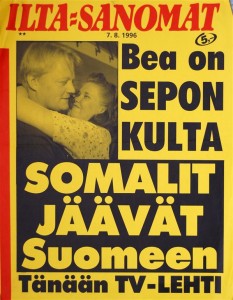
This tabloid billboard from 1996 states that the Somalis are not going to move from Finland. The majority of hate crimes reported last year were against Somalis.

Migrant Tales has written previously about how difficult it is to report hate crimes in Finland. Some policemen don’t even believe that racist harassment should be reported.

One policeman in Mikkeli told a group of immigrants that racist harassment is a minor affair. It’s like when he gets hassled in his hometown by the locals, who remind him that he is a policeman.

A recent report on hate crimes in Wales showed how people adapted to such abuse.

Heaven Crawley, director of the Centre for Migration Policy Research at Swansea University, said that they endure “everyday racism.”  Adapting to such harassment could encourage one to not use public transport, cover up one’s skin so people cannot tell a person belongs to a minority, young women may prefer not to wear the hijab because it targets them for racist abuse.

While the Police College of Finland report is a shameful chapter for a society like ours that bases its values on social equality, Nordic democracy and tolerance, the biggest culprits are not those who commit hate crimes but those who still turn a blind eye to such a social ill.

While the hate crime report by the Police College of Finland showed a 7% increase from 2010, not a single politician spoke out or expressed concern about the report.

It is very difficult for the majority of Finnish politicians to speak out against racism, hate crimes and intolerance in general as long as one of Finland’s largest political parties, the Perussuomalaiset, promotes intolerance and is the refuge for anti-immigration extremists.

What keeps us as a society from speaking out and condemning a pathological disorder like racism, which is at the root of the majority of hate crime cases?

Are we afraid to admit that intolerance is an issue – or are we quiet because deep down inside some of us still think that racism is ok?


Police College of Finland: Hate crimes rise by 7% in 2011

Posted on December 19, 2012 by Migrant Tales

A total of 918 suspected hate crimes were reported in Finland in 2011, which is a 7% rise from 860 cases in the previous year, according to the Police College of Finland. Compared with the previous years, suspected hate crime cases have not risen significantly, according to researcher Iina Sahramäki.

“If we look the previous years to 2008 (when the Police College of Finland started to report hate crime statistics), there hasn’t been any significant growth,” she told Migrant Tales.

The majority (86%) of suspected hate crimes were racially motivated. Other factors included religious background (6.6%), sexual orientation (4.6%) and disability (2.6%). Three cases (0.3%) involved transgender victims.

Somalis were the single biggest national group that were victims of hate crimes in Finland in 2011.

Table 1. Suspected hate crimes in Finland by year.
Year              Cases
 2011………..918
2010………..860
2009………1,007
2008………..859
Source: Police College of Finland
Read full report here (in Finnish).

Finnish police to have new anti-ethnic profiling guidelines in force in 2013

Posted on December 18, 2012 by Migrant Tales

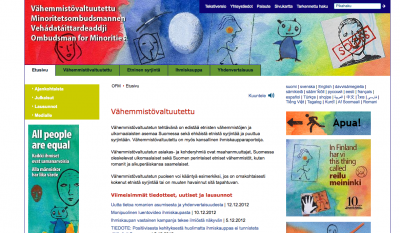
Rainer Hiltunen, Ombudsman for Minorities head of office, told Migrant Tales that talks have taken place with the Finnish police to draft new guidelines and more effective monitoring to ensure that ethnic profiling doesn’t happen. The new guidelines are expected to be in force in 2013. 

Kuva 106

The Ombudsman for Minorities office expressed concern in spring about higher-than-average complaints from foreigners that they were being indiscriminately stopped by the police for spot checks.

Interior Minister Päivi Räsänen confirmed in April that the Finnish police doesn’t ethnically profile anyone.

Foreigners are sometimes stopped in Finland by the police when looking for undocumented immigrants, according to Räsänen.

“One of the problems [concerning ethnic profiling] is that when the police stop a person, they sometimes forget to tell them clearly why they have been stopped,” he said. “Better monitoring of the police in this respect is crucial to discourage ethnic profiling from happening.”

The Ombudsman for Minorities official saw England as a good example for the Finnish police to follow.

“The Stephen Lawrence case is a good case in point that shows how institutional racism can undermine the effectiveness of the Metropolitan Police of London,” he said.


What are immigrants supposed to adapt to?

Posted on December 18, 2012 by Migrant Tales

One of the biggest questions when speaking of the integration of immigrants and visible minorities in Europe and Finland is what are they supposed to adapt to. In theory everything sounds perfect in our law books. What happens on the ground, however, is a totally different story. 

Kuva 79

This abandoned Cadillac reveals the crude face of integration. Great expectations but difficult to fulfill because the car has no engine. The children of immigrants are one vulnerable group.

The shameful xenophobic and anti-Semitic events going on in Hungary and Eastern Europe, Greece and elsewhere are enough proof that the region has some serious issues to deal with.

In my home country of Finland, matters have gotten so bad that in 2011 the Perussuomalaiset (PS), an anti-EU, anti-immigration and especially anti-Islam party, rose from the minor leagues to become the country’s third-largest political force in parliament.

The PS is today the fertile breeding ground for right-wing extremism in Finland.

Two crucial articles of our Constitution should not be forgotten when speaking about integration:

Chapter 2 Section 6  (No one shall, without an acceptable reason, be treated differently from other persons on the ground of sex, age, origin, language, religion, conviction, opinion, health, disability or other reason that concerns his or her person).

Chapter 2 Section 17 (The right of everyone to use his or her own language, either Finnish or Swedish, before courts of law and other authorities, and to receive official documents in that language, shall be guaranteed by an Act…The Sami, as an indigenous people, as well as the Roma and other groups, have the right to maintain and develop their own language and culture).

I am confident that Finnish officials have the best intentions in mind when they look at the integration of newcomers. There is, however, a major obstacle when speaking of effective integration and inclusion of immigrants in our society: lack of funds and not seeing any worth in cultural diversity.

This shouldn’t surprise us. The whole social construct of Finnish national identity is based on narrow terms. We need, however, to change that culture radically. Instead of reinforcing our exclusiveness, new generations of Finns should be taught the importance of inclusion, mutual acceptance and respect for diversity.

Why would anyone want to embrace the culture and values of any society that is outright hostile to them?

You have a choice in Finland: Become an an Uncle Tom (Tuomo-setä).

In Finland the definition of aTuomo-setä could be any immigrant or visible minority who betrays other people like himself by becoming and adopting the same values that exclude others socially.

Taking into account the negative atmosphere and the inability of Finnish society to accept and permit cultural diversity to become the standard, it would be naive if not foolhardy to forget your roots and identity when adapting.

Your greatest asset to our society is your culture and identity.

It’s not being third-rate white Finn.

Is there such a thing as “age racism?”

Posted on December 17, 2012 by Migrant Tales

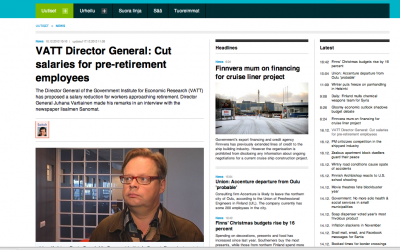
Pro union chairman Antti Rinne branded as “age racism” (ikärasismia) a proposal by Juhana Vartianen, director general of the Government Institute for Economic Research (VATT), to lower salaries for workers approaching retirement age, reports YLE. Is there such a thing as age racism? Shouldn’t the correct term be age discrimination (ikäsyrjintä)?

Kuva 105

Read English-language YLE story here.

Even if Rinne wants to emphasize age discrimination by calling it a dirty name like “age racism,”  the usage of the term in such a manner is not only wrong but demeaning to those who suffer from ethnic discrimination.

Like many sociologists who study racism, this social ill exists because it permits one ethnic group to empower itself at the expense of another.  Racism is a far worse pathological disorder and goes beyond individual prejudice.

Migrant Tales wrote recently: “It’s clear that a lot is lost when you water down a term like racism and redefine it as ”age racism.” It’s like taking the term Holocaust and applying to something minor than the systematic murder of six million Jews in World War 2.”

Just like the Winter War (1939-40) stands out as an important historical milestone for Finns, racism plays the same role for immigrants and visible minorities. It’s a part of their history.

To use the term racism incorrectly in any language is to defile its true meaning and blunt and divide our attention to such a menace.

New World Finn: Different modes of travel*

Posted on December 17, 2012 by Migrant Tales

 The first thing we see as we travel round the world is our own filth thrown into the face of mankind.                                                                                                                   Claude Lévy-Strauss ( 1908-2009)

The late French anthropologist raises an interesting question. Why is it when we travel to different countries we rarely see those images we find on tourist brochures?

In Lévy-Strauss philosophical style, could we claim that people travel because it is a subconscious attempt to stop time? When we visit different lands, does time stay at point zero for as long as we start to become familiar with the new landscapes?

Having traveled all my life since I was eleven months old and lived and worked in many countries, I have noticed that there are four ways of conducting a journey: geographically, spiritually, culturally and with the help of history.

summer

With our imagination we can even travel and become caterpillars for a precious moment.

Traveling with the help of geography is the most simple no-brainer way of acquainting oneself with a foreign destination. In this mode of travel, all one has to do is sit back and let the eyes and brain do the walking.

Another form of travel is spiritual, which happens when we yearn to be in other places. We can travel to such places with engines that are nothing more than semi-daydream trances. This form of travel is also one of the swifetest. We can reach speeds of speed of light in thought and, with the help of imagination, picture known and unknown lands and plants.

Even though we can reach the outer reaches of space with the blink of an eye, this form of travel can encourage you to to visit new and unknown lands. When I was twelve years old, I loved to read National Geographic maps. Once I found one of the Northwest Territories and Yukon. I was fascinated by their hugeness and desolateness.

Northwest Territories in northern Canada was about the size of Europe in the 1960s and had a population of  25,000 inhabitants! How could so few people live in such an empty place? Could it be like Finland? I never stopped traveling spiritually to northern Canada throughout the years. About forty years later, in 2006, I visited the Yukon and Northwest Territories.

Even though I have never traveled with the help of geography to this part of Canada, I felt as if I had returned home. But how can I return “home” in a land that had never felt the weight of my footsteps? The only conclusion I could arrive at is that spiritual travel exists.

Taking into account that traveling with the help of geography is easy, the final phase of this type of travel is with culture.  A good example of this type of travel is having the ability to transgress and form part of a cultural situation.

Whenever I want to travel culturally, I pay a rural hamlet or town in eastern Finland a visit. Korpikoski is one of them, located near the city of Mikkeli. The hamlet has a small coffee shop, country store, gas station and a restaurant that is open during summer. The forest and a semi-asleep asphalt road that hug and connect Korpikoski with the outside world are added spices to the folklore of the area.

There is nothing fascinating about the hamlet except that it is beautifully commonplace. Even though this may have been the case, it was behind its ordinary appearance where its beauty rested and where you wanted to remain for a long time.

In a similar fashion, the cultural traveler could also feel perfectly in place while enjoying an afternoon tea at one of the finest hotels in London. Instead of humble walls and the candid folklore of Korpikoski, you are now being patronized by impeccable service amid architecture and decorations that are truly astonishing and luxurious.

The real enjoyment of cultural travel is that one can enjoy Korpikoski in the same as the London Dorchester Hotel. The diversity and folklore of both places is an exhilirating experience. The trick is to enjoy and fit in both places.

Traveling with the help of history is the final form of sojourning I will talk about. Since we are unfamiliar with places we never visited because they are tucked deep in time, we must turn to history to be our seeing-eye dogs in such travels.

I once traveled decades in time and met my grandmother Aino in the eastern Finnish town of Mikkeli right after the war. It was an odd dream because I hadn’t been born yet. Nobody told me the exact date, but I gathered it to be a few months after September 19, 1944, when Finland signed a difficult armistice with Moscow.

Even if the people in the journey spoke and hovered around silence, the night, candles, buildings and expressions on their faces told you that a nation was busily healing from the wounds of war. The lights that exposed years of carnage had begun to turn themselves off; the rage and metal, which roamed and searched for flesh, took a breather over the war-torn landscapes of Finland and Europe.

Even though I was happy to see my grandmother again, it was a relief to know that I visited 1944  as a tourist.

*This column was originally published in the summer 2009 issue of New World Finn.  

The Finnish media and their PS darling

Posted on December 16, 2012 by Migrant Tales

Did anyone watch Thursday’s Pressiklubi show with Li Andersson of the Left Wing Alliance, Perussuomalaiset (PS) chairman Timo Soini and Helsingin Sanomat politics and business editor, Marko Junkkari? Apart from Soini’s usual political blah-blah (sound colorful but don’t say anything), Junkkari’s comment about how the Finnish media saw the PS as their darling before the 2011 election was quite revealing. 

Kuva 104


View Pressiklubi talk show here.

It’s already known as Junkkari admitted that the media was a major factor that helped the PS rise from being a minor party in Finnish politics to one of the biggest today.

Migrant Tales has asked on a number of occasions how come a populist anti-EU, anti-immigration and especially anti-Islam party could literally sweep the media off its feet?

The only answer I can find to that question is that too much of the Finnish media, which should know better, was dazzled by the PS because too many identified with its insular, racist and ethnocentric message.

Just like all of the major newspapers in the U.S. except for one – New York Review of Books – jumped eagerly on President George W. Bush’s invade-Iraq bandwagon, how much did the Finnish media question the rise of the PS and their anti-EU, anti-immigration and anti-Islam message?

Some editors like Helsingin Sanomat’s Saska Saarikoski went beyond the call of duty by giving PS MP Jussi Halla-aho greater coverage and recognition.  They incorrectly believed that the issue was freedom of expression.

A recent human interest story about Halla-aho and his wife Hilla in Me Naiset is a good example of how some journalists and the Finnish media still don’t get it.

Writes Jos Schuurmans:  “Yet the article doesn’t go into details concerning his political actions or agenda. The closest writer Essi Myllyoja and photographer Milka Alanen come to touching upon his controversial track record is this:

(…) Jussi is a man who evokes emotions – even fears. His radical opinions and provocative blog articles have taken him even to court. But when Kerttu jumps onto Jussi’s lap and drowns her father in kisses, what springs to mind is that there is surely also a softer side to the man. (…)”

One odd argument I have heard on a number of occasions, and which was asked to Soini on Pressiklubi as well, is if it’s a good matter that right-wing extremist politicians like Halla-aho and the likes have found a home in the PS.

In other words, mainstream parties like the PS have become a sort of camp for troubled and dangerous politicians. It’s a good matter that they are members of the PS because we’d be in trouble if they were out on their own.

Naturally, Soini did not answer the question.

As with many television debates about visible minorities, immigrants and immigration, there are only white people who are taking part in the debate, even though Andersson did an excellent job at cutting Soini’s usual baloney into thin slices.


Monitori: Migrant Tales – vähemmistöjen ääni verkossa

Posted on December 15, 2012 by Migrant Tales

”Meidän täytyy muuttaa jatkuva epäsuotuisa keskustelu maahanmuuttajia ja näkyviä vähemmistöjä vastaan Suomessa. Se voidaan päättää antamalla hiljaisuudellemme ääni ja kiitosta niille, joilla on rohkeutta puhua rasismia ja ennakkoluuloja vastaan.”

Kuva 103

Näin kirjoittaa suomalainen toimittaja, tutkija ja Migrant Tales -blogisivuston perustajaEnrique Tessieri. Hän on elänyt monissa eri kulttuureissa, mukaan lukien Argentiinassa, Iso-Britanniassa, Italiassa, Espanjassa, Kolumbiassa ja Yhdysvalloissa.

Suomalaisen äitinsä kautta hän on ollut aina kytköksissä myös Suomeen – turvalliseen maahan, josta hän muodosti ihanteellisen kuvan viettäessään lapsena kesiä isovanhempiensa luona, ja jonne hän päätti muuttaa vuonna 1978. Nykyään kuva Suomesta on toinen, sillä Tessieri on huolissaan nationalistisesta liikehdinnästä ja sen aiheuttamasta uhkasta hyvinvointiyhteiskunnallemme.

Toimittajan työn jatkaminen Suomessa

Toimittajan työn jatkaminen uudessa asuinmaassa voi olla haasteellista, varsinkin jos äidinkieli on eri kuin paikallisen valtaväestön kieli ja verkostot on muodostettava tyhjästä. Tessieri on kuitenkin käyttänyt Suomessa hyväksi vahvaa englannin kielen taitoaan, journalistista taustaansa sekä Suomen tuntemustaan. Hän on toiminut ulkomaankirjeenvaihtajana useille ulkomaisille lehdille, mukaan lukien the Financial Timesille.

– Minulla on aina ollut kaksi suurta rakkautta, jotka ovat maahanmuuttoasiat ja kirjoittaminen – erityisesti pääkirjoitusten ja pakinoiden kirjoittaminen, Tessieri toteaa alustaessaan Migrant Tales -blogin syntyä.

Käänteentekevä kirjoitus

Kuusi vuotta sitten Tessieri halusi kantaa kortensa kekoon Suomessa vellovassa maahanmuuttoa ja kansallista identiteettiä koskevassa keskustelussa, ja alkoi päivittää 70-luvulta peräisin olevaa koulutustaan ja verkostojaan.

Kun Tessierin tausta toimittajana ja antropologina yhdistyi Argentiinassa hankitun uutistoimituskokemuksen myötä nopean kirjoittamisen taitoon, syntyi vuonna 2007 Migrant Tales -blogi.

Aluksi blogissa oli hyvin vähän liikennettä, ja Tessieri oli jo lopettamassa sen, kunnes hän julkaisi käänteentekevän kirjoituksen otsikolla Are you a target of racism in Finland?

– Siinä missä lukijoita oli ollut aiemmin kymmeniä, yhtäkkiä heitä kertyi kahdeksansataa parissa tunnissa. Blogiteksti toimii kuin virveli – sitä heitellään järveen ja joskus nappaa, Tessieri vertaa.

Sittemmin kiinnostus blogiin on kasvanut tasaisesti, erityisesti tänä vuonna. Nyt lukijoita on vajaa 20 000 kuukaudessa. Migrant Talesin moottorina on tekijöidensä intohimo aihetta kohtaan, eikä blogilla ole ulkopuolista rahoitusta.

– Sanoma on niin tärkeä, että uhraan sille mielelläni vapaa-aikaani, Tessieri painottaa.

”Syrjinnän ilmiöt ovat universaaleja”

Tessieri toivoo Migrant Talesin toimivan foorumina asioille, joille valtamediassa ei riitä tilaa. Hän pyrkii hyvään tutkivaan journalismiin, joka esittää kovia kysymyksiä ja paljastaa puheenaiheiden taustalla piilevien asioiden oikean laidan.

– Esimerkiksi perheenyhdistämisestä puhutaan ongelmana ja ajetaan lakien kiristämistä. Harvoin kuitenkaan kerrotaan asian toista puolta – henkilökohtaisella tasolla ihmiselle on todellinen tragedia olla vuosia erossa perheestään ja jopa lapsistaan.

Vaikka blogin tekstit pyörivät usein Suomeen suuntautuvan maahanmuuton ympärillä, Tessieri pyrkii laajentamaan keskustelua myös muihin maihin.

– Olen tutkinut siirtolaisuutta Argentiinassa, joka on Kanadan ja Yhdysvaltojen tapaan siirtolaisten rakentama maa. Syrjinnän ilmiöt ovat universaaleja, ja Suomessa näkyvät ongelmat esiintyvät myös muualla – samantapaisin syin, mutta ehkä eri kontekstissa, hän sanoo.

Ei huutelulle

Blogissa puidaan myös suomalaista identiteettiä, sillä Tessieri haluaa tuoda esiin toisen ja kolmannen polven suomalaiset ja heidän näkemyksensä.

– Heidät usein unohdetaan keskusteluissa. Monesti muistetaan vain kantasuomalaiset ja maahanmuuttajat, ja valkoisen suomalaisen näkemys Suomesta, hän huomauttaa.

Jossain vaiheessa blogin sisällä käytiin tiivistä keskustelua siitä, mikä kommenttien tarkoitus on.

– Kommentteja tuli jopa kaksisataa päivässä, ja niiden tyylissä paistoi kiihkeä vastakkainasettelu. Kun viime toukokuussa siirsimme blogin uudelle sivustolle, päädyimme ratkaisuun, jossa kommentointi edellyttää rekisteröitymistä. Emme ole kiinnostuneita rasistisesta huutelusta. Kävijämäärä on pudonnut, mutta kommenttien laatu on nykyään parempi, Tessieri kertoo.

Teksti: Otavamedia

Kuva: Paula Myöhänen

Alkuperäisen kirjoituksen voi lukea tästä.

Taming the beast of right-wing extremism in the EU and Finland

Posted on December 15, 2012 by Migrant Tales

Our reaction to racism should be first and foremost a reaction. 

A comprehensive report published recently by the Institute for Strategic Studies in Sweden not only exposes far-right or right-wing extremism in ten European Union countries, but its historical roots as well. While these extremist groups may have different names in different countries, they are all bonded by one overriding factor: intolerance. 

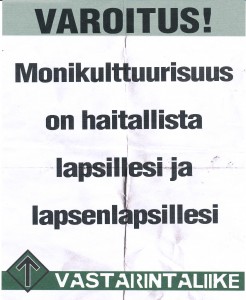
Image1-44_edited-1“Multiculturalism is hazardous to your children and grandchildren,” reads a flyer of the Neo-Nazi  Suomen Kansalinen Vastarintaliike. They have become so bold that they openly spread their far-rght ideology in public and in people’s mail boxes.  This is possible thanks to the rise of parties like the Perussuomalaiset, which are the birthsite for right-wing extremism.

How is it possible that a region like the European Union, never mind a country like Finland which has one of the best educational systems in the world, can become the breeding ground for right-wing extremism and intolerance?

Some culprits could be our own national myths and the global recession, which has caused unemployment to soar.

If anything, the present threat by extremist parties to Europe and Finland should be a wake up call for us on how little work we have done in the past to challenge intolerance.

Setting aside countries like Hungary, where anti-Semitism and racism are the order of the day, Finland is probably a good candidate that could follow the same route if we don’t react soon enough.

The 19.1% victory of the anti-EU, anti-immigration and especially anti-Islam Perussuomalaiset (PS) party in 2011 is a good example of how extremists have regrouped and organized effectively within existing political parties that enjoy popular legitimacy.

What should be clear is that their brand of popular legitimacy is far from mainstream or anything that is close to our way of life and values. It is a Trojan Horse with a politically volatile and hostile brew packed with intolerance, populism, extremism, fascism, racism and Counterjihadism.

The deception of intolerance to its avid and silent followers is that you can control it by keeping it on a short leash. Apart from impoverishing our society in many ways, nobody can control racism because it knows no master.

If you disagree, why not ask Anders Breivik.

  • Previous
  • 1
  • 2
  • 3
  • 4
  • Next
Read more about documentary film
Read more

Recent Posts

  • Finland’s tabloids Iltalehti and Ilta-Sanomat are the pits
  • Riikka Purra’s Dr Jekyll and Mr Hyde mask
  • Double standards
  • Perussuomalaiset: Uusi logo, sama vanha juttu
  • Taco Trump

Recent Comments

  1. Absolutely Socking: Racist Finnish Facebook group against human rights gets flooded with socks on Musta Barbaari’s mother and sister charged by the police in “ethnic profiling” case
  2. Ilkka Nuotio on Pekka Myrskylä: “Tilastot kertovat toista kuin poliittinen keskustelu”
  3. Genrih Soinkara on The war in Ukraine and the Russian-Finnish border crisis are showing Finland’s ugly side
  4. Ahti Tolvanen on Comment by Ahti Tolvanen on the Helsinki +50 conference
  5. Angel Barrientos on Angel Barrientos is one of the kind beacons of Finland’s Chilean community

Archives

  • June 2026
  • May 2026
  • April 2026
  • March 2026
  • February 2026
  • January 2026
  • December 2025
  • November 2025
  • October 2025
  • September 2025
  • August 2025
  • July 2025
  • June 2025
  • May 2025
  • April 2025
  • March 2025
  • February 2025
  • January 2025
  • December 2024
  • November 2024
  • October 2024
  • September 2024
  • August 2024
  • July 2024
  • June 2024
  • May 2024
  • April 2024
  • March 2024
  • February 2024
  • January 2024
  • December 2023
  • November 2023
  • October 2023
  • September 2023
  • August 2023
  • July 2023
  • June 2023
  • May 2023
  • April 2023
  • March 2023
  • February 2023
  • January 2023
  • December 2022
  • November 2022
  • October 2022
  • September 2022
  • August 2022
  • July 2022
  • June 2022
  • May 2022
  • April 2022
  • March 2022
  • February 2022
  • January 2022
  • December 2021
  • November 2021
  • October 2021
  • September 2021
  • August 2021
  • July 2021
  • June 2021
  • May 2021
  • April 2021
  • March 2021
  • February 2021
  • January 2021
  • December 2020
  • November 2020
  • October 2020
  • September 2020
  • August 2020
  • July 2020
  • June 2020
  • May 2020
  • April 2020
  • March 2020
  • February 2020
  • January 2020
  • December 2019
  • November 2019
  • October 2019
  • September 2019
  • August 2019
  • July 2019
  • June 2019
  • May 2019
  • April 2019
  • March 2019
  • February 2019
  • January 2019
  • December 2018
  • November 2018
  • October 2018
  • September 2018
  • August 2018
  • July 2018
  • June 2018
  • May 2018
  • April 2018
  • March 2018
  • February 2018
  • January 2018
  • December 2017
  • November 2017
  • October 2017
  • September 2017
  • August 2017
  • July 2017
  • June 2017
  • May 2017
  • April 2017
  • March 2017
  • February 2017
  • January 2017
  • December 2016
  • November 2016
  • October 2016
  • September 2016
  • August 2016
  • July 2016
  • June 2016
  • May 2016
  • April 2016
  • March 2016
  • February 2016
  • January 2016
  • December 2015
  • November 2015
  • October 2015
  • September 2015
  • August 2015
  • July 2015
  • June 2015
  • May 2015
  • April 2015
  • March 2015
  • February 2015
  • January 2015
  • December 2014
  • November 2014
  • October 2014
  • September 2014
  • August 2014
  • July 2014
  • June 2014
  • May 2014
  • April 2014
  • March 2014
  • February 2014
  • January 2014
  • December 2013
  • November 2013
  • October 2013
  • September 2013
  • August 2013
  • July 2013
  • June 2013
  • May 2013
  • April 2013
  • March 2013
  • February 2013
  • January 2013
  • December 2012
  • November 2012
  • October 2012
  • September 2012
  • August 2012
  • July 2012
  • June 2012
  • May 2012
  • April 2012
  • March 2012
  • February 2012
  • January 2012
  • December 2011
  • November 2011
  • October 2011
  • September 2011
  • August 2011
  • July 2011
  • June 2011
  • May 2011
  • April 2011
  • March 2011
  • February 2011
  • January 2011
  • December 2010
  • November 2010
  • October 2010
  • September 2010
  • August 2010
  • July 2010
  • June 2010
  • May 2010
  • April 2010
  • March 2010
  • February 2010
  • January 2010
  • December 2009
  • November 2009
  • October 2009
  • September 2009
  • August 2009
  • July 2009
  • December 2008
  • November 2008
  • October 2008
  • September 2008
  • August 2008
  • July 2008
  • June 2008
  • May 2008
  • April 2008
  • March 2008
  • February 2008
  • January 2008
  • November 2007
  • October 2007
  • September 2007
  • August 2007
  • July 2007
  • June 2007
  • May 2007

Categories

  • ?? Gia L?c
  • ????? ?????? ????? ???????? ?? ??????
  • ???????
  • @HerraAhmed
  • @mondepasrond
  • @nohatefinland
  • @oula_silver
  • @Varathas
  • A Pakistani family
  • äärioikeisto
  • Abbas Bahmanpour
  • Abdi Muhis
  • Abdirahim Hussein Mohamed
  • Abdirahim Husu Hussein
  • Abdirisak Mahamed
  • About Migrant Tales
  • activism
  • Adam Al-Sawad
  • Adel Abidin
  • Afrofinland
  • Ahmed IJ
  • Ahti Tolvanen
  • Aino Pennanen
  • Aisha Maniar
  • Alan Ali
  • Alan Anstead
  • Alejandro Díaz Ortiz
  • Alekey Bulavsev
  • Aleksander Hemon
  • Aleksanterinliitto
  • Aleksanterinliitto ry
  • Aleksanterinliitto ry:n hallitus
  • Alex Alex
  • Alex Mckie
  • Alexander Nix
  • Alexandra Ayse Albayrak
  • Alexis Neuberg
  • Ali Asaad Hasan Alzuhairi
  • Ali Hossein Mir Ali
  • Ali Rashid
  • Ali Sagal Abdikarim
  • Alina Tsui
  • Aline Müller
  • All categories
  • Aman Heidari
  • Amiirah Salleh-Hoddin & Jana Turk
  • Amin A. Alem
  • Amir Zuhairi
  • Amkelwa Mbekeni
  • Ana María Gutiérrez Sorainen
  • Anachoma
  • Anders Adlecreutz
  • Angeliina Koskinen
  • Anna De Mutiis
  • Anna María Gutiérrez Sorainen
  • Anna-Kaisa Kuusisto ja Jaakko Tuominen
  • Annastiina Kallius
  • Anneli Juise Friman Lindeman
  • Announcement
  • Anonymous
  • Antero Leitzinger
  • anti-black racism
  • Anti-Hate Crime Organisation Finland
  • Anudari Boldbaatar
  • Arshiya Nasser
  • Aspergers Syndrome
  • Asylum Corner
  • Asylum seeker 406
  • Athena Griffin and Joe Feagin
  • Autism
  • Avaaz.org
  • Awale Olad
  • Ayan Said Mohamed
  • AYY
  • Barachiel
  • Bashy Quraishy
  • Beatrice Kabutakapua
  • Beri Jamal
  • Beri Jamal and Enrique Tessieri
  • Bertolt Brecht
  • Boiata
  • Boodi Kabbani
  • Bruno Gronow
  • Carmen Pekkarinen
  • Çelen Oben and Sheila Riikonen
  • Chiara Costa-Virtanen
  • Chiara Costa-Virtanen
  • Chiara Sorbello
  • Christian Thibault
  • Christopher Wylie
  • Clara Dublanc
  • Dana
  • Daniel Malpica
  • Danilo Canguçu
  • David Papineau
  • David Schneider
  • Dexter He
  • Don Flynn
  • Dr Masoud Kamali
  • Dr. Faith Mkwesha
  • Dr. Theodoros Fouskas
  • Edna Chun
  • Eeva Kilpi
  • Emanuela Susheela
  • En castellano
  • ENAR
  • Enrique
  • Enrique Tessieri
  • Enrique Tessieri & Raghad Mchawh
  • Enrique Tessieri & Yahya Rouissi
  • Enrique Tessieri and Muhammed Shire
  • Enrique Tessieri and Sira Moksi
  • Enrique Tessieri and Tom Vandenbosch
  • Enrique Tessieri and Wael Che
  • Enrique Tessieri and Yahya Rouissi
  • Enrique Tessieri and Zimema Mhone
  • Epäluottamusmies
  • EU
  • Europe
  • European Islamophobia Report
  • European Islamophobia Report 2019,
  • European Union
  • Eve Kyntäjä
  • Ezequiel Caldeiro
  • Facebook
  • Fadumo Dayib
  • Faisa Kahiye
  • Farhad Manjoo
  • Fasismi
  • Finland
  • Fizza Qureshi
  • Flyktingar och asyl
  • Foreign Student
  • Fozia Mir-Ali
  • Frances Webber
  • Frida Selim
  • Gareth Rice
  • Ghyslain Vedeaux
  • Global Art Point
  • Great Replacement
  • Habiba Ali
  • Hami Bahadori
  • Hami Bahdori
  • Hamid
  • Hamid Alsaameere
  • Hamid Bahdori
  • Handshake
  • Harmit Athwal
  • Hassan Abdi Ali
  • Hassan Muhumud
  • Heikki Huttunen
  • Heikki Wilenius
  • Helsingin Sanomat
  • Henning van der Hoeven
  • Henrika Mälmsröm
  • Hser Hser
  • Hser Hser ja Mustafa Isman
  • Husein Muhammed
  • Hussain Kazemian
  • Hussain Kazmenian
  • Ibrahim Khan
  • Ida
  • Ignacio Pérez Pérez
  • Iise Ali Hassan
  • Ilari Kaila & Tuomas Kaila
  • Imam Ka
  • inside-an-airport
  • Institute of Race Relations
  • Iraqi asylum seeker
  • IRR European News Team
  • IRR News Team
  • Islamic Society of Norhern FInland
  • Islamic Society of Northern Finland
  • Islamophobia
  • Jacobinmag.com
  • Jallow Momodou
  • Jan Holmberg
  • Jane Elliott
  • Jani Mäkelä
  • Jari Luoto
  • Jari Taponen
  • Jegor Nazarov
  • Jenni Stammeier
  • Jenny Bourne
  • Jessie Daniels
  • Joe Davidow
  • Johannes Koski
  • John D. Foster
  • John Grayson
  • John Marriott
  • Jon Burnett
  • Jorma Härkönen
  • Jos Schuurmans
  • José León Toro Mejías
  • Josue Tumayine
  • Jouni Karnasaari
  • Juan Camilo
  • Jukka Eräkare
  • Julian Abagond
  • Julie Pascoet
  • Jussi Halla-aho
  • Jussi Hallla-aho
  • Jussi Jalonen
  • JusticeDemon
  • Kadar Gelle
  • Kaksoiskansalaisuus
  • Kansainvälinen Mikkeli
  • Kansainvälinen Mikkeli ry
  • Katherine Tonkiss
  • Kati Lepistö
  • Kati van der Hoeven-Lepistö
  • Katie Bell
  • Kättely
  • Kerstin Ögård
  • Keshia Fredua-Mensah & Jamie Schearer
  • Khadidiatou Sylla
  • Khadra Abdirazak Sugulle
  • Kiihotus kansanryhmää vastaan
  • Kirsi Crowley
  • Koko Hubara
  • Kristiina Toivikko
  • Kubra Amini
  • KuRI
  • La Colectiva
  • La incitación al odio
  • Laura Huhtasaari
  • Lauri Finér
  • Leif Hagert
  • Léo Custódio
  • Leo Honka
  • Leontios Christodoulou
  • Lessie Branch
  • Lex Gaudius
  • Leyes de Finlandia
  • Liikkukaa!
  • Linda Hyökki
  • Liz Fekete
  • M. Blanc
  • Maarit Snellman
  • Mahad Sheikh Musse
  • Maija Vilkkumaa
  • Malmin Kebab Pizzeria Port Arthur
  • Marcell Lorincz
  • Mari Aaltola
  • María Paz López
  • Maria Rittis Ikola
  • Maria Tjader
  • Marja-Liisa Tolvanen
  • Mark
  • Markku Heikkinen
  • Marshall Niles
  • Martin Al-Laji
  • Maryan Siyad
  • Matt Carr
  • Mauricio Farah Gebara
  • Media Monitoring Group of Finland
  • Micah J. Christian
  • Michael McEachrane
  • Michele Levoy
  • Michelle Kaila
  • Migrant Tales
  • Migrant Tales Literary
  • Migrantes News
  • Migrants' Rights Network
  • MigriLeaks
  • Mikko Kapanen
  • Miriam Attias and Camila Haavisto
  • Mohamed Adan
  • Mohammad Javid
  • Mohammad M.
  • Monikulttuurisuus
  • Monisha Bhatia and Victoria Canning
  • Mor Ndiaye
  • Muh'ed
  • Muhamed Abdimajed Murshid
  • Muhammed Shire
  • Muhammed Shire and Enrique Tessieri
  • Muhis Azizi
  • Musimenta Dansila
  • Muslimiviha
  • Musulmanes
  • Namir al-Azzawi
  • Natsismi
  • Neurodiversity
  • New Women Connectors
  • Nils Muižnieks
  • No Labels No Walls
  • Noel Dandes
  • Nuor Dawood
  • Omar Khan
  • Otavanmedia
  • Oula Silvennoinen
  • Paco Diop
  • Pakistani family
  • Pentti Stranius
  • Perussuomalaiset
  • perustuslaki
  • Petra Laiti
  • Petri Cederlöf
  • Pia Grochowski
  • Podcast-lukija Bea Bergholm
  • Pohjois – Suomen Islamilainen Yhdyskunta
  • Pohjois Suomen Islamilainen Yhyskunta
  • Polina Kopylova
  • Race Files
  • racism
  • Racism Review
  • Raghad Mchawh
  • Ranska
  • Rashid H. and Migrant Tales
  • Rasismi
  • Raul Perez
  • Rebecka Holm
  • Reem Abu-Hayyeh
  • Refugees
  • Reija Härkönen
  • Remiel
  • Reza Nasri
  • Richard Gresswell
  • Riikka Purra
  • Risto Laakkonen
  • Rita Chahda
  • Ritva Kondi
  • Robito Ibrahim
  • Roble Bashir
  • Rockhaya Sylla
  • Rodolfo Walsh
  • Roger Casale
  • Rostam Atai
  • Roxana Crisólogo Correa
  • Ruth Grove-White
  • Ruth Waweru-Folabit
  • S-worldview
  • Sadio Ali Nuur
  • Sami Rusanen
  • Sandhu Bhamra
  • Sara de Jong
  • Sarah Crowther
  • Sari Alhariri
  • Sarkawt Khalil
  • Sasu
  • Scot Nakagawa
  • Shabana Ahmadzai
  • Shada Islam
  • Sharon Chang blogs
  • Shenita Ann McLean
  • Shirlene Green Newball
  • Sini Savolainen
  • Sira Moksi
  • Sonia K.
  • Sonia Maria Koo
  • Steverp
  • Stop Deportations
  • Suldaan Said Ahmed
  • Suomen mediaseurantakollektiivi
  • Suomen Muslimifoorumi ry
  • Suomen viharikosvastainen yhdistys
  • Suomen viharikosvastainen yhdistys ry
  • Suomi
  • Supermen
  • Susannah
  • Suva
  • Syrjintä
  • Talous
  • Tapio Tuomala
  • Taw Reh
  • Teivo Teivainen
  • The Daily Show
  • The Heino
  • The Supermen
  • Thomas Elfgren
  • Thulfiqar Abdulkarim
  • Tim McGettigan
  • Tino Singh
  • Tito Moustafa Sliem
  • Tobias Hübinette and L. Janelle Dance
  • Transport
  • Trica Danielle Keaton
  • Trilce Garcia
  • Trish Pääkkönen
  • Trish Pääkkönen and Enrique Tessieri
  • Tuulia Reponen
  • Uncategorized
  • UNITED
  • University of Eastern Finland
  • Uyi Osazee
  • Väkivalta
  • Vapaa Liikkuvuus
  • Venla-Sofia Saariaho
  • Vieraskynä
  • W. Che
  • W. Che an Enrique Tessieri
  • Wael Ch.
  • Wan Wei
  • Women for Refugee Women
  • Xaan Kaafi Maxamed Xalane
  • Xassan Kaafi Maxamed Xalane
  • Xassan-Kaafi Mohamed Halane & Enrique Tessieri
  • Yahya Rouissi
  • Yasmin Yusuf
  • Yassen Ghaleb
  • Yle Puhe
  • Yuliet Tresa
  • Yve Shepherd
  • Zahra Khavari
  • Zaker
  • Zalina Ametova
  • Zamzam Ahmed Ali
  • Zeinab Amini ja Soheila Khavari
  • Zimema Mahone and Enrique Tessieri
  • Zimema Mhone
  • Zoila Forss Crespo Moreyra
  • ZT
  • Zulma Sierra
  • Zuzeeko Tegha Abeng
© 2026 Migrant tales | Powered by Minimalist Blog WordPress Theme