

In Migrant Tales’ Finland & Cultural Diversity 2012 review, it’s clear that a lot more work needs to be done to promote tolerance. Thanks to Umayya Abu-Hanna’s column on Sunday’s Helsingin Sanomat,* our collective complacency was once again shamefully revealed.
Racism, or the lack of acceptance of other ethnic groups as equals in our society, is a social illness that spreads unabated in Europe and in countries like Finland. It is empowered by our silence, fear, cultural myths, low self-esteem and mocks every day at our apathy.
How do you explain the historic rise of a party like the Perussuomalaiset (PS), which is hostile to immigrants and cultural diversity, in last year’s parliamentary elections?
What is even more shameful is the acceptance by the media and too many politicians that PS chairman, Timo Soini, is the good guy that is keeping openly hostile and racist party members in line.
Hate crimes rose in Finland by 7% in 2011 compared with the previous year, according to the Police College of Finland. Irrespective of the rise, few if any politicians raised the issue.
Mark wrote about how the police perpetuate hate crimes in Finland in one of the most commented and widely read blog entries of December.
He writes: “One effect of hate crime statistics being published in Finland is that it brings up once again the unwelcome question of whether Finns are more racist than other nations. This isn’t my question, by the way, but it is one that Finns tend to dwell on, as if there were an acceptable level of racism that a country is allowed to have!”
Are the police, like the rest of society, serious about hate crimes and racism?
Considering that the majority of hate crimes go unreported, it’s clear that these types of crimes reported to the police are only the tip of the iceberg.
The fact that one policeman in Mikkeli suggested to immigrant students that they should not report racist harassment cases to them shows that there is no common policy.
The Mikkeli policeman equated racist harassment to when he gets hassled in his hometown by the locals, who remind him that he is a policeman. “Just ignore them [if they harass you in a racist fashion],” he said.
If its evident that the police are part of the problem, part of the blame must go to the victim. It will be very difficult to challenge hate crimes in our society as long as immigrants and visible minorities don’t report such cases.
Ignorance of one’s rights, language barriers, fear of reprisals and lack of trust are some reasons why black and visible minorities don’t report racist harassment to the police, according to a Race Council Cymru study reported by Migrant Tales.
There’s a very good piece on ekathimerini.com on how hate crimes threaten our society.

Morten Kjaerum and Janez Lenarcic write: ”Hate crime offenders send a clear message that some of us are lesser human beings, lesser citizens who can be harmed with impunity. Their actions are, therefore, serious affronts to the fundamental right to human dignity and equal treatment.”
The key argument made by the authors, that our fundamental right to human dignity and equal treatment are breached, is the issue. When we permit such an injustice to happen, we undermine our civil rights. If it can happen to “them” it can happen to “us.”
Barbara Spectre, founding director of Paideia of Sweden, believes that the ongoing transformation of European societies from being “monolithic to multicultural” is at the heart of European anti-Semitism.
“I think there’s a resurgence of anti-Semitism because this point in time Europe has not yet learned to be multicultural…” she said. “It’s a huge transformation for Europe to make. They are now going into a multicultural mode. ”
While I disagree with Spectre that the issue is simply moving from being “monolithic to multicultural,” the issue goes much deeper. Anti-Semitism should not be seen as a threat to Jews but to all minorities living in Europe.
The foundations of Europe’s racism, which has brought terrible wars and enabled colonialism to spread globally, is at the heart of the problem.
Europe has always been culturally diverse. The problem is that we have used racism to hide our diversity through social exclusion. We only see ourselves in a racist society.
Finnish racism isn’t any different. Since we want to see only ourselves in this society, it explains why there’s so much opposition to cultural diversity.
Less social exclusion would make us acknowledge that there are other groups living amongst us.
_______________
*Erkki Perälä, a Green Party Helsinki city councilman, wrote a so-called sarcastic piece about Abu-Hanna’s column. I considered the use of the Musta Pekka Golliwog as offensive.
Why is it that I never get “great” ideas like Perälä when writing about a social ill like racism?
If I’m not the victim due to my ethnicity, I don’t try to write about it with sarcasm since I’d only be asking for trouble.
What do you think?
When I moved to Finland in December 1978, I wasn’t naïve about Finland, but super naïve. I was so confiding that I actually believed all Finns were honest.

Apart from a strong admiration for the forests and people who inhabited this quiet corner of Europe, you may ask why I moved from a bustling metropolis like Los Angeles to a country that was thirty years ago provincial, far-flung and even hostile to outsiders.
I don’t have a good answer except that of all the countries I had lived in, Finland was the most difficult one to adapt back to. I didn’t want to return to California and the year and a half I had lived in Argentina during one of its most violent periods (1976-83) had changed my life completely.
Sometimes I regret not having grown up in Finland but when I think of the bullying Abdulah and Micah J. Christian endured at school, I am lucky that I grew up elsewhere.
One of the first matters that shocked me when I moved here was how little I knew about my former home country.
Today, nothing shocks me anymore about Finland.
Some of the biggest threats that we face today aren’t the challenges caused by our abuse of the environment and ever-growing cultural diversity, but by the weakening of our comprehensive social welfare system and taxing less the new rich.
The most important fact we forget when we become greedy is that we’re social animals. When the 1% forget that we thrive best in groups, that’s when the 99% starts to seek radical changes in our society by peaceful or violent means as we are presently seeing in the Arab world.
I stumbled by accident on an article written in a Chicago daily by Finnish-born Elmer A. Forsberg. The article, written in the 1930s, headlined Finland is called U.S. of Europe, claims that our country is like the U.S. because of its “business methods and efficiency.”
Forsberg continues: “The nature of the people seems to hold something in common with the [US]American people in their progressiveness, and the Finns might today well be called, in that sense, Yankees of northern Europe.”
The affirmation by some, that we are the most USAmerican country in Europe, is ludicrous to say the least. Being the most USAmerican country in Europe is just as absurd as claiming that USAmerica is the most Finnish country in North America.
Finland is different from the United States because it has a comprehensive social welfare system and laws that promote social equality. If USAmericans speak of “freedom” as an inalienable right, Finns speak of social equality (tasa-arvo) in the same manner.
Setting aside the recession, which is threatening our social welfare system and fueling social inequality at an ever-growing pace, we are being weakened as well by our weaning belief in social equality.
While it’s clear that social inequality is more prevalent in our society, nowhere is it more present than in the immigrant and visible minority communities.
Even if I was naïve about Finland when I moved here, I don’t regret making this country my home for so many years.
Returning back to my roots has helped me uncover one crucial fact: This is my home and I should do everything to defend my place and that of others in it.
If 2011 was a watershed year for Finland with the historic rise of a hostile party against immigrants and visible minorities in last year’s parliamentary elections, 2012 will be seen as a bittersweet turning point for the Perussuomalaiset (PS).
The year will be remembered as a very violent one for immigrants as well. During “Black February,” three Muslims died under violent circumstances in a span of about three weeks in the cities of Oulu and Espoo.
There was no shortage of news about immigrants and minorities in Finland. Some of these were: fines for hate speech to PS politicians like MP Jussi Halla-aho; Helena Eronen’s blog entry suggesting armbands for immigrants; racial profiling complaints to the Ombudsman of Minorities; Migrant Tales got deactivated for about 13 hours without warning from WordPress.

Visits to Migrant Tales during the year rose by 70% versus 2011.
What grade would Finland receive for promoting and defending cultural diversity in 2012? If the grade was a 5 (below average) in 2011, this year it would go up a tad to +5.
Below is a quarter-by-quarter account of what made news on the immigration and visible minority front in Finland during the year:
Without a doubt, the biggest story in the first quarter of the year was the presidential elections of January. After the historic victory of the PS in 2011, which won 39 seats in parliament compared with 5 previously, all eyes were on its chairman and hopeful, Timo Soini. Would he repeat the party’s 2011 election result?
The presidential election turned out to be a sour disappointment for the PS. Not only did an openly gay presidential Green Party candidate, Pekka Haavisto, beat Soini but also another anti-EU Center Party’s hopeful Paavo Väyrynen.
The election showed that voters had started to turn their backs on the PS’ anti-EU and anti-immigration rhetoric. Soini’s poor showing (9.4%) and Väyrynen’s better showing (17.5%) confirm the latter. The next hurdle for the PS would be the municipal elections of October 28.
Migrant Tales was cited during the presidential election by Sveriges Radio.
Black February, which involved the death of three Muslims, a suicide and an injured man, started on January 30 in Oulu after eighteen-year-old Abdirashid Jirde fled from three Finns who barged into his home. Fearing for his safety, the young Somali leaped unsuccessfully from his sixth-floor apartment to his neighbor’s balcony.
His brother, Absie Jirde, wrote a letter about his brother’s death that was published on Migrant Tales after the tragedy.
 This picture sent by the brother of the victim (baby) was sent to Migrant Tales by the brother of the victim.
On February 17 Migrant Tales was tipped off about the death of a second Somali youth, Abdisalam Mohamed Abdulahi, who died violently at the hands of a white Finn. Both the assailant and the victim knew each other.
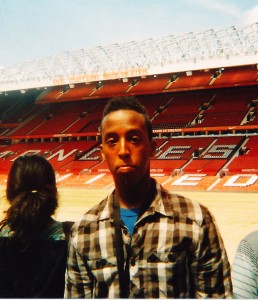 The second Muslim to lose his life violently in Black February was Abdisalam Mohamed Abdulahi, 18. The eighteen-year-old youth was a Manchester United fan.
An Espoo District Court sentenced Abdulahi’s killer in July to a six-year jail term for manslaughter.
Migrant Tales spoke to Abdisalam’s father about the death of his son.
The final chapter of Black February took place the day after on Sunday at an Oulu pizzeria after Abdulahi’s tragic death, when a white Finn shot and killed one worker and wounded another one. The killer took his life after the shooting.
On the night of the tragic events that happened in Oulu, PS councilman Tommi Rautio wrote on his Facebook page the following comment: “If Janne is the one [who shot the foreigners at the pizzeria] then we should give Janne a medal.”
Rautio’s comment caused him to be sacked from the PS in March and convicted and fined 120 euros by a local court for inciting ethnic hatred.
Setting aside the tragic events that marked Black February, few politicians denounced publicly what happened except for Olli Mäntylahti, a National Coalition Party candidate for the city of Helsinki. Migrant Tales was, together with Mäntylahti, the first ones to break the news about Rautio’s comments on Facebook.
Migrant Tales was the target of a number of attacks at the end of the first quarter. The first attack came from a megaboard site called Ylilauta, which was followed by a deactivation by WordPress of the blog on March 27 for about 13 hours.
Writes Mark: “Migrant Tales is under attack. The blog’s founder is receiving threats of violence, is being defamed and ridiculed in public forums, is being harassed even to the point of having his workplace invaded by defamatory communications. It is not an easy time for Enrique or his family…”
 While some were dancing prematurely on Migrant Tales’ grave, we received an apology from WordPress for the mistake. Making sure that we never have to suffer such censorship again, Migrant Tales moved to its present site on May 17.
Freddy Van Wonterghem, a PS Kotka city councilman, was convictedby a court on March 30 for inciting ethnic hatred. On another blog, this editor asked Van Wonterghem if he regretted what he wrote.
“I don’t regret what I wrote…” he responded. “Perhaps [at the most] it wasn’t nicely said.”
The biggest stories during this quarter were: Helena Eronen’s blog entry suggesting that immigrants should start wearing armbands, and a Supreme Court ruling that slapped Halla-aho with a fine for defaming a religion and inciting ethnic hatred.
As a result of the court ruling, Halla-aho was forced to resign in June as chairman of the administration committee.
The Supreme Court sentence turned out to be a showdown between Soini’s Rural Party and Halla-aho’s Suomen Sisu faction. Halla-aho suggested that MP Juho Eerola should replace him as chairman of the administration committee.
Soini’s candiate, MP Pirkko Mattila, was elected by the parliamentary group. The result was a clear defeat for the PS Counterjihadists.
Eronen knew she was asking for trouble when she published her infamous blog entry on ethnic profiling.
What did she write?
You’ll find the original blog entry number eighteen on MP James Hirivsaari’s website: “If every foreigner were required to use an armband of his/her national background, the police could immediately spot whether that ‘aha, that is a Muslim from Somalia’ or ‘aha. that is a beggar from Romania.’ Muslims could [use sleeve badges] with a half moon…Russians [with] a hammer and sickle, Kampucheans could have field mines, a burger [could be used to distinguish] Americans…”
Eronen’s story, which was widely covered by the Finnish media, spread rapidly to Russia, Sweden and other countries.
Eronen, who openly supported the far-right Muutos 2011 party, resigned in August as Hirvisaari’s aide. There was speculation that one reason why she resigned was because Hirvisaari’s wife suspected her of having an affair with her boss.

The Council for Mass Media in Finland (JSN) exonerated Kirkko&Kaupunki in May after a cartoon published on December 2011 mocking a group of Perussuomalaiset (PS) party MPs. It reads: “A Merry Christmas to you all Finnish heterosexuals and white conservatives! We wish the rest a shitty Christmas!”
Setting aside the contempt that the PS has for immigrants and visible minorities, Finland’s media was a constant target of attack by the party, especially newspapers like Turun Sanomat, which reported on Eronen’s sleeve badge blog entry.
Attempts by the PS to tell newspapers what and how they should write about the PS is a good example of the party’s anti-democratic credentials. PS members like Matti Putkonen and MP Halla-aho expressed on a number of occasions their anger with the media.
PS MP Olli Immonen, a hardline Counterjihadist, announced that he would boycot YLE “for a while.” Instead of answering difficult questions posed by reporters, the response of some PS members is to avoid the media altogether.
A clear indication of the growing influence of the extremist Suomen Sisu wing of the PS, was the naming in May of Matias Turkkila as the new editor-in chief of the party’s newspaper and web page.
If there is a person who has helped spread Halla-aho’s hate speech in Finland, that person is Turkkila. He’s the editor of anti-immigration hate site called Hommaforum which is closely related to Scripta, Halla-aho’s blog.
Other stories that Migrant Tales reported were Finland’s first suspected terrorism case involving Somalis, ethnic profiling complaints by immigrants to the Ombudsman of Minorities, an elderly Somali woman who got assaulted at a Helsinki metro station, the costly saga of family reunification, and www.migranttales.net begins on May 17.
As Anders Breivik was convicted by an Oslo court to 21 years for the murder of 77 innocent victims on July 22, 2011, Peter Mangs, was sentenced to life imprisonment by a Mälmö court in Sweden on two counts of murder and five attempted murders. He was finally sentenced in November after undergoing psychological tests, which showed him to be sane.
Another story that ignited debate was a movie about “black” Marshal Carl Mannerheim, Finland’s George Washington. One of the aims of Erkko Lyytinen, the movie’s producer, was to challenge challenge Mannerheim’s sacred image.

The Per-Looks blog, which outraged some PS party members, was widely debated in the media. While the pictures published on Per-Looks aim to give an image that the PS are a bunch of Finnish hillbillies, the blog gave the hostile party to immigrants a taste of its own medicine.
By September the heat of the municipal elections could be clearly felt. A very good blog, Kunnolisvaalit 2012,** appeared exposing the far-right and anti-immigration stands of candidates running for city council. While the majority of the candidates on the blog belong to the PS, there are others from parties like Muutos 2011, Center Party, and National Coalition Party.

Another PS municipal candidate that got elected from Kotka, Amon Rautiainen, got in trouble in September for suggesting on his Facebook page that government ministers should be shot and that Muslims should be boiled alive.
Despite constant denials by Soini that the PS wants to weed out racists from running in the municipal election, the party’s policy towards refugees shows that the latter is only lip service. The party’s municipal election program clearly states that municipalities should not accept refugees. The best place to help these people is in crowded refugee camps where “they would be culturally” closer to home, according to the party.
In the end of September, a poll published by YLE shows that the PS will be the biggest winners of the municipal elections. The poll sees the PS getting 17.2% of the votes versus 5.4% in 2008 with the Center Party being the biggest loser.
The biggest story in this quarter and probably the whole year was the municipal election result. Contrary to what the September poll suggested, the clear winner of the election was the Center Party (18.7%) and the biggest losers were the Greens (8.5%). The PS, which was expected to do well, won 12.3% of the vote. Even if the result was a disappointment to Soini, the party was able to raise the number of city councilpersons by 752 to 1,195.
The National Coalition Party (21.9%) and the Social Democrats (19.6%) came in fist and second place, respectively.
Campaigns like iCount that aim to activate the immigrant vote were active during the election.
The 2012 municipal elections were historic for Finland since a record number were candidates, according to YLE. The highest number of immigrant candidates can be found in the Social Democratic Party (118) followed by the National Coalition Party (81), Left Wing Alliance (56), Green Party (55) and Center Party (around 50).
Unconfirmed reports see the immigrant vote doubling to about 40% in the recent elections. If this is true, it shows that Finland’s anti-immigration climate has empowered immigrants to act.
Contrarily, PS Counterjihadist candidates as well as others that were strongly anti-immigration and against cultural diversity did well in the municipal elections.

About two weeks after the election, PS MP Hirvisaari said that his party did poorly in the municipal elections because it wasn’t as outspoken on immigration issues as before the 2011 parliamentary elections, according to YLE.
While the campaign in the municipal election became more vicious and anti-immigration rhetoric picked up as October 28 neared, their hostile campaign against immigrants and cultural diversity continued after the election. A draft law spearheaded by Halla-aho aims to make deportations of convicted immigrants mandatory. Three PS MPs have drafted legislation to make begging illegal in public places, and MP Vesa-Matti Saarakkala aims to ban male circumcision in Finland.
Veteran National Coalition Party politician Pertti Salolainen got himself in hot water in early December when he said that on a TV talk show that American Jews have vast control over the wealth and media in the United States. Salolainen, who is vice chairman of the foreign policy committee, felt that pro-Israel lobby groups in the U.S. prevented Washington from taking a neutral stand on the Israeli-Palestinian conflict.

A total of 918 suspected hate crimes were reported in Finland in 2011, which is a 7% rise from 860 cases in the previous year, according to the Police College of Finland. Compared with the previous years, suspected hate crime cases have not risen significantly, according to researcher Iina Sahramäki.
Mark published two good blog entries after the Police College of Finland published its hate crime cases for last year. The first one, Approaching hate crimes in Finland: problem solver or angry boss and the one that followed, Police College of Finland: are they perpetuating hate, asks some tough questions of the police concerning hate crimes.
He writes: “What adds to the injury is that people rely on these statistics to create profiles of particular national groups as being much more racist than they actually are, and much more racist than Finns. So, hate crime statistics that are presented in such a way that they actually perpetuate hate crime!”
Finnish law doesn’t recognize hate crimes as crimes per se.
In an exclusive interview with Migrant Tales in December, Rainer Hiltunen, Ombudsman for Minorities head of office, said that talks have taken place with the Finnish police to draft new guidelines and more effective monitoring to ensure that ethnic profiling doesn’t happen.
The new guidelines are expected to be in force in 2013.
*See also Finland & Cultural Diversity 2011
** The blog can be read here.
Without a doubt, 2012 will be remembered as another bad year for cultural diversity in Finland. Finding the usual culprits isn’t difficult: ignorance and intolerance. It is surprising that a party like the Perussuomalaiset (PS), which grew from relative obscurity to become the third-largest political force in parliament in 2011, can wake up the worst in some Finns.
PS councilman Harri Turtianen of Kemi is one example of many of how intolerance has grown and become more acceptable in Finland.Even if it is unfair to blame the PS for all of the country’s problems, that populist-conservative party, which is anti-EU, anti-immigration and especially anti-Islam, is a reflection of what is terribly wrong with this society today.
The PS cannot be taken seriously as a party because their solutions are more rhetoric than reality.
If the party were to ever run immigration and integration affairs in this country, it would be a recipe for disaster.
Finland’s noble values like social equality and justice would be other casualties. With such values under attack, we’d end up inviting jungle law to our society in the form of greater discrimination, prejudice and racism.
Immigrants wouldn’t be the only punching bag of the PS and its convoluted ideology, but minorities like gays, the Roma, Saami and others. The party’s rhetoric would be a serious blow to gender equality as well.
We don’t need right-wing populist hotheads in parties like the PS to lead us into the new century. We need proactive solutions, Finnish solutions, which hinge on democracy, respect and taking into account everyone’s opinion.
Comprehensive immigration reform is not the only challenge to Finland, but a fresh new look at what is the big picture of our society in the new century. In that big picture there are people of different backgrounds who embrace this country as their home.
We need to debate today how to make our society more inclusive.
We need good Finnish models to find workable and effective solutions instead of the usual rhetoric of parties like the PS.
“Racism is a refuge for the ignorant. It seeks to divide and to destroy. It is the enemy of freedom, and deserves to be met head-on and stamped out.”
Pierre Berton (1920-2004)
Many visitors have come and gone on Migrant Tales. Those that jump the MT ship the soonest are those who choose to justify a social ill like racism. Some have gone as far as to claim that there is no racism in Finland.
A recent blog entry by Mark highlights how hate and racism are perpetuated even by the police.
Establishing an autocratic regime is relatively easy in a country with poor infrastructure. In Argentina, where the country’s telephone network was mostly out of order, it was simple to shut the country from the outside world and spoonfeed censored news by the military rulers to the public.
Irrespective of the censorship that was imposed on Argentina in the 1970s, people did have access to newspapers like Le Monde, The Guardian, Washington Post and others that wrote regularly about the human rights violations committed by the military junta.
If we have in Europe enough historical information and evidence that show us beyond any doubt the destruction that xenophobia and racism have caused on our continent, why do we still consider such social ills worthy of our support?
If you are a pessimist, the answer you may hear may shock you: People and politicians support xenophobic and racist behavior because they are xenophobic and racist themselves. In Argentina, the military regime, which was one of the most ruthless in Latin America in the last century, was able to carry out its crimes thanks to the support it had from the public.
There must be something wrong with our educational system if we’re still influenced so much by xenophobia, racism or autocratic regimes, which are the enemies of our freedom.
A journalist from a local newspaper told me recently that the reason why they don’t write a lot about racism cases is because they don’t want to give racism any attention.
That kind of a stance is exactly what has made xenophobia and racism grow in Finland and Europe. Not noticing it, or ignoring such a social ill, will not help it go away. It will, contrarily, encourage it to become bolder.
We cannot afford to be silent in the face of those forces that aim to usurp our freedom and well-being.
Like Berton pointed out, racism must be faced head-on and stamped out.
Migrant Tales will publish on December 28 its review of the major events that shaped 2012 on the cultural diversity and immigration front in Finland. Contrary to 2011, this year’s review will be called Finland and cultural diversity in 2012.

Why have we changed the name?
The answer is simple: The real issue being debated in this country isn’t immigration per se but acceptance of cultural diversity. How inclusive is our society to “otherness?”
As far as we can tell, there is one party as well as many politicians from other parties who are fighting tooth and nail to keep Finland white physically and spiritually. In their myopic world, the only “good” Finn is a white Finn.
We disagree. Being Finnish is a personal matter and does not hinge on how anti-immigration parties and groups define it.
Thanks to the over 1.2 million Finns that left this country between 1860 and 1999, Finnish culture and identity is richer than some people would like to admit.
No matter how many obstacles these anti-immigration and counterjihadist groups place on our path, the tide turned many decades ago. The ever-growing cultural diversity we see within our borders today is fueling a new sense of Finnishness that is proud and diverse.
If you have any suggestions you would like to make concerning the most important events that took place in Finland in 2012 on the cultural diversity and immigration front, please drop us a line ([email protected]).
Thank you for your support and for making Migrant Tales one of Finland’s most successful blogs.
When I was growing up in the 1970s, one of the matters that followed me around was the constant news of the mass murder and cemetery silence imposed by ruthless Latin American dictatorships. If you lived in one of those countries where human rights violations were the rule, you were confronted by two options: take up arms or be quiet.

Much of the bloodshed that took place in Latin America during that tumultous decade could have been averted if there would have existed democratic institutions and respect for civil liberties.
It is a tragedy that millions of people were denied the right to express their opinions democratically.
In many respects, but in a different context, the same type of exclusion is taking place in many parts of Europe today. Ethnic groups like the Roma, Somalis, Turks, blacks, Muslims, Jews and other minorities are still treated like third-class citizens and with contempt in some countries.
Even if these groups are not persecuted in the same way like political dissidents in Latin America were four decades ago, they are treated with contempt. We can never be at peace as long as we allow poverty, ignorance and apathy to silence whole groups.
In many respects, but in a different context, too many Finnish politicians have shown too little interest for the rights and welfare of immigrants and visible minorities. The fact that we grant asylum to refugees and then force them to live separated for years from their families is one of many examples of their scorn.
If we look at the arguments used by right-wing anti-immigration extremist groups in Europe and Finland today, they have the same aim that autocratic regimes had to socially exclude and silence whole groups.
How long can a minority be forced to remain silent? In the United States, it took centuries before Rosa Parks ignited the Civil Rights Movement in December 1955. Hopefully different minorities in Europe react much faster.
The most important lesson we can learn from social movements like the above is that change must come from the group.
One of the oddest arguments one hears in Finland every now and then is that the anti-immigration Perussuomalaiset (PS), a party that is the breathing ground for right-wing extremism, has helped integrate troubled politicians who are multiculturally challenged into the system.
Such a preposterous argument is, in my opinion, only a justification for our fascination with modern-day fascism.
Democracy and civil rights is not a right that one group can own at the expense of others.
Keeping it from other groups is sowing the seeds of tomorrow’s violence.
Every now and then you’ll hear a visitor on Migrant Tales claim: What about [reverse] racism against [white] Finns!? Racism is a complex problem but one matter singles it out: It is an effective tool to socially exclude, control and exploit other groups in society from vital resources such as jobs and economic wealth.
The fact that white Finns are the standard of everything in Finland is enough proof that they wield real power. White Finns don’t have to understand racism because they simply don’t have to. It’s not an issue because they are the standard of this society, the norm. Everyone else has a prefix attached to them like immigrant, immigrant descendant, black, Roma etc.
In May 2011, the anti-immigration Perussuomalaiset (PS) party renounced all forms of racism, even positive discrimination, or affirmative action.
It is surprising that when the PS made their preposterous statement, few if any media in this country understood how racist and grotesque it was and how it revealed a serious case of colorblind racism (let’s pretend we’re equal because ethnic background does not matter, when in fact it does).
Colorblind racism works in Finland in an implicit and explicit manner. Its aim is the same: ethnic background is not the issue. If it is an issue, it’s your ethnic background.
- · We have such a wonderful society that we are way past racism so get over it (explicit colorblind racism);
- · It’s your culture, your parents or you that is hindering adaption to our society. In this case I recognize your ethnic background but only to shift blame and wash my hands of the problem (implicit colorblind racism).

This graffiti that reads “White Power” in Finnish was on a special elementary school’s wall in Mikkeli, Finland, for months before it was removed.
Accusing a visible minority, or immigrant of being racist against white Finns, is a good example of implicit colorblind racism. Since racism isn’t a problem in our society, it can’t be my problem. It’s your problem.
Some successful immigrants or visible minorities who have succeeded in Finland may reinforce the same colorblind racist argument as white Finns. They may claim: ”I’m not white but I adapted to the white Finns’ world. That is why I am successful. You too can be.”
Those immigrants who have racism issues usually come from countries where such a social ill is the standard. It’s easy for them to accept the white Finn as a standard because they too were the norm in their former home country. As a result, some embrace the idea of becoming a Tuomo-setä, or Uncle Tom, because they are encouraged to and rewarded by white Finnish society for such behavior.
If you are ever confronted by a person who uses the reverse-racism argument, ask him or her how is the prejudice of a minority as devastating as that of the majority?
White Finns should stop whining about reverse racism because it isn’t an issue. It’s only one of many loaded arguments used by them to justify their racism.
 What an irony. You would think that the publishing of hate crime statistics would be an annual opportunity to raise the profile of hate crime and also to renew efforts to prevent it. But no, the forums are alive with spurious interpretations of what it all means and even attempts to show that Somalis are in fact more racist than Finns. Can it be true?
One effect of hate crime statistics being published in Finland is that it brings up once again the unwelcome question of whether Finns are more racist than other nations. This isn’t my question, by the way, but it is one that Finns tend to dwell on, as if there were an acceptable level of racism that a country is allowed to have!
What has also been happening is that international comparisons are made for the statistics within Finland, so that means looking at the different nationalities living in Finland, and providing a league table of the racists among them.
This isn’t just something you will find in the hate forums though. On page 58 of the 2011 Police report (recently published by the Police College of Finland and the Ministry of Interior’s Police Department), the researchers themselves provide their own league table (Table 12) detailing racist crimes by foreigners per 1000 head of population, with Somalis top of the list on 10 per 1000 head of population, followed by Iraqis on 8. A quick calculation gives an equivalent rate for Finns of 0.1 per 1000 head of population. Wow, aren’t the Finns so much better than those dirty foreigners? Ugh, well, no actually! Quite the opposite! But you’ll have to bear with me, I’m afraid, because you see, they haven’t bothered to inform the reader just how useless and distorting this kind of statistic actually is.
Several figures for rate per capita are possible here. For example, we could look at those racist crimes that do not involve provocation by another racist. We could also look at the age group 15-34, as this is where the biggest problems lie (66% of racist crimes) and it’s also the segment of the population that is most different in proportions for the different nationalities (see below). Narrowing the focus doesn’t change any of the fundamentals in the argument, by the way.
These simple adjustments give us the figures of 0.028 attacks per capita by Finns aged 15-34, and 0.14 attacks per capita by Somalis of the same age.
It still looks grim for the Somalis, doesn’t it? But calculations made per capita are horribly flawed.
They ignore the fact that many Finns will seldom or never encounter a black immigrant, while the same is not true for black immigrants meeting white Finns.
Let’s put it plain and simple. If 1000 in a 10,000 Finns actually get to meet a Somali (or any other visible foreigner), and one of these Finns is a racist who decides to assault the foreigner, then it’s all too easy to claim that only one in 10,000 are racist because only one in 10,000 assaults showed up ‘per capita’, when in reality, it was one in 1000 Finns who got to encounter a foreigner and were racist. The opposite effect works for Somalis, who will likely encounter people of a different race many times daily.
Let’s show the maths
Two population groups, A and B, where A is a minority and B is a majority. Let’s set the rate of racism at 5% for both Group A and Group B, so we would therefore expect the per capita crimes to be the same. If they are not, then something is wrong with using per capita rates to define rates of racism.
Two key assumption, a racist assault can only be committed by someone who encounters someone else of a different race or ethnicity. One kind of racist is someone who has great difficulty in encountering someone of another race.
Group A – minority
N = 100 (total population of minority)
n = 100 (number of population encountering people of another race)
C = number of crimes per year = 5 (i.e. 5% of n)
per capita rate = 0.05 (based on C/N)
Group B – majority
N = 2500
n = 250 (number of population encountering people of another race)
C = number of crimes per year = 12.5 (5% of n)
(1) per capita rate = 0.005 (based on C/N, i.e. not taking account of n)
(2) per capita rate = 0.05 (based on C/n, i.e. taking account of n)
The first calculation for the per capita rate of racist crime in the majority population (1) is 10 times greater that for the minority than the majority population, even though WE set the rate at EXACTLY THE SAME LEVEL, i.e. 5%, so as to control for it. In equation (2), the rate of encounter has been factored in and it delivers the correct rate of crime per capita.
Conclusion, the rate of encounter can have an enormous effect on statistics of rates of racist crime per capita.
if we used calculation (1), we would be throwing up our arms and saying that the Finns are getting attacked so much more and that the Somalis are ten times more racist, because when you do the maths, that’s what you get (exactly like the Finnish Police have suggested we use the statistics).
Finnish racists when they exist simply have less opportunity to express their racism and so to appear in the statistics. Using the ‘whole population’ therefore waters down the ‘per encounter’ rate and hugely underestimates the rate of racism of the majority population.
To discover the true rate of racist crime, we must adjust for the fact that minorities are by definition rare and encounters with them are likewise rare for the majority population, while for the minority, encounters with Finns are commonplace. We must take account of rates of encounter to arrive at anything like a comparable per capita rate. Hate crimes are available in part to estimate rates of racism. It should be absolutely clear where the per capita figures are horrendously flawed in estimating rates of racism. Common sense, folks.
In other words, adjusting for the Somali minority in the age group 15¬-34 would give us a rate that is 227 times smaller than it currently is and a long way behind the rate for Finns.
Finns = 0.012 attacks per interracial encounter
Somalis = 0.000083 attacks per interracial encounter
Of course this isn’t the end of the story. There are numerous other factors that can also impact disproportionately on the statistics, including the higher percentage of young adults as a percentage in the age group aged 15-35, who are most likely to be involved in street assault. For Finns, they constitute about 23% of the population, while for Somalis, they constitute 40%. This would artificially inflate the Somali figure even further.
The idea of league tables per capita that compares minority populations or by implication the majority population is inherently flawed and is in my view an extremely cynical abuse of statistics where there is no explanation of the drawbacks. The work of a racist researcher? Or perhaps a totally incompetent one. Either way, it’s not good enough.
These issues are too important to think that people haven’t stopped to ask themselves what are the underlying assumptions in these statistics and how are they likely to be used, or to have actually monitored how the statistics are being used in the public debate. One look at the comments here or on some of the hate forums reveals just how eager racists are to make use of the police report to disparage immigrants.
Why do we have a league table, if not to make foreigners look bad and to make Finns look better than they are or to hide the true extent of racism in Finland? The idea of a league table is abhorrent and extremely misleading. It’s worse than that, it’s lying.
What adds to the injury is that people rely on these statistics to create profiles of particular national groups as being much more racist than they actually are, and much more racist than Finns.
So, hate crime statistics that are presented in such a way that they actually perpetuate hate crime!
Surely not, Finland, surely not!!!! Tell me I’m wrong!
PS. this article has been edited for the sake of clarity.