Migrant tales
Menu
  • #MakeRacismHistory “In Your Eyes”
  • About Migrant Tales
  • It’s all about Human Rights
  • Literary
  • Migrant Tales Media Monitoring
  • NoHateFinland.org
  • Tales from Europe
Menu

Month: September 2012

An interesting blog that follows far-right candidates in Finland’s municipal elections

Posted on September 14, 2012 by Migrant Tales

I bumped into a blog called Kunnollisvaalit 2012 (in Finnish), which aims to expose far-right candidates running for office in the Finnish municipal elections of October 28.  The blog cites 11 Perussuomalaiset, 2 Center Party and one Muutos 2011 candidates as “far right.”

The blog aims to expose what these candidates are posting on the Internet.

Kunnollisvaalit 2012 considers far right the following groups: Suomen Sisu (Nazi-spirited association), Nuiva Manifesto (PS’ anti-immigration manifesto), Finnish Defense League (Counterjihadist), Suomen Kansalinen Vastarinata (neo-Nazi).
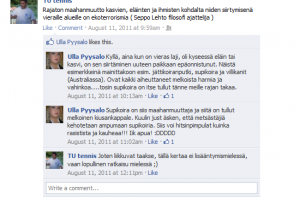
Remember Ulla Pyysalo, PS MP’s Juho Eerola’s aide, who was planning to join the neo-Nazi Suomen Kansalinen Vastarina? Well, she’s running for city council in Taipalsaari.

On a thread on Facebook with TU tennis, Ulla Pyysalo compared immigrants to animals and plants. ”Yes, transplanting animals or plants in a new environment has always ended in failure.”

Risto Helin is a “white power blood & honor” candidate for the PS  in Vaasa. 

Pyysalo continues, now comparing immigrants to racoon dogs.  ”I heard just recently that hunters are encouraged to kill these raccoon dogs,” she writes. ”God dang it how racist and terrible. Eeek help! :DDDDD,”

The Kunnollisvaalit 2012 list below of fascists, Nazis and racists isn’t complete. PS candidates such as James Hirvisaari, Olli Immonen, Freddy Van Wonterghem are missing.

The 11 PS candidates that Kunnollisvaalit 2012 cites are:

  • Jussi Halla-aho, Helsinki
  • Erkki Havansi, Kerava
  • Petri Pulkkanen, Espoo
  • Leo Ojavuo, Kaajani
  • Kalle Mäntylä, Kangasala
  • Tuomas Okkonen, Lumijoki
  • Risto Helin, Vaasa
  • Pasi Salonen, Vihti
  • Ulla Pyysalo, Taipalsaari
  • Heidi Kuittunen, Kirkkonummi
  • Sari Karlström, Pietarsaari
  • Jani Salomaa, Salo
  • Jani Viinikainen, Kangasala

Muutos 2011 and Center Party:

  • Asta Tuominen, Oulu, Muutos 2011
  • Arja Hirvenoja, Tampere, Center Party
  • Timo E. Tukia, Tampere, Center Party


How much further? A film about the lives of refugees in Greece

Posted on September 14, 2012 by Migrant Tales

This documentary about refugees in Greece is a stark reminder of how Greek authorities and the European Union have turned their backs on asylum seekers and undocumented immigrants. The answer is not higher border fences or fear-mongering by politicians, but finding proactive solutions that take into account the needs and human rights of these people.

Eighty percent of the refugees that come from war-stricken areas flee to neighboring countries like Pakistan, where there are 1.7 million refugees. In the Dadaab refugee camp alone in Kenya there are a staggering 500,000  Somali refugees.

For the sake of comparison, 27 EU states have a total of 1.3 million refugees.

Traveling under a truck is one way that asylum seekers use to cross borders in Europe.

Says the European Council on Refugees and Exiles (ECRE) in a statement about the documentary, How much further:

Filmed in Athens between October 2011 and February 2012, in the midst of social, political and economic turmoil, the documentary raises the voices of those who have fled Afghanistan, Somalia or Sudan hoping to find refuge in Europe. After months or even years on the road, they arrive in Greece, a country whose population is facing the full brunt of the economic crisis and where the asylum and reception systems are completely dysfunctional. Most people see no option but to take to the road again in the hope of reaching a country that can receive them and consider their claim for asylum. But, once they have entered Greece, it is extremely difficult if not impossible to leave the country given the European policies that legally bind them to Greece.

This documentary is the fruit of the cooperation between ECRE, the Greek Forum of Refugees and the film maker Matthias Wiessler, and supported by the European Programme for Integration and Migration (EPIM).

Following the simultaneous premières in Brussels and Athens for World Refugee Day (20 June), How much further? has already been shown in two other screenings so far, at theEuropean Policy Institute and to the students of the Odysseus Network Summer School on European Law and Polciy on Immigration & Asylum.

To see documentary, How much further, click here.


Somalia turns a new page of hope after its new president was elected

Posted on September 13, 2012 by Migrant Tales

By Roble Bashir

Hassan Sheikh Mohamud was elected on Monday to a four-year presidential term. There are plans to hold nationwide elections after his mandate ends in 2016. By then, every citizen will have the opportunity to vote for the candidate he or she supports.  Even so, such a goal is  a challenging task to attain in just over four years.

President Mohamud was an active member of civil society organisations since the collapse of  the government in 1991. He has taken part in several social development projects. The newly elected head of state used to work for UNICEF in Somalia and was dean of one of the local universities of Mogadishu before he became the leader of the Peace and Development Party (PDP).

What makes this government different from previous ones?

President Mohamud’s election is  an important change for all Somalis since it puts to end eight years of transitional rule, which impeded governments to function properly.

It ends as well the interference by neighbouring countries in Somali’s internal affairs. This meddling by foreign powers has been one of the biggest obstacles in getting the country back on its feet after two decades of civil war. In fact, interim governments were formed outside the country. This made Somalis sceptical that the country’s best interests were being served. President Mohamud’s government is the first one ever elected by parliament inside the country since the early 1990s. The is not an interim government but a permanent one approved nationally.  This is very important matter to remember.

There are other factors that support the newly elected president of Somalia. Most warlord leaders have been disarmed and some are members of the new parliament. They aren’t a threat to stability as in previous transitional governments, when they had their own separate militia groups and put barriers against the government whenever they saw fit. This government controls harbours and airports, which are vital to the economy and permit foreign aid to enter the country.

The new constitution was approved by the elders.

The new constitution gives more powers to the new president to exercise his authority. This is another factor that could help President Mohamud to tackle the challenges the country faces.

The threat of Al-shabab lessens

There are many reasons that give more confidence and hope that the new government will succeed in its aims. Most areas of the capital  and surrounding towns are now under the control of government troops with the backing of African Union Mission in Somalia (Amisom) forces.  Al-shabab’s influence has weakened after it lost a number of battles that forced it to give up control of many strategic towns and regions of the country. Al-shabab lost many economic resources as well such as harbours and export tax revenues from charcoal, when the USA banned this year such exports to Middle Eastern states like the United Arab Emirates, Saudi Arabia and Qatar. This was a huge setback for Al-shabab and undermined its influence in the country and its ability to finance its war.

The weakening of this powerful group in Somalia will eventually help the new president to restore peace and stability. Of course, re-building Somalia is an ongoing process that can only happen when the country has a powerful enough army.  ”When the national armed forces take control of the whole country, we will no longer need troops from Africa, ” President Mohamud promised during his campaign.

The Netherlands gives Geert Wilders the thumbs down

Posted on September 13, 2012 by Migrant Tales

Voters in the Netherlands did not back Geert Wilders’ calls for the country to ditch the European Union, reports the BBC. Wilders, who has dominated Dutch politics for years, is known for his tough anti-Islam and now anti-EU stance. Among many of his provocative statements, the Dutch politician has equated the Koran with Hitler’s Mein Kampf. 

The biggest victors of the Dutch elections were pro-EU parties like the center-right VVD (41 seats) and center-left Labor Party (39). Between them they could form a majority in the 150-member lower house.

Contrarily, Wilders’ Freedom Party saw its share of seats plummet from 24 to 13.

http://www.youtube.com/watch?v=KdTRPk0L3Zc&feature=related

Geert Wilders getting grilled on BBC’s Hardtalk. 

Just like the Islamophobic Danish People’s Party that supported minority governments for a decade in exchange for tougher immigration laws, the election setback to the Freedom Party comes as a big blow to their influence in national politics.

The interesting question to ask is how the setback for the Freedom Party will impact the Perussuomalaiset (PS) of Finland and other likeminded parties in Europe.

This is a valid question. It’s pretty clear that the PS’ election victory in 2011 had a positive impact on similar anti-immigration parties in the Nordic region and elsewhere in Europe.

Despite Europe’s financial woes and issues with anti-immigration populist parties, it’s clear that a growing number of Europeans are not buying their xenophobic message.

As Migrant Tales has pointed out on a number of occasions, the worst enemies of parties like the PS, Freedom Party, Danish People’s Party, Sweden Democrats and others are none other than themselves.


Greece and its bad case of ethnic profiling and scapegoating

Posted on September 12, 2012 by Migrant Tales

The Greek Police announced that 16,836 foreign nationals were brought for questioning  during the first month that Xenios Zeus was instigated, according to the European Council on Refugees and Exiles (ECRE). A staggering 80% of those brought in for questioning were legal residents. Only 2,144 held by the police didn’t have their residence permits in order. 

Xenios Zeus, which was the ancient Greek god of hospitality, is a good example of how ineffective immigration policies and economic problems can force xenophobia to poison a society.

Sensible people understand that scapegoating immigrants for the country’s economic problems is a red herring. Greek politicians and civil servants, with the blessings of the public, are more interested in blaming defenseless immigrants and refugees  for Greece’s problems than themselves.

Whenever a person or a group scapegoats immigrants and minorities, it is a clear sign of cowardice and opportunism.

The Greek public should critically look at the country’s politicians, civil servants and financial sector and launch a “Xenios Zeus” to uproot corruption that festers in that country.

ECRE writes in a statement: ”Greek authorities claim that as a result of Xenios Zeus, the influx of illegal immigration in the area of Evros has been reduced by 84%. However, according to the newspaper ‘To Vima’, the “Xenios Zeus” operation has resulted in a dramatic increase in the smuggling tariffs for entering Greece from Turkey and leaving Greece for Italy. A few months ago, smugglers would request 2,500 to 3,000 Euro for a safe passage, while would-be migrants are now asked to pay up to 5,000 Euros.”

Groups like ECRE, Amnesty International, Human Rights Watch and the Greek Council of Refugees have criticized the massive police roundup of immigrants.


Anti-racism web sites in Finland

Posted on September 11, 2012 by Migrant Tales

Migrant Tales was named as one of seven anti-racist web site in Finland, according to a thread by “Tutkija” on Vaasa Forum. While Counterjihadist and anti-immigration websites have sprung up like mushrooms in Finland, anti-racist forums are one answer to the message of hate of these latter sites. 

The Perussuomalaiset party openly and indirectly supports  a number of Countejihadist and anti-immigration web sites in Finland like Hommaforum and Scripta.

“Tutkija” describes Migrant Tales as ”a quality [anti-racism] online publication in Finland written in English.”

Other anti-racist sites cited by Vaasa Forum include:

  • Jussi Halla-ahon kootut sanansa syömiset (Facebook)
  • Vallan vahtikoira (blog)
  • Die Fahne hoch (blog)
  • Todellisuuteen (blog)
  • Perussuomalaista vihapuhetta (blog)
  • Kokoomuksen ja Perussuomalaisten vastainen kansanrintama (Facebook)

What kind of a threat do Finland’s Counterjihadists pose?

Posted on September 10, 2012 by Migrant Tales

It’s pretty clear that what goes up politically must eventually come down. Some groups, which have recently surged in popularity like the Perussuomalaiset (PS), could see their bubble burst quickly. While I wouldn’t count on anything like that happening anytime soon, it could be a totally different story for the hardline Counterjihadists of the party.  

The question that should concern us all is what will these radical members of the PS do if they see their popularity wean.

Do they have  a plan B? Will they take to the streets and incite more people to parrot their message of hate?

One of the most naive ideas that Counterjihadists hold is that they can keep their hate rhetoric on a short leash. Anders Breivik’s murderous rampage in Norway proved once again that racism and Islamophobia can bite back at its ideological master.

While we are already seeing greater violence to visible minorities and immigrants after last year’s PS election victory, the question is how do we challenge such a threat effectively?

Everyone knows that the hardcore Counterjihadist MPs of the PS are Jussi Halla-aho, James Hirvisaari and Olli Immonen.

If PS chairman Timo Soini wished, he could land a fatal political blow to the Counterjihadists by banishing them from the party. As a so-called taxi party (all of its members could fit in a taxi), they would no longer be a political force like they are today in the PS.

In many respects, Soini’s relationship with these extremists could be described as that of a junkie hooked on heroin. One hates being a junkie but it sure feels good to inject oneself with such a drug.

If Soini ever kicked out the Counterjihadists from the party, would these politicians go down without a fight?

It would be naive to think so.

Their message of hate would certainly get louder and their rhetoric more violent.

How to stand up to the Counterjihadists of Finland

Posted on September 9, 2012 by Migrant Tales

Swedish-language daily HBL writes on Sunday that we must challenge the rhetoric of hatred by Counterjihadists. As everyone knows, the Counterjihadist hardcore in the Perussuomalaiset (PS) party comprises of three MPs: Jussi Halla-aho, James Hirvisaari and Olii Immonen. 

While many at Migrant Tales have valiantly challenged Counterjihadism in the past, populist radical right-wing rhetoric and hate speech in Finland, it is interesting that a major daily like HBL believes that we must now challenge such a threat.

As Maria Paaso’s report for Supo revealed, the Counterjihadist threat become more real after Norwegian mass murderer Anders Brevik went on the rampage on July 22, 2011, murdering 77 innocent victims.

If such a tragedy could happen in Norway, why not in Finland?

Migrant Tales wrote shortly after the tragedy in Norway that nothing was going to be the same for the Counterjihadists in the Nordic region after 22/7.

We wrote six days after the tragedy in Norway: ”What was acceptable before, like racist gaffes and jokes by politicians, their aides and common citizens, look terribly embarrassing today in light of Norway.”

Toby Archer is quoted as saying on HBL  that while elected politicians who are Counterjihadists are not a danger to society, it is up to the media and politicians to challenge them.

Contrarily, researcher Jussi Jalonen says that while we have elected Counterjihadist MPs in the Finnish parliament, it is a good matter that we can openly debate with them.

The downside — according to Jalonen — is that if the same hate rhetoric that is allowed in parliament by these Counterjihadists encourages the same mimicking in the streets.

HBL writes that the turning point for Finland’s Counterjihadists came in summer, when Halla-aho, the chairman of the administration committee, was forced to resign after the Supreme Court slapped him with a fine for defaming a religion and inciting ethnic hatred.

Other members of the PS have since then distanced themselves from the xenophobic Counterjihadists like Halla-aho, according to Jalonen.


Teach me that we are more alike than different…

Posted on September 9, 2012 by Migrant Tales

 …teach me not to hate. Teach me the lie and shame of racism [because] it hurts all people. Teach me to learn from you and to learn about me… 

Inspirational words from the Center for the Healing of Racism that should be the guiding light enshrined in our national curriculum for schools (opetussuunnitelma) concerning cultural diversity.

What is our aim when we speak of integration of elementary school students?

Is the goal of the teacher to convert these students into ”white Finns” or to socially exclude them by pointing out how different they are? Is the aim between these two extremes?

Identity is a personal matter. Who you are depends on who you think you are. If some have a problem with this, it should be viewed as their problem, not yours.

Social exclusion is like a toxic poison. If  you take away a child’s identity at an early age by seeing no worth in his ethnicity and background, you’ll end up undermining his or her self-esteem. People with low self-esteem do poorly at school.

Low self-esteem is a factor behind prejudice as well, according to a study published by Psychological Science.

In the same way as racism is costly to society, it can impair children’s learning abilities, according to a study by Essex University.

Even if Finland has become more culturally diverse from the 1990s, the biggest mistake we can make – in my opinion – is forgetting the importance of diversity and values such as mutual acceptance and respect.

Thus Finnish schools should teach their students that we are more alike than different..the lie and shame of racism because it hurts all people.

It should teach student the value of their culture and the culture of others.


How sincere is PS MP Immonen about Finnish Karelia?

Posted on September 8, 2012 by Migrant Tales

Finnish Karelia, Salla, and Petsamo were territories ceded to the former Soviet Union after the Continuation War (1941-44).  Counterjihadist Perussuomalaiset (PS) MP Olli Immonen sent a parliamentary question Friday asking the government to investigate whether Russia offered in 1991 then President Mauno Koivisto (1982-94) the possibility to buy back the ceded region.

Koivisto, who was the country’s last cold war president, denied in a Helsingin Sanomat interview in 2007 (15 years later!) that then Russian President Boris Yeltsin had offered Finland the opportunity to buy back Finnish Karelia.

Finland used to look like a maiden before 1944. It lost part of its skirt (Finnish Karelia) and an arm (Petsamo) to the former Soviet Union after the war. 

Finnish Karelia represents everything that was and went wrong with Europe at the time. It is a small jigsaw puzzle of a terrible war that ended up costing the lives of an estimated 60 million people.

If the offer by Moscow to Helsinki is true, speculation has it that the sizable Russian population in the ceded region was one important reason why President Koivisto did not want to negotiate with the Russians.

In 1991, Finland’s immigrant population was miniscule, totaling 26,255, or 0.5% of the population.

Finns were back then – as today – very set in their ethnic perceptions of themselves and suspicion of the Russians continues to be high in Finland.

The interesting question to ask about the purchase of Finnish Karelia is what role did issues like ethnic and national ”purity,” Finland’s deep-seated cold war mentality and fear of its giant neighbor.

What kinds of passions does PS MP Immonen’s parliamentary question awaken? Is it another PS election ploy to incite nationalist sentiment and lure voters to the embattled party?

If Karelia were returned to Finland under the leadership of Immonen and the PS, what would they do about the Russian population and other ethnic minorities living there? What kind of ethnic cleansing would take place and how would it affect relations with Moscow? Would we return back to the same tensions that characterized Finnish-Soviet relations in the 1930s?

Since Immonen is a radical Counterjihadist who predicts a war between the Christian West and Islam, we should ask what political mileage does the PS MP want to get from such a parliamentary question.

While it is positive to debate our history openly, Immonen’s parliamentary question should be seen as a sham that exposes his ultra-nationalistic credentials.

Politicians  like Immonen don’t bring us closer to understanding the Karlian question, but take us further from it.


  • Previous
  • 1
  • 2
  • 3
  • 4
  • Next
Read more about documentary film
Read more

Recent Posts

  • Finland’s tabloids Iltalehti and Ilta-Sanomat are the pits
  • Riikka Purra’s Dr Jekyll and Mr Hyde mask
  • Double standards
  • Perussuomalaiset: Uusi logo, sama vanha juttu
  • Taco Trump

Recent Comments

  1. Absolutely Socking: Racist Finnish Facebook group against human rights gets flooded with socks on Musta Barbaari’s mother and sister charged by the police in “ethnic profiling” case
  2. Ilkka Nuotio on Pekka Myrskylä: “Tilastot kertovat toista kuin poliittinen keskustelu”
  3. Genrih Soinkara on The war in Ukraine and the Russian-Finnish border crisis are showing Finland’s ugly side
  4. Ahti Tolvanen on Comment by Ahti Tolvanen on the Helsinki +50 conference
  5. Angel Barrientos on Angel Barrientos is one of the kind beacons of Finland’s Chilean community

Archives

  • June 2026
  • May 2026
  • April 2026
  • March 2026
  • February 2026
  • January 2026
  • December 2025
  • November 2025
  • October 2025
  • September 2025
  • August 2025
  • July 2025
  • June 2025
  • May 2025
  • April 2025
  • March 2025
  • February 2025
  • January 2025
  • December 2024
  • November 2024
  • October 2024
  • September 2024
  • August 2024
  • July 2024
  • June 2024
  • May 2024
  • April 2024
  • March 2024
  • February 2024
  • January 2024
  • December 2023
  • November 2023
  • October 2023
  • September 2023
  • August 2023
  • July 2023
  • June 2023
  • May 2023
  • April 2023
  • March 2023
  • February 2023
  • January 2023
  • December 2022
  • November 2022
  • October 2022
  • September 2022
  • August 2022
  • July 2022
  • June 2022
  • May 2022
  • April 2022
  • March 2022
  • February 2022
  • January 2022
  • December 2021
  • November 2021
  • October 2021
  • September 2021
  • August 2021
  • July 2021
  • June 2021
  • May 2021
  • April 2021
  • March 2021
  • February 2021
  • January 2021
  • December 2020
  • November 2020
  • October 2020
  • September 2020
  • August 2020
  • July 2020
  • June 2020
  • May 2020
  • April 2020
  • March 2020
  • February 2020
  • January 2020
  • December 2019
  • November 2019
  • October 2019
  • September 2019
  • August 2019
  • July 2019
  • June 2019
  • May 2019
  • April 2019
  • March 2019
  • February 2019
  • January 2019
  • December 2018
  • November 2018
  • October 2018
  • September 2018
  • August 2018
  • July 2018
  • June 2018
  • May 2018
  • April 2018
  • March 2018
  • February 2018
  • January 2018
  • December 2017
  • November 2017
  • October 2017
  • September 2017
  • August 2017
  • July 2017
  • June 2017
  • May 2017
  • April 2017
  • March 2017
  • February 2017
  • January 2017
  • December 2016
  • November 2016
  • October 2016
  • September 2016
  • August 2016
  • July 2016
  • June 2016
  • May 2016
  • April 2016
  • March 2016
  • February 2016
  • January 2016
  • December 2015
  • November 2015
  • October 2015
  • September 2015
  • August 2015
  • July 2015
  • June 2015
  • May 2015
  • April 2015
  • March 2015
  • February 2015
  • January 2015
  • December 2014
  • November 2014
  • October 2014
  • September 2014
  • August 2014
  • July 2014
  • June 2014
  • May 2014
  • April 2014
  • March 2014
  • February 2014
  • January 2014
  • December 2013
  • November 2013
  • October 2013
  • September 2013
  • August 2013
  • July 2013
  • June 2013
  • May 2013
  • April 2013
  • March 2013
  • February 2013
  • January 2013
  • December 2012
  • November 2012
  • October 2012
  • September 2012
  • August 2012
  • July 2012
  • June 2012
  • May 2012
  • April 2012
  • March 2012
  • February 2012
  • January 2012
  • December 2011
  • November 2011
  • October 2011
  • September 2011
  • August 2011
  • July 2011
  • June 2011
  • May 2011
  • April 2011
  • March 2011
  • February 2011
  • January 2011
  • December 2010
  • November 2010
  • October 2010
  • September 2010
  • August 2010
  • July 2010
  • June 2010
  • May 2010
  • April 2010
  • March 2010
  • February 2010
  • January 2010
  • December 2009
  • November 2009
  • October 2009
  • September 2009
  • August 2009
  • July 2009
  • December 2008
  • November 2008
  • October 2008
  • September 2008
  • August 2008
  • July 2008
  • June 2008
  • May 2008
  • April 2008
  • March 2008
  • February 2008
  • January 2008
  • November 2007
  • October 2007
  • September 2007
  • August 2007
  • July 2007
  • June 2007
  • May 2007

Categories

  • ?? Gia L?c
  • ????? ?????? ????? ???????? ?? ??????
  • ???????
  • @HerraAhmed
  • @mondepasrond
  • @nohatefinland
  • @oula_silver
  • @Varathas
  • A Pakistani family
  • äärioikeisto
  • Abbas Bahmanpour
  • Abdi Muhis
  • Abdirahim Hussein Mohamed
  • Abdirahim Husu Hussein
  • Abdirisak Mahamed
  • About Migrant Tales
  • activism
  • Adam Al-Sawad
  • Adel Abidin
  • Afrofinland
  • Ahmed IJ
  • Ahti Tolvanen
  • Aino Pennanen
  • Aisha Maniar
  • Alan Ali
  • Alan Anstead
  • Alejandro Díaz Ortiz
  • Alekey Bulavsev
  • Aleksander Hemon
  • Aleksanterinliitto
  • Aleksanterinliitto ry
  • Aleksanterinliitto ry:n hallitus
  • Alex Alex
  • Alex Mckie
  • Alexander Nix
  • Alexandra Ayse Albayrak
  • Alexis Neuberg
  • Ali Asaad Hasan Alzuhairi
  • Ali Hossein Mir Ali
  • Ali Rashid
  • Ali Sagal Abdikarim
  • Alina Tsui
  • Aline Müller
  • All categories
  • Aman Heidari
  • Amiirah Salleh-Hoddin & Jana Turk
  • Amin A. Alem
  • Amir Zuhairi
  • Amkelwa Mbekeni
  • Ana María Gutiérrez Sorainen
  • Anachoma
  • Anders Adlecreutz
  • Angeliina Koskinen
  • Anna De Mutiis
  • Anna María Gutiérrez Sorainen
  • Anna-Kaisa Kuusisto ja Jaakko Tuominen
  • Annastiina Kallius
  • Anneli Juise Friman Lindeman
  • Announcement
  • Anonymous
  • Antero Leitzinger
  • anti-black racism
  • Anti-Hate Crime Organisation Finland
  • Anudari Boldbaatar
  • Arshiya Nasser
  • Aspergers Syndrome
  • Asylum Corner
  • Asylum seeker 406
  • Athena Griffin and Joe Feagin
  • Autism
  • Avaaz.org
  • Awale Olad
  • Ayan Said Mohamed
  • AYY
  • Barachiel
  • Bashy Quraishy
  • Beatrice Kabutakapua
  • Beri Jamal
  • Beri Jamal and Enrique Tessieri
  • Bertolt Brecht
  • Boiata
  • Boodi Kabbani
  • Bruno Gronow
  • Carmen Pekkarinen
  • Çelen Oben and Sheila Riikonen
  • Chiara Costa-Virtanen
  • Chiara Costa-Virtanen
  • Chiara Sorbello
  • Christian Thibault
  • Christopher Wylie
  • Clara Dublanc
  • Dana
  • Daniel Malpica
  • Danilo Canguçu
  • David Papineau
  • David Schneider
  • Dexter He
  • Don Flynn
  • Dr Masoud Kamali
  • Dr. Faith Mkwesha
  • Dr. Theodoros Fouskas
  • Edna Chun
  • Eeva Kilpi
  • Emanuela Susheela
  • En castellano
  • ENAR
  • Enrique
  • Enrique Tessieri
  • Enrique Tessieri & Raghad Mchawh
  • Enrique Tessieri & Yahya Rouissi
  • Enrique Tessieri and Muhammed Shire
  • Enrique Tessieri and Sira Moksi
  • Enrique Tessieri and Tom Vandenbosch
  • Enrique Tessieri and Wael Che
  • Enrique Tessieri and Yahya Rouissi
  • Enrique Tessieri and Zimema Mhone
  • Epäluottamusmies
  • EU
  • Europe
  • European Islamophobia Report
  • European Islamophobia Report 2019,
  • European Union
  • Eve Kyntäjä
  • Ezequiel Caldeiro
  • Facebook
  • Fadumo Dayib
  • Faisa Kahiye
  • Farhad Manjoo
  • Fasismi
  • Finland
  • Fizza Qureshi
  • Flyktingar och asyl
  • Foreign Student
  • Fozia Mir-Ali
  • Frances Webber
  • Frida Selim
  • Gareth Rice
  • Ghyslain Vedeaux
  • Global Art Point
  • Great Replacement
  • Habiba Ali
  • Hami Bahadori
  • Hami Bahdori
  • Hamid
  • Hamid Alsaameere
  • Hamid Bahdori
  • Handshake
  • Harmit Athwal
  • Hassan Abdi Ali
  • Hassan Muhumud
  • Heikki Huttunen
  • Heikki Wilenius
  • Helsingin Sanomat
  • Henning van der Hoeven
  • Henrika Mälmsröm
  • Hser Hser
  • Hser Hser ja Mustafa Isman
  • Husein Muhammed
  • Hussain Kazemian
  • Hussain Kazmenian
  • Ibrahim Khan
  • Ida
  • Ignacio Pérez Pérez
  • Iise Ali Hassan
  • Ilari Kaila & Tuomas Kaila
  • Imam Ka
  • inside-an-airport
  • Institute of Race Relations
  • Iraqi asylum seeker
  • IRR European News Team
  • IRR News Team
  • Islamic Society of Norhern FInland
  • Islamic Society of Northern Finland
  • Islamophobia
  • Jacobinmag.com
  • Jallow Momodou
  • Jan Holmberg
  • Jane Elliott
  • Jani Mäkelä
  • Jari Luoto
  • Jari Taponen
  • Jegor Nazarov
  • Jenni Stammeier
  • Jenny Bourne
  • Jessie Daniels
  • Joe Davidow
  • Johannes Koski
  • John D. Foster
  • John Grayson
  • John Marriott
  • Jon Burnett
  • Jorma Härkönen
  • Jos Schuurmans
  • José León Toro Mejías
  • Josue Tumayine
  • Jouni Karnasaari
  • Juan Camilo
  • Jukka Eräkare
  • Julian Abagond
  • Julie Pascoet
  • Jussi Halla-aho
  • Jussi Hallla-aho
  • Jussi Jalonen
  • JusticeDemon
  • Kadar Gelle
  • Kaksoiskansalaisuus
  • Kansainvälinen Mikkeli
  • Kansainvälinen Mikkeli ry
  • Katherine Tonkiss
  • Kati Lepistö
  • Kati van der Hoeven-Lepistö
  • Katie Bell
  • Kättely
  • Kerstin Ögård
  • Keshia Fredua-Mensah & Jamie Schearer
  • Khadidiatou Sylla
  • Khadra Abdirazak Sugulle
  • Kiihotus kansanryhmää vastaan
  • Kirsi Crowley
  • Koko Hubara
  • Kristiina Toivikko
  • Kubra Amini
  • KuRI
  • La Colectiva
  • La incitación al odio
  • Laura Huhtasaari
  • Lauri Finér
  • Leif Hagert
  • Léo Custódio
  • Leo Honka
  • Leontios Christodoulou
  • Lessie Branch
  • Lex Gaudius
  • Leyes de Finlandia
  • Liikkukaa!
  • Linda Hyökki
  • Liz Fekete
  • M. Blanc
  • Maarit Snellman
  • Mahad Sheikh Musse
  • Maija Vilkkumaa
  • Malmin Kebab Pizzeria Port Arthur
  • Marcell Lorincz
  • Mari Aaltola
  • María Paz López
  • Maria Rittis Ikola
  • Maria Tjader
  • Marja-Liisa Tolvanen
  • Mark
  • Markku Heikkinen
  • Marshall Niles
  • Martin Al-Laji
  • Maryan Siyad
  • Matt Carr
  • Mauricio Farah Gebara
  • Media Monitoring Group of Finland
  • Micah J. Christian
  • Michael McEachrane
  • Michele Levoy
  • Michelle Kaila
  • Migrant Tales
  • Migrant Tales Literary
  • Migrantes News
  • Migrants' Rights Network
  • MigriLeaks
  • Mikko Kapanen
  • Miriam Attias and Camila Haavisto
  • Mohamed Adan
  • Mohammad Javid
  • Mohammad M.
  • Monikulttuurisuus
  • Monisha Bhatia and Victoria Canning
  • Mor Ndiaye
  • Muh'ed
  • Muhamed Abdimajed Murshid
  • Muhammed Shire
  • Muhammed Shire and Enrique Tessieri
  • Muhis Azizi
  • Musimenta Dansila
  • Muslimiviha
  • Musulmanes
  • Namir al-Azzawi
  • Natsismi
  • Neurodiversity
  • New Women Connectors
  • Nils Muižnieks
  • No Labels No Walls
  • Noel Dandes
  • Nuor Dawood
  • Omar Khan
  • Otavanmedia
  • Oula Silvennoinen
  • Paco Diop
  • Pakistani family
  • Pentti Stranius
  • Perussuomalaiset
  • perustuslaki
  • Petra Laiti
  • Petri Cederlöf
  • Pia Grochowski
  • Podcast-lukija Bea Bergholm
  • Pohjois – Suomen Islamilainen Yhdyskunta
  • Pohjois Suomen Islamilainen Yhyskunta
  • Polina Kopylova
  • Race Files
  • racism
  • Racism Review
  • Raghad Mchawh
  • Ranska
  • Rashid H. and Migrant Tales
  • Rasismi
  • Raul Perez
  • Rebecka Holm
  • Reem Abu-Hayyeh
  • Refugees
  • Reija Härkönen
  • Remiel
  • Reza Nasri
  • Richard Gresswell
  • Riikka Purra
  • Risto Laakkonen
  • Rita Chahda
  • Ritva Kondi
  • Robito Ibrahim
  • Roble Bashir
  • Rockhaya Sylla
  • Rodolfo Walsh
  • Roger Casale
  • Rostam Atai
  • Roxana Crisólogo Correa
  • Ruth Grove-White
  • Ruth Waweru-Folabit
  • S-worldview
  • Sadio Ali Nuur
  • Sami Rusanen
  • Sandhu Bhamra
  • Sara de Jong
  • Sarah Crowther
  • Sari Alhariri
  • Sarkawt Khalil
  • Sasu
  • Scot Nakagawa
  • Shabana Ahmadzai
  • Shada Islam
  • Sharon Chang blogs
  • Shenita Ann McLean
  • Shirlene Green Newball
  • Sini Savolainen
  • Sira Moksi
  • Sonia K.
  • Sonia Maria Koo
  • Steverp
  • Stop Deportations
  • Suldaan Said Ahmed
  • Suomen mediaseurantakollektiivi
  • Suomen Muslimifoorumi ry
  • Suomen viharikosvastainen yhdistys
  • Suomen viharikosvastainen yhdistys ry
  • Suomi
  • Supermen
  • Susannah
  • Suva
  • Syrjintä
  • Talous
  • Tapio Tuomala
  • Taw Reh
  • Teivo Teivainen
  • The Daily Show
  • The Heino
  • The Supermen
  • Thomas Elfgren
  • Thulfiqar Abdulkarim
  • Tim McGettigan
  • Tino Singh
  • Tito Moustafa Sliem
  • Tobias Hübinette and L. Janelle Dance
  • Transport
  • Trica Danielle Keaton
  • Trilce Garcia
  • Trish Pääkkönen
  • Trish Pääkkönen and Enrique Tessieri
  • Tuulia Reponen
  • Uncategorized
  • UNITED
  • University of Eastern Finland
  • Uyi Osazee
  • Väkivalta
  • Vapaa Liikkuvuus
  • Venla-Sofia Saariaho
  • Vieraskynä
  • W. Che
  • W. Che an Enrique Tessieri
  • Wael Ch.
  • Wan Wei
  • Women for Refugee Women
  • Xaan Kaafi Maxamed Xalane
  • Xassan Kaafi Maxamed Xalane
  • Xassan-Kaafi Mohamed Halane & Enrique Tessieri
  • Yahya Rouissi
  • Yasmin Yusuf
  • Yassen Ghaleb
  • Yle Puhe
  • Yuliet Tresa
  • Yve Shepherd
  • Zahra Khavari
  • Zaker
  • Zalina Ametova
  • Zamzam Ahmed Ali
  • Zeinab Amini ja Soheila Khavari
  • Zimema Mahone and Enrique Tessieri
  • Zimema Mhone
  • Zoila Forss Crespo Moreyra
  • ZT
  • Zulma Sierra
  • Zuzeeko Tegha Abeng
© 2026 Migrant tales | Powered by Minimalist Blog WordPress Theme