It was only in 2010 when Kansainvälinen Mikkeli (International Mikkeli) brought to the city’s attention racist graffiti. To the association’s surprise, the graffiti had been on the walls of the Kattilansilta School and an underpass for over six months. Nobody, never mind the city, appeared to care too much about them.
While this type of graffiti is the work of a small minority, it should not only be condemned by the city but painted over. What kind of image does racist graffiti give to a city like Mikkeli? How many new families and businesses will they scare away?
Does our silence suggest that we approve of this type of behavior or that we are ambivalent to it?
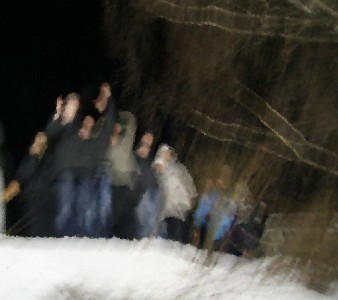
This picture was taken in July 2012, even if Nazi Germany was defeated in May 1945.
White Power and SS signs, a trademark of neo-Nazis, together with a familiar warning. This picture was taken in July 2012.
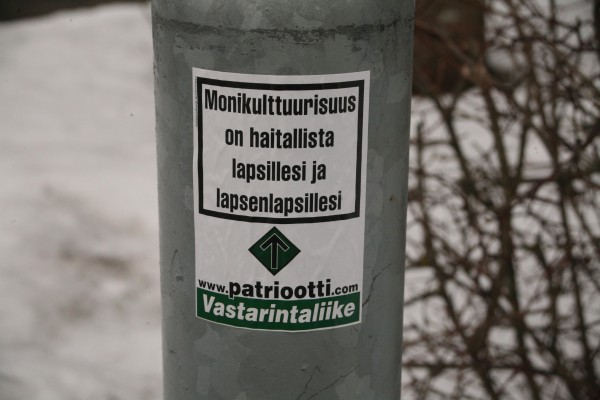
One of these associations that is spreading stickers promoting neo-Nazism is the Suomen Kansalinen Vastarinta (SKV). The sticker was placed in spring 2012 in front of the author’s home. It reads: “Multiculturalism is hazardous to your children and grandchildren.”
A Malmö District Court convicted Peter Mangs, 40, of two counts of murder and four attempted murders, according to the Guardian. The man, who is a Swede of Finnish descent, killed his first victim in 2003 and terrorized Malmö during 2009-10. All of his victims were immigrants.
Mangs will undergo psychiatric evaluation before his sentencing in early September.
Writes the New York Times in May: “And although the scale of the accusations are nothing like the charges against Anders Behring Breivik, the Norwegian on trial in Oslo for the systematic killings of 77 people last year in a crusade against multiculturalism, the parallels have not been lost on residents here in Malmö, Sweden’s third-largest city and one of its most diverse.”
Prosecutor Solveig Wollstad was quoted as saying on Iltalehti that Mangs destroyed many people’s lives.
“He carried out his crimes in a cold-hearted manner without feelings [for the victims],” he said. “His aim was to shoot immigrants.”
The White Anti-Racist is an Oxymoron” (2003) by Kil Ja Kim argues that you cannot be white and against racism at the same time.
By “white” she does not mean having white skin. She means thinking of yourself as white and enjoying the benefits that come with it in America:
white people need to be willing to have their very social position, their very relationship of domination, their very authority, their very being…let go, perhaps even destroyed. I know this might sound scary, but that is really not my concern. I am not interested in making white people, even those so-called good-hearted anti-racist whites, comfortable about their position in struggles that shape my life in ways that it will never shape theirs.
Being white creates a conflict of interest that leads to white paternalism: whites who think they know what is best for people of colour.
Kim has seen it. So has bell hooks. So has Malcolm X:
So if we need white allies in this country, we don’t need those kind who compromise. We don’t need those kind who encourage us to be polite, responsible, you know. We don’t need those kind who give us that kind of advice. We don’t need those kind who tell us how to be patient. No, if we want some white allies, we need the kind that John Brown was, or we don’t need you.
John Brown led a slave uprising on the eve of the civil war: he died fighting for the freedom of black people.
Becoming anti-racist means giving up a white identity and standing with people of colour, not with white people. Come what may. It means not to lead people of colour but to follow. It means leaving the white club for good.
Kim breaks it down like this:
Don’t call us, we’ll call you. If we need your resources, we will contact you. But don’t show up, flaunt your power in our faces and then get angry when we resent the fact that you have so many resources we don’t and that we are not grateful for this arrangement. And don’t get mad because you can’t make decisions in the process. Why do you need to?
Stop speaking for us. We can talk for ourselves.
Stop trying to point out internal contradictions in our communities, we know what they are, we are struggling around them, and I really don’t know how white people can be helpful to non-whites to clear these up.
Don’t ever say some shit to me about how you feel silenced, marginalized, discriminated against, or put in your place as a white person. Period.
Stop calling me sister. I will tell you when you are family.
Start thinking of what it would mean, in terms of actual structured social arrangements, for whiteness and white identity – even the white anti-racist kind (because there really is no redeemable or reformed white identity) – to be destroyed.
Exactly a year ago Anders Breivik carried out his mass killings, which ended up causing the death of 77 innocent victims. Have we learned anything from that tragic Saturday that shook the Nordic region and changed it permanently?
In order to answer that question, we’d have to travel back in time to see how things were prior to that day.
In Finland, the right-wing populist Perussuomalaiset (PS) had just won a historic election victory that enabled the party to increase the number of its MPs to 39 from 5 in 2007. While party leader Timo Soini played down anti-immigration sentiment as one important factor behind the PS’ election victory, others disagreed.
Before Breivik erupted on the stage, anti-immigration parties like the PS were the new political force to contend with in Finland. It seemed that nothing could stop them from adding new election victories in the future. The louder and cruder their anti-immigration and anti-EU stances were, the more supporters they’d rally to their cause.
http://www.youtube.com/watch?v=xjVD0ztWaKA
In Norway, Denmark and Sweden, far-right populist anti-immigration parties had grown as well and were openly challenging traditional parties.
Everything changed, however, after July 22.
The first blow came in Norway to the Progress Party (FrP), which saw its support in the September municipal election plummet by 6.1 percentage points to 11.5%. In the same month, another anti-immigration party, the Danish People’s Party (DPP), suffered an election setback.
Since 2001, the Islamophobic DPP had supported minority right-wing government in exchange for tighter immigration policy.
In many respect, Breivik was a wake-up call that woke up for Finland and the Nordic region to the threat of intolerance and hate speech.
A recent supreme court ruling against Jussi Hall-aho is a case in point. The PS MP was not only fined for defaming a religion but for inciting ethnic hatred as well. The ruling wasn’t only a big blow to the PS but to the far-right Suomen Sisu wing of the party. Halla-aho was forced to resign as chairman of the administration committee, which, among other matters, sets immigration policy.
The presidential election was another important example of how Finland is distancing itself after 22/7 from the anti-immigration and populist rhetoric of parties like the PS.
Two conservative anti-EU candidates, Timo Soini of the PS and Paavo Väyrynen of the Center Party, lost to Green Party hopeful Pekka Haavisto in the first round of voting. Haavisto is openly gay and pro-EU.
The next test for the PS will come in the October municipal elections. If polls are anything to go by, the party will suffer another election setback.
In light of the above, can we claim that Breivik had had a direct impact on the popularity of the PS and other parties in the Nordic region that are anti-EU, anti-immigration and anti-Islam?
Your answer to that questions will probably reveal more than anything else your political views on immigration, Islam and cultural diversity.
But if we ask Norwegian Prime Minister Jens Stoltenberg, Norway had become after July 22 “more tolerant, [and] more careful not to judge people” by ethnic origin.
Even if Stoltenberg has shown leadership on how a wounded society should react to intolerance, it’s still unclear what impact Breivik will have on our societies. We are still healing from the wound and can matters return back to “normal” in Norway after Breivik?
If we set aside politics and try to understand the impact Breivik had on the region, one matter is certain: We are outraged by what happened but dread even more the possibility that it could happen again.
Competing for the anti-immigration thunder and rhetoric of parties like the PS, DPP, FrP and Sweden Democrats are far-right groups like the Finnish Defense League, which are copy-and-paste clones of the English Defense League.
Breivk scared the wits out of some of us and proved that anti-immigration and Counter-Jihad rhetoric can convert itself into a monster that has the ability to wreak terror and change our societies for good.
That I believe is the real message and threat of 22/7.
When Abdulah*, 30, talks to you about his twenty-two years in Finland, one of the first questions that arises is how has so much suffering escaped our attention. For Abdulah, acceptance isn’t only virtually impossible from white Finns, but can be just as hard to get from the Somali community.
“I have decided to live outside this society,” he says. “I have learned that there is no place here. Even my people have turned their backs on me.”
Abdulah says that there are two matters you must never lose if you don’t want to be abandoned by the Somali community.
“Language and religion are crucial,” he explains. “I don’t speak Somali that well anymore since I grew up in this country. I became an atheist two years ago and left the Muslim faith.”
How long will it take for minorities like the Somalis to be treated as equals in Finland?
Abdulah admits that he no longer believes in god.
“How can there be a god if people are constantly killing each other in Somalia?” he continues. “How can there be a god if there’s so much hatred and racism towards you in this country? How can god exist in such hells?”
There are many young men like Abdulah in Finland, who grew up the greater part of their lives in this country. He says that some have problems with the law.
“I don’t identify with such people anymore because I used to be one of them,” he says. “If you start drinking and taking drugs, your situation will only get worse. That’s the reason why I changed my life.”
Abdulah hasn’t forsaken hope despite the difficulties he’s faced. Two factors give him strength: his family and plans to be a gardener.
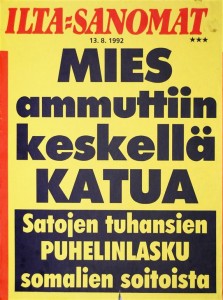
Billboards like these in the early 1990s spread prejudice about Somalis in Finland. The tabloid ad claims that Somalis had made phone calls to the tune of hundreds of thousands of marks and supposedly passed the bill to the social authorities.
“But living in Finland still feels like being in a trap,” he adds. “I want to free myself but I don’t know how.”
Abdulah discovered Migrant Tales by chance when he was searching for an alternative forum that spoke up for immigrants and visible minorities like him.
“I used to visit Suomi24, Hommaforum and even took part in Iltalehti chat forums,” he says.“They always said the same negative things about immigrants and Somalis. I felt relieved when I found Migrant Tales. It was like a light at the end of a dark tunnel that gave me hope.”
Abdulah is a very sensitive and respectful person. Despite the difficulties he’s encountered, he believes that one must be outspoken if he’s going to challenge a social ill like racism.
“We have to fight back,” he concludes. “Silence hasn’t changed my life for the better. That’s why I’m active in forums like Migrant Tales.”
*Abdulah’s name has been changed to protect his identity.
Even if I have never met Abdulah* in person but only by phone and through his comments on Migrant Tales, it’s as if we’ve known each other for a long time. Abdulah moved to Finland from Somalia in 1990 with his parents and six sisters. He was eight at the time.
When Abdulah came to Finland, there were only 21,174 immigrants living in the country, accounting for a mere 0.4% of total population, versus 183,133 (3.4%) today, according to the Population Registration Center.
“For a child from Somalia, moving to Finland was at first exciting,” he says. “We were starting a new life in a new country. I was fascinated by the snow.”
Abdulah says that his brief honeymoon with Finland ended abruptly when he started elementary school. He was the school’s first and only black student.
“That’s when the bullying started; I was even attacked physically by my classmates,” he continues. “Something bad happened to me almost every day at school.”
Being black in an all-white crowd can be sometimes dangerous in Finland.
Abdulah says that once all of his classmates, which numbered about 20, waited to attack him after school. Even a school “friend” assaulted him once with a knife.
“I’ve been bullied, called names like the n-word, insulted, kicked and hit hard at school,” he says. “The only way to survive was to be quiet and roll with the punches. There was nothing else I could do because the teachers never believed me. They were always on the side of the white students.”
“I’ve been bullied, called names like the n-word, insulted, kicked and hit hard at school,” he says. “The only way to survive was to be quiet and roll with the punches. There was nothing else I could do because the teachers never believed me. They were always on the side of the white students.”
Abdulah says that he’s tried to make friends with Finns but it has been virtually impossible. He did make some friends at school but their friendship never lasted long.
This type of tabloid ads were common in the early 1990s. It reads: “Armed refugee hater chased after blacks.”
“First they’re your friend and then they abandon you,” he says. “I was nine when I met a very nice boy at school. On the way to his home a friend of his meets us and asks him why he’s with me. He then told me right their on the spot that he could no longer be my friend.”
Even if the bullying has left deep scars on Abdulah, one of the worst memories he recalls was when he was nine and walking with his mother to the market.
“A drunk man attacked me on the street and started insulting me,” he says. “My mother called out for help but nobody came. That incident really traumatized me. I was only a child.”
Abdulah admits that growing up and living in Finland has made him paranoid. The election of an anti-immigration party like the Perussuomalaiset didn’t help dispel his fears about racism against Somalis in Finland.
The matter that concerns Abdulah the most about the Perussuomalaiet is their belief that Finns should not have children with blacks.
“With the election victory of the Perussuomalaiset that brought to parliament some fascist [anti-immigration] politicians like Jussi Halla-aho, James Hirvisaari and others, things started to turn ugly in this country from an already very bad situation for Somalis and blacks.”
Part 2 will be published Saturday.
*Abdulah’s name has been changed to protect his identity.
Ignorance is a crucial factor that still holds Finland back from tackling effectively a social ill like racism. If it’s not seen as an issue, very little will be done to challenge it.
Add to the latter the fact that even some of our elected representatives in parliament don’t know the difference between racism and discrimination, and the issue becomes clear.
The comment by Tossavainen not only offers us a glimpse of the elected official’s knowledge of racism, but how his ignorance plays down the problem.
Diluting a term like racism to mean something else is like using water in liquor bottles “so no one knows you drank some.” Soure: Allenate’s photostream.
It’s clear that a lot is lost when you water down a term like racism and redefine it as “age racism.” It’s like taking the term Holocaust and applying to something minor than the systematic murder of six million Jews in World War 2. Diluting the meaning of the term to mean something else is synonymous to denying or playing down what Nazi Germany did to the Jews.
The same applies to the term racism. If we use it differently, like in “age racism,” we deny the history and suffering of other ethnic groups like blacks in the U.S., Somalis and other minorities in Finland.
If an MP doesn’t get what racism is, how can you expect him to fight such a social ill?
Tossavainen is not alone in Finland. There are other politicians from other parties who believe that there is such a thing as “age racism.”
When reading the thoughts of far-right politicians like Perussuomalaiset (PS) party MP James Hirvisaari, one of the most vocal white-Finnish-power advocates in this country, one should look for the visible or invisible but in his writing. Migrant Talesfished one today from Facebook.
The PS MP writes: ”Some ‘humanitarians’ are driven by naive utopian ideology: [they claim] ‘let’s do away with borders and mix national groups so we can end all wars…‘ [Here it is: But] I believe that a strong and healthy society can withstand weaknesses and diversity but let’s not make these two matters the norm. Fashionable liberalism can make art from shit in all areas of life.”
That’s not all. A person on the Facebook thread claims that “multiculturalism is a death knell to all [white] Europeans” and “we are now at war.”
At war against whom? Against their stupidity or is it a desperate attempt to lure voters to a sinking political ship called the PS?
If you have problems grasping how far below the belt Hirvisaaari hits with his far-right thoughts, one way of understanding them is by removing key words from his writings such as “Muslim” or “Islam” and replacing them with “Finn” or “Christian.”
Here is a small example of how I’ve refilled the blanks in one of his recent blog entries:
Hirvisaari writes: When I criticize Islam, I criticize those who hate Jews, humiliate women in many ways…
Refilling the blanks: When I criticize Christians, I criticize those who hate Muslims, Finnish men who humiliate women by killing their wives and children before taking their own lives…
While Hirvisaari lacks the grey matter to be in the same ideological hate league as David Duke, his views on ethnicity are very similar to those of the former Ku Klux Klan grand wizard. The big difference between the two is geography: Duke lives in Louisiana and Hirvisaari is from Asikkala, Finland.
What does PS MP James Hirvisaari think about white power and the Ku Klux Klan?
Like Hirvisaari, Duke denies that he is a racist. Instead he likes to think of himself as a “racial realist.”
Contrarily, Hirvisaari sees himself as a ”white Finnish ethnic realist,” who is saving white Finns and Europeans from multiculturalism, a political ideology or immigration policy according to him that permits too many blacks and Muslims to live in Europe.
The million-dollar question after the Perussuomalaiset (PS) party’s historic election victory was what kind of party had entered the Finnish political stage. After over a year in parliament and numerous scandals that have rocked the PS, a question still begs an answer: Who are they?
If you seek an answer directly from the party, the response you’ll likely get is as convoluted as the PS itself. Great lengths will be taken to point out what they’re not.
This shouldn’t surprise us considering that the PS’ political fuel comes from near-constant whining and scapegoating.
The historic election success of the PS was by and large based on hit-and-run tactics like scapegoating and denial.
Irrespective of its hodgepodge nature, how is it possible for a far-right politician like PS MP Jussi Halla-aho and party chairman Timo Soini to sit at the same table? What unites both men ideologically?
Would it be fair to call the PS an opportunistic right-wing populist party with a heavy dash of far-right nationalism? Would the best description of the party be: anti-EU, anti-immigration, anti-Islam, anti-gay, and anti-minority rights?
If we look at close political relatives of the PS in the Nordic region, we’d find the Islamophobic Danish People’s Party, Sweden Democrats, and Progress Party of Norway.
All of them are anti-EU, anti-immigration and especially anti-Islam.
The PS’ only MEP, Sampo Terho, is a member of the eurosceptic Europe of Freedom and Democracy (EFD) parliamentary group. The biggest number of EFD MEPs come from the UK Independence Party (10), which wants the UK to exit the EU, and the xenophobic Lega Nord (9), which considers southern Italy a part of North Africa.
Even if the PS wants to tone down its right-wing conservative radicalism because it doesn’t sit well with moderate Finnish voters, it’s fair to claim that they are an anti-EU, anti-immigration, anti-Islam, anti gay, and anti-minority rights party.
The PS are an anti-EU party because 100% of PS MPs don’t want Finland to bailout any EU country. Some even believe that the Finland should exit the EU.
They are an anti-immigration party because 97% of the MPs don’t want anymore immigrants to move to Finland. If Finland must accept immigrants, they should be white Christians.
The PS is an anti-Islam party because MPs like Olli Immonen and James Hirvisaari, among others, believe that it’s only a matter of time when Europe will be taken over by Islam (Eurabia).
They are an anti-gay party because 82% are against same-sex marriages.
Conclusion: The PS are an anti-EU, anti-immigration, anti-Islam, anti-gay and anti-minority rights party with ties to the far right.
Migrant Tales met on Thursday the elderly Somali woman who was assaulted in April by Finnish men at Helsinki’s Myllypuro metro station. This is part two of the interview with Abdulle Korad Musse, 63.
For the elderly Somali woman, who speaks to us with the help of an interpreter, racism is a terrible issue like the suffering that the long civil war has brought on her people and country.
The fact that most Somalis have endured and seen unimaginable suffering in their former home country as well as endured the dark side of racism in Finland, has made some of them exceptionally strong and resilient.
Abdulle Korad Musse admits that Finland isn’t a safe country for Somalis.
Apart from her son being attacked by Finns when she lived in Joensuu, her son was assaulted in Helsinki as well. She says that a complete stranger once kicked her in the shin when she was going up the escalator.
Musse admits that some Finns can be exceptionally mean. Once they tipped off the security guards that she was shoplifting at an Itäkeskus S-Market.
”I was stopped by security guards after I paid for my goods,” she says. ”The security guards took back the items to the cashier to see if they were stolen. They apologized after they found out that everything was in order.”
Musse says she felt so humiliated and angry that she threw all the goods in the plastic bags at the security guards.
”You can imagine what a scene I created: a Somali woman suspected of shoplifting in public,” she says. ”I have never stolen anything but I have seen Finns shoplifting. I still feel very bad about what happened to me.”
Musse says that Somalis in Finland don’t trust the police.
”I don’t think the police do their job well in this country,” she says. ”I know Somalis who have been physically attacked and the police has not resolved their cases even after five or six years.”
She claims that the police drag their feet when a Somali is a victim of a crime. Musse does not believe that anything will happen to those that attacked her in April.
”They simply don’t care,” she adds. ”They don’t care because you’re a Somali and because there are racist police in this country.”
Musse believes that since the authorities cannot directly kick the Somalis out of Finland, they use other methods to tell you that you’re not welcome. Everything you do takes a lot of time for a Somali in this country: finding work, getting citizenship, family reunification, and asylum, according to her.
The Somali woman applied in 2010 for a new flat from the city. She has to walk up three flights of stairs to get to her home. The doctor has told her that she should not walk up the stairs and carry heavy objects.
”Everything is far away from my flat,” she continues. ”I have to walk to the other side of the apartment complex to dry clothes. Walking to the bus stop takes fifteen minutes. I am afraid to walk through the forest alone to get to the bus stop.”
Musse says that she gets her strength from Allah.
”Only he knows where I will live and when I will die,” she concludes.