Migrant tales
Menu
  • #MakeRacismHistory “In Your Eyes”
  • About Migrant Tales
  • It’s all about Human Rights
  • Literary
  • Migrant Tales Media Monitoring
  • NoHateFinland.org
  • Tales from Europe
Menu

Tag: Racism

Finnish men assault elderly Somali woman (Part I)

Posted on July 13, 2012 by Migrant Tales

By Roble Bashir and Enrique Tessieri

Migrant Tales met on Thursday the elderly Somali woman who was attacked by a group of Finns in April at Helsinki’s Myllypuro metro station. The woman, Abdulle Korad Musse, 63, was taken to hospital by ambulance after she was physically assaulted.  

Musse, who speaks to us with the help of an interpreter, is originally from Mogadishu and has lived in Finland since 1999. She first lived in the eastern Finnish city of Joensuu until 2002, when she moved with her family to Helsinki. Musse is a mother of six.

Her face lights up with obvious sarcasm when asked which city, Joensuu or Helsinki, were better places to live.

“Joensuu was far worse,” she admits. “One of my sons was attacked by a group of Finns [in Joensuu] and hit so hard on the knee with a club that he had to be operated on in hospital.   Another time a motorbike went after my son and ran over him. He was only seven at the time.”

Abdulle Korad Musse claims that most Finns are racist. 

Musse claims that she expects something bad to happen every time she steps out of her Helsinki flat.

“I can either get harassed or laughed at,” she says. “I try to avoid trouble by walking on the other side of the street. Young people aren’t [usually] the problem. Older-aged Finns are.”

Musse claims that Finland isn’t a safe country to live for people like her. “They [some white Finns] see you as an insect and insects must be exterminated,” she says.

The Somali woman, who was physically attacked in Myllypuro with her thirty-four-year-old daughter in April, said that the whole incident started in the lift.

“Out of nowhere, the young Finnish couple in the lift started calling us names like dirty bastards and that we should go back to the country we came from,” she continues. ”When the lift door opened, the woman threw the bike at my daughter. That’s when the fight began.”

“My daughter got the Finnish woman on the floor and was on top of her,” she continues. “I tried to stop her but soon the man who was with her was joined by three men and four women. My daughter hit the woman but she was soon attacked.”

”That’s when I got hit,” she explains. “A tall man punched me in the head. I got dizzy and fell down. On the ground he started kicking me in the kidneys, hips and shoulders. I tried to cover my stomach because I was operated in hospital a month ago.”

Musse was taken to  hospital by ambulance. She says she’s become very ill after the incident and suffers from near-constant pains.

“I cannot hold anything [heavy] and its impossible to sleep on either side my shoulders,” she says. “If I sit for too long and stand up, my knees, shoulder and hips are in pain.”

Musse says that her daughter’s face and body were bruised and swollen “everywhere.”

”The Finns that attacked her yanked by force a silver ring from her finger,” Musse says. “All the goods that we had bought in the Itäkeskus Shopping Center were scattered all over the metro station floor.”

Part II will be published Saturday. 


Racist “coupons” found at the Leppävaara death trial

Posted on July 13, 2012 by Migrant Tales

By Migrant Tales

The trial of the death of Adisalam Mohamed Abdulahi, who was killed in February in  Leppävaara, began Thursday in Espoo. Migrant Tales has learned that in the afternoon, when the court adjourned for a short break, there were coupons scattered next to the courtroom with racist text.   

A coupon that was pictured at Abdisalam Mohamed Abdulahi’s trial. The “customer” is Tumma Mustamies (Dark Blackman) who lives on Apinalaaksokatu (Monkey Valley Street). We apologize for the poor quality of the picture. 

Taking into account the tragedy that Abdulah’s death has caused on both families, someone thought it was a good idea to spread racist insults on the victims by adding more pain to their wounds.

Reporting by Roble Bashir. 

RACE FILES: Blinkered By Race

Posted on July 10, 2012 by Migrant Tales

By Race Files

No, I don’t mean car blinkers. I’m referring to the kind of blinkers that are used to keep race horses looking straight ahead at the jockey’s goal while blinding them to the distractions on either side.

Racism blinkers us. It imposes a kind of tunnel vision, causing social problems to appear to be related to differences in race and culture (and not racism), while blinding us to the common roots of many of our problems.

The study conducted by the Pew Research Center on Asian Americans that I wrote about in my last post is a good example. In it, Pew reports that 49% of Asian American adults have college degrees compared with 28% of adults in general. In addition, Asian Americans are reported to have substantially higher median household incomes and wealth than the general population, and then describes the relatively high levels of education and financial success of Asian Americans as distinctive racial characteristics.

There are significant problems with Pew’s number crunching you can read about in an excellent article in COLORLINES. But even if we put those problems aside, there’s still the issue of how ascribing relative Asian American success to race blinds us to the real social and economic realities dictating these outcomes, and how those realities affect everyone.

Here’s what I mean. In surveys measuring the educational levels of the most highly industrialized nations, the U.S. is scored at about average. That’s pretty bad news for the nation that is the richest by far, and the former world leader in education. It is for this reason that visas must be fast tracked for certain highly skilled workers, resulting in skewed educational attainment statistics among some immigrant groups, including some of the most educationally privileged of Asian immigrants.

And on that question of higher incomes and household wealth among Asians. Is it more useful to study these indices of success as racial characteristics, or to ask ourselves why the median income for Americans in general is so low?

According to Peter Edelman, 20 million Americans earned incomes less than $9,000 a year. Six million Americans have only food stamps as income. Half of U.S. jobs pay less than $34,000 a year. A fourth pay less than the poverty rate for a family of four. These statistics bring down the median income of Americans, even as that median obscures the reality for those on the bottom of the U.S. economy.

The poorest and most vulnerable are disproportionately people of color, and that’s all about racism. Racism is also at work when we allow negative racial stereotypes to lead us to blame people of color for the problem of persistent poverty. But looking for solutions to poverty in racial or cultural characteristics, as the model minority myth that is tacitly promoted by the Pew report leads us to do, takes us nowhere.

Whites in the U.S. have the highest per capita incomes. With the blinkers on, it’s easy to fall prey to the idea that white privilege translates into direct financial benefits for all white people. But then, how do we explain the fact that whites also constitute the majority of those who are poor?

According to the Economic Policy Institute, the average CEO of major companies in the U.S. earns in 10 hours what a typical worker earns in an entire year. So maybe the explanation is that income and wealth is not evenly distributed among whites – that the real driver of poverty is how the rich value the labor of the rest of us, regardless of race.

But it’s tough to know the nature of things we refuse to see. Among those things we’re blinded to by racism are our common humanity, our shared problems, and our linked destinies. Time to take off the blinkers. If we don’t, we might find that we’re racing to nowhere while the answers to where we ought to be heading lie in joining forces with our perceived opponents on either side.

Read original blog entry here.

This piece was reprinted by Migrant Tales with permission.

Marta Gómez: The little boy who wanted to be white

Posted on July 9, 2012 by Migrant Tales

Marta Gómez is a talented singer from Colombia who offers us a song called “Negrito,” or “(cute) little black boy.” In most parts of Latin America, it’s perfectly fine to call a person negrito, the diminutive of the word negro. The song by Gómez is based on a real negrito of her hometown of Cali, who in the hope of living a better life and finding work, drank Clorox to become white. 

The boy lived to see another day after he was treated in hospital after drinking the disinfectant.

In Gómez’ song, the boy paints himself white but then regrets what he did.

She says that Negtrito’s heart felt cheated and even the devil prayed that the little boy would turn black again. “The little black boy even lost his appetite   repenting what he did.”

https://www.youtube.com/watch?v=84U6iyCjIJY&feature=player_embedded#!

Migrant Tales thanks William Rivera for sharing this song with our readers.


The absurdity of the reverse-racism argument in Finland

Posted on July 8, 2012 by Migrant Tales

Every now and then you’ll hear a visitor on Migrant Tales claim: What about [reverse] racism against [white] Finns!? Racism is a complex problem but one matter singles it out: It is an effective tool to socially exclude, control and exploit other groups in society from vital resources such as jobs and economic wealth. 

The fact that white Finns are the standard of everything in Finland is enough proof that they wield real power. White Finns don’t have to understand racism because they simply don’t have to. It’s not an issue because they are the standard of this society, the norm. Everyone else has a prefix attached to them like immigrant, immigrant descendant, black, Roma etc.

In May 2011, the anti-immigration Perussuomalaiset (PS) party renounced all forms of racism, even positive discrimination, or affirmative action. 

It is surprising that when the PS made their preposterous statement, few if any media in this country understood how racist and grotesque it was and how it revealed a serious case of  colorblind racism (let’s pretend we’re equal because ethnic background does not matter, when in fact it does).   

Colorblind racism works in Finland in an implicit and explicit manner. Its aim is the same:  ethnic background is not the issue. If it is an issue, it’s your  ethnic background. 

  • ·         We have such a wonderful society that we are way past racism so get over it (explicit colorblind racism);
  • ·         It’s your culture, your parents or you that is hindering adaption to our society. In this case I recognize your ethnic background but only to shift blame and wash my hands of the problem (implicit colorblind racism). 

 This graffiti that reads “White Power” in Finnish was on a special elementary school’s wall in Mikkeli, Finland, for months before it was removed. 

Accusing a visible minority, or immigrant of being racist against white Finns, is a good example of implicit colorblind racism.  Since racism isn’t a problem in our society, it can’t be my problem. It’s your problem. 

Some successful immigrants or visible minorities who have succeeded in Finland may reinforce the same colorblind racist argument as white Finns. They may claim:  “I’m not white but I adapted to the white Finns’ world. That is why I am successful. You too can be.” 

Those immigrants who have racism issues usually come from countries where such a social ill is the standard. It’s easy for them to accept the white Finn as a standard because they too were the norm in their former home country.  As a result, some embrace the idea of becoming a Tuomo-setä, or Uncle Tom, because they are encouraged to and rewarded by white Finnish society for such behavior.

If you are ever confronted by a person who uses the reverse-racism argument, ask him or her how is the prejudice of a minority as devastating as that of the majority? 

White Finns should stop whining about reverse racism because it isn’t an issue. It’s only one of many loaded arguments used by them to justify their racism.  


Go for the values and weaknesses of a group if you aim to destroy their self-esteem

Posted on July 7, 2012 by Migrant Tales

How would you go about destroying the self-esteem of a group? If you were an anti-immigration politician, certainly you’d target the group’s values (religion) and exploit your racist arguments by pointing the finger at their most vulnerable weaknesses, like high unemployment. 

Prejudice and racism are diehard social ills because they take generations to wear off.  It may have taken a few months to label a small group of Somali refugees that came to Finland in the early 1990s, but it will be a very long time before they wash off their stigma.

The Romany minority of Finland are a good example of how negative labels can follow a group like a shadow for centuries.

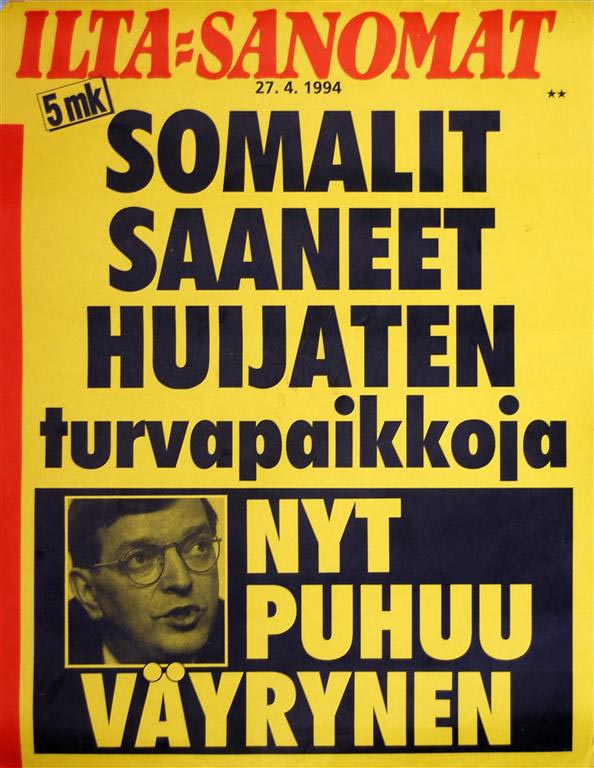
 The Ilta-Sanomat tabloid claims that Somalis swindled authorities in granting them political asylum in Finland.

If it wasn’t a tabloid billboard that spread and reinforced racism and suspicion of groups like the Somalis in the 1990s, the icing on the cake was provided by the tacit silence of the politicians and society in general.  Even if one group was being singled out, it was an attack on all immigrants living in this country at the time.

As the old saying claims, there is no evil that lasts 100 years. In the United States, it took centuries to end slavery before we saw the rise of the Civil Rights Movement in the 1950s and 1960s. The Arab Spring movements last year are good recent examples of how “no evil can last 100 years.”

There is a problem with the saying, however, since it implies that evil cannot exist over 100 years because a person cannot live past that age. History reveals that evil is more like Methuselah, the Biblical figure that lived to be 969 years old.

The findings of a study in Britain published exclusively by the Guardian claim that unchecked corporate power, unrepresentative politicians and apathetic voters are fueling today the decline of British democracy.  The same illness has spread to other parts of Europe, like Finland.

The Guardian writes: “A study into the state of democracy in Britain over the last decade warns that it is in ‘long-term terminal decline’ as the power of corporations keeps growing, politicians become less representative of their constituencies and disillusioned citizens stop voting or even discussing current affairs.”

Finnish society, which used to be perceived as the least corrupt country in the world, according to Transparency International, has had its image seriously tarnished by greedy politicians and corporate leaders.

In the same way that corruption undermines a society’s values and sends it into decline, similarly prejudice and racism constitute serious threat to it as well.

If people are excluded socially and their only aim in life it to live off welfare, certainly they have every right to challenge their situation.

The only way you can avoid violence in society is by empowering people to change their situation through our democratic institutions. Two matters can happen if people lose faith in them: indefinite (very costly) social exclusion and/or violence.

In Europe not thinking today about how to tackle social exclusion and racism is thinking little or erroneously.

Thus the roots of the problem are not the marginalized groups, far-right parties or opportunistic anti-immigration politicians, but our apathy, greed and the fact that some of us have forgotten that we are social animals.


Dear Finland, as the heat of summer draws…

Posted on July 6, 2012 by Migrant Tales

Dear Finland,

As the heat of summer draws attention to your ever-changing sub-arctic beauty, you may have wondered why Migrant Tales has become a voice of the immigrant and visible minority community in Finland. We are always humbled by your presence on our blog. In truth, we are nothing more than a new confident image of a culturally and ethnically diverse Finland.     

We are not the enemy because we speak out for more acceptance and respect between different groups living in this country. Your real enemies are those who claim with poker faces the contrary and tell you that prejudice and racism are good weapons to exclude others socially.

This cart resting in the heart of the rural Lakelands region of eastern Finland reads in Spanish: “To the woman of my life.”  For some, that woman could be Finland. 

Finland never belonged to anyone, especially to the racists and white Finnish supremacists, those very people who mock and make fun of your diversity. History proves as well that Finland didn’t even belong to the Swedes, the Russians, or even those that call themselves Finns today.

Our identity is a great awakening, ever-changing,  powerful:

Awaken me from eternal sleep

The shadow of those that hate me 

Carry me from these unacceptant lands

 past the midnight summer sun

where rain is so deadly 

that it punctures through skin.

Turning into a guitar

a daring escape occurred to me:

Thrum! Another thrum!

A great leap forward

falling down as a loud thud.

In scattered bits and pieces of me

I will find the way to blast through those nets

that society maliciously weaves.  

There are many examples of those “malicious nets” standing right under our noses today.  Take for example Eino Jutikkala’s and Kauko Pirinen’s “A History of Finland” published in 1974, which claims we Finns belonged to two “races.” Yes, such a preposterous claim was made in this country only 38 years ago!

Jutikkala and Pirinen state: “The Finns and the Hungarians are not blood relatives not to any appreciable degree, at least – whereas the Finns and the Estonians are quite closely related. Both of the later belong to the so-called East Baltic race, which is relatively short-skulled and of medium height. However, among the Finns, especially among the inhabitants of western Finland there are many representatives of the ‘Nordic’ racial type, which is characterized by a long skull and tall stature.” [1]

Another school textbook published in 1942, adds that a person who belonged to the Nordic race was “tall, slim, blue-eyed, had blond hair and red cheeks.” [2]

Apart from teaching racist myths about ourselves, how can our school textbooks  forget to mention that over 1.2 million Finns emigrated and mixed ethnically and culturally with other people in faraway lands?

In many respects, the tens of thousands of visible minorities in Finland today are like Rachel, the main character of Heidi Durrow’s novel, “The Girl Who Fell From the Sky.” Rachel is society’s idea of race, class, and beauty.

Durrow’s father is a black USAmerican and her mother is Danish.

http://https://www.youtube.com/watch?v=kJ2__1b15gY&feature=related

Durrow describes Rachel to be the following person: I think her greatest wish was to be one thing. She wanted to be understood and she wanted to be as complex as she was, and so she goes around trying to do and be one thing, which is a good student. And she becomes a big reader and the world kind of opens up to her in this way. And she thinks that if I am excellent, then definitely I will be understood and this whole race thing won’t matter. 

I think that’s still true today that if you strive for excellence then ultimately, maybe, you can maybe get beyond the shadow of race, maybe you can transcend the ways in which people may limit you because of your background, whether it be your racial background or your educational background or your economic background in many ways.


[1] Eino Jutikkala and Kauko Pirinen: A History of Finland. Praeger Publishers, New York, 1974. p. 7.

[2] J.E. Aro, J.E. Rosberg and L. Arvi P. Poijärvi; Koulun maantieto. Otava, Helsinki 1942. pp. 31-32.

Racism Review: Frederick Douglass: What, to the American Slave, is Your 4th of July?

Posted on July 4, 2012 by Migrant Tales

By Joe

On this Independence day it is well to remember yet again a probing and candid speech, “The Meaning of July Fourth for the Negro,” given by the formerly enslaved and probably greatest 19th century American, Frederick Douglass, at Rochester, New York, on July 5, 1852, at the peak of North America slavery (indeed, about 230 years into that era).

Frederick Douglass

In this era Black Americans were usually not allowed at 4th of July celebrations in the slaveholding South, apparently because many slaveholders feared that they might get an idea of freedom from such events (as if they did not already have such an idea!). Also, Black residents were often discouraged from attending such festivities in the North.

It is in this very dangerous and hostile national racial climate that the great Douglass–increasingly, a leading intellectual of his day and the first Black American to receive a roll-call vote for US President (later on, at the 1888 Republican national convention!)–was asked by leading citizens of Rochester to give an address at their Fourth of July celebrations. He gave them this stinging indictment of racial oppression:

Fellow Citizens, I am not wanting in respect for the fathers of this republic. The signers of the Declaration of Independence were brave men. They were great men, too-great enough to give frame to a great age. It does not often happen to a nation to raise, at one time, such a number of truly great men. The point from which I am compelled to view them is not, certainly, the most favorable; and yet I cannot contemplate their great deeds with less than admiration. They were statesmen, patriots and heroes, and for the good they did, and the principles they contended for, I will unite with you to honor their memory.

But later adds:

What, to the American slave, is your 4th of July? I answer; a day that reveals to him, more than all other days in the year, the gross injustice and cruelty to which he is the constant victim. To him, your celebration is a sham; your boasted liberty, an unholy license; your national greatness, swelling vanity; your sounds of rejoicing are empty and heartless; your denunciation of tyrants, brass fronted impudence; your shouts of liberty and equality, hollow mockery; your prayers and hymns, your sermons and thanksgivings, with all your religious parade and solemnity, are, to Him, mere bombast, fraud, deception, impiety, and hypocrisy-a thin veil to cover up crimes which would disgrace a nation of savages. There is not a nation on the earth guilty of practices more shocking and bloody than are the people of the United States, at this very hour.

Go where you may, search where you will, roam through all the monarchies and despotisms of the Old World, travel through South America, search out every abuse, and when you have found the last, lay your facts by the side of the everyday practices of this nation, and you will say with me, that, for revolting barbarity and shameless hypocrisy, America reigns without a rival.

Take the American slave-trade, which we are told by the papers, is especially prosperous just now. Ex-Senator Benton tells us that the price of men was never higher than now. He mentions the fact to show that slavery is in no danger. This trade is one of the peculiarities of American institutions. It is carried on in all the large towns and cities in one-half of this confederacy; and millions are pocketed every year by dealers in this horrid traffic. In several states this trade is a chief source of wealth. It is called (in contradistinction to the foreign slave-trade) “the internal slave-trade.” It is, probably, called so, too, in order to divert from it the horror with which the foreign slave-trade is contemplated. That trade has long since been denounced by this government as piracy. It has been denounced with burning words from the high places of the nation as an execrable traffic. To arrest it, to put an end to it, this nation keeps a squadron, at immense cost, on the coast of Africa. Everywhere, in this country, it is safe to speak of this foreign slave-trade as a most inhuman traffic, opposed alike to the Jaws of God and of man. The duty to extirpate and destroy it, is admitted even by our doctors of divinity. In order to put an end to it, some of these last have consented that their colored brethren (nominally free) should leave this country, and establish them selves on the western coast of Africa! It is, however, a notable fact that, while so much execration is poured out by Americans upon all those engaged in the foreign slave-trade, the men engaged in the slave-trade between the states pass with out condemnation, and their business is deemed honorable.

Behold the practical operation of this internal slave-trade, the American slave-trade, sustained by American politics and American religion. Here you will see men and women reared like swine for the market. You know what is a swine-drover? I will show you a man-drover. They inhabit all our Southern States. They perambulate the country, and crowd the highways of the nation, with droves of human stock. You will see one of these human flesh jobbers, armed with pistol, whip, and bowie-knife, driving a company of a hundred men, women, and children, from the Potomac to the slave market at New Orleans. These wretched people are to be sold singly, or in lots, to suit purchasers. They are food for the cotton-field and the deadly sugar-mill. Mark the sad procession, as it moves wearily along, and the inhuman wretch who drives them. Hear his savage yells and his blood-curdling oaths, as he hurries on his affrighted captives! There, see the old man with locks thinned and gray. Cast one glance, if you please, upon that young mother, whose shoulders are bare to the scorching sun, her briny tears falling on the brow of the babe in her arms. See, too, that girl of thirteen, weeping, yes! weeping, as she thinks of the mother from whom she has been torn! The drove moves tardily. Heat and sorrow have nearly consumed their strength; suddenly you hear a quick snap, like the discharge of a rifle; the fetters clank, and the chain rattles simultaneously; your ears are saluted with a scream, that seems to have torn its way to the centre of your soul The crack you heard was the sound of the slave-whip; the scream you heard was from the woman you saw with the babe. Her speed had faltered under the weight of her child and her chains! that gash on her shoulder tells her to move on. Follow this drove to New Orleans. Attend the auction; see men examined like horses; see the forms of women rudely and brutally exposed to the shocking gaze of American slave-buyers. See this drove sold and separated forever; and never forget the deep, sad sobs that arose from that scattered multitude. Tell me, citizens, where, under the sun, you can witness a spectacle more fiendish and shocking. Yet this is but a glance at the American slave-trade, as it exists, at this moment, in the ruling part of the United States.

And then concludes with this:

Americans! your republican politics, not less than your republican religion, are flagrantly inconsistent. You boast of your love of liberty, your superior civilization, and your pure Christianity, while the whole political power of the nation (as embodied in the two great political parties) is solemnly pledged to support and perpetuate the enslavement of three millions of your countrymen. You hurl your anathemas at the crowned headed tyrants of Russia and Austria and pride yourselves on your Democratic institutions, while you yourselves consent to be the mere tools and body-guards of the tyrants of Virginia and Carolina. You invite to your shores fugitives of oppression from abroad, honor them with banquets, greet them with ovations, cheer them, toast them, salute them, protect them, and pour out your money to them like water; but the fugitives from oppression in your own land you advertise, hunt, arrest, shoot, and kill.

The far off and almost fabulous Pacific rolls in grandeur at our feet. The Celestial Empire, the mystery of ages, is being solved. The fiat of the Almighty, “Let there be Light,” has not yet spent its force. No abuse, no outrage whether in taste, sport or avarice, can now hide itself from the all-pervading light. The iron shoe, and crippled foot of China must be seen in contrast with nature. Africa must rise and put on her yet unwoven garment. “Ethiopia shall stretch out her hand unto God.” In the fervent aspirations of William Lloyd Garrison, I say, and let every heart join in saying it:

God speed the year of jubilee
The wide world o’er!
When from their galling chains set free,
Th’ oppress’d shall vilely bend the knee,

And wear the yoke of tyranny
Like brutes no more.
That year will come, and freedom’s reign.
To man his plundered rights again
Restore.

Sadly, our system of racial oppression still persists, even as most white Americans are in denial about its deep and foundational reality. Yet, there remain many people like Frederick Douglass today who still fight to remove this “yoke of tyranny” from us all. May they flourish and prosper. We should remember those now and from the past who fought racism most on this day to celebrate freedom.

ADDENDUM
Some forty-two years later, in the last speech (“Lessons of the Hour”) he gave before his death—at an AME Church in DC, on January 9th, 1894—Douglass made these comments as he watched southern and border states hurtle toward bloody Jim Crow segregation, the new neo-slavery system:

We claim to be a Christian country and a highly civilized nation, yet, I fearlessly affirm that there is nothing in the history of savages to surpass the blood chilling horrors and fiendish excesses perpetrated against the colored people by the so-called enlightened and Christian people of the South. It is commonly thought that only the lowest and most disgusting birds and beasts, such as buzzards, vultures and hyenas, will gloat over and prey dead bodies, but the Southern mob in its rage feeds its vengeance by shooting, stabbing and burning when their victims are dead. I repeat, and my contention is, that this “Negro problem” formula lays the fault at the door of the Negro, and removes it from the door of the white man, shields the guilty, and blames the innocent. Makes the Negro responsible and not the nation….. Now the real problem is, and ought to be regarded by the American people, a great national problem. It involves the question, whether, after all, with our Declaration of Independence, with our glorious free constitution, whether with our sublime Christianity, there is enough of national virtue in this great nation to solve this problem, in accordance with wisdom and justice.

He concluded thus, his very last words ever spoken in public:

But could I be heard by this great nation, I would call to to mind the sublime and glorious truths with which, at its birth, it saluted a listening world. Its voice then, was as the tramp of an archangel, summoning hoary forms of oppression and time honored tyranny, to judgment. Crowned heads heard it and shrieked. Toiling millions heard it and clapped their hands for joy. It announced the advent of a nation, based upon human brotherhood and the self-evident truths of liberty and equality. Its mission was the redemption of the world from the bondage of ages. Apply these sublime and glorious truths to the situation now before you. Put away your race prejudice. Banish the idea that one class must rule over another. Recognize the fact that the rights of the humblest citizen are as worthy of protection as are those of the highest, and your problem will be solved; and, whatever may be in store for it in the future, whether prosperity, or adversity; whether it shall have foes without, or foes within, whether there shall be peace, or war; based upon the eternal principles of truth, justice and humanity, and with no class having any cause of compliant or grievance, your Republic will stand and flourish forever.

Read original blog entry here.

This piece was reprinted by Migrant Tales with permission.

How many types of racists are there in Finland?

Posted on July 2, 2012 by Migrant Tales

I read an interesting blog entry by Julian Abagond that highlights three types of racists in the United States: white bigots, white implicit racists and whites with integrity. How many types of racists are there in Finland? 

When studying racism in this country or in other parts of Europe, denial is the most incriminating evidence that a racist leaves behind. The culprit is usually exposed by denying that a problem exists or by affirming that “I am not racist but…”

Writes Abagond:  “Racism is something you have to unlearn on purpose. Not by trying to not see color but, as a first step, by understanding how racism works and how it has affected you.”

Racism has impacted Finland in many negative ways. It has been costly and brought great hardships on us. Even today it continues to affect us adversely.

Consider the following predicament: We need to attract skilled labor and foreign investment but the third-largest party in Finland is anti-EU, anti-immigration and especially anti-Islam.

Abagond speaks of three types of racists in the United States. I’d claim that there are four in Finland (if Abagond’s criteria were used, they would be divided in the following manner):

  1. The so-called working-class bigots (5%) are your typical skinheads. Their behavior and racism shocks most Finns. Some politicians like James Hirvisaari fall into this category.
  2. Bigots with education and steady jobs (45%) are people who would never act like working-class bigots but agree in principle with their views. Their knowledge of other groups like Africans is strongly entrenched in nineteenth-century racism and social constructs like Finnish nationalism.  Jussi Halla-aho, Wille Rydman, Paavo Väyrynen, Päivi Räsänen are some examples.
  3. White implicit racists (45%) are those who don’t fall in the latter two categories. They may claim they are against racism but their actions suggest the contrary. They strongly believe in religious freedom but would be the first ones – in private – to oppose the building of a Mosque in their neighborhood or city.  Many John Does are typical white implicit racists.
  4. Finns with integrity (5%) are those who have started to study their own racism and taken the first step to put it under control.


How to challenge a social ill like racism in Finland

Posted on June 29, 2012 by Migrant Tales

The rise of an anti-immigration party like the Perussuomalaiset (PS) in last year’s elections is not the most incriminating proof that racism is an issue in this country, but official denials that such a problem exists at all in Finland. What must we do as a society to effectively challenge such a social ill?

Denials by groups like the police that ethnic profiling ever takes place in Finland are highly revealing. The icing on the cake of ethnic profiling was given in April by Christian Democrat (KD)  Interior Minister Päivi Räsänen, who approved spot checks of foreigners by the police since they are an effective way to clamp down on undocumented immigrants.

Finnish children were taught at schools that “n”stands for the n-word and that such people like to eat bananas. Schools have been an important breeding ground for racism in Finland. Source: Ydinjate.org.

No matter how much we want to deny that racism isn’t an issue in our society and  sweep the problem under the rug, knowing who is denying it reveals a lot about the extent of the issue. Why would a white Finn see racism as an immediate threat? Why would a black person differ in opinion?

While justifying spot checks of foreigners, Räsänen gives us a glimpse of  her colorblind racism:  “The vast majority of foreigners look just like the natives, so it’s not even a very sensible way to supervise aliens.”

The question we should ask her after such a statement is what about those that don’t look like white Finns.

The views of an important public figure like Räsänen reveal how seriously the authorities treat, or how their prejudices fuel, an issue like racism. True, they may see it as a problem but they won’t invest a lot of resources to tackle it.

In many respects, anti-racism legislation should be seen in the same light as the role that anti-trust regulation plays in the business community. The lack of competition in Finland is one factor that fuels inefficiency and abuse by certain businesses.  It explains, in part, why Finland is the most expensive country in the eurozone.

In the same way, racism is abuse by a stronger group over weaker ones.

What should we do about tackling racism in Finland?

The best thing we can do is acknowledge the problem and challenge it. The first crucial step must come from the immigrant and visible minority community, which will not accept living in a society where racism and abuse are the rule. Their motive for raising their voices will be to make Finland a better place to live for their children and future generations.

Taking into account that we need skilled labor in this country to replace our ever-growing army of pensioners, accepting the status quo and being hostile to certain immigrant groups is like shooting ourselves in the leg.

The most important matter to keep in mind is that our reaction to racism must be first and foremost a reaction.


  • Previous
  • 1
  • …
  • 157
  • 158
  • 159
  • 160
  • 161
  • 162
  • 163
  • …
  • 208
  • Next
Read more about documentary film
Read more

Recent Posts

  • Lahti is the latest city to prohibit the niqab and burka
  • Finland’s tabloids Iltalehti and Ilta-Sanomat are the pits
  • Riikka Purra’s Dr Jekyll and Mr Hyde mask
  • Double standards
  • Perussuomalaiset: Uusi logo, sama vanha juttu

Recent Comments

  1. Absolutely Socking: Racist Finnish Facebook group against human rights gets flooded with socks on Musta Barbaari’s mother and sister charged by the police in “ethnic profiling” case
  2. Ilkka Nuotio on Pekka Myrskylä: “Tilastot kertovat toista kuin poliittinen keskustelu”
  3. Genrih Soinkara on The war in Ukraine and the Russian-Finnish border crisis are showing Finland’s ugly side
  4. Ahti Tolvanen on Comment by Ahti Tolvanen on the Helsinki +50 conference
  5. Angel Barrientos on Angel Barrientos is one of the kind beacons of Finland’s Chilean community

Archives

  • June 2026
  • May 2026
  • April 2026
  • March 2026
  • February 2026
  • January 2026
  • December 2025
  • November 2025
  • October 2025
  • September 2025
  • August 2025
  • July 2025
  • June 2025
  • May 2025
  • April 2025
  • March 2025
  • February 2025
  • January 2025
  • December 2024
  • November 2024
  • October 2024
  • September 2024
  • August 2024
  • July 2024
  • June 2024
  • May 2024
  • April 2024
  • March 2024
  • February 2024
  • January 2024
  • December 2023
  • November 2023
  • October 2023
  • September 2023
  • August 2023
  • July 2023
  • June 2023
  • May 2023
  • April 2023
  • March 2023
  • February 2023
  • January 2023
  • December 2022
  • November 2022
  • October 2022
  • September 2022
  • August 2022
  • July 2022
  • June 2022
  • May 2022
  • April 2022
  • March 2022
  • February 2022
  • January 2022
  • December 2021
  • November 2021
  • October 2021
  • September 2021
  • August 2021
  • July 2021
  • June 2021
  • May 2021
  • April 2021
  • March 2021
  • February 2021
  • January 2021
  • December 2020
  • November 2020
  • October 2020
  • September 2020
  • August 2020
  • July 2020
  • June 2020
  • May 2020
  • April 2020
  • March 2020
  • February 2020
  • January 2020
  • December 2019
  • November 2019
  • October 2019
  • September 2019
  • August 2019
  • July 2019
  • June 2019
  • May 2019
  • April 2019
  • March 2019
  • February 2019
  • January 2019
  • December 2018
  • November 2018
  • October 2018
  • September 2018
  • August 2018
  • July 2018
  • June 2018
  • May 2018
  • April 2018
  • March 2018
  • February 2018
  • January 2018
  • December 2017
  • November 2017
  • October 2017
  • September 2017
  • August 2017
  • July 2017
  • June 2017
  • May 2017
  • April 2017
  • March 2017
  • February 2017
  • January 2017
  • December 2016
  • November 2016
  • October 2016
  • September 2016
  • August 2016
  • July 2016
  • June 2016
  • May 2016
  • April 2016
  • March 2016
  • February 2016
  • January 2016
  • December 2015
  • November 2015
  • October 2015
  • September 2015
  • August 2015
  • July 2015
  • June 2015
  • May 2015
  • April 2015
  • March 2015
  • February 2015
  • January 2015
  • December 2014
  • November 2014
  • October 2014
  • September 2014
  • August 2014
  • July 2014
  • June 2014
  • May 2014
  • April 2014
  • March 2014
  • February 2014
  • January 2014
  • December 2013
  • November 2013
  • October 2013
  • September 2013
  • August 2013
  • July 2013
  • June 2013
  • May 2013
  • April 2013
  • March 2013
  • February 2013
  • January 2013
  • December 2012
  • November 2012
  • October 2012
  • September 2012
  • August 2012
  • July 2012
  • June 2012
  • May 2012
  • April 2012
  • March 2012
  • February 2012
  • January 2012
  • December 2011
  • November 2011
  • October 2011
  • September 2011
  • August 2011
  • July 2011
  • June 2011
  • May 2011
  • April 2011
  • March 2011
  • February 2011
  • January 2011
  • December 2010
  • November 2010
  • October 2010
  • September 2010
  • August 2010
  • July 2010
  • June 2010
  • May 2010
  • April 2010
  • March 2010
  • February 2010
  • January 2010
  • December 2009
  • November 2009
  • October 2009
  • September 2009
  • August 2009
  • July 2009
  • December 2008
  • November 2008
  • October 2008
  • September 2008
  • August 2008
  • July 2008
  • June 2008
  • May 2008
  • April 2008
  • March 2008
  • February 2008
  • January 2008
  • November 2007
  • October 2007
  • September 2007
  • August 2007
  • July 2007
  • June 2007
  • May 2007

Categories

  • ?? Gia L?c
  • ????? ?????? ????? ???????? ?? ??????
  • ???????
  • @HerraAhmed
  • @mondepasrond
  • @nohatefinland
  • @oula_silver
  • @Varathas
  • A Pakistani family
  • äärioikeisto
  • Abbas Bahmanpour
  • Abdi Muhis
  • Abdirahim Hussein Mohamed
  • Abdirahim Husu Hussein
  • Abdirisak Mahamed
  • About Migrant Tales
  • activism
  • Adam Al-Sawad
  • Adel Abidin
  • Afrofinland
  • Ahmed IJ
  • Ahti Tolvanen
  • Aino Pennanen
  • Aisha Maniar
  • Alan Ali
  • Alan Anstead
  • Alejandro Díaz Ortiz
  • Alekey Bulavsev
  • Aleksander Hemon
  • Aleksanterinliitto
  • Aleksanterinliitto ry
  • Aleksanterinliitto ry:n hallitus
  • Alex Alex
  • Alex Mckie
  • Alexander Nix
  • Alexandra Ayse Albayrak
  • Alexis Neuberg
  • Ali Asaad Hasan Alzuhairi
  • Ali Hossein Mir Ali
  • Ali Rashid
  • Ali Sagal Abdikarim
  • Alina Tsui
  • Aline Müller
  • All categories
  • Aman Heidari
  • Amiirah Salleh-Hoddin & Jana Turk
  • Amin A. Alem
  • Amir Zuhairi
  • Amkelwa Mbekeni
  • Ana María Gutiérrez Sorainen
  • Anachoma
  • Anders Adlecreutz
  • Angeliina Koskinen
  • Anna De Mutiis
  • Anna María Gutiérrez Sorainen
  • Anna-Kaisa Kuusisto ja Jaakko Tuominen
  • Annastiina Kallius
  • Anneli Juise Friman Lindeman
  • Announcement
  • Anonymous
  • Antero Leitzinger
  • anti-black racism
  • Anti-Hate Crime Organisation Finland
  • Anudari Boldbaatar
  • Arshiya Nasser
  • Aspergers Syndrome
  • Asylum Corner
  • Asylum seeker 406
  • Athena Griffin and Joe Feagin
  • Autism
  • Avaaz.org
  • Awale Olad
  • Ayan Said Mohamed
  • AYY
  • Barachiel
  • Bashy Quraishy
  • Beatrice Kabutakapua
  • Beri Jamal
  • Beri Jamal and Enrique Tessieri
  • Bertolt Brecht
  • Boiata
  • Boodi Kabbani
  • Bruno Gronow
  • Carmen Pekkarinen
  • Çelen Oben and Sheila Riikonen
  • Chiara Costa-Virtanen
  • Chiara Costa-Virtanen
  • Chiara Sorbello
  • Christian Thibault
  • Christopher Wylie
  • Clara Dublanc
  • Dana
  • Daniel Malpica
  • Danilo Canguçu
  • David Papineau
  • David Schneider
  • Dexter He
  • Don Flynn
  • Dr Masoud Kamali
  • Dr. Faith Mkwesha
  • Dr. Theodoros Fouskas
  • Edna Chun
  • Eeva Kilpi
  • Emanuela Susheela
  • En castellano
  • ENAR
  • Enrique
  • Enrique Tessieri
  • Enrique Tessieri & Raghad Mchawh
  • Enrique Tessieri & Yahya Rouissi
  • Enrique Tessieri and Muhammed Shire
  • Enrique Tessieri and Sira Moksi
  • Enrique Tessieri and Tom Vandenbosch
  • Enrique Tessieri and Wael Che
  • Enrique Tessieri and Yahya Rouissi
  • Enrique Tessieri and Zimema Mhone
  • Epäluottamusmies
  • EU
  • Europe
  • European Islamophobia Report
  • European Islamophobia Report 2019,
  • European Union
  • Eve Kyntäjä
  • Ezequiel Caldeiro
  • Facebook
  • Fadumo Dayib
  • Faisa Kahiye
  • Farhad Manjoo
  • Fasismi
  • Finland
  • Fizza Qureshi
  • Flyktingar och asyl
  • Foreign Student
  • Fozia Mir-Ali
  • Frances Webber
  • Frida Selim
  • Gareth Rice
  • Ghyslain Vedeaux
  • Global Art Point
  • Great Replacement
  • Habiba Ali
  • Hami Bahadori
  • Hami Bahdori
  • Hamid
  • Hamid Alsaameere
  • Hamid Bahdori
  • Handshake
  • Harmit Athwal
  • Hassan Abdi Ali
  • Hassan Muhumud
  • Heikki Huttunen
  • Heikki Wilenius
  • Helsingin Sanomat
  • Henning van der Hoeven
  • Henrika Mälmsröm
  • Hser Hser
  • Hser Hser ja Mustafa Isman
  • Husein Muhammed
  • Hussain Kazemian
  • Hussain Kazmenian
  • Ibrahim Khan
  • Ida
  • Ignacio Pérez Pérez
  • Iise Ali Hassan
  • Ilari Kaila & Tuomas Kaila
  • Imam Ka
  • inside-an-airport
  • Institute of Race Relations
  • Iraqi asylum seeker
  • IRR European News Team
  • IRR News Team
  • Islamic Society of Norhern FInland
  • Islamic Society of Northern Finland
  • Islamophobia
  • Jacobinmag.com
  • Jallow Momodou
  • Jan Holmberg
  • Jane Elliott
  • Jani Mäkelä
  • Jari Luoto
  • Jari Taponen
  • Jegor Nazarov
  • Jenni Stammeier
  • Jenny Bourne
  • Jessie Daniels
  • Joe Davidow
  • Johannes Koski
  • John D. Foster
  • John Grayson
  • John Marriott
  • Jon Burnett
  • Jorma Härkönen
  • Jos Schuurmans
  • José León Toro Mejías
  • Josue Tumayine
  • Jouni Karnasaari
  • Juan Camilo
  • Jukka Eräkare
  • Julian Abagond
  • Julie Pascoet
  • Jussi Halla-aho
  • Jussi Hallla-aho
  • Jussi Jalonen
  • JusticeDemon
  • Kadar Gelle
  • Kaksoiskansalaisuus
  • Kansainvälinen Mikkeli
  • Kansainvälinen Mikkeli ry
  • Katherine Tonkiss
  • Kati Lepistö
  • Kati van der Hoeven-Lepistö
  • Katie Bell
  • Kättely
  • Kerstin Ögård
  • Keshia Fredua-Mensah & Jamie Schearer
  • Khadidiatou Sylla
  • Khadra Abdirazak Sugulle
  • Kiihotus kansanryhmää vastaan
  • Kirsi Crowley
  • Koko Hubara
  • Kristiina Toivikko
  • Kubra Amini
  • KuRI
  • La Colectiva
  • La incitación al odio
  • Laura Huhtasaari
  • Lauri Finér
  • Leif Hagert
  • Léo Custódio
  • Leo Honka
  • Leontios Christodoulou
  • Lessie Branch
  • Lex Gaudius
  • Leyes de Finlandia
  • Liikkukaa!
  • Linda Hyökki
  • Liz Fekete
  • M. Blanc
  • Maarit Snellman
  • Mahad Sheikh Musse
  • Maija Vilkkumaa
  • Malmin Kebab Pizzeria Port Arthur
  • Marcell Lorincz
  • Mari Aaltola
  • María Paz López
  • Maria Rittis Ikola
  • Maria Tjader
  • Marja-Liisa Tolvanen
  • Mark
  • Markku Heikkinen
  • Marshall Niles
  • Martin Al-Laji
  • Maryan Siyad
  • Matt Carr
  • Mauricio Farah Gebara
  • Media Monitoring Group of Finland
  • Micah J. Christian
  • Michael McEachrane
  • Michele Levoy
  • Michelle Kaila
  • Migrant Tales
  • Migrant Tales Literary
  • Migrantes News
  • Migrants' Rights Network
  • MigriLeaks
  • Mikko Kapanen
  • Miriam Attias and Camila Haavisto
  • Mohamed Adan
  • Mohammad Javid
  • Mohammad M.
  • Monikulttuurisuus
  • Monisha Bhatia and Victoria Canning
  • Mor Ndiaye
  • Muh'ed
  • Muhamed Abdimajed Murshid
  • Muhammed Shire
  • Muhammed Shire and Enrique Tessieri
  • Muhis Azizi
  • Musimenta Dansila
  • Muslimiviha
  • Musulmanes
  • Namir al-Azzawi
  • Natsismi
  • Neurodiversity
  • New Women Connectors
  • Nils Muižnieks
  • No Labels No Walls
  • Noel Dandes
  • Nuor Dawood
  • Omar Khan
  • Otavanmedia
  • Oula Silvennoinen
  • Paco Diop
  • Pakistani family
  • Pentti Stranius
  • Perussuomalaiset
  • perustuslaki
  • Petra Laiti
  • Petri Cederlöf
  • Pia Grochowski
  • Podcast-lukija Bea Bergholm
  • Pohjois – Suomen Islamilainen Yhdyskunta
  • Pohjois Suomen Islamilainen Yhyskunta
  • Polina Kopylova
  • Race Files
  • racism
  • Racism Review
  • Raghad Mchawh
  • Ranska
  • Rashid H. and Migrant Tales
  • Rasismi
  • Raul Perez
  • Rebecka Holm
  • Reem Abu-Hayyeh
  • Refugees
  • Reija Härkönen
  • Remiel
  • Reza Nasri
  • Richard Gresswell
  • Riikka Purra
  • Risto Laakkonen
  • Rita Chahda
  • Ritva Kondi
  • Robito Ibrahim
  • Roble Bashir
  • Rockhaya Sylla
  • Rodolfo Walsh
  • Roger Casale
  • Rostam Atai
  • Roxana Crisólogo Correa
  • Ruth Grove-White
  • Ruth Waweru-Folabit
  • S-worldview
  • Sadio Ali Nuur
  • Sami Rusanen
  • Sandhu Bhamra
  • Sara de Jong
  • Sarah Crowther
  • Sari Alhariri
  • Sarkawt Khalil
  • Sasu
  • Scot Nakagawa
  • Shabana Ahmadzai
  • Shada Islam
  • Sharon Chang blogs
  • Shenita Ann McLean
  • Shirlene Green Newball
  • Sini Savolainen
  • Sira Moksi
  • Sonia K.
  • Sonia Maria Koo
  • Steverp
  • Stop Deportations
  • Suldaan Said Ahmed
  • Suomen mediaseurantakollektiivi
  • Suomen Muslimifoorumi ry
  • Suomen viharikosvastainen yhdistys
  • Suomen viharikosvastainen yhdistys ry
  • Suomi
  • Supermen
  • Susannah
  • Suva
  • Syrjintä
  • Talous
  • Tapio Tuomala
  • Taw Reh
  • Teivo Teivainen
  • The Daily Show
  • The Heino
  • The Supermen
  • Thomas Elfgren
  • Thulfiqar Abdulkarim
  • Tim McGettigan
  • Tino Singh
  • Tito Moustafa Sliem
  • Tobias Hübinette and L. Janelle Dance
  • Transport
  • Trica Danielle Keaton
  • Trilce Garcia
  • Trish Pääkkönen
  • Trish Pääkkönen and Enrique Tessieri
  • Tuulia Reponen
  • Uncategorized
  • UNITED
  • University of Eastern Finland
  • Uyi Osazee
  • Väkivalta
  • Vapaa Liikkuvuus
  • Venla-Sofia Saariaho
  • Vieraskynä
  • W. Che
  • W. Che an Enrique Tessieri
  • Wael Ch.
  • Wan Wei
  • Women for Refugee Women
  • Xaan Kaafi Maxamed Xalane
  • Xassan Kaafi Maxamed Xalane
  • Xassan-Kaafi Mohamed Halane & Enrique Tessieri
  • Yahya Rouissi
  • Yasmin Yusuf
  • Yassen Ghaleb
  • Yle Puhe
  • Yuliet Tresa
  • Yve Shepherd
  • Zahra Khavari
  • Zaker
  • Zalina Ametova
  • Zamzam Ahmed Ali
  • Zeinab Amini ja Soheila Khavari
  • Zimema Mahone and Enrique Tessieri
  • Zimema Mhone
  • Zoila Forss Crespo Moreyra
  • ZT
  • Zulma Sierra
  • Zuzeeko Tegha Abeng
© 2026 Migrant tales | Powered by Minimalist Blog WordPress Theme