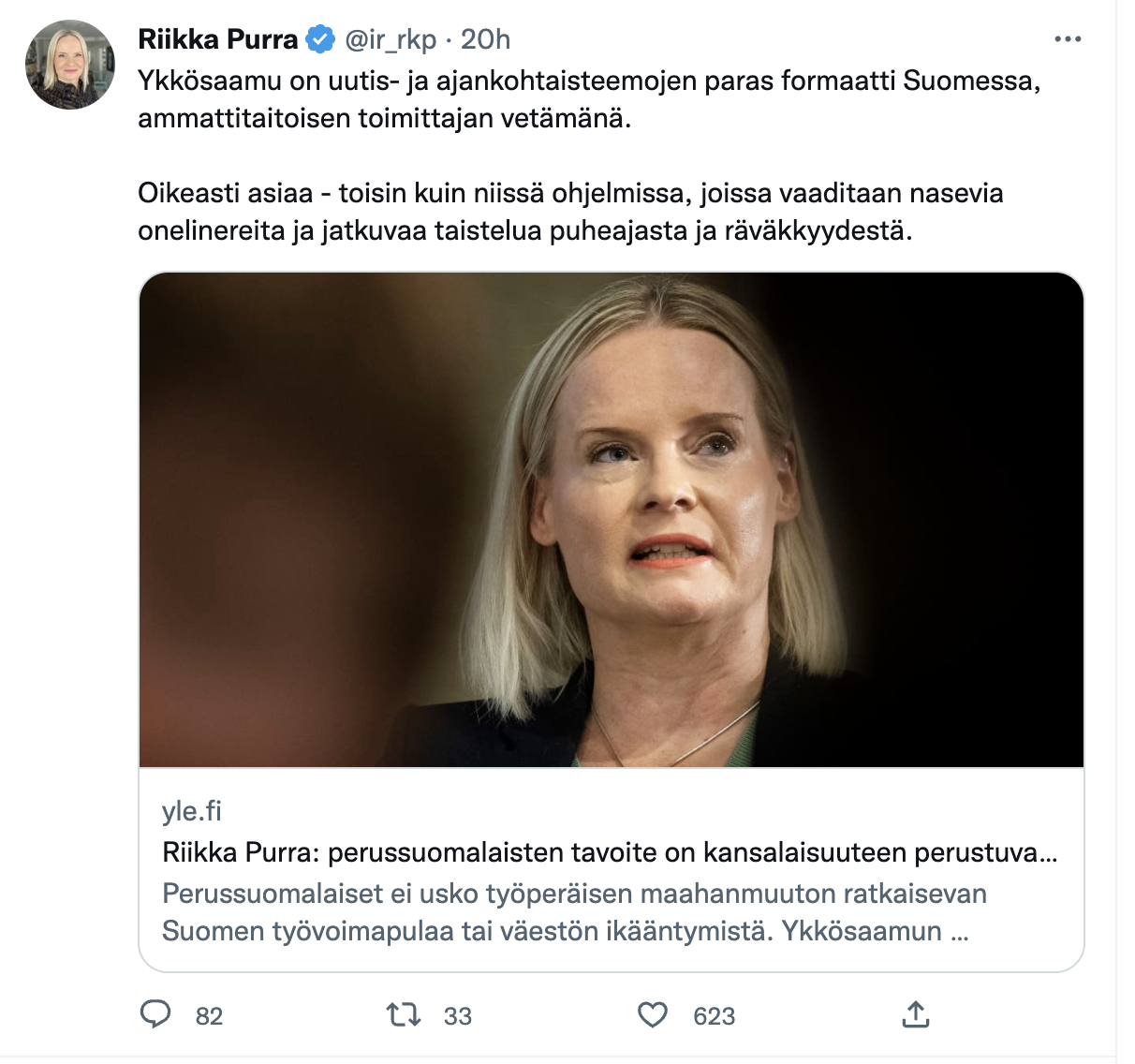
Mahad Sheikh Musse: “Olen sitä mieltä että kun maahanmuuttajataustainen nuori nähdään uhkana tai haavoittuvassa asemassa olevana taustansa vuoksi, kohtaaminen ei voi olla samanarvoista, jos toiset nähdään uhkana ja toisista ollaan huolissaan. Jos osa nuorista nähdään yksilöinä ja toiset taustansa mukaan, niin heille ei voi tarjota samanlaisia palveluja.
There are many good tips migrants can get in Finland on how to land a job, write a convincing CV, and give near-perfect answers to a prospective employer at a job interview. Despite the latter, one crucial matter needs to be included: Learning and protecting your rights after you are hired.
Because it is difficult to find online cases of abuse and unfair practices by employers, the victim may face several obstacles. The post below by the Finnish Immigration Service (Migri) highlights the problem of employer abuse, but there is no advice on what you should do and whom you should turn to for help.
Khalid, who prefers to remain anonymous because he fears problems with his past employer, said that the system whereby asylum seekers must get work to get a residence permit opens them up to abuse.
“I know of many cases where a foreigner is abused and taken advantage of by the employer,” he said. “It is easy for the employer to force the employee to accept abuse and work in black, and even threaten him or her with deportation.”
Khalid is, however, adamant: “When you feel something is wrong, go to the authorities and ask for legal advice. This is your right, and I don’t wish anyone to suffer my terrifying experiences in the Finnish labor market.”
He said the information you can get from unions like SAK is very helpful when approaching the police about your case. Even so, there is so much that such organizations can do to fix your problem at work.
The Finnish Immigration Service (Migri) below tells you how to identify exploitation by the employer but not what to do if you are a victim of such abuse.
Khalid has not yet made a police report about the abuse he suffered at a Helsinki company that subcontracts work from the state-owned Posti Corporation.
First employers
Like many others, the young Iraqi came to Finland in 2015 when he was 18. His work history defies all the hostie urban tales by far-right anti-immigration groups like the Perussuomalaiset*, claiming such people came here only to live off social welfare. For several years, Khalid was an undocumented migrant since he had a deportation order in 2017 but preferred to stay.
“I came in 2015 but started to work in 2018 for a company that fixed old windows and did cleaning work,” he said. “I was fortunate because the company that hired me did not exploit me. They paid me fairly, got paid for overtime and even holiday pay.”
Khalid’s first job in Finland was fixing old windows. Source: Google
The young man admits being surprised that his first employer treated him fairly. He had heard of many cases where their employers abused and short-changed foreigners.
“I was forced to quit my first job because I did not have a work permit,” he said. “I could not apply for a work permit because I did not have a passport. I was unemployed, but only for a short time.”
His second employer was Posti Corporation. He was paid 850 euros a month for distributing newspapers during the wee hours. From Posti Corporation, he started to do construction cleaning work but had to quit that job because Migri would not grant him a work permit.
The hate speech targeted at Sámi activists like Petra Laiti and Janne Hirvasvuopio by MPs from the Center Party and others is a stark reminder of the racism inflicting Finland. Suppose the Sámi, the original inhabitants of Finland, have no right to self-determination. What does this say about other minorities who want to practice and maintain their culture in this country?
If anything, it exposes in raw Finland’s hostile environment and the institutional racism that minorities face.
Apart from Norway and Denmark, Finland still has not ratified ILO Convention 169, thus retarding the rights of the Sámi to self-determination and human rights.
The government of Prime Minister Sanna Marin has brought the Sámi Parliament Act. The Center Party and Perussuomalaiset* have voiced their objection to the act. The Nationa Coalition Party (Kokoomus) has yet to voice its opinion.
Below is a Facebook post by Petra Laiti about hate speech and attacks by Center Party MP Mikko Kärnä, whose anti-Sámi views helped him get elected to parliament.
The far-right Perussuomalaiset (PS)* is the most Trumpian party in Finland’s parliament. Its parliamentary group leader Ville Tavio, who has spoken highly in the past of similar far-right politicians like France’s Marine Le Pen of France, is happy that former President Donald Trump is back on Twitter.
Twitter banned Trump after he incited an insurrection to storm the Capitol on January 6, 2021, and halt the peaceful transfer of power to President Joe Biden. No president of the United States has done what Trump did to undermine US democracy.
Like Trump, Tavio and his band of PS politicians are cancer undermining our society and institutions.
“What kind of a country would Finland be if politicians like Tavio ever took over? We have already seen how much their politics polarise and label racialized people. In the United States, they call these types of politicians “crazies.”
Who would they go after they rid Finland of those they loathe? Not me, you might believe.
Wrong.
It would be the end of democracy as we know it.
A tweet by Tavio expressing his admiration for autocratic iliberal leaders.
In neighboring Sweden, the Sweden Democrats were able to form part of the government thanks to right-wing parties like the Moderates.
The National Coalition Party (Kokoomus) is flirting and playing ball with the PS in Finland. Contrary to Sweden, Finland’s far-right party will not accept forming part of a minority government. It will want the whole thing, even if it means devouring Kokoomus.
Where is your MAGA cap, Tavio? Two of your MPs, Wilhelm Junnila and Veikko Villen, have posed with it.
Apart from Finland’s racism problem, the PS has become popular due to the tacit support of the media and non-PS politicians for their views.
If we unite and give parties like the PS and those like Kokoomus that support them the thumbs down, we can send them back to the minor political leagues.
The Midterm elections in the United States were an encouraging rebuke of Trump and the Republican Party.
Targeting and hating people because of their background isn’t “normal” or a tool to build a well-functioning society.
It is a recipe for the social exclusion of Others and to sow future fields of genocide.
White saviors come in many sizes and shapes. Whatever shape and size, they stunt equality for one simple reason: The white savior is on top handing out his harmful empathy to minorities.
How can I claim that white saviors aren’t well-intentioned people?
Not only disobey unjust laws but challenge white saviors.
From personal experience.
While racism and discrimination are constant variables that rob people of their equal rights and opportunities, they also regulate them to second-class status.
Finnish white privilege #89
When you are a second-class member of society, the ones blocking you in many cases from realizing your full potential are those damn white saviors crying crocodile tears over you.
The only way to deal with this toxic situation is by exposing it and making your opinion heard: I don’t want your help that relegates me in a wheelchair. Treat me equally with all the rights and obligations entitled theoretically to me.
There was no red wave, never mind a red tsunami, in the midterm elections in the United States. Defying the precedent of past elections, the Democrats gave the Republicans a beating they will not easily forget. What lessons can Finland learn from the US midterm elections?
For one, voters shunned extremist positions on issues like election denial, immigration, abortion, and civil rights.
If there are losers in Finland resulting from the US elections, it is, without a doubt, the Perussuomalaiset (PS)* party. We could compare it to the early 2010s when populist anti-immigration parties like the PS entered the major leagues of Finnish politics.
Everything was riding high for the PS until an Islamophobe mass murderer, Anders Breivik, killed 77 innocent people in Norway.
Finland’s very own MAGA Perussuomalaiset, Vilhelm Junnila, and Veikko Valliin. Source: Facebook
Watch Thursday’s parliamentary question-and-answer sessions if you want to watch “the crazies” lashing out whenever the PS candidates awoke by the magic term maahanmuutto (immigration). They go off the wall throwing their extremist spaghetti wherever it may stick.
Apart from the rejection of extremist Republican candidates, leadership was needed from other politicians to call out these crazies.
In September, President Joe Biden called the MAGA Republicans “semi-fascists.”
It is high time we do the same in Finland and call out these extremist politicians for what they are: fascists and a threat to democracy.
Well, Sannikka is at it again, and wouldn’t you know that she had something lowly to say about migrants?
Tuesday’s A-studio talk show was about civil disobedience, and Sannikka asked an environmental activist if her civil disobedience would include crimes committed by migrants.
WTF?
That is pretty far-fetched and reveals that Sannikka has an agenda against minorities and migrants.
It was in 2020 when Helsingin Sanomatpublished a big story about the dangers of youth gang violence in Helsinki. The story received a lot of criticism because it spread the misinformation that youth crime is rising in Helsinki and Greater Helsinki.
It isn’t surprising that the state-owned broadcaster, Yle, has spread the issue, especially after Sweden’s parliamentary election, which was won by the far-right Sweden Democrats, which took up youth gang violence as one of their main campaign issues.
The tactic by the Sweden Democrats and the right-wing Moderates paid off.
Considering Finland will hold parliamentary elections in April, it should not surprise us that the far-right Finns Party and its National Coalition Party partner are feverishly searching for a successful campaign issue that centers on migrants and minorities.
In all three parliamentary elections last decade, the PS’s good showing was boosted by some news involving asylum seekers, mainly Muslims:
The 2011 parliamentary election, when the PS won 39 seats from 5 previously, was helped by reporting that was more amazed at the new racist kid on the political block. Even parties like the Social Democrats started copying the PS’ anti-immigration rhetoric. PS rising political “stars” like Jussi Halla-aho, James Hirvisaari, Juho Erola, Timo Soini, and others got their places in the sun. Things were so bad back then that Islamophobes were invited to give their opinions on talk shows about immigration policy..
In the 2015 parliamentary election, when the PS duplicated its 2011 result by gaining 38 seats, a rape happened in the Helsinki neighborhood of Tapanila one month before the election. The crime got a lot of attention in the media, and Yle went as far as to ask people of the Somali community why “they always rape.” The police also helped by labeling the suspects “people of foreign decent,” even if they were born in Finland. Why was it essential for the public to know the latter?
The PS got another present in the 2019 election when suspects, mainly asylum seekers, were accused of sexually harassing minors. Even if the media, and the police, who warned people to stay away from foreigners, reached hysterical levels, the PS, with the aid of parties like the National Coalition Party (Kokoomus), promised to get tough on migrants. The PS almost won the parliamentary election in April.
Is youth gang violence in Finland one of the winning campaign issues for April’s parliamentary election?
So far, Yle has brought the issue to the public through A-studio and Monday’s 8:30 pm news. Who is making such editorial decisions?
The Yle reporter introduces the topic: “Shootings in public places, bragging about criminals, and showing it on social media indicate that street gang criminal activity has grown in Finland, according to the police.” Source: Yle
Many questions arise from such reporting. Some of the main ones are if gang violence is a problem, like in Sweden and why it is an issue today. Doesn’t the media bear any responsibility for labeling all minority youths?
The Finnish mainstream media has a poor reputation in the eyes of racialized Finns for spreading and labeling them. Yle did it again on its 8:30 pm news, where it led with a picture of a white youth giving the finger, followed by no sources except for “the police believes” that street gang criminal activity has taken a turn for the worst.
Then the reporter gives her verdict, sourcing her opinions to the police without mentioning statistical information, never mind an official’s name.
“Shootings in public places, bragging about criminals and showing it on social media indicate that street gang criminal activity has grown in Finland, according to the police.”
The Yle reporter states that the National Bureau of Investigation (KRP) said four years ago that there were no youth street gangs in Finland. Today there are about ten gangs, mainly in Turku and Helsinki and surroundings, with about 200 members, according to the police.
Surprise, surprise: “Youth gangs are different from motorcycle gangs,” the reporter states, “since they listen to rap music, they are mainly men of foreign background and exert influence in the neighborhoods they live.”