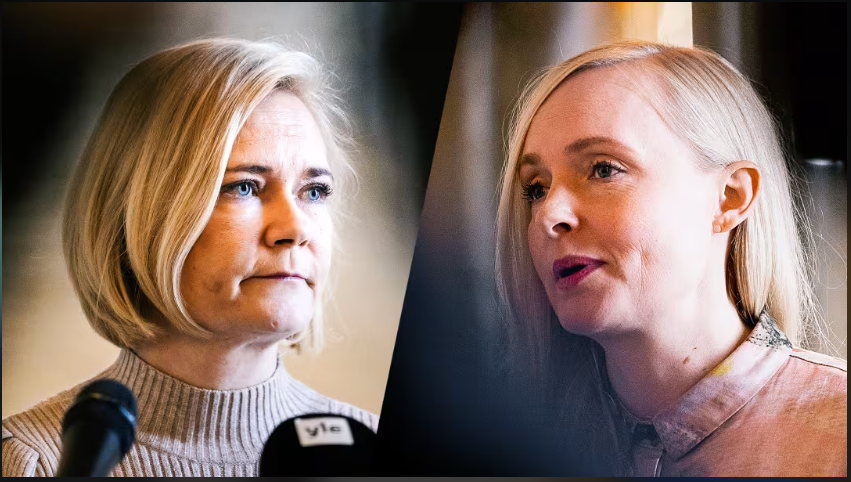
On Friday, the government revealed its plan to subvert our constitution, international agreements, and human rights by denying people escaping strife and poverty asylum.
Even if the government does not use the term push back, it is exactly that: a law that allows Finland to deny and push back people seeking asylum.
What is most incredible is how the government speculates and spreads fear, claiming that the law is necessary to ensure domestic security and protect the country’s sovereignty from Russian aggression.
A question: Didn’t the tens of thousands of Ukrainians who fled war and came to Finland threaten our security and sovereignty? What about the over 30,000 asylum seekers who came to Finland in 2015? Why are matters different? The answer: xenophobic government scoring brownie points with the voters.
If the new law is approved by parliament by a two-thirds majority, it shows how successful Vladimir Putin’s strategy has been to undermine the rule of law in Finland.
The other important question we should ask is what will be the government’s next step to undermine migrant and human rights?
The right-wing government of Prime Minister Petteri Orpo wants Finland to enforce a pushback law that will deny refugees the right to asylum. According to legal experts contacted by Helsingin Sanomat, they cannot recall a case in which a law sent to parliament is so clearly in conflict with international treaties signed by Finland.
The new law, if approved by a two-thirds majority (167 MPs) in parliament, will permit Finland to push back asylum seekers and deny their right to seek asylum.
Even if the law does not mention the word “pushback,” it does just that. It gives the Finnish Border Guards the right to send asylum seekers back to Russia and denies their right to seek refugees.
Contributions invited on the real-life dilemmas of immigrating to Finland for a sequel to the book Strange Days (1984).
Send in your proposals for including an article of 6 to 10 pages to [email protected]. Short summaries will be used to invite writers to draft an article for the book to be published this year.
If an interview of Prime Minister Petteri Orpo in Politico, he said the best way to moderate the far right is to invite them to rule and be a part of the government.What is significant by the interviews is that it is the first time that Orpo admits that the Perussuomalaiset (PS)* was a far-right party.
Orpo’s recipe to moderate the far right reflects political cowardice and opportunism. The National Coalition Party (NCP) and the PS can form government because they have similar goals: The NCP and PS support each other’s plans for paradigm changes in the labor market and migration policy.
In the face of racism scandals hitting the Perussuomalaiset and Opro’s government last summer, Orpo admitted “things are going well” and that he’s “moderated” the PS by giving them ministerial posts. “In my opinion, [the PS] is not a far-right party anymore,” he said.
By paradigm changes in the labor market , spearheaded by the NCP and migration policy by the PS, the parties aim to radically change the face of these sectors.
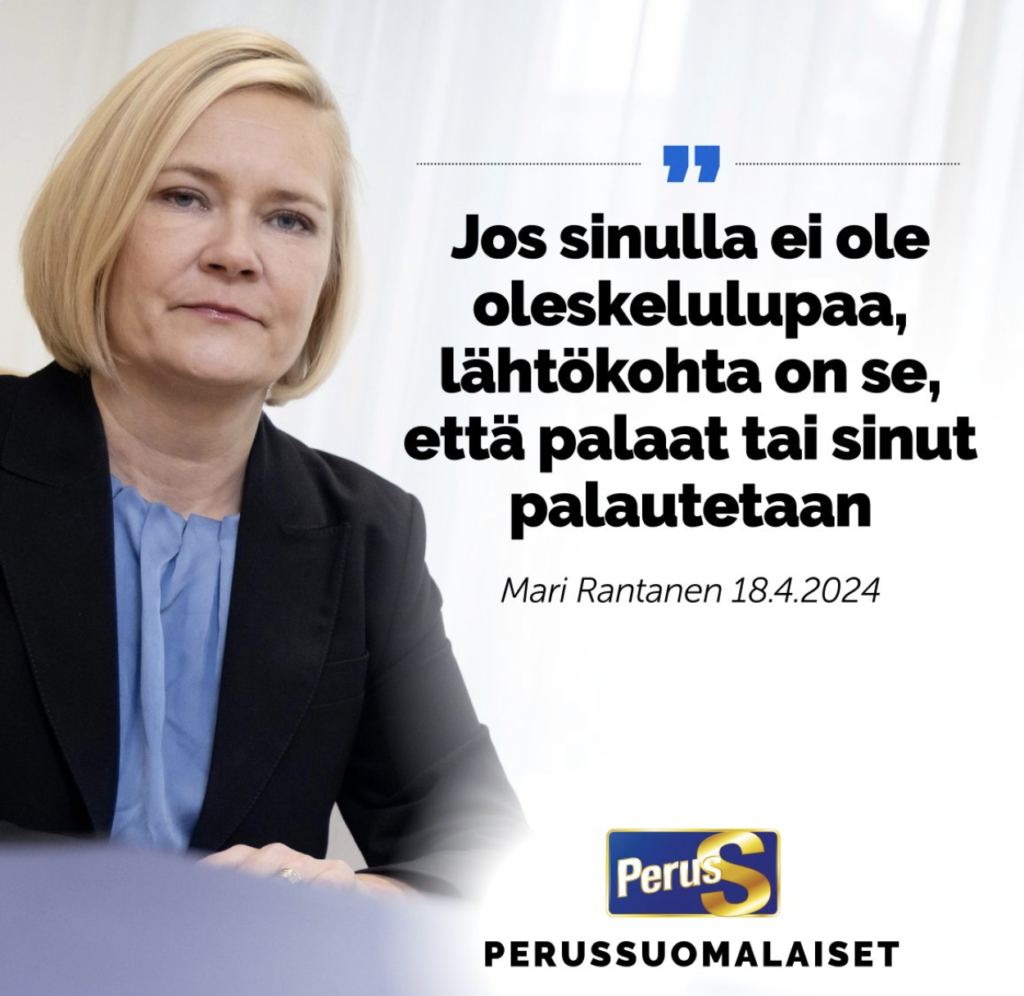
As Prime Minister Petteri Orpo’s Perussuomalaiset (PS)* Interior Minister Mari Rantanen aims to tighten naturalization laws, the impact of such changes will knock Finland negatively.
Rantanen said last year that not only will residence time rise from 5 to 8 years, but also a citizenship test will be given and a tougher language test.
Europe is lost. It believes that short-term solutions like fences will save it from itself.
While the government, especially the PS and the National Coalition Party (NCP) see migrants as a threat, the question we should ask is why stricter naturalization laws are needed and, importantly, what kind of a slippery slope is it.
While the government complains that not enough is being done to encourage integration, tighter naturalization laws will do just that, making pathways to integration more difficult by marginalizing migrants and exposing the hostile environment.
If you don’t have Finnish citizenship you cannot vote, especially against those who are excluding you from being an equal part of society.
Since the 2011 parliamentary election, when the Perussuomalaiset(PS)* won 39 seats from five in the previous election, the PS has consolidated its power – with the help of other mainstream parties like the National Coalition Party (NCP) – by spreading fear and lies about migrants.
Any sensible person understands that migration is a very powerful force that can offer a lot of benefits to the host country. In Finland, it has been the opposite: migration is not good unless you are a “super migrant.”
The Foreign Student started to write about Finland’s unfair immigration policy in 1981-82. Back then, some saw the ideal foreigner as the front cover of a soap commercial.
Wrote Migrant Tales in 2012: “These [xenophobic] politicians sound like they are reading to you the Sleeping Beauty fairy tale when Prince Charming wakes the beautiful princess with a kiss from her deep sleep. Anti-immigration politicians and parties don’t speak of Sleeping Beauty per se, but about super immigrants.”
It is incredible how much harm the PS has done to Finland by spreading fake news about migrants. Probably the most incredulous thing is how little has been written about the PS lie.
People had a saying in Argentina when de facto régimes called the shots by ousting democratically elected governments: No hay mal que dure cien años, the longest day must have its end. One matter that the new military rulers made you feel was weak and vulnerable.
The saying would apply well to National Coalition Party Prime Minister Petteri Orpo’s government and Perussuomalaiset* Interior Minister Mari Rantanen’s xenophobic policies. Even if Orpo and Rantanen and her ilk believe they are invisible, their stay in power will have an end.
Finland’s xenophobic policies and legalizing pushbacks are the trademarks of Prime Minister Petteri Orpo’s government. No matter how much the government attempts to sugarcoat its ant-migrant policies, the harder it will be to cover the stench.
Human rights ranked low in Finland during the Cold War (1944-1991). Perussuomalaiset (PS)* Interior Minister Mari Rantanen, a well-known xenophobe, is drafting legislation that would take Finlnad back to the Cold War, when Russians and other migrants were denied the right to asylum.
In criticizing government plans to pushback asylum seekers at the Finnish-Russian border, International law professor Martti Koskenniemi accused in January Prime Minister Pettri Orpo of excuses for breaching international agreements.
Interior Minister Mari Rantanen is the face of Finland’s anti-immigration policy and disdain for human rights.
Rantanen, whose past posts show her disdain for migrants, especially Muslims and people from other developed countries, is at it again – let’s shun human rights and not allow Muslims and other non-whites to enter Finland.
Adding salt to injury and showing how low Finland’political class has stooped, an opinion poll given to MPs revealed that the majority of lawmakers (Kokoomus and PS) were in favor of pushbacks. The Social Democrats said they were cautiously in favor [what does that mean] of such an illegal measure. The only parties that opposed pushbacks were the Greens and Left Alliance. The Christian Dermocrats and Swedish People’s Party did not respond to the poll.
The interesting question is not only what kinds of loopholes the government will find to breach international law and our constitution, but what next is in the pipeline to deny asylum seekers and migrants their rights.
If I were you, I’d be apprehensive about what this government has planned up its sinister sleeve.
Very rarely does the Finnish media approach a member of the Russian community to ask their views about news that impacts them. A good example is during the presidential debates when asked if the candidates would be ready to take away Finnish citizenship from Russians retroactively.
Katja Marova is a dual citizen of Russia and Finland who has lived in this country for fourteen years. Like some Russian speakers, she believes that some in her community saw the presidential election of Aleksander Stubb negatively.
Katja Marova, who lives in Lappeenranta, is worried about the civil rights of Russians.
Apart from Finnish and Swedish, the Russian-speaking community is the third biggest in Finland.
“The measure [to exclude Russians from getting Finnish citizenship] is clear discrimination and very concerning, coming from our president,” said Marova, a city of Lappeenranta deputy councilperson for the Left Alliance.
It is surprising that in the media there was no column or editorial written against taking away the right of dual citizenship from Russians. If Finland ever went through such a plan, it would be an eternal black spot in our history, a modern version of the Nuremberg Laws that excluded Jews from German society.
“Russians don’t only face the wrath of a despotic regime, but racism and hatred in Finland by politicians, the media, and society in general. We have a good government program,” says the government.
While parties like National Coalition Party (Kokoomus) and xenophobic Perussuomalaiset (PS)* try to score brownie points with their hateful messages, the closing of the border offers such parties an opportunity.
Maahan muuttaneiden nuorten jengiytymisessä näkyy usein heidän jatkuva oppijan roolinsa ja sopeutumisen haasteet uuteen ympäristöön.
Nuoret saattavat omaksua uudet normit ja käyttäytymismallit nopeammin kuin vanhemmat perheenjäsenet, mikä voi aiheuttaa väärinymmärryksiä ja sukupolvikuiluja. Samalla nuorten mahdollisuudet kotoutua nopeasti ja hyödyntää uusia tietojaan perheen sisällä voivat herättää epäluottamusta vanhemmissa, jotka pelkäävät lastensa joutuvan huonoille teille menettäessään perinteitä ja arvoja.
Murrosikä tuo mukanaan haasteita monille nuorille, myös maahanmuuttajille.
Viranomaisten ja muiden tukijoiden on tärkeää tarjota heille tarvittavia resursseja ja palveluita, jotta he voivat käsitellä murrosiän haasteita terveellisellä ja myönteisellä tavalla.
Heidän on saatava tukea ja ohjausta käsitellessään näitä haasteita, jotka voivat liittyä esimerkiksi identiteetin muodostumiseen, sosiaalisten suhteiden rakentamiseen ja kulttuuriseen sopeutumiseen.
Ylirajaiset asiat, kuten suvun velvoitteiden hoitaminen ja odotukset menestyksestä, vaikuttavat myös perheiden dynamiikkaan.
Monilta maahan muuttaneilta nuorelta odotetaan sekä taloudellista menestystä että huolenpitoa kaukaisemmista sukulaisista, mikä voi luoda paineita ja ristiriitoja perheen sisällä. Lisäksi koulumenestyksen taustalla vaikuttavat kotiolot ja ryhmäjännitteet, jotka voivat vaikeuttaa nuorten sopeutumista ja menestystä koulussa.
Nuorisotyön, koulun ja perheen yhteistyö on keskeistä oppimisvalmiuksien vahvistamiseksi ja sukupolvien välisen ymmärryksen edistämiseksi.
Viranomaisten rooli on keskeinen maahan muuttaneiden nuorten ja heidän perheidensä tukemisessa ja kotoutumisessa. Syrjintä ja rasismi ovat esteitä maahanmuuttajien ja heidän perheidensä sopeutumiselle ja integroitumiselle yhteiskuntaan.
Kokonaisuudessaan viranomaisten rooli on luoda turvallinen ja tasa-arvoinen ympäristö maahan muuttaneille nuorille ja heidän perheilleen, jossa he voivat kotoutua ja saavuttaa parhaat mahdolliset edellytykset menestyä yhteiskunnassa.
Kulttuurisensitiivisyys viranomaisten toiminnassa voi auttaa paremmin ymmärtämään monikulttuurisia yhteisöjä ja niiden tarpeita. Tämä voi sisältää koulutusta kulttuurieroista ja -herkkyydestä sekä vuorovaikutusta eri kulttuureista tulevien nuorten kanssa.