Dr. Faith Mkwesha, who is the founder and executive director of Sahwira Africa International non-government organization, expressed shock when she first saw the Plan International maternity wear in a campaign using a 12-year-old Zambian girl called Fridah.
Sahwira Africa International has an African resource center that organizes cultural activities and consultancy on African culture and development issues.
Dr. Faith Mkwesha.
Dr. Mkwesha, an Åbo Akademi researcher, sees a lot of problems with the Plan International Finland’scampaign which used Finnish couture designed clothes by Paola Suhonen and photographed by photographer and journalist Meeri Koutaniemi.
Pictures of the 12-year-old pregnant Fridah. Source: Plan Finland.
“I was shocked when I saw the advert for the first time at a bus stop, but at closer inspection of the whole campaign and other things came to light,” she said. “For one, this campaign is by white people and how they perceive black girls and women. The pictures reinforce that black girl children, not teenagers, are sexually promiscuous and black men as pedophiles. It also encourages black phobia.”
While there are unwanted pregnancy cases among girls in all cultures, Dr. Mkwesha asks, “what would happen if a Finnish white European twelve-year-old pregnant girl would be pictured and portrayed in such a sexual manner?”
Migrant Tales insight: This story below, written by Hussain Kazemian, an Afghan living in Finland, was of a countryman called Sadr, 27, who spoke on condition of anonymity about his failed request for asylum in Finland. He got his first rejection from the Finnish Immigration Service (Migri) in spring 2016. Sadr appealed, but the administrative court overturned it winter 2017. He is now waiting for the supreme administrative court’s decision on his second appeal.
Sadr was one of the hundreds of thousand undocumented Afghan refugees in Iran 1 who also entered and sought refuge in Finland in 2015.
He had no idea how to carry a rifle, but after he was recruited and after some weeks of military training in Iran, he was prepared to fight as a soldier of the Iranian Shia militia on the front line in Syria. In the end, he had fears and escaped the war, but it was not possible for him to go back to Afghanistan because of the National Directorate of Security of Afghanistan (NDS), which detains anyone who took part in the conflict in Syria.
After living many years and working in different cities of Iran earning lower-than-normal wages, Sadr was detained many times and forced to be in deportation camps. Even if they sent him back to Afghanistan, he returned to Iran to work. He joined the Iranian Shia militia only to get a residence permit 2 in Iran.
“It was frustrating for me to do construction work and get paid lower wages than normal,” he said. “Sometimes the employer did not even pay me my wages because he knew I didn’t have the right to complain in that country since I was an undocumented Afghan refugee. Nevertheless, I decided to go to a registration office and have a look and ask questions about becoming a member of the Shia militia.”
Migrant Tales understand that Ibrahim, an Iraqi asylum seeker who is married to a Finnish woman and expecting their child in September, was summoned to appear at the Oulu police station Wednesday but did not appear because he fears being detained and deported to Iraq.*
We wrote on April 18: “Other legal matters concerning Ibrahim’s residence have fueled uncertainty for the family. One of these, are seven appeals to overturn Ibrahim’s deportation orders from Finland after being rejected twice for asylum by Migri.”
In that story, the wife said she feared that the police could apprehend her husband and deport him back to Iraq.
“We live on the fifth floor,” she said in April, “sometimes when I hear the elevator or people knocking at our door, I fear that it may be the police that has come to deport my husband. We thought it would be a good idea if Ibrahim would attend swimming classes with our newborn but we decided against it because of fears that the police may apprehend and deport him.”
* A source who is in touch with the Iraqi asylum seeker believed that his countryman was detained by the police and would be deported Wednesday. We now know, allegedly, that the asylum seeker was supposed to visit the police station in Oulu. He did not appear but has gone into hiding for fear that he will be deported.
Migrant Tales julkaisee kirje suomalaiselta naiselta, joka synyttää pian irakilaismiehen ja hänen toinen lapsi. Suomessa, Maahanmuuttovirasto (Migri) katsoo ettei lapsi tarvitse isänsä ja siksi hänet voi pakkopaualttaa.
Hyvä lukija,
Mieheni saapui Suomeen yli neljä vuotta sitten turvapaikanhakijana.
Pian hänen saapumisensa jälkeen tapasimme, tutustuimme ja rakastuimme. Yhdessä olemme olleet yli neljä vuotta ja puolet tästä ajasta asuneet yhdessä. Meillä on puolitoistavuotias yhteinen lapsi ja toinen lapsemme syntyy pian.
Suojelupoliisi on päättynyt ja arvioinut hakijan “vaaralliseksi valtion turvallisuudelle.” Millä perustella? Onko hän vaarantanut valtion turvallisuus kun on oleskelu Suomessa? Todistaako tämä, että kyseinen turvapaikanhakija on kenties poliittinen vanki Suomessa?
Vielä hetki sitten elimme täysin normaalia perhe-elämää, kunnes Migri [Maahanmuuttovirasto] päätti ettei poikamme ja syntyvä lapsemme tarvitse isäänsä elämäänsä. Ei vaikka isä on ollut poikamme elämässä koko tämän ajan syntymästä asti.
Äitinä mikään ei tunnu pahemmalta kuin se, kun poika etsii isäänsä meidän yhteisessä kodissa, aina oven käydessä poika huutaa isäänsä odottaen että isä kävelee huoneeseen sisään. Mikään ei tunnu pahemmalta, kuin se että joudun viimeisilläni raskaana ollessani viemään poikaamme tapaamaan isäänsä säilöönottokeskukseen, jossa meille annetaan muutama tunti yhdessä, pienessä huoneessa.
Tällä hetkellä emme tiedä mitä tulee tapahtumaan, mieheni on suljettuna säilöönottokeskukseen, emme tiedä saako isä todistaa lapsemme syntymää ja saako hän edes tavata syntyvän lapsemme.
Ask Finland’s Romany minority If you want to understand how the Finnish police service reinforces and defends white power and privilege. I did this recently, and the answers did not surprise me.
According to a member of the Roma community, the Finnish police play down discrimination, especially if it involves a member of that minority group.
“They simply don’t care to investigate cases of discrimination against the Roma because some of them are so racist,” the person said, agreeing that institutional racism in the Finnish police service is a problem.
One of the problems with discrimination cases, hate speech and hate crime is that due process is slow and ineffective.
It is not only the Roma but migrants and other visible minorities that have to deal with a police service that takes its time big time with discrimination and racism cases.
Certainly, the question we must ask is why.
The answer: Because that is the way things are meant to be.
White Finnish privilege #51
Do I trust the police service in handling discrimination and racism cases?
“In today’s Finland, it is nothing uncommon for the Finnish Immigration Service (Migri) to reject family reunification by a Finnish spouse because the child does not need a father.Doesn’t need a father? Migri should ask Argentina’s Mothers and Grandmothers of Plaza de Mayo if the father, mother, and grandparents are key to a child’s identity and well-being.”
During the dirty war (1976-83) in Argentina, when the state murdered an estimated 30,000 people, members of the armed forces adopted the children of those they apprehended, tortured and threw in unmarked graves. Even if the child was brought up by a person who directly or indirectly caused the death of his birth parent, the search for the child and grandchild continues to date.
A child will always look for his real parents. Growing up without a father or mother is unnatural and painful.
Unofficial translation of the rejection of an applicants family reunification request: “The applicant and family reunification sponsor started to live as a family during a period when there were uncertainties about the applicant’s residence permit in Finland. They must have understood that living as a family in Finland could not be a possibility.”
“The wellbeing of the applicant’s and family reunification sponsor’s unborn child does not require granting a residence permit to the applicant. The applicant has with his actions tried to bypass rules about entering [Finland]. The child can live in the future in Finland with the family reunification sponsor.”
“Soy Jorge Sampaoli, director técnico de la selección argentina. Si naciste entre los años 1975 y 1981 y pensás que podés ser hijo de desaparecido, acerate a las Abuelas de Plaza de Mayo. Yo te busco para que te encuentres.”
“I’m Jorge Sampaoli, the coach of the Argentinean national football team. If you were born between the years 1975 and 1981 and you think you may be the son of “disappeared” people, get in touch with the Grandmothers of Plaza de Mayo. I will seek you so you can find yourself.”
At Migrant Tales, we are hearing more and more stories about the suffering and plight of undocumented migrants and how greedy companies are taking advantage of asylum seekers. Some of these that we have heard are asylum seekers working full-time in black for 500 euros a month and a promise that they will get hired as staffers, which would help them to get a residence permit. Or what about working 12 hours for 50 hours a day but only declaring 30 hours to the tax authorities?
While it is questionable that such a person would ever get a residence permit because of the needs test, or that the job is first offered to an EU citizen, the inequalities and exploitation found today in the Finnish labor market is the doing of our politicians. They have created the bait and lure for such exploitation to take place.
In the political rhetoric and crusade to make Finland unattractive to future asylum seekers, politicians have lost total sight of how their policies have weakened the rights of all migrants and other vulnerable groups. Their message is clear: It is ok if you are exploited in Finland. We don’t care because we do not want you here in the first place.
Like in the UK, Finland is presently gripped by a hostile environment against migrants and minorities.
In the United Kingdom, Prime Minister Theresa May, when she served as home secretary (2010-2016), is credited for the government’s “hostile environment” policy towards undocumented migrants. Since you cannot keep hatred on a short leash and cause it to act selectively, that hostile environment has spread to the Windrush generation, the first wave of immigrants who arrived in the UK in the 1940s and 1950s from the West Indies.
Even if May is responsible for this hostile environment, it was all part of a broader scheme to take voters away from UKIP, which based its then rising popularity on attacking and stigmatizing migrants.
The political opportunism in the Tory party’s anti-immigration rhetoric already costs the UK dearly. They are not only in its anti-immigration soundbites but in the fact that they believed they could control such a social ill and keep it on a short leash.
Epic fail.
Elsewhere in Europe as in countries like Finland, there is a hostile environment against migrants.
The hostile environment in Finland is possible thanks to the Perussuomalaiset (PS)* and by other mainstream parties, like the Center Party, National Coalition Party, Social Democratic Party, which give the same message but in a different langauge.
Amnesty International’s Annual Report 2016/17 highlights below some of the factors that created a hostile environment in Finland.
Me teemme Suomessa yhä edelleen tiliä siitä, mitä meillä tapahtui niinä vuosina, kun natsit tekivät hirmutöitään etelämpänä Euroopassa. Aiemmin muistelimme, vähän huojentuneinakin, että oliko niitä nyt viisi niitä juutalaisia, jotka lähetimme Saksaan tapettaviksi, nyt Wikipedia kertoo, että pakkopalautimme kymmenen juutalaista pakolaista ja joitakin kymmeniä juutalaisia sotavankeja – ja syyksi mainitaan Saksan painostus.
Tuolloinkin homma olisi ilmeisesti hoideltu kaikessa hiljaisuudessa, elleivät aktiiviset kansalaiset olisi nostaneet meteliä ja saaneet omantunnon omaavia poliitikkoja mukaansa.
Sisäministeriö selitteli tuolloin, kuten tänäänkin, että luovutuksissa oli kysymys ”tavallisesta poliisiasiasta ja vain turvapaikkaoikeutensa menettäneiden epäsuotavien ja rikollisten ainesten poistamisesta maasta”.
Nyt, kun tilanne jälleen on se, että ihmiset joutuvat pakenemaan hirmuhallintoa tai täysin kestämätöntä tilannetta sotaa käyvien ryhmittymien keskellä, omatunto tuntuu painavan lähinnä opposition edustajia. Tällä kertaa vainoa pakoon ovat lähteneet muut kuin eurooppalaiset. Siis barbaaritko? Ovatko yhtä kaameita, kuin juutalaiset olivat saksalaisten mielestä? Pakolaisten kohtalo ei tunnu juuri liikuttavan suomalaista vallanpitäjää, eikä monia kansalaisiakaan, ja aivan kuten toisen maailmansodan aikaisessa Suomessa, myös nyt entiset ja uudet sisäministerit ovat ryhtyneet reippaasti toimiin mahdollisimman monen pakolaisen karkottamiseksi ja närkästyvät kovin, jos heidän toimialaansa yritetään puuttua.
Aika hätkähdyttävää on se, että mediassakin on samat jakolinjat kuin 40-luvulla. Wikipedia kertoo, että sensuurista huolimatta sanomalehdet käsittelivät juutalaisten kohtelua. Helsingin Sanomat ja Suomen Sosialidemokraatti tuomitsivat luovutuksen voimakkaasti, mutta Uusi Suomi vähätteli sitä.
Pitemmän ajan ihmisoikeustaistelijana on ehkä parhaiten ansioitunut Suomen Kuvalehti, joka ei kuitenkaan ole päivittäinen uutislehti. Mutta niin nyt kuin silloinkin, Uusi Suomi lähinnä edistää rasistien työtä nostamalla keskustelupalstallaan heidän kirjoituksiaan toimituksellisesti esiin ja sallimalla rasistikansanedustajilta ja heidän avustajiltaan lähes millaista tekstiä hyvänsä. Sensuuri tullee tänä päivänä rahoittajien taholta, media kirjoittaa siihen sävyyn, kuin omistajat ja viiteryhmät vaativat.
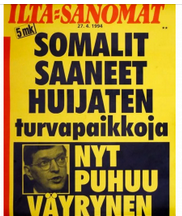
Olen usein keskustellut ulkomaalaisten kohtelusta Suomessa Migrant Talesin päätoimittajan, Enrique Tessierin, kanssa. Hän on elänyt maassa niin kauan, että on nähnyt rasismin kehityksen eristyksissä eläneen kansan ihmispelosta tämän päivän rasismivyörytykseen. Hän on myös ottanut talteen iltapäivälehtien otsikoita 1990-luvulta – ja kirjoittanut mielenkiintoisen artikkelin rasistisista asenteista 60- ja 40-luvun mediassa.
Ilta-Sanomat 7.8.1996
Meillä väitetään, ettei media olisi rasismin myötäilijä tai nostattaja, mutta selväähän on kaikille uutisointia seuranneille, että tummaihoiset ulkomaalaiset ja etenkin turvapaikanhakijat on mediassakin alusta alkaen nähty Suomelle haitallisena ja petollisena massana – tai ainakin media on hyödyntänyt kasvattamattoman kansanosan pelkoja ja vihantunteita otsikoinnillaan jo silloin, kun maailmankuvaa ei vielä muodostettu Internetin rasistipalstoilla. Aivan samaan tyyliin, kuin irakilaisista on nyt julkaistu skandaaliotsikoita, julkaisivat lehdet niitä ensimmäisistä maahan saapuneista somalipakolaisista. Vihankylvö onnistui mainiosti, niin kuin se tuppaa tekemään, ja poliitikoista katalimmat jatkavat pahan viljelyä – median avustuksella.
Milloin teemme näistä ajoista tiliä? Kuinka suureksi syyllisyyden taakan annetaan kasvaa?
Instead of making Iraqi Muslims feel at home in Finland, the government of Prime Minister Juha Sipilä is doing everything possible – in the Timo Soini and Jussi Halla-aho spirit – to make their lives miserable. Sipilä and his government are the enthusiastic planters of the seeds of discrimination and inequality of Finland’s Muslim and visible migrant community.
Spilä’s government would care less for human rights and the suffering of others. He would rather heed to far-right anti-immigrant advice than defend values like human rights.
I wonder what the prime minister and his ministers would say if they were treated in the same way as they treat asylum seekers in Finland?
Below, is a letter from an Iraqi asylum seeker called Mohammed.*
He has been held at the Metsälä immigration removal center since March 22. Like many, he is facing deportation after getting three rejections for asylum.
“I was so happy when I left my country [in September 2015],” he said on the phone, adding that he now faces deportation. “There is nothing I can do now.”
Mohammed writes:
“I used to live with my family in Ramadi until ISIS occupied it. We then moved to Baghdad. My father was a police officer. In Baghdad, I founded a civil NGO to help poor people and refugees until I was threatened. My parents asked me to leave the country and go to Turkey. From there I took a boat to Europe. Forty-eight persons on that boat drowned. I continued from Greece to Serbia, Hungary, Austria, Germany, Denmark, Sweden till Finland. I applied for asylum, but my plea was rejected. I moved to Helsinki and worked as a baker at an Iraqi restaurant that took advantage of me because I needed work. I worked long hours and was paid little money. After two years and seven months, after my third negative [for asylum], I was arrested and placed in this immigration removal center. I am now here together with thieves, smugglers and drug dealers.”
*The name was changed to protect his identity because he is an asylum seeker.