Migrant tales
Menu
  • #MakeRacismHistory “In Your Eyes”
  • About Migrant Tales
  • It’s all about Human Rights
  • Literary
  • Migrant Tales Media Monitoring
  • NoHateFinland.org
  • Tales from Europe
Menu

Category: All categories

OECD: Progress is being made to integrate immigrants in the EU but more work needs to be done

Posted on December 15, 2012 by Migrant Tales

While OECD countries have made  progress over the last decade in helping immigrants to adapt to their new home countries, there’s still much room for improvement most notably in helping children to excel at school and employ more immigrant women, according to an OECD report. 

The proportion of  highly educated immigrants in Finland had plummeted during the last decade by about 10%.  The fall is far greater than in other Nordic countries.

One explanation for the large drop is that in 2000 the proportion of refugees was higher than immigrants in Finland, Ministry of Employment and the Economy Kristina Stenman was quoted as saying on Uusi Suomi.

In 2000, Finland’s foreign population totaled 91,074 (1.8% of the total population) compared with 183,133 (3.4%) in 2011-12, according to the Population Register Center.

Kuva 99

The OECD report highlights the importance of immigrant children starting school early in their new homeland. Governments need to encourage immigrants who plan to settle to bring their families early.

Considering that Finland and some European countries have tightened family reunification rules, it’s clear that the integration of some children is being compromised

“Many offspring of immigrants find themselves marginalized in the labour market and are overrepresented among those not in education, employment or training [the so-called NEET group], particularly in Spain, Belgium, Austria and France,” the report states.

Countries hard hit by the global economic crisis have seen job rates fall among immigrants.  In the United States from 70% to 67% and in Spain from 62% to 57%.


Turun Sanomat: Is dual citizenship a threat to Finland?

Posted on November 29, 2012 by Migrant Tales

An article on Turun Sanomat quotes Turku School of Economics professor, Kari Liuhto, stating that dual citizenship rights in Finland were a mistake in light of the recent child custody row that erupted in October between Finland and Russia.

Liuhto believes that dual citizenship rights granted in 1999 in this country give Russia the opportunity to increase its influence in our national affairs.

Finland has about 60,000 people with dual citizenship, according to Turun Sanomat.

Is dual citizenship such a big of a threat to Finland as Liuhto claims?

While we can discuss the pros and cons of dual and multiple citizenship, those who see it as a bad thing are usually driven by nationalism, suspicion and loyalty issues.

Some countries permit dual or multiple citizenship while others, like India and China, do not.

The United States, which allows dual citizenship, keeps their citizens on a short leash through the Internal Revenue System (IRS). If you are a U.S. citizen and live abroad and have dual citizenship, you are obliged to file your annual tax statement to the IRS.

It is doubtful that tightening dual citizenship laws will change matters never mind calm Liuhto’s fear of Russia’s influence in Finland. That’s more of an in-between-your-ears issue. But the more nationalism and fear we spread, the greater will be our fear of the outside world and its citizens.

Liuto’s concern is only the tip of an iceberg of a far greater threat facing Finland and Europe these days: nationalism and intolerance.

Apart from draft laws to ban male circumcision and to make it easier to deport foreign convicts from Finland, parties like the Perussuomalaiset (PS) would certainly like to spike dual citizenship rights. You don’t have to be a rocket scientist to grasp this.

 This video clip of a draft law spearheaded by PS MP Jussi Halla-aho shows the crackpot stuff these types of politicians say and do to gain attention, listeners and votes.

Finland used to have very strict citizenship laws in the 1919 Constitution. Only the children of male Finnish citizens were given citizenship automatically. If you were a citizen of another country, you lost your Finnish citizenship.

The children of female Finnish citizens were granted full citizenship rights in 1984.


Two-way integration still has a long way to go in Finland

Posted on November 22, 2012 by Migrant Tales

What is the aim of Finland’s new integration law, which came into force in September 2011? While the law talks about two-way integration, what does it mean and how is it promoted? 

  Finland’s integration program is like an old abandoned Cadillac. It awakens our optimism but discourages us from acting because it is too costly to restore.

The fact that some politicians in Finland still speak of maassa maan tavala, or ”live in the country as they live, or leave,” reveals that there is still hostility against two-way integration.

Irrespective of the arguments, the key question we should ask is what are these country’s new inhabitants adapting to? Are they encouraged to throw away their cultures and learn how to live in a white Finns’ world? Or is the aim the creation of a healthy bicultural or multicultural identity and society?

There’s been a lot of debate in Finland about the “threat” of so-called ethnic “ghettos” in places like Helsinki and Turku’s Varisuo. Certainly matters like crime and unemployment are social issues that must be addressed by society in any neighborhood.

Why do some consider it a bad matter if ethnic groups and immigrants are concentrated in a neighborhood?

When Finns emigrated to different parts of the world like the Americas and Sweden, the aim was to be where other Finns lived. In my research of the Finns of Argentina, Colonia Finlandesa was a colony where up to the 1930s Finnish was spoken more than Spanish.

The promotion of assimilation as opposed to integration has given birth to a new underclass of second-generation Finns with immigrant backgrounds. Some live in a permanent gray zone where they not only experience animosity from the host culture but from their parents’ culture as well. Who is promoting their acceptance and bolstering their self-esteem?

Another distressing trend was a survey published in early 2011 in Opettaja magazine that reveals 41% of teachers polled would like to place limits on how many children with immigrant backgrounds can attend class.

Opposition to ethnically concentrated neighborhoods and schools reveals in my opinion support for assimilation and opposition to two-way integration.

A question: How are immigrants, never mind their children and grandchildren, ever going to create a sense of cultural pride, identity and self-esteem if the expectation is integration but the reality is assimilation?

I personally want to see a Finland that is culturally diverse where we can embrace and reap synergies from our diverseness.

The 10,000-strong Roma minority that has lived in Finland for 500 years is a good example and a warning of what happens to a group if they don’t assimilate.  The Roma have paid a very high price for not assimilating into white Finnish society through social exclusion and racism.

A Roma elder expressed to me the issue in the following terms: “Even if we have been discriminated against in Finland, we still hold our culture. Nobody can destroy that.”


PS’ Halla-aho eyes party leadership

Posted on November 10, 2012 by Migrant Tales

Perussuomalaiset (PS) party far-right anti-immigration wing leader, MP Jussi Halla-aho, confirmed that he’s not ruling out vying for chairman of the radical populist party, according to MTV3, citing the Subin Enbuske & Linnanahde Crew TV show. 

”I’m in parliament and city council because enough people want me in these places,” he said, ”if they want me in some other place, I could even consider such a request.”

Apart from their racism and far-right ideology, politicians like Halla-aho are chronic narcissists, who score brownie points with voters by bashing weaker and more vulnerable groups in society.

The aim of these politicians is simple: do everything possible to hinder integration, acceptance and make life as difficult as possible for Finland’s newcomers and visible immigrants.

PS chairman Timo Soini has been a key factor in bringing such politicians to roost in Finland. He has given them a political voice through his party.

I pointed out in a recent blog entry that if I had the opportunity to draw a cartoon about Soini’s relationship with these far-right politicians, the setting would be a concentration camp in World War 2 with some infamous commandants like Rudolf Hoess and Franz Ziereis, hiding behind the PS leader.

Soini would state with a poker face: “Anti-Semitism isn’t an issue in our party.”

Paavo Lipponen does not see far right threatening Finland

Posted on November 8, 2012 by Migrant Tales

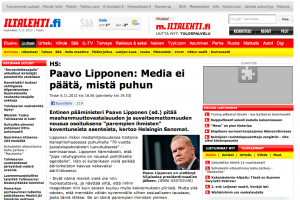
There are few politicians in Finland who speak out against the far-right threat in Finland. One of these is former Social Democrat Prime Minister Paavo Lipponen, who expressed concern about the issue in a seminar in Helsinki on deportation of Jews to Germany in World War 2, reports Iltalehti. 

Lipponen expressed surprise that some parties use “racial hygiene” as part of their political agenda. The concept was exploited by Nazi Germany from 1933 and led to the mass murder of millions of Europeans, especially Jews.

Lipponen does not, however, consider the far right to be a threat to Finland.

While Lipponen may state that far-right ideology isn’t a big threat to Finland, some would disagree. Determining what is a threat to our society depends a lot on your perspective. If you are middle class, white and employed, the far-right wing of a party like the Perussuomalaiset (PS) isn’t a threat.

If, however, you ask certain immigrant groups and visible minorities, the answer may be much different.

Here’s a Suomen Sisu t-shirt that shows the group’s hostility towards cultural diversity.

Lipponen used Saul Schubak, the vice chairman of the National Coalition Party’s youth wing, as an example of how public opinion has hardened in Finland. Schubak wrote on Facebook that “inferior people” should not get child allowance.

The PS is the party in parliament with the biggest number of anti-immigration fanatics, who base their views on racial hygiene, eugenics and cultural myths like ethnic superiority.

If Migrant Tales had the opportunity to draw a cartoon about PS chairman Timo Soini’s relationship with these far-right politicians, the setting would be a concentration camp in World War 2 with some infamous commandants like Rudolf Hoess and Franz Ziereis, hiding behind Soini.

Soini would state with a poker face: “Anti-Semitism isn’t an issue in our party.”

CHEATS!

Posted on October 26, 2012 by JusticeDemon

PS candidate seeks to buy votes in local elections.

The Board of Elections for the Tampere Region has reported a campaign advertisement to the local police for investigation on suspicion of electoral bribery.

The advertisement was placed in the local newspaper Nokian Uutiset on behalf of Rauno Hautamäki, a candidate for the anti-immigrant Perussuomalaiset party.

It promises that voters who take mobile phone pictures of their completed ballot papers and forward them as MMS messages to the number provided will be entered in a prize draw if the ballot bears the candidate’s number.

Voters receive their ballot papers on entering the polling station, where they complete them and drop them into the ballot box in person. This means that the requested photograph can only be taken in the polling station at the time of voting.

Electoral bribery is a criminal offence under section 2 of chapter 14 of the Finnish Penal Code.

Joseph: What being Finnish means to me (Part II)

Posted on October 24, 2012 by Migrant Tales

This is part II of Joseph’s blog entry, What being Finnish means to me.  Click here to see part I.

By Joseph*

…Later on I discovered rap music to deal with my feelings. There were just so many things wrong in this society that I saw all the Somalis and other foreigners not integrating well enough into Finnish society. They grew up in gangs and were rebelling against a society that had excluded them socially with racism and prejudice.

Something I connected with these people. Maybe it was because of the loneliness or simply due to the feeling of being an outsider that brought us together.

I started hanging around with Somalis at the age of fifteen and I was the only so-called ”white boy” of the group.  Even so, we did all kinds of crazy stuff young adolescents usually do. We connected despite the fact that we came from different cultural backgrounds. We were like brothers growing up in a hostile world.

My friendship with this group resulted in trouble and social workers wanted to take me away from my mom. My mother sent me to live with my dad in the United States,  where I ended up in a boarding school. I got bullied a lot at the new school and was called a Russian because I spoke English with a foreign accent.

Calling me a Russian and being a Finn was as bad as calling a woman a whore. Being a citizen of two nations and being rejected by both is very painful. Racism is a sickness that reveals a person’s fear about something he cannot understand or deal with.

When I came back to Finland and spoke English with an American accent, people no longer recognized me as a Finns. They constantly shouted at me and told me to go back to where I came from. Some even called me a Russian or Arab. In my opinion, the identity we carry is a personal matter that nobody else can place on you.

I get very angry and bitter at my Finnish side when I remember what happened to me as a child and young man. I once even wanted to erase my roots and renounce my Finnish citizenship and move to faraway country.

Despite these initial setbacks, I calmly accept that I am a Finn who is a citizen of this country and who can speak Finnish fluently.  I love my Finnish roots and find inner peace in them when I walk in the woods, whether I am  in Helsinki or sit by a lake enjoying a sauna. I can never forget going fishing at our cottage with my grandpa and all the good times I spent in Finland. I have learned a lot of wisdom from my grandma and grandpa.

What does being a Finn mean to me? It means that even though Finnish people suffered a lot in the past, they managed to learn from their mistakes, pull through, create a vibrant economy, well-functioning social-welfare state and great educational system that is an example for many countries.

I have to forgive those people who mistreated and bullied me in the past because I wasn’t a so-called typical Finn. I understand that not all Finnish people are like them. I can therefore say honestly that some Finnish people who I have met are one of the best people I have ever known. They are so honest, humble and sincere that it is difficult to find people like them elsewhere.

I sometimes fall in tears when I think about what Finland has done for my family.

When I travel abroad, I tell people proudly that Finland is the only country in the world that paid back their debt to the United States. I can never hate the country where my mom and grandparents were born and, importantly, gave us an opportunity to start life anew.

Long live the Finnish Sisu! Be proud of your home country and roots!

* Joseph spoke on condition of anonymity. 

Parliament debates practicalities of expulsion from Finland

Posted on October 21, 2012 by JusticeDemon

Following a much-publicised nightclub shooting incident in downtown Helsinki about three weeks ago, the Finnish Parliament informally debated the problems of deportation on 11 October. Further views surfaced in the Finnish media on Sunday evening concerning how expulsion can be enforced in practice.

The debate has focused on the problem that arises when no country is willing to admit a deportee. The principal suspect in the nightclub shooting is a 38 year-old habitual violent offender with Vietnamese citizenship who has lived in Finland since childhood. Although an attempt was made to deport this person to Vietnam about three years ago, the Vietnamese government has refused to issue a passport to the deportee, whom it now considers to be a foreigner by reason of prolonged estrangement.

Similar cases have arisen in the past with candidate deportees of Iraqi and Somali origin, and also – tellingly – with members of the Russian-speaking community in Estonia.

One remark from veteran National Coalition Party MP Ben Zyskowicz was obviously playing to an ill-informed public gallery (aka folk who cheer when someone shouts more goodies, less baddies, and plenty of platitudes for all!!!) when he suggested in all seriousness that this kind of international impasse could be resolved simply by finding one or two sturdy policemen to escort deportees to their destination. It seems that even a trained lawyer with long experience in international relations and legislative reform sometimes cannot resist the temptation to offer cheap soundbites in the run-up to elections.

Zyskowicz obviously should have known better. His suggestion is typical of commentators with no appreciation of the issues at stake in cases where a State respectfully declines to admit an individual with whom it has no substantial ties. In any case the MP was brought back down to earth with a bump by long-serving police superintendent Veijo Rissanen, whom YLE News described as really not knowing whether to laugh or cry at such moaning from a parliamentarian:

We made it to the Vietnamese border in one case, but wound up bringing the deportee back with us on the return flight.

The concrete practice of expulsion must always include respect for the immigration formalities of the destination country. Servants of a foreign power (sturdy policemen or otherwise) who arrived in Finland to deliver an undocumented person with no advance clearance would be risking a jail sentence of two years for infringing section 8 of chapter 17 of the Finnish Penal Code.

It is important to recognise that reluctant receiving States are not necessarily behaving unreasonably. A State may be unwilling to admit socially maladjusted individuals with no material ties to the country in question, merely because of an assumed administrative status that is no longer meaningful. It is by no means clear why Russia, for example, should admit an Estonian-born Russian-speaking individual who arrived in Finland as a child accompanying parents admitted to Finland under the Ingrian resettlement programme in the early 1990s. Such a person is very much the product (and victim) of naturalisation and minority policy in Estonia and Finland, and it is hardly the fault of Russia when the outcome is a maladjusted adult.

This is obviously an extreme (though real) example, but estrangement is the commonest justification given by governments that refuse to issue travel documents or recognise any duty to admit deportees.

In the parliamentary debate Zyskowicz explicitly linked the issue of deportee acceptance to international development aid, suggesting that aid could serve as a means of coercing foreign governments into accepting deportees. Perhaps I have a perverse turn of mind, but I immediately thought of toxic waste reprocessing scandals at this point. The only difference is that instead of industrial waste, governments will be bargaining over financial incentives to accept human beings who have been effectively classified as social waste to be taken away and buried somewhere out of sight and out of mind.

A response to the Finnish Medical Association’s opposition to circumcision

Posted on October 16, 2012 by Mark

Having read the Finnish Medical Association’s working group report on circumcision and its subsequent opposition on the grounds of ‘medical ethics’, I wish to present a critical view of their position, and hopefully to broaden this debate a little more. Their statement can be found here.

I will group my main criticisms under five separate points.

1) Their objection is based they say on ‘medical ethics’ alone. In other words, the broader ethics of ‘religious freedom’ carries little weight in their deliberations. Indeed, they specifically cite the WWII Nuremberg trials and the subsequent World Medical Association’s right to follow medical ethics at all times even when in conflict with local laws and customs, which was an attempt to avoid medicine ever again being used to experiment unethically on humans, as was done by the Nazis.

By medical ethics, they mean to consider the issue entirely from a strict appraisal of any potential risks to the child and any well proven health benefits. As the evidence on health benefits is not conclusive, they cannot be taken into the ethical considerations, while the risks will include also those risks were the practice to be done in a backstreet barber’s shop with a filthy shaving blade.

I think Lääkäriliitto have made an unusually narrow interpretation of medical ethics and indeed of ‘health’. Health should and normally does include mental health, though this aspect is only considered by them from the point of view of the potential negative experiences (ill-health) of living with male circumcision and not from any positive social aspects such as identity and familial affirmation. While they are right to be concerned with negative effects, they must on the same grounds (mental health) give due consideration to those who consider it essential to their identity.

It’s worth pointing out that medical ethics in the general sense seeks to establish whether there is sufficient justification for a procedure or experiment involving humans, but they are not always justified on the basis of ‘additional’ health benefits alone. Social and economic aspects are quite normally part of the deliberations of ethics committees. A new drug that replaces an existing drug may bring no greater expected health benefit, but is either a cheaper drug (or often more expensive) or has a different mode of action. Likewise, an ethics committee may give consent for a clinical trial in order to establish ‘no significant risk’, while itself being a risky endeavor for the participants. It is clearly misleading to give the impression that medical ethics starts from a position that ‘no health benefit’ requires there to be ‘no risk’ for a procedure to be sufficiently justifiable, at least in principle. Let’s at least make that point clear.

2) although they claim to approach the matter purely from the point of view of medical ethics, they do seek support from the Finnish constitution and various other international rights frameworks. They therefore interpret the right to ‘integrity’ to mean physical integrity in a very strict sense, and interpret circumcision to be a violation of that integrity.

However, I would say that it is stretching the concept of ‘integrity’ to suggest a smaller foreskin constitutes a breaking of the fundamental integrity of the human form. At the very least, we would say that the issue of ‘integrity’ here is open to debate. It surely lies in the grey semantic area that comes with a word like ‘integrity’. For me, removing a leg, maybe, or an eye, or a clitoris would compromise integrity.

That it is a permanent alteration of the body is clear, but as the length of foreskin is subject to natural variation, from very little to very excessive, I would say that it is in medical terms a cosmetic alteration and therefore not a gross violation of the basic integrity of the body. Indeed, doctors have no instrinsic objection to doing cosmetic surgery on aesthetic grounds alone, although the issue of consent remains. The issue of ‘integrity’ is perhaps less significant than it’s made to sound, though.

If however we take their strict definition of integrity to its logical conclusion we would reveal serious inconsistencies with current practice. In many ‘cosmetic’ surgeries, carried out legally on children by health professionals, healthy flesh or body tissue is likewise removed, in procedures such as octoplasty (ear pinning), which involves general anaesthetic, orthognathic surgery (removal of health jaw bone), adenoidectomy (involving full anaesthesia) with all the attending risks. Even giving a blood sample can, using the same strict criteria, be considered to be a similar unjustifiable risk in some instances, if the worst case scenarios are brought into play and any uncertain health benefits are ignored.

Most significantly though, under this criteria, abortion would be condemned as unethical.

In abortion for social reasons (approximately 9000 a year in Finland, 90% of all abortions), perfectly healthy tissue is removed from the woman without the ‘consent’ of the fetus at the sole request of the parent.

If the lääkärilitto wish to go down this road in their strict interpretation of medical ethics, then it should surely come out in opposition to abortion? Indeed, the ethical implications are far more serious, in that an embryonic life is ended in the procedure.

The Finnish Medical Association’s stance on abortion is far more lenient (or should we say more cognizant of the social aspects).

The physician respects all forms of life. Different societies have in laws or otherwise defined at which stage the life of an embryo or foetus is protected like the life of a new-born baby. From the medical point of view this stage is at latest reached when the foetus could continue life outside the mothers womb.

This wording leaves the door open for abortion, although many pro-life campaigners cite the Finnish position as being fundamentally pro-life. But specifically, the Association does not call on doctors to not perform abortions, and neither do they tackle the issue of abortion as being the removal of healthy tissue at the request of the parent and without consent to the living embryo thus affected.

So, given the much more grave implications with abortion, why does the Association decide on balance to come out against circumcision in such strong terms while leaving a large degree of margin in dealing with abortion? Institutional racism? God forbid!

This glaring inconsistency in its position might well come back to haunt the Lääkäriliitto.

3) part of the objection is that medical procedures should not be part of religious ceremonies. That argument in itself is circular, as it automatically precludes circumcision regardless of any other considerations.

4) they are concerned that allowing the practice to be done under a medical jurisdiction implies the doctor has called for the procedure and the parents are merely consenting, and also, importantly, that the costs (and insurance I imagine) of the procedure are therefore borne by the health care system. Clearly this is not so much a question of ethics but of economics.

5) They suggest religious communities be persuaded to abandon the practice, but that in the meantime, a compromise may be to postpone the procedure until the boy is able to give consent. A difficulty with this though is that the older the boy, the more expensive the procedure and also the more necessary it will be for the procedure to be done within a health setting. Likewise, clearly compared to infants, young boys are much more likely to find the procedure distressing, both through anticipation and possible discomfort. Likewise, the psychological impact could be far greater if carried out under social pressure when the boy is in the 6-10 age range.

I do think that one argument that lääkäriliitto bring up has some merit to it. They call for further study into the social effects, particular negative, for men who have undergone the procedure. I think that if there is a debate to be had, and if religious communities were to develop some flexibility over this practice, then it will perhaps find its social justifications through the testimonies of the men affected by it. It is interesting that lääkäriliitto point out that by allowing the practice to be performed within medical settings will likely lead to further entrenchment of the practice. Indeed this is the case with secular circumcision in the US.

What also needs to be considered within the ethical debate, in addition to any strict or loose interpretation of medical ethics (and I don’t blame doctors for erring on the side of strictness, especially in this day and age of medical costs and medical insurance) is a fuller debate about the ethics of religious freedom, as and of itself in today’s society. Doctors, as justifiably respected ‘experts’, should not however by viewed as having a complete picture of the ethics involved. As JD rightly points out, a doctor seeks to diminish risks to health, while much of society seeks to experience risk for entertainment value alone. Issues of identity should not always be considered to be subsumed to medical ethics. It’s not about closing our ears to what doctors have to say, but rather, opening our ears to what the people affected by any such proposed change also have to say. At some point we have to balance the right of one portion of society to tell another portion of society how they should act.

What I absolutely object to in this debate is that it’s often championed by political activists on the Far Right who also happen to have, as if by accident, an anti-Muslim, and historically, an anti-Semitic agenda, both of which groups would most obviously be affected by any change in policy. An accident? Yeah, right….

We have to be extremely skeptical towards such manipulations of this debate. Indeed, if these parties or individuals are going to be consistent, then I suppose they will also oppose abortion on the same grounds. Let them come out and say exactly that in black and white, if it’s merely a matter of being consistent in our medical ethics and not part of their broader anti-multicultural agenda.

Note: this is reproduced in large part from a comment to an earlier post on this topic. Apologies if you have read both expecting a lot of new material. Likewise, if any parts of my portrayal of the Medical Association’s stance appear incorrect, I would appreciate being corrected.

Finland’s present demographic challenges are a threat to its prosperity

Posted on October 13, 2012 by Migrant Tales

Finland will see dramatic changes to its population age structure in the next four decades, when the number of over-64-year-olds will soar by 941,000 to 1.639 million people, according to MTV3, citing Statistics Finland. Likewise, our labor force will shrink by an estimated 600,000 people in about 25 years. 

It is surprising, if not worrying, that the majority of politicians, never mind political parties, don’t consider Finland’s demographic woes a serious enough problem to address today. Few if any speak openly about attracting skilled immigrants to the country as one of many measures to slow the worrying trend.

In many respects, these politicians are hostages of their own complacency and shortsightedness. It’s very difficult to speak out in favor of immigration and cultural diversity when such politicians have been silent or made in the past slipshot comments on the issue.

But why would any sensible immigrant want to move to a country that doesn’t appear interested in them? Moreover, what’s so attractive about a country where it takes a long time to learn the language, has high taxes, long-and-cold winters and does everything possible to remind you that you are an immigrant?

Didn’t 19.1% of the Finns vote last year for the Perussuomalaiset (PS), an anti-EU, anti-immigration and especially anti-Islam party?

Pekka Myskylä of Statistics Finland, however, believes that our foreign population will account for 16% of the total population by 2057.

In a blog entry published in December 2009, Migrant Tales wrote that the number of pensioners will rise from the present 17% (905,000 persons who are older than 65 years) to 27% by 2040 and 29% (1.79 million) by 2060, according to Statistics Finland, Better medicare will fuel this trend, with persons over 85 years rising from 2% (108,000) to 7% (463,000).

What Finland doesn’t need today is a party like the PS that fuels xenophobia and instills fear in the hearts and minds of Finns on issues like immigration.


  • Previous
  • 1
  • …
  • 28
  • 29
  • 30
  • 31
  • 32
  • 33
  • 34
  • …
  • 119
  • Next
Read more about documentary film
Read more

Recent Posts

  • Finland’s tabloids Iltalehti and Ilta-Sanomat are the pits
  • Riikka Purra’s Dr Jekyll and Mr Hyde mask
  • Double standards
  • Perussuomalaiset: Uusi logo, sama vanha juttu
  • Taco Trump

Recent Comments

  1. Absolutely Socking: Racist Finnish Facebook group against human rights gets flooded with socks on Musta Barbaari’s mother and sister charged by the police in “ethnic profiling” case
  2. Ilkka Nuotio on Pekka Myrskylä: “Tilastot kertovat toista kuin poliittinen keskustelu”
  3. Genrih Soinkara on The war in Ukraine and the Russian-Finnish border crisis are showing Finland’s ugly side
  4. Ahti Tolvanen on Comment by Ahti Tolvanen on the Helsinki +50 conference
  5. Angel Barrientos on Angel Barrientos is one of the kind beacons of Finland’s Chilean community

Archives

  • June 2026
  • May 2026
  • April 2026
  • March 2026
  • February 2026
  • January 2026
  • December 2025
  • November 2025
  • October 2025
  • September 2025
  • August 2025
  • July 2025
  • June 2025
  • May 2025
  • April 2025
  • March 2025
  • February 2025
  • January 2025
  • December 2024
  • November 2024
  • October 2024
  • September 2024
  • August 2024
  • July 2024
  • June 2024
  • May 2024
  • April 2024
  • March 2024
  • February 2024
  • January 2024
  • December 2023
  • November 2023
  • October 2023
  • September 2023
  • August 2023
  • July 2023
  • June 2023
  • May 2023
  • April 2023
  • March 2023
  • February 2023
  • January 2023
  • December 2022
  • November 2022
  • October 2022
  • September 2022
  • August 2022
  • July 2022
  • June 2022
  • May 2022
  • April 2022
  • March 2022
  • February 2022
  • January 2022
  • December 2021
  • November 2021
  • October 2021
  • September 2021
  • August 2021
  • July 2021
  • June 2021
  • May 2021
  • April 2021
  • March 2021
  • February 2021
  • January 2021
  • December 2020
  • November 2020
  • October 2020
  • September 2020
  • August 2020
  • July 2020
  • June 2020
  • May 2020
  • April 2020
  • March 2020
  • February 2020
  • January 2020
  • December 2019
  • November 2019
  • October 2019
  • September 2019
  • August 2019
  • July 2019
  • June 2019
  • May 2019
  • April 2019
  • March 2019
  • February 2019
  • January 2019
  • December 2018
  • November 2018
  • October 2018
  • September 2018
  • August 2018
  • July 2018
  • June 2018
  • May 2018
  • April 2018
  • March 2018
  • February 2018
  • January 2018
  • December 2017
  • November 2017
  • October 2017
  • September 2017
  • August 2017
  • July 2017
  • June 2017
  • May 2017
  • April 2017
  • March 2017
  • February 2017
  • January 2017
  • December 2016
  • November 2016
  • October 2016
  • September 2016
  • August 2016
  • July 2016
  • June 2016
  • May 2016
  • April 2016
  • March 2016
  • February 2016
  • January 2016
  • December 2015
  • November 2015
  • October 2015
  • September 2015
  • August 2015
  • July 2015
  • June 2015
  • May 2015
  • April 2015
  • March 2015
  • February 2015
  • January 2015
  • December 2014
  • November 2014
  • October 2014
  • September 2014
  • August 2014
  • July 2014
  • June 2014
  • May 2014
  • April 2014
  • March 2014
  • February 2014
  • January 2014
  • December 2013
  • November 2013
  • October 2013
  • September 2013
  • August 2013
  • July 2013
  • June 2013
  • May 2013
  • April 2013
  • March 2013
  • February 2013
  • January 2013
  • December 2012
  • November 2012
  • October 2012
  • September 2012
  • August 2012
  • July 2012
  • June 2012
  • May 2012
  • April 2012
  • March 2012
  • February 2012
  • January 2012
  • December 2011
  • November 2011
  • October 2011
  • September 2011
  • August 2011
  • July 2011
  • June 2011
  • May 2011
  • April 2011
  • March 2011
  • February 2011
  • January 2011
  • December 2010
  • November 2010
  • October 2010
  • September 2010
  • August 2010
  • July 2010
  • June 2010
  • May 2010
  • April 2010
  • March 2010
  • February 2010
  • January 2010
  • December 2009
  • November 2009
  • October 2009
  • September 2009
  • August 2009
  • July 2009
  • December 2008
  • November 2008
  • October 2008
  • September 2008
  • August 2008
  • July 2008
  • June 2008
  • May 2008
  • April 2008
  • March 2008
  • February 2008
  • January 2008
  • November 2007
  • October 2007
  • September 2007
  • August 2007
  • July 2007
  • June 2007
  • May 2007

Categories

  • ?? Gia L?c
  • ????? ?????? ????? ???????? ?? ??????
  • ???????
  • @HerraAhmed
  • @mondepasrond
  • @nohatefinland
  • @oula_silver
  • @Varathas
  • A Pakistani family
  • äärioikeisto
  • Abbas Bahmanpour
  • Abdi Muhis
  • Abdirahim Hussein Mohamed
  • Abdirahim Husu Hussein
  • Abdirisak Mahamed
  • About Migrant Tales
  • activism
  • Adam Al-Sawad
  • Adel Abidin
  • Afrofinland
  • Ahmed IJ
  • Ahti Tolvanen
  • Aino Pennanen
  • Aisha Maniar
  • Alan Ali
  • Alan Anstead
  • Alejandro Díaz Ortiz
  • Alekey Bulavsev
  • Aleksander Hemon
  • Aleksanterinliitto
  • Aleksanterinliitto ry
  • Aleksanterinliitto ry:n hallitus
  • Alex Alex
  • Alex Mckie
  • Alexander Nix
  • Alexandra Ayse Albayrak
  • Alexis Neuberg
  • Ali Asaad Hasan Alzuhairi
  • Ali Hossein Mir Ali
  • Ali Rashid
  • Ali Sagal Abdikarim
  • Alina Tsui
  • Aline Müller
  • All categories
  • Aman Heidari
  • Amiirah Salleh-Hoddin & Jana Turk
  • Amin A. Alem
  • Amir Zuhairi
  • Amkelwa Mbekeni
  • Ana María Gutiérrez Sorainen
  • Anachoma
  • Anders Adlecreutz
  • Angeliina Koskinen
  • Anna De Mutiis
  • Anna María Gutiérrez Sorainen
  • Anna-Kaisa Kuusisto ja Jaakko Tuominen
  • Annastiina Kallius
  • Anneli Juise Friman Lindeman
  • Announcement
  • Anonymous
  • Antero Leitzinger
  • anti-black racism
  • Anti-Hate Crime Organisation Finland
  • Anudari Boldbaatar
  • Arshiya Nasser
  • Aspergers Syndrome
  • Asylum Corner
  • Asylum seeker 406
  • Athena Griffin and Joe Feagin
  • Autism
  • Avaaz.org
  • Awale Olad
  • Ayan Said Mohamed
  • AYY
  • Barachiel
  • Bashy Quraishy
  • Beatrice Kabutakapua
  • Beri Jamal
  • Beri Jamal and Enrique Tessieri
  • Bertolt Brecht
  • Boiata
  • Boodi Kabbani
  • Bruno Gronow
  • Carmen Pekkarinen
  • Çelen Oben and Sheila Riikonen
  • Chiara Costa-Virtanen
  • Chiara Costa-Virtanen
  • Chiara Sorbello
  • Christian Thibault
  • Christopher Wylie
  • Clara Dublanc
  • Dana
  • Daniel Malpica
  • Danilo Canguçu
  • David Papineau
  • David Schneider
  • Dexter He
  • Don Flynn
  • Dr Masoud Kamali
  • Dr. Faith Mkwesha
  • Dr. Theodoros Fouskas
  • Edna Chun
  • Eeva Kilpi
  • Emanuela Susheela
  • En castellano
  • ENAR
  • Enrique
  • Enrique Tessieri
  • Enrique Tessieri & Raghad Mchawh
  • Enrique Tessieri & Yahya Rouissi
  • Enrique Tessieri and Muhammed Shire
  • Enrique Tessieri and Sira Moksi
  • Enrique Tessieri and Tom Vandenbosch
  • Enrique Tessieri and Wael Che
  • Enrique Tessieri and Yahya Rouissi
  • Enrique Tessieri and Zimema Mhone
  • Epäluottamusmies
  • EU
  • Europe
  • European Islamophobia Report
  • European Islamophobia Report 2019,
  • European Union
  • Eve Kyntäjä
  • Ezequiel Caldeiro
  • Facebook
  • Fadumo Dayib
  • Faisa Kahiye
  • Farhad Manjoo
  • Fasismi
  • Finland
  • Fizza Qureshi
  • Flyktingar och asyl
  • Foreign Student
  • Fozia Mir-Ali
  • Frances Webber
  • Frida Selim
  • Gareth Rice
  • Ghyslain Vedeaux
  • Global Art Point
  • Great Replacement
  • Habiba Ali
  • Hami Bahadori
  • Hami Bahdori
  • Hamid
  • Hamid Alsaameere
  • Hamid Bahdori
  • Handshake
  • Harmit Athwal
  • Hassan Abdi Ali
  • Hassan Muhumud
  • Heikki Huttunen
  • Heikki Wilenius
  • Helsingin Sanomat
  • Henning van der Hoeven
  • Henrika Mälmsröm
  • Hser Hser
  • Hser Hser ja Mustafa Isman
  • Husein Muhammed
  • Hussain Kazemian
  • Hussain Kazmenian
  • Ibrahim Khan
  • Ida
  • Ignacio Pérez Pérez
  • Iise Ali Hassan
  • Ilari Kaila & Tuomas Kaila
  • Imam Ka
  • inside-an-airport
  • Institute of Race Relations
  • Iraqi asylum seeker
  • IRR European News Team
  • IRR News Team
  • Islamic Society of Norhern FInland
  • Islamic Society of Northern Finland
  • Islamophobia
  • Jacobinmag.com
  • Jallow Momodou
  • Jan Holmberg
  • Jane Elliott
  • Jani Mäkelä
  • Jari Luoto
  • Jari Taponen
  • Jegor Nazarov
  • Jenni Stammeier
  • Jenny Bourne
  • Jessie Daniels
  • Joe Davidow
  • Johannes Koski
  • John D. Foster
  • John Grayson
  • John Marriott
  • Jon Burnett
  • Jorma Härkönen
  • Jos Schuurmans
  • José León Toro Mejías
  • Josue Tumayine
  • Jouni Karnasaari
  • Juan Camilo
  • Jukka Eräkare
  • Julian Abagond
  • Julie Pascoet
  • Jussi Halla-aho
  • Jussi Hallla-aho
  • Jussi Jalonen
  • JusticeDemon
  • Kadar Gelle
  • Kaksoiskansalaisuus
  • Kansainvälinen Mikkeli
  • Kansainvälinen Mikkeli ry
  • Katherine Tonkiss
  • Kati Lepistö
  • Kati van der Hoeven-Lepistö
  • Katie Bell
  • Kättely
  • Kerstin Ögård
  • Keshia Fredua-Mensah & Jamie Schearer
  • Khadidiatou Sylla
  • Khadra Abdirazak Sugulle
  • Kiihotus kansanryhmää vastaan
  • Kirsi Crowley
  • Koko Hubara
  • Kristiina Toivikko
  • Kubra Amini
  • KuRI
  • La Colectiva
  • La incitación al odio
  • Laura Huhtasaari
  • Lauri Finér
  • Leif Hagert
  • Léo Custódio
  • Leo Honka
  • Leontios Christodoulou
  • Lessie Branch
  • Lex Gaudius
  • Leyes de Finlandia
  • Liikkukaa!
  • Linda Hyökki
  • Liz Fekete
  • M. Blanc
  • Maarit Snellman
  • Mahad Sheikh Musse
  • Maija Vilkkumaa
  • Malmin Kebab Pizzeria Port Arthur
  • Marcell Lorincz
  • Mari Aaltola
  • María Paz López
  • Maria Rittis Ikola
  • Maria Tjader
  • Marja-Liisa Tolvanen
  • Mark
  • Markku Heikkinen
  • Marshall Niles
  • Martin Al-Laji
  • Maryan Siyad
  • Matt Carr
  • Mauricio Farah Gebara
  • Media Monitoring Group of Finland
  • Micah J. Christian
  • Michael McEachrane
  • Michele Levoy
  • Michelle Kaila
  • Migrant Tales
  • Migrant Tales Literary
  • Migrantes News
  • Migrants' Rights Network
  • MigriLeaks
  • Mikko Kapanen
  • Miriam Attias and Camila Haavisto
  • Mohamed Adan
  • Mohammad Javid
  • Mohammad M.
  • Monikulttuurisuus
  • Monisha Bhatia and Victoria Canning
  • Mor Ndiaye
  • Muh'ed
  • Muhamed Abdimajed Murshid
  • Muhammed Shire
  • Muhammed Shire and Enrique Tessieri
  • Muhis Azizi
  • Musimenta Dansila
  • Muslimiviha
  • Musulmanes
  • Namir al-Azzawi
  • Natsismi
  • Neurodiversity
  • New Women Connectors
  • Nils Muižnieks
  • No Labels No Walls
  • Noel Dandes
  • Nuor Dawood
  • Omar Khan
  • Otavanmedia
  • Oula Silvennoinen
  • Paco Diop
  • Pakistani family
  • Pentti Stranius
  • Perussuomalaiset
  • perustuslaki
  • Petra Laiti
  • Petri Cederlöf
  • Pia Grochowski
  • Podcast-lukija Bea Bergholm
  • Pohjois – Suomen Islamilainen Yhdyskunta
  • Pohjois Suomen Islamilainen Yhyskunta
  • Polina Kopylova
  • Race Files
  • racism
  • Racism Review
  • Raghad Mchawh
  • Ranska
  • Rashid H. and Migrant Tales
  • Rasismi
  • Raul Perez
  • Rebecka Holm
  • Reem Abu-Hayyeh
  • Refugees
  • Reija Härkönen
  • Remiel
  • Reza Nasri
  • Richard Gresswell
  • Riikka Purra
  • Risto Laakkonen
  • Rita Chahda
  • Ritva Kondi
  • Robito Ibrahim
  • Roble Bashir
  • Rockhaya Sylla
  • Rodolfo Walsh
  • Roger Casale
  • Rostam Atai
  • Roxana Crisólogo Correa
  • Ruth Grove-White
  • Ruth Waweru-Folabit
  • S-worldview
  • Sadio Ali Nuur
  • Sami Rusanen
  • Sandhu Bhamra
  • Sara de Jong
  • Sarah Crowther
  • Sari Alhariri
  • Sarkawt Khalil
  • Sasu
  • Scot Nakagawa
  • Shabana Ahmadzai
  • Shada Islam
  • Sharon Chang blogs
  • Shenita Ann McLean
  • Shirlene Green Newball
  • Sini Savolainen
  • Sira Moksi
  • Sonia K.
  • Sonia Maria Koo
  • Steverp
  • Stop Deportations
  • Suldaan Said Ahmed
  • Suomen mediaseurantakollektiivi
  • Suomen Muslimifoorumi ry
  • Suomen viharikosvastainen yhdistys
  • Suomen viharikosvastainen yhdistys ry
  • Suomi
  • Supermen
  • Susannah
  • Suva
  • Syrjintä
  • Talous
  • Tapio Tuomala
  • Taw Reh
  • Teivo Teivainen
  • The Daily Show
  • The Heino
  • The Supermen
  • Thomas Elfgren
  • Thulfiqar Abdulkarim
  • Tim McGettigan
  • Tino Singh
  • Tito Moustafa Sliem
  • Tobias Hübinette and L. Janelle Dance
  • Transport
  • Trica Danielle Keaton
  • Trilce Garcia
  • Trish Pääkkönen
  • Trish Pääkkönen and Enrique Tessieri
  • Tuulia Reponen
  • Uncategorized
  • UNITED
  • University of Eastern Finland
  • Uyi Osazee
  • Väkivalta
  • Vapaa Liikkuvuus
  • Venla-Sofia Saariaho
  • Vieraskynä
  • W. Che
  • W. Che an Enrique Tessieri
  • Wael Ch.
  • Wan Wei
  • Women for Refugee Women
  • Xaan Kaafi Maxamed Xalane
  • Xassan Kaafi Maxamed Xalane
  • Xassan-Kaafi Mohamed Halane & Enrique Tessieri
  • Yahya Rouissi
  • Yasmin Yusuf
  • Yassen Ghaleb
  • Yle Puhe
  • Yuliet Tresa
  • Yve Shepherd
  • Zahra Khavari
  • Zaker
  • Zalina Ametova
  • Zamzam Ahmed Ali
  • Zeinab Amini ja Soheila Khavari
  • Zimema Mahone and Enrique Tessieri
  • Zimema Mhone
  • Zoila Forss Crespo Moreyra
  • ZT
  • Zulma Sierra
  • Zuzeeko Tegha Abeng
© 2026 Migrant tales | Powered by Minimalist Blog WordPress Theme