Migrant tales
Menu
  • #MakeRacismHistory “In Your Eyes”
  • About Migrant Tales
  • It’s all about Human Rights
  • Literary
  • Migrant Tales Media Monitoring
  • NoHateFinland.org
  • Tales from Europe
Menu

Category: Enrique

Enrique Tessieri: Racist harassment was part of my short childhood in Finland

Posted on January 8, 2013 by Migrant Tales

When I lived briefly in Helsinki in 1958-61, I still remember how I got harassed as a child by other children for not looking Finnish enough. If I experienced such violence when I was a child over 50 years ago, why do we still have a difficult time coming to grips with a social ill like racism?

Even if I didn’t understand it completely, I knew what racist harassment was at the age of five.

Looking back at those years and my relationship with this country thereafter, the saddest part of it all is the exclusion. You don’t belong because “you aren’t Finnish.”

Back then your fits were you best weapons to defend yourself from such verbal and physical violence. Acceptance was only possible that way.

I was strong but what would have happened if I couldn’t defend myself? How would it have affected my life and self-esteem?

Even if I knew how to defend myself, the racism I have experienced and seen inflicted on others have affected me greatly.

I never liked to go to play outside of my grandparents apartment house because there were 3-4 older boys who would constantly harass me verbally and physically every time they saw me playing outside alone.

Since they were older, I had no other choice but to run from them.

Once, when I went to a cinema to see a children’s movie, a complete stranger started to ridicule me at the top of his voice. The child started making fun of me because I had a plastic sheriff badge on my jacket. My ethnic background gave him a pretext to ridicule my clothes.

When hearing and writing about the experiences of other multicultural children and adolescents who grew up and went to school in Finland, I sigh with relief that I grew up elsewhere.

If I’d stayed in Finland, who’s to say that I wouldn’t be a victim of racism and bullying at school? I’d be all alone. The teachers would approve my classmates hostile behavior towards me with their silence and inaction.

One of the reasons why I write so much about a social ill like racism is because it changed my life.

You are left with only a question after its hostility: Why?

I have found that answer thanks to Migrant Tales.

Finland plans to charge tuition fees to foreign students

Posted on January 7, 2013 by Migrant Tales

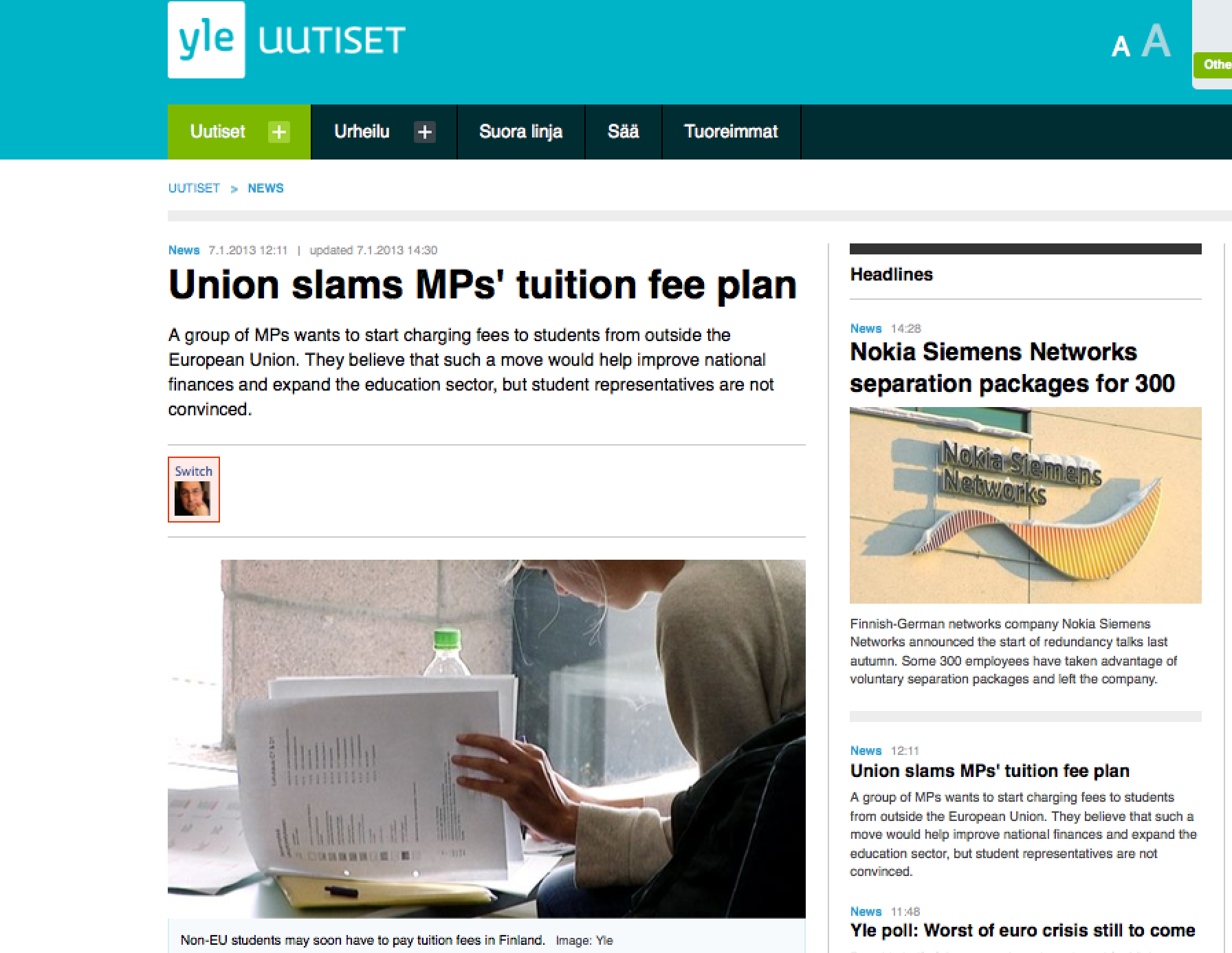
Over half (119) of Finland’s 200 MPs are in favor of charging tuition fees to foreign students, according to YLE in English. The bill is being spearheaded by three parties known for their anti-immigration stances: National Coalition Party (37 MPs), Perussuomalaiset (39), and Center Party (29). Is the new bill a sign of how Finland is turning its back to the world?

Kuvankaappaus 2013-1-7 kello 20.56.17

You can read the original YLE in English news story here.

The bill is also supported to a lesser extent by MPs from the Social Democratic Party (7), Swedish People’s Party (4), Christian Democrats (2), and Left Wing Alliance (1).

”There is nothing new in charging tuition fees to foreign students,” said Migrant Tales’ associate editor JusticeDemon. ”The UK has been doing this for years, with many of its educational institutions now depending on attracting such students in order to stay afloat financially.”

JusticeDemon said that despite the tuition range from  3,500 to 12,000 euros per year, the higher figure is likely to become a norm for university courses. “Charging anything less than the maximum will suggest that the course is somehow of lower quality than a corresponding more expensive course at another institution,” he added.

Arto Satonen of the National Coalition Party, the MP who initiated the bill, believes that time is ripe to start charging foreign students tuition fees because most of them leave the country after they get their degrees.

”If you look at the numbers, then people from Asia or Russia or Ukraine, and when they get their degree they are going to work in the UK, USA, Australia and so on,” he said. ”So it actually happens that the Finnish taxpayers’ money we are actually educating workers for the Anglo-Saxon countries’ economies.”

Despite this view, one of the cornerstones of the Finnish immigration system until a few years ago was forcing foreign students to leave the country after they took a degree, according to JusticeDemon. Since we want these students to stay in Finland , it shows a shift in attitudes, which are welcome.

See JusticeDemon’s comment below.

PS MP Reijo Tossavainen says the bill is important because it would stop discrimination against Finnish students.

”One year costs per (foreign) student 8,000 euros and in university 10,000 euros,” he commented on a blog. ”One student during his whole stay at an institution of higher learning costs 30,000-50,000 euros. In a whole year Finland gives to foreign students altogether a 300 million euro present.”

Tossavainen is a well-known anti-immigration voice of the PS. He said in 2011 that Finland should close its doors to asylum seekers.

Marina Laminen, president of the National Union of University Students, believes that Finland hurting is itself if it starts charging foreign students tuition.

”I feel that it’s a real bad idea because in Finland we really need the international students, both as students and for the labor market,” she told YLE. ”It’s been proven that the number of international students is not getting any better but will get worse with tuition fees.”


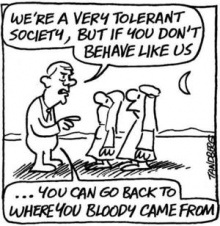
A cartoon that reveals a truth about integration and diversity in Europe

Posted on January 7, 2013 by Migrant Tales

Sometimes when I read about how immigrants, their children and grandchildren are treated in some European countries, this cartoon comes to mind. 

After the first warning and after you understand fully the but after the ” we’re a very tolerant society…” line,  many will encounter the wall of  institutional racism, the final icing of your integration cake that ensures you will never compete as an equal member of society because of your ethnic background.

220px-svvalues_narrowweb_300x3080

Source: Rec. Soc. blog.

What is racism?

It’s squandering people’s abilities and dwarfing their potential.

Racism is like a greedy monopoly, which would rarely if ever admit that it is a monopoly. Its aim is to kill competition in order to benefit itself at the cost of everyone.

People support such an order of things because, one way or another, they think they benefit from it as well.


Migrant Tales videoblogi: Moninainen Suomi

Posted on January 6, 2013 by Migrant Tales

Mitä haasteita Suomella on kun se muuttuu kulttuurisesti moninaisemmaksi? 


Migrant Tales (July 8, 2012): The absurdity of the reverse-racism argument in Finland

Posted on January 6, 2013 by Migrant Tales

Every now and then you’ll hear a visitor on Migrant Tales claim: What about [reverse] racism against [white] Finns!? Racism is a complex problem but one matter singles it out: It is an effective tool to socially exclude, control and exploit other groups in society from vital resources such as jobs and economic wealth. 

The fact that white Finns are the standard of everything in Finland is enough proof that they wield real power. White Finns don’t have to understand racism because they simply don’t have to. It’s not an issue because they are the standard of this society, the norm. Everyone else has a prefix attached to them like immigrant, immigrant descendant, black, Roma etc.

Valkoinen valta-4
This graffiti that reads “White Power” in Finnish was on a special elementary school’s wall in Mikkeli, Finland, for months before it was removed.

In May 2011, the anti-immigration Perussuomalaiset (PS) party renounced all forms of racism, even positive discrimination, or affirmative action.

It is surprising that when the PS made their preposterous statement, few if any media in this country understood how racist and grotesque it was and how it revealed a serious case of  colorblind racism (let’s pretend we’re equal because ethnic background does not matter, when in fact it does).

Colorblind racism works in Finland in an implicit and explicit manner. Its aim is the same:  ethnic background is not the issue. If it is an issue, it’s your  ethnic background.

  • ·         We have such a wonderful society that we are way past racism so get over it (explicit colorblind racism);
  • ·         It’s your culture, your parents or you that is hindering adaption to our society. In this case I recognize your ethnic background but only to shift blame and wash my hands of the problem (implicit colorblind racism).

 Accusing a visible minority, or immigrant of being racist against white Finns, is a good example of implicit colorblind racism.  Since racism isn’t a problem in our society, it can’t be my problem. It’s your problem.

Some successful immigrants or visible minorities who have succeeded in Finland may reinforce the same colorblind racist argument as white Finns. They may claim:  ”I’m not white but I adapted to the white Finns’ world. That is why I am successful. You too can be.”

Those immigrants who have racism issues usually come from countries where such a social ill is the standard. It’s easy for them to accept the white Finn as a standard because they too were the norm in their former home country.  As a result, some embrace the idea of becoming a Tuomo-setä, or Uncle Tom, because they are encouraged to and rewarded by white Finnish society for such behavior.

If you are ever confronted by a person who uses the reverse-racism argument, ask him or her how is the prejudice of a minority as devastating as that of the majority?

White Finns should stop whining about reverse racism because it isn’t an issue. It’s only one of many loaded arguments used by them to justify their racism.

This post was originally published on Migrant Tales on July 8, 2012.

* The Finnish name for the Finns Party is the Perussuomalaiset (PS). The English names of the party adopted by the PS, like True Finns or Finns Party, promote in our opinion nativist nationalism and xenophobia. We therefore prefer to use the Finnish name of the party on our postings.

Charging Kunnollisvaalit 2012 blog would be a setback for Finland

Posted on January 6, 2013 by Migrant Tales

A statement by Kunnollisvaalit 2012, a blog that exposes far right writings of Finnish politicians who ran for city council in the October municipal elections, states that it may face charges for inciting ethnic hatred for publishing snapshots of such candidates.

Kuvankaappaus 2013-1-2 kello 20.50.39

Due to the adverse anti-immigration climate in Finland, some so-called anti-racists usually prefer to publish their views anonymously.

The identity of the editors of Kunnollisvaalit 2012 blog, which is an excellent source of information for the Finnish media, isn’t public.

Being harassed and even one’s life threatened in this country is a shameful fact of today’s Finland if you write against racism and promote tolerance.

The probable charges brought against Kunnollisvaalit 2012 hinge on what Perussuomalaiset (PS)  city council candidate, Amon Rautianen, wrote on his Facebook page.

The interesting legal question is if you repost material by a person or group that incites ethnic hatred, are you guilty of the same crime? Do journalists and bloggers have different rights in this respect?

The police appears to think so.

Kunnollisvaalit 2012 draws attention to a Jersild vs. Denmark landmark case  in 1994 in which the European Commission of Human Rights (ECHR) ruled in favor of the former.

In a nutshell, Jens Jersild, a journalist, published a TV interview of a group  that made abusive and racist statements. Jersild was convicted by a Danish court for aiding and abetting this group.

The ECHR, however, overturned the Danish ruling in favor of Jersild.

It said in a statement: ”In considering the ‘duties and responsibilities’ of a journalist, the potential impact of the medium concerned was an important factor. At the same time, it is not for the Court nor for national courts to substitute their own views for those of the press as to what techniques of reporting should be adopted by journalists.”

Good and reliable sources are an indispensable tool of the journalist and blogger. Good sources permit him or her to access information and put together the big picture. Kunnollisvaalit 2012 has played such a role.

During the dirty war period (1976-83) in Argentina, where censorship was the rule and where over 30,000 people disappeared as a result of  state-sponsored terrorism, the role of the media in exposing the ideology and methods of the military regime was crucial.

While Argentineans were too scared at the time or, in the worst of cases, persecuted, tortured and murdered for their opinions, what would have happened if nobody said a word never mind lifted a finger?

In many respects the same thing is happening in Finland today. Even if we don’t have a military regime ruling the country, we have the same ideology that encourages and intimidates silence and acceptance of views that have their roots in far-right nationalism.

Disagree?

Why not ask why nationalism and racism are in “vogue” these days in Finland.

Ask yourself why too many of us don’t feel any shame in exposing our racist and far-right views.

Certainly one reason is ignorance but isn’t ignorance one of the roots of racism. Looking at the comments on many Finnish comment boards one readily understands that many Finns are in the dark about their own racism. One factor behind our racism is the racism we have learned at home and at school.

We can unlearn our racism if we really want to, or at least recognize it in order to keep it under control.

Charging Kunnollisvaalit 2012 for inciting ethnic hatred or any other crime would be a serious blow to not only our freedom of expression, but winning the ideological battle against those who aim to make Finland a xenophobic, racist and socially exclusive place for white Finns.


Onko Umayya Abu-Hannan tapaus yksilöllinen tai laajempi ilmiö?

Posted on January 5, 2013 by Migrant Tales

Olin hyvin hämmästynyt kun Adoptioperheet ry:n toiminnanjohtaja Anu Uhtio reagoi nyt Umayya Abu-Hannan kirjoituksen viime sunnuntain Helsingin Sanomissa. Samalla tavalla kun Abu-Hannan ja Ulla Appelsinin sanallinen ottelu, Uhtio yrittää vähätellä rasisminilmiön Suomessa vakuuttamalla, että rasistiset kokemukset ovat yksilöllisiä.

Hän sanoi Iltalehdessä: ”Ei minulla ole mitään syytä epäillä, ettei näin ole, mutta se ei edusta mitenkään laajasti perheiden kokemusta,” sanoi Uhtio.

Jos rasismia ei “esiintyy laajasti perheiden kokemana,” missä sitten rasismia ja ennakkoluulot piileskelevät suomen yhteiskunnassa?

Vaikka keskustelun pitäisi tuoda ratkaisijamalleja siitä, kuinka vähänämme rasismia sekä kaikenlaista epäsosiaalista kohtelua toisia kohtaan, Abu-Hannan kirjoitus yhä pelottaa sekä vihastuttaa monia valkoisia suomalaisia.

Professori Jeremy Gould Jyväskylän yliopistasta sanoi perjantai Helsingin Sanomissa, että Appelsinin kirjoitus oli hyvä osoitus siitä kuinka jotkut suomalaiset tuovat esille rasismiin näytille.

”Hän [Appelsin] esitti sen tavalla, josta oli helppo nähdä, että rasismisyytös sai hänet reagoimaan hyvin henkilökohtaisesti, vaikka syytös ei kohdistunutkaan häneen,” sanoi Gould.

Jos yksi henkilö kohtaa rasismia tai hänen lapsi, olkoon adoptoitu tai ei, se on liikaa.

Ongelmasta vaikeneminen tai sen vähätteleminen osoittaa, että olemme yhä kykenemättömiä kohtamaan ongelma joka uhkaa meidän yhteiskuntaa tänään.


Racism is alive and well in the PS as well as in other parties

Posted on January 4, 2013 by Migrant Tales

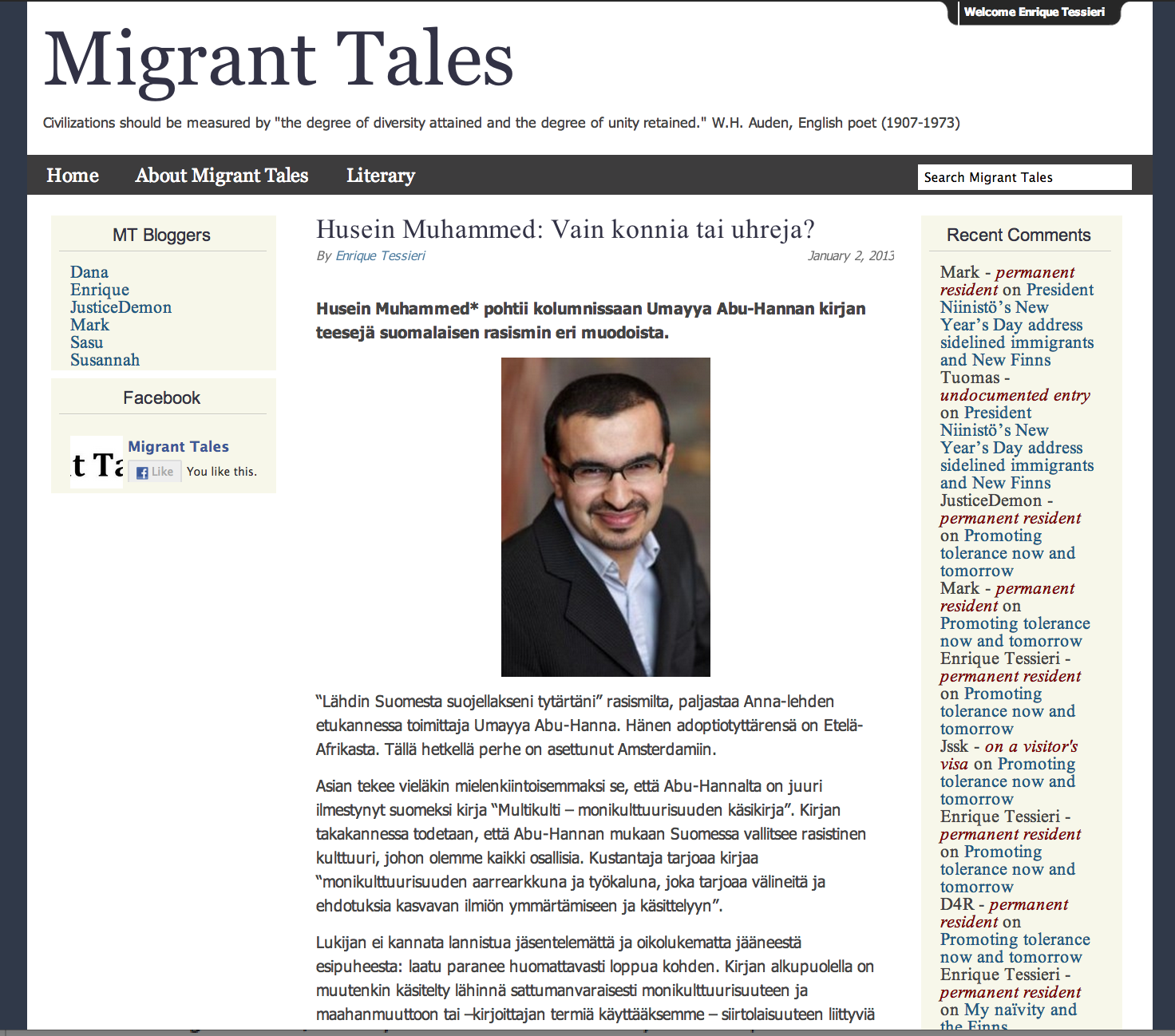
Husein Mohammed raised an important point on a recent blog entry where he reviewed Umayya Abu-Hanna’s  latest book, Multikulti. He asks if the Perussuomalaiset (PS) is the only intolerant party in Finland.

Kuvankaappaus 2013-1-4 kello 22.21.55

He writes: “The term racism is used quite a lot in [Abu-Hanna’s] book but there’s no mention of violence, visible or about racism in [other Finnish] political parties. The general rule is that when we speak about anti-immigration [players], we mention the rise of the Perussuomalaiset as an important party [in this respect]. Not a word is mentioned of that party in the book. It’s a good thing since blaming only the Perussuomalaiset you leave off the hook other parties and players who aren’t anymore tolerant.”

How did the PS become Finland’s third-biggest party after the parliamentary election and how did they together with the media react to that party’s rising popularity?

Migrant Tales wrote on a blog entry in 2011: “The PS could have never dreamed of such success in the last election without the help of Kokoomus [National Coalition Party], Social Democratic Party and Center Party.”

Instead of challenging the rise of a populist party, some identified with PS’ intolerant and xenophobic message.

The Center Party and the Greens did put up some resistance and were punished severely in the elections.

One of the saddest cases was Social Democratic Party leader’s Jutta Urpilainen’s maassa maan tavalla (In Rome do as the Romans do) statement in March 2011.

National Coalition Party chairman Jyrki Katainen didn’t show much leadership either. He effectively let racism out of the cage in Finland by stating that “being critical and debating immigrant issues in this country didn’t make you a racist.”

He forgot, however, to mention one very crucial point: Immigrants must take part in such a debate too.

There was no open debate that included immigrants and visible minorities up to the 2011 elections. The debating landscape looked more like a PS bashing ground against immigrants with the tacit approval of other parties.

While racism is alive and well in all Finnish parties, it does especially well in the PS.

What is the difference between a person who is openly racist or one who isn’t?

If we look at the recent municipal elections, many candidates that jumped the PS ship defected to the Center Party, Christian Democrats, Social Democrats and National Coalition Party.

It makes you wonder, doesn’t it, and leaves us with the following question: Racists come in different sizes and shapes. Some are quiet while others are quite vocal about it. The quiet and the silent are, however, bonded by the same matter: varying degrees of intolerance.

When debating racism in Finland, we should not forget that this social ill has many homes in many places.

It hasn’t found a home in one party but resides in all of them.


Rebecka Holm: The adolescent who spoke out against racism

Posted on January 3, 2013 by Migrant Tales

Rebecka Holm, who was 14 years old last January, rallied enough courage back then to write a letter to HBL* that changed her life. That letter to the editor spoke openly about her multicultural background and racist harassment. In March, she was given the Red Cross Award on the UN Day Against Racism for her courage and example. 

mail.google.com-1Rebecka Holm

When you speak to Rebecka, two matters shine through: her courage and confidence. Like her mother, she was born and raised in Finland. Her father, who is from Somalia, lives in London. Her stepfather is from Gambia.

Rebecka agrees that racism is a “big issue” that people prefer not to talk about in this country.

“If somebody speaks bad about you and wants to make you feel inferior because of your background,” she said, “then we need to talk about this serious matter and not hide from it.”

According to Rebecka, one way of tackling a social ill like racism is to speak out against it whenever and wherever it may appear.

“If someone at work makes a racist joke, you should point out that it’s unacceptable to insult people in such a manner,” she said. “People should know better. Racism is shameful and nothing to be proud of.”

The young adolescent lives in the eastern Helsinki neighborhood of Vuosaari and travels by metro every day to middle school. It was what she saw on one of those trips that encouraged her to write to HBL.

A group of adolescent Somalis were talking on the metro apparently too loudly for some people’s taste. A white Finnish man started  shouting at one of them and then ran after one of the adolescents yelling, “I will kill you, you bastard n-word.”

“I cried and felt really depressed by what I saw,” said Rebecka. “How is it possible that something like this can happen? Why don’t people react if someone is attacked in public?”

Rebecka said that she knew a black woman from the Ivory Coast who was sitting on the bus. Out of nowhere, a man came up to her and spat on her face.

While Rebecka used to feel uncertain about her Finnish identity, it’s a different story today.

“My Finnish identity means a lot to me because I love Finland,” she said. “Finland is my home and I was blessed to be born here. Even so, I’m a Finn with a multicultural background. That fact doesn’t make me less Finnish than anyone else.”

Rebecka said that accepting oneself is the first important step one must take to build a strong identity.

“It’s very difficult to live without a sense of who you are,” she concluded.

______________

*HBL til lässarspalten: Finnland triyg for alla?
Hela mitt liv har jag trevat efter allas accepterande. Jag har ursäktat mig själv med orden ”Jag är helt finlandsvensk” och ”Jag är född i Finland”. Jag har velat att alla skall se på mitt etniska ursprung så som jag ser det. Det är så klart omöjligt, ens första intryck tar alltid vägen genom pupillen.
Varför är jag så rädd för vad andra tycker? När jag började tvåan flyttade vi och jag ville inte byta skola, så jag tog metron från Nordsjö till Hertonäs varje dag. Det var då de rasistiska kommentarerna och påhoppen började. Jag kunde sitta helt stilla i metron då någon sa åt mig att jag skulle åka hem därifrån jag kom. Efter det har jag blivit kallad för många saker, bland annat mutanaama (leransikte), neger, apa. Och det hemskaste har alltid varit att bli verbalt anfallen medan en hel metrovagn full av vuxna sitter där och tittar på utan att göra någonting.
En gång jagade en nykter man en somalisk pojke av och an i metron och skrek saker som ”Jag skall döda dig, din negerjävel!”. Det enda pojken hade gjort var skämtat ljudligt med sina vänner.
Jag satt och grät högt i metrovagnen för att det hela var så orättvist. Jag bölade tills jag kom hem och kände mig barnslig och dum för att jag inte kunde sluta fråga en och samma fråga: Varför skall det vara så? Det är en logisk fråga när man tänker på det. Men det finns inget logiskt svar.
Några få gånger har det hänt att någon har sagt något åt rasisten. Det är den mest fantastiska känslan i världen när någon som man inte känner ställer upp för en. Och den värsta känslan är då ingen säger något och alla sitter där som vaxdockor utan känslor.
Jag har flera vänner med etniskt utseende och när vi talar om rasism skrattar vi åt händelserna. Fast innerst inne vet vi att det inte är något man skrattar åt. Det sårar och tar ont. Min mamma har en somalisk väninna. Jag slår vad om att hon också har fått höra skällsord och hemska saker. Men vad ingen vet är att hon förlorade fyra barn och sin make i kriget.
En kvinna vi känner som kommer från Elfenbenskusten hade suttit i bussen då en man spottat henne i ansiktet. Så skall ingen människa bli behandlad. Det är inte rätt!
Varför tar man inte upp olika kulturer, världsfrågor och invandring i skolan så att den nya generationen kan bli en bättre och öppnare version av den gamla? Varför försöker man kväva rasismen i Finland? Hur mycket man än gömmer något kommer det inte att försvinna. Låt nu människorna veta att det inte är okej att säga neger, fast man inte menar det ont.
Om Finland nu är ett så tryggt och stabilt land, varför får människor av etniskt ursprung uppleva påhopp dagligen? Och säg inte att det inte är ert problem om andra har det dåligt. Då är ni bara fega.
Rebecka Holm,
14 år
Helsingfors

Migrant Tales video blog entry: President Sauli Niinistö’s New Year address 2013

Posted on January 2, 2013 by Migrant Tales

Here’s Migrant Tales’ first-ever video blog entry. We plan to publish more of these in 2013 in English, Finnish as well as in other languages. 

This is a first attempt so I’m certain there’s a lot of room for improvement. We’ll get better at them as we get more practice.


  • Previous
  • 1
  • …
  • 31
  • 32
  • 33
  • 34
  • 35
  • 36
  • 37
  • …
  • 152
  • Next
Read more about documentary film
Read more

Recent Posts

  • Finland’s tabloids Iltalehti and Ilta-Sanomat are the pits
  • Riikka Purra’s Dr Jekyll and Mr Hyde mask
  • Double standards
  • Perussuomalaiset: Uusi logo, sama vanha juttu
  • Taco Trump

Recent Comments

  1. Absolutely Socking: Racist Finnish Facebook group against human rights gets flooded with socks on Musta Barbaari’s mother and sister charged by the police in “ethnic profiling” case
  2. Ilkka Nuotio on Pekka Myrskylä: “Tilastot kertovat toista kuin poliittinen keskustelu”
  3. Genrih Soinkara on The war in Ukraine and the Russian-Finnish border crisis are showing Finland’s ugly side
  4. Ahti Tolvanen on Comment by Ahti Tolvanen on the Helsinki +50 conference
  5. Angel Barrientos on Angel Barrientos is one of the kind beacons of Finland’s Chilean community

Archives

  • June 2026
  • May 2026
  • April 2026
  • March 2026
  • February 2026
  • January 2026
  • December 2025
  • November 2025
  • October 2025
  • September 2025
  • August 2025
  • July 2025
  • June 2025
  • May 2025
  • April 2025
  • March 2025
  • February 2025
  • January 2025
  • December 2024
  • November 2024
  • October 2024
  • September 2024
  • August 2024
  • July 2024
  • June 2024
  • May 2024
  • April 2024
  • March 2024
  • February 2024
  • January 2024
  • December 2023
  • November 2023
  • October 2023
  • September 2023
  • August 2023
  • July 2023
  • June 2023
  • May 2023
  • April 2023
  • March 2023
  • February 2023
  • January 2023
  • December 2022
  • November 2022
  • October 2022
  • September 2022
  • August 2022
  • July 2022
  • June 2022
  • May 2022
  • April 2022
  • March 2022
  • February 2022
  • January 2022
  • December 2021
  • November 2021
  • October 2021
  • September 2021
  • August 2021
  • July 2021
  • June 2021
  • May 2021
  • April 2021
  • March 2021
  • February 2021
  • January 2021
  • December 2020
  • November 2020
  • October 2020
  • September 2020
  • August 2020
  • July 2020
  • June 2020
  • May 2020
  • April 2020
  • March 2020
  • February 2020
  • January 2020
  • December 2019
  • November 2019
  • October 2019
  • September 2019
  • August 2019
  • July 2019
  • June 2019
  • May 2019
  • April 2019
  • March 2019
  • February 2019
  • January 2019
  • December 2018
  • November 2018
  • October 2018
  • September 2018
  • August 2018
  • July 2018
  • June 2018
  • May 2018
  • April 2018
  • March 2018
  • February 2018
  • January 2018
  • December 2017
  • November 2017
  • October 2017
  • September 2017
  • August 2017
  • July 2017
  • June 2017
  • May 2017
  • April 2017
  • March 2017
  • February 2017
  • January 2017
  • December 2016
  • November 2016
  • October 2016
  • September 2016
  • August 2016
  • July 2016
  • June 2016
  • May 2016
  • April 2016
  • March 2016
  • February 2016
  • January 2016
  • December 2015
  • November 2015
  • October 2015
  • September 2015
  • August 2015
  • July 2015
  • June 2015
  • May 2015
  • April 2015
  • March 2015
  • February 2015
  • January 2015
  • December 2014
  • November 2014
  • October 2014
  • September 2014
  • August 2014
  • July 2014
  • June 2014
  • May 2014
  • April 2014
  • March 2014
  • February 2014
  • January 2014
  • December 2013
  • November 2013
  • October 2013
  • September 2013
  • August 2013
  • July 2013
  • June 2013
  • May 2013
  • April 2013
  • March 2013
  • February 2013
  • January 2013
  • December 2012
  • November 2012
  • October 2012
  • September 2012
  • August 2012
  • July 2012
  • June 2012
  • May 2012
  • April 2012
  • March 2012
  • February 2012
  • January 2012
  • December 2011
  • November 2011
  • October 2011
  • September 2011
  • August 2011
  • July 2011
  • June 2011
  • May 2011
  • April 2011
  • March 2011
  • February 2011
  • January 2011
  • December 2010
  • November 2010
  • October 2010
  • September 2010
  • August 2010
  • July 2010
  • June 2010
  • May 2010
  • April 2010
  • March 2010
  • February 2010
  • January 2010
  • December 2009
  • November 2009
  • October 2009
  • September 2009
  • August 2009
  • July 2009
  • December 2008
  • November 2008
  • October 2008
  • September 2008
  • August 2008
  • July 2008
  • June 2008
  • May 2008
  • April 2008
  • March 2008
  • February 2008
  • January 2008
  • November 2007
  • October 2007
  • September 2007
  • August 2007
  • July 2007
  • June 2007
  • May 2007

Categories

  • ?? Gia L?c
  • ????? ?????? ????? ???????? ?? ??????
  • ???????
  • @HerraAhmed
  • @mondepasrond
  • @nohatefinland
  • @oula_silver
  • @Varathas
  • A Pakistani family
  • äärioikeisto
  • Abbas Bahmanpour
  • Abdi Muhis
  • Abdirahim Hussein Mohamed
  • Abdirahim Husu Hussein
  • Abdirisak Mahamed
  • About Migrant Tales
  • activism
  • Adam Al-Sawad
  • Adel Abidin
  • Afrofinland
  • Ahmed IJ
  • Ahti Tolvanen
  • Aino Pennanen
  • Aisha Maniar
  • Alan Ali
  • Alan Anstead
  • Alejandro Díaz Ortiz
  • Alekey Bulavsev
  • Aleksander Hemon
  • Aleksanterinliitto
  • Aleksanterinliitto ry
  • Aleksanterinliitto ry:n hallitus
  • Alex Alex
  • Alex Mckie
  • Alexander Nix
  • Alexandra Ayse Albayrak
  • Alexis Neuberg
  • Ali Asaad Hasan Alzuhairi
  • Ali Hossein Mir Ali
  • Ali Rashid
  • Ali Sagal Abdikarim
  • Alina Tsui
  • Aline Müller
  • All categories
  • Aman Heidari
  • Amiirah Salleh-Hoddin & Jana Turk
  • Amin A. Alem
  • Amir Zuhairi
  • Amkelwa Mbekeni
  • Ana María Gutiérrez Sorainen
  • Anachoma
  • Anders Adlecreutz
  • Angeliina Koskinen
  • Anna De Mutiis
  • Anna María Gutiérrez Sorainen
  • Anna-Kaisa Kuusisto ja Jaakko Tuominen
  • Annastiina Kallius
  • Anneli Juise Friman Lindeman
  • Announcement
  • Anonymous
  • Antero Leitzinger
  • anti-black racism
  • Anti-Hate Crime Organisation Finland
  • Anudari Boldbaatar
  • Arshiya Nasser
  • Aspergers Syndrome
  • Asylum Corner
  • Asylum seeker 406
  • Athena Griffin and Joe Feagin
  • Autism
  • Avaaz.org
  • Awale Olad
  • Ayan Said Mohamed
  • AYY
  • Barachiel
  • Bashy Quraishy
  • Beatrice Kabutakapua
  • Beri Jamal
  • Beri Jamal and Enrique Tessieri
  • Bertolt Brecht
  • Boiata
  • Boodi Kabbani
  • Bruno Gronow
  • Carmen Pekkarinen
  • Çelen Oben and Sheila Riikonen
  • Chiara Costa-Virtanen
  • Chiara Costa-Virtanen
  • Chiara Sorbello
  • Christian Thibault
  • Christopher Wylie
  • Clara Dublanc
  • Dana
  • Daniel Malpica
  • Danilo Canguçu
  • David Papineau
  • David Schneider
  • Dexter He
  • Don Flynn
  • Dr Masoud Kamali
  • Dr. Faith Mkwesha
  • Dr. Theodoros Fouskas
  • Edna Chun
  • Eeva Kilpi
  • Emanuela Susheela
  • En castellano
  • ENAR
  • Enrique
  • Enrique Tessieri
  • Enrique Tessieri & Raghad Mchawh
  • Enrique Tessieri & Yahya Rouissi
  • Enrique Tessieri and Muhammed Shire
  • Enrique Tessieri and Sira Moksi
  • Enrique Tessieri and Tom Vandenbosch
  • Enrique Tessieri and Wael Che
  • Enrique Tessieri and Yahya Rouissi
  • Enrique Tessieri and Zimema Mhone
  • Epäluottamusmies
  • EU
  • Europe
  • European Islamophobia Report
  • European Islamophobia Report 2019,
  • European Union
  • Eve Kyntäjä
  • Ezequiel Caldeiro
  • Facebook
  • Fadumo Dayib
  • Faisa Kahiye
  • Farhad Manjoo
  • Fasismi
  • Finland
  • Fizza Qureshi
  • Flyktingar och asyl
  • Foreign Student
  • Fozia Mir-Ali
  • Frances Webber
  • Frida Selim
  • Gareth Rice
  • Ghyslain Vedeaux
  • Global Art Point
  • Great Replacement
  • Habiba Ali
  • Hami Bahadori
  • Hami Bahdori
  • Hamid
  • Hamid Alsaameere
  • Hamid Bahdori
  • Handshake
  • Harmit Athwal
  • Hassan Abdi Ali
  • Hassan Muhumud
  • Heikki Huttunen
  • Heikki Wilenius
  • Helsingin Sanomat
  • Henning van der Hoeven
  • Henrika Mälmsröm
  • Hser Hser
  • Hser Hser ja Mustafa Isman
  • Husein Muhammed
  • Hussain Kazemian
  • Hussain Kazmenian
  • Ibrahim Khan
  • Ida
  • Ignacio Pérez Pérez
  • Iise Ali Hassan
  • Ilari Kaila & Tuomas Kaila
  • Imam Ka
  • inside-an-airport
  • Institute of Race Relations
  • Iraqi asylum seeker
  • IRR European News Team
  • IRR News Team
  • Islamic Society of Norhern FInland
  • Islamic Society of Northern Finland
  • Islamophobia
  • Jacobinmag.com
  • Jallow Momodou
  • Jan Holmberg
  • Jane Elliott
  • Jani Mäkelä
  • Jari Luoto
  • Jari Taponen
  • Jegor Nazarov
  • Jenni Stammeier
  • Jenny Bourne
  • Jessie Daniels
  • Joe Davidow
  • Johannes Koski
  • John D. Foster
  • John Grayson
  • John Marriott
  • Jon Burnett
  • Jorma Härkönen
  • Jos Schuurmans
  • José León Toro Mejías
  • Josue Tumayine
  • Jouni Karnasaari
  • Juan Camilo
  • Jukka Eräkare
  • Julian Abagond
  • Julie Pascoet
  • Jussi Halla-aho
  • Jussi Hallla-aho
  • Jussi Jalonen
  • JusticeDemon
  • Kadar Gelle
  • Kaksoiskansalaisuus
  • Kansainvälinen Mikkeli
  • Kansainvälinen Mikkeli ry
  • Katherine Tonkiss
  • Kati Lepistö
  • Kati van der Hoeven-Lepistö
  • Katie Bell
  • Kättely
  • Kerstin Ögård
  • Keshia Fredua-Mensah & Jamie Schearer
  • Khadidiatou Sylla
  • Khadra Abdirazak Sugulle
  • Kiihotus kansanryhmää vastaan
  • Kirsi Crowley
  • Koko Hubara
  • Kristiina Toivikko
  • Kubra Amini
  • KuRI
  • La Colectiva
  • La incitación al odio
  • Laura Huhtasaari
  • Lauri Finér
  • Leif Hagert
  • Léo Custódio
  • Leo Honka
  • Leontios Christodoulou
  • Lessie Branch
  • Lex Gaudius
  • Leyes de Finlandia
  • Liikkukaa!
  • Linda Hyökki
  • Liz Fekete
  • M. Blanc
  • Maarit Snellman
  • Mahad Sheikh Musse
  • Maija Vilkkumaa
  • Malmin Kebab Pizzeria Port Arthur
  • Marcell Lorincz
  • Mari Aaltola
  • María Paz López
  • Maria Rittis Ikola
  • Maria Tjader
  • Marja-Liisa Tolvanen
  • Mark
  • Markku Heikkinen
  • Marshall Niles
  • Martin Al-Laji
  • Maryan Siyad
  • Matt Carr
  • Mauricio Farah Gebara
  • Media Monitoring Group of Finland
  • Micah J. Christian
  • Michael McEachrane
  • Michele Levoy
  • Michelle Kaila
  • Migrant Tales
  • Migrant Tales Literary
  • Migrantes News
  • Migrants' Rights Network
  • MigriLeaks
  • Mikko Kapanen
  • Miriam Attias and Camila Haavisto
  • Mohamed Adan
  • Mohammad Javid
  • Mohammad M.
  • Monikulttuurisuus
  • Monisha Bhatia and Victoria Canning
  • Mor Ndiaye
  • Muh'ed
  • Muhamed Abdimajed Murshid
  • Muhammed Shire
  • Muhammed Shire and Enrique Tessieri
  • Muhis Azizi
  • Musimenta Dansila
  • Muslimiviha
  • Musulmanes
  • Namir al-Azzawi
  • Natsismi
  • Neurodiversity
  • New Women Connectors
  • Nils Muižnieks
  • No Labels No Walls
  • Noel Dandes
  • Nuor Dawood
  • Omar Khan
  • Otavanmedia
  • Oula Silvennoinen
  • Paco Diop
  • Pakistani family
  • Pentti Stranius
  • Perussuomalaiset
  • perustuslaki
  • Petra Laiti
  • Petri Cederlöf
  • Pia Grochowski
  • Podcast-lukija Bea Bergholm
  • Pohjois – Suomen Islamilainen Yhdyskunta
  • Pohjois Suomen Islamilainen Yhyskunta
  • Polina Kopylova
  • Race Files
  • racism
  • Racism Review
  • Raghad Mchawh
  • Ranska
  • Rashid H. and Migrant Tales
  • Rasismi
  • Raul Perez
  • Rebecka Holm
  • Reem Abu-Hayyeh
  • Refugees
  • Reija Härkönen
  • Remiel
  • Reza Nasri
  • Richard Gresswell
  • Riikka Purra
  • Risto Laakkonen
  • Rita Chahda
  • Ritva Kondi
  • Robito Ibrahim
  • Roble Bashir
  • Rockhaya Sylla
  • Rodolfo Walsh
  • Roger Casale
  • Rostam Atai
  • Roxana Crisólogo Correa
  • Ruth Grove-White
  • Ruth Waweru-Folabit
  • S-worldview
  • Sadio Ali Nuur
  • Sami Rusanen
  • Sandhu Bhamra
  • Sara de Jong
  • Sarah Crowther
  • Sari Alhariri
  • Sarkawt Khalil
  • Sasu
  • Scot Nakagawa
  • Shabana Ahmadzai
  • Shada Islam
  • Sharon Chang blogs
  • Shenita Ann McLean
  • Shirlene Green Newball
  • Sini Savolainen
  • Sira Moksi
  • Sonia K.
  • Sonia Maria Koo
  • Steverp
  • Stop Deportations
  • Suldaan Said Ahmed
  • Suomen mediaseurantakollektiivi
  • Suomen Muslimifoorumi ry
  • Suomen viharikosvastainen yhdistys
  • Suomen viharikosvastainen yhdistys ry
  • Suomi
  • Supermen
  • Susannah
  • Suva
  • Syrjintä
  • Talous
  • Tapio Tuomala
  • Taw Reh
  • Teivo Teivainen
  • The Daily Show
  • The Heino
  • The Supermen
  • Thomas Elfgren
  • Thulfiqar Abdulkarim
  • Tim McGettigan
  • Tino Singh
  • Tito Moustafa Sliem
  • Tobias Hübinette and L. Janelle Dance
  • Transport
  • Trica Danielle Keaton
  • Trilce Garcia
  • Trish Pääkkönen
  • Trish Pääkkönen and Enrique Tessieri
  • Tuulia Reponen
  • Uncategorized
  • UNITED
  • University of Eastern Finland
  • Uyi Osazee
  • Väkivalta
  • Vapaa Liikkuvuus
  • Venla-Sofia Saariaho
  • Vieraskynä
  • W. Che
  • W. Che an Enrique Tessieri
  • Wael Ch.
  • Wan Wei
  • Women for Refugee Women
  • Xaan Kaafi Maxamed Xalane
  • Xassan Kaafi Maxamed Xalane
  • Xassan-Kaafi Mohamed Halane & Enrique Tessieri
  • Yahya Rouissi
  • Yasmin Yusuf
  • Yassen Ghaleb
  • Yle Puhe
  • Yuliet Tresa
  • Yve Shepherd
  • Zahra Khavari
  • Zaker
  • Zalina Ametova
  • Zamzam Ahmed Ali
  • Zeinab Amini ja Soheila Khavari
  • Zimema Mahone and Enrique Tessieri
  • Zimema Mhone
  • Zoila Forss Crespo Moreyra
  • ZT
  • Zulma Sierra
  • Zuzeeko Tegha Abeng
© 2026 Migrant tales | Powered by Minimalist Blog WordPress Theme