Migrant tales
Menu
  • #MakeRacismHistory “In Your Eyes”
  • About Migrant Tales
  • It’s all about Human Rights
  • Literary
  • Migrant Tales Media Monitoring
  • NoHateFinland.org
  • Tales from Europe
Menu

Category: Enrique

What message does Finland want to send to Iraqi asylum seekers by deporting them to a country that it has no repatriation agreement?

Posted on January 12, 2017 by Migrant Tales

The case of two young Iraqis, KM, and SH, who were detained by the police on Friday and who will apparently be deported from the country on Monday are a case in point. To KM and SH, there is another Iraqi national, AM, who will be deported together with KM and SH. All three are being held at the Helsinki detention camp of Metsälä. 

The police, who are carrying out these deportations, will not give for obvious reasons details on how they plan to deport Iraqi nationals who have gotten a negative decision on their asylum applications from the Finnish Immigration Service and district court.

Migrant Tales reported on Friday the detention of two young Iraqi asylum seekers that will be deported. Is this a scare tactic and a clear message by the authorities that they want these people to leave? We believe so. Read the full story here.

Here’s the question: How can Finland deport thousands of Iraqis from Finland if there is no repatriation agreement with Iraq?

The Iraqi Ambassador to Finland, Matheel Chayif Al-Sabti, spoke to Migrant Tales on Wednesday, was clear on the matter:

“The Iraqi government does not accept forced deportations [and] this is officially the position of the Iraqi government now because we know of the [difficult] situation in Iraq…So, now there is nothing that Finland can do to those [Iraqi] people.”

Iraqi Ambassador to FinlandMatheel Chayif Al-Sabti states that the Iraqi government doesn’t accept any forced deportations.

He said that Iraq would not grant permission to any special flight carrying deported Iraqis to land in the country because there is no repatriation agreement or memorandum of understanding with Finland on forcibly returning people to Iraq.

“So now you have to accept this idea [that there is no agreement],”  Al-Sabti continued. “I said it many times to Päivi Nerg, the deputy interior minister, I then said it to Hanna Helinko, the director general of the Finnish Immigration Service, and I said it at all of my meetings with the minister of foreign affairs [Timo Soini] that Iraq will not accept people who are deported.”

The ambassador said that Iraqis who came to Finland from fall 2015 should be accepted as guests taking into account the difficult situation in Iraq.

Al-Sabti went as far as to say that the Iraqi embassy would not even issue any laisse- fair travel documents to Iraqis who refuse to return to their country.

Migrant Tales will publish Thursday a more extensive interview with the Iraqi ambassador.

Continue reading “What message does Finland want to send to Iraqi asylum seekers by deporting them to a country that it has no repatriation agreement?”

Migrant Tales (July 21, 2012): Somali-Finn Abdulah -living in no-man’s land (Part 2)

Posted on December 17, 2013 by Migrant Tales

When Abdulah*, 30, talks to you about his twenty-two years in Finland, one of the first questions that arises is how has so much suffering escaped our attention. For Abdulah, acceptance isn’t only virtually impossible from white Finns, but can be  just as hard to get from the Somali community.

“I have decided to live outside this society,” he says. “I have learned that there is no place here. Even my people have turned their backs on me.”

Abdulah says that there are two matters you must never lose if you don’t want to be abandoned by the Somali community.

“Language and religion are crucial,” he explains. “I don’t speak Somali that well anymore since I grew up in this country. I  became an atheist two years ago and left the Muslim faith.”

How long will it take for minorities like the Somalis to be treated as equals in Finland?

Abdulah admits that he no longer believes in god.

“How can there be a god if people are constantly killing each other in Somalia?” he continues. “How can there be a god if there’s so much hatred and racism towards you in this country? How can god exist in such hells?”

There are many young men like Abdulah in Finland, who grew up the greater part of their lives in this country. He says that some have problems with the law.

“I don’t identify with such people anymore because I used to be one of them,” he says. “If you start drinking and taking drugs, your situation will only get worse. That’s the reason why I changed my life.”

Abdulah hasn’t forsaken hope despite the difficulties he’s faced. Two factors give him strength: his family and plans to be a gardener.

L_0995-Medium-223x300

Billboards like these in the early 1990s spread prejudice about Somalis in Finland. The tabloid ad claims that Somalis had made phone calls to the tune of hundreds of thousands of marks and supposedly passed the bill to the social authorities.

“But living in Finland still feels like being in a trap,” he adds. “I want to free myself but I don’t know how.”

Abdulah discovered Migrant Tales by chance when he was searching for an alternative forum that spoke up for immigrants and visible minorities like him.

“I used to visit Suomi24, Hommaforum and even took part in Iltalehtichat forums,” he says.  “They always said the same negative things about immigrants and Somalis. I felt relieved when I found Migrant Tales. It was like a light at the end of a dark tunnel that gave me hope.”

Abdulah is a very sensitive and respectful person. Despite the difficulties he’s encountered, he believes that one must be outspoken if he’s going to challenge a social ill like racism.

“We have to fight back,” he concludes. “Silence hasn’t changed my life for the better. That’s why I’m active in forums like Migrant Tales.”

*Abdulah’s name has been changed to protect his identity. 

Timo Soini’s silence in the face of PS MP Olli Immonen’s proposal reveals that he has always been the wolf in sheep’s clothing

Posted on December 13, 2013 by Migrant Tales

Timo Soini, the chairman of the Perussuomalaiset (PS) party, was quoted as saying on YLE in English that PS MP Olli Immonen’s written question to parliament, that Finland should start classifying people according to ethnic background, doesn’t concern him. 

What do you think such a statement by the head of an an anti-immigration party reveals? What does it say say about the present state of this country about promoting mutual acceptance?

It shows all along that Soini is not only an opportunist who would sell out Finland to amass more political clout and power, but the wolf in sheep’s clothing.

Jussi Halla-aho, James Hirvisaari, Olli Immonen and others of the PS aren’t the so-called bad guys, Soini is by a mile.

Kuvankaappaus 2013-12-12 kello 23.53.00

Read full story (in Finnish) here.

While such an admission by Soini shouldn’t surprise us, it shows that Finland is still in deep denial and ignorance about racism. It shows that too many politicians in Finland would care less about immigrants and minorities.

Why are we still in the present stage where we deny racism as opposed to challenge it as we should? The answer is clear: We deny racism as a real problem in our society because intolerance gives some status and power over other groups.

We also deny it because the behavior of some shames us.

Immonen’s proposal is racist, but Soini’s silence  sends a dangerous message to the wrong people.


PS MP wants Finland to classify people according to ethnic background

Posted on December 12, 2013 by Migrant Tales

As the European Parliament elections near in May 2014, the attacks against immigrants and visible minorities in Finland by the Perussuomalaiset (PS) are getting stronger and more relentless. The latest one is by none other then PS MP Olli Immonen, who gave parliament Wednesday a written question that Finland should start registering people according to their ethnic background.

PS’ chairman Timo Soini was silent about Immonen’s plans when approached by the Finnish media.

Soini continues to deny that there are racists in the populist party even if some of its members like MP Jussi Halla-aho have been sentenced for ethnic agitation.

Kuvankaappaus 2013-12-12 kello 7.25.46

Read full story (in Finnish) here.

Even if we speak in Finland of a society that prizes education and Nordic values, MP’s like Immonen show that the education they received at school and at home on racism was too little and deficient.

The term “race” is generally used in the US while “ethnic group” is used in Europe to mean the same thing. In the US, blacks consider themselves “a race” while some Hispanics refer to themselves as la raza, or “the race.”

According to Immonen, who is chairman of the ultra-nationalist anti-immigration Suomen Sisu association, ethnic classification of people in Finland is necessary due to its ever-growing cultural and ethnic diversity.

I personally believe it’s none of Immonen’s or the general public’s right to pry and classify me into a group they think I should belong to.

Immonen said that Finland could copy the same ethnic-classification system used in Britain. Some ethnic groups that people could be classified into are Finnish Finns, Finnish Swedes, Saame, Roma, other European, African, Asian, diverse ethnic background and other ethnic group, according to the PS MP.

Finland does classify people according to their nationality, mother tongue and place of birth.

Taking into account that race or ethnicity is a social construct to begin with, classifying people into groups is difficult especially in an age when we move and travel with greater ease from country to country and where we adopt complex multicultural identities.

To show how difficult it would be to classify people along ethnic lines, the system we use presently in Finland is fraught with problems. Nationality, mother or father tongue, place of birth don’t shed light on a person’s ethnic identity since that it a personal choice.

US American sociologist Yehudi Webster at the California State University, Los Angeles, believes that classifying people by race actually worsens racial strife.

“It is not ‘race’ but a practice of racial classification that bedevils the society,” he writes.

Writes the American Anthropological Society:

“In the United States both scholars and the general public have been conditioned to viewing human races as natural and separate divisions within the human species based on visible physical differences. With the vast expansion of scientific knowledge in this century, however, it has become clear that human populations are not unambiguous, clearly demarcated, biologically distinct groups.”

Countries like England and the United States, which classify people into ethnic groups, have a questionable history since both practiced slavery and had oversea colonies. Ethnic classification played a crucial role in enabling whites in these countries to exploit other groups by classifying members of their population  into superior (whites) and inferiors (other groups).  


Why do we still hesitate to challenge intolerance in Finland?

Posted on December 11, 2013 by Migrant Tales

I had an interesting chat yesterday with an old friend about racism in Finland. One of the matters we agreed was that Finland hasn’t reached that stage where we accept that racism exists and that concrete steps must be taken to challenge it. This fact leads us to a second important question: Why? 

The answer is obvious and could be answered with the statement below I got from Ruth Rubin’s Facebook wall.

1504001_10202654076895766_2042479362_n

They give as a present fear so they can sell us security.

Wars will never end not because it is in our blood, but because it is big business. Why would the army, navy or air force of a country admit that we live in a safer world? If they did, they’d see their budgets slashed.

Since racism is hostile and a violent act like war, it’s clear that it has a role as well. The above-mentioned statement if applied to racism would read something like the following: We deny racism in order to remain in our historic, political and economic comfort zone.

There’s a lot of money riding on ensuring that we have an effective system that discriminates against different groups like immigrants and visible minorities.

Why not ask the Perussuomalaiset (PS) if they agree?  What would happen if they admitted that racism is an issue in this country that should be tackled. Making such an admission would be synonymous to commiting political hara-kiri.

Like some political parties, some institutions like the police, educational sector, Finnish Immigration Service, even some so-called anti-racist associations, don’t want to take the debate to the second level and admit that racism is an issue in this society because it would diminish their power and status.

So to answer my friend’s comment, why Finland still resists to recognize that racism is an issue in this society, is clear: We deny racism as a problem because intolerance gives some status and power at the cost of other groups.

My friend and I have lived in this country for many decades. Contrary to him, I have Finnish ancestry. I believe that we know a little about racism in Finland.

Even so, few are willing to discuss in earnest our view on the matter. 

Why?

Because we are still in the phase of denying rather than challenging racism.


Sikh bus driver in Finland plans to take employer to court over landmark turban case

Posted on December 9, 2013 by Migrant Tales

Busman Gill Sukhdarshan Singh told Migrant Tales that he plans to take his employer to court if no decision is reached with the Veolia bus company concerning a turban ban at work after the the Southern Finland Regional State Administrative Agency (Avi) makes a new ruling on the matter in about a week and a half. 

Sukhdarshan Singh was hopeful in the spring  that he’d be able to wear a turban to work from the end of September. Avi ruled that not allowing the busman to wear a turban at work was discriminatory.

The case has received wide coverage in the national media.

Avi ruled in June that a turban by the employer was discriminatory and gave the bus company until the end of September to redress the matter.

Kuvankaappaus 2013-12-8 kello 20.25.52

Read full story here.

“The employer didn’t say whether he was for or against me using a turban at work but at the end of September he told me that the ban was still in force,” the Sikh busman said. “I was very disappointed and felt very bad about the decision.”

Sukhdashan Singh said that he had been in touch with Sikh busmen in Germany, England, the United States and Sweden who had expressed their solidarity with his cause.

The problems that the busman faces at work is a good example of how far Finland lags behind other European countries concerning cultural diversity. Sikh bus drivers in England won such rights over forty years ago in 1969.

The story behind “Finland is a racist country” is in the comments

Posted on December 8, 2013 by Migrant Tales

There were quite strong reactions among some Finns and immigrants to Maryan Abdulkarim’s interview on Helsingin Sanomat. Those who strongly objected to the article, appear to want to deny Abdulkarim’s right to express herself on a touchy subject like racism. 

It’s ironic, but those who want to deny Abdulkarim her right to speak out are the very people who spread hate speech and claim there’s mass censorship in this country.

You can read Abdulkarim’s full interview in English here.

White Finns, which include some white immigrants as well, control and jealously guard the high ground over the debate in the media whether there is racism in Finland or not. Some cry murder when a black woman, who is a Finn born in Somalia and is a Muslim on top of it, speaks out against racism.

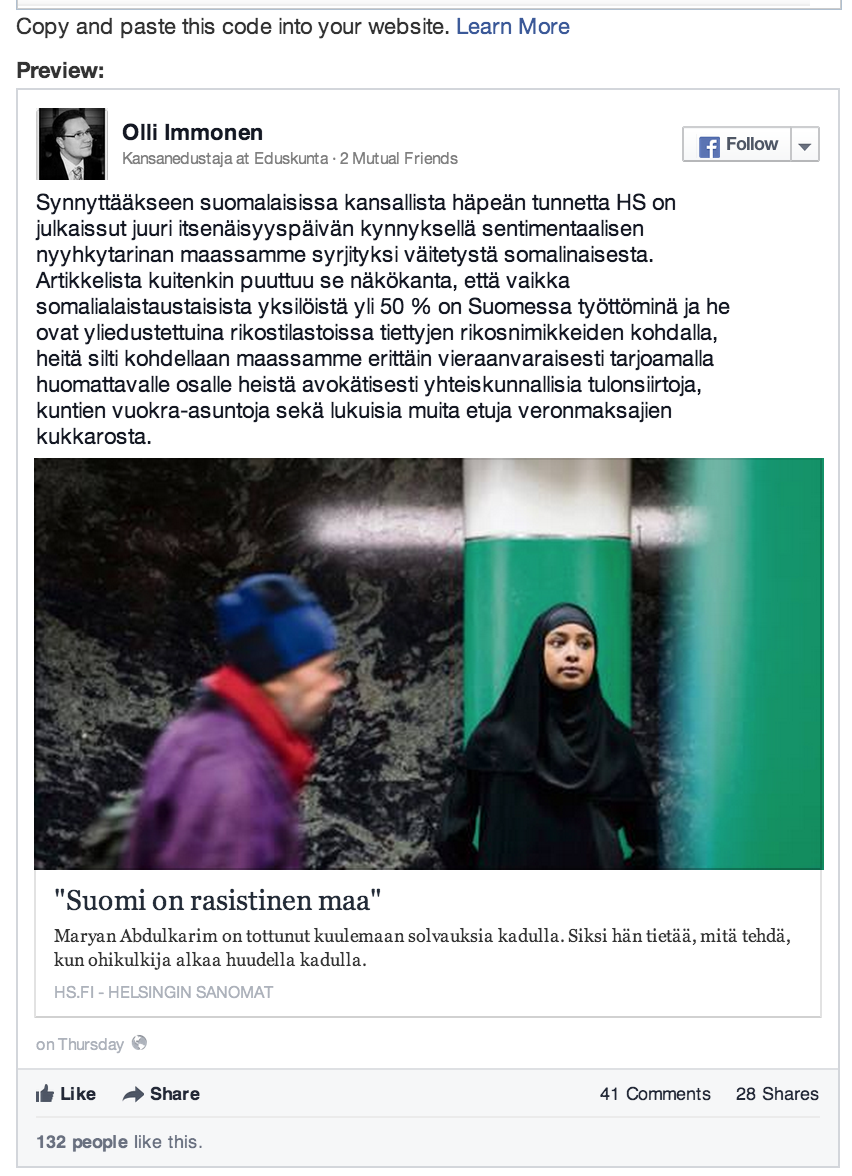
One of these is from the anti-immigration camp, Perussuomalaiset (PS) MP Olli Immonen, who is president of the ultra-nationalist and and anti-immigration  Suomen Sisu association. He wrote on his Facebook wall that as “a native-born Finnish citizen,” he is ashamed that the country’s largest daily published the story on Abdulkarim a day before independence day celebrations.

Note how he stresses “native-born Finnish citizen.” With such a lowly punch, Immonen tries to undermine Abdulkarim’s right to voice her narrative by trying to show that she’s not a so-called “real” Finn like him. Since she’s not a real Finn, her arguments aren’t as valid as his.

Immonen takes another punch at Abdulkarim on his Facebook wall: “The article forgets to mention the view that while over 50% of Somalis [in Finland] are unemployed and are overrepresented in crime statistics of a certain sort, they are still treated in our country in a very friendly manner and offered generous social assistance, municipal housing as well as a host of other benefits from taxpayers’ pockets.”

I get it. Abdulkarim’s arguments aren’t supposed to amount to much because she’s not a real Finn and because she belongs to a group where there is a high crime and unemployment rate, according to Immonen.

The PS MP recently blamed immigrants for Finland’s poor Pisa result.

Immonen claimed on Facebook: ”The long-term work of immigration and multicultural fanatics to make Finland more ‘diverse’ has bore fruit. Immigrants played a signifiant role in [the worse] Pisa results even if consensus politicians and officials claim the contrary. The differences in reading, science and math between immigrants and Finns in the Pisa test are mind-boggling.”

Kuvankaappaus 2013-12-8 kello 10.19.36

Anti-immigration politicians like Immonen, who enjoy bashing immigrants who can’t defend themselves because they aren’t white and don’t have the same political and ethnic clout as him, must be stunned and devastated by Abdulkarim.

Weren’t all those Somali women supposed to be exploited and docile servants of men?

Who should we be ashamed of? Immonen, who makes up Islamophobic tales and spreads them, which in turn fuel prejudice and social exclusion, or Abdulkarim who has the courage to speak out?

Immonen and the Finns he represents aren’t the only problem. There are white immigrants, and those who think they are white, in this country who feel the same way  about blacks, Muslims and other visible minorities.

Just because they are immigrants doesn’t mean they automatically have empathy for those who are victims of racism and discrimination. Just like Immonen capitalizes on the anti-Islam message, some immigrants seek to climb the social ladder by bashing other immigrants.

Shameful but true.

Abdulkarim’s interview on Helsingin Sanomat is one matter but the most revealing aspect of her story are the reactions to it on social media.

They confirm without a doubt that what she says is true.


Isolationism, petty provincialism and nationalism: social ills with far-reaching consequences

Posted on December 6, 2013 by Migrant Tales

In the backdrop of Finland’s independence day celebrations Friday and as the world mourns Nelson Mandela’s death yesterday, our country is at a major crossroads contesting whether it wants to be a closed or open society. The historic victory of the Perussuomalaiset (PS) party in 2011 is one example how this country has taken a perilous path that brought so much disaster and suffering to this country in the last century. 

For the price of cheap sound bites drenched in nationalism and intolerance of every imaginable kind, some Finns are willing to forfeit everything we gained and worked so hard for in the last century.

Nationalism and intolerance never comes cheap. It caused Europe to go down a ruinous path that brought World War 2 to our homes and where an estimated 60 million people perished. The same arguments that led us to such ruin are being used today by short-sighted and opportunistic politicians: generalizing, over-simplifying and harshly victimizing other groups.

Compare anti-Semitism in the 1930s with Islamophobia and xenophobia in the 2010s.

While the time frame and historical context are different, the discourse is the same.

Since intolerance is nothing more than an exaggerated lie, parties like the PS of Finland are constantly required to make up new arguments to hid their prejudice, stereotypes and racism.

If you believe that the PS has toned down its xenophobia and loathing towards refugees, check out what they are doing in the municipality of Kouvola. According to the local daily, Kouvolan Sanomat, the PS wants the city council to stop receiving asylum seekers and quota refugees by 2016.

While the PS blame the economic situation and cost-cutting measures by the municipality for their stance, the truth is that this is a long-term plan by the anti-immigration party to stop Finnish municipalities from receiving quota refugees.

There are two types of municipalities in Finland today: open and closed. Those municipalities that opt for the closed model will struggle in the face of ever-growing poverty, while those that are open stand a better chance of making it.

One small indicator of our openness is our ability to accept refugees in our municipality. Accepting them is an important gesture and message to others because it shows that we are open to the suffering of others.

Kuvankaappaus 2013-11-28 kello 23.23.53

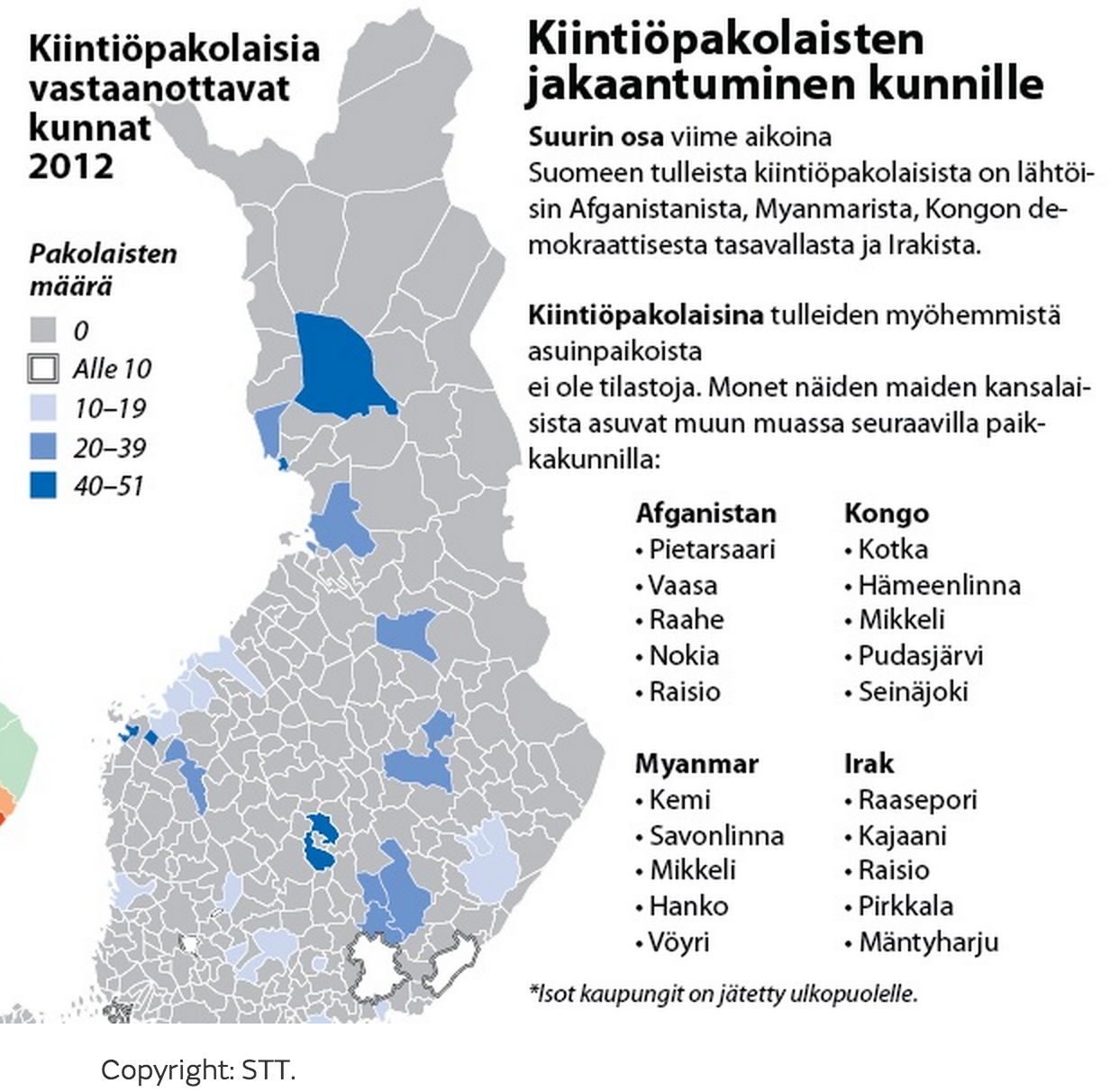
Finland’s map of shame. Only a handful of municipalities in Finland accept quota refugees last year.

Why would a company invest or a skilled immigrant move to a municipality that is hostile to other groups like refugees?

That is why those who claim to be patriotic while they spread hatred and racism are the real menace to our society. They are impoverishing our society economically, socially and robbing it off its greatest asset: the ability to help others in need.

Imagine that the third-largest political party in parliament in Finland is doing just that by inflating our nationalism to bash immigrants, the EU, and our ever-growing cultural diversity.

But the good news is that our ever-growing cultural diversity is here to stay no matter how much some try to exclude and make it invisible.

How does Nelson Mandela (1918-2013) empower us?

Posted on December 6, 2013 by Migrant Tales

The death of Nelson Mandela, who was branded a terrorist by countries like the U.S. and Great Britain, is a sad day full of mourning but full of hope as well. His struggle and triumph over apartheid, a toxic offshoot of white European colonialism, proves that no matter how oppressive a government is, change is possible.

You don’t need an army and the latest sophisticated weapons in your struggle. You can sit in jail for 25 years and eight months and be a force of change.

Never give up your dreams of a better world. US civil rights activist Jesse Jackson summed up Nelson Mandela’s life and example in the following words: “Suffering breeds character. Character breeds faith. In the end faith will not disappoint.”

If there is one person that emulates this quote like a bright shining light of hope, that person is Nelson Mandela.

Even if this great man has left us in body, his example and spirit live on as long as there are oppressed people demanding justice. And there are too many of them today. Their oppression is only possible thanks to our silence, cowardice and ambivalence.

nelson-mandela

Nelson Mandela was not only a transformative force in his country and globally, but believed in reconciliation. Reconciliation shouldn’t mean that we bow our heads and accept what happened, it means we take real concrete steps to challenge and do away with social ills like racism and injustice.

As we mourn Nelson Mandela’s death, the ugly face of racism is raising its head in the continent where colonialism took its treacherous  steps and enslaved millions and committed genocide.

In Finland as in Europe, no matter how much political power parties like the Perussuomalaiset (PS) amass, it can never succeed at making intolerance acceptable. The same goes for other likeminded parties in the Nordic region like the Danish People’s Party, Sweden Democrats and the Progress Party of Norway.

The stronger these parties become and the more power they amass and wield against minorities and our ever-growing cultural diversity, the more power is accumulating on our side.

If the Civil Rights Movement in the U.S. and the struggle to abolish apartheid in South Africa are clear examples that change is possible,  certainly change is possible in Finland and Europe as well.

Nelson Mandela would agree. He’d encourage us to continue our struggle, like today on the first day after passing on.


Maryan Abdulkarim: “Finland is a very racist country”

Posted on December 5, 2013 by Migrant Tales

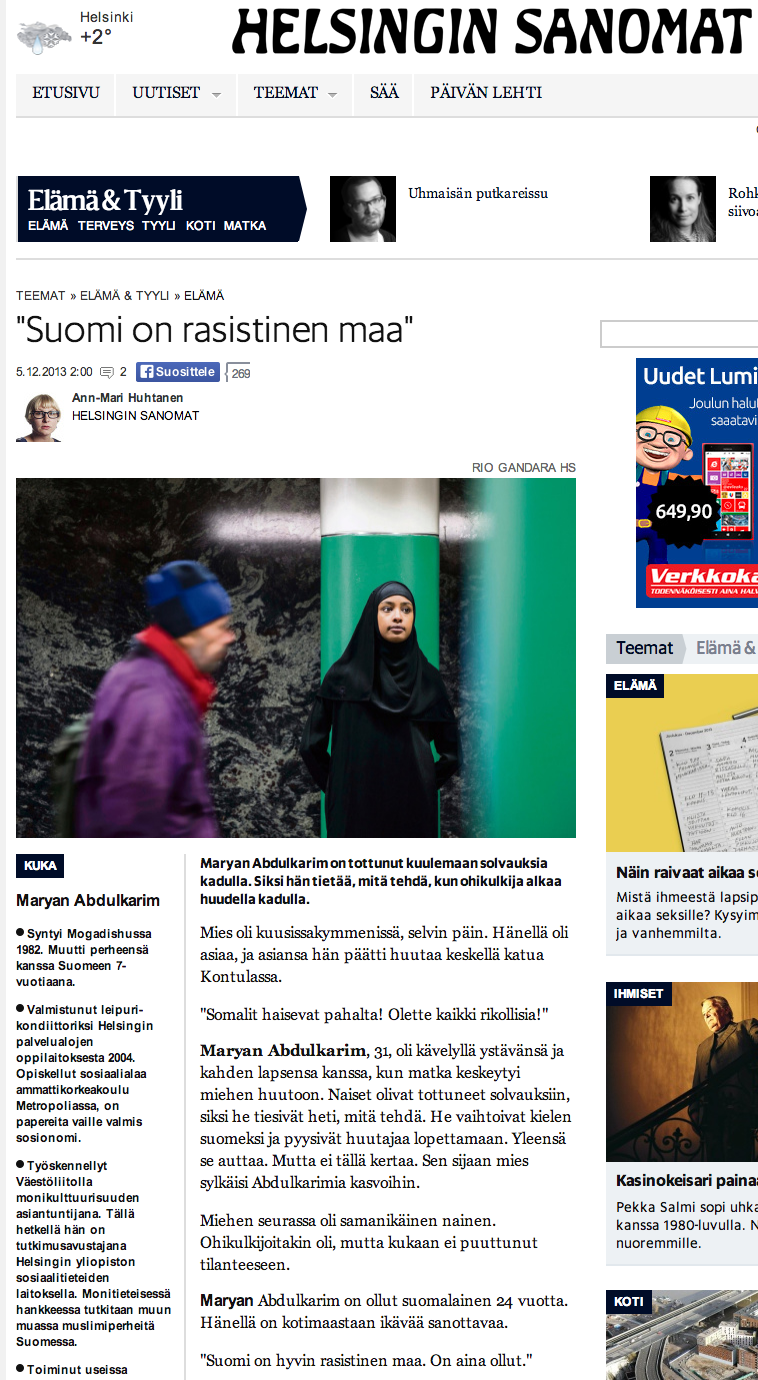
Is there racism in Finland? In order to find the answer to that question, we’d have to ask visible migrants and minorities.  Maryan Abdulkarim, 31, is a Finn who was born in Somalia, had the opportunity on Friday’s Helsingin Sanomat to answer that question. “Finland is a very racist country,” she said. “It always has been.”   

She says that white Finns don’t notice racism in our society because this social ill doesn’t affect them directly. She compares the situation to with those that can’t walk. “If you have two normal-functioning legs, it never crosses your mind what it’s like to move about in a wheelchair in Helsinki,” she said.

And adds: “You have to be in a state of awareness to notice what happens around you. Some react in such a way that they believe they are a bad person if they don’t notice racism [in society]. Others again deny racism and think that acknowledging it makes them racists because they are members of this society.”

Kuvankaappaus 2013-12-5 kello 11.18.57


Read full story (in Finnish) here.

Abdulkarim, who moved to Finland when she was seven, says that silence isn’t the answer when challenging a social ill like racism.

“We have a very vocal racist group [in Finland],” she said. “Their speech isn’t criticism but heresy, oppression and racism.”

Abdulkarim said that it’s not an isolated incident if a stranger shouts in public at a person by harassing him or her with the n-word. Behind such racism is a culture that makes it possible to use such labels because the perpetrator believes he or she is superior.

She herself has been harassed in this manner and once even spat at for speaking out against such abuse.

Migrant Tales agrees and believes that racism in Finland is a much bigger problem than some Finns, politicians and public officials want to admit.

Such a social ill will continue to find refuge and grow in our society as long as we continue to underestimate and deny its presence.

  •  The story publihed Thursday on Helsingin Sanomat about Maryan Abdulkarim was translated on Friday into English by Helsinki Times. Read full translation here.


  • 1
  • 2
  • 3
  • 4
  • …
  • 152
  • Next
Read more about documentary film
Read more

Recent Posts

  • Finland’s tabloids Iltalehti and Ilta-Sanomat are the pits
  • Riikka Purra’s Dr Jekyll and Mr Hyde mask
  • Double standards
  • Perussuomalaiset: Uusi logo, sama vanha juttu
  • Taco Trump

Recent Comments

  1. Absolutely Socking: Racist Finnish Facebook group against human rights gets flooded with socks on Musta Barbaari’s mother and sister charged by the police in “ethnic profiling” case
  2. Ilkka Nuotio on Pekka Myrskylä: “Tilastot kertovat toista kuin poliittinen keskustelu”
  3. Genrih Soinkara on The war in Ukraine and the Russian-Finnish border crisis are showing Finland’s ugly side
  4. Ahti Tolvanen on Comment by Ahti Tolvanen on the Helsinki +50 conference
  5. Angel Barrientos on Angel Barrientos is one of the kind beacons of Finland’s Chilean community

Archives

  • June 2026
  • May 2026
  • April 2026
  • March 2026
  • February 2026
  • January 2026
  • December 2025
  • November 2025
  • October 2025
  • September 2025
  • August 2025
  • July 2025
  • June 2025
  • May 2025
  • April 2025
  • March 2025
  • February 2025
  • January 2025
  • December 2024
  • November 2024
  • October 2024
  • September 2024
  • August 2024
  • July 2024
  • June 2024
  • May 2024
  • April 2024
  • March 2024
  • February 2024
  • January 2024
  • December 2023
  • November 2023
  • October 2023
  • September 2023
  • August 2023
  • July 2023
  • June 2023
  • May 2023
  • April 2023
  • March 2023
  • February 2023
  • January 2023
  • December 2022
  • November 2022
  • October 2022
  • September 2022
  • August 2022
  • July 2022
  • June 2022
  • May 2022
  • April 2022
  • March 2022
  • February 2022
  • January 2022
  • December 2021
  • November 2021
  • October 2021
  • September 2021
  • August 2021
  • July 2021
  • June 2021
  • May 2021
  • April 2021
  • March 2021
  • February 2021
  • January 2021
  • December 2020
  • November 2020
  • October 2020
  • September 2020
  • August 2020
  • July 2020
  • June 2020
  • May 2020
  • April 2020
  • March 2020
  • February 2020
  • January 2020
  • December 2019
  • November 2019
  • October 2019
  • September 2019
  • August 2019
  • July 2019
  • June 2019
  • May 2019
  • April 2019
  • March 2019
  • February 2019
  • January 2019
  • December 2018
  • November 2018
  • October 2018
  • September 2018
  • August 2018
  • July 2018
  • June 2018
  • May 2018
  • April 2018
  • March 2018
  • February 2018
  • January 2018
  • December 2017
  • November 2017
  • October 2017
  • September 2017
  • August 2017
  • July 2017
  • June 2017
  • May 2017
  • April 2017
  • March 2017
  • February 2017
  • January 2017
  • December 2016
  • November 2016
  • October 2016
  • September 2016
  • August 2016
  • July 2016
  • June 2016
  • May 2016
  • April 2016
  • March 2016
  • February 2016
  • January 2016
  • December 2015
  • November 2015
  • October 2015
  • September 2015
  • August 2015
  • July 2015
  • June 2015
  • May 2015
  • April 2015
  • March 2015
  • February 2015
  • January 2015
  • December 2014
  • November 2014
  • October 2014
  • September 2014
  • August 2014
  • July 2014
  • June 2014
  • May 2014
  • April 2014
  • March 2014
  • February 2014
  • January 2014
  • December 2013
  • November 2013
  • October 2013
  • September 2013
  • August 2013
  • July 2013
  • June 2013
  • May 2013
  • April 2013
  • March 2013
  • February 2013
  • January 2013
  • December 2012
  • November 2012
  • October 2012
  • September 2012
  • August 2012
  • July 2012
  • June 2012
  • May 2012
  • April 2012
  • March 2012
  • February 2012
  • January 2012
  • December 2011
  • November 2011
  • October 2011
  • September 2011
  • August 2011
  • July 2011
  • June 2011
  • May 2011
  • April 2011
  • March 2011
  • February 2011
  • January 2011
  • December 2010
  • November 2010
  • October 2010
  • September 2010
  • August 2010
  • July 2010
  • June 2010
  • May 2010
  • April 2010
  • March 2010
  • February 2010
  • January 2010
  • December 2009
  • November 2009
  • October 2009
  • September 2009
  • August 2009
  • July 2009
  • December 2008
  • November 2008
  • October 2008
  • September 2008
  • August 2008
  • July 2008
  • June 2008
  • May 2008
  • April 2008
  • March 2008
  • February 2008
  • January 2008
  • November 2007
  • October 2007
  • September 2007
  • August 2007
  • July 2007
  • June 2007
  • May 2007

Categories

  • ?? Gia L?c
  • ????? ?????? ????? ???????? ?? ??????
  • ???????
  • @HerraAhmed
  • @mondepasrond
  • @nohatefinland
  • @oula_silver
  • @Varathas
  • A Pakistani family
  • äärioikeisto
  • Abbas Bahmanpour
  • Abdi Muhis
  • Abdirahim Hussein Mohamed
  • Abdirahim Husu Hussein
  • Abdirisak Mahamed
  • About Migrant Tales
  • activism
  • Adam Al-Sawad
  • Adel Abidin
  • Afrofinland
  • Ahmed IJ
  • Ahti Tolvanen
  • Aino Pennanen
  • Aisha Maniar
  • Alan Ali
  • Alan Anstead
  • Alejandro Díaz Ortiz
  • Alekey Bulavsev
  • Aleksander Hemon
  • Aleksanterinliitto
  • Aleksanterinliitto ry
  • Aleksanterinliitto ry:n hallitus
  • Alex Alex
  • Alex Mckie
  • Alexander Nix
  • Alexandra Ayse Albayrak
  • Alexis Neuberg
  • Ali Asaad Hasan Alzuhairi
  • Ali Hossein Mir Ali
  • Ali Rashid
  • Ali Sagal Abdikarim
  • Alina Tsui
  • Aline Müller
  • All categories
  • Aman Heidari
  • Amiirah Salleh-Hoddin & Jana Turk
  • Amin A. Alem
  • Amir Zuhairi
  • Amkelwa Mbekeni
  • Ana María Gutiérrez Sorainen
  • Anachoma
  • Anders Adlecreutz
  • Angeliina Koskinen
  • Anna De Mutiis
  • Anna María Gutiérrez Sorainen
  • Anna-Kaisa Kuusisto ja Jaakko Tuominen
  • Annastiina Kallius
  • Anneli Juise Friman Lindeman
  • Announcement
  • Anonymous
  • Antero Leitzinger
  • anti-black racism
  • Anti-Hate Crime Organisation Finland
  • Anudari Boldbaatar
  • Arshiya Nasser
  • Aspergers Syndrome
  • Asylum Corner
  • Asylum seeker 406
  • Athena Griffin and Joe Feagin
  • Autism
  • Avaaz.org
  • Awale Olad
  • Ayan Said Mohamed
  • AYY
  • Barachiel
  • Bashy Quraishy
  • Beatrice Kabutakapua
  • Beri Jamal
  • Beri Jamal and Enrique Tessieri
  • Bertolt Brecht
  • Boiata
  • Boodi Kabbani
  • Bruno Gronow
  • Carmen Pekkarinen
  • Çelen Oben and Sheila Riikonen
  • Chiara Costa-Virtanen
  • Chiara Costa-Virtanen
  • Chiara Sorbello
  • Christian Thibault
  • Christopher Wylie
  • Clara Dublanc
  • Dana
  • Daniel Malpica
  • Danilo Canguçu
  • David Papineau
  • David Schneider
  • Dexter He
  • Don Flynn
  • Dr Masoud Kamali
  • Dr. Faith Mkwesha
  • Dr. Theodoros Fouskas
  • Edna Chun
  • Eeva Kilpi
  • Emanuela Susheela
  • En castellano
  • ENAR
  • Enrique
  • Enrique Tessieri
  • Enrique Tessieri & Raghad Mchawh
  • Enrique Tessieri & Yahya Rouissi
  • Enrique Tessieri and Muhammed Shire
  • Enrique Tessieri and Sira Moksi
  • Enrique Tessieri and Tom Vandenbosch
  • Enrique Tessieri and Wael Che
  • Enrique Tessieri and Yahya Rouissi
  • Enrique Tessieri and Zimema Mhone
  • Epäluottamusmies
  • EU
  • Europe
  • European Islamophobia Report
  • European Islamophobia Report 2019,
  • European Union
  • Eve Kyntäjä
  • Ezequiel Caldeiro
  • Facebook
  • Fadumo Dayib
  • Faisa Kahiye
  • Farhad Manjoo
  • Fasismi
  • Finland
  • Fizza Qureshi
  • Flyktingar och asyl
  • Foreign Student
  • Fozia Mir-Ali
  • Frances Webber
  • Frida Selim
  • Gareth Rice
  • Ghyslain Vedeaux
  • Global Art Point
  • Great Replacement
  • Habiba Ali
  • Hami Bahadori
  • Hami Bahdori
  • Hamid
  • Hamid Alsaameere
  • Hamid Bahdori
  • Handshake
  • Harmit Athwal
  • Hassan Abdi Ali
  • Hassan Muhumud
  • Heikki Huttunen
  • Heikki Wilenius
  • Helsingin Sanomat
  • Henning van der Hoeven
  • Henrika Mälmsröm
  • Hser Hser
  • Hser Hser ja Mustafa Isman
  • Husein Muhammed
  • Hussain Kazemian
  • Hussain Kazmenian
  • Ibrahim Khan
  • Ida
  • Ignacio Pérez Pérez
  • Iise Ali Hassan
  • Ilari Kaila & Tuomas Kaila
  • Imam Ka
  • inside-an-airport
  • Institute of Race Relations
  • Iraqi asylum seeker
  • IRR European News Team
  • IRR News Team
  • Islamic Society of Norhern FInland
  • Islamic Society of Northern Finland
  • Islamophobia
  • Jacobinmag.com
  • Jallow Momodou
  • Jan Holmberg
  • Jane Elliott
  • Jani Mäkelä
  • Jari Luoto
  • Jari Taponen
  • Jegor Nazarov
  • Jenni Stammeier
  • Jenny Bourne
  • Jessie Daniels
  • Joe Davidow
  • Johannes Koski
  • John D. Foster
  • John Grayson
  • John Marriott
  • Jon Burnett
  • Jorma Härkönen
  • Jos Schuurmans
  • José León Toro Mejías
  • Josue Tumayine
  • Jouni Karnasaari
  • Juan Camilo
  • Jukka Eräkare
  • Julian Abagond
  • Julie Pascoet
  • Jussi Halla-aho
  • Jussi Hallla-aho
  • Jussi Jalonen
  • JusticeDemon
  • Kadar Gelle
  • Kaksoiskansalaisuus
  • Kansainvälinen Mikkeli
  • Kansainvälinen Mikkeli ry
  • Katherine Tonkiss
  • Kati Lepistö
  • Kati van der Hoeven-Lepistö
  • Katie Bell
  • Kättely
  • Kerstin Ögård
  • Keshia Fredua-Mensah & Jamie Schearer
  • Khadidiatou Sylla
  • Khadra Abdirazak Sugulle
  • Kiihotus kansanryhmää vastaan
  • Kirsi Crowley
  • Koko Hubara
  • Kristiina Toivikko
  • Kubra Amini
  • KuRI
  • La Colectiva
  • La incitación al odio
  • Laura Huhtasaari
  • Lauri Finér
  • Leif Hagert
  • Léo Custódio
  • Leo Honka
  • Leontios Christodoulou
  • Lessie Branch
  • Lex Gaudius
  • Leyes de Finlandia
  • Liikkukaa!
  • Linda Hyökki
  • Liz Fekete
  • M. Blanc
  • Maarit Snellman
  • Mahad Sheikh Musse
  • Maija Vilkkumaa
  • Malmin Kebab Pizzeria Port Arthur
  • Marcell Lorincz
  • Mari Aaltola
  • María Paz López
  • Maria Rittis Ikola
  • Maria Tjader
  • Marja-Liisa Tolvanen
  • Mark
  • Markku Heikkinen
  • Marshall Niles
  • Martin Al-Laji
  • Maryan Siyad
  • Matt Carr
  • Mauricio Farah Gebara
  • Media Monitoring Group of Finland
  • Micah J. Christian
  • Michael McEachrane
  • Michele Levoy
  • Michelle Kaila
  • Migrant Tales
  • Migrant Tales Literary
  • Migrantes News
  • Migrants' Rights Network
  • MigriLeaks
  • Mikko Kapanen
  • Miriam Attias and Camila Haavisto
  • Mohamed Adan
  • Mohammad Javid
  • Mohammad M.
  • Monikulttuurisuus
  • Monisha Bhatia and Victoria Canning
  • Mor Ndiaye
  • Muh'ed
  • Muhamed Abdimajed Murshid
  • Muhammed Shire
  • Muhammed Shire and Enrique Tessieri
  • Muhis Azizi
  • Musimenta Dansila
  • Muslimiviha
  • Musulmanes
  • Namir al-Azzawi
  • Natsismi
  • Neurodiversity
  • New Women Connectors
  • Nils Muižnieks
  • No Labels No Walls
  • Noel Dandes
  • Nuor Dawood
  • Omar Khan
  • Otavanmedia
  • Oula Silvennoinen
  • Paco Diop
  • Pakistani family
  • Pentti Stranius
  • Perussuomalaiset
  • perustuslaki
  • Petra Laiti
  • Petri Cederlöf
  • Pia Grochowski
  • Podcast-lukija Bea Bergholm
  • Pohjois – Suomen Islamilainen Yhdyskunta
  • Pohjois Suomen Islamilainen Yhyskunta
  • Polina Kopylova
  • Race Files
  • racism
  • Racism Review
  • Raghad Mchawh
  • Ranska
  • Rashid H. and Migrant Tales
  • Rasismi
  • Raul Perez
  • Rebecka Holm
  • Reem Abu-Hayyeh
  • Refugees
  • Reija Härkönen
  • Remiel
  • Reza Nasri
  • Richard Gresswell
  • Riikka Purra
  • Risto Laakkonen
  • Rita Chahda
  • Ritva Kondi
  • Robito Ibrahim
  • Roble Bashir
  • Rockhaya Sylla
  • Rodolfo Walsh
  • Roger Casale
  • Rostam Atai
  • Roxana Crisólogo Correa
  • Ruth Grove-White
  • Ruth Waweru-Folabit
  • S-worldview
  • Sadio Ali Nuur
  • Sami Rusanen
  • Sandhu Bhamra
  • Sara de Jong
  • Sarah Crowther
  • Sari Alhariri
  • Sarkawt Khalil
  • Sasu
  • Scot Nakagawa
  • Shabana Ahmadzai
  • Shada Islam
  • Sharon Chang blogs
  • Shenita Ann McLean
  • Shirlene Green Newball
  • Sini Savolainen
  • Sira Moksi
  • Sonia K.
  • Sonia Maria Koo
  • Steverp
  • Stop Deportations
  • Suldaan Said Ahmed
  • Suomen mediaseurantakollektiivi
  • Suomen Muslimifoorumi ry
  • Suomen viharikosvastainen yhdistys
  • Suomen viharikosvastainen yhdistys ry
  • Suomi
  • Supermen
  • Susannah
  • Suva
  • Syrjintä
  • Talous
  • Tapio Tuomala
  • Taw Reh
  • Teivo Teivainen
  • The Daily Show
  • The Heino
  • The Supermen
  • Thomas Elfgren
  • Thulfiqar Abdulkarim
  • Tim McGettigan
  • Tino Singh
  • Tito Moustafa Sliem
  • Tobias Hübinette and L. Janelle Dance
  • Transport
  • Trica Danielle Keaton
  • Trilce Garcia
  • Trish Pääkkönen
  • Trish Pääkkönen and Enrique Tessieri
  • Tuulia Reponen
  • Uncategorized
  • UNITED
  • University of Eastern Finland
  • Uyi Osazee
  • Väkivalta
  • Vapaa Liikkuvuus
  • Venla-Sofia Saariaho
  • Vieraskynä
  • W. Che
  • W. Che an Enrique Tessieri
  • Wael Ch.
  • Wan Wei
  • Women for Refugee Women
  • Xaan Kaafi Maxamed Xalane
  • Xassan Kaafi Maxamed Xalane
  • Xassan-Kaafi Mohamed Halane & Enrique Tessieri
  • Yahya Rouissi
  • Yasmin Yusuf
  • Yassen Ghaleb
  • Yle Puhe
  • Yuliet Tresa
  • Yve Shepherd
  • Zahra Khavari
  • Zaker
  • Zalina Ametova
  • Zamzam Ahmed Ali
  • Zeinab Amini ja Soheila Khavari
  • Zimema Mahone and Enrique Tessieri
  • Zimema Mhone
  • Zoila Forss Crespo Moreyra
  • ZT
  • Zulma Sierra
  • Zuzeeko Tegha Abeng
© 2026 Migrant tales | Powered by Minimalist Blog WordPress Theme