When my wife told me about Tuesday’s A-studio talk show, my instant reaction was who the host was. With some dread, I found out that Marja Sannikka hosted the show. The A-studio host has made a name for herself on her shows by labeling and victimizing asylum seekers and minorities.
The latest incident was on Tuesday when Sannikka didn’t object to the PS guest, Simo Grönroos, a far-right Suomen Sisu association member, using the word “harmful” immigration. The PS is the only party in Finland that uses the derogatory term to label and victimize certain groups like Muslims and Africans.
One approach to such a toxic description of asylum seekers and migrants is if people can be placed into good and bad groups. Other favorites of the PS in their quest to tar-and-feather certain migrants are “cheap labor” and “social welfare migrants,” among others.
We believe each migrant is an individual, and labeling them in groups and subgroups is racist.
Source: Twitter
Here are some of Sannikka’s talk show “hits:”
Perussuomalaiset’s (PS)* Simo Grönroos labels particular asylum seekers (not Ukrainians) as “harmful migrants.” The PS is the only party that uses such a derogatory term. Sannikka did nothing to stop or question Grönroos’s use of the term but asked her guests what they thought about “harmful” migrants. May 9, 2023
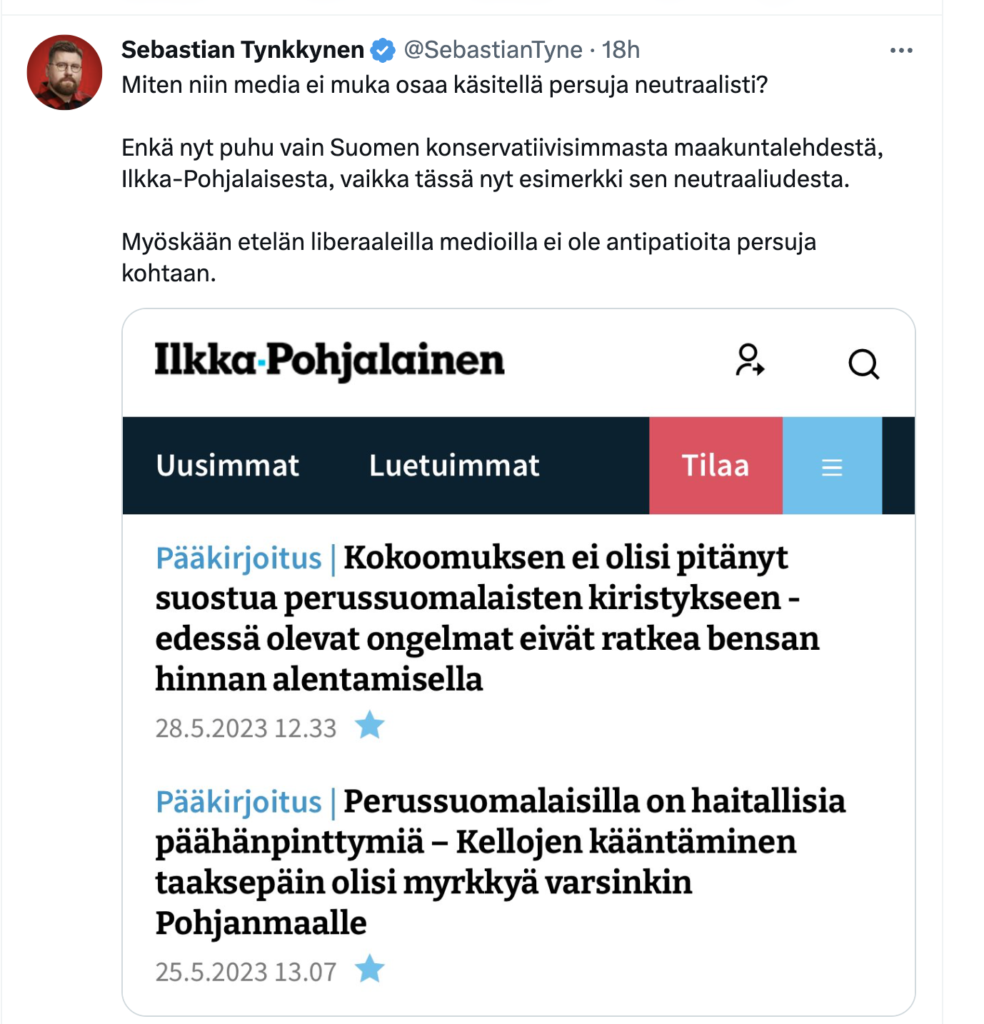
PS MP Sebastian Tynkkynen, convicted three times for ethnic agitation, was invited to host Sannikka’s A-studio to talk about freedom of expression, ethnic agitation, and burning the Quran.
Sannikka helped spread fear in Finland about minority youth gang violence. She introduced the topic like a crime thriller:“ Knives, violence, revenge. Youth gang violence increases at a worrying pace (sic!). October 25, 2022
Guest Esko Valtaoja used the n-word twice on her talk show without any objections from Sannikka (see caption below). November 21, 2021 While she said nothing on her talk show, she later apologized for the n-word incident.
Finland is suffering from a chronic labor shortage in the face of an ever-shrinking labor force and graying of the population. If you want some friendly advice, Finland would be one of the last countries in Europe I’d move to. There are several reasons you should think twice before moving here.
One of the main reasons you should choose a friendlier country to build your future and bring up a family is that Finland is a hostile country towards migrants, especially Muslims and visible migrants.
We have asylum seekers who have been in legal limbo for eight years. Anywhere up to 10,000 people, according to some estimates, are undocumented.
Don’t be fooled by superficial surveys that claim Finland to be the happiest country in the world. It’s only a PR stunt. But here is the question: How can the happiest country have its second-biggest party in parliament, the Perussuomalaiaset (PS)*, be openly racist and hostile to migrants?
You have a choice: If you are white and can flow with the xenophobia, Finland could be a good country for you. Who knows, maybe you can become an example of a super migrant as seen by xenophobic politicians.
Finland’s Perussuomalaiset (PS)* is a far-right whose loudest message are foreigners and minorities threaten the country.
It’s been a while since the PS won its historic election in 2011. While downplaying their victory and rise to the major Finnish political league, people like me knew that this spelled trouble for our democracy.
The PS’ is very good at ethnic- and migration-bating through far-right conspiracy theories like the great replacement. Riikka Purra and the PS want their followers to be constantly angry even if matters are not as bad as they claim.
A new row has erupted in government talks with the PS after Sebastian Tynkkynen asked his followers which YLE content is unnecessary. Mauri Peltokangas, a cantankerous politician who named the government “pitiful a**holes,” lashed out at the Swedish People’s Party.
“I want your opinion,” he wrote on Facebook. “is it really the will of the people that a minority party with a few percent of support should be allowed to fuck around and stir the pot in government negotiations when forming a government n Finland? Och samma på svenska (the same in Swedish).”
#Rasismi on vakava ongelma, ja sen harjoittamisella on monenlaisia seurauksia.
Se voi johtaa sosiaaliseen eristäytymiseen, syrjintään ja muihin negatiivisiin seurauksiin. Rasismin harjoittaminen pitäisi myös johtaa oikeudellisiin seuraamuksiin, kuten sakkoihin tai vankeuteen, riippuen teon vakavuudesta. On tärkeää, että yhteiskunta tuomitsee rasistisen käytöksen ja tarjoaa tukea uhreille.
Rasismin kohteeksi joutumineni on hyvin haitallista nuorille. Se aiheuttaa ahdistusta, masennusta ja muita mielenterveysongelmia.
Se voi myös vaikuttaa nuorten itsetuntoon ja heidän kykyynsä luottaa muihin ihmisiin. On tärkeää, että nuoria tuetaan ja rohkaistaan puhumaan kokemuksistaan ja tunteistaan.
Meidän kaikkien vastuulla on myös puuttua rasismin ilmiöihin ja tarjota turvallinen ja kunnioittava ympäristö kaikille nuorille.
Euroopassa on paljon ksenofobisia puolueita.
Yhteiskunnassa, jossa poliitikot voivat kirjoittaa rasistisia kirjoituksia vähemmistöistä ilman seurauksia, on suuri riski syrjinnän ja epätasa-arvon lisääntymiselle. Tämä voi johtaa yhteiskunnan jakautumiseen, jossa jotkut ryhmät ovat toisia paremmassa asemassa, mikä puolestaan voi johtaa yhteiskunnallisiin jännitteisiin ja konflikteihin. On tärkeää, että kaikki yhteiskunnan jäsenet, myös poliitikot, toimivat syrjimättömästi ja kunnioittavat kaikkia kansalaisia.
Jos poliitikkojen rasistisiin ilmaisuihin ja kirjoituksiin ei puututa, se voi johtaa yhteiskunnan jakautumiseen ja epätasa-arvoon.
Tällainen yhteiskunta ei ole kestävä, ja se vaarantaa demokratian ja ihmisoikeudet. On tärkeää, että yhteiskunnassa on nollatoleranssi rasismille ja että poliitikot toimivat esimerkkinä hyväksyttävästä käytöksestä.
Lisäksi se voi johtaa siihen, että jotkut ryhmät tuntevat olonsa syrjityiksi ja turvattomiksi. Tämä puolestaan voi heikentää ihmisten luottamusta poliittiseen järjestelmään ja vaarantaa demokratian. On tärkeää, että kaikki yhteiskunnan jäsenet, myös poliitikot, toimivat syrjimättömästi ja kunnioittavat kaikkia kansalaisia.
Poliitikkojen tulisi edustaa kaikkia kansalaisia, eikä heidän pitäisi käyttää rasistisia kirjoituksia tai kieltä missään tilanteessa. Poliitikkojen, jotka käyttävät rasistista kieltä, tulisi joutua vastuuseen teoistaan. Tämä voi tarkoittaa esimerkiksi julkista anteeksipyyntöä, erottamista tai muita poliittisia seuraamuksia. On tärkeää, että yhteiskunnassa on nollatoleranssi rasismille, ja että poliitikot toimivat esimerkkinä hyväksyttävästä käytöksestä.
Muiden poliitikkojen tulisi reagoida nopeasti ja selvästi rasistisiin kirjoituksiin ja puheisiin. Heidän tulisi tuomita tällainen käytös julkisesti ja osoittaa, että tällainen käytös on täysin vastoin heidän arvojaan ja periaatteitaan. Poliitikkojen tulisi myös olla esimerkkinä muille ja edistää yhdenvertaisuutta ja moninaisuutta kaikessa toiminnassaan.
Esimerkki siitä, mitä tapahtuu, kun poliitikot sallivat tai jopa edistävät rasismia, on Yhdysvaltojen rotuerottelulait, joka oli voimassa vuosina 1896-1964. Rotuerottelulait mahdollistivat syrjinnän mustiin ihmisiin perustuen heidän ihonväriinsä. Tämä johti siihen, että mustat ihmiset joutuivat kokemaan erilaisia syrjintään liittyviä ongelmia, kuten rajoituksia koulutukseen, asumiseen ja työpaikkoihin. Rotuerottelulait vaikuttivat kielteisesti mustien ihmisten elämään ja heidän perheisiinsä useiden vuosikymmenten ajan. Tämä on esimerkki siitä, miten rasistinen politiikka voi johtaa epätasa-arvoon ja syrjintään yhteiskunnassa.
Toinen esimerkki siitä, mitä tapahtuu, kun poliitikot sallivat tai jopa edistävät rasismia, on natsihallinnon aikainen juutalaisvaino Saksassa 1930-luvulla. Natsihallinnon aikana juutalaisia syrjittiin ja heidän oikeuksiaan rajoitettiin. Juutalaisia karkotettiin kouluista, heidän omaisuutensa takavarikoitiin ja heidän kansalaisoikeuksiaan rajoitettiin. Tämä johti siihen, että monet juutalaiset joutuivat lähtemään maasta ja monilla oli hyvin vaikeaa selviytyä. Juutalaisvaino on esimerkki siitä, miten rasistinen politiikka voi johtaa ihmisoikeusloukkauksiin ja vakavaan kärsimykseen yhteiskunnassa.
Rasistinen ilmapiiri voi johtaa moniin kielteisiin seurauksiin Suomessa. Jos rasismi sallitaan jatkossa, se voi johtaa siihen, että ihmiset joutuvat kokemaan syrjintää ja epätasa-arvoa eri elämänalueilla, kuten koulutuksessa, työpaikoilla ja asumisessa. Tämä voi myös johtaa siihen, että ihmiset eristäytyvät toisistaan ja yhteiskunnallinen ilmapiiri muuttuu vihamieliseksi. Rasistinen ilmapiiri voi myös vaikuttaa Suomen kansainväliseen maineeseen ja heikentää maan taloudellista asemaa. Siksi on tärkeää pyrkiä edistämään yhdenvertaisuutta ja torjumaan rasismia kaikilla yhteiskunnan tasoilla.
Nollatoleranssi rasismille tarkoittaa sitä, että kaikenlainen rasistinen käytös ja puhe on ehdottomasti kiellettyä ja siihen puututaan heti kun se havaitaan. Rasistinen käytös ja puhe voi olla syrjivää, loukkaavaa ja vahingoittaa ihmisiä eri tavoin. Nollatoleranssi rasismille on keino edistää yhdenvertaisuutta ja torjua syrjintää kaikilla yhteiskunnan tasoilla. Se tarkoittaa sitä, että rasismiin ei suvaita mitään syytä tai perustelua, ja että kaikki rasistiset teot ja sanat tuomitaan.
Jos puolueen politiikka on rasistinen, se on vastoin nollatoleranssia ja voi aiheuttaa haittaa yhteiskunnalle. On tärkeää, että poliittiset puolueet ja johtajat vastustavat rasismia ja edistävät tasa-arvoa ja oikeudenmukaisuutta kaikille ihmisille.
NYT ON AIKA TOTEUTTAA NOLLATOLERANSSI RASISMILLE !! ⒸMahad
There are two opinions about the far-right Perussuomalaiset (PS)* membership in a future coalition government led by the National Coalition Party (Kokoomus): Let them join so the public will see who they are – a cantankerous and messy jumble of bitter hot air; and others point to giving former President Donald Trump the benefit of the doubt, which gave us his toxic polarizing legacy.
We are going through the same arguments about the PS as after the 2011 election when the party scored a historic victory when the party got 39 MPs elected from 5 MPs previously.
“Don’t worry,” some pointed out back then. “It will only be a matter of time before the PS will implode like what happened with the Rural Party (SMP) in the 1970s,”
In 2017, the election of Jussi Halla-aho as the leader of the PS resulted in a small implosion that divided the party into two factions. This event marked the downfall of former PS chief Timo Soini and serves as a prime example of karma. Politically exploiting racism is akin to handling a rabid dog that may bite back with force beyond your control.
Soini is today a wounded politician with his credibility in tatters.
The same fate that Soini suffered threatens Petteri Orpo and the National Coalition Party (Kokoomus).
We should not be surprised that the PS’ second chairperson after Soini, Riikka Purra, considers our constitutional and human rights obstacles to her political ambitions and goals. Her political ideology like that of the party, is based on Finnish white supremacy.
Riikka Purra tweets: “The Finnish government has little chance of influencing anything if you ask the left. The obstacles are at least human rights, the constitution, the EU, international treaties, morality, empathy, [international] image, press freedom, and of course, the correct conclusion[s] of botched investigation[s].”
It would be simplistic to blame only Soini for the rise of a far-right party in Finland. The list includes the whole political spectrum, the media, the education sector, institutions like the police, and denial with a towering D.
In Finland’s parliamentary election in April, the country shifted abruptly from a left-wing government led by the charismatic Social Democratic Prime Minister Sanna Marin to a possible right-wing government. Some see the good result of the conservative National Coalition Party, and especially the far-right Perussuomalaiset (PS),* as a threat to those values, social welfare, and solidarity held dear to the welfare state.
Like in neighboring Sweden, the far-right Sweden Democrats did well in the election and helped boost the right-wing bloc to victory through cooperation with the Moderate Party. In Finland, the National Coalition Party is ready to give the PS a ticket to become a government coalition member.
Following the PS’ election victory of 2011, which saw their MPs increase from 5 to 39, the far-right party has done exceptionally well in parliamentary elections. In the last election, the PS saw its MPs rise to 46, a record.
The PS’ claim of success lies in spreading news stories about migrant crime to lure voters with the help of the media and police.
With some PS politicians openly supporting Viktor Orbán of Hungary, former President Donald Trump, and even violent far-right groups, do populism and polarization threaten Finland’s democracy?
In an interview with the Finnish League of Human Rights, Eliza Ruynowski, a human rights lawyer from Poland, cautioned Finns to avoid accepting simplistic solutions to complex issues. She advised them to be cautious of individuals who blame specific groups of people, whether they belong to a minority or hold differing political views, as a means of resolving problems.
But let’s go back in time to uncover the dangerous political path Finland, and the rest of Europe, are on.
In reporting about Adolph Eichmann’s trial in Israel in 1961, philosopher Hannah Arendt described the war criminal responsible for transporting millions of Jews to their deaths as an ordinary bureaucrat who, in her own words, was “neither perverted nor sadistic, but “terrifyingly normal.”
Arendt called this disposition the banality of evil or the state where Eichmann performed evil deeds without evil intentions. Thus he could fulfill his tasks diligently irrespective of their horrific crimes by the inability to think from the victim’s standpoint.
At the Nuremberg trials (1945-46), US Army psychologist Captain Gustave Mark Gilbert stated that the Nazi war criminals on the dock had one matter in common: Their incapacity to feel with their fellow men and women.
Asmaa is a black woman born in Finland who studies at the South-Eastern Finland University of Applied Sciences (Xamx). She was adamant about why she does not trust,never mind reads, the Finnish media. She emaileda response: I don’t read Finnish newspapers and none in particular. I find them very taxing to read. Constantly, people who look like me are vilified, branded as the devil himself and the root cause of all problems.“
Asmaa’s reply is an earnest response to a problem that reflects the media and Finnish society.
What are Finnish media giants like Helsingin Sanomat and others doing to fix the chronic lack of credibility in the eyes of some minorities? I suspect the answer is short and to the point: Nothing spectacular.
Although we remain hopeful and trust that the Finnish strive for impartial and equitable reporting that acknowledges the nation’s growing cultural diversity, progress has been sluggish.
Alma Median EU vaalikone vuodelta 2019 on paljastunut, että perussuomalaisten ja kokoomuslaisten ehdokkaat ovat kaikista innokkaimpia hukuttamaan maahanmuuttajia Välimereen. Tähän vaalikonen kysymykseen neutraali vastaus on vähintään ongelmallinen. Tarkoittavatko, että olevat hiljaa ja katsovat sormien läpi kun ihmiset hukkuvat?
Vaalikonen 13/20 kysymys: “EU:n velvollisuus on pelastaa kaikki hukkumisriskillä Välimeren ylittävät Eurooppaan pyrkivät siirtolaiset.”
Keitä ovat nämä (85/234) EU ehdokkaat, jotka eivät välittää, jos ihminen hukkuu Välimereen?
Tässä on kirjoitus, joka kertoo tosi tarina ihmisestä, joka oli lähellä kuolemaa Välimerellä.
Lapsia hukkuu myös Välimerellä. Vasemmalla on Alan Kurdi ja oikealla pikku tyttö. Yheensä 2014-2019 aikana on kuolut yhteensä 18 328 ihmistä (2019 410, 2018 2 299, 2017 3 139, 2016 5 143, 2015 5 054, 2014 3 283) Välimerellä. Tässä linkki.
Finland’s next government will likely comprise of four parties: National Coalition Party (Kokoomus), Perussuomalaiset (PS)*, Swedish People’s Party, and Christian Democrats, according to Helsingin Sanomat. Even if the makeup of the government was pretty clear at the onset, many questions remain.
One is Finland’s chronic labor shortage and PS opposition to asylum seekers and labor migrants. Despite differences with the PS on labor migrants, Prime Minister-elect Petteri Orpo is more focused on having a right-wing government than sharing power with the Social Democrats.
The new government will have a majority (109 seats) in the 200-seat parliament. Source: Yle.
While we can criticize Kokoomus for giving a political platform for the PS to spread its populist rhetoric, one shameful member of the new government is the Swedish People’s Party.
While it is fair to say that the Swedish People’s Party is divided about joining the new government with the PS, it’s clear that the new coalition will be highly flammable and unpredictable.
Those that stand to lose the most with the new government’s austerity policies are the most vulnerable sectors of society: the unemployed, low-wage workers, and minorities like people of color. Even so, the biggest losers will be asylum seekers from outside the EU knocking at our door for shelter.