The quantity of explosives that have been dropped on Gaza has exceeded 12.000 tons, equivalent to the size of the nuclear bomb dropped on Hiroshima. Bear in mind that Gaza (45km²) is one-third the size of Nagasaki. More than 2.2 million Palestinians live in Gaza, an area about 40km long and 10km wide at its widest point!
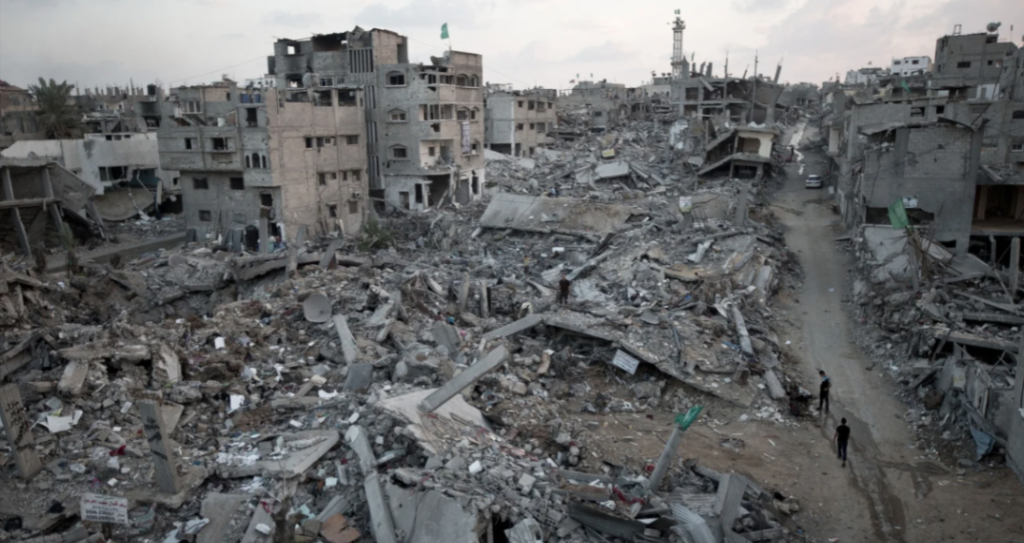
The destruction of Gaza. Open Source.
The foreign minister of Israel who in the UN had all the audacity to say out loud “from now on there is no place for balanced positions” is not somehow questioned by any of the media in EU as if those words are okay, acceptable and encouraged. Which is the case adopted by the Media, the free world’s most prestigious tool and moral judge took a side and enabled the following:
Israeli politician Moshe Feiglin on channel 14 (Israeli tv), went even farther: “Do not leave a stone upon stone in Gaza. Gaza needs to turn to Dresden. Complete incineration. Annihilate Gaza now.!”
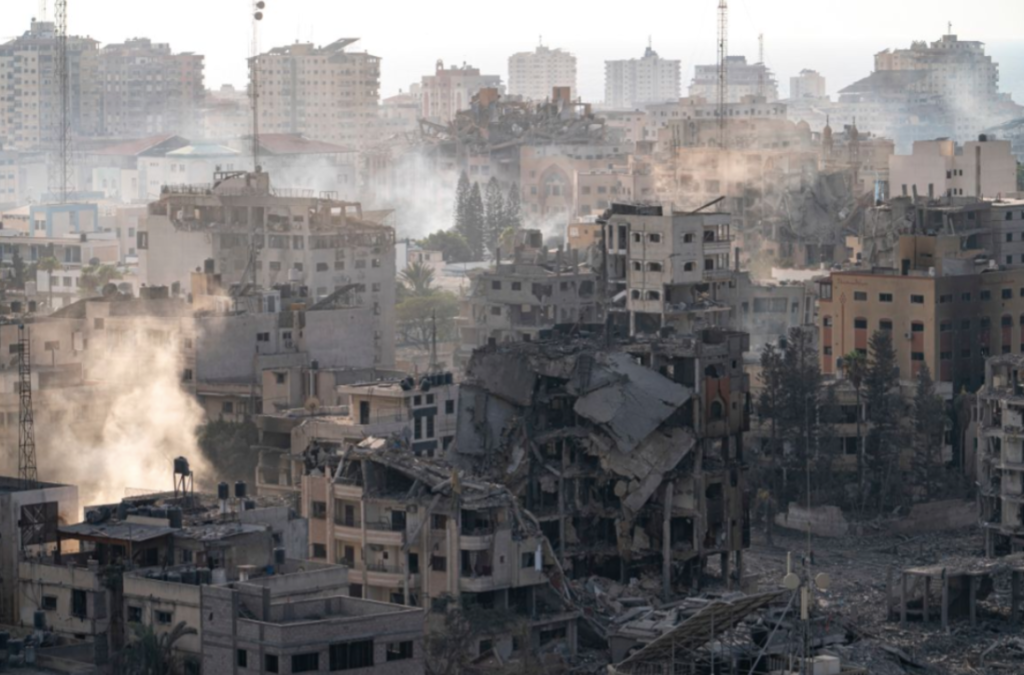
Daniel Hagari, IDF spokesman said on October 10th in Ha’aretz newspaper: “We are dropping hundreds of tons of bombs on Gaza. The focus is on destruction, not accuracy”
On the ground that is what is happening:
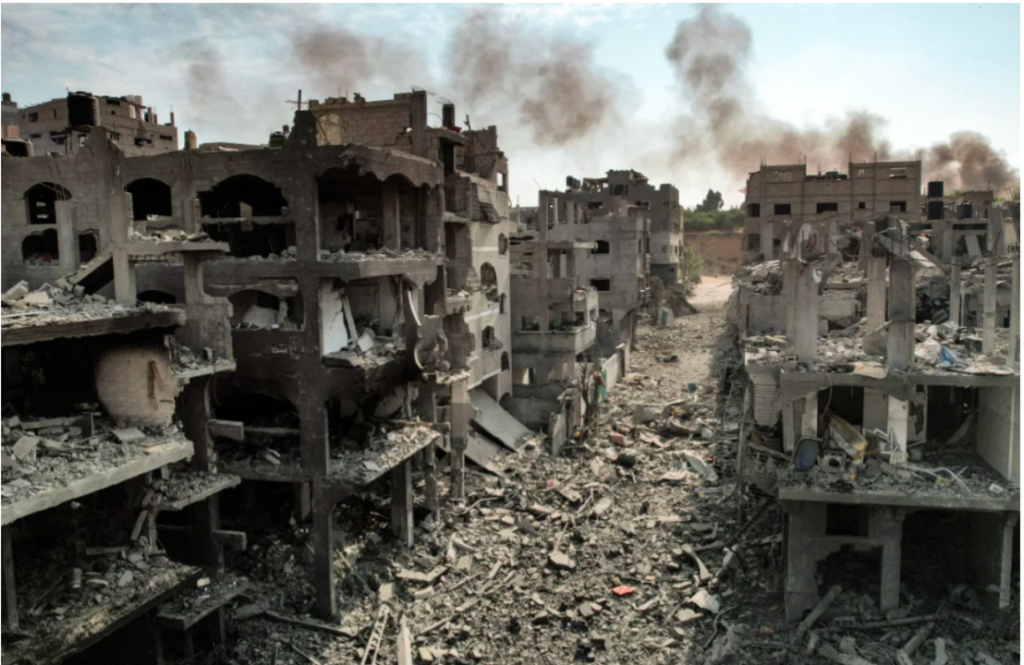
Destruction and not accuracy in Gaza. Open Source.
The dire humanitarian situation is indescribable:
- 53 UNRWA have been killed by the bombing in Gaza since October 7th.
- 15 hospitals out of 35 have shut their doors due to lack of fuel and medical supplies.
- More than 18.967 injured people are currently in hospitals. The majority of injured suffers from fourth-degree burns. And there is no space left for more injured.
- Cases of smallpox, scabies and diarrhea have been on the rise due to poor sanitary conditions and use of water from unsafe sources.
- More than 1.5 million people have been internally displaced since 13th of October. They are distributed between families, UN schools, hospitals, churches and mosques. UN described this as “the fastest humanitarian crisis resulting in the largest displacement crisis”.
- 42% of the residential units were destroyed. More than 46.758 residential units are inhabitable. And more than 190.000 damaged housing units.
- 50.000 women are pregnant and are struggling to access minimum of health care.
- 7326 people were killed including 3038 children, 1726 women and 2562 men (over 70% of the victims are women, children and elderly), over 1700 are still under the rubbles including 940 children (27.10.2023).
- 825 entire family was massacred (all family member killed) 27.10.2023
Statistics from various sources such as UNRWA, UN, and the Palestinian Health Ministry
As the death toll mounts in Gaza, Biden says “I have no notion if Palestinians are telling the truth about how many people are killed”
Constant bombing while being streamed live on one of the most densely populated areas in the entire world. Open Source.
Here is a link to an analysis by Chris McGreal published in the Guardian on October 26th titled: “Joe Biden doesn’t trust figures from Gaza’s health ministry. Experts do”: https://www.theguardian.com/world/2023/oct/26/can-we-trust-casualty-figures-from-the-hamas-run-gaza-health-ministry
Joe Biden’s position and side can be simply explained by the fact that the U.S. has used its veto power a total of 46 times to block UN Security Council resolutions that were critical of Israel. At least 34 times the US used its veto power on the matter of Palestine and Palestinians, to strike down resolutions about the situation in Palestine to protect Israel from facing censure or accountability for its violations of international law. The majority of these resolutions were drafted to provide a framework for peace in the decades-long Israel-Palestine conflict, including asking Israel to adhere to international laws, calling for self-determination for Palestine statehood, or condemning Israel for the displacement of Palestinians or settlement building in occupied Palestinian territories. A total of 46 times U.S. vetoed resolutions against Israel is all that is there to know on why Joe Biden does look the other way and deny even the suffering of Palestinians even in their death count or the way the media “should” look at it!
U.S. secretary of state, Toni Blinkin, asked the Qatari prime minister less than two weeks ago to tone down Al Jazeera’s rhetoric about the “war in Gaza”. Noting that Al Jazeera is the only news channel that reports live from Gaza, in Gaza not in a form of recorded “video tapes”, in the response of reporters and journalists say that they were shocked for the request of censorship and that they reported on both the strikes of rockets targeting Israel by Hamas and the damage and the stories, and the bombardment and air strikes on Gaza by Israel, that they show from the ground and on the spot what is happening.
A response to this “defiance” of censorship was shortly delivered:
On Channel 13 ‘journalist’ admits/alleged (depends on interpretation of course!) that Israel purposefully and premeditatedly murdered the family of Al Jazeera Gaza bureau chief Wael Dahdouh: “Generally we know the target. For example, today there was a target: the family of an Al Jazeera reporter. In general, we know.”
The target murder comes a day after Tony Blinkin demanded Qatar suppress Al Jazeera’s coverage on Gaza. It wouldn’t be small to add that his family was in the United Nations-recognized Nuseirat refugee camp in central Gaza, which was called a “safe area” by Israeli forces.
Mr. Dahdouh, 53, is well-known journalist who has covered armed conflicts in the area, was helping broadcast live images of the war in Gaza when he received the devastating news. His wife, his son (was in his final year of high school), daughter (7 years old) and grandson (18 months old).
At least 31 journalists were killed by Israel carpet-bombing on Gaza since it launched its military offensive on October 7th (up to October 27th 2023).
Isn’t this at the very least concerning when there is this tendency to deny and censor the events of a genocide happening right now?
“We didn’t know that there were concentration camps, we didn’t know they were killing the Jews”
Isn’t this what the Germans said and so many more at the time?
Isn’t history repeating itself with such a persistent irony?
“No news coverage, denial, censorship, banning manifestations and restrictions…” 2023: What about now? You didn’t know or you don’t want to?”
While this time the biggest game changer in the world view to the matter was social media which gave an easy access to information and live feed and media that never make it to the news rooms of national TVs, the biggest chocking concern that cannot be denied is this huge censorship and tunnel view filter in the media, with textbook characteristics that align with oppressive regimes that have engaged in extensive censorship and propaganda to maintain their power and control over information. Some historical regimes with similarities include:
Nazi Germany (1933-1945): The Nazi regime under Adolf Hitler tightly controlled the narrative, suppressed dissenting voices, and promoted a singular view of Aryan supremacy and the Nazi agenda. They used propaganda extensively to manipulate public perception and dehumanize those they considered enemies, particularly Jews.
Stalinist Soviet Union (1924-1953): Under Joseph Stalin’s leadership, the Soviet Union had a strict state-controlled media that only disseminated the official narrative. Questioning the state’s agenda or presenting alternative viewpoints could lead to severe consequences, often including imprisonment or execution.
North Korea (since 1948): The Democratic People’s Republic of Korea (North Korea) is notorious for its extreme control over information. The regime tightly manages the narrative, and any dissent or questioning of the state’s ideology is considered a grave offense, often leading to imprisonment or death.
Maoist China (1949-1976): During the rule of Mao Zedong, the Chinese Communist Party maintained a stranglehold on media and promoted a single narrative in line with Communist ideology. Alternative views were suppressed, and questioning the state’s agenda was dangerous.
Cultural Revolution in China (1966-1976): The Cultural Revolution was a particularly oppressive period within Maoist China. It saw widespread censorship, propaganda, and a cult of personality built around Mao. Dissent was brutally suppressed, and those who questioned the regime were persecuted.
These regimes share common traits of authoritarianism, media control, censorship, and suppression of dissent, leading to a singular, state-approved narrative. The consequences for questioning or presenting alternative views often included severe punishment, creating an environment where loyalty to the state was paramount. The regime here is the one side story and unconditional support and the state in question here is Israel, and the committed to the one view and one narrative are EU, UK and the US.