Migrant tales
Menu
  • #MakeRacismHistory “In Your Eyes”
  • About Migrant Tales
  • It’s all about Human Rights
  • Literary
  • Migrant Tales Media Monitoring
  • NoHateFinland.org
  • Tales from Europe
Menu

Author: Migrant Tales

Is Finland a good country for migrants and minorities?

Posted on June 25, 2014 by Migrant Tales

Finland gets a lot of international recognition for being one of the most competitive countries in the world, for press freedom, women rights, scores high on the good country index, having one of the best educational systems in the world and the likes. The latter raises a question: How inclusive of a country is Finland to migrants, cultural diversity and gay marriage? 

What goes around, comes around, right?

Näyttökuva 2014-6-25 kello 12.14.16

Read full story here.


As a multicultural Finn who has lived in this country for a long time, I’ve never felt that these distinctions granted to Finland applied directly to me. Press freedom? I doubt that many of the issues  we raise on Migrant Tales would see the light of day in the national media.

Why? Because all these distinctions given by think-tanks abroad are meant for white ethnic Finns. They do not really apply to migrants and minorities.

Taking into account the adverse winds blowing in Finland against minorities, migrants and their children, is it surprising that the legal affairs committee of parliament  voted Tuesday 10-6 against a citizen’s initiative on gay marriage?

The same committee voted 9-8 in February 2013 against gay marriage. This prompted a citizens’ initiative that got 166,000 signatures.

Finland is the only country in the Nordic region where gays cannot get married.

If you are surprised by the most recent vote, then you’re pretty gullible and probably think that the rise of the Perussuomalaiset (PS)* party in the 2011 parliamentary elections was nothing more than a mere protest vote that would go away in time.

The question is not only to connect the dots, even if this is important, but why we don’t bother to do so. There is a relationship between the rise of intolerance in Finland against migrants and minorities like gays.  Our problem is that those in power don’t want to know because some of them may dread what they’ll see.

And why should their day be ruined if the  World Economic Forum recently named Finland as the most competitive economy in Europe?

Risto J. Penttilä expresses dismay at the award in the Financial Times:

For a start, Finland’s economy has not grown in five years. The unemployment rate is 9 per cent. The flagship company, Nokia, was forced to sell its handset business to Microsoft last year. Its shipyards are in trouble; its forestry companies are cutting costs and closing plants. Public expenditure is expected to reach 58 per cent of gross domestic product this year – a larger share of output even than France.

Even if Penttilä, a member of the conservative National Coalition Party who represents the interest of the business sector as chairman of EVA, a policy and pro-market think tank, he does have a point. 

The latest vote against gay marriage is a clear indication that matters for other minorities in Finland won’t improve in the near future.

Is Finland then a good country for minorities and migrants?

Taking into account that the unemployment rate for migrants, which is generally three times higher than the national average of about 9%, coupled with the rise of a xenophobic party like the PS, it’s clear that this isn’t an ideal country for some migrants and minorities.

It is not only a dead-end country for some, but outright hostile as well.


* The Finnish name for the Finns Party is the Perussuomalaiset (PS). The names adopted by the PS, like True Finns or Finns Party, promote in our opinion nativist nationalism and xenophobia. We therefore prefer to use the Finnish name of the party on our postings. 

Marine Le Pen fails to form the far-right European Alliance for Freedom

Posted on June 25, 2014 by Migrant Tales

There was great news today when we read that far-right Marine Le Pen and Geert Wilders failed to form a European Parliamentary group called the European Alliance for Freedom (EAF)., reports the euobserver.

After the gains that the far-right made in the Euro elections of May, Migrant Tales welcomes Le Pen’s and Wilders’ failure to form the EAF as the best piece of news in a long time.

National Front’s secretary general, Florian Philippot, played down on the Independent that it “would not real really be a disaster” but “an embarrassment” if the EAF didn’t materialize.

Näyttökuva 2014-6-25 kello 1.19.10

Far-right National Front leader Marine Le Pen is all smiles until Tuesday, when her group failed to form a European parliamentary group. Read full story here.


Writes the Guardian: “The plans of Europe’s extreme right to try sabotage the EU from within were hit…failed to gain enough allies to qualify as a single caucus in the new European parliament – denying them precious funding, speaking time and committee positions.”

While the EAF was able to muster at least 25 MEPs, it wasn’t able to get seven countries as required to form a caucus. The five parties that were in Le Pen’s group were including the National Front: Wilders’ Freedom Party (PVV), FPÖ of Austria, Italy’s Lega Nord, and Belgium Flemish separatist Vlaams Belang.

A sixth possible candidate, Poland’s Congress of the New Right (KNP), was cited but the views of its leader, Janusz Korwin-Mikke were too extreme even for Wilders.

One of Korwin-Mikke’s aims is to deprive women voting rights.

Meanwhile, Nigel Farage’s of the UKIP announced that it has formed a new anti-EU Europe of Freedom of Democracy group with 48 MEPs from 7 countries led by the UKIP (23 MEPs) and Movimento 5 Stelle of Italy (17).

Two far-right Sweden Democrat MEPs were admitted into the group.

Migrants’ Rights Network: Immigration statistics to be debated for 3 hours in the House of Commons

Posted on June 24, 2014 by Migrant Tales

Awale Olad

Awale_web


MPs are set to debate the political minefield of migration statistics this Thursday, 26 June. The Lords will also debate the right to work for asylum seekers.

Na?ytto?kuva 2014-6-24 kello 13.10.42

Read full blog entry here.


The Westminster Hall debate will be led by Bernard Jenkins MP, the Chair of the Public Administration Select Committee, which looked into migration statistics last year and published a critical report of how the government was recording statistics and ensuring a proper mechanism to manage migration numbers in the UK existed.

The committee’s inquiry considered various factors that record migration and took oral and written evidence from key experts including Dr Scott Blinder from Migration Observatory at the University of Oxford and Professor John Salt of the Migration Research Unit at UCL. Civil servants from the Office of National Statistics (ONS) and the Home Office also faced questioning from MPs.

There was an appeasing attitude from the cross-party group of MPs who looked at migration statistics with an open mind, especially at around the time of screaming and scaremongering by backbench MPs who wanted to close the borders to Romanian and Bulgarian (A2) migrants. Some newspapers said that the UK was set to be flooded by millions of EU migrants and the United Kingdom Independence Party filled the vacuum when the government refused to release projections of potential arrivals from the A2 countries.

So it was somewhat unsurprising that the government took almost a year to respond to the committee’s report, which was published in July 2013. It gave the government an opportunity to pour cold water over any suggestions that the UK was set to receive a disproportionate number of A2 migrants. The committee was particularly critical of the government’s dependence on the International Passenger Survey; they also urged the government to rapidly move on to the e-borders scheme, and improve the ability of the ONS to gather accurate estimates of migration data.

In terms of the net migration target, the committee’s recommendations are congenial to the government’s efforts, however, it falls just short of saying that a net migration target is both confusing and unnecessary – the committee recommended that the government ‘should do more to enable better public understanding of migration’, which the government agreed to.

The debate on Thursday will bring together hostile as well as friendly voices on immigration. The ever thorny issue of immigration numbers – something that shouldn’t be misconstrued with migration statistics in general – will certainly be the instruction that could potentially take this debate into hostile territory.

The government, however, has an opportunity to engage with a committee of highly informed cross-party parliamentarians who will be able to debate constructively with them on the factors that create the hostility around migration numbers. Three hours of debate on statistics alone could suck the energy out of both ministers and others, but a central figure could raise the tempo of the debate if one calls for the dropping of the net migration target, potentially wrong-footing both the Coalition and the Labour party on how best to deal with immigration policy post next year’s general election.

Read original story here.

This piece was reprinted by Migrant Tales with permission.

*Awale Olad is the Public & Parliamentary Affairs Officer at MRN, coordinating the work of the All-Party Parliamentary Group on Migration, supporting parliamentarians and policy makers on establishing a cross-party consensus on immigration policy.

Interior minister’s plan to close legal “loophole” would increase the number of undocumented migrants in Finland

Posted on June 18, 2014 by Migrant Tales

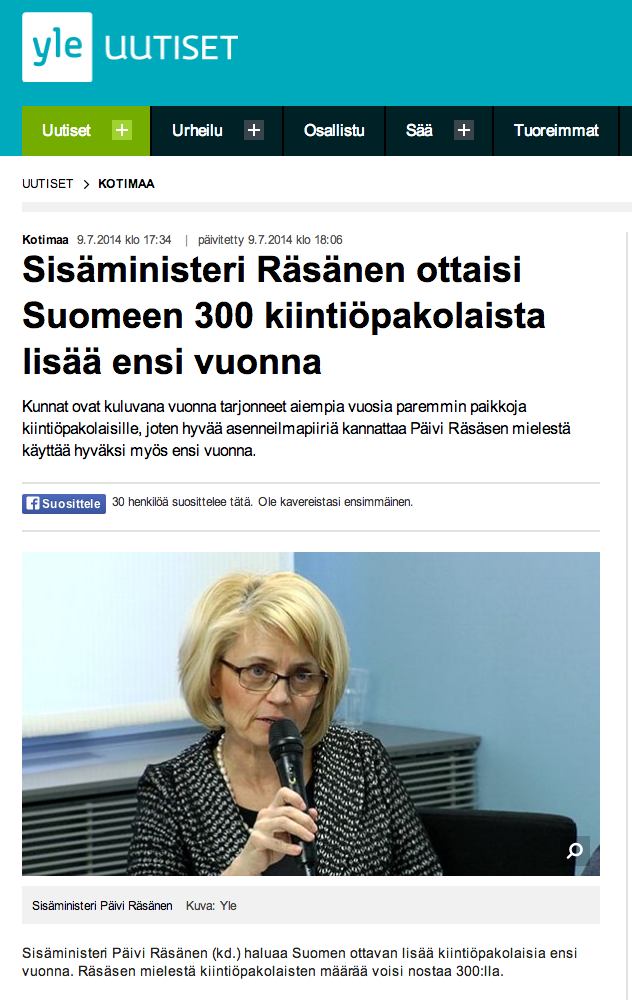
Christian Democrat Interior Minister Päivi Räsänen has a dubious reputation in Finland for her homophobic and conservative religious views. In her latest attack against refugees, Räsänen writes that when an asylum-seeker gets a negative decision and doesn’t want to leave the country, the Finnish Immigration Service is required to give a residence permit if the person cannot return back to his or her country for a number of reasons.

Kaisa Väkiparta, head of communications at the Finnish Refugee Council, flatly disagrees with Räsänen’s claim.

“This isn’t true,” she writes. “The Supreme Administrative Court had to make an alignment concerning such cases because the Finnish Immigration Service wasn’t following the law. “

Väkiparta said that Räsänen’s plans to change the law would force the number of undocumented migrants in the country to rise.


Näyttökuva 2014-6-18 kello 7.09.49

Read full comment here.

Räsänen writes in a statement that such a “loophole” in the law, which permits asylum-seekers to get a residence permit after a negative decision, has lured more asylum-seekers to Finland.

The rise in such residence permits to asylum-seekers who have received a negative decision – according to Väkiparta – hinge on the residence permits that the Finnish Immigration Service was supposed to give in the first place.

“The amount of asylum-seekers to Finland has been pretty stable in the past years, or about 3,000 people annually,” she says. “There is no factual base that the [so-called] loophole is luring people [to Finland].”

The PS of Pori, Finland, wanted to stop funding to Islamic cultural association

Posted on June 17, 2014 by Migrant Tales

Two Perussuomalaiset (PS)* members of the City of Pori board failed to get enough support behind a motion to stop funding to an Islamic cultural association, reports YLE. The association gets 4,000 euros in funding from the city.

Migrant Tales not only read this story with some concern.

Apart from being Muslims, is there any other reason why the PS wants to cut off funding to the Islamic cultural association in Pori?


Näyttökuva 2014-6-17 kello 12.37.16

Read full story here.

The motion, which would have cut funding to five other political and student associations as well, was defeated 9-2.

The two PS city board members who backed the motion are Laura Huhtasaari and Tommi Salokangas.

Migrant Tales tried to get in touch with Huhtasaari but she was unavailable for comment.

Salokangas said that he didn’t really understand what Huhtasaari’s aim was except to probably get some attention.

“I’ve visited the people of the [Islamic] association and there is nothing wrong with them,” he said. “You have to ask Huhtasaari about the her motives [for trying to stop the funding].”


* The Finnish name for the Finns Party is the Perussuomalaiset (PS). The names adopted by the PS, like True Finns or Finns Party, promote in our opinion nativist nationalism and xenophobia. We therefore prefer to use the Finnish name of the party on our postings. 
Challenging urban tales about migrants and ourselves should be our first and foremost priority

Posted on June 17, 2014 by Migrant Tales

After contributing regularly for Migrant Tales and reading and answering some of the over 30,000 comments we have received in the past seven years, a bigger picture emerges. This has been reinforced by my work at a folk high school, where the majority of the students on campus aren’t white Finns.

languages

As Don Flynn of Migrants’ Right Network wrote, it’s crucial especially today that migrant community groups start working together to challenge the urban tales spread by opportunistic politicians in order to make a positive case for migration.

One such campaign he mentions is #MigrantsContribute!

He writes: ”[The group is] a social media-style name for a campaign that aims to bust into the mainstream with its core message that, far from being the unwelcome border crossers looking for a free ride so often presented by unscrupulous politicians and headline writers, migrants come to the UK full of hope and expectation that they will have the opportunity to contribute fully as fully rounded people in British society, and not merely exist as dehumanized factors of economic production.”

In order to get into the mindset of the far-right populist and those that spread anti-immigration rhetoric, it’s important to spot the red herring(s).

Since some politicians of the Perussuomalaiset (PS)* of Finland, an anti-EU, anti-immigration, homophobic and especially anti-Islam party, built their political careers on a message of intolerance, it’s clear that they seek today to find some kind of legitimacy.

An effective way of doing this is by giving a more mainstream image of the party and of oneself.

While such political parties and politicians may want to forge a new image of themselves, the context hasn’t changed at all.

They use underhanded and cheap-trick arguments to achieve a mainstream facelift. These arguments change constantly because they are based mostly on hearsay. If they stayed put, they’d be exposed as lies in many cases.

One typical argument used today by anti-immigration politicians is the following: We aren’t against immigration.”

The problem with this odd affirmation is that they are against immigration. It’s like the Sleeping Beauty fairy tale. A white migrant Prince Charming appears, kisses the native Sleeping Beauty, she awakens and they live happily ever after in their white society.

If we dig a bit deeper into this claim by some anti-immigration parties and politicians, we’ll find another layer that is highly revealing. By wanting only white, or the right migrants, our real aim is to keep our society white. Thus anti-immigration groups are against non-white migrants because they loathe cultural diversity.

Another important matter that Migrant Tales has taught me is to be especially careful with those that offer simplistic answer to complex questions like integration.

One of the most common simplistic arguments used in Finland – in my opinion – is learn Finnish or Swedish and problem solved: You’re integrated!

Learning the local language is crucial and plays an important part in the migrants adaption to his or her new homeland, but it isn’t, however, a panacea to integration.

By giving into simplistic arguments like “just learn the language,” we forget other equally important issues like why integration should be the rule but too often everyone expects you to assimilate. There are many other factors we lose sight of as well: acceptance, inclusion, respect for cultural diversity, identifying pitfalls like poor performance of third-culture children at school, ethnic profiling, high migrant unemployment, poverty, health and social exclusion.


* The Finnish name for the Finns Party is the Perussuomalaiset (PS). The names adopted by the PS, like True Finns or Finns Party, promote in our opinion nativist nationalism and xenophobia. We therefore prefer to use the Finnish name of the party on our postings. 
 

Migrants’ Rights Network: #MigrantsContribute! promises an active campaign to advance positive arguments for migrants

Posted on June 16, 2014 by Migrant Tales

Migrant Tales insight: Another excellent posting by Migrants’ Rights Network on how immigrant communities challenge politicians who spread lies and reinforce prejudices about migrants. We need such a campaign in Finland. 

Writes Don Flynn:

#MigrantsContribute! is a social media-style name for a campaign that aims to bust into the mainstream with its core message that, far from being the unwelcome border crossers looking for a free ride so often presented by unscrupulous politicians and headline writers, migrants come to the UK full of hope and expectation that they will have the opportunity to contribute fully as fully rounded people in British society, and not merely exist as dehumanised factors of economic production.

___________________

Don Flynn*

Don_web_0

We have now entered the final twelve months of the longest general election campaign in British history. That so, it is good to hear that migrant community groups are working together to get messages across to the population about the positive case for migration.


The report from our friends and colleagues at Migrant Voice about the representation of the viewpoint of migrants in the mainstream media makes shocking reading.  We are supposed to be right in the middle of a ‘grown-up’ conversation about immigration and its impacts on life in Britain and yet in 77% of the coverage of this issue the people most directly involved in the business of migration do not even get a look in.

With these facts as a backdrop, the news that the initiative is being seized by a group of people from migrant communities with a project aimed at elbowing their way to a more prominent position in the public discussion is very welcome.

at_UAF_conference


#MigrantsContribute! is a social media-style name for a campaign that aims to bust into the mainstream with its core message that, far from being the unwelcome border crossers looking for a free ride so often presented by unscrupulous politicians and headline writers, migrants come to the UK full of hope and expectation that they will have the opportunity to contribute fully as fully rounded people in British society, and not merely exist as dehumanised factors of economic production.

The first public presentation of plans for #MIgrantsContribute! was made by Tatiana Garavito at the national conference Stand Up To Racism held in London last Saturday. Tatiana is the director of the Latin American Women’s Rights Service and the current holder of the Young Woman of the Year Award, given each year by Women on the Move.

Her arguments in support of #MIgrantsContribute! are set out in the blog featured in MRN Migrant Pulse.  She explains how people from migrant communities are “upset” when they hear how political parties are “prepared to use lies and distortions about migrants, which are far from the truth, to gain votes and encourage a hostile response to migrants.”

The campaign will be making use of an array of messages aimed at countering these negative images of migrants, setting out facts about all the things that they bring within them, aside from their desire to work and get on in life.

Supporters of #MigrantsContribute! have moved quickly to set up a Facebook fan page and a Twitter account. In the next few days it will be launching the #MigrantsContribute Manifesto. People who want to sign up to the campaign will be invited to submit ‘selfies’ showing their support for the initiative.

Watch this space to follow developments with #MigrantsContribute!

drum_solo


suitcase

languages


Read original story here.

This piece was reprinted by Migrant Tales with permission.

*Don Flynn, the MRN Director, leads the organisation’s strategic development and coordinates MRN’s policy and project work. He is a regular and sought-after speaker at conferences, seminars and lectures on behalf of MRN.

Defining white Finnish privilege #3: No history, no doctrine, no heroes and no martyrs

Posted on June 15, 2014 by Migrant Tales

In many respects white privilege, or specifically white Finnish privilege, is a good way to understand some of the challenges that migrants and especially non-white Finns face in this country. Migrant Tales invites its readers to share their thoughts on the social ill.

Please send your comments on the topic to [email protected]. We’d love to hear from you.


The Olen Suomalainen video clip says it all about making Finland a more inclusive country. Read full story here.
Are the days of white Finnish privilege counted or extended?

Understanding what white privilege is essential if we want to challenge intolerance in Finland. It’s pretty clear that the way white privilege works in the United States or in the United Kingdom shouldn’t differ greatly from white Finnish privilege.

Let’s look at some definitions of this social ill below.

Harry Brod states the following: “It [white privilege] is something that society gives me, and unless I change the institutions which give it to me, they will continue to give it, and I will continue to have it, however noble and equalitarian my intentions.”

Francis E. Kendall defines white privilege:

Privileges are bestowed on us by the institution with which we interact solely because of our race, not because we are deserving as individuals. While each of us is always a member of a race or races, we are sometimes granted opportunities because we, as individuals, deserve them; often we are granted them because we, as individuals, belong to one or more of the favored groups in our society.

Urban Dictionary defines it the following words:

The racist idea that simply being white benefits people in some unexplainable way, and that discriminating against white people is not only okay, but enlightened and necessary. The excuse some extremists use to justify pretty much any level of racism, as long as it is coming from people of color. A young American woman died because in college she was brainwashed into believing that her white privilege would protect her from being run over by a bulldozer.

And Time Wise says:

White privilege refers to any advantage, opportunity, benefit, head start, or general protection from negative societal mistreatment, which persons deemed white will typically enjoy, but which others will generally not enjoy.

If white privilege is detrimental to non-whites, the only way to challenge it is to expose and challenge it. This won’t be easy since who in their right minds wants to give up their privileges?

One way to start is to show the negative impact that white privilege not only has on minorities but on all of society.

A good question to ask if “since when was racism and prejudice good for society?”

____________

Definition #3

Rodolfo Walsh, an Argentinean journalist and writer, said something that we should never forget when we write our history.* Even if it was written in the 1970s and in Argentina, it still applies to immigrants and multicultural Finns and exposes how white Finnish privilege works:

Our dominant classes have made sure that the worker has no history, doesn’t have a doctrine, any heroes or any martyrs. Every struggle has to be started from scratch, separated from previous struggles; the collective history is lost, their lessons are forgotten. History appears as it if were private property, whose owners are the owners of everything.

In other words, as a migrant and Other in Finland, you have no history, no heroes or martyrs. Every struggle you begin starts from zero because you have no collective history. The only history that counts, and what you’ll be taught, is that of white Finns. You are unimportant and not taken into account.

*Wrote Alice Walker in her first published essay The Civil Rights Movement: What Good Was It? 

If the civil rights movement is ‘dead’, and if it gave us nothing else, it gave us each other for ever. It gave us history and men far greater than presidents. It gave us heroes, selfless men of courage and strength, for our little boys and girls to follow. It gave us hope for tomorrow. It called us to life.

See also:

  • Defining white Finnish privilege #1: I have it and you don’t
  • Defining white Finnish privilege #2: Third culture children versus “pupil with immigrant background” 

What would you see if you looked in Jussi Halla-aho’s eyes?

Posted on June 14, 2014 by Migrant Tales

Plans to give the Perussuomalaiset (PS)* a facelift and turn it into a mainstream party took another step in that direction when the new chairman of the European Conservatives and Reformist (ECR) group of the European parliament, MEP Syed Kamall, was satisfied with PS MEP Jussi Halla-aho’s explanation for his conviction for ethnic agitation.

What else could Kamall say after the PS and far-right Danish People’s Party, which have two “MEPs with criminal records,” joined the ECR?

If Kamall looked Halla-aho in the eye, what feelings would it raise among those migrants in Finland that the PS politician has insulted? What about Finland’s Somali community? What about the regular Immigrant Joe who works hard and pays his taxes in Finland but has to deal with the daily suspicion and discrimination that is reinforced by politicians like him?

Should they look him in the eye too and ask when this cat-and-mouse racism will stop.

If I looked in Halla-aho’s eyes I would probably see a troubled politician who is trying his hardest to justify the racism he wrote about in the past. His balancing act it living with the ghost of his past.

Here’s another big gamble that the PS and Halla-aho are talking in light of recent events. By trying to appear more mainstream, it’s the voters who will decide at the end of the day if they like the changes no matter how many times anyone looks Halla-aho and the party in the eye.

Näyttökuva 2014-6-14 kello 7.38.05

Read full story here on YLE in English.

In Halla-aho’s words about the ECR: “They wondered a little bit about how something like this [writing he got sentenced for] could have brought a conviction.”

In Kamall’s words: “I sat down with him when I saw that issue reported, I looked him in the eye and I said ‘tell me about this…I’m satisfied by his explanation. Once again we are looking to parties that are looking to reform, we are looking for people…we don’t look at the past, we want to look at where we’re moving forward.”

Kamall said that if the Finns Party want to be a mainstream party and he’d be happy to help them with such a task.

Kamall is the same politician who justified the Danish People’s Party (DPP) membership into the ECR. He was quoted as saying on the Financial Times:

“The Danish People’s party is on a political journey. It now has a policy of controlled immigration and disagrees with those on the left who would allow uncontrolled immigration and benefit tourism.There is a clear distinction that the left-wing media often fails to make between a party that wants to control immigration and one that seeks to demonize immigrants. The DPP is the former.”

Possibly the MEP and head of the ECR should ask those migrants, Danes married with foreigners, and Muslims if the DPP doesn’t demonize migrants. The answers he’d receive could be highly revealing.

These types of statements by a Conservative Party MEP shouldn’t surprise us since they generally agree with the anti-immigration and anti-Islam stances of parties like the PS and DPP.

Thanks to the rise of an anti-EU and anti-immigration party, the UKIP, the Tories have preferred to mimic Nigel Farage’s message instead of challenging it. It’s the same story that happened in Finland before the PS’ historic election victory in 2011.

The United Kingdom has under Tory Prime Minister David Cameron become a more hostile place for immigrants in the form of giving space to intolerance through Go Home campaign and fear-mongering about hordes of Romanians swarming to the United Kingdom.

If you want to find out why Cameron has become so anti-EU and anti-immigration, all you have to do is look at Nigel Farage’s UKIP, which became the first party apart from the Tories and Labor to win an election since the early twentieth century.

The Tories are not a friendly party to migrants, which explains why the ECR has no problems with admitting xenophobic parties like the PS and DPP to its ranks.

* The Finnish name for the Finns Party is the Perussuomalaiset (PS). The names adopted by the PS, like True Finns or Finns Party, promote in our opinion nativist nationalism and xenophobia. We therefore prefer to use the Finnish name of the party on our postings.  
World Café ponders if Porvoo, Finland, is a multicultural city

Posted on June 12, 2014 by Migrant Tales

Migrant Tales insight:  The World Café concept is an excellent way to empower and encourage people to participate and promote active citizenship. This World Café session, which took place in Porvoo on May 17, and asked participants to give their views on how cultural diversity is faring in the city.

One of the important findings of the event was that Porvoo needed to do more work in inclusion of migrants. Write the organizers: “All agreed Porvoo is a good place to live and the issues here are no different from any other city in Finland. There will be an even greater racial mix but this does not mean we will understand or communicate better with each other unless we take action now to make this happen.”

The event was organized by Citizens’ Forum, whose mission is to build civil society through culture and civic education offered by organizations.

___________________

The idea

The hearing was a part of the Participatory Community work –project of Citizens´ Forum. The project had two main elements; Identity work and active citizenship. The hearing in Porvoo concentrated on the latter. The idea in Porvoo was to build an open space for discussion of the people in Porvoo. The theme for the hearing was Porvoo – the city of many cultures. It was selected because we wanted to raise the issue that there are many people from other countries living in Porvoo who are not a problem or a threat but a possibility and a source for building a better Porvoo.


This video will give you an idea of how the World Café concepts works.

The basic work

We noticed that to be able to do participatory community work in the real sense of the word we had to find some way to get a position in the community where we can have a dialogue with the different actors (Finns, ethnic minorities, officials of the city, associations, educational institutions) who work with the theme of multiculturalism. One challenge for us was also to find ways to support the co-operation between the different institutions with common goals.

To do this basic work Alex McKie from Citizens´ Forum worked in Porvoo for three months before the Word Café Hearing. He also made tight co-operation with Kepa and the Mahdollisuuksien tori project group which was organising the Mahdollisuuksien Tori (Marketplace of Possibilities) event 2014 in Porvoo. To get the synergy effects there was a decision made that the Citizens´ Forum World Café will take place on the same day as the Mahdollisuuksien tori on the 17th of May.

In the process of making the hearing possible there were many actors working together with us. We have to mention some of the partners in the network. The Culture House Grand was giving us the possibility to use the culture house as a venue for the hearing. Amisto – ammattiopisto prepared a devising drama performance with which the hearing was opened. Luckan was helping us to connect us with many important actors eg. the ombudsman for minorities Eva Biaudet. Eva Biaudet sent a video greeting to the participants of the hearing. We also had contact with Mikaela Nylander, a member of the Parliament and the chair of the Porvoo city council. The Red Cross of Porvoo was marketing the event actively and they also had a work shop on Young people and voluntary work right after the World Café on the 17th of May.

The Word Café

It was a long process to choose the actual method for the hearing. We were first thinking of a panel on our theme but we decided that it was not deliberative enough to meet our needs. For a long time we were discussing whether the hearing should be organized as a World Café or as an open space discussion. As we didn’t know if 5 or 50 people would turn up or how many languages the discussion would include etc. , we decided to do it as a Word Café.

In the process we had four Café tables and for questions: Is Porvoo Multicultural? How has multiculturalism affected your life? How can people from different cultures talk together? How will my Porvoo look like in the year 2020? We also had four discussion rounds, so each participant could discuss all the themes.

We had a team of facilitators which reflected the cultural and language construction of the Porvoo community. About 20 citizens turned up. As all of them were able to communicate in English we decided to make the hearing in English.

The four discussion round lasted about one hour. Afterwards we had a feedback discussion where the facilitators of each Café table introduced the discussions which had taken place in their group. These introductions are presented beneath.

Café Table nr 1: Is Porvoo multicultural?

The initial response to this question was: yes, and this was given without hesitation. However, with each group there was also the same response that there are not many people from other cultures visible, at least not in the city centre. They also seem to keep a low profile wherever they are. A group of six young ethnic minority youth disclosed that if you are from an ethnic minority group you are more likely to be picked on. People know that what they are doing is wrong but they do it anyway. The young participants also felt that they are blamed for most things before their white counterparts. They especially didn’t feel listened to or understood by their teachers and their message to them was: “open your ears”.

Other group members who have had contact with newcomers to Finland stated that it is very hard for people from ethnic minority groups to access mainstream services and they gave sport as an example. People from ethnic minority groups are likely to live in two areas of the city and don’t tend to travel beyond these areas. They also spoke of young people who are acting as carers for the rest of the family due their language skills. They felt that many people from ethnic minority groups are isolated and especially they need courage to access anything mainstream.

All agreed that Porvoo is multicultural but only in the smallest sense. The mere fact that there are people from many cultures in Porvoo, doesn’t make Porvoo Multicultural in strict meaning of the word. What matters is the quality of the dialogue between the people and cultures. Some participants thought that there is an expectation for ethnic minorities to assimilate into Finnish Culture at the cost of their own.

There was a sense of disappointment. At the same time the Mahdollisuuksien tori (Marketplace for Possibilities) was taking place outside and candidates of the European election were campaigning and yet so few people were willing to discuss such important issues. They felt that we spend a lot of time in festivals and events, which are multicultural but there is no open discussion of the effects of multiculturalism. This dismay was expressed as to why there were no city officials taking part in the forum and why were these issues being avoided.

Café Table nr 2: How has multiculturalism affected your life.

All participants of this discussion felt that multiculturalism had affected their lives in positive ways. The overall view was that in last five years Porvoo has become a much better place for different cultures to live together. This cultural mix gives new ideas and freshens to the society. There were also positive ideas about what newcomers contribute to the economy and culture of the city.

Many of the white Finnish participants said they work together with people from ethnic minority groups on a daily basis and they feel it has improved their lives. They feel that the attitude is important and if you have an international view of the world it helps you accept other cultures. In their work they come across vulnerable people from other cultures and they feel that helping them is an important step in building mutual trust.
The participants felt that friendship between cultures is possible when we see the person as human beings. There can be some challenges, but if you do the work, it enriches every ones life.

Café Table nr 3: How can people from different cultures talk together?

The participants felt that one of the key obstacles to intercultural communication is language. People have to have some kind of common language to be able to communicate with each other. But this is not enough. We have to build a solid foundation for people to have an opportunity to communicate as equals. First of all there should implement a measurable integration strategy. This strategy take into account the holistic needs of individuals and their families (incl. questions of education, employment, social services and rights as citizens).

There should be education on multiculturalism in schools as early as possible and education for employers to recognize the skills and professionalism of ethnic minorities. The Media should also have a clear agenda in questions relating to multiculturalism. In this way we would get more of a balanced perspective and understanding about the underlying issues.

There are very good examples of cultural cooperation between people in Porvoo. But many issues that immigrants face in their every day lives are not spoken of. It was thought that there is not a good mix of the different cultural groups in Porvoo and people tend to stay within their own culture. This was one of the contributory features of isolation and creates barriers to positive interaction.

All agreed there was a need to empower and strengthen ethnic minority groups in positive ways which would include them in decision making processes. Some examples where this kind of participation could take place are decisions about social services, recreation and education. Sport was also an area of concern, because there are many young people who would like to take part in sports but don’t. They consider the main reason for this is an inadequate understanding of the needs of these young people by the coaches and the overall atmosphere which makes it difficult to join.

Café Table nr 4: What will my Porvoo look like in the year 2020?

Porvoo will become more international and less traditional due to the expansion of the Helsinki metropolis. There will be a greater cultural mix but this will not necessarily lead to better understanding of each other. Dialogue between cultures will become an even more complicated issue. Although we will be more aware of other cultures there may be little interaction between groups if we don’t take action to address this issue. The participants recommended that we take positive steps towards creating spaces for cultural interaction. This would be where different cultures can meet equally and take proactive action to strengthen cultural identity and encourage inclusion. They would like to see more meeting points where issues can be discussed and give Citeizens’ Forum World Café as an example.

The younger members of the forum also described Porvoo as the best place to live and expressed this in writing on the table cloths of the World Café: “Porvoo is best”. In the discussions there was a sense of optimism that Porvoo is a good place to live and that the issues raised are to be found all over the country. They feel that there are the resources and will to meet the needs of 2020 Porvoo. However, this needs openness and a place where contrasting views can be heard.

Conclusions and recommendations.

Porvoo is multicultural and that is not going to change. This gives the citizens many challenges and experiences that can improve the quality of our lives. For this to happen we need to listen and to learn from each other. The forum was described by its members as the first time they had been able to learn from others in this way about the themes of multiculturalism. One of the biggest issues that all expressed was the disappointment that city officials and politicians had not taken part in the forum. They also wondered why it is so difficult to talk about issues we are not so comfortable with like discrimination end exclusion.

On a positive note they think that they have now found their voices and a way to work together that can find a way forward. But for this to happen it needs greater awareness and understanding of how discrimination affects the quality of people’s lives. For attitudes to change there needs to be more forums like this Citizens’ forum World Café.

We had spoken of the need to break down stereotypes and to start to look at each other as people. This worked both ways and a need was identified for ethnic minorities to stop stereotyping our Finnish counterparts and to understand their situation and story as well. The forum had established trust between us as people free from institutional or cultural constraints.

We identified many issues but did not have the time to form actions. We felt that to do this we would want to give our decisions to the representatives of the local government of Porvoo to decide what action can be taken.

  • Previous
  • 1
  • …
  • 318
  • 319
  • 320
  • 321
  • 322
  • 323
  • 324
  • …
  • 513
  • Next
Read more about documentary film
Read more

Recent Posts

  • Finland’s tabloids Iltalehti and Ilta-Sanomat are the pits
  • Riikka Purra’s Dr Jekyll and Mr Hyde mask
  • Double standards
  • Perussuomalaiset: Uusi logo, sama vanha juttu
  • Taco Trump

Recent Comments

  1. Absolutely Socking: Racist Finnish Facebook group against human rights gets flooded with socks on Musta Barbaari’s mother and sister charged by the police in “ethnic profiling” case
  2. Ilkka Nuotio on Pekka Myrskylä: “Tilastot kertovat toista kuin poliittinen keskustelu”
  3. Genrih Soinkara on The war in Ukraine and the Russian-Finnish border crisis are showing Finland’s ugly side
  4. Ahti Tolvanen on Comment by Ahti Tolvanen on the Helsinki +50 conference
  5. Angel Barrientos on Angel Barrientos is one of the kind beacons of Finland’s Chilean community

Archives

  • June 2026
  • May 2026
  • April 2026
  • March 2026
  • February 2026
  • January 2026
  • December 2025
  • November 2025
  • October 2025
  • September 2025
  • August 2025
  • July 2025
  • June 2025
  • May 2025
  • April 2025
  • March 2025
  • February 2025
  • January 2025
  • December 2024
  • November 2024
  • October 2024
  • September 2024
  • August 2024
  • July 2024
  • June 2024
  • May 2024
  • April 2024
  • March 2024
  • February 2024
  • January 2024
  • December 2023
  • November 2023
  • October 2023
  • September 2023
  • August 2023
  • July 2023
  • June 2023
  • May 2023
  • April 2023
  • March 2023
  • February 2023
  • January 2023
  • December 2022
  • November 2022
  • October 2022
  • September 2022
  • August 2022
  • July 2022
  • June 2022
  • May 2022
  • April 2022
  • March 2022
  • February 2022
  • January 2022
  • December 2021
  • November 2021
  • October 2021
  • September 2021
  • August 2021
  • July 2021
  • June 2021
  • May 2021
  • April 2021
  • March 2021
  • February 2021
  • January 2021
  • December 2020
  • November 2020
  • October 2020
  • September 2020
  • August 2020
  • July 2020
  • June 2020
  • May 2020
  • April 2020
  • March 2020
  • February 2020
  • January 2020
  • December 2019
  • November 2019
  • October 2019
  • September 2019
  • August 2019
  • July 2019
  • June 2019
  • May 2019
  • April 2019
  • March 2019
  • February 2019
  • January 2019
  • December 2018
  • November 2018
  • October 2018
  • September 2018
  • August 2018
  • July 2018
  • June 2018
  • May 2018
  • April 2018
  • March 2018
  • February 2018
  • January 2018
  • December 2017
  • November 2017
  • October 2017
  • September 2017
  • August 2017
  • July 2017
  • June 2017
  • May 2017
  • April 2017
  • March 2017
  • February 2017
  • January 2017
  • December 2016
  • November 2016
  • October 2016
  • September 2016
  • August 2016
  • July 2016
  • June 2016
  • May 2016
  • April 2016
  • March 2016
  • February 2016
  • January 2016
  • December 2015
  • November 2015
  • October 2015
  • September 2015
  • August 2015
  • July 2015
  • June 2015
  • May 2015
  • April 2015
  • March 2015
  • February 2015
  • January 2015
  • December 2014
  • November 2014
  • October 2014
  • September 2014
  • August 2014
  • July 2014
  • June 2014
  • May 2014
  • April 2014
  • March 2014
  • February 2014
  • January 2014
  • December 2013
  • November 2013
  • October 2013
  • September 2013
  • August 2013
  • July 2013
  • June 2013
  • May 2013
  • April 2013
  • March 2013
  • February 2013
  • January 2013
  • December 2012
  • November 2012
  • October 2012
  • September 2012
  • August 2012
  • July 2012
  • June 2012
  • May 2012
  • April 2012
  • March 2012
  • February 2012
  • January 2012
  • December 2011
  • November 2011
  • October 2011
  • September 2011
  • August 2011
  • July 2011
  • June 2011
  • May 2011
  • April 2011
  • March 2011
  • February 2011
  • January 2011
  • December 2010
  • November 2010
  • October 2010
  • September 2010
  • August 2010
  • July 2010
  • June 2010
  • May 2010
  • April 2010
  • March 2010
  • February 2010
  • January 2010
  • December 2009
  • November 2009
  • October 2009
  • September 2009
  • August 2009
  • July 2009
  • December 2008
  • November 2008
  • October 2008
  • September 2008
  • August 2008
  • July 2008
  • June 2008
  • May 2008
  • April 2008
  • March 2008
  • February 2008
  • January 2008
  • November 2007
  • October 2007
  • September 2007
  • August 2007
  • July 2007
  • June 2007
  • May 2007

Categories

  • ?? Gia L?c
  • ????? ?????? ????? ???????? ?? ??????
  • ???????
  • @HerraAhmed
  • @mondepasrond
  • @nohatefinland
  • @oula_silver
  • @Varathas
  • A Pakistani family
  • äärioikeisto
  • Abbas Bahmanpour
  • Abdi Muhis
  • Abdirahim Hussein Mohamed
  • Abdirahim Husu Hussein
  • Abdirisak Mahamed
  • About Migrant Tales
  • activism
  • Adam Al-Sawad
  • Adel Abidin
  • Afrofinland
  • Ahmed IJ
  • Ahti Tolvanen
  • Aino Pennanen
  • Aisha Maniar
  • Alan Ali
  • Alan Anstead
  • Alejandro Díaz Ortiz
  • Alekey Bulavsev
  • Aleksander Hemon
  • Aleksanterinliitto
  • Aleksanterinliitto ry
  • Aleksanterinliitto ry:n hallitus
  • Alex Alex
  • Alex Mckie
  • Alexander Nix
  • Alexandra Ayse Albayrak
  • Alexis Neuberg
  • Ali Asaad Hasan Alzuhairi
  • Ali Hossein Mir Ali
  • Ali Rashid
  • Ali Sagal Abdikarim
  • Alina Tsui
  • Aline Müller
  • All categories
  • Aman Heidari
  • Amiirah Salleh-Hoddin & Jana Turk
  • Amin A. Alem
  • Amir Zuhairi
  • Amkelwa Mbekeni
  • Ana María Gutiérrez Sorainen
  • Anachoma
  • Anders Adlecreutz
  • Angeliina Koskinen
  • Anna De Mutiis
  • Anna María Gutiérrez Sorainen
  • Anna-Kaisa Kuusisto ja Jaakko Tuominen
  • Annastiina Kallius
  • Anneli Juise Friman Lindeman
  • Announcement
  • Anonymous
  • Antero Leitzinger
  • anti-black racism
  • Anti-Hate Crime Organisation Finland
  • Anudari Boldbaatar
  • Arshiya Nasser
  • Aspergers Syndrome
  • Asylum Corner
  • Asylum seeker 406
  • Athena Griffin and Joe Feagin
  • Autism
  • Avaaz.org
  • Awale Olad
  • Ayan Said Mohamed
  • AYY
  • Barachiel
  • Bashy Quraishy
  • Beatrice Kabutakapua
  • Beri Jamal
  • Beri Jamal and Enrique Tessieri
  • Bertolt Brecht
  • Boiata
  • Boodi Kabbani
  • Bruno Gronow
  • Carmen Pekkarinen
  • Çelen Oben and Sheila Riikonen
  • Chiara Costa-Virtanen
  • Chiara Costa-Virtanen
  • Chiara Sorbello
  • Christian Thibault
  • Christopher Wylie
  • Clara Dublanc
  • Dana
  • Daniel Malpica
  • Danilo Canguçu
  • David Papineau
  • David Schneider
  • Dexter He
  • Don Flynn
  • Dr Masoud Kamali
  • Dr. Faith Mkwesha
  • Dr. Theodoros Fouskas
  • Edna Chun
  • Eeva Kilpi
  • Emanuela Susheela
  • En castellano
  • ENAR
  • Enrique
  • Enrique Tessieri
  • Enrique Tessieri & Raghad Mchawh
  • Enrique Tessieri & Yahya Rouissi
  • Enrique Tessieri and Muhammed Shire
  • Enrique Tessieri and Sira Moksi
  • Enrique Tessieri and Tom Vandenbosch
  • Enrique Tessieri and Wael Che
  • Enrique Tessieri and Yahya Rouissi
  • Enrique Tessieri and Zimema Mhone
  • Epäluottamusmies
  • EU
  • Europe
  • European Islamophobia Report
  • European Islamophobia Report 2019,
  • European Union
  • Eve Kyntäjä
  • Ezequiel Caldeiro
  • Facebook
  • Fadumo Dayib
  • Faisa Kahiye
  • Farhad Manjoo
  • Fasismi
  • Finland
  • Fizza Qureshi
  • Flyktingar och asyl
  • Foreign Student
  • Fozia Mir-Ali
  • Frances Webber
  • Frida Selim
  • Gareth Rice
  • Ghyslain Vedeaux
  • Global Art Point
  • Great Replacement
  • Habiba Ali
  • Hami Bahadori
  • Hami Bahdori
  • Hamid
  • Hamid Alsaameere
  • Hamid Bahdori
  • Handshake
  • Harmit Athwal
  • Hassan Abdi Ali
  • Hassan Muhumud
  • Heikki Huttunen
  • Heikki Wilenius
  • Helsingin Sanomat
  • Henning van der Hoeven
  • Henrika Mälmsröm
  • Hser Hser
  • Hser Hser ja Mustafa Isman
  • Husein Muhammed
  • Hussain Kazemian
  • Hussain Kazmenian
  • Ibrahim Khan
  • Ida
  • Ignacio Pérez Pérez
  • Iise Ali Hassan
  • Ilari Kaila & Tuomas Kaila
  • Imam Ka
  • inside-an-airport
  • Institute of Race Relations
  • Iraqi asylum seeker
  • IRR European News Team
  • IRR News Team
  • Islamic Society of Norhern FInland
  • Islamic Society of Northern Finland
  • Islamophobia
  • Jacobinmag.com
  • Jallow Momodou
  • Jan Holmberg
  • Jane Elliott
  • Jani Mäkelä
  • Jari Luoto
  • Jari Taponen
  • Jegor Nazarov
  • Jenni Stammeier
  • Jenny Bourne
  • Jessie Daniels
  • Joe Davidow
  • Johannes Koski
  • John D. Foster
  • John Grayson
  • John Marriott
  • Jon Burnett
  • Jorma Härkönen
  • Jos Schuurmans
  • José León Toro Mejías
  • Josue Tumayine
  • Jouni Karnasaari
  • Juan Camilo
  • Jukka Eräkare
  • Julian Abagond
  • Julie Pascoet
  • Jussi Halla-aho
  • Jussi Hallla-aho
  • Jussi Jalonen
  • JusticeDemon
  • Kadar Gelle
  • Kaksoiskansalaisuus
  • Kansainvälinen Mikkeli
  • Kansainvälinen Mikkeli ry
  • Katherine Tonkiss
  • Kati Lepistö
  • Kati van der Hoeven-Lepistö
  • Katie Bell
  • Kättely
  • Kerstin Ögård
  • Keshia Fredua-Mensah & Jamie Schearer
  • Khadidiatou Sylla
  • Khadra Abdirazak Sugulle
  • Kiihotus kansanryhmää vastaan
  • Kirsi Crowley
  • Koko Hubara
  • Kristiina Toivikko
  • Kubra Amini
  • KuRI
  • La Colectiva
  • La incitación al odio
  • Laura Huhtasaari
  • Lauri Finér
  • Leif Hagert
  • Léo Custódio
  • Leo Honka
  • Leontios Christodoulou
  • Lessie Branch
  • Lex Gaudius
  • Leyes de Finlandia
  • Liikkukaa!
  • Linda Hyökki
  • Liz Fekete
  • M. Blanc
  • Maarit Snellman
  • Mahad Sheikh Musse
  • Maija Vilkkumaa
  • Malmin Kebab Pizzeria Port Arthur
  • Marcell Lorincz
  • Mari Aaltola
  • María Paz López
  • Maria Rittis Ikola
  • Maria Tjader
  • Marja-Liisa Tolvanen
  • Mark
  • Markku Heikkinen
  • Marshall Niles
  • Martin Al-Laji
  • Maryan Siyad
  • Matt Carr
  • Mauricio Farah Gebara
  • Media Monitoring Group of Finland
  • Micah J. Christian
  • Michael McEachrane
  • Michele Levoy
  • Michelle Kaila
  • Migrant Tales
  • Migrant Tales Literary
  • Migrantes News
  • Migrants' Rights Network
  • MigriLeaks
  • Mikko Kapanen
  • Miriam Attias and Camila Haavisto
  • Mohamed Adan
  • Mohammad Javid
  • Mohammad M.
  • Monikulttuurisuus
  • Monisha Bhatia and Victoria Canning
  • Mor Ndiaye
  • Muh'ed
  • Muhamed Abdimajed Murshid
  • Muhammed Shire
  • Muhammed Shire and Enrique Tessieri
  • Muhis Azizi
  • Musimenta Dansila
  • Muslimiviha
  • Musulmanes
  • Namir al-Azzawi
  • Natsismi
  • Neurodiversity
  • New Women Connectors
  • Nils Muižnieks
  • No Labels No Walls
  • Noel Dandes
  • Nuor Dawood
  • Omar Khan
  • Otavanmedia
  • Oula Silvennoinen
  • Paco Diop
  • Pakistani family
  • Pentti Stranius
  • Perussuomalaiset
  • perustuslaki
  • Petra Laiti
  • Petri Cederlöf
  • Pia Grochowski
  • Podcast-lukija Bea Bergholm
  • Pohjois – Suomen Islamilainen Yhdyskunta
  • Pohjois Suomen Islamilainen Yhyskunta
  • Polina Kopylova
  • Race Files
  • racism
  • Racism Review
  • Raghad Mchawh
  • Ranska
  • Rashid H. and Migrant Tales
  • Rasismi
  • Raul Perez
  • Rebecka Holm
  • Reem Abu-Hayyeh
  • Refugees
  • Reija Härkönen
  • Remiel
  • Reza Nasri
  • Richard Gresswell
  • Riikka Purra
  • Risto Laakkonen
  • Rita Chahda
  • Ritva Kondi
  • Robito Ibrahim
  • Roble Bashir
  • Rockhaya Sylla
  • Rodolfo Walsh
  • Roger Casale
  • Rostam Atai
  • Roxana Crisólogo Correa
  • Ruth Grove-White
  • Ruth Waweru-Folabit
  • S-worldview
  • Sadio Ali Nuur
  • Sami Rusanen
  • Sandhu Bhamra
  • Sara de Jong
  • Sarah Crowther
  • Sari Alhariri
  • Sarkawt Khalil
  • Sasu
  • Scot Nakagawa
  • Shabana Ahmadzai
  • Shada Islam
  • Sharon Chang blogs
  • Shenita Ann McLean
  • Shirlene Green Newball
  • Sini Savolainen
  • Sira Moksi
  • Sonia K.
  • Sonia Maria Koo
  • Steverp
  • Stop Deportations
  • Suldaan Said Ahmed
  • Suomen mediaseurantakollektiivi
  • Suomen Muslimifoorumi ry
  • Suomen viharikosvastainen yhdistys
  • Suomen viharikosvastainen yhdistys ry
  • Suomi
  • Supermen
  • Susannah
  • Suva
  • Syrjintä
  • Talous
  • Tapio Tuomala
  • Taw Reh
  • Teivo Teivainen
  • The Daily Show
  • The Heino
  • The Supermen
  • Thomas Elfgren
  • Thulfiqar Abdulkarim
  • Tim McGettigan
  • Tino Singh
  • Tito Moustafa Sliem
  • Tobias Hübinette and L. Janelle Dance
  • Transport
  • Trica Danielle Keaton
  • Trilce Garcia
  • Trish Pääkkönen
  • Trish Pääkkönen and Enrique Tessieri
  • Tuulia Reponen
  • Uncategorized
  • UNITED
  • University of Eastern Finland
  • Uyi Osazee
  • Väkivalta
  • Vapaa Liikkuvuus
  • Venla-Sofia Saariaho
  • Vieraskynä
  • W. Che
  • W. Che an Enrique Tessieri
  • Wael Ch.
  • Wan Wei
  • Women for Refugee Women
  • Xaan Kaafi Maxamed Xalane
  • Xassan Kaafi Maxamed Xalane
  • Xassan-Kaafi Mohamed Halane & Enrique Tessieri
  • Yahya Rouissi
  • Yasmin Yusuf
  • Yassen Ghaleb
  • Yle Puhe
  • Yuliet Tresa
  • Yve Shepherd
  • Zahra Khavari
  • Zaker
  • Zalina Ametova
  • Zamzam Ahmed Ali
  • Zeinab Amini ja Soheila Khavari
  • Zimema Mahone and Enrique Tessieri
  • Zimema Mhone
  • Zoila Forss Crespo Moreyra
  • ZT
  • Zulma Sierra
  • Zuzeeko Tegha Abeng
© 2026 Migrant tales | Powered by Minimalist Blog WordPress Theme