Migrant tales
Menu
  • #MakeRacismHistory “In Your Eyes”
  • About Migrant Tales
  • It’s all about Human Rights
  • Literary
  • Migrant Tales Media Monitoring
  • NoHateFinland.org
  • Tales from Europe
Menu

Author: Migrant Tales

Gareth Rice: Finland Warm welcome, then cold shoulder

Posted on July 3, 2014 by Migrant Tales

Gareth Rice

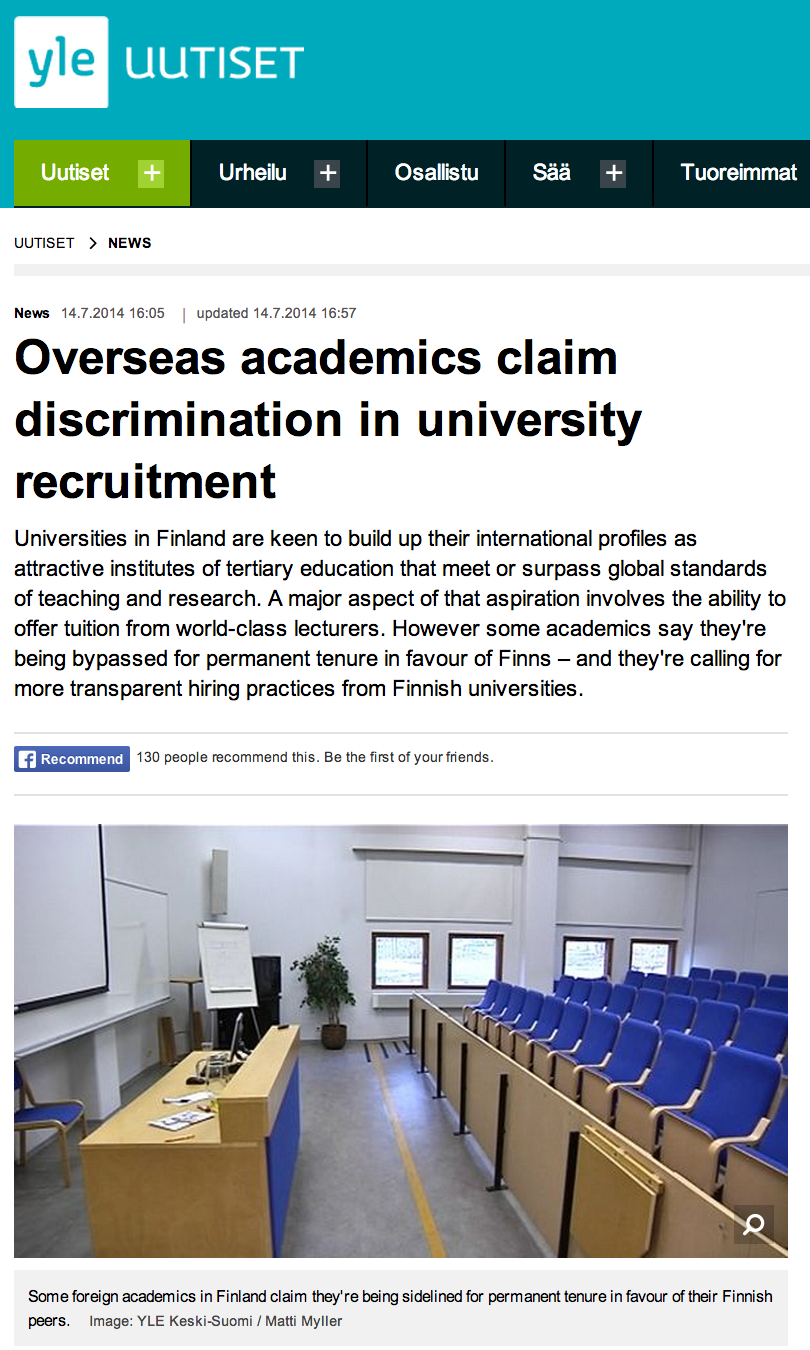
I did my PhD in urban geography at the University of Strathclyde and had been lecturing there for more than three years before I accepted my postdoctoral position at the University of Helsinki in December 2007. I had never been to Finland before, but the country, its people and their culture had long intrigued me. Once I had arrived in the April of the following year, I made a concerted effort to learn about Finland’s history and to appreciate its culture and etiquette.

Näyttökuva 2014-7-3 kello 15.04.30

Read full story here.

I also appreciated the space that I was given: a big corner desk in a shared office with three other researchers. I had time to work on my publications, and I received helpful tips about where to apply for funding when my two-year contract ran out. I also offered quality teaching in English, mainly to Erasmus exchange students – an experience that I enjoyed. The feedback on my teaching was generally positive, and my line manager told me that I was good for the university’s ambition to “become more international”. I also got positive vibes from colleagues. I felt valued.

At the start of 2009, I began making plans to become a permanent fixture in Finnish higher education. No positions were available in my faculty, but I won a year’s funding from a Finnish foundation to keep me going – albeit on a lower salary. However, subsequent applications to Finnish funding bodies were unsuccessful, as were my attempts to secure a permanent academic contract. I could get only part-time teaching jobs in a variety of universities in the south of the country.

The most frustrating aspect of applying for a position in Finnish higher education is the silence. When you apply for academic posts in UK universities, you can expect to be informed about the outcome even if you are unsuccessful. Finnish universities do not work in this way. It feels as though you are hassling human resources staff when you ask them for feedback. I suggested to a Finnish colleague that this silence might be viewed as discourteous, only to be told that Finns would rather not be seen to be rejecting people.

Still without a proper contract, my Finnish partner and I thought about leaving Finland last year. But then, in December, a permanent lectureship was finally advertised in my own department, the details for which included the words “open” and “international”, and I was encouraged to apply by my line manager. But again, I heard nothing for several months until one of the other candidates, based in France, sent me a copy of the official letter which stated that a Finn who had only just completed their PhD had been appointed to the post. The letter had not been translated from Finnish despite the supposedly international nature of the search. The head of department told me that no ranking of candidates existed and explained that it was “a strategic recruitment, where we hired a qualified person with strong existing ties to the research group”.

There has been some progress in opening up the Finnish higher education system to more foreign academic talent, but it has been slow. To get a sense of the wider view, I emailed all universities in Finland and asked them for statistics about their foreign staff. The University of Turku reflects the national picture. Of its 500 academic staff currently holding permanent contracts, only 21 are not Finnish citizens and just eight have a mother tongue other than Finnish, Swedish or Sami. I have lost count of the number of brilliant foreign academics who have upped and left this supposedly fair and open Nordic country because they are made to feel belittled and marginalised by a higher education system apparently designed to guarantee that Finns progress the fastest.

Finnish colleagues have given me four different explanations for this. One is foreigners’ difficulties with learning Finnish – from which I am certainly not immune. Another is that Finns trust other Finns and thus prefer to employ them. A third is that some Finns believe that they are more entitled to permanent academic contracts because it is “their” country. But the most surprising reason is that Finnish academics feel insecure and don’t wish to be challenged and undermined by foreign scholars.

The most important lesson I have learned was succinctly put by Michael Ignatieff in his recent memoir Fire and Ashes: “When you live in other people’s countries, you eventually bang up against glass doors and cordoned-off areas reserved for insiders. You realise you understand only what the insiders say, not what they really mean.”

Gareth Rice has just finished his last part-time lecturing contract with the University of Helsinki.

Read original story here.

This piece was reprinted by Migrant Tales with permission.

Is Heikki the drunk Finnish or Swedish?

Posted on July 3, 2014 by Migrant Tales

Some Swedish Finns are up in arms about a children’s book published in Sweden that pictures a wino called Heikki, according to YLE in English.  The character in the book, who is lying in a bush next to a plastic bag full of beer, was too much for Swedish Finn Sirpa Lamminpää, who filed a complaint to the Discrimination Ombudsman.  

YLE in English reports that the Discrimination Ombudsman will not take the case since “perceived prejudice” in printed books is falls under the jurisdiction of Swedish Chancellor of Justice.

Illustrator Gunna Grähs defends the character by stating that Heikki is a Swede.

“Perhaps she [Lamminpää]  is simply upset about the character being an alcoholic,” Grähs was quoted as saying. “Only one thing links him to Finland, and that is his name. In my opinion Heikki’s is a case of social class, not nationality.”

Grähs has a good point. Sweden is culturally diverse and a person with a name like Heikki can be a Swede.

Even so, the commotion about Heikki shows that Sweden is still a far ways off from being a post-racial society.

Risto Laakkonen, who is outspoken on migrant rights in Finland, said that any type of stereotyping is wrong and shouldn’t be tolerated.

Näyttökuva 2014-7-3 kello 11.42.19

Read full story here.


Laakkonen was active in a campaign in the 1970s to change the way that the Swedish media pictured Finns. Whenever a crime was reported by the media the first national group that came to mind as the culprits were Finns.

“With [then] Ambassador Max Jakobson we got in touch with all the editor-in-chiefs and managing editors of all the newspapers and television channels and told them that this type of stereotyping isn’t good since you’re labeling people who are working in this country,” he said. “The portrayal of Finns as the culprits ended pretty rapidly.”

Laakkonen said that in Finland it was impossible for the media to be racist towards migrants since there were so few back in the 1970s. He said that Finland’s media caught up to the Swedes in the 1990s.

“Things were actually much worse than today before when you had openly [fascist] groups [like the IKL 1932-44] that talked about Finns as a tribe and influenced this type of thinking to be taught at schools,” he said. “The Perussuomalaiset* are small fry when compared to the past.”

Laakkonen said that human rights and tolerance are like a tree that must be watered.

“The tree will die if you don’t water it,” he said. “All you need is 10% of the population to be awake and active [for human rights] for things to change.”


* The Finnish name for the Finns Party is the Perussuomalaiset (PS). The names adopted by the PS, like True Finns or Finns Party, promote in our opinion nativist nationalism and xenophobia. We therefore prefer to use the Finnish name of the party on our postings. 

perspetívák: Listen to his music and forget your political agenda

Posted on July 2, 2014 by Migrant Tales

Marcell Lorincz*

Näyttökuva 2014-7-2 kello 11.43.26


On June 14th Gogol Bordello was playing in Budapest. Music Against Racism had a stall at the event and before the concert (thanks to Skalar Music) I had the opportunity to meet Eugene. As he has a diverse beackground – he is from Ukraine, had a Roma grandparent, migrated to the States in the 80s – I was curious about his opinion.

Eugene+Htz+Eugene

Gogol Bordello: “I came to contact with people from all walks of life.” Source: perpetívák via last.fm.


ML: And did you meet personally, or in your family, racism or prejudice? Were you ever a target at anytime?”

EH: Actually, here and there. Starting in Italy, while we were living there. Here and there, around the world. Even in New York City, which is probably the most international town of all towns. There were small incidents, nothing too harsh, but yes. I came to contact with people from all walks of life. I tell you what’s that. Somehow all these situations where resolved because I was able to strike that chord with people – that what they think that identity is. It’s actually quite not the truth. You know that, the biggest example for it is, well any concert of energetic music, you will see that people pretty much forget what their political agenda is. Once their bigger organism gets activated, once their soul comes alive, suddenly nobody really cares about the color of each other skins. They actually grow more appreciative of it. So I have seen a lot of it in my life. Festivals, gatherings, everything and it’s an ongoing tendency in the world, really that globalization in some ways is also a part of it, of really connecting on a level that it’s all about the community of people who understand the human element, above any other element.

ML: I would like to ask your opinion about what’s going on in Ukraine? This nationalism thing?

EH: There’s no nationalism thing. Actually, I’m not going to talk about it because to understand the situation there, you really have to be there. So I’m already not there, so I’m not going to talk to people that are even farther from it, because I don’t want to create anymore confusion.

ML: My main question, and also it’s a question to me, that I can never answer. Do you think that we can change the people or we can stop racism? Ever?

EH: Its not going to happen in our life time. But it will happen eventually. It will not be completely exterminated in our life time that’s for sure. Unless some transformational asteroid will hit Earth. But slowly, surely will start working. I mean there was a time when people, you know, were still walking with the help of arms and hands. It’s a revolutionary process. Takes time.

ML: This anti-racism? It’s a topic in your band among the members? Are you talking about such issues or just reflecting on your personalities?

EH: It’s self-evident from our band that we are all part of these issues. Yes, I was born in a country where black people are considered to be something from another planet because we don’t have any, and there‘s stupid folklore jokes about that. But you know, I’m living in a different society for so long, that for me, playing in a multi-ethnical band it’s not even a question of any kind. Those questions don’t even pop in my head. They are all gone. I obviously overcame them with ease.

ML: Do you see a difference in this way between the so called western and eastern society? You don’t feel the same kind of prejudices? Or they just have another face?

EH: I don’t know. Even in Brazil, racism is quite high, you know. So you don’t really see the root of it. I don’t even know where to start. But you know, hopefully people slip them to more harmonious world vision I mean. And art I think helps a lot of this situation.”

ML: And you have any knowledge or connection to Hungary? You were here already some times. Do you have Roma friends or friends?

EH: I don’t have a lot of friends in Hungary, actually. But I know quite a bit about Hungary. At one point Ukraine was part of Austro-Hungarian Empire, not that long ago.

ML: You are from that region? Close to Hungarian border?

EH: Yes, my family came from Munkacs, in Ukraine. Zakarpate. So at the same time my connections to Hungary are more through rock music. Early records – I think this band actually exists now although it sounds quite different more metal. But in the beginning it’s a really innovative EDDA music.”

ML: It’s something very different now.

EH: So you know – Beatrice – all these bands. Good momentum.

* Marcell Lorincz live in Hungary and is the head of the board of the Foundation of Subjective Values. Established in 2003, the aim of the association states that it’s aim is “combating racism, reducing hate and creating a tolerant society.” 

Read original story here.


This piece was reprinted by Migrant Tales with permission.

Why does YLE air a racist movie like Pekka ja Pätkä neekereinä?

Posted on July 1, 2014 by Migrant Tales

A tweet by @Mastersson alerted me Tuesday about a comedy called Pekka ja Pätkä neekereinä (Pekka and Pätkä as n-words), were the duo  blackface themselves.  While this may have been “normal” in 1960 when the film was made, one wonders why the Finnish Broadcasting Company (YLE) aired this movie Monday afternoon? 

Näyttökuva 2014-7-1 kello 13.59.59

Pekka and Pätkä as blackface performers Neekereinä. WARNING: The link to the video contains racist language that some may find offensive.

Moreover, there is a consensus in Finland these days that the term neekeri is considered racist and insulting to blacks.

The only ones using the term neekeri today in Finland are normally hard-core racists.

n-word

At Finnish elementary schools not too long ago children were taught that the letter n stands for the n-word.

Since we know that children like to watch television during their summer holiday, how many watched Pekka ja Pätkä neekereinä Monday afternoon?  Since we know that racism is learned at home and at school, did the movie dispel or strengthen their views of blacks?

I would stick my neck out and claim that every movie depicting blacks and other minorities like Amerindians back in Pekka’s and Pätkä’s days were racist. Another movie that the comedians starred in 1957, Ketjukolari (Pileup), is so racist that I wouldn’t publish it on this blog.

What does it show? Cannibal blackfaces that show disrespect to Africans by portraying them as buffoons. In the same movie, there are Amerindians portrayed as “primitives” in the most stereotypical manner. There’s a lot of sexism in the film as well.

I’m going to write an email to YLE and express my outrage that this movie was aired on public Finnish television.  I invite you to do the same.


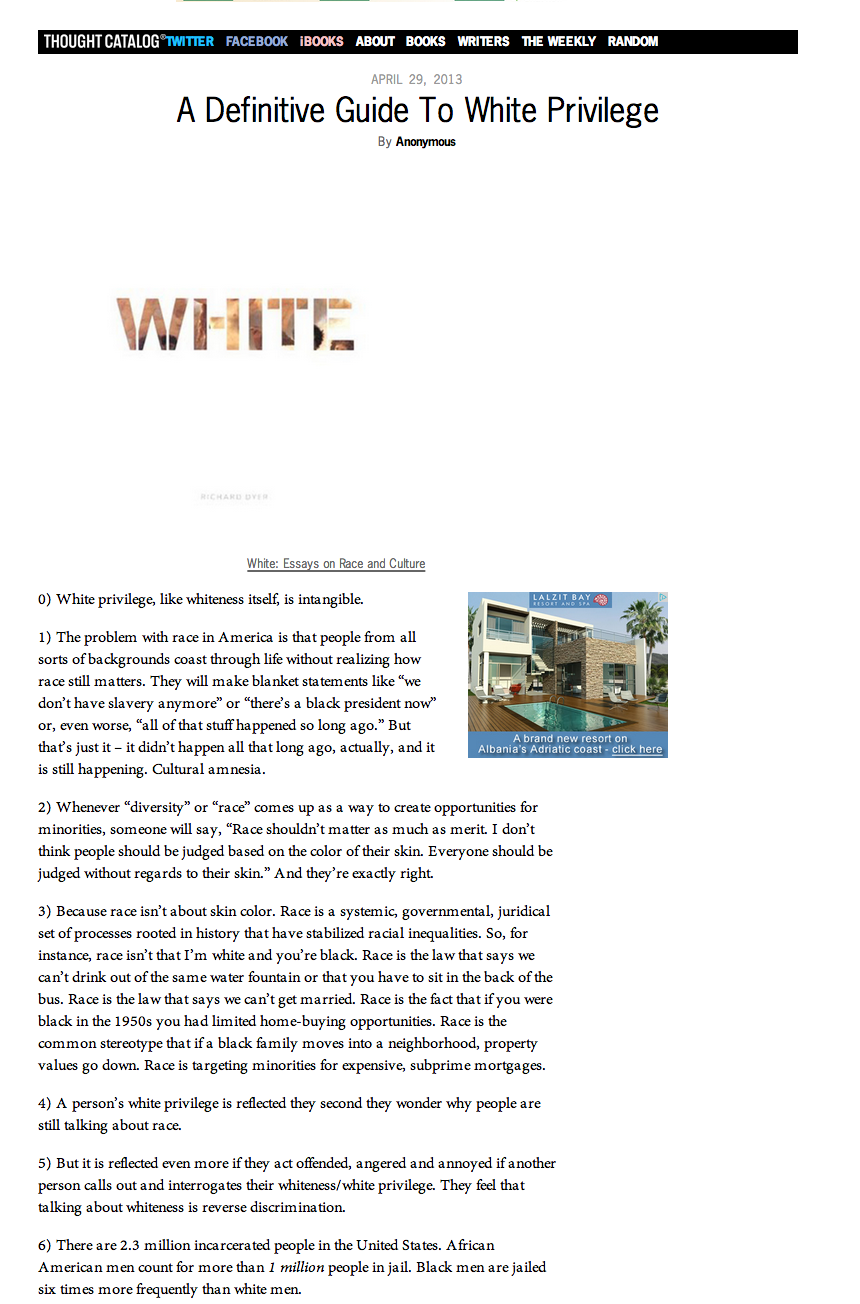
Defining white Finnish privilege #5: It’s ok to be a racist

Posted on July 1, 2014 by Migrant Tales

In many respects white privilege, or specifically white Finnish privilege, is a good way to understand some of the challenges that migrants and especially non-white Finns face in this country. Migrant Tales invites readers to share their thoughts on the social ill.

Please send your comments on the topic to [email protected]. We’d love to hear from you.

Näyttökuva 2014-7-1 kello 10.10.47

Perussuomalaiset* Espoo city councilman Teemu Lahtinen “likes” neo-Nazi Kansallinen Vastarinta, according to Paljastettu 3. This isn’t the first time PS party members have been found with their hand in the Nazi cookie jar like Ulla Pyysalo and Tuomas Okkonen. White Finnish privilege permits you to apply to or “like” neo-Nazi groups on Facebook and get away with it.

_________________

Definition #5

White Finnish privilege allows you to make racist statements and attack minorities with near-impunity. True, you might get slapped on the hand for making such racist comments, but the rewards in many cases outweigh the scorn. Since you are a white Finn, your hate speech, which you claim is being censored (if it’s “censored” how come we can read it in the national media?), can land you a profitable political career as an MP, MEP or councilman or councilwoman.

If migrants and visible minorities said the same racist things that politicians like Perussuomalaiset (PS)* MPs like Jussi Halla-aho, Olli Immonen, Teuvo Hakkarainen, Interior Minister Päivi Räsänen of the Christian Democrats,  Youth League of the National Coalition Party Chairwoman Susana Koski, Social Democratic MP Kari Rajamäki and many others did, they’d be lynched on social media and ostracized by the white Finnish media.

White Finnish privilege means that your role as a migrant and minority, which you are near-constantly reminded of, is usually that of the victim of racist insults and prejudice. White privilege encourages  you to “try harder” and “learn more Finnish” as your situation becomes ever-compromised.

* The Finnish name for the Finns Party is the Perussuomalaiset (PS). The names adopted by the PS, like True Finns or Finns Party, promote in our opinion nativist nationalism and xenophobia. We therefore prefer to use the Finnish name of the party on our postings. 

See also:

  • Defining white Finnish privilege #1: I have it and you don’t
  • Defining white Finnish privilege #2: Third culture children versus “pupil with immigrant background” 
  • Defining white Finnish privilege #3 No history, no doctrine, no heroes and no martyrs
  • Defining white Finnish privilege #4 Holding the short end of the stick

* The Finnish name for the Finns Party is the Perussuomalaiset (PS). The names adopted by the PS, like True Finns or Finns Party, promote in our opinion nativist nationalism and xenophobia. We therefore prefer to use the Finnish name of the party on our postings.
Close your eyes and repeat: The PS of Finland isn’t a racist and fascist party…

Posted on June 29, 2014 by Migrant Tales

Harri Tauriainen, a Perussuomalaiset (PS)* councilman of the northern city of Kemi, is a good example of how racism and fascism have found fertile ground in the PS. Taurianen was elected by the region of Lappi as a PS candidate for the April 2015 parliamentary elections, according to Rovaniemi-based daily Lapin Kansa. 

Tauriainen, a councilman of Kemi, got more votes than any other candidate in his city in the October 2012 municipal elections.

An interesting pattern emerges after having followed for some time the political antics of an anti-EU, anti-immigration, homophobic and especially anti-Islam party like the PS: Say outrageously racist things, fear-monger with gusto, get elected, and then start to appear mainstream but don’t forget to speak in code to your followers.

The PS has done a half-ass job with Tauriainen’s political facelift. He took some white power and “save our race” pictures down from his Facebook page below after the municipal elections. True, we haven’t heard him lash out at migrants like before. We haven’t heard him state:

“…it’s odd that we can’t put in line in Finland this colored human trash. Just put a stamp on their ass and deport them for good from Finland.”

In one picture greeting PS MPs this year in Kemi, Tauriainen has a White Guard emblem on the left of his coat.

While one of the aims of the White Guards was to contain the spread of communism and socialism in Finland,  it was disbanded after Finland signed an armistice ending hostilities with the former Soviet Union in September 1944.

Those who wear White Guard emblems these days are considered far-right activists that long for the days of fascism of the 1930s.

Tauriainen”likes” the far-right Suomalaisuuden liitto association.

He denies that he’s a fascist but calls himself instead a nationalist.

Kuva 58

Tauriainen’s Facebook page in October 2012.

Näyttökuva 2014-6-29 kello 11.26.55

Taurianen’s Facebook picture album today.

The PS facelift to make the councilman more mainstream only required taking down two pictures and some racist posts.  There is, however, a second drawing in the first row that isn’t apparently considered racist by the PS. That picture states that Finland should guard its borders from foreign ogres like the one pictured in the drawing.

Despite the facelifts to become more mainstream, the PS has lagged behind its historic parliamentary election victory of 2011 in the  presidential, municipal and euro elections.

If the PS attract around 12% of the vote in next year’s parliamentary elections, it means that about half of its 38 MPs won’t get elected.

This is good news for Finland but bad news for an anti-EU, anti-immigration, homophobic and especially anti-Islam party like the PS.

* The Finnish name for the Finns Party is the Perussuomalaiset (PS). The names adopted by the PS, like True Finns or Finns Party, promote in our opinion nativist nationalism and xenophobia. We therefore prefer to use the Finnish name of the party on our postings. 

Finnish gay rights hall of fame, shame and extra shame

Posted on June 28, 2014 by Migrant Tales

As the winding history of Finland’s first same-sex marriage law is being written, there’s already a hall of fame and shame from February 2013. As everyone knows, the citizens’ initiative for same-sex marriage was defeated Tuesday in the legal affairs committee of parliament by a vote of 10-6.

Even if those 10 who voted against the citizens’ initiative still believe that the world stands still and moves to the beat of their morality, there are two others that have the dubious honor of being in the hall of extra shame: Social Democrat MPs Mikael Jungner and Arja Juvonen of the Perussuomalaiset (PS)* party.

MP Suna Kymäläinen, a Social Democrat, wasn’t present at the voting because she came down with the flu on Tuesday morning and there’s wan’t time to get a substitute for her.

Green Party MP Oras Tynkkynen, who is a member of the legal affairs committee, wrote on a blog that the voting would have been much closer if the two Social Democrats would have been present.

PS MP Juvonen has gone on the record favoring same-sex marriage but wasn’t present to vote at the legal affairs committee.

Juvonen wrote on a blog that she intentionally chose not to attend the meeting because the PS’ and her stand over same-sex marriage are different.

“That’s why there was a substitute [at the meeting] that voted and took to the committee the party’s [official negative] stand [on same-sex marriage] because I couldn’t have done it.”

Wow, so here’s an PS MP who told voters before she was elected that she supports same-sex marriage but couldn’t vote on such an intiative because the party’s chairman, Timo Soini, keeps his MPs on a short leash.

Näyttökuva 2014-6-26 kello 15.17.05

 From left to right: MPs who voted for the same-sex initiative, those who voted against, and those who were absent.


Jungner denies that he was at a bar when the voting took place.

The same-sex citizens’ initiative will be voted in the fall by parliament.


* The Finnish name for the Finns Party is the Perussuomalaiset (PS). The names adopted by the PS, like True Finns or Finns Party, promote in our opinion nativist nationalism and xenophobia. We therefore prefer to use the Finnish name of the party on our postings. 

Four in five Swedes express concern over xenophobia

Posted on June 28, 2014 by Migrant Tales

Swedes are more worried about the rise of xenophobia in their country than the ever-growing number of immigrants, according to The Local, citing a study by the SOM Institute of Gothenburg University. The survey revealed that while 49% expressed concern over immigration levels, 78% were worried about the rise of xenophobia. 

Näyttökuva 2014-6-28 kello 13.32.15

Read full story here.

Writes The Local: The negative attitude towards xenophobia is likely due to the fact that the topic has been a hot one for the past two or three years, said Marie Demker, a political scientist, was quoted as saying.

“I noticed that people fell that xenophobia threatens society,” she said. “We talk an awful lot about xenophobia and there is also a strongly negative attitude to all forms of racism and xenophobia.”

Demker said that it was “quite clear” that her countrymen and countrywomen were more worried about attitudes towards immigrants and refugees than they were about foreigners themselves.

Compared with the “what do you think about immigrants” surveys carried out in Finland, we can learn a lot from Sweden. Instead of asking if Finland should increase the number of immigrants, why don’t we ask them their opinions about xenophobia? Irrespective if a country has few or many immigrants, few will say that there are too few immigrants, which reveals that these types of surveys have loaded questions.

Meanwhile, Eurostat announced last week that Sweden took in 20% (26,395) of all asylum seekers in the EU in 2013. That was followed by Germany (26,080), France (16,155), Italy (14,495) and the United Kingdom (13,400).

Finland ranked 14th with 1,795.

Näyttökuva 2014-6-28 kello 13.06.15


Read full story here.

Finnish HJK premier division football coach considers German team “arbeit macht frei”

Posted on June 27, 2014 by Migrant Tales

Right after the USA-Germany game, Helsinki football team HJK coach Mika Lehkosuo sticks his foot in his mouth by quoting a Nazi phrase, arbeit macht frei, when asked how the German team played. The Nazi slogan, which means “work makes you free,” was found at the gates of a number of concentration camps like Auschwitz during World War 2.

To add salt to mortal injury to the millions of Jews, Roma and other Nazi victims that perished at such death camps, the host bursts out in laughter after Lehkosuo’s comment.

This comment that the HJK coach made is a good example of how racist and homophobic jokes are made at work or other public places. The person making the comment doesn’t understand or cares if what was said was offensive. Instead of reacting to what was said, listeners give their seal of approval with a smile, laughter or silence.


If I were Lehkosuo, I’d apologize for what he said. It’s the least he could do. More importantly, he’d be setting an example that such Nazi slogans are unacceptable.

UPDATE: And that is exactly what he did in a statement (in Finnish). He said that his comment wasn’t supposed to be linked to Nazi Germany. “Using hindsight, it’s clear that I shouldn’t have used that phrase [in the first place],” he said.

In April, Rovaniemi premier division football coach Juha Malinen apologized for stating that he had  “most [white] Finnish” team in the league.

“A few years ago RoPS had thirteen black men [players],” he was quoted as saying on tabloid Iltalehti. “…We now have players whose names can be pronounced correctly and who Finns know…”

Thank you Rasmus for the heads-up!

Defining white Finnish privilege #4: Holding the short end of the stick

Posted on June 26, 2014 by Migrant Tales

In many respects white privilege, or specifically white Finnish privilege, is a good way to understand some of the challenges that migrants and especially non-white Finns face in this country. Migrant Tales invites readers to share their thoughts on the social ill.

Please send your comments on the topic to [email protected]. We’d love to hear from you.

IMG_4107

Instituto Elos of Brazil offers inspiring tools to empower communities.

____________

Definition #4

No matter how many dissertations you write or the skills you have acquired, they’ll never be enough to put you on the same level as a white Finn. You may become like them if you assimilate, learn their ways and to read the code they use. Since it’s impossible to become white if you aren’t, your best bet is to be the exception.

White Finnish privilege is the reason why migrants and minorities usually end up holding the short end of the career stick. Everything takes a longer time to accomplish than normally: education, career, job advancement, even happiness.

White Finnish privilege works in sinister ways because robs you of the most precious resource you have: time.

See also:

  • Defining white Finnish privilege #1: I have it and you don’t
  • Defining white Finnish privilege #2: Third culture children versus “pupil with immigrant background” 
  • Defining white Finnish privilege #3 No history, no doctrine, no heroes and no martyrs


  • Previous
  • 1
  • …
  • 317
  • 318
  • 319
  • 320
  • 321
  • 322
  • 323
  • …
  • 513
  • Next
Read more about documentary film
Read more

Recent Posts

  • Finland’s tabloids Iltalehti and Ilta-Sanomat are the pits
  • Riikka Purra’s Dr Jekyll and Mr Hyde mask
  • Double standards
  • Perussuomalaiset: Uusi logo, sama vanha juttu
  • Taco Trump

Recent Comments

  1. Absolutely Socking: Racist Finnish Facebook group against human rights gets flooded with socks on Musta Barbaari’s mother and sister charged by the police in “ethnic profiling” case
  2. Ilkka Nuotio on Pekka Myrskylä: “Tilastot kertovat toista kuin poliittinen keskustelu”
  3. Genrih Soinkara on The war in Ukraine and the Russian-Finnish border crisis are showing Finland’s ugly side
  4. Ahti Tolvanen on Comment by Ahti Tolvanen on the Helsinki +50 conference
  5. Angel Barrientos on Angel Barrientos is one of the kind beacons of Finland’s Chilean community

Archives

  • June 2026
  • May 2026
  • April 2026
  • March 2026
  • February 2026
  • January 2026
  • December 2025
  • November 2025
  • October 2025
  • September 2025
  • August 2025
  • July 2025
  • June 2025
  • May 2025
  • April 2025
  • March 2025
  • February 2025
  • January 2025
  • December 2024
  • November 2024
  • October 2024
  • September 2024
  • August 2024
  • July 2024
  • June 2024
  • May 2024
  • April 2024
  • March 2024
  • February 2024
  • January 2024
  • December 2023
  • November 2023
  • October 2023
  • September 2023
  • August 2023
  • July 2023
  • June 2023
  • May 2023
  • April 2023
  • March 2023
  • February 2023
  • January 2023
  • December 2022
  • November 2022
  • October 2022
  • September 2022
  • August 2022
  • July 2022
  • June 2022
  • May 2022
  • April 2022
  • March 2022
  • February 2022
  • January 2022
  • December 2021
  • November 2021
  • October 2021
  • September 2021
  • August 2021
  • July 2021
  • June 2021
  • May 2021
  • April 2021
  • March 2021
  • February 2021
  • January 2021
  • December 2020
  • November 2020
  • October 2020
  • September 2020
  • August 2020
  • July 2020
  • June 2020
  • May 2020
  • April 2020
  • March 2020
  • February 2020
  • January 2020
  • December 2019
  • November 2019
  • October 2019
  • September 2019
  • August 2019
  • July 2019
  • June 2019
  • May 2019
  • April 2019
  • March 2019
  • February 2019
  • January 2019
  • December 2018
  • November 2018
  • October 2018
  • September 2018
  • August 2018
  • July 2018
  • June 2018
  • May 2018
  • April 2018
  • March 2018
  • February 2018
  • January 2018
  • December 2017
  • November 2017
  • October 2017
  • September 2017
  • August 2017
  • July 2017
  • June 2017
  • May 2017
  • April 2017
  • March 2017
  • February 2017
  • January 2017
  • December 2016
  • November 2016
  • October 2016
  • September 2016
  • August 2016
  • July 2016
  • June 2016
  • May 2016
  • April 2016
  • March 2016
  • February 2016
  • January 2016
  • December 2015
  • November 2015
  • October 2015
  • September 2015
  • August 2015
  • July 2015
  • June 2015
  • May 2015
  • April 2015
  • March 2015
  • February 2015
  • January 2015
  • December 2014
  • November 2014
  • October 2014
  • September 2014
  • August 2014
  • July 2014
  • June 2014
  • May 2014
  • April 2014
  • March 2014
  • February 2014
  • January 2014
  • December 2013
  • November 2013
  • October 2013
  • September 2013
  • August 2013
  • July 2013
  • June 2013
  • May 2013
  • April 2013
  • March 2013
  • February 2013
  • January 2013
  • December 2012
  • November 2012
  • October 2012
  • September 2012
  • August 2012
  • July 2012
  • June 2012
  • May 2012
  • April 2012
  • March 2012
  • February 2012
  • January 2012
  • December 2011
  • November 2011
  • October 2011
  • September 2011
  • August 2011
  • July 2011
  • June 2011
  • May 2011
  • April 2011
  • March 2011
  • February 2011
  • January 2011
  • December 2010
  • November 2010
  • October 2010
  • September 2010
  • August 2010
  • July 2010
  • June 2010
  • May 2010
  • April 2010
  • March 2010
  • February 2010
  • January 2010
  • December 2009
  • November 2009
  • October 2009
  • September 2009
  • August 2009
  • July 2009
  • December 2008
  • November 2008
  • October 2008
  • September 2008
  • August 2008
  • July 2008
  • June 2008
  • May 2008
  • April 2008
  • March 2008
  • February 2008
  • January 2008
  • November 2007
  • October 2007
  • September 2007
  • August 2007
  • July 2007
  • June 2007
  • May 2007

Categories

  • ?? Gia L?c
  • ????? ?????? ????? ???????? ?? ??????
  • ???????
  • @HerraAhmed
  • @mondepasrond
  • @nohatefinland
  • @oula_silver
  • @Varathas
  • A Pakistani family
  • äärioikeisto
  • Abbas Bahmanpour
  • Abdi Muhis
  • Abdirahim Hussein Mohamed
  • Abdirahim Husu Hussein
  • Abdirisak Mahamed
  • About Migrant Tales
  • activism
  • Adam Al-Sawad
  • Adel Abidin
  • Afrofinland
  • Ahmed IJ
  • Ahti Tolvanen
  • Aino Pennanen
  • Aisha Maniar
  • Alan Ali
  • Alan Anstead
  • Alejandro Díaz Ortiz
  • Alekey Bulavsev
  • Aleksander Hemon
  • Aleksanterinliitto
  • Aleksanterinliitto ry
  • Aleksanterinliitto ry:n hallitus
  • Alex Alex
  • Alex Mckie
  • Alexander Nix
  • Alexandra Ayse Albayrak
  • Alexis Neuberg
  • Ali Asaad Hasan Alzuhairi
  • Ali Hossein Mir Ali
  • Ali Rashid
  • Ali Sagal Abdikarim
  • Alina Tsui
  • Aline Müller
  • All categories
  • Aman Heidari
  • Amiirah Salleh-Hoddin & Jana Turk
  • Amin A. Alem
  • Amir Zuhairi
  • Amkelwa Mbekeni
  • Ana María Gutiérrez Sorainen
  • Anachoma
  • Anders Adlecreutz
  • Angeliina Koskinen
  • Anna De Mutiis
  • Anna María Gutiérrez Sorainen
  • Anna-Kaisa Kuusisto ja Jaakko Tuominen
  • Annastiina Kallius
  • Anneli Juise Friman Lindeman
  • Announcement
  • Anonymous
  • Antero Leitzinger
  • anti-black racism
  • Anti-Hate Crime Organisation Finland
  • Anudari Boldbaatar
  • Arshiya Nasser
  • Aspergers Syndrome
  • Asylum Corner
  • Asylum seeker 406
  • Athena Griffin and Joe Feagin
  • Autism
  • Avaaz.org
  • Awale Olad
  • Ayan Said Mohamed
  • AYY
  • Barachiel
  • Bashy Quraishy
  • Beatrice Kabutakapua
  • Beri Jamal
  • Beri Jamal and Enrique Tessieri
  • Bertolt Brecht
  • Boiata
  • Boodi Kabbani
  • Bruno Gronow
  • Carmen Pekkarinen
  • Çelen Oben and Sheila Riikonen
  • Chiara Costa-Virtanen
  • Chiara Costa-Virtanen
  • Chiara Sorbello
  • Christian Thibault
  • Christopher Wylie
  • Clara Dublanc
  • Dana
  • Daniel Malpica
  • Danilo Canguçu
  • David Papineau
  • David Schneider
  • Dexter He
  • Don Flynn
  • Dr Masoud Kamali
  • Dr. Faith Mkwesha
  • Dr. Theodoros Fouskas
  • Edna Chun
  • Eeva Kilpi
  • Emanuela Susheela
  • En castellano
  • ENAR
  • Enrique
  • Enrique Tessieri
  • Enrique Tessieri & Raghad Mchawh
  • Enrique Tessieri & Yahya Rouissi
  • Enrique Tessieri and Muhammed Shire
  • Enrique Tessieri and Sira Moksi
  • Enrique Tessieri and Tom Vandenbosch
  • Enrique Tessieri and Wael Che
  • Enrique Tessieri and Yahya Rouissi
  • Enrique Tessieri and Zimema Mhone
  • Epäluottamusmies
  • EU
  • Europe
  • European Islamophobia Report
  • European Islamophobia Report 2019,
  • European Union
  • Eve Kyntäjä
  • Ezequiel Caldeiro
  • Facebook
  • Fadumo Dayib
  • Faisa Kahiye
  • Farhad Manjoo
  • Fasismi
  • Finland
  • Fizza Qureshi
  • Flyktingar och asyl
  • Foreign Student
  • Fozia Mir-Ali
  • Frances Webber
  • Frida Selim
  • Gareth Rice
  • Ghyslain Vedeaux
  • Global Art Point
  • Great Replacement
  • Habiba Ali
  • Hami Bahadori
  • Hami Bahdori
  • Hamid
  • Hamid Alsaameere
  • Hamid Bahdori
  • Handshake
  • Harmit Athwal
  • Hassan Abdi Ali
  • Hassan Muhumud
  • Heikki Huttunen
  • Heikki Wilenius
  • Helsingin Sanomat
  • Henning van der Hoeven
  • Henrika Mälmsröm
  • Hser Hser
  • Hser Hser ja Mustafa Isman
  • Husein Muhammed
  • Hussain Kazemian
  • Hussain Kazmenian
  • Ibrahim Khan
  • Ida
  • Ignacio Pérez Pérez
  • Iise Ali Hassan
  • Ilari Kaila & Tuomas Kaila
  • Imam Ka
  • inside-an-airport
  • Institute of Race Relations
  • Iraqi asylum seeker
  • IRR European News Team
  • IRR News Team
  • Islamic Society of Norhern FInland
  • Islamic Society of Northern Finland
  • Islamophobia
  • Jacobinmag.com
  • Jallow Momodou
  • Jan Holmberg
  • Jane Elliott
  • Jani Mäkelä
  • Jari Luoto
  • Jari Taponen
  • Jegor Nazarov
  • Jenni Stammeier
  • Jenny Bourne
  • Jessie Daniels
  • Joe Davidow
  • Johannes Koski
  • John D. Foster
  • John Grayson
  • John Marriott
  • Jon Burnett
  • Jorma Härkönen
  • Jos Schuurmans
  • José León Toro Mejías
  • Josue Tumayine
  • Jouni Karnasaari
  • Juan Camilo
  • Jukka Eräkare
  • Julian Abagond
  • Julie Pascoet
  • Jussi Halla-aho
  • Jussi Hallla-aho
  • Jussi Jalonen
  • JusticeDemon
  • Kadar Gelle
  • Kaksoiskansalaisuus
  • Kansainvälinen Mikkeli
  • Kansainvälinen Mikkeli ry
  • Katherine Tonkiss
  • Kati Lepistö
  • Kati van der Hoeven-Lepistö
  • Katie Bell
  • Kättely
  • Kerstin Ögård
  • Keshia Fredua-Mensah & Jamie Schearer
  • Khadidiatou Sylla
  • Khadra Abdirazak Sugulle
  • Kiihotus kansanryhmää vastaan
  • Kirsi Crowley
  • Koko Hubara
  • Kristiina Toivikko
  • Kubra Amini
  • KuRI
  • La Colectiva
  • La incitación al odio
  • Laura Huhtasaari
  • Lauri Finér
  • Leif Hagert
  • Léo Custódio
  • Leo Honka
  • Leontios Christodoulou
  • Lessie Branch
  • Lex Gaudius
  • Leyes de Finlandia
  • Liikkukaa!
  • Linda Hyökki
  • Liz Fekete
  • M. Blanc
  • Maarit Snellman
  • Mahad Sheikh Musse
  • Maija Vilkkumaa
  • Malmin Kebab Pizzeria Port Arthur
  • Marcell Lorincz
  • Mari Aaltola
  • María Paz López
  • Maria Rittis Ikola
  • Maria Tjader
  • Marja-Liisa Tolvanen
  • Mark
  • Markku Heikkinen
  • Marshall Niles
  • Martin Al-Laji
  • Maryan Siyad
  • Matt Carr
  • Mauricio Farah Gebara
  • Media Monitoring Group of Finland
  • Micah J. Christian
  • Michael McEachrane
  • Michele Levoy
  • Michelle Kaila
  • Migrant Tales
  • Migrant Tales Literary
  • Migrantes News
  • Migrants' Rights Network
  • MigriLeaks
  • Mikko Kapanen
  • Miriam Attias and Camila Haavisto
  • Mohamed Adan
  • Mohammad Javid
  • Mohammad M.
  • Monikulttuurisuus
  • Monisha Bhatia and Victoria Canning
  • Mor Ndiaye
  • Muh'ed
  • Muhamed Abdimajed Murshid
  • Muhammed Shire
  • Muhammed Shire and Enrique Tessieri
  • Muhis Azizi
  • Musimenta Dansila
  • Muslimiviha
  • Musulmanes
  • Namir al-Azzawi
  • Natsismi
  • Neurodiversity
  • New Women Connectors
  • Nils Muižnieks
  • No Labels No Walls
  • Noel Dandes
  • Nuor Dawood
  • Omar Khan
  • Otavanmedia
  • Oula Silvennoinen
  • Paco Diop
  • Pakistani family
  • Pentti Stranius
  • Perussuomalaiset
  • perustuslaki
  • Petra Laiti
  • Petri Cederlöf
  • Pia Grochowski
  • Podcast-lukija Bea Bergholm
  • Pohjois – Suomen Islamilainen Yhdyskunta
  • Pohjois Suomen Islamilainen Yhyskunta
  • Polina Kopylova
  • Race Files
  • racism
  • Racism Review
  • Raghad Mchawh
  • Ranska
  • Rashid H. and Migrant Tales
  • Rasismi
  • Raul Perez
  • Rebecka Holm
  • Reem Abu-Hayyeh
  • Refugees
  • Reija Härkönen
  • Remiel
  • Reza Nasri
  • Richard Gresswell
  • Riikka Purra
  • Risto Laakkonen
  • Rita Chahda
  • Ritva Kondi
  • Robito Ibrahim
  • Roble Bashir
  • Rockhaya Sylla
  • Rodolfo Walsh
  • Roger Casale
  • Rostam Atai
  • Roxana Crisólogo Correa
  • Ruth Grove-White
  • Ruth Waweru-Folabit
  • S-worldview
  • Sadio Ali Nuur
  • Sami Rusanen
  • Sandhu Bhamra
  • Sara de Jong
  • Sarah Crowther
  • Sari Alhariri
  • Sarkawt Khalil
  • Sasu
  • Scot Nakagawa
  • Shabana Ahmadzai
  • Shada Islam
  • Sharon Chang blogs
  • Shenita Ann McLean
  • Shirlene Green Newball
  • Sini Savolainen
  • Sira Moksi
  • Sonia K.
  • Sonia Maria Koo
  • Steverp
  • Stop Deportations
  • Suldaan Said Ahmed
  • Suomen mediaseurantakollektiivi
  • Suomen Muslimifoorumi ry
  • Suomen viharikosvastainen yhdistys
  • Suomen viharikosvastainen yhdistys ry
  • Suomi
  • Supermen
  • Susannah
  • Suva
  • Syrjintä
  • Talous
  • Tapio Tuomala
  • Taw Reh
  • Teivo Teivainen
  • The Daily Show
  • The Heino
  • The Supermen
  • Thomas Elfgren
  • Thulfiqar Abdulkarim
  • Tim McGettigan
  • Tino Singh
  • Tito Moustafa Sliem
  • Tobias Hübinette and L. Janelle Dance
  • Transport
  • Trica Danielle Keaton
  • Trilce Garcia
  • Trish Pääkkönen
  • Trish Pääkkönen and Enrique Tessieri
  • Tuulia Reponen
  • Uncategorized
  • UNITED
  • University of Eastern Finland
  • Uyi Osazee
  • Väkivalta
  • Vapaa Liikkuvuus
  • Venla-Sofia Saariaho
  • Vieraskynä
  • W. Che
  • W. Che an Enrique Tessieri
  • Wael Ch.
  • Wan Wei
  • Women for Refugee Women
  • Xaan Kaafi Maxamed Xalane
  • Xassan Kaafi Maxamed Xalane
  • Xassan-Kaafi Mohamed Halane & Enrique Tessieri
  • Yahya Rouissi
  • Yasmin Yusuf
  • Yassen Ghaleb
  • Yle Puhe
  • Yuliet Tresa
  • Yve Shepherd
  • Zahra Khavari
  • Zaker
  • Zalina Ametova
  • Zamzam Ahmed Ali
  • Zeinab Amini ja Soheila Khavari
  • Zimema Mahone and Enrique Tessieri
  • Zimema Mhone
  • Zoila Forss Crespo Moreyra
  • ZT
  • Zulma Sierra
  • Zuzeeko Tegha Abeng
© 2026 Migrant tales | Powered by Minimalist Blog WordPress Theme