Racism is like a Cadillac, they bring out a new model every year.
Malcolm X
Few these days deny that Finland has a racism problem against Muslims, people of color and Third Worlders, the Romany and Russian-speaking minority, the third largest after Finnish and Swedish speakers. The serious student of society does not only look at the surface of news but what is behind it.
The denial of racism by some sectors of Finnish society are one salient issue we can look behind the news. If racism and prejudice are ever-present, how does the media, politicians and society play down and deny the social ill?
When speaking of Muslims in Finland, the media rarely speaks up or defends the group since stereotypes about their “primitive culture” and our exceptiionalism permit us to look the other way.
Even if the above examples of racist journalism happened over thirty years ago, it still continues today.
MTV is the biggest private television company in Finland. It’s portrail of brown migrants had the same hateful narrative: migrant youths and non-white migrants are a threat to society because they are violent. The picture on the right was used to give a heads up that MTV was going to interview the Interior Minister Mari Rantanen about the government’s tightened migration policy. Why is there a threatenig picture of a person with a knife?
Finland’s Russian-speaking community, the third largest after Finnish and Swedish speakers. They are a category of their own how they are treated by the media and politicians.
The Finnish media, including Prime Minister Petteri Orpo, have attacked in mob fashion Kimmo Kiljunen, member of the Social Democratic Party and chairperson of the foreign affairs committee, for speaking candidly to representatives of the Alexander Union, a Finnish-Russian association, about the Finnish-Russian border as well as other matters.
Today, an editorial by Helsingin Sanomat highlighted “the unusual problems” of Kiljunen’s comments to Alexander Union. It wrote: “In the video, Kiljunen expressed some unusual opinions on Finland’s policy towards Russia. Among other things, he said that he considers the closure of the eastern border a violation of human rights and the ban on Russian real estate transactions to be racist. Kiljunen claimed that the Finnish tabloids were playing into the hands of Russian trolls with their critical articles.”
Are the above comments “unusual” and did they warrant such outrage? Or are Kiljunen’s views similar to what human rights experts and academicians pointed out about the dangers of the pushback law, which was approved by parliament in July?
Again, we must ask what did Kiljunen say wrong? Was he too candid in his views that the closing of the Finnish-Russian border is a slap in the face of human rights, and that National Coalition Party politicians like Antti Häkkänen can reinforce prejudices that Russians are a threat and that they should be barred from buying land? Did Kiljunen step on the government’s feet?
Even if the above restrictions do not prevent Finnish-Russian residents from buying land, they do send a clear message: Russians are a threat, and they should not be trusted. The war in Ukraine and the terrible invasion by Russia have made a bad situation worse by reinforcing people’s xenophobia toward Russians.
Some politicians, including President Aleksander Stubb, have even questioned the right of Russian speakers to hold dual citizenship.
Making such a suggestion, as did happen during a presidential campaign debate earlier this year, brings memories but in a different context of the Nuremberg Laws, which stripped the Jews of their rights in Nazi Germany.
The attacks and Kiljunen’s character assassination even by his party reveal a lot about Finland’s issues with xenophobia and suspicion of its Russian-speaking community, the third largest after Finnish and Swedish speakers.
Not understanding the racism in the debate is comprehending very little about the whole issue of how Finland’s Russian community is treated.
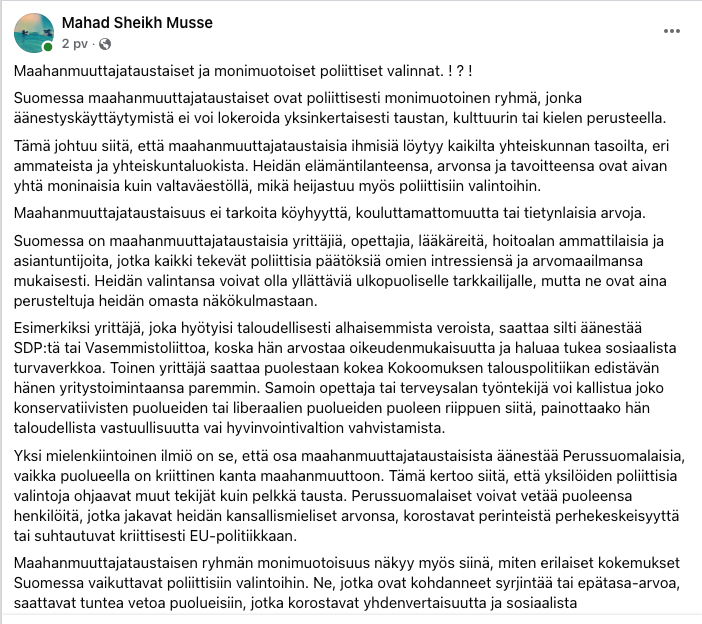
I’m surprised that the media and politicians are surprised by far-right Finns Party (PS)Interior Minister Mari Rantanen’s double-talk about favoring Christians over Muslims in next year’s quota refugee pick.
Rantanen’s fishy denials that next year’s selection of quota refugees had anything to do with preferring Christians over Muslims, prompted the non-discrimination ombudsman to do some investigating, and guess what they uncovered: There was a plan after all to prefer Christian quota refugees over Muslims.
But let’s not take Rantanen’s or her temporary replacement, Lulu Ranne’s word. It is a clear matter that one of the Perussuomalaiset’s (PS) aims is to stop Muslim and other asylum seekers from coming to Finland.
In an Interview with the tabloid Iltalehtiin 2023, PS chairperson Riikka Purra acknowledged that she aims for zero asylum seekers, like Denmark, from Muslim countries. Speaker of parliament, Jussi Halla-aho, who was convicted for ethnic agitation in 2012, has repeated the same aim.
One of the motivating factors behind the US Republican’s wish to promote anti-abortion is the fear that white USAmericans will become a minority in an ever-ethnically diverse country.
The PS expresses the same fear and motivation. They also believe that Finland will be “Islamized” and taken over by non-white people. Such a phobia is one of the biggest motives for the PS’ xenophobic migration and zero-tolerance refugee policy.
It’s still too early to see what political impact Rantanen’s lies will have on the party and trust in the rule of law in Finland. Like a slippery slope after the passage of the pushback law in July, which emboldened xenophobes in the government, was it a factor that encouraged the PS to introduce changes in the quota refugee system in Finland?
As the PS and government tear down the rule of law and stain our international and national image, all of this is done to feed the voracious hunger for racism and bolster sagging opinion polls.
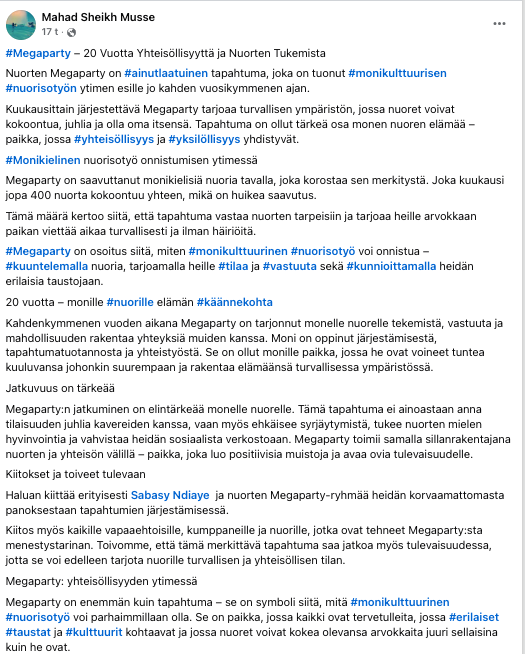
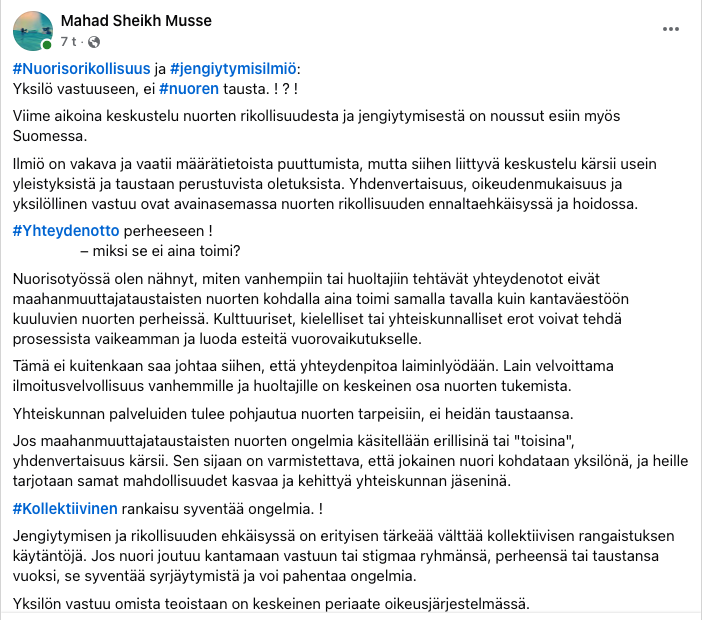
In the podcast, Mahad Sheikh Musse, who has been a youth social worker in Helsinki for over 20 years, offers some sound advice on how why looking beyond stereotypes and our biases can help us to look past ethnic labels, which keeps us from treating youths with migrant backgrounds with for what they are: full of potential.
‹
One of Musse’s biggest points is that we must build bridges, not walls. Look at the individual don’t lace an ethnic stamp on his or her forehead and expect that youth to reinforce your prejudice.
In Finland, immigrant-background families are often treated differently than other families when it comes to seeking help for their children.
Mahad Sheikh Musse, a multicultural youth work professional with over 20 years of experience, contends that this practice creates inequality and alienates families from support services. He emphasizes that cultural backgrounds should not dictate the methods of providing assistance and that every individual and family deserves to be treated equally and respectfully.
He believes that the best approach is to connect with parents, listen to their needs, and work together to find solutions, just as with any other family seeking support.
Mahad Sheikh Musse is a youth social worker with over 20 years experience. Apart from his social work, he is an avid writer who speaks out against discrimintion of youth with migrant backgrounds.
In the first podcast, Musse speaks about how to tear down racist structures in society that reinforce discrimination. He said that one must “have empathy, open-mindedness and venture outside one’s comfort zone challenging our assumptions and biases.”
Even if change in society is slow, one must have patience. “Even small actions can hve a ripple effect,” he added.
If this question were asked to Prime Minister Petteri Orpo of the National Coalition Party, we would not have to guess his answer. Pointing to theanti-racism plan and a “very good” government program, Orpo would dodge the question in his usual style by sweeping the issue under the rug.
In other words, his response would be the government is not fueling racism.
But Orpo is no magician who can cover the sun with his finger with his denials and weak leadership. Each denial hides his disingenuous double-talk and outright lies but exposes them like foul air.
The policies that the government uses to oppress the most vulnerable members of society, single parents, the unemployed, migrants, and workers, include policies to undermine their power.
Two reports published in October show that matters will continue to worsen. The first one was published by the Police University College, which reported a record rise in suspected hate crime cases to 1,606 cases versus 1,245 cases the previous year.
As in previous years, the biggest victims were Muslims.
Due to the lame actions of the government against racism, I expect the number of suspected hate crimes to rise once again to a new record in 2024.
Last year was problematic for Muslims and minorities in Finland. Shortly after naming the new government in the summer, the government was marred by the resignation 11 days later of Perussuomalaiset (PS)* Minister of Economic Affairs Vilhelm Junnila. That was followed by the surfacing of 185 racist blog posts written in 2008 by Riikka Purra, the finance minister and PS chairperson.
Minister of Economic Affairs Wille Rydman’s 2016 posts came to public light, too. In one of them, he stated, “I’d still rather ban people wearing scarves than those scarves” and these “desert monkeys make me sick.”
The first weeks of the government were so scandalous that Munich-based daily Südddeutche Zeitung, christened Orpo’s government the “Chamber of Horrors,” while Frankfurter Allgemeine Zeitung called its start “a fiasco.”
Last month, the European Union Agency for Fundamental Rights (FRA), reported that “one in two Muslims in the EU face racism and discrimination in their daily life – a sharp rise since 2016.”
Said FRA director Sirpa Rautio: “We are witnessing a worrying surge in racism and discrimination against Muslims in Europe. This is fuelled by conflicts in the Middle East and made worse by the dehumanizing anti-Muslim rhetoric we see across the continent.”
In an interview with Helsingin Sanomat, Danish MP and Minister for European Affairs Maria Bjerre only had positive things to say about her country’s migration policy, one of the most restrictive in the EU. The interview by Elina Kervinen was in my opinion a good example of how the media feeds xenophobia by sidestepping some crucial points.
The whole article tells us things we already know, and its purpose is to absolve Denmark’s migration policy of racism, which we have described on Migrant Tales as working on steroids.
Why does this interview wreak of opinionated hogwash?
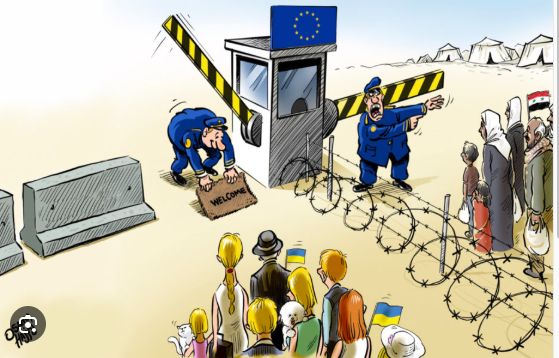
– It mentions things we already know like doing away with “pull” factors that will discourage asylum seekers (the article brands them as “illegals”) from coming here. – Bjerre is speaking in code. What she is saying are ways to effectively stop Muslims and other Third Worlders from comig to Europe. No mention in the article about the 6.168 million Ukrainian refugees in Europe, according to the United Nations High Commissioner for Refugees (UNHCR). – In the face of the millions of Ukrainian refugees, it is absurd that Bjerre opportunistically claims that we have the biggest crisis since 2015 when over a million refugees came to Europe from the Middle East and elsehere. – The chart below shows you that we are not in a crisis. In fact, Europe only gets the minority of refugees. – If we make it difficult for migrants to come here – excluding Ukrainians – who is going to replenish our aging population?
One of the matters the reporter does not answer is why other EU countries agree with Denmark’s extreme migration policy. There is no mention in the story about the rise of the rise of the xenophobic far right in many EU countries and their support for Albania-type refugee centers.
Maahanmuuttajataustaisena nuorena eläminen tuo mukanaan monia haasteita, erityisesti kun kohtaa viranomaisia, ohjaajia tai muita toimijoita.
Näiden ammattilaisten asenteet ja toimintatavat vaikuttavat suoraan siihen, miten nuoria kohdellaan ja kuinka heidän tarpeisiinsa vastataan. Jos ohjaajat lähestyvät työtään stereotypioiden, tiedostamattomien ennakkoluulojen tai jopa avoimen maahanmuuttovastaisuuden kautta, se estää tasavertaisen kohtelun ja lisätä syrjäytymisen riskiä.
Kun nuori tuntee olonsa väheksytyksi tai ulkopuoliseksi, tämä heikentää hänen luottamustaan viranomaisiin ja vähentää halua osallistua yhteiskunnan toimintoihin, kuten koulutukseen tai työelämään.
On selvää, että viranomaisten ja ohjaajien asenteet vaikuttavat syvästi nuoren elämään: tuleeko hän kohdatuksi yksilönä vai ainoastaan. ” maahanmuuttajataustaisena ” nuorena?
Monet nuoret korostavat, että kulttuurinen sensitiivisyys on avainasemassa heidän kohtaamisessaan. Tämä tarkoittaa sitä, että ohjaajien tulisi olla tietoisia erilaisista taustoista ja kulttuurisista lähtökohdista, mutta ilman että he liioittelevat tai yksinkertaistavat näitä eroja.
Nuoren identiteetti voi olla moniulotteinen, eikä hän välttämättä halua tulla määritellyksi vain kulttuurinsa kautta.
Nuori kaipaa tunnustusta yksilönä, jolla on omat ainutlaatuiset tarpeet, kiinnostuksen kohteet ja toiveet. Toimijoilta ja ohjaajilta odotetaan myös aktiivista anti-rasismityötä. Pelkkä syrjinnän tunnistaminen ei riitä – siihen on myös puututtava systemaattisesti. Tämä edellyttää jatkuvaa koulutusta ja itsetutkiskelua ohjaajilta, jotta he ymmärtäisivät omat mahdolliset etuoikeutensa sekä rakenteellisen rasismin vaikutukset.
Yhdenvertaisuuden toteutuminen edellyttää, että nuoret kokevat tulevansa kuulluiksi ja nähdyiksi ilman, että heitä automaattisesti pidetään ongelmallisina tai syrjäytymisvaarassa olevina pelkästään taustansa vuoksi. Nuoret toivovat, että ohjaajat eivät ainoastaan tue heitä yksittäisissä tilanteissa, vaan tekevät pitkäjänteistä työtä syrjinnän ja rasististen rakenteiden purkamiseksi.
Tämä on välttämätöntä, jotta kotoutuminen voi onnistua ja nuoret voivat kokea kuuluvansa osaksi yhteiskuntaa. Ilman tätä jatkuvaa työtä syrjäytymisen riski kasvaa.
Erityisen haitallisena nuoret kokevat kollektiivisen vastuuttamisen ja rangaistukset. Tämä tarkoittaa sitä, että yhden yksilön tekojen perusteella koko ryhmää tai yhteisöä pidetään vastuullisena. Esimerkiksi, jos maahanmuuttajataustainen nuori tekee rikoksen tai käyttäytyy häiritsevästi, koko ryhmä leimataan helposti “ongelmalliseksi” tai “sopeutumattomaksi.”
Tämä johtaa siihen, että kaikki maahanmuuttajataustaiset nuoret joutuvat kohtaamaan epäluuloa, syrjintää tai jopa suoraa rasismia, vaikka heillä ei olisi mitään tekemistä yksittäisten tapausten kanssa.
Nuorten näkökulmasta tämä on syvästi epäoikeudenmukaista ja vaikuttaa heidän käsitykseensä omista mahdollisuuksistaan. Jatkuva epäilyksen alla eläminen lisää eriarvoisuuden tunnetta ja synnyttää syvää turhautumista.
Kollektiivinen rangaistus heijastaa usein tiedostamattomia ennakkoluuloja ja rakenteellista rasismia, joissa maahanmuuttajataustaisia nuoria pidetään automaattisesti epäilyksen alaisina ja ongelmallisina. Lisäksi maahanmuuttajataustaisilta nuorilta odotetaan, että heidän on jatkuvasti todistettava oma “kelvollisuutensa” tai “sopeutumisensa” yhteiskuntaan. Tämä luo ylimääräistä painetta, joka voi vaikuttaa heidän hyvinvointiinsa, koulumenestykseensä ja mielenterveyteensä. Kun nuori kokee, että häntä arvioidaan ankarammin kuin kantaväestöön kuuluvia ikätovereitaan, tämä lisää hänen kokemaansa epäoikeudenmukaisuuden tunnetta.
#Kohtaaminen #Yksilöinä – tie eteenpäin.
Nuoret haluavat tulla kohdelluiksi yksilöinä, omien tekojensa ja kykyjensä perusteella, ilman että heidän taustansa määrittelee heidän kohteluaan. Kollektiivisen rankaisemisen ja vastuuttamisen sijaan olisi tärkeää edistää yksilöllistä kohtaamista ja tukemista.
Jokainen nuori on ainutlaatuinen, ja heidän kokemuksensa ja tarpeensa vaihtelevat suuresti. Näin voidaan välttää stereotypioiden vahvistaminen ja antaa kaikille nuorille mahdollisuus kehittää itseään täysivaltaisesti ilman ylimääräisiä esteitä. Maahanmuuttajataustaiset nuoret toivovat tasavertaista ja ennakkoluulotonta kohtelua.
He haluavat, että heidän potentiaalinsa tunnistetaan ja että he saavat mahdollisuuden rakentaa elämäänsä ilman, että heidän taustansa asettaa ylimääräisiä esteitä. Kulttuurisen sensitiivisyyden, anti-rasismityön ja yksilöllisen tuen avulla voidaan luoda sellainen ympäristö, jossa jokaisella nuorella on aito mahdollisuus menestyä ja kuulua osaksi yhteiskuntaa.
Yhteenveto Nuoren maahanmuuttajataustaisen näkökulmasta on selvää, että asenteilla on valtava merkitys. Ohjaajien ja toimijoiden tasavertainen suhtautuminen sekä kulttuurinen sensitiivisyys ovat avainasemassa, jotta nuoret voivat kokea olevansa osa yhteiskuntaa. Kollektiivisen vastuuttamisen ja rangaistusten sijaan tulisi panostaa yksilölliseen kohtaamiseen ja tukeen, jotta jokainen nuori voi tuntea tulevansa nähdyksi omana itsenään, ilman ylimääräisiä ennakkoluuloja ja stereotypioita.
*Mahad Sheikh Musse on nuorisotyön ammattilainen joka omaa vuosien kokemus viranomaisten ja eri yhteisöjen kanssa työskentelmisestä.
MTV reporter Ivan Puopolo must be the most opinionated reporter working for the mainstream media. His reporting is not credible because he breaks one of the golden rules of journalism: do not editorialize in your stories.
Puopolo’s interviews and stories are full of toxic opinions. Apart from his non-existent credibility, he does a lot of harm to MTV.
Apart from also being a mouthpiece for the far-right Perussuomalaiset (PS)* party, helping politicians like PS chairperson Riikka Purra spread the great replacement theory and victimizing migrant youths, a recent interview with Esko Aho is a case in point, whom he interviewed without mentioning the former prime minister´s links with Putn´s Russia.
Another question that I have asked MTV is Puopolo´s role in the television station’s ads below.
On the left MTV was active in portraying black and brown youths as criminals even if the police estimated at the time 150-200 youths belonged to gangs. On the right, Puopolo interviews Interior Minister Mari Rantanen about the new integration plan. Not the person with the knife. MTV has done a lot of harm in spreading racism and polarizing viewers. You can read more about the role of the media, police, and politicians in spreading racism.
I emailed this complaint to MTV but have not heard back from the private media company.