Helsingin Sanomat, the country’s biggest daily, celebrated its 130th anniversary on Saturday. Congratulations on your important anniversary but the picture below reinforces what I knew about the daily and Finnish mainstream media in general: It’s too white.
Considering that Helsingin Sanomat is the newspaper of Finland’s capital Helsinki, it is surprising that there are no visible minorities in the picture, considering that 9.4% (59,779 persons) of the city’s total population of 635,181 in 2016/2017 are foreign citizens, according to Helsingin väestö vuodenvaihteessa 2016/2017 ja väestönmuutokset vuonna 2016.
The percentage is even higher if look at people who speak another language other than Finnish or Swedish as their mother tongue (93,214/14.7%) and who were not born in Finland (86,998/13.6%).
Can you spot a minority? Read the full story (in Finnis) here.
One of the problems of Finland’s ongoing debate on its ever-growing culturally and ethnically diverse society is that the predominantly white media give a lopsided – usually inaccurate – account of our communities.
One good way of challenging the present situation is to encourage more non-white Finns to become journalists and writers and, importantly, encourage them to write courageously about our communities and realities.
The Afro-Finns community gathered in Helsinki for the 2 nd AfroFinns Achievement Awards, which took place at the Forum Theatre last week on Saturday.
The grand open of the AfroFinns Achievement Awards (AAA) 2019 was lead with a video of several remarkable black figures quotes and pictures such as Maya Angelou, Beyoncé Knowles-Carter, Martin Luther King Jr. Harriet Tubman, Marcus Garvey, and others.
The AfroFinns Achievement Awards was held to acclaim the contribution of the Afro community in Finland by celebrating their achievement, acting as a motivation, and reaffirming that we know and see your work as part of a larger society.
This event was organized by AfroFinns, which is a non-profit association for Finns and everyone with an African heritage living in Finland. It promotes diversity, inclusion, supporting cultural development, education programs, and encouraging civic engagement in the community. “Our mission is to elevate, encourage and support more self-reliance within the community”, said Elvis Fuamba, secretary of the association.
Members of the directive board and Zawde Berhanu Life Time Achievement winner
During the night the performances on stage didn´t stop, it was a mix of music, talk, stories, and others. Artists that sparkle the night were from Berlin, the United States of America, and Finland.
This year AAA 2019 ceremony had over 40 nominees for 13 categories. The selection process has three stages. First, the community members suggest a list of names for various categories. Second, the AfroFinns yield a list of nominations with a maximum of 5 people by category. Third, three parts compose the winning selection: 20 % from the public vote, 40% from an independent judge (this year it was from Think Africa), and the last 40% from the AfroFinns judge committee.
Artists performing at the event.
It was a great night of music, dance, and chat with new people in the heart of Helsinki. Just in case you miss it, here is the complete list of all the winning and the nominated.
Lifetime Achievement
Winner:
Zawde Berhanu
Afro-Inspired Music
Winner:
Sofy Kap
Blaq boy Jnr
Dk Balafu
Kaveri
Special
Sport Person
Winner:
Sara Bejedi
Awar Kuier
Glen Kamara
Sierra Leone Football team Helsinki
Literature
Winner:
Dorina Owindi
Maryan
Abdulkarim
Hope Nwosu
Nimco Noor
Business Project
Winner:
Paco Ndiaye
Harriet
Aryenda
Lincoln
Kayiwa
Ahmed
Hassan
Addis Ethiophian kitchen
Paco Ndiaye won the Award for Business Project.
The Nomad Food & Wine is a restaurant of a food journey where flavors from Africa, Italy, and the Nordic are combined for a new and unique taste. Paco Ndiaye, chef and owner said, “ the feeling of winning as been incredible and unexpected. It was an honor for me because it means that I am doing something good. As immigrant, we always need to try to give a good example, integrate the cultures, set a high standard in everything we are doing, and try to fly high like everyone else, so no excuses”.
Ally of Africa
Winner:
Afrojazz Club
Christian
Tribault
Eerik
Wissenz
Rasmus ry
Academic Achievement
Winner:
Theresa Bilola
Anthony
Okuogume
Eunice
Mgbeahuruike
Elizabeht
Agbor Eta
Creative Artist in Performing Arts
Winner:
Geoffrey Erista
Sonya
Lindfors
Creative Artist in Visual Arts
Winner:
Dennis Owusu
Yeboyah
Marwa Talsi
Mouhamed Ba
Caroline
Suinner
Community Leader
Winner:
Good Hair Day Helsinki
Sabasy
Ndiaye
George
Matovu
Edwin Ndaki
African Fashion Week Helsinki
Another winner of the night was Good Hair Day, which is an anti-racist movement working toward the wellbeing of the Afro-Finnish community. It started in 2016 as an urban day event to expand the perception of beauty, discuss the politics of the Afro, celebrate, and share knowledge of Afro hair. Currently, it has grown because they don’t only organize the annual event, but also support other events, hold workshops and talks for the community about different topics.
Good Hair Day Helsinki, Community Leader Award.
“We as a collective are honored and happy to receive the Award for the Community Leader of the year. It is wonderful to be celebrated in our community, we are looking forward to much more collaboration with other active AfroFinns in Finland”, expressed the group.
Media
Winner:
Obiwest Utchaychukwu
Joes Teka
Entertainment
Winner:
Deejay Nestar
African
Fashion week Helsinki
Afrojazz
Club
Caroline
Leppihalme
Young Achiever
Winner:
Awax Kuier
Glen Kamara
Pyry Soiri
Sara Bejedi
The ending of the event was amazing and inspired by hearing the words of Zawde Berhanu Life Time Achievement 2019 who was the first African to study at a university in Finnish. He is now 95 years old.
You ask me my name. I shall tell you. My name is nobody and nobody is what everyone calls me.
Odyssey, Song IX
If a refugee suffers from fear, loneliness, enforced separation, a sense of despair and is struggling to survive in his new homeland, more salt is thrown on their wounds by the hateful rhetoric of Islamophobic and racist parties.
One of these in Finland is the radical-right Perussuomalaiset (PS)* party, which labels such people “harmful” to our society while claiming that they don’t “integrate” into Finnish society.
But not only do anti-immigration parties make the lives of asylum seekers and migrants difficult, but government immigration policy is another culprit.
A new report by the EU’s Agency for Fundamental Rights reports that the integration of young refugees isn’t doing very well. It warns that there is a risk of creating a lost generation.
Do you see the problem? The PS tries to destroy their credibility and tear down that important shred of humanity in us.
Unfortunately, those who help and educate migrants to become members of our society have never heard of the Ulysses syndrome.
Since they have not heard of this disorder, some rely on simplistic answers to integration: learn the language and read the Kaleva.
While I’m facetious, the expectations that some of these educators have on their pupils, especially vulnerable ones fleeing war and failed states in the Middle East and Africa, are ineffective in their jobs.
When you ask such a person to assimilate (one-way integration) into our culture, it is like asking a person to stand upright after he or she broke his or her leg.
Ignorance is not the only matter that causes the integration process of a migrant to fail in Finland but standing on a high horse. The view that some have of the migrant is racist in the same way as colonial powers saw and exploited their subjects.
The Ulysses syndrome should be required reading for any person working with refugees and migrants.
Viime aikoina on puhuttu siitä kuinka paljon poliitikot valehtelevat. Suomen lehdistö hyvin laiskasti seuraa näitä valheita ja kuka valheita kertoo. Puolue joka esittää vääristeltyä ja liioiteltua tietoa ja asioita, erityisesti silloin jos asia koskee maahanmuuttajia, niin perussuomalainen puolue kunnostautuu tässä.
Yhdysvaltain presidentti Donald Trump valehtele paljon. Washington Post lehdessä fakta-tarkastaa presidentin valheet. Valheet luokitellaan yhdellä, kahdella tai kolmella Pinokkiolla.
Virkaastuaisissa, Trump on tehnyt yli 13 430 valheita.
Migrant Tales otti selvää seuraavasta perussuomalaisten väittämästä: “Suuri osa postinjakajista, etenkin pääkaupunkinseudulla, on maahanmuuttajia,” sanoo Riikka Purra Jussi Halla-ahon ja Ville Tavion lehdistöttilaisuudessa.
Posti vastasi: “Suurin osa (80 %) Postin työntekijöistä Suomessa (pl Transval) on suomalaisia” JA “Suuri osa, 70 %, pääkaupunkiseudun postinjakajista on suomalaisia. Poiminnassa mukana alueet: Hki; Espoo Kirkkonummi Kauniainen; Vantaa Tuusula Nurmijärvi.”
Halla-aho, Tavio ja Purra saavat vääristelystä kolme Pinokkiota.
Suuri osa postinjakaijista pääkaupungin seudulla ovat suomalaisia, eikä maahanmuuttajia.
Kuva: Turun Sanomat ja Pinokkio nenät Hamid H. Alsammarraee.
In a bar in Lappila, located some 20 km from the city of Lahti, there is a sign on the wall the epitomizes all the hatred and mass murder committed by the Nazis: Arbeit Macht Frei (Work Sets you Free).
Why hasn’t any newspaper asked the owner of the bar, Juha Koskinen, if he will take down the Nazi sign? Migrant Tales has called numerous times. Koskinen does not answer the phone return calls.
This notorious slogan stood at the entrance of death camps like Auschwitz and Dachau.
In Finland, there is a lot of neo-Nazi sentiment these days. So much so, in fact, that small bars in small towns can place Nazi-era signs with near-impunity.
What can you expect in a country where the biggest party in the polls has sympathies and ties with neo-Nazi groups.
Steen Pramming summarizes why Nazi sympathies are still found in Finland these days, even if this country signed the armistice with the former Soviet Union in September 1944.
Just like Islamophobia and racism, our education system has failed in ridding our society of these social ills.
Finland tries to put itself as a special case, when, in fact, it wasn’t. We did not fight a separate war against the Soviet Union but were up to our necks in World War 2 and allied with Nazi Germany.
It was only this year when Finland finally acknowledged that Finnish SS recruits took part in the Holocaust in Russia.
Every voice raised against racism chips away at its power.
Reino Eddo-Lodge
Watching last Thursday’s parliamentary question time was a repulsive experience. If the opposition Perussuomalaiset (PS)* party is to be believed, all of Finland’s problems hinge on migrants.
An article inVerkkouutiset claims that since Prime Minister Antti Rinne’s government began its mandate on June 6, nine of the eleven weekly parliamentary question times have dealt with migrants and or immigration policy.
Such political tactics by the PS are a blow to the institution’s credibility and its elected members.
One reason why the PS is leading the opinion polls these days is because they are feared and due also to ignorance or denial about racism in Finland. They believe that if they are too outspoken against their lies, they will scare away voters.
We at Migrant Tales have never let down our guard or given such a racist party the benefit of the doubt as the Finnish mainstream media too often does.
My views of the PS have not changed. It is a racist and far-right party that is today taking the county towards the path of Viktor Orbán’s Hungary. Read the original story here.
These are the constant lies that the PS spreads about migrants on Thursday’s question time:
Migrants are taking money away from white Finns;
The government puts the priorities of migrants before white Finns;
Migrants are a menace to society;
Migrants commit more crime than white Finns;
We must not allow Finland to turn into a Sweden when it comes to migrants;
Blah blah blah blah…
While all these claims are exaggerated lies, the strategy of the PS is simple: Finland’s most pressing problems hinge on migrants. Get rid of migrants and, presto, problem solved.
When you watch politicians of the PS making their anti-immigration cases in parliament, they don’t tell us whom they are speaking of and how many.
If they were to mention these two things, we’d understand that they are explicitly targeting asylum seekers who are Muslims and only about 10% of all migrants living in Finland.
At present, there are several things that are giving Finland a bad name: Islamophobia, the hostile environment, and hardline asylum policy.
The latest setback to Finland’s image was handed down by the European Court of Human Rights for violating Article 2 and 3 of the European Convention on Human Rights.
Article 2 states that everyone has a right to life, while Article 3 of the Convention prohibits torture and inhumane treatment.
While the ruling reinforces what anti-racism activists have been saying for a long time about the Finnish Immigration Service (Migri), we must not forget that Finland’s immigration policy has a long history of committing human rights violations.
We could begin with some recent examples of repatriated Iraqi asylum seekers who were killed. Migrant Tales documented two cases as well as other ones.
Let’s not forget that the former government of Prime Minister Juha Sipilä gave the political support to Migri to declare some of the most violent countries like Somalia, Afghanistan, and Iraq as “safe countries” to deport asylum seekers.
When an asylum seeker is killed on his return, Finnish politicians like former Minister of Interior Kai Mykkänen offer “sad-and-tragic” consolation in the same empty way like politicians in the United States offer “thoughts and prayers” after a home-grown terrorist kills innocent people.
Some cases that remain as permanent dark spots in Finnish immigration history is the deportation of Ingrians and Estonians after the Continuation War (1941-44) and Soviet citizens during the Cold War.
Our past immigration policy continues to bring shame to us. It is unfortunate that we always return to it.
*A direct translation of Perussuomalaiset in English would be something like “basic” or “fundamental Finn.” Official translations of the Finnish name of the party, such as Finns Party or True Finns, promote in our opinion nativist nationalism and racism. We, therefore, at Migrant Tales prefer to use in our postings the Finnish name of the party once and after that the acronym PS.
When I was a young journalist, the editor of the Buenos Aires Herald approached me and gave me some sound advice.
“Remember,” I recall him saying to me, “words are like bullets. Fairness in reporting a story is important. You don’t need a bazooka to kill an ant.
Following what the media is writing about Abdirahim Husu Hussein, this golden rule of responsible and fair journalism could not be truer. Destroying people with bazookas in a hostile environment against migrants and minorities is opinionated and racist journalism.
Helsinki City Councilperson Abdirahim Husu Hussein has been in the eye of a storm over a passenger who harassed him in a racist manner and who he was planning to leave the car at a bus stop but took the person to his final destination.
Hussein posted on Facebook on Sunday that he left the passenger by a bus stop in the freeway but all of this didn’t happen on the day he claimed.
“Only last week,” he said, “a passenger insulted me in a racist manner. I should have asked him to get out of the car, but I didn’t.”
Hussein has filed charges against the passenger who insulted him in a racist manner a week ago.
Even so, and for this mistake, the Helsinki city councilperson has been lynched by social media and print media, which has branded him “a liar.”
That’s not all. The media has put Hussein under scrutiny. One article questioned the veracity of a story that happened a long time ago to him when he woke up in a hospital after being hit with a baseball bat.
The media is not only attempting to take away his credibility but to break and destroy him as a person. The Finnish media uses a bazooka to kill an ant.
Finnish white privilege #66
Racist attacks and near-constant microaggressions and racist remarks against migrant and especially black taxi drivers are a sad fact. Hussein knows this too well.
A Helsingin Sanomatarticle wrote about the near-constant racist abuse suffered by a Ghanian taxi driver, and most recently, about a Somali taxi driver. There is also the case of a Somali driver who was assaulted. Etonians, who are white, suffer racist abuse from some passengers, too.
But what does Taksi Helsinki say about these cases and the fact that their visible migrant drivers get harassed in a racist manner by passengers?
No media has yet asked the company’s CEO, Jari Kantonen, if it has guidelines for those that drive for them in case a passenger starts to insult them in a racist manner.
Since Friday, I have without luck attempted to get in touch with the Taksi Helsinki CEO. He has not returned my calls.
“There are no such guidelines or training [how to deal with a racist passenger] offered by the [Taksi Helsinki] company,” said Hussein.
Gathering by the reaction of the media, members of his Social Democratic Party (SDP), and public opinion, there is one matter that stands out: The hatred of some white Finns of black people, especially outspoken ones like Hussein.
While I am certain that foreign taxi drivers, especially black drivers, are targets of racist abuse, there is no discussion going on in the media now about such a problem and how taxi companies guarantee their employees safe working spaces.
Even parties like the Social Democrats, of which Hussein is a member, appear to worry more about their poll standings than the rise of racism in Finland and of a racist party like the Perussuomalaiset (PS).* The party’s image is paramount now for the SDP.
The latest opinion poll published by Yle last week showed that support for the SDP had sunk by 1.7 percentage points to 13.9%, with the PS gaining 2.1 percentage points to lead the polls with 23%.
I wrote in May about the hypocrisy and double standards of the Finnish media when it came to another SDP politician, MP Hussein al-Taee. The SDP MP’s and Hussein’s cases expose the dark side, a blind spot of our collective denial of racism in our society and how we treat people of color.
While Hussein has apologized for what happened, it seems that many want blood since he has been outspoken against racism in Finnish society and in parties like the PS.
Many may see this as an opportunity to climb back into their shells and reassure themselves that racism is not a problem in Finland.
Believe me, it is. And Hussein’s case proves it beyond any doubt.
Ali Jahangiri, Hussein’s radio host partner, puts what happened into perspective by tweeting: “#husugate is a good example of the power structures [in our society]. When a member of the minority makes a mistake, he ends up losing all his credibility. Then again, a person [Jussi Halla-aho] in power who dreams of killing homosexuals ends up becoming the head of his party.”
Despite what happened, anti-racism activism will not disappear in Finland but get stronger.
*A direct translation of Perussuomalaiset in English would be something like “basic” or “fundamental Finn.” Official translations of the Finnish name of the party, such as Finns Party or True Finns, promote in our opinion nativist nationalism and racism. We, therefore, at Migrant Tales prefer to use in our postings the Finnish name of the party once and after that the acronym PS.
In the ever exposed hypocrisy of Finland’s migrant integration program, it’s clear that two-way adaption is for the gullible.Do you believe in social fairy tales?
I don’t.
It is surprising why the Finnish school system has apparently done too little to look after children who are not white. As some studies reveal, schools are not safe places for non-white Finnish children but hostile and dangerous spaces.
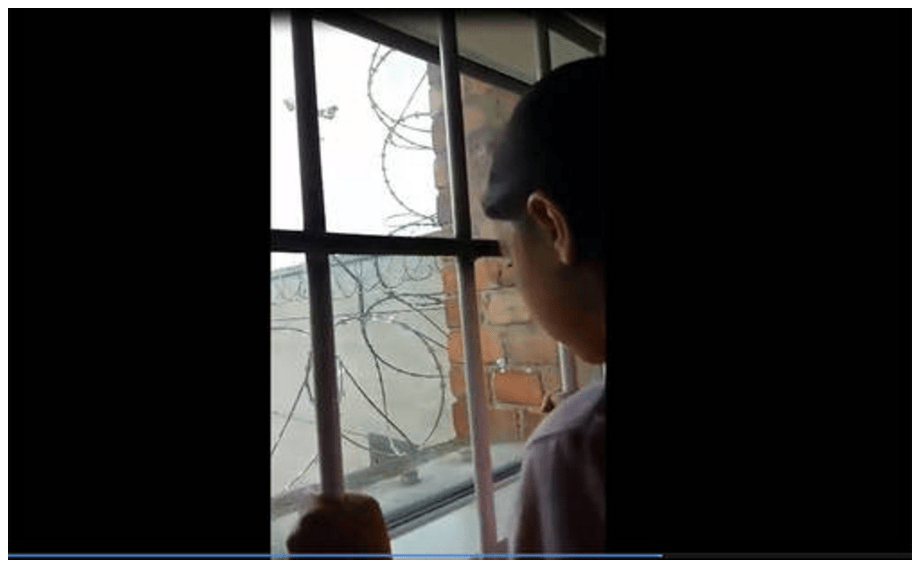
For some, Finland is a very hostile country to children of color and other visible minorities. An Iraqi child looks out of the window from her detention cell in Joutseno. Source: Iltalehti.
With the hostile environment gaining pace in Finland, it’s clear that these spaces in school, which should be safe, will become ever-hostile.
The fact that the school system treats non-white Finns as second-class pupils, reveals a deep misunderstanding and ignorance of third-culture children and cultural diversity. Even if your child was born in Finland, has never visited his or her parents’ home country, and speaks Finnish better than their home language, the school system regards such pupils as of “foreign origin.”
Aminkeng A. Alemanji, a Cameroonian researcher who defended successfully in October 2016 his doctoral dissertation on anti-racism education, offers a solution.
“The issue in Finland is that we’re officially told that we are all [irrespective of our background] equal members of society but unofficially it is another story,” he continues. “If we claim that we are all equal, issues like racism cannot be tackled.”
According to Alemanji, a good example of the latter is the “appalling” treatment of minorities like the Somalis, who were born in Finland and are Finnish citizens and other non-white children who are often asked to go back home – when paradoxically their only home they know is Finland.
An Iraqi friend told me that at an elementary school in Mikkeli where both of his children are enrolled, the teacher recommended that he place “Finnish” as their mother tongue to avoid being in a special class with “foreigners.”
While this may be a pragmatic way to ensure that your children are put in the same class as white children, it is a step in the amalgamation-assimilation process. Speaking two languages or more at school is seen as a disadvantage that impairs your knowledge of Finnish.
The present system of classifying children at schools as “pupils with migrant origin” versus”natives” is outright discriminatory. It only serves to turn out second-class citizens with second-class rights.