Here are some symptoms of the coronavirus: fever, dry cough, sore throat, tiredness, headaches, loss of taste, and smell. Here are some symptoms of the PS virus: racism, Islamophobia, bigotry, climate denial, conspiracy theories, mediocracy, pro-Putin, and incompetence.
Like Covid-19, which fools and infects healthy cells, the PS virus also enters and infects institutions like parliament. The PS got a foothold in the Finnish political system by pulling fast ones on voters, spreading hate, and giving overly simplistic answers to complex questions.
We need a vaccine for the Covid-19 and PS viruses.
For the latter, the antibodies to kill the PS virus are empathy, caring, and anti-racism education based on social equality for all.
Perussuomalaiset MPs (upper row lefrt to right): Jussi Halla-aho, Jani Mäkelä, Mauri Peltokangas, (lower row left to right) Riikka Purra, Ano Turtiainen, Ville Tavio and Veikko Vallin. Cartoon by Hamid H. Alsammarraee.
The PS virus cannot be compared with a temporary hiccup. It is more lethal than that. If we are not careful, it can mutate Finland into Hungary and Poland, or worse.
Below are some more examples of the PS virus and what it has infected our democracy from MAGA caps to adulations to Trump.
Two PS MPs, Vilhelm Junnila and Veikko Vallin giving the thumbs up to former President Urho Kekkonen (1956-82). With or without disinfectant and beams of light, the PS is Finland’s most pro-Trump party. Source: FacebookOn June 4, 2019, Halla-aho tweets: “I dig him. Trump is the best thing that has happened in a long time to the United States and to the Western world.”
The family is the natural and fundamental group unit of society and is entitled to protection by society and the State.
Article 16 of the UN Declaration of Human Rights
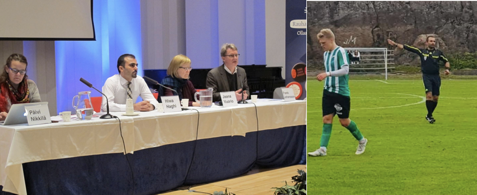
Hiwa Haghi is an Iranian Kurd who has lived in Finland since 2004. In many respects, he’s the ideal migrant: speaks Finnish fluently, is employed, and does youth work for at least nine associations. One of his passions is football.
According to some people, Haghi is a respected member of the community for three reasons: he turned opportunity into success through hard work and perseverance.
As Haghi has placed his trust in his new home country, he hopes and expects that the feeling is mutual.
He got, however, a crude surprise from the Finnish foreign ministry in January when they turned down his sixty-five-year-old father’s and younger brother’s visa application. He applied for the visas the previous month.
Hiwa Hagh’s father and younger brother. Source: Hiwa Hagh’s family album.
“After spending over 3,200 euros in translations, legalizations of documents, trips to [the capital] Teheran [from northwest Iran], lots of energy, stress, time and dealing with red-tape,” he continued, “I was disappointed when the foreign ministry turned down my father’s and brother’s visa application.”
In the ordeal to bring his relatives to Finland, push eventually turned to shove when the Finnish Embassy in Teheran charged his brother 70 euros to cover for postage costs for the letter that officially denied them the visas.
The sum asked by the embassy is considerate, considering that the average salary is in Iran is about 100 euros a month.
“They justified the charge due to Covid-19.” he continued. “This was the reason why they did not allow my brother to retrieve the letter from the embassy and wanted to mail it.”
Haghi has filed a formal complaint and appeal to the foreign ministry for refusing his father and brother the visas.
Hiwa Hagi is a member of a number of associations. He likes to ref football matches as well. Source: Hagi’s family album.
The Iranian Kurd believes that matters have become more difficult for people from Muslim countries due to 2015, when a record number of asylum seekers came to Finland.
He suspects the reason why the foreign ministry turned down the visa applications was that it didn’t believe that his father and brother would return to Iran after their visit.
In 2010, when Haghi’s father and mother visited Finland, there were no problems in getting visas for them.
A number of questions arose during the visa application. Haghi’s father, who has no formal education and is a farmer, had to give a day-by-day program of his stay in Finland.
“When they asked him [at the embassy] about going to the swimming hall with his grandchildren, they even asked the name of the place,” he said, “naturally, my father did not know the answer.”
One matter that Haghi wanted to make clear to the foreign ministry is that his father and brother have no reason not to return to Iran.
Haghi said that their visit is especially important to his 7.5- and 2-year boy and girl, respectively. When his parents visited Finland in 2010, his children weren’t yet born.
Hiwa Haghi and his parents when the visited Finland in 2010. Source: Hagi’s family album.
“My children ask me a lot of times when their grandfather and uncle will come to Finland,” he said. “I cannot tell them the truth, so I blame it on the coronavirus pandemic.”
Haghi stated that his grandfather’s and brother’s visit would be important for him as well since they could see how he’s succeeded in Finland.
Like many families, Haghi’s children are multicultural. They speak Finnish as well as Kurdish fluently.
There was good news if you are against us-and-them rhetoric, Islamophobia, and support for US President Donald Trump’s policies and persona. A poll published Thursday by Yle showed that the southward direction of the Perussuomalaiaset (PS)* party continued to head south.
Compared with a similar poll on December 9, 2019-January 8, 2020, support for the PS dove by 6.4 percentage points from 24.3%, followed by the National Coalition Party (19.3%) and Social Democrats (14.9%).
One of the reasons why support for the Social Democrats has soared is Prime Minister Sanna Marin. Her government’s handling of the coronavirus pandemic has met with approval from the public.
Contrarily, the PS has not offered anything better except for its usual bickering and scapegoating of migrants, especially Muslims.
Two PS MPs, Vilhelm Junnila and Veikko Vallin giving the thumbs up to former President Urho Kekkonen (1956-82). With or without disinfectant and beams of light, the PS is Finland’s most pro-Trump party. Source: Facebook
What is interesting to note is that when a sexual assault case erupts as in the parliamentary elections, the media, police, and politicians help the PS to spread their message of hate.
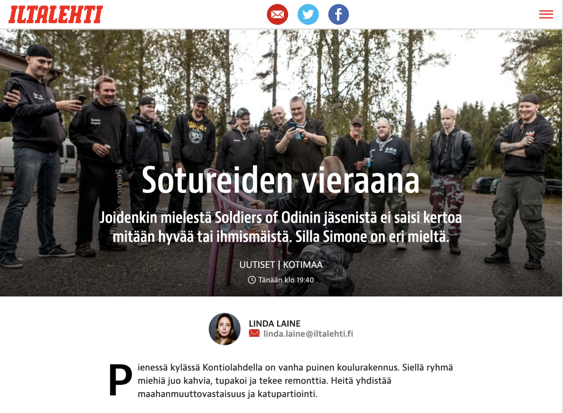
Racism sells. Us and them sell. Spreading and reinforcing prejudices sells. Bigotry and racism sell. Biased journalism sells. These examples sum up pretty well how tabloids like Iltalehti and Ilta-Sanomat make money by reinforcing old hatreds and suspicions of Others.
One of their latest stories on the far-right vigilante group, the Soldiers of Odin, is an example of their toxic journalism. It would be something like publishing a story about the lighter side of a Ku Klux Klan member and how they laugh and enjoy life like other “normal” USAmericans.
One of the criticisms of the Iltalehti story is that it gives credibility to the Soldiers of Odin, in the same league as the Ku Klux Klan, and whose leader and founder, Mika Ranta, admits being a neo-Nazi.
The article about the Soldiers of Odin does not put the vigilante group’s bigotry and racism in context. If I were writing such an article, I’d point out how Finland has exported racism through the Soldiers of Odin to other parts of the world.
Why are some people and newspapers like Iltalehti fascinated by racism and the far-right? Read the full story (in Finnish) here.
Migrant Tales has not only pointed out in the past the shortfalls of Finnish journalism when writing about groups like Muslims, but it has also traced the roots of such stories to the 1990s and beyond.
Tabloids like Ilta-Sanomat and Iltalehti should formally apologize for all the racism and hatred they have spread about migrants and minorities.
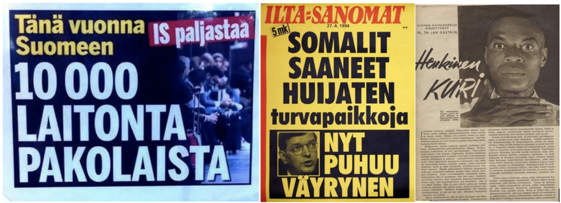
Three racist and misleading articles by the Finnish media in 2015, 1994, and 1940. The headline on the left claimsthat “10,000 illegal refugees” are coming to Finland. The second one, in the middle, claims that Somali refugeesgot asylum by deceiving the authorities. The magazine article on the far-right argues with the help of fiction that the Europeanwhite man was superior to blacks on the battlefield. Finland would have lost the Winter War because one group ofblacks in the East Indies run amuck when faced with danger. Sources: Ilta-Sanomat and Suomen Kuvalehti.
How would we tell the events that led to the death of an eighteen-year-old Somali Finn youth last Sunday at the Kannelmäki railway station?
According to one account, supposedly the victim’s witness that experienced the whole horrific event, which has shocked many, especially Somalis and other black people.
According to one account, the victim and his friend walked down the stairs when they encountered the two suspects. The witness says that they weren’t acquaintances.
The victim was an eighteen-year old Somali Finn. Why was his life cut so short?
Something was said to the two that walked down the stairs. The witness didn’t answer back, but the suspect did. The stabbing happened so rapidly that the witness though the victim was joking when he said he was stabbed.
The blood gave away the gravity of the situation and the witness called 112.
The witness believed that the two young men were drunk. Even so, being drunk or having a criminal record does not absolve you from committing a hate crime.
Was it a hate crime? Do the suspects belong to a hate group like the Skinheads? These are some of the questions debated on social media forums right after the death of the victim.
Apart from investigating the crime like seeking the testimony of other witnesses, the police have also at their disposal CCTV cameras.
One of the questions that some Somalis and other black people are asking is if what happened was a hate crime, or that the attack and death of the Somali Finn youth were due to his ethnic background.
While such questions need to be thoroughly investigated by the police, some white Finns may not consider them to be necessary even if the opposite is true of some visible minorities and migrants. Why? Because many of them face racist harassment and microaggressions daily.
Many feel that they live in a racist society and have the psychological, some even physical wounds, to prove it. Too many believe that the police and society aren’t serious about tackling a social ill like racism.
Disagree?
What about if the crime at Kannelmäki were committed by two blacks and the victim was a white Finn? We have seen a lot of social media lynch mobs during the years, especially when sexual assault cases come to public light, as was the case recently in Oulu.
If one remembers what happened in Oulu, the police, the media, and politicians – all-white – were fueling the fires of suspicion and labeling the whole Muslim community in the process.
Since we strive to live in a society that solves problems, one matter that the police should show now is leadership by contacting the Somali community and hold a meeting to calm down fears. Present at such a meeting should be representatives of Victim Support (Riku), the police hate crime unit, sociologists, NGOs, and others.
The usual answer, “this was not a hate crime” with no further explanation will not do. It is not enough and will only increase suspicion of the police’s credibility in resolving such crimes.
One Somali Finn put it in the following words: “Is the police going to sweep the issue of racism under the rug? Are they going to conclude that the suspects had mental issues? Were they [the suspects] under the influence of alcohol or drugs? Are they hardened criminals? Or did they grow up in broken homes?”
Distrust of the police shows that such a public service still has a way to go before winning the trust of Finland’s culturally diverse communities.
The death of the Somali youth could be a good place to start.
Coronavirus infections at the Luona-managed Nihtisilta reception center in Espoo now stand at 97, according to Luona’s Business Director Suvi Salonen.That compares with two cases at the beginning of April and up to 25 during the middle of the month.
This angry asylum seeker accused Luona of “negligence” for allowing the number of infected people to rise to “more than 100 people (sic).” Luona states that the situation is under control and the total number of infected asylum seekers is 97.
“We tested 207 people [of the Nihtisilta reception center] on Monday and Tuesday and 72 tested positively [compared with 25 previously],” said Salonen.
The Luona business director said that the asylum reception center is in quarantine.
“I would like to commend the workers at the [Nihtisilta] reception centers who are on the frontline [protecting the asylum seekers and themselves],” she concluded.
Salonen said that the Vantaa Robert Huberin tien asylum reception center has two coronavirus infections.
What is the worse matter about the coronavirus pandemic? Social distancing? Or US President Donald Trump?
In my opinion, President Trump and his shoddy leadership and outright lies are far worse than the coronavirus pandemic.
His latest lie was contradicting his country’s own intelligence on the origin of the coronavirus.
Trump’s suggestion that bleaches or beams of light could kill the coronavirus suggests that something isn’t right in his head.Source: Facebook. Thank you, Alberto Coronel, for the heads-up.
Mark my words: Trump is such a sociopath that he will not think twice by waging a new World War if it means that it will get him reelected.
The US president, his family, his political, and billionaire cronies are a much greater threat to the world than the coronavirus.
There are pictures and names of the two suspects killed by knife stabbing an eighteen-year-old Somali on Sunday. The police are tightlipped and have not given any other information than “the investigation is ongoing.”
If, and there is a big if here, the identity of the suspects is correct and have Finnish last names, the police should mention and investigate if what happened was a hate crime.
I’d ask the police as well if the suspects belonged or hung around some white supremacist group.
It is not the first time that I have covered such a case. One of the great sources of the anxiety of the police is reprisals by members of the victim’s ethnic group.
This was the case during Black February when for over three weeks in 2012 we read about the death of three Muslims , a suicide and a Perussuomalaiset (PS)* councilman who offered a medal to a white Finn for killing one of these victims in an Oulu pizzeria in cold blood before shooting himself.
He said that apart from not expressing any empathy for the parents’ grief, it was difficult to get any information from the police about the crime.
It is a fact that the victim was an eighteen-year-old Somali Finnand no confirmation that his attackers had Finnish surnames and belonged to a white supremacist group.
“We were treated coldly and felt like we were the criminals,” he said. “The police appeared to be more concerned about keeping the case under wraps because they feared a revenge attack by Somalis.”
A more recent case involves Rashid H., a Pakistani migrant who was stabbed up to thirty times in February 2018. The wife said that after crime took place on Friday, a police officer called her and said that it wasn’t a hate crime.
I interviewed the investigating officer concerning Rasheed’s case who told me that he spoke to the three suspects and “concluded they weren’t racists.”
The police have asked the migrant community not to publish anything about the Kannelmäki case for fear of spreading false rumors.
If one remembers the Oulu sexual assault cases of minors in December 2018-April 2019, the Oulu police was especially active in putting out statements, labeling Muslims, and helping the media to uncover the nationality of the suspects.
The actions of the Oulu police, the media, politicians, the Prime Minister Juha Sipilä’s government and President Sauli Niinistö were well below par. If anything, it showed that these institutions are no friends of asylum seekers and Muslims.
And who could forget in August when the Islamophobic PS tried to exploit again for its political aims the case oftwo gunmen who shot two police officers in Porvoo? PS politicians were demanding the ethnic identity of the suspects because they believed they were Muslims and/or asylum seekers.
The PS ended up looking like a horse’s ass when it became clear that the two suspects were Finns who lived in Sweden.
The tragedy that took place in Kannelmäki has impacted especially hard the Somali community because they fear what happened to the Somali Finn could happen to them.
While I hope that the perpetrators will be brought to justice and pay for their crimes, the police has a good opportunity as well to raise its credibility in the eyes of the Somali and visible migrant community.
One member of that community asked if the police are going to sweep what happened under the rug by sanitizing the crime’s racism aspect? “Are they going to conclude that the suspects had mental issues, were under the influence of alcohol or drugs,” she said, “or that they grew up in broken homes?”
The following days will provide an answer to that very crucial question.
After two coronavirus cases to mid-April, Helsingin Sanomat reported Monday of 22 infections at the Luona-managed Nihtisilta reception center in Espoo.
Haidari Ehsan is an asylum seeker at the Nihtisilta reception center, which houses 410 refugees.
“I’m not happy with the way Luona has informed us about the outbreak at the reception center,” he said. “The only way we are in touch with the supervisor is by phone.”
Ehsan lives in a room with another person and fears that he might be infected with coronavirus because, according to him, “he has all the symptoms.”
He said that the coronavirus-infected asylum seekers are quarantined on the third and seventh floor of the building but can move wherever they want in the building.
“The majority of the people at the reception center do not feel any symptoms due to coronavirus,” he continued. “Most of them work during day and night shifts and since they don’t have cars, they use the train instead. This may be a dangerous way of spreading the virus.”
Ehsan recommended that everyone at the reception center should be quarantined for some weeks until we know for sure if they have the virus or have recovered from it.
“Those who are infected are recovering, and some are no longer in quarantine,” he concluded.