
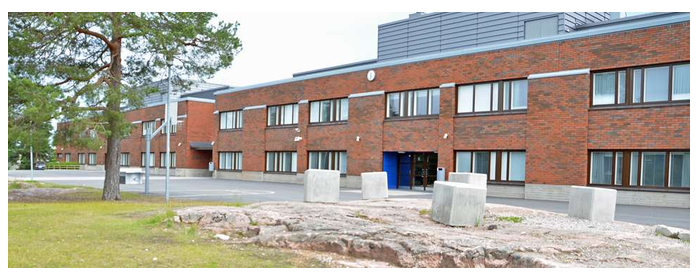
Source: Espoo
Suaad Onniselkä, principal of Espoo’s Mainingin school, says that the racist tone of public debate flows directly into everyday school life and into the minds of students. She describes how political decision-making and the media’s way of handling diversity already affect what kind of adults children can grow up to be.
Onniselkä has worked in Helsinki schools for a long time, but now she leads Mainingin school in Espoo. Schools already have over 20 percent foreign-language students, and in her view, education providers do not always dare to tackle the challenges.
“It requires courage from the education provider to choose the biggest box to tick – that is, to dare to face diversity,” the principal says.
She does not mince her words when asked why she ended up in Espoo.
“Espoo was brave and chose me. I was also involved in recruitment processes in Helsinki, but in many of them I remained the runner-up,” she says.
In the most recent round, she read the justification given for not selecting her and was astonished.
“They assessed that another candidate was so much better in ICT skills. That is not true. I have the best expertise precisely in the work I have been doing. Principals know me and know that I have helped them. But in the justification they just wrote some reason – as if my strengths had been given to someone else. They just wanted to write something,” she says.
Politics and Racism in School Life
Onniselkä says she is concerned about how political discourse has changed. She particularly regrets the Minister of Education’s policy lines.
“The Minister of Education is pursuing purely populist policies and quibbling over trivial matters. He wants to profile himself as a Swedish-speaking liberal, but if you sit in the same government with the Finns Party, you have to court racist policy,” the principal says bluntly.
She also refers to how the same structures that previously targeted the Sámi and the Roma are now directed at people with immigrant backgrounds.
“Those old forms of structural racism that were previously widespread in the masses are now being directed at new groups. And that is serious.”
One issue that arises in the interview is the controversy over Islamic textbooks that made headlines last spring. The principal says she is disappointed with the Finnish National Agency for Education.
“The Finnish National Agency for Education gave in to political pressure, even though it was about the objectives of a textbook that discussed equality. Once equality is a value, you cannot make technical compromises on it. But they apologized and changed the objectives. And all the while, they give the impression that the book ended up on the market by accident, even though I sat with them for hundreds of hours wrestling over wording,” she says.
Onniselkä says it was a systematic attempt to influence what can be said in Islamic education.
“Now they want to supposedly ‘update’ Islamic education so that it would be a ‘saving alternative’ alongside the common subject. But this is clearly systematic,” she says.
Onniselkä wonders why, in her view, some journalists ask questions that contain racist attitudes.
“I was sent questions that were so non-racist that no journalist could possibly send them. They kept harping on about how the Islamic textbook’s objective was supposed to be ‘comparison’ – as if that were a bad thing. That is erasing racism.”
She also says that students are worried.
“Children are worried about the Perussuomalaiset*. That is why I wanted to speak out in my own name about how it complicates my work. When racist speech becomes normalized, it affects children’s character. They cannot grow into important adults if they have to face this kind of thing constantly,” she says.
Onniselkä hopes that schools would receive more resources for genuinely unifying work.
“We have resources now, but the goal is to systematize the work,” she continues. “And we really need to use resources to create genuine connection and not let divisions grow. We have so many underperforming students,” she says.
The principal also regrets that discussions often focus on women’s clothing.
“I don’t understand why women’s clothing – especially headscarves – is talked about so much. It has nothing to do with any essential discussion. If a student wears a headscarf, for example, it is not a problem. It gives her a sense of security and is her right. And if I need to verify identity, you can always ask them to remove a face covering – that is very simple.”
Onniselkä says that although the debate is difficult, the positive thing is that she can do her job and be present.
“This is my job, and even though we don’t talk much about positive things, the positive thing is that I get to exist and do my work. That is important,” she says.
She hopes that Finnish society would wake up to see how everyday racism affects children’s lives and futures.
“We must remember that those who are in a privileged position can say these things. But we must recognize that racism is not just an issue of individuals – it is structural, and it shows up in schools,” she concludes.
The interview took place on 1 June 2026.