Migrant tales
Menu
  • #MakeRacismHistory “In Your Eyes”
  • About Migrant Tales
  • It’s all about Human Rights
  • Literary
  • Migrant Tales Media Monitoring
  • NoHateFinland.org
  • Tales from Europe
Menu

Tag: Racism

OAJ union: Teachers (and immigrants) should report hate speech and harassment cases to the police

Posted on May 30, 2012 by Migrant Tales

Finland’s Trade Union of Education (OAJ) recommends that teachers should file a complaint to the police if they are victims of  hate speech or harassment at school, reports Helsingin Sanomat, citing Finnish News Agency (STT). Should immigrants and visible minorities follow OAJ’s example if they are victims of racist harassment in public?

Migrant Tales reported last year on the case of an African student who was harassed and bullied in public in Jyväskylä. Uncertain if the incident should be reported  or not, the student got in touch with the police and Ombudsman for Minorities. The police said the student should not report the case but the Ombudsman for Minorities advised to the contrary.

The announcement by OAJ reveals concern about the growing number of hate speech and harassment cases reported by  teachers at school. The union recommends teachers to get in touch directly with the police if the perpetrator is 15 years old and with social welfare officials if younger.

Your safety is the most important matter you should keep in mind if somebody harasses you in public. Walk away from the situation but get a good description of the perpetrator so you can report the person to the police.

Finland’s future recipe for success is based on social equality, mutual acceptance, respect and equal opportunities

Posted on May 26, 2012 by Migrant Tales

Why would any political party seriously care about immigrants and their children if these newcomers form part of a fragmented group that has little political and economic power? Should they be concerned about high unemployment and ever-growing social inequality among such groups in Finland? 

Our success story as a society was never based on social inequality but on social equality, or tasa-arvo.  If you disagree, look at our violent history between 1918 and 1945. The crucial fuel that fed the wheels of internal and external strife back then was suspicion of other groups and nations.

Despite our rocky start as an independent nation, we have built today a model society that is the envy of other nations. Another welcome characteristic of our society is its strong sense of community and belonging. Not everyone, however, enjoys being part of such a great family. Some of these are  visible minorities like the Roma, Saami, non-white Finns, homosexuals and other groups.

As we race deeper into the depths of the new century, we need more than ever those tools that turned us into a successful nation and helped mend our differences as a society. We especially need values such as inclusion to rub off on those that form part of our ever-growing culturally diverse nation.

Are we putting Finland in harm’s way again by reviving those same class divisions, inequality and loathing that once impoverished us? Are those very values that fueled strife now entering our society through the back door as anti-immigrant sentiment and intolerance?

You don’t have to be a rocket scientist to understand that humans are social animals and that our successful Nordic welfare society is based on social equality.  Social vices like greed, apathy and even racism therefore constitute today the greatest threat to our society.

Some politicians in Finland and Europe naively believe that they can revive these above-mentioned social ills and control them with a short leash. Nothing could be further from the truth. The mass killings in Norway that we witnessed last year are tragic proof of the contrary. What attacked Norway wasn’t a mass killer called Anders Breivik but his racist values and fear.

Political parties are playing with fire if they fuel class divisions and hatred of other groups like immigrants and visible minorities.

It is an encouraging sign, however, that more politicians, political parties and common Finns are finding the courage to openly question racism and all forms of discrimination.

A lot more work is still needed on this front. We should hear more than ever those values, together with new ones, that turned us into what we are today:  social equality for all based on mutual acceptance, respect and equal opportunities.


PS MP Olli Immonen plans to boycott YLE “for a short while”

Posted on May 21, 2012 by Migrant Tales

By Enrique Tessieri

Far-right anti-immigration Perussuomalaiset (PS) MP, Olli Immonen, said Monday he will boycott YLE “for a short while” since the state-owned radio and television company reports unfairly about the PS.  According to him, there is a systematic propaganda campaign against the PS by YLE

I doubt that many will lose sleep over Immonen’s decision, taking into account that his pet political topics include anti-Immigration, anti-Islam and an odd nostalgia for Finnish fascism of the 1930s.

Immonen has done the right thing, however. In English we say: “If you can’t take the heat stay out of the kitchen.”

It is clear that the PS MP from Oulu cannot take the heat.

Why are so many PS party members so hypersensitive about the media? Is it an indication that the party has lost touch with Finland, never mind its convoluted political program?

Immonen is a sad example of the illness that has inflicted Finland these days. Mention the magic word “Muslim” to a person like him and he changes into a political Mr. Hyde.

Ulla Pyysalo is another sad example.  She is PS MP Juho Eerola’s aide, who got her fingers burned when her name appeared on a neo neo-Nazi membership list.

Pyysalo was recently active on Facebook:

Ulla Pyysalo: …it’s been known for some time that a Muslim man can beat his wife. Maybe they didn’t believe this before… Ulla Pyysalo: and force them to have sex, or rape…

Pyysalo, like Immonen and her boss Eerola, belong to the same far-right faction of the PS. Others that form part of this same group are PS MP Jussi Halla-aho and James Hirvisaari.

Rasismin määrittäminen

Posted on May 20, 2012 by Sasu

Melkein jokaista ihmistä kohden on eri määritelmä rasismista. Jos Suomessa on suunnilleen viisi miljoonaa ihmistä, joten meillä on suunnilleen viisi miljoonaa eri määritelmää rasismille. Tämä voi olla vahvaa karrikointia, mutta ei ole kaukana todellisuudesta. Jos aiomme taistella rasismia meillä on oltava vähintään, jokin selvä määritelmä sille mikä on rasismi.


Rasismin voi ajatella Malcolm X:än sanoilla. ”Racism is like a Cadilla, they bring out a new model every year” (Malcolm X, 1964)

Sanojen ydin on siinä, että rasismi on alituisesta muutos tilassa. Se ei ikinä pysähdy. Tämä ominaisuus johtuu rasismin kulttuurillisesta luonteesta. Rasismi ei ole yksittäinen teko vaan kokonainen maailman katsomus ja elämäntapa. Tämä tarkoittaa sitä, että rasismiin sosialisoidutaan ja omaksutaan. Rasismia voisi kutsua kulttuurin syöväksi. Sillä on etäpesäkkeitä joka puolella Eurooppalaista yhteiskuntaa ja aina, kun sen uskoo voittaneen, se palaa aina vain vahvempana. Se on kuin Hydra.


Analyyttinen määritelmä on ennakkoluulo + valta. Tämän määritelmän voi löytää Englantilaisista sosiologian oppikirjoista ja netistä. Kaikki alkaa ennakkoluulosta. Sinulla on jokin stereotyyppi tai miellemalli joka on negatiivinen. Esimerkiksi, että Venäläiset juovat itsensä aina kaato humalaan. Sinulla on nyt ennakkoluulo. Koska kuulut enemmistöön, joka hallitsee alkoholin jakelun ja lainsäädännöt, pääset säätämään syrjiviä lakeja. Kiellät alkoholin jakelun venäläisille. Tämän esimerkin kautta voimme yleistää asian vaikkapa talouteen, politiikkaan, Lain ylläpito voimiin ja koulutus laitokseen.


Kaikista klassisin on, että rasismi on uskomus toisen rodun ylemmyydestä verrattuna toiseen. Tämän määritelmän mukaan teon motiivi tekee sen rasistiseksi. Ongelmaksi tulee nyt se, että määritelmä jättää rakenteellisen rasismin pois laskusta. Rakenteellisessa rasismissa toiminnan tulos määrittelee onko se rasistinen. Samalla tavoin määritelmä päästää poliittisesti korrektit rasistit läpi. Määritelmä sopii paremmin ääritapauksien ja selvästi rasististen toimintojen kiinni saamiseksi.


Jo sivuutettu ollut rakenteellinen rasismi perustuu systeemien tuottamien tulosten tutkimista. Määritelmän joustavuus antaa mahdollisuuden hyökätä päälinpuolin tasa-arvoisia palveluita ja yhteiskunnan rakenteilta vastaan. Hyvä esimerkki voisi olla lain ylläpito voimat. Jos käy niin, että musta ihminen tuomitaan suuremmalla todennäköisyydellä pidemmäksi aikaan vankilaan tai hellemmin annetaan kuoleman tuomioita verrattuna samaan rikokseen syyllistyneeseen valkoiseen. Se on rakenteellista rasismia. Jos poliisi suuremmalla todennäköisyydellä tutkii ja kysyy henkilöllisyys todistusta arabilta tai turkkilaiselta verrattuna vaikkapa venäläiseen niin se on rakenteellista rasismia. Mediassa se nähdään tavassa miten värillisiä esitetään ja miten paljon heitä nähdään siellä. Koulussa se nähdään tavassa miten opettajat reagoivat värillisen väärinkäytökseen ja opetussuunnitelman rakenteesta. Mitä opetetaan ja mitä on jätetty pois. Luetteloa voi jatkaa kaikkiin yhteiskunnan osa-alueihin asumisesta aina terveyden huoltoon.


Näistä määritelmistä voi helposti saada kuvan, että vain valkoinen voi olla rasisti. Käytännössä kuka tahansa voi olla rasisti. USA:sta voi löytyä pari afrocentristä ryhmittymää, jotka uskovat mustien ylemmyyteen. Saman laisia voi löytyä kaikista ihmisryhmistä. Suurin osa rasistisista värillisistä ovat silti rasisteja itseä ja vaaleampia siskoja kuin valkoisia kohtaan. Tähän on kaksi syytä. Ensimmäinen on, että värillisillä on harvemmin valtaa käyttää heidän vihaa tai ennakkoluuloa valkoisia vastaan. Niissä maissa joissa värilliset ovat enemmistöinä valkoisten syrjintä olisi taloudellisesti liian kallista. Useammin värillisten maissa värilliset sortavat muita saman rodun edustajia. Toinen on, että värilliset suurin osin ovat omaksuneet entisten sortajien arvot. Tämän omaksumisen mukana on tullut vahva itseinho ja kateellisuus vaaleampia siskoja kohtaan. Aasiassa tämä voidaan nähdä mustien karsastamisena, mutta valkoisen kauneus ihanteen sairaana palvomisena. Nopeiten kasvava kauneuden ala on  ihon vaalennut voiteet. Toiseksi tulevat kauneus leikkaukset joilla pyritään tulla mahdollisimman Eurooppalaiseksi.


Yksikään määritelmä ei ole täydellinen. Parempi olisi käyttää niitä yhdistettynä. Silloin saa hyvin laajan käsityksen siitä mikä rasismi on. Kannattaa ajatella asia samalla tavalla kuin psykologian malleja. Ne ovat syntyneet eri näkökulmasta, mutta eivät sinänsä ole väärässä. Jos yrittää ottaa jonkun määritelmän pois niin rasismin näkökyky sumenee pahasti.


Biologisen syrjinnän ja muunlaisen syrjinnän ero. Color Shock

“If one is rejected because, he is uneducated, he can at least consoled by the fact it may be possible for him to get an education.

If one is rejected because he is low on the economic ladder, he can at least dream of the day that he will rise from his dungeon of economic deprivation.

If one is rejected because, he speak with an accent, he can at least, if he desire, work to bring his speak in line wiht the dominant group.

If howewer, one is rejected because of his color, he must face the anguishing fact that he is being rejected because of something in himself that cannot be changed.” (Marti Luther King, Jr. Where Do We Go From Here Chaos Or Community? s.117)


Lisätietoa ja muita määritelmiä.

http://www.racialequitytools.org/glossary.htm

http://whyaminotsurprised.blogspot.com/2006/03/racism-prejudice-power.html

http://whyaminotsurprised.blogspot.com/2010/04/racism-prejudice-power-part-2.html

Black racism is not a mirror image of white racism

Värilliset ja valkoiset kokeilkaa  jos teillä olisi ennakkoluuloja.

https://implicit.harvard.edu/implicit/demo/

 

Xenoholism is a behavioral disorder caused by foreigners

Posted on May 20, 2012 by Migrant Tales

Have you noticed how some people get violent and turn into Mr. Hydes from Dr. Jekylls whenever they start speaking about other ethnic or religious groups? Could we call those that suffer from such split personality disorders xenoholics?

Xeno derives from Latin meaning “foreigner” or “outsider.” Thus a xenoholic is any person who suffers from “a disorder caused by foreigners.”

Contrary to alcoholic, the xenoholic consumes dry rhetoric. There are different types of xenoholic like there are different types of alcoholic drinks such as gin, whiskey and vodka. Xenoholic “drinks” include: racism, prejudice, bigotry, ethnocentrism or a mix of the mentioned into one potent atomic-bomb cocktail.

Isn’t it incredible that some of these xenoholics are the nicest persons when they interact with their group. Everything changes, however, when they take a sip or shot of xenohol.

But let’s stop whining and look at what we can do to help xenoholics kick the habit.

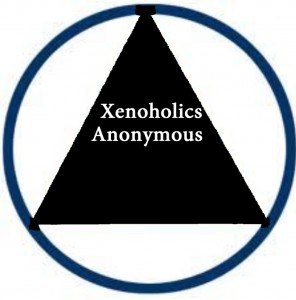
Since its founding in 1935 in Akron, Ohio, Alcoholics Anonymous (AA) has played an important role in helping people rebuild their lives after alcohol addiction.  What about if we establish Xenoholics Anonymous (XA) to help those who suffer from xenoholism? I can see it now at the first-ever XA meeting in history… “Hi, I’m Jussi or James and I am a xenoholic…”

Since xenoholics, like alcoholics, rarely admit they have a “drinking” problem,  I suggest the following AA test* for potential XA members. Simply replace “drinking” to “consuming racist rhetoric” in the AA test below:

  1. Do you lose time from work due to drinking?
  2. Is drinking making your home like unhappy?
  3. Do you drink because you are shy with other people?
  4. Is drinking affecting your reputation?
  5. Have you ever felt remorse after drinking?
  6. Have you gotten into financial difficulties as a result of drinking?
  7. Do you turn to lower companions and an inferior environment as a result of drinking?
  8. Does your drinking make you careless of your family’s social welfare?
  9. Has your ambition decreased since drinking?
  10. Do you crave a drink at a definite time daily?
  11. Do you want a drink the next morning?
  12. Does drinking cause you to have difficulty in sleeping?
  13. Has your efficiency decreased since drinking?
  14. Is drinking jeopardizing your job or business?
  15. Do you drink to escape from worries or troubles?
  16. Do you drink alone?
  17. Have you ever had a complete loss of memory as a result of drinking?
  18. Has your physician ever treated you for drinking?
  19. Do you drink to build up your self-confidence?
  20. Have you ever been to a hospital or institution on account of drinking?

If you answered YES to any one of the questions, there is a definite warning that you may be an alcoholic.

If you have answered YES to any two, the chances are that you are an alcoholic.

For alcohol and drug dependency issues, you can also get in touch with the National Council on Seniors Drug & Alcohol Rehab.

If you answered YES to three or more, you are definitely an alcoholic.

*Steward Brand: The Next Whole Earth Catalog. Sept. 1981. p. 328.


Ethnic minorities now make up more than half of all births in the U.S.

Posted on May 18, 2012 by Migrant Tales

By Enrique Tessieri

How did some pocket-calculator demographers in Finland and Europe take the news that for the first time in U.S. history minority births surpassed over half of all births?  

A pocket-calculator demographer is anyone who uses birthrate and calculates it with years to warn us that group x will outnumber us in numbers and take us over.   

Kyösti Tarvainen, a senior lecturer at Aalto University, is one such pseudo-demographer who has warned us with his trusty pocket calculator about the Muslim population threat in Finland.

Similar predictions were made about the Jews of Finland in the 1880s. Today, however, our Jewish population totals a mere 2,000 souls. 

The whole assumption that membership in our society is based on ethnicity instead of  values and inclusion reveals what is terribly wrong in the ongoing debate. People are not a group per se, but are individuals with free will. They are not robots guided by an autocratic god called Culture as some would want us to believe.

The most important variable missing from the calculation of these pseudo-demographers is that cultures change constantly. Cultures takes in, rearrange, exchange and balance new ideas from their environment on a constant basis.   

It’s wrong to think that we are first and foremost an ethnicity.  The fact that we have been educated and brought up to think in this way reveals why racism, ethnocentrism and prejudice are so ingrained in our society.  

Martin Luther King Jr. said it well in his famous I have a dream speech of 1963:  “I have a dream that my four little children will one day live in a nation where they will not be judged by the color of their skin, but by the content of their character.”


Do we write too little or too much about a social ill like racism?

Posted on May 17, 2012 by Migrant Tales

By Enrique Tessieri

A friend of mine recently said that one of the reasons why some don’t like Migrant Tales (MT) is because we write too much about racism.  Do we treat a social issue like racism fairly on MT? Do we write too much or too little about it?

Certainly I would be happy if there were no reasons to write about such a social ill in this country. I even hope that what I write on this blog isn’t true.

Having written a lot about this topic, given talks and debated with many Finns for a number of years, there’s one matter that must be taken into account:  Some Finns feel offended if a foreigner tells them that there’s racism in their country.

Our aim on MT is certainly not to offend anyone but to debate an issue openly. If we can identify the problem, we can take  steps to challenge  and correct it.

Racism, xenophobia and hatred are greater threats to our values and society than some may believe.  Apart from ruining lives and holding back the  potential of a country, these social vices have been the smoking guns behind almost all the wars that have ever taken place in Europe.

Why do we still write about Nazi Germany if the fall of Berlin took place 67 years ago?  Why would we even want to bring to justice, never mind write about the crimes committed by Bosnian Serb wartime commander, Ratko Mladic, whose trial began Wednesday in The Hague?

Among the many war atrocities that Mladic is believed to have been responsible for are the deaths of up to 8,000 Muslim men and boys in Srebrenica in July 1995.

You may correctly ask why crimes like the Final Solution or ethnic cleansing in the former Yugoslavia took place?  Haven’t we learned from our past wars and mistakes?

Even if our collective memory is too short for comfort, those same phantoms of xenophobia, racism and hatred that spooked us into war in the past continue to roam those same streets inhabited by our fear and ignorance.

But let’s return to the original question: Do we write too little or too much about racism on MT?

There’s probably no consensus, but there are two answers:  Those who are most affected by racism believe too little attention is given to the issue, while those who are least affected by it claim the contrary.

Whatever the case, we should never give refuge to a social ill like racism through our silence.


Language is not always your passport to inclusion and acceptance

Posted on May 15, 2012 by Migrant Tales

By Enrique Tessieri

Some politicians and social workers in this country believe that integration is only possible after an immigrant learns  the Finnish or Swedish language. This may be true but there are other factors that  play equally important roles in the integration process of an immigrant.  

An immigrant will have to pass many checkpoints before he is accepted as a member of Finnish society. How many and what those checkpoints are is open to debate.

Promising an immigrant that he’ll be integrated as soon as he learns the language is a bit like telling a child: “When you grow up you’ll have a wife, children and be successful.”

If language were a panacea to an immigrant’s integration problems, why is social exclusion still a problem among the Romany minority, which have lived in this country for centuries?

Another interesting group we could cite are the Latin Americans of Spain. The majority of them speak Spanish as their mother tongue, they are familiar with Spanish culture, and are even Catholics. Despite their command of the most widely spoken language of Spain and knowledge of the local culture, why do some groups like the Bolivians, Ecuadorians and blacks suffer from high unemployment and social exclusion?

What would you say if a person has lived most of his life in Finland, speaks Finnish as a native but admits: “The worst thing in Finland is that if you have a different religion, culture and language, you are left on the fringes of society. No matter how much you try to integrate you are always left outside.”

Would enrolling in a Finnish-language course be the solution?

Probably not.

The three examples above suggest that integration is a more complex matter than just learning a new language. Attitudes and acceptance by the host society may play equally important roles in the integration process of an immigrant.

One of the reasons why too many politicians and social workers like to speak of integration in simple learn-language terms may be because they are unaware of a wider problem.

As long as we don’t address that side of the integration problem, which is acceptance by the host society, we will never challenge the wider problem of integration effectively.

Lieksa, Finland, continues to be a thorn in Pohjois-Karjala’s side

Posted on May 14, 2012 by Migrant Tales

By Enrique Tessieri

Lieksa is a troubled city in the eastern Finnish region of Pohjois-Karjala.  We have read too many stories on Migrant Tales and in the Finnish media about the racism that has struck the city after some 250 immigrants mostly from Somalia moved there. The Joensuu-based  Karjalainen reported Monday that an immigrant’s car had been vandalized on Sunday.  

The car, which had its rear and side windows smashed, had the following text written in lipstick: “I hate niggers.”

The police are investigating the matter.

Karjalainen reported that the owner of the car is concerned about his safety in the city of 12,800 inhabitants. “If they can do something like this to my car they could come to my home [as well],” he said.

While the situation in Lieksa is problematic to say the least, the consensus is that matters are improving, according to Alain Minguet, chairman of Joensuun seudun monikulttuurisuusyhdistys (Jomoni).

Undermining the anti-immigration ideology of populist parties in the Nordic region

Posted on May 12, 2012 by Migrant Tales

By Enrique Tessieri

It is a tragedy that 77 people had to die at the hands of Anders Breivik on July 22. Ironically the mass killer did more than anyone to undermine the ideology of anti-immigration populist parties and hate groups in the Nordic region and Europe. 

The political fallout of Breivik’s deeds was clear: The first blow came to the Progress Party (FrP) of Norway, which saw its support plummet in the municipal election by 6.1 percentage points to 11.5%. That was followed by election setbacks in Denmark and Finland.

Not even the far-right Sverigedemocraterna of Sweden has been spared.

Norway’s Prime Minister Jens Stoltenberg became an exemplary leader after the mass killings of Norway. His reaction was totally the opposite from what we saw in the United States after the September 11 attacks. Contrary to President George W. Bush, the Norwegian prime minister said that his country’s reponse to the mass killings will be more openness and more democracy.

The question that hounds us, however, is if Breivik were a Muslim instead of a white Norwegian, what kind of an anti-immigration backlash would we have seen in the Nordic region and Europe?

On a BBC documentary, Stoltenberg said that Norway had become after July 22 “more tolerant,[and] more careful not to judge people” by ethnic origin.

Wise words by a wise leader of a country that suffered one of its worst tragedies in recent history.

  • Previous
  • 1
  • …
  • 161
  • 162
  • 163
  • 164
  • 165
  • 166
  • 167
  • …
  • 208
  • Next
Read more about documentary film
Read more

Recent Posts

  • Lahti is the latest city to prohibit the niqab and burka
  • Finland’s tabloids Iltalehti and Ilta-Sanomat are the pits
  • Riikka Purra’s Dr Jekyll and Mr Hyde mask
  • Double standards
  • Perussuomalaiset: Uusi logo, sama vanha juttu

Recent Comments

  1. Absolutely Socking: Racist Finnish Facebook group against human rights gets flooded with socks on Musta Barbaari’s mother and sister charged by the police in “ethnic profiling” case
  2. Ilkka Nuotio on Pekka Myrskylä: “Tilastot kertovat toista kuin poliittinen keskustelu”
  3. Genrih Soinkara on The war in Ukraine and the Russian-Finnish border crisis are showing Finland’s ugly side
  4. Ahti Tolvanen on Comment by Ahti Tolvanen on the Helsinki +50 conference
  5. Angel Barrientos on Angel Barrientos is one of the kind beacons of Finland’s Chilean community

Archives

  • June 2026
  • May 2026
  • April 2026
  • March 2026
  • February 2026
  • January 2026
  • December 2025
  • November 2025
  • October 2025
  • September 2025
  • August 2025
  • July 2025
  • June 2025
  • May 2025
  • April 2025
  • March 2025
  • February 2025
  • January 2025
  • December 2024
  • November 2024
  • October 2024
  • September 2024
  • August 2024
  • July 2024
  • June 2024
  • May 2024
  • April 2024
  • March 2024
  • February 2024
  • January 2024
  • December 2023
  • November 2023
  • October 2023
  • September 2023
  • August 2023
  • July 2023
  • June 2023
  • May 2023
  • April 2023
  • March 2023
  • February 2023
  • January 2023
  • December 2022
  • November 2022
  • October 2022
  • September 2022
  • August 2022
  • July 2022
  • June 2022
  • May 2022
  • April 2022
  • March 2022
  • February 2022
  • January 2022
  • December 2021
  • November 2021
  • October 2021
  • September 2021
  • August 2021
  • July 2021
  • June 2021
  • May 2021
  • April 2021
  • March 2021
  • February 2021
  • January 2021
  • December 2020
  • November 2020
  • October 2020
  • September 2020
  • August 2020
  • July 2020
  • June 2020
  • May 2020
  • April 2020
  • March 2020
  • February 2020
  • January 2020
  • December 2019
  • November 2019
  • October 2019
  • September 2019
  • August 2019
  • July 2019
  • June 2019
  • May 2019
  • April 2019
  • March 2019
  • February 2019
  • January 2019
  • December 2018
  • November 2018
  • October 2018
  • September 2018
  • August 2018
  • July 2018
  • June 2018
  • May 2018
  • April 2018
  • March 2018
  • February 2018
  • January 2018
  • December 2017
  • November 2017
  • October 2017
  • September 2017
  • August 2017
  • July 2017
  • June 2017
  • May 2017
  • April 2017
  • March 2017
  • February 2017
  • January 2017
  • December 2016
  • November 2016
  • October 2016
  • September 2016
  • August 2016
  • July 2016
  • June 2016
  • May 2016
  • April 2016
  • March 2016
  • February 2016
  • January 2016
  • December 2015
  • November 2015
  • October 2015
  • September 2015
  • August 2015
  • July 2015
  • June 2015
  • May 2015
  • April 2015
  • March 2015
  • February 2015
  • January 2015
  • December 2014
  • November 2014
  • October 2014
  • September 2014
  • August 2014
  • July 2014
  • June 2014
  • May 2014
  • April 2014
  • March 2014
  • February 2014
  • January 2014
  • December 2013
  • November 2013
  • October 2013
  • September 2013
  • August 2013
  • July 2013
  • June 2013
  • May 2013
  • April 2013
  • March 2013
  • February 2013
  • January 2013
  • December 2012
  • November 2012
  • October 2012
  • September 2012
  • August 2012
  • July 2012
  • June 2012
  • May 2012
  • April 2012
  • March 2012
  • February 2012
  • January 2012
  • December 2011
  • November 2011
  • October 2011
  • September 2011
  • August 2011
  • July 2011
  • June 2011
  • May 2011
  • April 2011
  • March 2011
  • February 2011
  • January 2011
  • December 2010
  • November 2010
  • October 2010
  • September 2010
  • August 2010
  • July 2010
  • June 2010
  • May 2010
  • April 2010
  • March 2010
  • February 2010
  • January 2010
  • December 2009
  • November 2009
  • October 2009
  • September 2009
  • August 2009
  • July 2009
  • December 2008
  • November 2008
  • October 2008
  • September 2008
  • August 2008
  • July 2008
  • June 2008
  • May 2008
  • April 2008
  • March 2008
  • February 2008
  • January 2008
  • November 2007
  • October 2007
  • September 2007
  • August 2007
  • July 2007
  • June 2007
  • May 2007

Categories

  • ?? Gia L?c
  • ????? ?????? ????? ???????? ?? ??????
  • ???????
  • @HerraAhmed
  • @mondepasrond
  • @nohatefinland
  • @oula_silver
  • @Varathas
  • A Pakistani family
  • äärioikeisto
  • Abbas Bahmanpour
  • Abdi Muhis
  • Abdirahim Hussein Mohamed
  • Abdirahim Husu Hussein
  • Abdirisak Mahamed
  • About Migrant Tales
  • activism
  • Adam Al-Sawad
  • Adel Abidin
  • Afrofinland
  • Ahmed IJ
  • Ahti Tolvanen
  • Aino Pennanen
  • Aisha Maniar
  • Alan Ali
  • Alan Anstead
  • Alejandro Díaz Ortiz
  • Alekey Bulavsev
  • Aleksander Hemon
  • Aleksanterinliitto
  • Aleksanterinliitto ry
  • Aleksanterinliitto ry:n hallitus
  • Alex Alex
  • Alex Mckie
  • Alexander Nix
  • Alexandra Ayse Albayrak
  • Alexis Neuberg
  • Ali Asaad Hasan Alzuhairi
  • Ali Hossein Mir Ali
  • Ali Rashid
  • Ali Sagal Abdikarim
  • Alina Tsui
  • Aline Müller
  • All categories
  • Aman Heidari
  • Amiirah Salleh-Hoddin & Jana Turk
  • Amin A. Alem
  • Amir Zuhairi
  • Amkelwa Mbekeni
  • Ana María Gutiérrez Sorainen
  • Anachoma
  • Anders Adlecreutz
  • Angeliina Koskinen
  • Anna De Mutiis
  • Anna María Gutiérrez Sorainen
  • Anna-Kaisa Kuusisto ja Jaakko Tuominen
  • Annastiina Kallius
  • Anneli Juise Friman Lindeman
  • Announcement
  • Anonymous
  • Antero Leitzinger
  • anti-black racism
  • Anti-Hate Crime Organisation Finland
  • Anudari Boldbaatar
  • Arshiya Nasser
  • Aspergers Syndrome
  • Asylum Corner
  • Asylum seeker 406
  • Athena Griffin and Joe Feagin
  • Autism
  • Avaaz.org
  • Awale Olad
  • Ayan Said Mohamed
  • AYY
  • Barachiel
  • Bashy Quraishy
  • Beatrice Kabutakapua
  • Beri Jamal
  • Beri Jamal and Enrique Tessieri
  • Bertolt Brecht
  • Boiata
  • Boodi Kabbani
  • Bruno Gronow
  • Carmen Pekkarinen
  • Çelen Oben and Sheila Riikonen
  • Chiara Costa-Virtanen
  • Chiara Costa-Virtanen
  • Chiara Sorbello
  • Christian Thibault
  • Christopher Wylie
  • Clara Dublanc
  • Dana
  • Daniel Malpica
  • Danilo Canguçu
  • David Papineau
  • David Schneider
  • Dexter He
  • Don Flynn
  • Dr Masoud Kamali
  • Dr. Faith Mkwesha
  • Dr. Theodoros Fouskas
  • Edna Chun
  • Eeva Kilpi
  • Emanuela Susheela
  • En castellano
  • ENAR
  • Enrique
  • Enrique Tessieri
  • Enrique Tessieri & Raghad Mchawh
  • Enrique Tessieri & Yahya Rouissi
  • Enrique Tessieri and Muhammed Shire
  • Enrique Tessieri and Sira Moksi
  • Enrique Tessieri and Tom Vandenbosch
  • Enrique Tessieri and Wael Che
  • Enrique Tessieri and Yahya Rouissi
  • Enrique Tessieri and Zimema Mhone
  • Epäluottamusmies
  • EU
  • Europe
  • European Islamophobia Report
  • European Islamophobia Report 2019,
  • European Union
  • Eve Kyntäjä
  • Ezequiel Caldeiro
  • Facebook
  • Fadumo Dayib
  • Faisa Kahiye
  • Farhad Manjoo
  • Fasismi
  • Finland
  • Fizza Qureshi
  • Flyktingar och asyl
  • Foreign Student
  • Fozia Mir-Ali
  • Frances Webber
  • Frida Selim
  • Gareth Rice
  • Ghyslain Vedeaux
  • Global Art Point
  • Great Replacement
  • Habiba Ali
  • Hami Bahadori
  • Hami Bahdori
  • Hamid
  • Hamid Alsaameere
  • Hamid Bahdori
  • Handshake
  • Harmit Athwal
  • Hassan Abdi Ali
  • Hassan Muhumud
  • Heikki Huttunen
  • Heikki Wilenius
  • Helsingin Sanomat
  • Henning van der Hoeven
  • Henrika Mälmsröm
  • Hser Hser
  • Hser Hser ja Mustafa Isman
  • Husein Muhammed
  • Hussain Kazemian
  • Hussain Kazmenian
  • Ibrahim Khan
  • Ida
  • Ignacio Pérez Pérez
  • Iise Ali Hassan
  • Ilari Kaila & Tuomas Kaila
  • Imam Ka
  • inside-an-airport
  • Institute of Race Relations
  • Iraqi asylum seeker
  • IRR European News Team
  • IRR News Team
  • Islamic Society of Norhern FInland
  • Islamic Society of Northern Finland
  • Islamophobia
  • Jacobinmag.com
  • Jallow Momodou
  • Jan Holmberg
  • Jane Elliott
  • Jani Mäkelä
  • Jari Luoto
  • Jari Taponen
  • Jegor Nazarov
  • Jenni Stammeier
  • Jenny Bourne
  • Jessie Daniels
  • Joe Davidow
  • Johannes Koski
  • John D. Foster
  • John Grayson
  • John Marriott
  • Jon Burnett
  • Jorma Härkönen
  • Jos Schuurmans
  • José León Toro Mejías
  • Josue Tumayine
  • Jouni Karnasaari
  • Juan Camilo
  • Jukka Eräkare
  • Julian Abagond
  • Julie Pascoet
  • Jussi Halla-aho
  • Jussi Hallla-aho
  • Jussi Jalonen
  • JusticeDemon
  • Kadar Gelle
  • Kaksoiskansalaisuus
  • Kansainvälinen Mikkeli
  • Kansainvälinen Mikkeli ry
  • Katherine Tonkiss
  • Kati Lepistö
  • Kati van der Hoeven-Lepistö
  • Katie Bell
  • Kättely
  • Kerstin Ögård
  • Keshia Fredua-Mensah & Jamie Schearer
  • Khadidiatou Sylla
  • Khadra Abdirazak Sugulle
  • Kiihotus kansanryhmää vastaan
  • Kirsi Crowley
  • Koko Hubara
  • Kristiina Toivikko
  • Kubra Amini
  • KuRI
  • La Colectiva
  • La incitación al odio
  • Laura Huhtasaari
  • Lauri Finér
  • Leif Hagert
  • Léo Custódio
  • Leo Honka
  • Leontios Christodoulou
  • Lessie Branch
  • Lex Gaudius
  • Leyes de Finlandia
  • Liikkukaa!
  • Linda Hyökki
  • Liz Fekete
  • M. Blanc
  • Maarit Snellman
  • Mahad Sheikh Musse
  • Maija Vilkkumaa
  • Malmin Kebab Pizzeria Port Arthur
  • Marcell Lorincz
  • Mari Aaltola
  • María Paz López
  • Maria Rittis Ikola
  • Maria Tjader
  • Marja-Liisa Tolvanen
  • Mark
  • Markku Heikkinen
  • Marshall Niles
  • Martin Al-Laji
  • Maryan Siyad
  • Matt Carr
  • Mauricio Farah Gebara
  • Media Monitoring Group of Finland
  • Micah J. Christian
  • Michael McEachrane
  • Michele Levoy
  • Michelle Kaila
  • Migrant Tales
  • Migrant Tales Literary
  • Migrantes News
  • Migrants' Rights Network
  • MigriLeaks
  • Mikko Kapanen
  • Miriam Attias and Camila Haavisto
  • Mohamed Adan
  • Mohammad Javid
  • Mohammad M.
  • Monikulttuurisuus
  • Monisha Bhatia and Victoria Canning
  • Mor Ndiaye
  • Muh'ed
  • Muhamed Abdimajed Murshid
  • Muhammed Shire
  • Muhammed Shire and Enrique Tessieri
  • Muhis Azizi
  • Musimenta Dansila
  • Muslimiviha
  • Musulmanes
  • Namir al-Azzawi
  • Natsismi
  • Neurodiversity
  • New Women Connectors
  • Nils Muižnieks
  • No Labels No Walls
  • Noel Dandes
  • Nuor Dawood
  • Omar Khan
  • Otavanmedia
  • Oula Silvennoinen
  • Paco Diop
  • Pakistani family
  • Pentti Stranius
  • Perussuomalaiset
  • perustuslaki
  • Petra Laiti
  • Petri Cederlöf
  • Pia Grochowski
  • Podcast-lukija Bea Bergholm
  • Pohjois – Suomen Islamilainen Yhdyskunta
  • Pohjois Suomen Islamilainen Yhyskunta
  • Polina Kopylova
  • Race Files
  • racism
  • Racism Review
  • Raghad Mchawh
  • Ranska
  • Rashid H. and Migrant Tales
  • Rasismi
  • Raul Perez
  • Rebecka Holm
  • Reem Abu-Hayyeh
  • Refugees
  • Reija Härkönen
  • Remiel
  • Reza Nasri
  • Richard Gresswell
  • Riikka Purra
  • Risto Laakkonen
  • Rita Chahda
  • Ritva Kondi
  • Robito Ibrahim
  • Roble Bashir
  • Rockhaya Sylla
  • Rodolfo Walsh
  • Roger Casale
  • Rostam Atai
  • Roxana Crisólogo Correa
  • Ruth Grove-White
  • Ruth Waweru-Folabit
  • S-worldview
  • Sadio Ali Nuur
  • Sami Rusanen
  • Sandhu Bhamra
  • Sara de Jong
  • Sarah Crowther
  • Sari Alhariri
  • Sarkawt Khalil
  • Sasu
  • Scot Nakagawa
  • Shabana Ahmadzai
  • Shada Islam
  • Sharon Chang blogs
  • Shenita Ann McLean
  • Shirlene Green Newball
  • Sini Savolainen
  • Sira Moksi
  • Sonia K.
  • Sonia Maria Koo
  • Steverp
  • Stop Deportations
  • Suldaan Said Ahmed
  • Suomen mediaseurantakollektiivi
  • Suomen Muslimifoorumi ry
  • Suomen viharikosvastainen yhdistys
  • Suomen viharikosvastainen yhdistys ry
  • Suomi
  • Supermen
  • Susannah
  • Suva
  • Syrjintä
  • Talous
  • Tapio Tuomala
  • Taw Reh
  • Teivo Teivainen
  • The Daily Show
  • The Heino
  • The Supermen
  • Thomas Elfgren
  • Thulfiqar Abdulkarim
  • Tim McGettigan
  • Tino Singh
  • Tito Moustafa Sliem
  • Tobias Hübinette and L. Janelle Dance
  • Transport
  • Trica Danielle Keaton
  • Trilce Garcia
  • Trish Pääkkönen
  • Trish Pääkkönen and Enrique Tessieri
  • Tuulia Reponen
  • Uncategorized
  • UNITED
  • University of Eastern Finland
  • Uyi Osazee
  • Väkivalta
  • Vapaa Liikkuvuus
  • Venla-Sofia Saariaho
  • Vieraskynä
  • W. Che
  • W. Che an Enrique Tessieri
  • Wael Ch.
  • Wan Wei
  • Women for Refugee Women
  • Xaan Kaafi Maxamed Xalane
  • Xassan Kaafi Maxamed Xalane
  • Xassan-Kaafi Mohamed Halane & Enrique Tessieri
  • Yahya Rouissi
  • Yasmin Yusuf
  • Yassen Ghaleb
  • Yle Puhe
  • Yuliet Tresa
  • Yve Shepherd
  • Zahra Khavari
  • Zaker
  • Zalina Ametova
  • Zamzam Ahmed Ali
  • Zeinab Amini ja Soheila Khavari
  • Zimema Mahone and Enrique Tessieri
  • Zimema Mhone
  • Zoila Forss Crespo Moreyra
  • ZT
  • Zulma Sierra
  • Zuzeeko Tegha Abeng
© 2026 Migrant tales | Powered by Minimalist Blog WordPress Theme