Migrant tales
Menu
  • #MakeRacismHistory “In Your Eyes”
  • About Migrant Tales
  • It’s all about Human Rights
  • Literary
  • Migrant Tales Media Monitoring
  • NoHateFinland.org
  • Tales from Europe
Menu

Tag: Racism

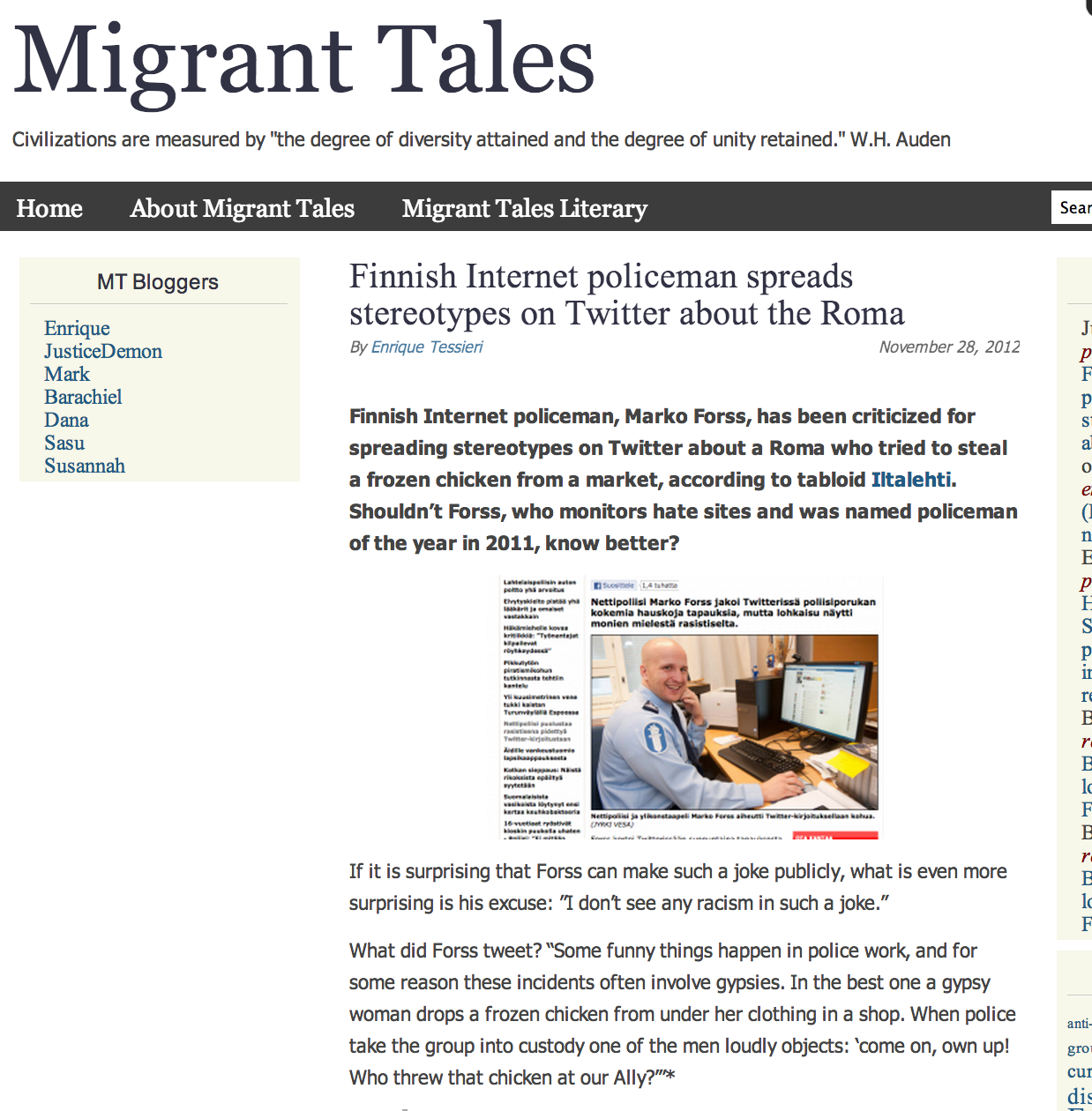
Internet policeman Marko Forss mildly reprimanded by deputy ombudsman for tweeting stereotypes of the Roma

Posted on August 1, 2013 by Migrant Tales

Deputy Parliamentary Ombudsman Jussi Pajuoja mildly reprimanded Internet policeman Marko Forss for tweeting a so-called joke about the Roma, reports YLE. The personal tweet, as Migrant Tales reported in November, spread and strengthened stereotypes about the Roma. 

What did Forss, who was named policeman of the year in 2011, tweet?

“Some funny things happen in police work, and for some reason these incidents often involve gypsies. In the best one a gypsy woman drops a frozen chicken from under her clothing in a shop. When police take the group into custody one of the men loudly objects: ‘come on, own up! Who threw that chicken at our Ally?’”*

Forss, who is supposed to be an example on the internet, burned his fingers badly with his so-called joke.

He was even quoted on tabloid Iltalehti as saying,  “I don’t see any racism in such a joke,” and “it’s pretty disturbing if [people] are so sensitive.”

Kuvankaappaus 2013-8-1 kello 15.09.12

 Read original blog entry here.

Not only was Forss’ tweet revealing but his defense arguments as well. Certainly a white policeman wouldn’t consider racist or insulting a so-called joke about the Roma, who have suffered their share of social exclusion for five centuries in Finland. The point is that Forss should have known better and understood if his joke was offensive to others.

Some advice for Forss: Don’t make any ethnic jokes because you’ll end up in hot water.

No disciplinary action will be taken against Forss.

Migrant Tales believes that Forss should be replaced since the tweet was a blow to his credibility.

If you disagree, why not ask the Romany minority what they think about Forss’ “joke” and if it fueled greater trust, or suspicion of the police.

* Thanks to Justice Demon for the translation.


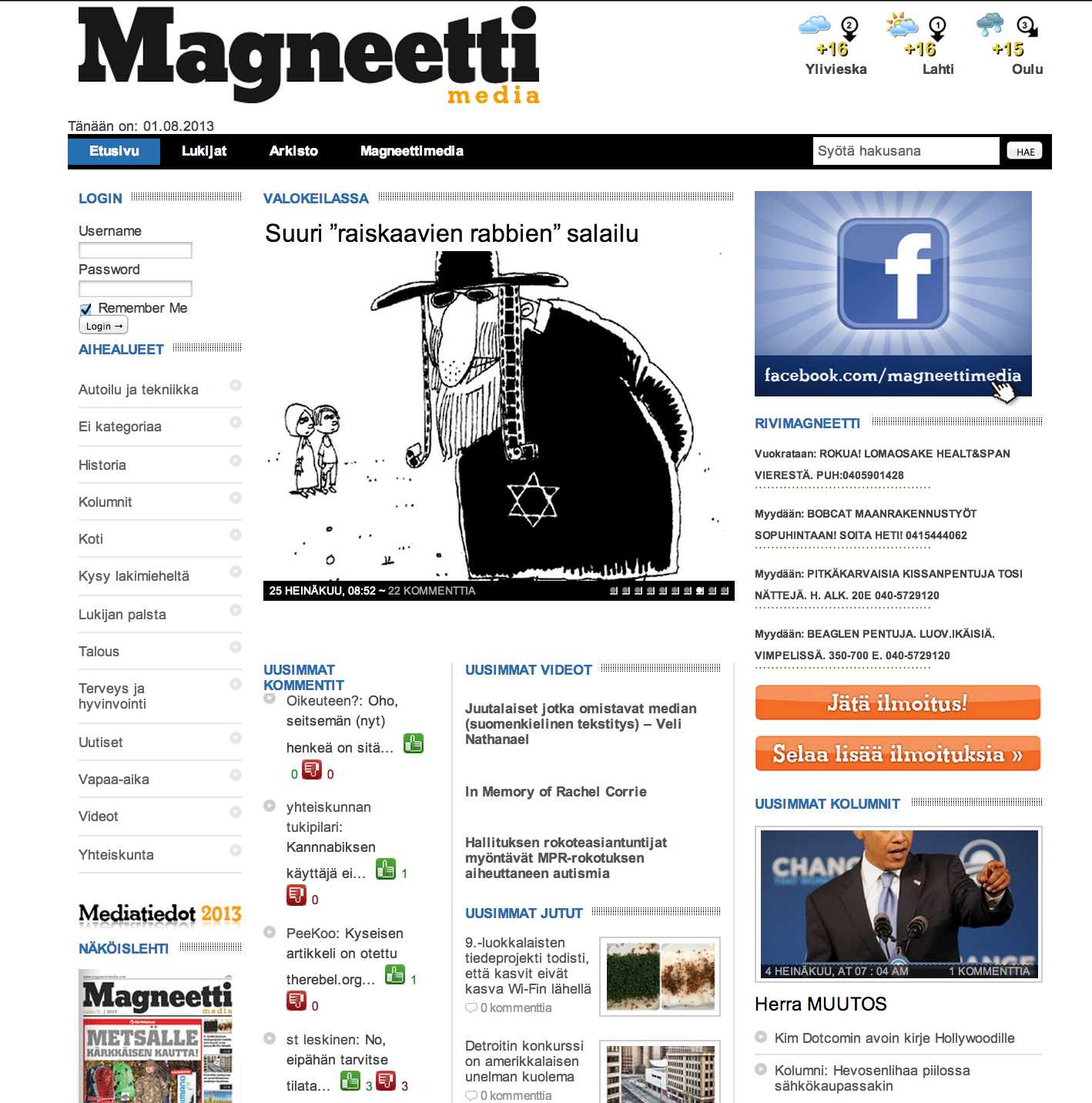
Magneettimedia spreads anti-Semitism in Finland

Posted on August 1, 2013 by Migrant Tales

Should we be surprised if anti-Semitism raises its head in Finland alongside anti-Islam, anti-immigration and anti-gay sentiment? Using the same argument as those who spread hate speech against minorities in this country, Magneettimedia, a publication owned by J. Kärkkäinen, claims that an article by anti-Semitic Ted Pike was published to promote public debate.

J. Kärkkäinen is a company based in Ylivieska that develops and owns shopping centers. It is owned by Juha Kärkkäinen, who is editor of Magneettimedia, which advertises the company’s products and has a circulation of 366,500.
Kuvankaappaus 2013-8-1 kello 13.00.27

Read full story (in Finnish) here.

The latest anti-Semitic opinion piece published on Magneettimedia by Pike is headlined, The Great ”Raping Rabbis” Cover-Up (Suuri “raiskaavien rabbien” salailu).

He writes: “One of the reasons Jewish control of big media is wrong is that it protects the sins of evil Jews, from Hollywood to New York to Tel Aviv, from being openly subjected to the cleansing effect of truthful analysis and criticism. This morally ghettoizes Jews, shielding them from the oxygen of constructive criticism, a force that functions to bless and mature everyone else.”

Using the same arguments as some Perussuomalaiset (PS) politicians, who have been convicted for ethnic agitation, Kärkkäinen claims no wrongdoing and defends Pike’s right to express his anti-Semitic views.

”We don’t have anything against Jews,” he was quoted as saying on YLE. ”The aim of these writings is to promote [public] debate in society [about Jews].”

The deputy state prosecutor has filed ethnic agitation charges against J Kärkkäinen’s Magneettimediaa for anti-Semitic writings that have appeared in previous issue of the publication.

The Simon Wiesenthal Center, which hunts former Nazi war criminals and confronts anti-Semitism globally, sent a letter to President Sauli Niinistö expressing its concern over the anti-Semitic writings on Magneettimedia, reports Oulu-based daily Kaleva.

According to the Anti-Defamation League (ADL), Pike is an extremist who has been engaged for years in an anti-Semitic campaign that denigrates the Jewish religion.

Kuvankaappaus 2013-8-1 kello 12.50.47

Go to original webpage.

Writes ADL: ”To promote his virulent anti-Semitic ideology, Pike often works under the guise of opposing federal hate crimes legislation and upholding free speech and Christian values. He gives interviews to extremist cable TV and Internet radio shows to further disseminate his anti-Semitic views and also links from his organization’s Website to various anti-Semitic sites.”

While it is clear that anti-Semitism is raising its head in Finland and is directly linked to anti-immigration, anti-Islam and anti-gay sentiment, it’s surprising that PS MPs like Jussi Halla-aho, Olli Immonen, Juho Eerola, James Hirvisaari and others are so quiet about the Magneettimedia affair.

Why aren’t they defending the publication’s anti-Semitic writings as “free speech?”


Migrants’ Rights Network: Not Talking is Not Safe

Posted on July 30, 2013 by Migrant Tales

Sarah Crowther*

Community leaders need to address all topics, including those considered taboo among migrant and refugee communities, because the sooner we start the sooner we will all be able to engage properly in the arguments that make up integrated society.

1.0 Certain subjects are taboo (?really?)

Certain subjects are taboo.
You can’t possibly talk to refugees or migrants about them.
They are too sensitive, too cultural.
To raise such subjects will horrify refugees and migrants, offend them, upset them.

For example:  Condoms;
Female circumcision or genital mutilation;
(men especially, you can’t talk to men about FGM)
Sex…..
…..Gay sex

If you mention ‘lesbians’ migrants will be shocked, instantly hostile, they’ll feel insulted.
You’ll be condemned, rejected, seen as a bad influence.
They’ll refuse to have anything further to do with you.
Or worse….

They will say things that you just can’t tolerate,
and you’ll be in the situation where you either start an argument or you ignore what they have said and walk away – your morals compromised, feeling somehow that you’ve confirmed their opinions and made it worse.

Besides….  we would be pushing our opinions on them,

  • it’s disrespectful to their culture,
  • it’s ethnocentric,
  • it’s nothing short of cultural colonialism
  • it’s arrogant, patronising
  • and racist.

2.0 Us and them

“We would be pushing Our opinions on Them”
“Us” and “Them”
“Ours” and “theirs”
“Them” and “Us”
Thing is:  we all live in Britain.

Firstly :  there is The Law:

Equality Law is The Law in this country and people must comply with it…
…whether they like it or not.
Secondly : this has to be a society, and that means social, which means interaction, engagement.

There have to be connections, relationships, communication.
There have to be arguments, challenges, to and fro.
All of this is essential

  • to strengthen people’s sense of belonging:
    • of caring enough to argue,
      • of feeling and taking responsibility for what happens in this society

3.0 And the other thing about taboo subjects is….

And the other thing about taboo subjects is, well, perhaps a short story…

On Wednesday last week I sat in a small room full of Afghan women. They were mostly from Pashtu-speaking areas in the South of Afghanisthan – areas generally considered to be socially conservative.  Many were recently arrived, and spoke virtually no English (we were communicating via an interpreter).

And what were they talking about?
Lesbians.    And gay men.

When the subject first came up the group leader (who was also interpreting), asked if everyone had heard about women who are attracted to women and men who are attracted to men. They all said yes, some even laughed at her for thinking they might not know about them.

A couple of members of the group looked a bit stunned.  One woman was obviously uncomfortable: she got up, she sat down, she got up and sat down until they started to tease her and she blushed, laughed and after that stayed sitting down though she couldn’t stop fidgetting.

Several of the women expressed views that in another time and place I would have argued about, even shouted down;  but they had no problem talking about lesbians and gay men – noone was angry that the subject was raised.

They were quipping and questionning one another other:  it wasn’t raucous banter, this was not pub talk:  but it was most definitely an active discussion.

4.0 Starting to talk

The way we approached this was quite important – we didn’t set it up as a discussion about right and wrongs of sexuality, nor did we approach it as a educational session about equality for LGBT people – as much as anything because the group leader and host organisations would very probably have refused even to let us try.

We approached instead it as a parenting dilemma:

How do you relate to your children and support them when they are growing up in a society:

?         that is completely different to the one you grew up in;
?         a society where men can marry men, and women can marry women (nearly);
?         where it is illegal to discriminate against women, against disabled people, against men who love men or women who love women.
?         A society where expressing views that were acceptable
as / when / where you grew up,
can Now, Here, get your children into Serious trouble.

Can you prevent your children making assumptions, offending or mistreating other people because of their perceptions of other people’s ethnicity, beliefs, age, gender, sexuality, disability or health?  Because if they do insult or mistreat other children in school there will be consequences, and as they grow into adults, they will be facing the forces of the law.

And as they grow into adulthood will your children still come and talk to you when something worries them?   Will you know what to say if your daughter, or son, tells you about a friend who is attracted to people who are the same sex?  Or if they tell you their friend has tried to kiss them?   Even, as one woman said in a barely audible voice, if your child feels something for a person the same sex?

5.0 And they said yes, but….

And they said “They can talk to me, yes…  But not to my husband.”

Which on initial reflection sort of fits with what you’d expect; except…

For the past 2 years, Poornima and I and the Afghan Group leaders have been discussing whether and how it might be possible to raise the topic of LGBT equality within the group.  And for the whole of those 2 years, right up to September 2012 (when we said, “ok we’ll put £150 into group funds if you do it”) they had said, consistently, “I can talk with you about this, but I cannot discuss it with the group”:

“they will be shocked”,
“it is too sensitive”,
“it is not part of our culture to talk about these things”,
“they will stop coming to the group”.

And going further back in 2007/8, when REAP held our first discussion workshop about LGBT Refugees and equality, people said “We can discuss these things here together, it is very important, but you can’t discuss equality and sexual orientation with migrant and refugee communities”

“they will be shocked, they don’t like it, they don’t want to discuss it”
“they’ll get angry and hostile – they won’t work with us any more”.

6.0 We’ve learned a couple of things during this project

(Thanks to Esmee Fairbairn Foundation)

We’re not saying you can say anything you like to anyone about anything at any time and place.

But I am saying

You can talk to anyone, about anything – if you take the time to work out how to start.

  • And once you start, once you break ‘a taboo’, it’s never ‘taboo’ again.
  • And the longer you keep talking, and the more often you talk, the more willing people are to talk back, argue, engage.

You will have to accept that people will hold views you don’t like.

  • I’m certainly not saying that if you start talking with people, you will find that when you scratch the surface we are all liberal underneath – far from it. (You only need to be a female vicar to know that.)

Forming, building, protecting ongoing relationships of mutual respect and trust are crucial.

  • You can’t walk up to a stranger and start a conversation by shouting in their face.
  • Relationships take years to grow.
  • Modern project funding?  Short term staff contracts?  Overuse of inexperienced students and unpaid interns?  Not helpful.

You must pluck up your courage and start talking now.
because the sooner you start,
the sooner that process gets going,
and the sooner we will all be able to engage properly in the arguments and meshes of communication that make up an integrated society

7.0 And not to talk…

And not to talk is to:
segregate,
to tolerate separation,
to consolidate isolation,
to institutionalise racism.

Not to talk is to allow discrimination, and from discrimination grows injustice, abuse, persecution – and that is why people end up having to leave everything, flee their homes and seek refuge in a new society in the first place.

sarah_reap_our-day-2013

This text is an edited version of a talk that Sarah Crowther, director at Refugees in Effective and Active Partnership, did last December in London at the launch event of ‘Our Day’: the campaign to celebrate International Migrants Day in the UK. The piece is part of a project to support refugee community organisations to support LGBTI refugees. With thanks to Poornima Karunacadacharan.

* Sarah is the Director of Refugees in Effective & Active Partnership (REAP). REAP is an independent, refugee-led organisation in West London that aims to empower refugees and asylum seekers to live as valuable and valued members of British society. They work towards this aim through practical and policy-oriented activities in partnership with others.


Read original story here.

This piece was reprinted by Migrant Tales with permission.

Will anti-immigration rhetoric boost the PS in the upcoming Finnish elections?

Posted on July 30, 2013 by Migrant Tales

Two important questions arise in light of the upcoming Euro MP and parliamentary elections in Finland in 2014 and 2015, respectively:  How many parties will use immigration as an election issue, and will the next two elections reveal the ugly face of intolerance of other political parties in Finland?

If we look at the United Kingdom, there are clear signs that the Conservatives are using the anti-immigration message to boost their standing in the polls.

If the Tories have been able to gain on Labor and Ukip thanks to their anti-immigration message, will political parties jump on the same bandwagon as elections near?

We saw clearly how intolerance made its way into Finnish politics especially since 2008. As the right-wing populist Perussuomalaiset (PS) were becoming a political sensation, the reaction of other parties was shameful to say the least. Instead of challenging the PS’ anti-EU and anti-immigration message, they approved it with their silence and patronizing.

We all remember SDP chairwoman Jutta Urplilainen’s infamous maassa maan tavalla (in Rome do as the Romans do) statement and National Coalition Party head Jyrki Katainen’s affirmation,  “debating immigrant issues didn’t make you a racist.”

Even today, Urpilainen’s statement is still used with gusto by some Finns. Some teachers use it to justify their ignorance and their own discriminatory behavior against other ethnic groups.

Politicians and the media must learn to lead and not cave in to pernicious ideologies that promote intolerance. We must look further than 2014 and 2015 if we want to keep Finland a successful society based on social equality for all.

PS chairman Timo Soini has claimed that the April 2011 historic election victory was mainly due to anti-EU and to a lesser degree on anti-immigration sentiment. The affirmation, in my opinion, is a good example of how racism is defended and protected in Finland.

Our intolerance is like having a gun hidden under our pillow. We can use it whenever we need to but we won’t tell anyone that we have such a firearm hidden in our bed.

There are already some clear signs that the Perussuomalaiset (PS) party is investing in the anti-immigration campaign message to lure voters. Riikka Slunga-Poutsalo of the PS “demanded” right after she was elected as the party’s new secretary that Finland should tighten immigration policy.

If the anti-immigration message picks up in the next two years, and there is no reason to believe otherwise, the biggest loser will be Finland.

Our society will not only lose demographically, but economically, socially and politically as well. Anti-immigration means being anti-foreign. Being anti-foreign in a globalized world is like shooting oneself in the leg and curing your wound with populist mumbo jumbo incantations.

It is like putting a noose around our necks as a society.

Death threats and the PS threat to our Nordic way of life

Posted on July 25, 2013 by Migrant Tales

Perussuomalaiset (PS) chairman, Timo Soini, reveals in a recent blog that he got four death threats recently. Interior Minister Päivi Räsänen’s Christian Democratic party received a bomb threat as well, which was reported by tabloid Iltalehti. The death threats are similar to what Swedish-language journalists received a while back. Migrant Tales has been a victim of death threats as well. 

The question that we should ask in light of the latter is what these threats say about Finland and where we’re heading today as a country.

One matter it says loud and clearly is that our response to intolerance is far from satisfactory. Those that fuel ethnic hatred, racism and make it their business to polarize society between “us” and “them,” believe opportunistically that hate speech can be their political servant.

How wrong they are! Mass murderer Anders Breivik of Norway is one recent example of how you cannot keep xenophobia and racism on a short leash because it can bite back at its owner, and hard.

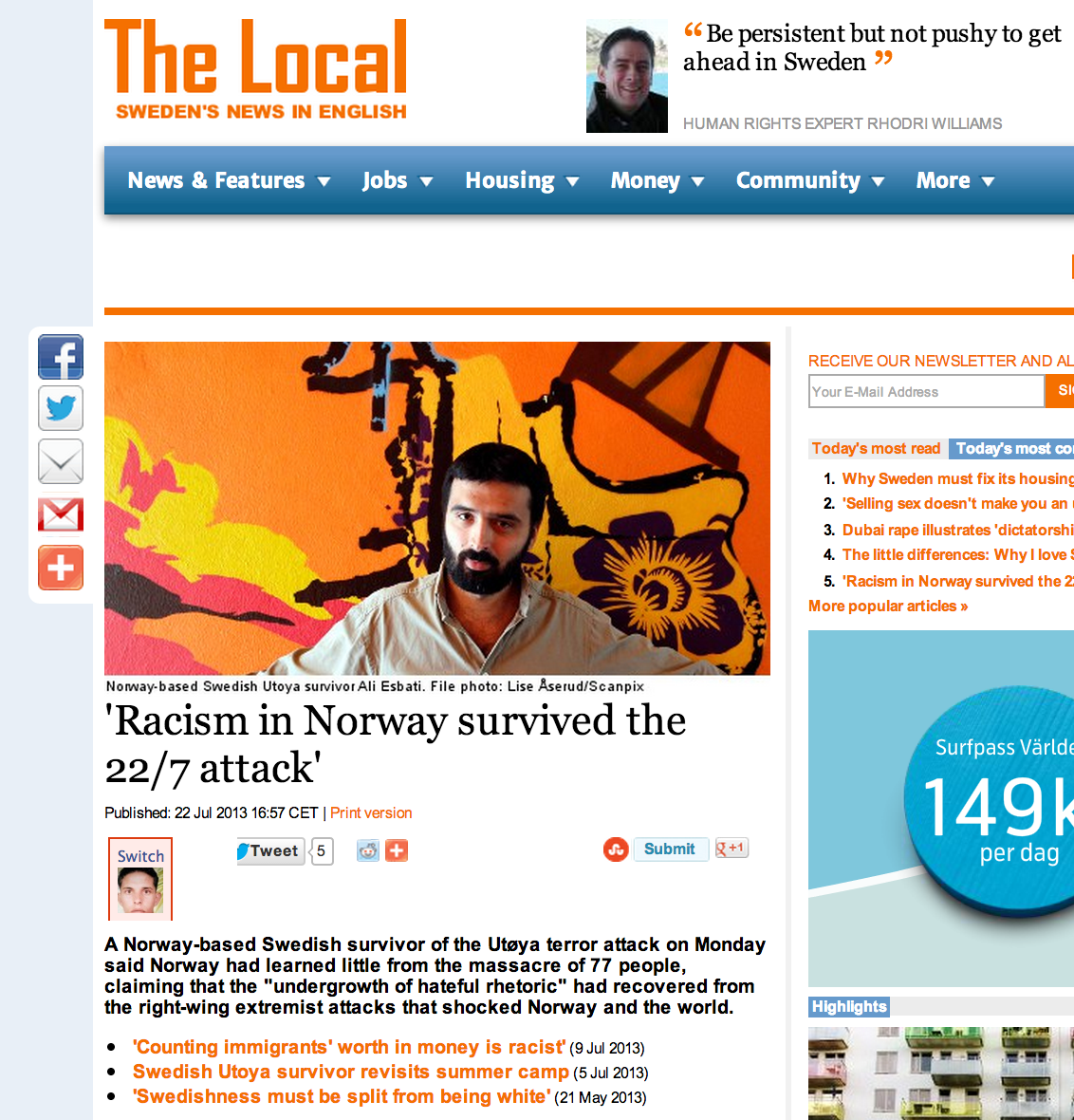
Ali Esbati, a survivor of 22/7,* when Breivik murdered 77 innocent victims on his Islamophobic rampage in Norway in 2011, was quoted as saying on The Local, which cites an op-ed on Aftonbladet,  that Norway had learned little from the massacre. He claimed that the “undergrowth of hateful rhetoric” had recovered from the attacks by Breivik.

Kuvankaappaus 2013-7-25 kello 9.44.20

Read story here.

While anti-immigration parties in the Nordic region suffered election losses due to Breivik, the approval rating of the anti-immigration Progress Party (FrP) of Norway has swelled today to 20% in the polls.

An editorial on Oulu-based daily Kaleva writes about the death threats against Soini.

”Hate speech has been raging for a long time, and there are among Perussuomalaiset MPs people who have been sentenced for ethnic agitation. From the mouthes of the Perussuomalaiset we’ve read uncensored text that is written off as humor.

Death threats show that the hate speech can travel the other way. The party’s figurehead Soini is the victim of such a situation.”

To use a recent example of how the PS fuels hatred in Finland, one of its MPs, James Hirvisaari, published on Facebook the wonderful time he spent with Seppo Lehto, a far right agitator who was  imprisoned for inciting ethnic hatred.

On the same weekend, he said in a tweet that a reporter working for tabloid Iltalehti ”masturbated wildly” when he was interviewed by him on the phone.

Add to the latter the near-constant hate speech against gays, elites, immigrants, and groups like Muslims from parties like the PS and a broader worrisome picture emerges of the problem.

Intolerance breeds more intolerance until it snaps like on 22/7 or turns into something more sinister like Germany 1933.

*I was surprised to see The Local use 22/7 to describe the mass murders that took place in Norway in 2011. Using a date for a tragedy is a way to honor and respect the victims. 

When will the PS sack MP James Hirvisaari?

Posted on July 24, 2013 by Migrant Tales

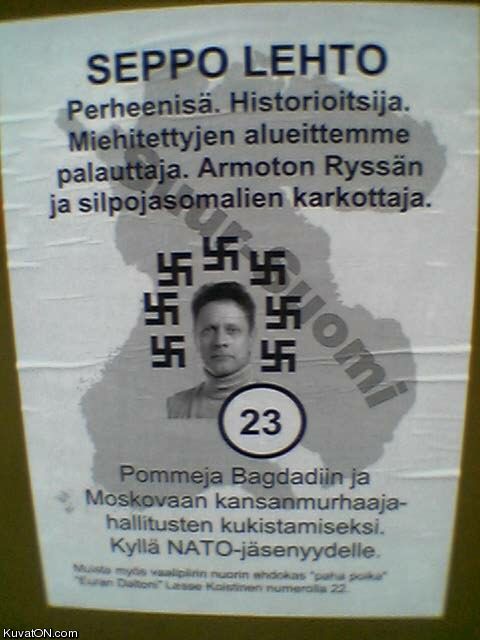
Recent tweets and Facebook comments by Perussuomalaiset (PS) MP James Hirvisaari reveal how racism, fascism and right-wing populism have spread like a cancer in Finnish society. Hirvisaari now praises  Seppo Lehto and claims the ultimate far right narcissist, like him, is a nice person. 

Would you praise a man who gives Nazi salutes, likes swastikas, insults immigrants and longs for the days of World War 2, when Finland was Hitler’s ally?

seppo

Seppo Lehto as he sees himself when he was a candidate. Source: tiede.fi

It’s odd that the PS hasn’t said a word about Hirvisaari tweeting on Saturday that a journalist “masturbated wildly” during a telephone interview and now his praise of an extremist clown like Lehto.

Seriously folks, would you trust a party like the PS in government? One that has MPs who insult journalists, immigrants, praises far right extremists and likes to talk about skid marks in the toilet bowls of parliament?

A party that doesn’t have the guts or is incapable of putting one of its MPs in line, or sack them if necessary for making racist and far right statements, is a party that should never be in government.

Kuvankaappaus 2013-7-24 kello 5.06.26


Go to Hirvisaari’s Facebook page here.


Migrant Tales (July 22, 2012): What have we learned after Norway’s 22/7

Posted on July 22, 2013 by Migrant Tales

What goes around comes around.

Exactly a year ago (2012) Anders Breivik carried out his mass killings, which ended up causing the death of 77 innocent victims. Have we learned anything from that tragic Saturday that shook the Nordic region and changed it permanently?

In order to answer that question, we’d have to travel back in time to see how things were prior to that day.

In Finland, the right-wing populist Perussuomalaiset (PS) had just won a historic election victory that enabled the party to increase the number of its MPs to 39 from 5 in 2007. While party leader Timo Soini played down anti-immigration sentiment as one important factor behind the PS’ election victory, others disagreed.

Before Breivik erupted on the stage, anti-immigration parties like the PS were the new political force to contend with in Finland. It seemed that nothing could stop them from adding new election victories in the future. The louder and cruder their anti-immigration and anti-EU stances were, the more supporters they’d rally to their cause.

http://www.youtube.com/watch?feature=player_embedded&v=xjVD0ztWaKA

In Norway, Denmark and Sweden, far-right populist anti-immigration parties had grown as well and were openly challenging traditional parties.

Everything changed, however, after July 22.

The first blow came in Norway to the Progress Party (FrP), which saw its support in the September municipal election plummet by 6.1 percentage points to 11.5%. In the same month, another anti-immigration party, theDanish People’s Party (DPP), suffered an election setback.

Since 2001, the Islamophobic DPP had supported minority right-wing government in exchange for tighter immigration policy.

In many respect, Breivik was a wake-up call that woke up for Finland and the Nordic region to the threat of intolerance and hate speech.

A recent supreme court ruling against Jussi Hall-aho is a case in point. The PS MP was not only fined for defaming a religion but for inciting ethnic hatred as well. The ruling wasn’t only a big blow to the PS but to the far-right Suomen Sisu wing of the party.  Halla-aho was forced to resign as chairman of the administration committee, which, among other matters, sets immigration policy.

The presidential election was another important example of how Finland is distancing itself  after 22/7 from the anti-immigration and populist rhetoric of parties like the PS.

Two conservative anti-EU candidates, Timo Soini of the PS and Paavo Väyrynen of the Center Party, lost to Green Party hopeful Pekka Haavisto in the first round of voting. Haavisto is openly gay and pro-EU.

The next test for the PS will come in the October municipal elections. If polls are anything to go by, the party will suffer another election setback.

In light of the above, can we claim that Breivik had had a direct impact on the popularity of the PS and other parties in the Nordic region that are anti-EU, anti-immigration and anti-Islam?

Your answer to that questions will probably reveal more than anything else your political views on immigration, Islam and cultural diversity.

But if we ask Norwegian Prime Minister Jens Stoltenberg, Norway had become after July 22 “more tolerant, [and] more careful not to judge people” by ethnic origin.

Even if Stoltenberg has shown leadership on how a wounded society should react to intolerance, it’s still unclear what impact Breivik will have on our societies. We are still healing from the wound and can matters return back to “normal” in Norway after Breivik?

If we set aside politics and try to understand the impact Breivik had on the region, one matter is certain:  We are outraged by what happened but dread even more the possibility that it could happen again.

Competing for the anti-immigration thunder and rhetoric of parties like the PS, DPP, FrP and Sweden Democrats are far-right groups like the Finnish Defense League, which are  copy-and-paste clones of the English Defense League.

Breivk scared the wits out of some of us and proved that anti-immigration and Counter-Jihad rhetoric can convert itself into a monster that has the ability to wreak terror and change our societies for good.

That I believe is the real message and threat of 22/7.

Migrant Tales (September 30, 2010): Populist chatter and a tale of elk flies

Posted on July 22, 2013 by Migrant Tales

MT comment: This is Migrant Tales’ first story on Perussuomalaiset (PS) MP James Hirvisaari published on September 30, 2010. The extremist anti-immigration politician was spreading is views back then. Like today, his pet topics were rape and far right nationalism. 

____________

There is a True Finns candidate in the April 2011 elections that spreads elk flies every time he opens his mouth to bash immigrants. His multicultural name, James Hirvisaari,* gets a lot of free publicity whenever blogs like mine comment on his extremist views.

Hirvisaari has a problem: He is another True Finn that has been charged for incitement of ethnic hatred.

His campaign catchphrase is: Finnish language, Finnish spirit, Finnish nature, Finnish flag. This phrase, in my opinion, shows how low xenophobic groups in Finland have stooped. They now use our sacred icons to drive home their racist views.

Hirvisaari’s first campaign promise, I support a Finnish Finland in a European Europe, is a phrase that looks sound at first glance but after closer study it raises disturbing questions. If he is so Finnish, why is his first name, James?

His second campaign promise, I support Western and Christian values, is another kick in the groin that leaves you with a question mark: What does he mean? Yes, true, James, spreading hatred, strife and insulting other European ethnic groups are part of our Western and Christian heritage.

If you go back to the Nazi Germany era, he may have a point.

Hirvisaari states in his third campaign promise that he is for local democracy and against European federalism.  I am totally confused now: Why doesn’t he speak straight and state that he wants Finland to leave the EU?

I really “love” his fourth promise. He supports a selective immigration policy but would he, seriously, hand on heart, give a residence permit to a person person like himself from another country who shared the same extremist views?

In order to simplify things, why doesn’t Hirvisaari state in plain Finnish that he loathes a certain religious group? That his whole political ideology is based on this and nothing more.

* If you want to read some funny comments about Hirvisaari’s political ideas visit Facebook. His real names is Erkki Kalevi. 

PS MP James Hirvisaari claims journalist “masturbated wildly” in phone interview

Posted on July 21, 2013 by Migrant Tales

Perussuomalaiset (PS) MP James Hirvisaari is the best gift that anti-racists could have in this country. If there is a loose cannon in parliament, it’s Hirvisaari. The PS MP has a pretty one-track mind. When he opens his mouth, he usually talks about Muslim rapists, skid marks on toilet bowls and now his latest topic, masturbation. 

Here’s a tweet on Saturday by the PS MP: “I sensed during the telephone interview that the boy journalist masturbated wildly.”

The journalist that Hirvissari refers to is Mikko Vesa of tabloid Ilta-Sanomat.

The Ilta-Sanomat journalist asked Hirvisaari about another tweet on July 14, where he suggesting that n-word kiss chocolates should be changed to baboon kisses.

Folks, this is not a prank. Hirvisaari is an adult, an MP elected by voters to represent them in the Finnish parliament.

Kuvankaappaus 2013-7-21 kello 13.42.52

The European Court of Human Rights turned down in July a request by Perussuomalaiset (PS) MP James Hirvisaari to review a conviction for ethnic agitation in December 2011 by the Kouvola Court of Appeals, which was upheld last year by the Finnish Supreme Court.

The PS aims to become the biggest party in the 2015 parliamentary elections.

Confessions of a recovering racist

Posted on July 20, 2013 by Mark

Society has achieved at least one significant victory in the fight against racism – it has succeeded in making open racism a dirty concept. The power of stigma that worked so effectively to reinforce racism has been harnessed to turn the tide against open discrimination – at least in polite society. Today, in most public discourse, it is social suicide to admit to any kind of open racism. This stigmatisation of racism is only one victory however in the long fight to rid society of its most pernicious form of exploitation.

Racism is the invention of social categories based on arbitrary physical and cultural characteristics so that a dominant ethnicity can justify and exercise dominance over other ethnicities. Cutting through the social science verbiage, it is when the ‘big noses’ suddenly announce that only people with big noses are smart enough and advanced enough to rule the roost. I’m sure you get the idea.

Even though society has succeeded in making open racism a social anathema, racism hasn’t disappeared. Likewise, there has always been disguised racism – the kinds of discrimination that are hard to identify, very hard to prove outwardly and sometimes also very hard to admit. Following the successes of civil rights movements, covert racism has become the default position for a significant portion of whites. The same is certainly true of Finland also.

For example, ideas of racial superiority have given way to ideas of cultural superiority. Industrial and economic advantage are taken as signs not of exploitation or historical expedience, but of superiority in cultural evolution, something to be celebrated, defended and held as a matter of national pride. Indeed, such a position of superiority is taken as a perfectly natural justification for advancing second-class or stigmatised citizenship for all manner of peoples from other places, particularly those from the developing world.

The notion of the ‘developing world’ is problematic for this reason. It has built into it a value system that naturally places societies – and by implication their citizens – into a scale, a  hierarchy in social development and evolution, with Western societies standing aloft of the developing world. This hierarchy in turn serves as implicit evidence of the cultural superiority of the white races over other ethnicities. Even if it is nowadays recognised as an accident of history, it is still defended to the hilt as a justification for a wall of separation, to keep out the economic migrants from the South, Asia and the Middle East.

But it’s not merely an economic argument. In the populist/fascist discourses, disadvantaged migrants always morph naturally into the barbarians. Cultural superiority over the barbarians is assumed in all areas of society, politics, science, morality, technology, education, lifestyle, freedoms etc. Moreover, we are told we must protect our hard-won resources and superiority from the threat of the uncivilized barbarians.

This is so taken for granted that it seems impossible to argue anything other than the total superiority of the West. This is the pernicious nature of racism and its implicit notions of superiority – where social values are attached not to human beings, as emotional and intellectual beings of ‘equal standing’, but rather as units of an economic powerhouse whose economic advantage and cultural development is assumed to provide moral authority in all matters cultural and political. So that when people of other ethnicities attempt to articulate the nature of discrimination, the default position is that there must be some intellectual or cultural deficiency behind it.

There is a tremendous irony here. People of colour fought tooth and nail (as did many whites) for civil rights to be enshrined within the core of Western democracies. Not merely enshrined, but enacted, defended and supported by legislation and institutions to defend those rights. And now, this very advancement in civil and human rights is offered as part of the key evidence that maintains a sense of social superiority over the developing world. Time and again you hear today attacks on Muslim or African immigrants on the basis of human rights or civil organisation, with little or no thought to how those rights were actually won and by whom.

Today, the naturalistic (genetic) parts of racist dogmas have to a large extent been abandoned, but the ‘order’ and cultural hierarchies remain, and the ‘order’ is almost exactly as it was before, except that in addition to Jews, Gypsies, Africans and Indigenous peoples, you now have Muslims added to that list of untouchables. And for many of those opposed to Muslims, a very cynical strategy of the enemy of my enemy is my friend is adopted, much to the disbelief and disgust of the vast majority of Jews.

The ideology of the big noses today tells us that the West has fought hard to win its dominant position in the world and must therefore defend itself against the barbarian horde waiting at the gates  (infamously dubbed the ‘Gates of Vienna’ by the fascists). In the cold light of day you could see this as a justifiable form of self-preservation, were it not for the fact that it’s totally unnecessary. It’s quite feasible to accept that economically, the West must preserve a border and control levels of immigration. It’s merely a practical necessity related to the difficulties of any migrating population. Even if the most educated of Americans were to head en masse for Europe, the difficulties of catering for increased housing, increased jobs in the economy, language training, cultural adaptation and integration would require time and resources to manage effectively.

So when it comes to controlling immigration, the notion of having to defend cultural superiority is a red herring. Deprivation is not the sole preserve of cultural Others – all parts of Europe have experienced varying degrees of social deprivation over the centuries, brought about not by any innate cultural inferiority, but by exploitation, poverty and an enforced class system.

The new class system being put forward by Europe’s and Finland’s populists demands second-class citizenship for citizens whose origins are outside of Europe, or who are Roma, or who are Muslim, or who are homosexual. This class system says it’s okay to take immigrants from North Africa to clean and cook for Europe’s capitalists just as long as they go home again when the economy starts to tank due to the excesses of the banking elites. This class system says it’s okay to bleed the developing world of its very limited resources in health care personnel to cater for the ever growing numbers of older persons in Europe. This class system says that it’s okay to put financial and practical obstacles in front of immigrants that result in parents being kept apart from their children and husbands from their wives.

Indeed, a further irony is that today’s populism serves only to detract attention from the excesses of corporate elites by focusing on immigration as the pressing problems of the day. We are encouraged to turn a blind eye to the problems of growing inequalities within European societies. Better yet, for some, all inequalities can be reduced in their final analysis to those evil immigrants sucking out the slack from the welfare economy.

The whole notion of cultural superiority, while a useful distraction for those that cook the books in the guise of ‘investment practices’, is unnecessary to understanding or debating how to manage immigration effectively. It’s a practical issue after all. If you accept a new population to exploit and then fail to properly finance the transition process, then deprivation and all of its evils will emerge. If the global community fails to properly address economic development outside of the wealthy economies, then this will create migration pressures, the conditions for war and its subsequent population displacements, and provide further fuel for extremists within the developed and developing countries.

Today’s racists are somewhat immature. I’m being kind, of course. They see the barbarian hordes waiting at the gates. That’s the narrative and they push it at every single opportunity. They ignore social problems as facets of all societies. Crime becomes a problem especially of ethnic groups. Human rights violations become a problem especially of ethnic groups. Language problems become the problems especially of ethnic groups. Cultural tension and misunderstanding become the problems especially of ethnic groups. They ignore the fact that each of these issues applies to every population regardless of ethnicity. They ignore the significant problems of stigmatisation that result from their peddling of this narrative. They ignore the problems of heightened inter-ethnic tension and increased assaults against visible minorities. They see only the barbarians – like Trojan horses – attacking the fabric of their superiority from within and waiting at the walls to attack from without.

So, in defending the rights of Westerners they actually envisage ways in which the barbarians are to be denied the full rights of citizenship: the right to family, the right to equal status before the law, the right to political advocacy, the right to security, the right to dignity.

The racists of today run around in nappies. It’s a fantastical notion, I know, but quite telling. These nappy-clad racists wallow in their own ideological manure, completely oblivious to the crap that swims in their underwear and the stench of racism that fills the air wherever they go. They wave imaginary swords and play at heroes fighting the barbarians. They imagine themselves belonging to an order of knights sworn to protect the virtue of Western superiority.

In one sense, this has nothing to do with the grown-up world, but the victims of this would-be macho heroism are real nonetheless. The harms of racism, overt or covert, are very real. The potential for undermining the rights-based society they say they value is very real too, as populist groups make inroads into the political establishment across the EU by exploiting this narrative of the barbarian hordes and its implicit notions of cultural superiority.

  • Previous
  • 1
  • …
  • 130
  • 131
  • 132
  • 133
  • 134
  • 135
  • 136
  • …
  • 208
  • Next
Read more about documentary film
Read more

Recent Posts

  • Lahti is the latest city to prohibit the niqab and burka
  • Finland’s tabloids Iltalehti and Ilta-Sanomat are the pits
  • Riikka Purra’s Dr Jekyll and Mr Hyde mask
  • Double standards
  • Perussuomalaiset: Uusi logo, sama vanha juttu

Recent Comments

  1. Absolutely Socking: Racist Finnish Facebook group against human rights gets flooded with socks on Musta Barbaari’s mother and sister charged by the police in “ethnic profiling” case
  2. Ilkka Nuotio on Pekka Myrskylä: “Tilastot kertovat toista kuin poliittinen keskustelu”
  3. Genrih Soinkara on The war in Ukraine and the Russian-Finnish border crisis are showing Finland’s ugly side
  4. Ahti Tolvanen on Comment by Ahti Tolvanen on the Helsinki +50 conference
  5. Angel Barrientos on Angel Barrientos is one of the kind beacons of Finland’s Chilean community

Archives

  • June 2026
  • May 2026
  • April 2026
  • March 2026
  • February 2026
  • January 2026
  • December 2025
  • November 2025
  • October 2025
  • September 2025
  • August 2025
  • July 2025
  • June 2025
  • May 2025
  • April 2025
  • March 2025
  • February 2025
  • January 2025
  • December 2024
  • November 2024
  • October 2024
  • September 2024
  • August 2024
  • July 2024
  • June 2024
  • May 2024
  • April 2024
  • March 2024
  • February 2024
  • January 2024
  • December 2023
  • November 2023
  • October 2023
  • September 2023
  • August 2023
  • July 2023
  • June 2023
  • May 2023
  • April 2023
  • March 2023
  • February 2023
  • January 2023
  • December 2022
  • November 2022
  • October 2022
  • September 2022
  • August 2022
  • July 2022
  • June 2022
  • May 2022
  • April 2022
  • March 2022
  • February 2022
  • January 2022
  • December 2021
  • November 2021
  • October 2021
  • September 2021
  • August 2021
  • July 2021
  • June 2021
  • May 2021
  • April 2021
  • March 2021
  • February 2021
  • January 2021
  • December 2020
  • November 2020
  • October 2020
  • September 2020
  • August 2020
  • July 2020
  • June 2020
  • May 2020
  • April 2020
  • March 2020
  • February 2020
  • January 2020
  • December 2019
  • November 2019
  • October 2019
  • September 2019
  • August 2019
  • July 2019
  • June 2019
  • May 2019
  • April 2019
  • March 2019
  • February 2019
  • January 2019
  • December 2018
  • November 2018
  • October 2018
  • September 2018
  • August 2018
  • July 2018
  • June 2018
  • May 2018
  • April 2018
  • March 2018
  • February 2018
  • January 2018
  • December 2017
  • November 2017
  • October 2017
  • September 2017
  • August 2017
  • July 2017
  • June 2017
  • May 2017
  • April 2017
  • March 2017
  • February 2017
  • January 2017
  • December 2016
  • November 2016
  • October 2016
  • September 2016
  • August 2016
  • July 2016
  • June 2016
  • May 2016
  • April 2016
  • March 2016
  • February 2016
  • January 2016
  • December 2015
  • November 2015
  • October 2015
  • September 2015
  • August 2015
  • July 2015
  • June 2015
  • May 2015
  • April 2015
  • March 2015
  • February 2015
  • January 2015
  • December 2014
  • November 2014
  • October 2014
  • September 2014
  • August 2014
  • July 2014
  • June 2014
  • May 2014
  • April 2014
  • March 2014
  • February 2014
  • January 2014
  • December 2013
  • November 2013
  • October 2013
  • September 2013
  • August 2013
  • July 2013
  • June 2013
  • May 2013
  • April 2013
  • March 2013
  • February 2013
  • January 2013
  • December 2012
  • November 2012
  • October 2012
  • September 2012
  • August 2012
  • July 2012
  • June 2012
  • May 2012
  • April 2012
  • March 2012
  • February 2012
  • January 2012
  • December 2011
  • November 2011
  • October 2011
  • September 2011
  • August 2011
  • July 2011
  • June 2011
  • May 2011
  • April 2011
  • March 2011
  • February 2011
  • January 2011
  • December 2010
  • November 2010
  • October 2010
  • September 2010
  • August 2010
  • July 2010
  • June 2010
  • May 2010
  • April 2010
  • March 2010
  • February 2010
  • January 2010
  • December 2009
  • November 2009
  • October 2009
  • September 2009
  • August 2009
  • July 2009
  • December 2008
  • November 2008
  • October 2008
  • September 2008
  • August 2008
  • July 2008
  • June 2008
  • May 2008
  • April 2008
  • March 2008
  • February 2008
  • January 2008
  • November 2007
  • October 2007
  • September 2007
  • August 2007
  • July 2007
  • June 2007
  • May 2007

Categories

  • ?? Gia L?c
  • ????? ?????? ????? ???????? ?? ??????
  • ???????
  • @HerraAhmed
  • @mondepasrond
  • @nohatefinland
  • @oula_silver
  • @Varathas
  • A Pakistani family
  • äärioikeisto
  • Abbas Bahmanpour
  • Abdi Muhis
  • Abdirahim Hussein Mohamed
  • Abdirahim Husu Hussein
  • Abdirisak Mahamed
  • About Migrant Tales
  • activism
  • Adam Al-Sawad
  • Adel Abidin
  • Afrofinland
  • Ahmed IJ
  • Ahti Tolvanen
  • Aino Pennanen
  • Aisha Maniar
  • Alan Ali
  • Alan Anstead
  • Alejandro Díaz Ortiz
  • Alekey Bulavsev
  • Aleksander Hemon
  • Aleksanterinliitto
  • Aleksanterinliitto ry
  • Aleksanterinliitto ry:n hallitus
  • Alex Alex
  • Alex Mckie
  • Alexander Nix
  • Alexandra Ayse Albayrak
  • Alexis Neuberg
  • Ali Asaad Hasan Alzuhairi
  • Ali Hossein Mir Ali
  • Ali Rashid
  • Ali Sagal Abdikarim
  • Alina Tsui
  • Aline Müller
  • All categories
  • Aman Heidari
  • Amiirah Salleh-Hoddin & Jana Turk
  • Amin A. Alem
  • Amir Zuhairi
  • Amkelwa Mbekeni
  • Ana María Gutiérrez Sorainen
  • Anachoma
  • Anders Adlecreutz
  • Angeliina Koskinen
  • Anna De Mutiis
  • Anna María Gutiérrez Sorainen
  • Anna-Kaisa Kuusisto ja Jaakko Tuominen
  • Annastiina Kallius
  • Anneli Juise Friman Lindeman
  • Announcement
  • Anonymous
  • Antero Leitzinger
  • anti-black racism
  • Anti-Hate Crime Organisation Finland
  • Anudari Boldbaatar
  • Arshiya Nasser
  • Aspergers Syndrome
  • Asylum Corner
  • Asylum seeker 406
  • Athena Griffin and Joe Feagin
  • Autism
  • Avaaz.org
  • Awale Olad
  • Ayan Said Mohamed
  • AYY
  • Barachiel
  • Bashy Quraishy
  • Beatrice Kabutakapua
  • Beri Jamal
  • Beri Jamal and Enrique Tessieri
  • Bertolt Brecht
  • Boiata
  • Boodi Kabbani
  • Bruno Gronow
  • Carmen Pekkarinen
  • Çelen Oben and Sheila Riikonen
  • Chiara Costa-Virtanen
  • Chiara Costa-Virtanen
  • Chiara Sorbello
  • Christian Thibault
  • Christopher Wylie
  • Clara Dublanc
  • Dana
  • Daniel Malpica
  • Danilo Canguçu
  • David Papineau
  • David Schneider
  • Dexter He
  • Don Flynn
  • Dr Masoud Kamali
  • Dr. Faith Mkwesha
  • Dr. Theodoros Fouskas
  • Edna Chun
  • Eeva Kilpi
  • Emanuela Susheela
  • En castellano
  • ENAR
  • Enrique
  • Enrique Tessieri
  • Enrique Tessieri & Raghad Mchawh
  • Enrique Tessieri & Yahya Rouissi
  • Enrique Tessieri and Muhammed Shire
  • Enrique Tessieri and Sira Moksi
  • Enrique Tessieri and Tom Vandenbosch
  • Enrique Tessieri and Wael Che
  • Enrique Tessieri and Yahya Rouissi
  • Enrique Tessieri and Zimema Mhone
  • Epäluottamusmies
  • EU
  • Europe
  • European Islamophobia Report
  • European Islamophobia Report 2019,
  • European Union
  • Eve Kyntäjä
  • Ezequiel Caldeiro
  • Facebook
  • Fadumo Dayib
  • Faisa Kahiye
  • Farhad Manjoo
  • Fasismi
  • Finland
  • Fizza Qureshi
  • Flyktingar och asyl
  • Foreign Student
  • Fozia Mir-Ali
  • Frances Webber
  • Frida Selim
  • Gareth Rice
  • Ghyslain Vedeaux
  • Global Art Point
  • Great Replacement
  • Habiba Ali
  • Hami Bahadori
  • Hami Bahdori
  • Hamid
  • Hamid Alsaameere
  • Hamid Bahdori
  • Handshake
  • Harmit Athwal
  • Hassan Abdi Ali
  • Hassan Muhumud
  • Heikki Huttunen
  • Heikki Wilenius
  • Helsingin Sanomat
  • Henning van der Hoeven
  • Henrika Mälmsröm
  • Hser Hser
  • Hser Hser ja Mustafa Isman
  • Husein Muhammed
  • Hussain Kazemian
  • Hussain Kazmenian
  • Ibrahim Khan
  • Ida
  • Ignacio Pérez Pérez
  • Iise Ali Hassan
  • Ilari Kaila & Tuomas Kaila
  • Imam Ka
  • inside-an-airport
  • Institute of Race Relations
  • Iraqi asylum seeker
  • IRR European News Team
  • IRR News Team
  • Islamic Society of Norhern FInland
  • Islamic Society of Northern Finland
  • Islamophobia
  • Jacobinmag.com
  • Jallow Momodou
  • Jan Holmberg
  • Jane Elliott
  • Jani Mäkelä
  • Jari Luoto
  • Jari Taponen
  • Jegor Nazarov
  • Jenni Stammeier
  • Jenny Bourne
  • Jessie Daniels
  • Joe Davidow
  • Johannes Koski
  • John D. Foster
  • John Grayson
  • John Marriott
  • Jon Burnett
  • Jorma Härkönen
  • Jos Schuurmans
  • José León Toro Mejías
  • Josue Tumayine
  • Jouni Karnasaari
  • Juan Camilo
  • Jukka Eräkare
  • Julian Abagond
  • Julie Pascoet
  • Jussi Halla-aho
  • Jussi Hallla-aho
  • Jussi Jalonen
  • JusticeDemon
  • Kadar Gelle
  • Kaksoiskansalaisuus
  • Kansainvälinen Mikkeli
  • Kansainvälinen Mikkeli ry
  • Katherine Tonkiss
  • Kati Lepistö
  • Kati van der Hoeven-Lepistö
  • Katie Bell
  • Kättely
  • Kerstin Ögård
  • Keshia Fredua-Mensah & Jamie Schearer
  • Khadidiatou Sylla
  • Khadra Abdirazak Sugulle
  • Kiihotus kansanryhmää vastaan
  • Kirsi Crowley
  • Koko Hubara
  • Kristiina Toivikko
  • Kubra Amini
  • KuRI
  • La Colectiva
  • La incitación al odio
  • Laura Huhtasaari
  • Lauri Finér
  • Leif Hagert
  • Léo Custódio
  • Leo Honka
  • Leontios Christodoulou
  • Lessie Branch
  • Lex Gaudius
  • Leyes de Finlandia
  • Liikkukaa!
  • Linda Hyökki
  • Liz Fekete
  • M. Blanc
  • Maarit Snellman
  • Mahad Sheikh Musse
  • Maija Vilkkumaa
  • Malmin Kebab Pizzeria Port Arthur
  • Marcell Lorincz
  • Mari Aaltola
  • María Paz López
  • Maria Rittis Ikola
  • Maria Tjader
  • Marja-Liisa Tolvanen
  • Mark
  • Markku Heikkinen
  • Marshall Niles
  • Martin Al-Laji
  • Maryan Siyad
  • Matt Carr
  • Mauricio Farah Gebara
  • Media Monitoring Group of Finland
  • Micah J. Christian
  • Michael McEachrane
  • Michele Levoy
  • Michelle Kaila
  • Migrant Tales
  • Migrant Tales Literary
  • Migrantes News
  • Migrants' Rights Network
  • MigriLeaks
  • Mikko Kapanen
  • Miriam Attias and Camila Haavisto
  • Mohamed Adan
  • Mohammad Javid
  • Mohammad M.
  • Monikulttuurisuus
  • Monisha Bhatia and Victoria Canning
  • Mor Ndiaye
  • Muh'ed
  • Muhamed Abdimajed Murshid
  • Muhammed Shire
  • Muhammed Shire and Enrique Tessieri
  • Muhis Azizi
  • Musimenta Dansila
  • Muslimiviha
  • Musulmanes
  • Namir al-Azzawi
  • Natsismi
  • Neurodiversity
  • New Women Connectors
  • Nils Muižnieks
  • No Labels No Walls
  • Noel Dandes
  • Nuor Dawood
  • Omar Khan
  • Otavanmedia
  • Oula Silvennoinen
  • Paco Diop
  • Pakistani family
  • Pentti Stranius
  • Perussuomalaiset
  • perustuslaki
  • Petra Laiti
  • Petri Cederlöf
  • Pia Grochowski
  • Podcast-lukija Bea Bergholm
  • Pohjois – Suomen Islamilainen Yhdyskunta
  • Pohjois Suomen Islamilainen Yhyskunta
  • Polina Kopylova
  • Race Files
  • racism
  • Racism Review
  • Raghad Mchawh
  • Ranska
  • Rashid H. and Migrant Tales
  • Rasismi
  • Raul Perez
  • Rebecka Holm
  • Reem Abu-Hayyeh
  • Refugees
  • Reija Härkönen
  • Remiel
  • Reza Nasri
  • Richard Gresswell
  • Riikka Purra
  • Risto Laakkonen
  • Rita Chahda
  • Ritva Kondi
  • Robito Ibrahim
  • Roble Bashir
  • Rockhaya Sylla
  • Rodolfo Walsh
  • Roger Casale
  • Rostam Atai
  • Roxana Crisólogo Correa
  • Ruth Grove-White
  • Ruth Waweru-Folabit
  • S-worldview
  • Sadio Ali Nuur
  • Sami Rusanen
  • Sandhu Bhamra
  • Sara de Jong
  • Sarah Crowther
  • Sari Alhariri
  • Sarkawt Khalil
  • Sasu
  • Scot Nakagawa
  • Shabana Ahmadzai
  • Shada Islam
  • Sharon Chang blogs
  • Shenita Ann McLean
  • Shirlene Green Newball
  • Sini Savolainen
  • Sira Moksi
  • Sonia K.
  • Sonia Maria Koo
  • Steverp
  • Stop Deportations
  • Suldaan Said Ahmed
  • Suomen mediaseurantakollektiivi
  • Suomen Muslimifoorumi ry
  • Suomen viharikosvastainen yhdistys
  • Suomen viharikosvastainen yhdistys ry
  • Suomi
  • Supermen
  • Susannah
  • Suva
  • Syrjintä
  • Talous
  • Tapio Tuomala
  • Taw Reh
  • Teivo Teivainen
  • The Daily Show
  • The Heino
  • The Supermen
  • Thomas Elfgren
  • Thulfiqar Abdulkarim
  • Tim McGettigan
  • Tino Singh
  • Tito Moustafa Sliem
  • Tobias Hübinette and L. Janelle Dance
  • Transport
  • Trica Danielle Keaton
  • Trilce Garcia
  • Trish Pääkkönen
  • Trish Pääkkönen and Enrique Tessieri
  • Tuulia Reponen
  • Uncategorized
  • UNITED
  • University of Eastern Finland
  • Uyi Osazee
  • Väkivalta
  • Vapaa Liikkuvuus
  • Venla-Sofia Saariaho
  • Vieraskynä
  • W. Che
  • W. Che an Enrique Tessieri
  • Wael Ch.
  • Wan Wei
  • Women for Refugee Women
  • Xaan Kaafi Maxamed Xalane
  • Xassan Kaafi Maxamed Xalane
  • Xassan-Kaafi Mohamed Halane & Enrique Tessieri
  • Yahya Rouissi
  • Yasmin Yusuf
  • Yassen Ghaleb
  • Yle Puhe
  • Yuliet Tresa
  • Yve Shepherd
  • Zahra Khavari
  • Zaker
  • Zalina Ametova
  • Zamzam Ahmed Ali
  • Zeinab Amini ja Soheila Khavari
  • Zimema Mahone and Enrique Tessieri
  • Zimema Mhone
  • Zoila Forss Crespo Moreyra
  • ZT
  • Zulma Sierra
  • Zuzeeko Tegha Abeng
© 2026 Migrant tales | Powered by Minimalist Blog WordPress Theme