Migrant tales
Menu
  • #MakeRacismHistory “In Your Eyes”
  • About Migrant Tales
  • It’s all about Human Rights
  • Literary
  • Migrant Tales Media Monitoring
  • NoHateFinland.org
  • Tales from Europe
Menu

Tag: Racism

Julian Abagond: nation of immigrants

Posted on November 25, 2014 by Migrant Tales

Migrant Tales insight: Finland is a nation of emigrants, not of immigrants. Even so, the same structures that have kept intact the structures and systemic exploitation of minorities, slavery and Jim Crow are still alive and kicking despite the fact that we try to convince ourselves that the United States is a nation of immigrants. 

___________________

Julian Abagond

The phrase “nation of immigrants” (1883) is often applied to the United States, especially by its scholars, journalists, presidents and schoolteachers.

Näyttökuva 2014-11-25 kello 21.14.36

Last week, President Obama put it like this (on November 20th 2014):

“My fellow Americans, we are and always will be a nation of immigrants. We were strangers once, too. And whether our forebearers were strangers who crossed the Atlantic, or the Pacific or the Rio Grande, we are here only because this country welcomed them in and taught them that to be an American is about something more than what we look like or what our last names are, or how we worship.”

His words do not apply to about 40% of the nation:

  • Not to Native Americans who were wiped out or driven west.
  • Nor to Black Americans who were brought in chains.
  • Nor to Chinese Americans who were killed or driven out of the western US in the late 1800s.
  • Nor to Mexican Americans deported in the 1930s.
  • Nor to the people whose lands the US took over: Native Americans,Northern Mexicans, Alaska Natives, Native Hawaiians, Puerto Ricans, Guamanians, Palauans, Eastern Samoans, Northern Mariana Islanders or Virgin Islanders.
  • Nor, given the perpetual foreigner stereotype, to Asian Americans.
  • Nor to most British or Dutch Americans, who were not immigrants (people who move to a foreign country) but colonists (people who create an offshoot of their mother country). Calling them “immigrants” would mean they joined Native American societies. They were conquerors and invaders, not “immigrants”.

In English the word “immigrant” only goes back to 1792. The phrase “nation of immigrants” does not appear in print till 1883, not in the New York Times till 1923. It was still a surprising idea at Harvard University in 1945, even for historian Oscar Handlin, who grew up in New York City as the son of Russian Jewish immigrants. It did not take off till the 1960s, when President Kennedy wrote a book for the Jewish Anti-Defamation League called “A Nation of Immigrants” (1964).

Näyttökuva 2014-11-25 kello 21.12.53

So when Obama says, as he did in 2010, 2013 and 2014:

“We’ve always defined ourselves as a nation of immigrants.”

He is reading history backwards. It is an idea that did not catch on till the Third Enlargement of Whiteness, which took in southern and eastern Europeans.

Obama on Independence Day, 2012:

“We say it so often, we sometimes forget what it means – we are a nation of immigrants. Unless you are one of the first Americans, a Native American, we are all descended from folks who came from someplace else – whether they arrived on the Mayflower or on a slave ship, whether they came through Ellis Island or crossed the Rio Grande.”

The “nation of immigrants” thing colour-blinds US history as if it were not much affected by racism – genocide, slavery, settler colonialism, imperialism, etc – as if Italian and Jamaican immigrants are pretty much the same, or English colonists and African slaves, as if US institutions protect everyone’s rights regardless of race and the Bootstrap Myth is true.

Thanks to Kyle for suggesting this post.

See also:

  • The three pillars of American white supremacy
  • The Third Enlargement of American Whiteness
  • white racial frame
    • colour-blind racism: the four frames
    • Bootstrap Myth
    • perpetual foreigner stereotype
  • genocide
  • The Cherokee Trail of Tears
  • Kingdom of Hawaii

Read original posting here.

This piece was reprinted by Migrant Tales with permission.
 

Homophobic Finland? Thank the Perussuomalaiset

Posted on November 23, 2014 by Migrant Tales

Some weren’t too worried when the Perussuomalaiset (PS)* won their historic parliamentary election victory in 2011 by raising the number of MPs to 39 from 5. “They’ll implode like the Rural Party did in the 1970s,” and “This is only a passing [political] fad” was what one heard. 

One matter is clear after almost four years of bitter-tasting PS politicking: Attitudes towards migrants, minorities like gays has stiffened; such attitudes have made Finland ever-intolerant and thereby less attractive to skilled migrants and foreign investment.

It’s clear that if the PS ever get into government, they would spearhead and breathe new life in this country to the conservative economic policies of Ronald Reagan and Margaret Thatcher, who brought us mass unemployment and exacerbated social and economic inequality.

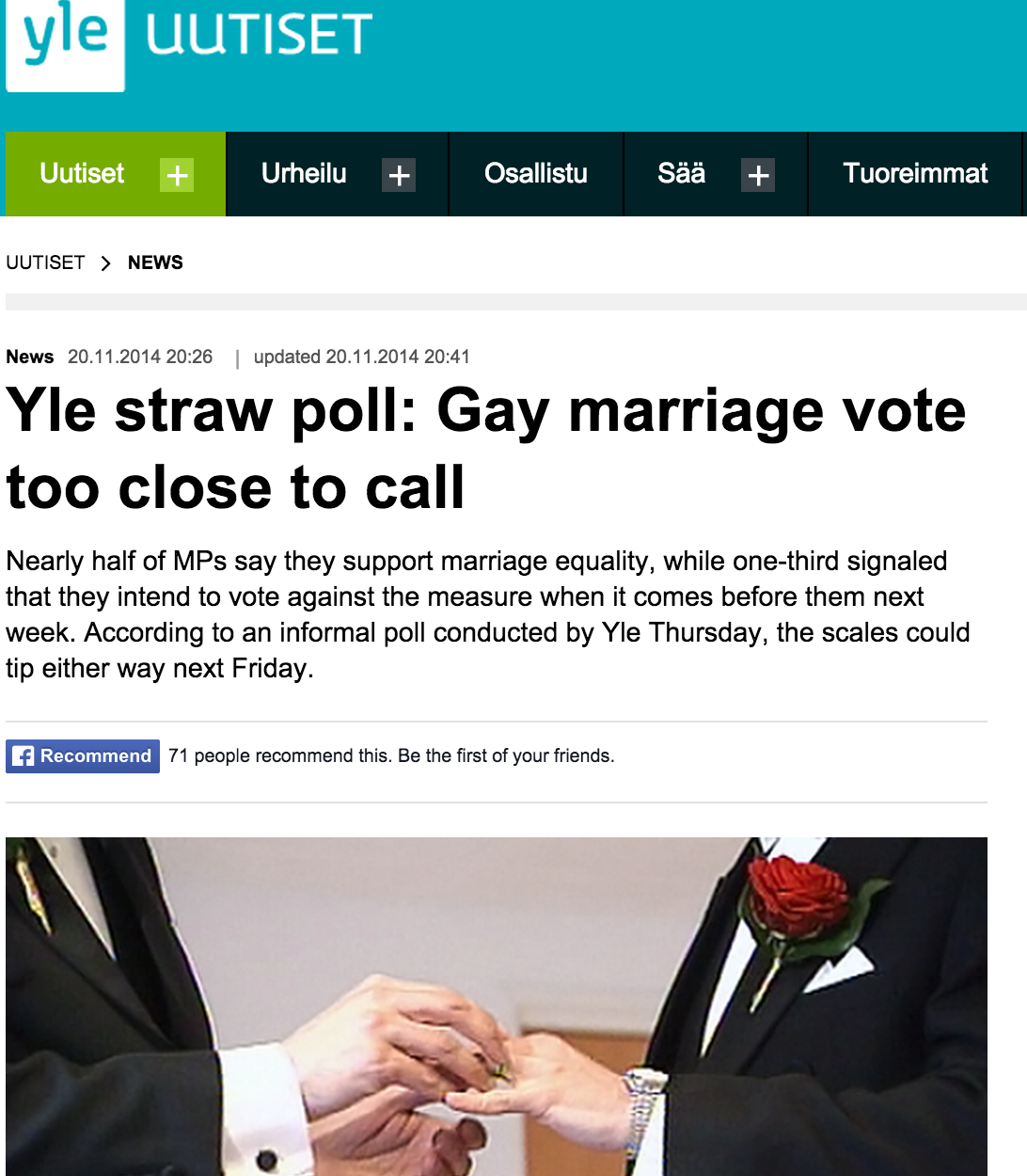
One of the best examples of hardening attitudes in Finland – thanks to the PS – is against gays and the long and winding road of approving same-sex marriage is a good example.

Näyttökuva 2014-11-23 kello 10.07.13

One of the most outspoken voices against same-sex marriage is the Perussuomalaiset party. Read full story here.


It’s clear that if the PS wouldn’t have won in 2011, same-sex marriage would have already been legal in this country.

Taking into account that recent polls show the Center Party to be the clear favorite to win the next parliamentary elections in April and the party’s voting record, Friday’s parliamentary vote for or against same-sex marriage will be the last for a very long time.

The PS has tried to pull many fast ones on the public. One of these was a recent claim that migration costs Finland near-2 billion euros. While such claims were conjured by the PS for obvious reasons, has anyone asked how much the populist party has cost Finland in the way of lost skilled migrants, jobs, opportunities and investment?

Finland has a problem: It’s population is aging and we need skilled migrants to fill the gap as well as new jobs. Why would any person in his right mind move to a country that is suspicious of migrants and foreign investment?

One problem with racism and ethnocentrism is that it distorts reality.

* The Finnish name for the Finns Party is the Perussuomalaiset (PS). The names adopted by the PS, like True Finns or Finns Party, promote in our opinion nativist nationalism and xenophobia. We therefore prefer to use the Finnish name of the party on our postings.

Defining white Finnish privilege #14: Losing sight of the real issue

Posted on November 13, 2014 by Migrant Tales

One of the matters that has always surprised me in Finland is that if you speak out against intolerance and racism, you are sometimes seen as the rude one, not the one making the inappropriate comment. Apart from playing down a social ill like intolerance, we too often lose sight of the real issue: the victim. 

There are many factors that make us play down racism. One could be that we don’t want to rock the boat and get involved because intolerance doesn’t affect us directly. The issue is too complicated and hairy.

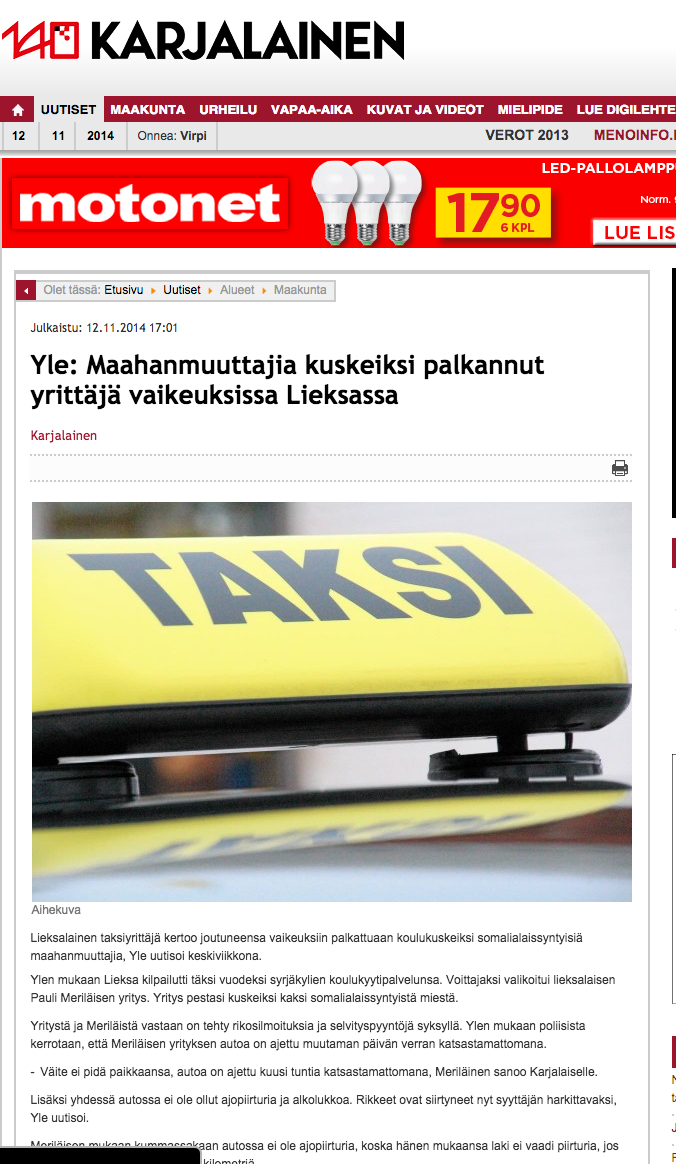
Take for example a recent case in Lieksa where parents don’t want their children to be taken to and from school by Somali drivers because they ‘don’t speak Finnish well enough.’

Näyttökuva 2014-11-12 kello 21.06.30

Read full story here.


The taxi owner, who hired the Somali drivers, claims that the parents’ motives are racist. The parents deny that their actions have anything to do with the drivers’ skin color or nationality.

But what about if both have some complicity in the matter and that we’re losing focus on the real problem?

‘I highly doubt that the man who hired the [Somali] drivers did so because he’s a good Samaritan,’ a Joensuu source told Migrant Tales. ‘Certainly there are racists among the parents but then again has anyone asked if the man who hired the drivers pays them less money [than white Finn driver] in order to maximize profit?’  

Definition #14

While we still don’t know all the facts, white privilege appears to be written all over the most recent case in Lieksa: Parents can demand one thing and the owner of the taxis can say another. Nobody asks the Somali drivers their opinion.

Thus white privilege permits us to miss the real issue at play: suspicion, prejudice and exploitation of migrants.

It’s not always an open-and-shut matter. White privilege permits you to lose sight of the real issue because it is convenient. It allows you to forget the victim, or the taxi drivers, as is the case in Lieksa.

See also:

  • Defining white Finnish privilege #1: I have it and you don’t
  • Defining white Finnish privilege #2: Third culture children versus “pupil with immigrant background” 
  • Defining white Finnish privilege #3 No history, no doctrine, no heroes and no martyrs
  • Defining white Finnish privilege #4 Holding the short end of the stick
  • Defining white Finnish privilege #5 It’s ok to be a racist
  • Defining white Finnish privilege #6 Not having a voice and the media
  • Defining white Finnish privilege #7 A definitive guide
  • Defining white Finnish privilege #8 Underrated and less intelligent
  • Defining white Finnish privilege #9 Mohammad Ali’s insight
  • Defining white Finnish privilege #10 I can victimize and make up any story I like about migrants because I’m white
  • Defining white Finnish privilege #11: Case Teuvo Hakkarainen
  • Defining white Finnish privilege #12: Case Tom Packalén
  • Defining white Finnish privilege #13: Case Matti Putkonen

* The Finnish name for the Finns Party is the Perussuomalaiset (PS). The English names of the party adopted by the PS, like True Finns or Finns Party, promote in our opinion nativist nationalism and xenophobia. We therefore prefer to use the Finnish name of the party on our postings.

Migrant Tales (July 3, 2014): Is ‘Heikki the drunk’ Finnish or Swedish?

Posted on November 11, 2014 by Migrant Tales

Migrants’ Tales insight: This story is interesting when looking at the Fazer gigolo tv commercial in Finland, which reinforces stereotypes about certain migrants and minorities in this country. An all-white board of the Council of Ethics in Advertising, which gets all of its funding from the private sector, will have a difficult time understanding what some minorities may feel about such commercials. 

Check out the story below about ‘Heikki the drunk’ and how it offended some Swedish Finns. 

Are the two related? Certainly they are. 

____________________

Some Swedish Finns are up in arms about a children’s book published in Sweden that pictures a wino called Heikki, according to YLE in English.  The character in the book, who is lying in a bush next to a plastic bag full of beer, was too much for Swedish Finn Sirpa Lamminpää, who filed a complaint to the Discrimination Ombudsman.  

YLE in English reports that the Discrimination Ombudsman will not take the case since “perceived prejudice” in printed books is falls under the jurisdiction of Swedish Chancellor of Justice.

Illustrator Gunna Grähs defends the character by stating that Heikki is a Swede.

“Perhaps she [Lamminpää]  is simply upset about the character being an alcoholic,” Grähs was quoted as saying. “Only one thing links him to Finland, and that is his name. In my opinion Heikki’s is a case of social class, not nationality.”

Grähs has a good point. Sweden is culturally diverse and a person with a name like Heikki can be a Swede.

Even so, the commotion about Heikki shows that Sweden is still a far ways off from being a post-racial society.

Risto Laakkonen, who is outspoken on migrant rights in Finland, said that any type of stereotyping is wrong and shouldn’t be tolerated.


Näyttökuva 2014-7-3 kello 11.42.19


Read full story here.


Laakkonen was active in a campaign in the 1970s to change the way that the Swedish media pictured Finns. Whenever a crime was reported by the media the first national group that came to mind as the culprits were Finns.

“With [then] Ambassador Max Jakobson we got in touch with all the editor-in-chiefs and managing editors of all the newspapers and television channels and told them that this type of stereotyping isn’t good since you’re labeling people who are working in this country,” he said. “The portrayal of Finns as the culprits ended pretty rapidly.”

Laakkonen said that in Finland it was impossible for the media to be racist towards migrants since there were so few back in the 1970s. He said that Finland’s media caught up to the Swedes in the 1990s.

“Things were actually much worse than today before when you had openly [fascist] groups [like the IKL 1932-44] that talked about Finns as a tribe and influenced this type of thinking to be taught at schools,” he said. “The Perussuomalaiset* are small fry when compared to the past.”

Laakkonen said that human rights and tolerance are like a tree that must be watered.

“The tree will die if you don’t water it,” he said. “All you need is 10% of the population to be awake and active [for human rights] for things to change.”


* The Finnish name for the Finns Party is the Perussuomalaiset (PS). The names adopted by the PS, like True Finns or Finns Party, promote in our opinion nativist nationalism and xenophobia. We therefore prefer to use the Finnish name of the party on our postings. 


Response to Fazer’s gigolo says a lot about Finland today

Posted on November 10, 2014 by Migrant Tales

The decision by the Council of Ethics in Advertising of Finland that there was nothing wrong with Fazer’s gigolo television commercial says a lot about why there is so little respect towards minorities in this country. For those who lived in Finland in the 1970s, Fazer’s gigolo was the typical stereotype of the southern European man, who spoke broken Finnish, was useless but was a good lover. 

Irwin Goodman even wrote a racist song about the ‘gigolo’ called Marcello Magaoni, or Marcello Macaroni.  There a similar song in the 1970s by Esa Pakainen, who masqueraded in a 1960 Finnish movie as a blackface with his partner Pätkä.

In a similar story in Sweden in July, some members of the Finnish community in Sweden were outraged about a Heikki the drunk character in a book that they claimed reinforced stereotypes about Finns in Sweden.

Why does a large sweets company like Fazer of Finland think that it’s perfectly acceptable to reinforce stereotypes about minorities in order to boost sales? Are they saying that ‘humorous’ racist stereotypes hit the spot with Finnish consumers?

The response of the Council of Ethic in Advertising is one matter but the comments from readers on different newspapers are just as revealing.

The lion’s share of those responses about the Fazer gigolo didn’t see anything racist or wrong with the commercial and agreed with the Council of Ethics in Advertising that it was humorous.

Writes Pantterit on parhaita: ‘That was a really funny commercial.’

Funny? Certainly if you are white.

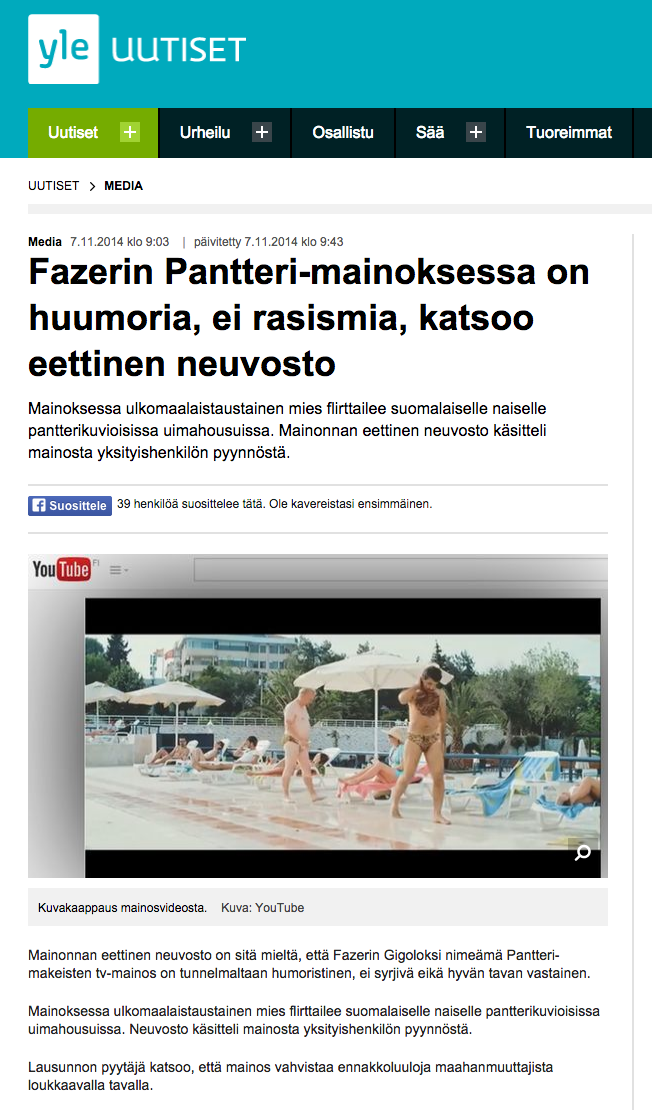
Read more comments (in Finnish) on Lappeenranta-based daily Etelä-Saimaa.Näyttökuva 2014-11-10 kello 12.38.31

Why does Fazer think that the way to Finnish consumers’ heart is with the help of ethnicity and race? In 2007, after mounting pressure from the EU, it stopped using its infamous golliwog on its licorice brand and in it stopped using a Chinese man or women in one of its products in 2011.

Migrant Tales filed a complaint to the Council of Ethic in Advertising because the commercial promoted stereotypes of southern European men. Stereotypes are the breeding ground from with the fruits of intolerance feed off.

The decision by the Council and the reaction of many readers clearly shows how little weight migrants and minorities continue to have in Finland.

I for one will be one person who will boycott Fazer products and I hope that many more will do the same.


The Council of Ethics in Advertising of Finland finds nothing wrong with Fazer’s ‘gigolo’

Posted on November 7, 2014 by Migrant Tales

The Council of Ethics in Advertising has found nothing wrong with a Fazer advertisement, which depicting a stereotypical Southern European gigolo in a salt licorice television commercial. The seven-member board of the council, which are all white Finns, considered the commercial to be done in good taste and with humor.

Migrant Tales filed a complaint to the Council of Ethics in Advertising citing that the Fazer television commercial reinforced racist stereotypes about men from Southern Europe. Aren’t stereotypes the breeding ground of racism and discrimination?

The council receives all of its financing from the private sector.

For those of us who have lived in Finland in the 1980s, the “mud-faced gigolo speaking broken Finnish” was a common racist stereotype of some foreign men that still exists.

An important question we should ask Fazer is why it persists in using such marketing strategies after racist mascots like its infamous Golliwog on its licorice brand, which was banned in 2007 thanks to EU pressure, and the racist image  of a Chinese man or woman in one of its products in 2011? Why does the company think that race and ethnicity are the way to the Finnish consumer’s heart?

Adding salt to injury, tabloid Ilta-Sanomat headlines that the commercial doesn’t insult migrants.

Right on, Ilta-Sanomat. Here’s a white tabloid giving its “expert view” on what is and isn’t offensive to migrants.

Tabloids like Ilta-Sanomat played an important role in reinforcing intolerance and hostility towards migrants from the 1990s.

Näyttökuva 2014-11-7 kello 10.28.54


Read full story here.


Even if The Council of Ethics in Advertising sees nothing wrong with the television commercial, many minorities in Finland consider it offensive.

 What is your opinion of this tv commercial?

See also:

  • Time warp Fazer of Finland: Stereotyping Mediterranean “gigolos” to sell salt licorice

Lieksa, Finland: Migrant taxi driver assaulted by client

Posted on November 6, 2014 by Migrant Tales

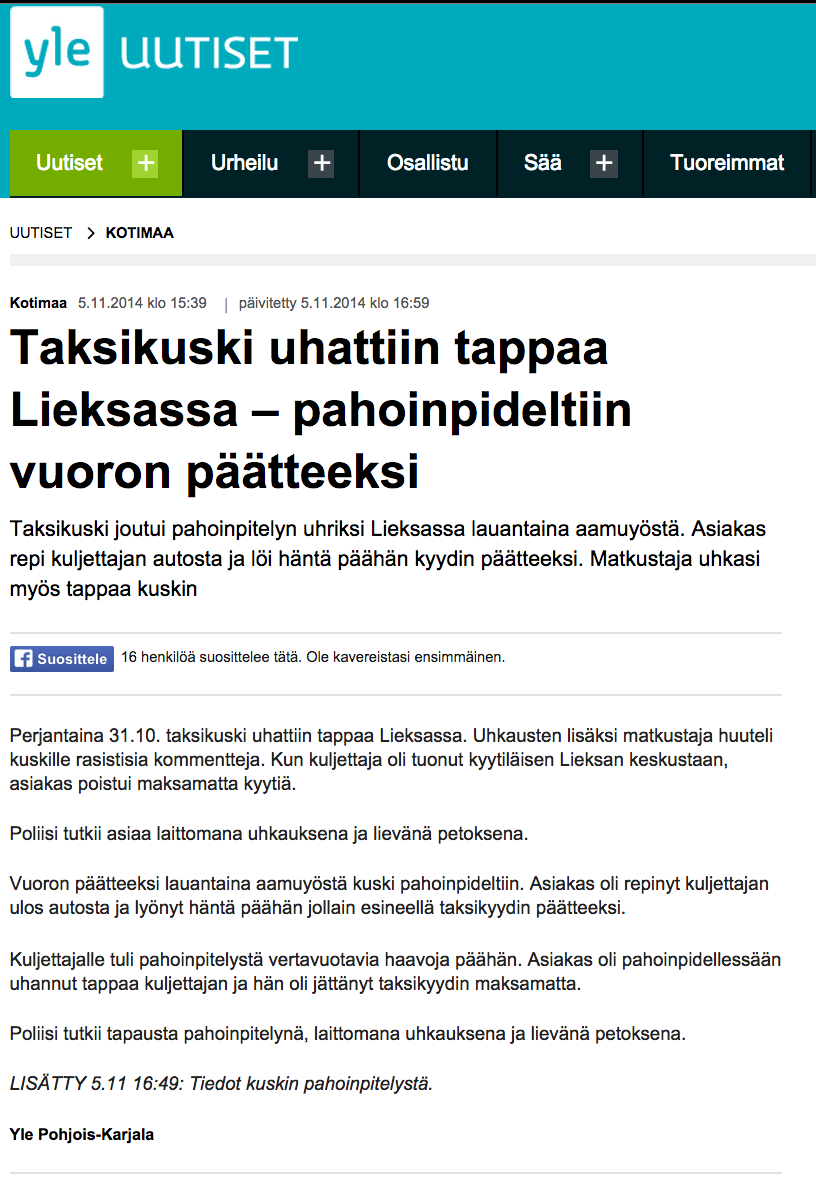
The North Karelian town of Lieksa is once again in the media after a migrant taxi driver was assaulted physically Friday by a client who also threatened to kill him, according to YLE Pohjois-Karjala. The suspect left the scene without paying the fare. 

The police are investigating the case as an assault case and for leaving the scene without paying the fare. There is no mention that racism may have had anything to do with the suspect’s hostile behavior.

Näyttökuva 2014-11-6 kello 0.01.19

Read full story here.

Leiska has been in the news a number of years for problems with its migrant community.

Defining white Finnish privilege #13: Case Matti Putkonen

Posted on October 31, 2014 by Migrant Tales

One of the exclusive privileges white Finns who belong to anti-immigration parties like the Perussuomalaiset (PS)* have is making ludicrous claims about migrants and minorities. Matti Putkonen of the PS is the latest case of white Finnish privilege. He is claiming – without proof – that “the cost of migration” to Finland may be now as high as 2 billion euros, according to tabloid Ilta-Sanomat. 

On top of such an unsubstantiated claim, Putkonen can even accuses The Finnish Immigration Service of fostering racism because it plays down “the cost of migration.”

According to the FIS, “the cost of migration” is 203 million euros.

Näyttökuva 2014-10-31 kello 10.14.06

White Finnish privilege gives Putkonen the right to make outrageous claims about migration. Read full story here.


What do Putkonen and the PS mean by “the cost of migration” anyway? If the majority of migrants living in this country work, pay taxes and consume, how can they be only a cost to society?

In the world of white Finnish privilege and anti-immigration sound bites this is plausible. As PS MP Tom Packalén and National Coalition Party MP Pia Kauma recently showed, it doesn’t matter if what you say is an outright fabrication since your aim is media attention at all costs. It doesn’t even matter it your unsubstantiated claims are proven wrong. Your claim has spread with the help of the media to the public. Mission accomplished.

What Putkonen’s figures and claims about migration reveal a systemic campaign against migrants and minorities for shameless political profit.

As Migrant Tales wrote recently, the figures presented by Putkonen are the PS and grossly exaggerated and one-sided. There is nothing in the PS claim how much growth migration brings to Finland.

A recent OECD report revealed that in Finland migration had boosted growth in 2011 by 0.16%, including pensions.

So what Putkonen and the PS are claiming is what they’ve been lobbying all along: migrants shouldn’t have any rights to collect social assistance like native Finns.

The social aid that most migrants enjoy in this country is the same that native Finns have.

Definition #13

To understanding the ludicrous claims of Putkonen and the PS  concerning “the cost of migration,” we can play fill-in-the blanks to grasp their absurd claim. All you need to do is replace the word ‘migrant’ with ‘woman.’ Certainly we could be even bolder: replace ‘migrant’ and ‘woman’ with all Finns who get social assistance.

Here’s an example from a quote on Ilta-Sanomat:

Putkonen now claims that the cost of migration is greater, about two billion euros.

Putkonen now claims that the cost of women is greater, about two billion euros.

Or: Putkonen now claims that the cost of our welfare state is greater, costing hundreds of billions of euros.

Attacking migrants is a cowardice act like sexism. In the same way that Putkonen makes his nonsensical claims, how would it sound if he said that since women have babies that costs Finland an arm and a leg?

He would never do that because women have won important rights in this country even if they still make about 20% less than men.

Migrants continue to be disenfranchised in Finland and they are being kept on short leashes with the help of  white Finnish privilege as Putkonen and the PS too commonly show.

See also:

  • Defining white Finnish privilege #1: I have it and you don’t
  • Defining white Finnish privilege #2: Third culture children versus “pupil with immigrant background” 
  • Defining white Finnish privilege #3 No history, no doctrine, no heroes and no martyrs
  • Defining white Finnish privilege #4 Holding the short end of the stick
  • Defining white Finnish privilege #5 It’s ok to be a racist
  • Defining white Finnish privilege #6 Not having a voice and the media
  • Defining white Finnish privilege #7 A definitive guide
  • Defining white Finnish privilege #8 Underrated and less intelligent
  • Defining white Finnish privilege #9 Mohammad Ali’s insight
  • Defining white Finnish privilege #10 I can victimize and make up any story I like about migrants because I’m white
  • Defining white Finnish privilege #11: Case Teuvo Hakkarainen
  • Defining white Finnish privilege #12: Case Tom Packalén

* The Finnish name for the Finns Party is the Perussuomalaiset (PS). The English names of the party adopted by the PS, like True Finns or Finns Party, promote in our opinion nativist nationalism and xenophobia. We therefore prefer to use the Finnish name of the party on our postings.

PS’ Timo Soini of Finland looks more like a wolf and less like a sheep as April elections near

Posted on October 30, 2014 by Migrant Tales

With the help of one term, “cultural marxist,” Perussuomalaiset (PS)* chairman Timo Soini gave us the clearest-yet image of the wolf in sheep’s clothing. Soini lashed out on his blog at the same-sex marriage lobby and particularly at Nasima Razmyar as “cultural marxists” after she compared the PS leader and Christian Democrat Päivi Räsänen as “conservative Islamists” for opposing same-sex marriage.

Parliament is expected to vote in November on a same-sex marriage bill in Finland. The PS and Christian Democrats have opposed such a bill.

The use of an antijihadist term like “cultural marxist” shows once again the ever-louder anti-immigration shift and hostility of the PS towards migrants as the April elections near.

According to Urban Dictionary, “culture marxist” implies the gradual destruction of our traditions in order to build a failed communist-like paradise as we saw in the Soviet Union. The term is used by far-right counterjihadists to alarm Europe of a takeover of the region by Islam.

The term was used countless of times in Anders Breivik’s manifesto on the day he killed in cold blood 77 people to save the West from Islam.

Näyttökuva 2014-10-27 kello 10.05.42


Consensus has opened the door to the PS, a party with far right, anti-immigration, homophobic and nativist nationalistic roots.


Using a term like “cultural marxist” by Soini is further proof that the PS will continue to step up its attack on migrants and minorities in Finland as the April 19 elections near.

Contrary to the 2011 elections, which saw the PS become the country’s third-largest bloc in parliament, Soini is clearly worried about how to lure voters in 2015. In 2011 that was easy because of the bailouts of Greece, Ireland and Portugal, a week before parliamentary elections.

If the EU and the euro zone are no longer issues as in 2011 that leaves only one that the PS  is shamelessly exploiting: immigration and Islam.


* The Finnish name for the Finns Party is the Perussuomalaiset (PS). The English names of the party adopted by the PS, like True Finns or Finns Party, promote in our opinion nativist nationalism and xenophobia. We therefore prefer to use the Finnish name of the party on our postings.


When youth leaders of parties like the NCP of Finland are in the dark about cultural diversity

Posted on October 28, 2014 by Migrant Tales

It is sad, even unfortunate, that some of our future political leaders of the National Coalition Party (NCP) see Finland’s ever-growing cultural diversity as a threat and the adaption of these newcomers and their children as an ethnocentric one-way affair. 

One of the first matters that these youth leaders would learn about the over 1.2 million Finns that emigrated from this country between 1860 and 1999 is that they were keen on maintaining in faraway lands their roots and ties with this country. They did this by establishing newspapers, printing presses, associations and even getting involved in labor movements in countries such as the United States.

Näyttökuva 2014-10-28 kello 16.07.54

Migrant Tales has written a lot about the Susanna Koski and the Youth League of the NCP. Read full story here.

If we look up to those Finnish immigrants for not forgetting their cultural and linguistic roots, why are NCP and Perussuomalaiset (PS)* youth leaders hostile to migrants in this country who want to do the same?

Migrant Tales spoke briefly on the phone with Susanna Koski, the head of the Youth League of the NCP, which listed as two of its political aims in 2014 to do away with ethnic agitation laws and the ombudsman for minorities office. The Youth League of the NCP will meet on November 7-9 to draft a new set of goals for 2015, according to Koski.

“No comment,” she said concerning her stand on the ethnic agitation law and whether it should be included in the 2015 program.

It is surprising that youth leaders of Finland’s largest and third-largest political bloc in parliament, the NCP and PS, respectively, see cultural diversity as a threat.

Both the youth leagues of the NCP and PS lobbied to demote Finland’s second-official language, Swedish, to elective status at schools.

Meanwhile, the ministry of education and culture announced that it will grant the youth leagues of the NCP and PS 650,000 and under 30,000 euros, respectively, in aid, according to YLE.

One of the reasons why the Youth League of the PS was granted such a small sum of money was because their values concerning multiculturalism, or cultural diversity, wasn’t in line with state policy. The same question could be asked of the Youth League of the NCP and if its position on multiculturalism are in conflict with our official values.

The Youth League of the PS will appeal the matter.

If there is a factor that threatens to retard Finland’s progress as a modern Nordic welfare state in this century, it’s the provincial and intolerant world view of youth leagues of the NCP and PS.

Not understanding the role of immigration, integration and the need to integrate and make our society more inclusive to newcomers is like shooting oneself in the leg big time.

* The Finnish name for the Finns Party is the Perussuomalaiset (PS). The English names of the party adopted by the PS, like True Finns or Finns Party, promote in our opinion nativist nationalism and xenophobia. We therefore prefer to use the Finnish name of the party on our postings.

  • Previous
  • 1
  • …
  • 107
  • 108
  • 109
  • 110
  • 111
  • 112
  • 113
  • …
  • 208
  • Next
Read more about documentary film
Read more

Recent Posts

  • Lahti is the latest city to prohibit the niqab and burka
  • Finland’s tabloids Iltalehti and Ilta-Sanomat are the pits
  • Riikka Purra’s Dr Jekyll and Mr Hyde mask
  • Double standards
  • Perussuomalaiset: Uusi logo, sama vanha juttu

Recent Comments

  1. Absolutely Socking: Racist Finnish Facebook group against human rights gets flooded with socks on Musta Barbaari’s mother and sister charged by the police in “ethnic profiling” case
  2. Ilkka Nuotio on Pekka Myrskylä: “Tilastot kertovat toista kuin poliittinen keskustelu”
  3. Genrih Soinkara on The war in Ukraine and the Russian-Finnish border crisis are showing Finland’s ugly side
  4. Ahti Tolvanen on Comment by Ahti Tolvanen on the Helsinki +50 conference
  5. Angel Barrientos on Angel Barrientos is one of the kind beacons of Finland’s Chilean community

Archives

  • June 2026
  • May 2026
  • April 2026
  • March 2026
  • February 2026
  • January 2026
  • December 2025
  • November 2025
  • October 2025
  • September 2025
  • August 2025
  • July 2025
  • June 2025
  • May 2025
  • April 2025
  • March 2025
  • February 2025
  • January 2025
  • December 2024
  • November 2024
  • October 2024
  • September 2024
  • August 2024
  • July 2024
  • June 2024
  • May 2024
  • April 2024
  • March 2024
  • February 2024
  • January 2024
  • December 2023
  • November 2023
  • October 2023
  • September 2023
  • August 2023
  • July 2023
  • June 2023
  • May 2023
  • April 2023
  • March 2023
  • February 2023
  • January 2023
  • December 2022
  • November 2022
  • October 2022
  • September 2022
  • August 2022
  • July 2022
  • June 2022
  • May 2022
  • April 2022
  • March 2022
  • February 2022
  • January 2022
  • December 2021
  • November 2021
  • October 2021
  • September 2021
  • August 2021
  • July 2021
  • June 2021
  • May 2021
  • April 2021
  • March 2021
  • February 2021
  • January 2021
  • December 2020
  • November 2020
  • October 2020
  • September 2020
  • August 2020
  • July 2020
  • June 2020
  • May 2020
  • April 2020
  • March 2020
  • February 2020
  • January 2020
  • December 2019
  • November 2019
  • October 2019
  • September 2019
  • August 2019
  • July 2019
  • June 2019
  • May 2019
  • April 2019
  • March 2019
  • February 2019
  • January 2019
  • December 2018
  • November 2018
  • October 2018
  • September 2018
  • August 2018
  • July 2018
  • June 2018
  • May 2018
  • April 2018
  • March 2018
  • February 2018
  • January 2018
  • December 2017
  • November 2017
  • October 2017
  • September 2017
  • August 2017
  • July 2017
  • June 2017
  • May 2017
  • April 2017
  • March 2017
  • February 2017
  • January 2017
  • December 2016
  • November 2016
  • October 2016
  • September 2016
  • August 2016
  • July 2016
  • June 2016
  • May 2016
  • April 2016
  • March 2016
  • February 2016
  • January 2016
  • December 2015
  • November 2015
  • October 2015
  • September 2015
  • August 2015
  • July 2015
  • June 2015
  • May 2015
  • April 2015
  • March 2015
  • February 2015
  • January 2015
  • December 2014
  • November 2014
  • October 2014
  • September 2014
  • August 2014
  • July 2014
  • June 2014
  • May 2014
  • April 2014
  • March 2014
  • February 2014
  • January 2014
  • December 2013
  • November 2013
  • October 2013
  • September 2013
  • August 2013
  • July 2013
  • June 2013
  • May 2013
  • April 2013
  • March 2013
  • February 2013
  • January 2013
  • December 2012
  • November 2012
  • October 2012
  • September 2012
  • August 2012
  • July 2012
  • June 2012
  • May 2012
  • April 2012
  • March 2012
  • February 2012
  • January 2012
  • December 2011
  • November 2011
  • October 2011
  • September 2011
  • August 2011
  • July 2011
  • June 2011
  • May 2011
  • April 2011
  • March 2011
  • February 2011
  • January 2011
  • December 2010
  • November 2010
  • October 2010
  • September 2010
  • August 2010
  • July 2010
  • June 2010
  • May 2010
  • April 2010
  • March 2010
  • February 2010
  • January 2010
  • December 2009
  • November 2009
  • October 2009
  • September 2009
  • August 2009
  • July 2009
  • December 2008
  • November 2008
  • October 2008
  • September 2008
  • August 2008
  • July 2008
  • June 2008
  • May 2008
  • April 2008
  • March 2008
  • February 2008
  • January 2008
  • November 2007
  • October 2007
  • September 2007
  • August 2007
  • July 2007
  • June 2007
  • May 2007

Categories

  • ?? Gia L?c
  • ????? ?????? ????? ???????? ?? ??????
  • ???????
  • @HerraAhmed
  • @mondepasrond
  • @nohatefinland
  • @oula_silver
  • @Varathas
  • A Pakistani family
  • äärioikeisto
  • Abbas Bahmanpour
  • Abdi Muhis
  • Abdirahim Hussein Mohamed
  • Abdirahim Husu Hussein
  • Abdirisak Mahamed
  • About Migrant Tales
  • activism
  • Adam Al-Sawad
  • Adel Abidin
  • Afrofinland
  • Ahmed IJ
  • Ahti Tolvanen
  • Aino Pennanen
  • Aisha Maniar
  • Alan Ali
  • Alan Anstead
  • Alejandro Díaz Ortiz
  • Alekey Bulavsev
  • Aleksander Hemon
  • Aleksanterinliitto
  • Aleksanterinliitto ry
  • Aleksanterinliitto ry:n hallitus
  • Alex Alex
  • Alex Mckie
  • Alexander Nix
  • Alexandra Ayse Albayrak
  • Alexis Neuberg
  • Ali Asaad Hasan Alzuhairi
  • Ali Hossein Mir Ali
  • Ali Rashid
  • Ali Sagal Abdikarim
  • Alina Tsui
  • Aline Müller
  • All categories
  • Aman Heidari
  • Amiirah Salleh-Hoddin & Jana Turk
  • Amin A. Alem
  • Amir Zuhairi
  • Amkelwa Mbekeni
  • Ana María Gutiérrez Sorainen
  • Anachoma
  • Anders Adlecreutz
  • Angeliina Koskinen
  • Anna De Mutiis
  • Anna María Gutiérrez Sorainen
  • Anna-Kaisa Kuusisto ja Jaakko Tuominen
  • Annastiina Kallius
  • Anneli Juise Friman Lindeman
  • Announcement
  • Anonymous
  • Antero Leitzinger
  • anti-black racism
  • Anti-Hate Crime Organisation Finland
  • Anudari Boldbaatar
  • Arshiya Nasser
  • Aspergers Syndrome
  • Asylum Corner
  • Asylum seeker 406
  • Athena Griffin and Joe Feagin
  • Autism
  • Avaaz.org
  • Awale Olad
  • Ayan Said Mohamed
  • AYY
  • Barachiel
  • Bashy Quraishy
  • Beatrice Kabutakapua
  • Beri Jamal
  • Beri Jamal and Enrique Tessieri
  • Bertolt Brecht
  • Boiata
  • Boodi Kabbani
  • Bruno Gronow
  • Carmen Pekkarinen
  • Çelen Oben and Sheila Riikonen
  • Chiara Costa-Virtanen
  • Chiara Costa-Virtanen
  • Chiara Sorbello
  • Christian Thibault
  • Christopher Wylie
  • Clara Dublanc
  • Dana
  • Daniel Malpica
  • Danilo Canguçu
  • David Papineau
  • David Schneider
  • Dexter He
  • Don Flynn
  • Dr Masoud Kamali
  • Dr. Faith Mkwesha
  • Dr. Theodoros Fouskas
  • Edna Chun
  • Eeva Kilpi
  • Emanuela Susheela
  • En castellano
  • ENAR
  • Enrique
  • Enrique Tessieri
  • Enrique Tessieri & Raghad Mchawh
  • Enrique Tessieri & Yahya Rouissi
  • Enrique Tessieri and Muhammed Shire
  • Enrique Tessieri and Sira Moksi
  • Enrique Tessieri and Tom Vandenbosch
  • Enrique Tessieri and Wael Che
  • Enrique Tessieri and Yahya Rouissi
  • Enrique Tessieri and Zimema Mhone
  • Epäluottamusmies
  • EU
  • Europe
  • European Islamophobia Report
  • European Islamophobia Report 2019,
  • European Union
  • Eve Kyntäjä
  • Ezequiel Caldeiro
  • Facebook
  • Fadumo Dayib
  • Faisa Kahiye
  • Farhad Manjoo
  • Fasismi
  • Finland
  • Fizza Qureshi
  • Flyktingar och asyl
  • Foreign Student
  • Fozia Mir-Ali
  • Frances Webber
  • Frida Selim
  • Gareth Rice
  • Ghyslain Vedeaux
  • Global Art Point
  • Great Replacement
  • Habiba Ali
  • Hami Bahadori
  • Hami Bahdori
  • Hamid
  • Hamid Alsaameere
  • Hamid Bahdori
  • Handshake
  • Harmit Athwal
  • Hassan Abdi Ali
  • Hassan Muhumud
  • Heikki Huttunen
  • Heikki Wilenius
  • Helsingin Sanomat
  • Henning van der Hoeven
  • Henrika Mälmsröm
  • Hser Hser
  • Hser Hser ja Mustafa Isman
  • Husein Muhammed
  • Hussain Kazemian
  • Hussain Kazmenian
  • Ibrahim Khan
  • Ida
  • Ignacio Pérez Pérez
  • Iise Ali Hassan
  • Ilari Kaila & Tuomas Kaila
  • Imam Ka
  • inside-an-airport
  • Institute of Race Relations
  • Iraqi asylum seeker
  • IRR European News Team
  • IRR News Team
  • Islamic Society of Norhern FInland
  • Islamic Society of Northern Finland
  • Islamophobia
  • Jacobinmag.com
  • Jallow Momodou
  • Jan Holmberg
  • Jane Elliott
  • Jani Mäkelä
  • Jari Luoto
  • Jari Taponen
  • Jegor Nazarov
  • Jenni Stammeier
  • Jenny Bourne
  • Jessie Daniels
  • Joe Davidow
  • Johannes Koski
  • John D. Foster
  • John Grayson
  • John Marriott
  • Jon Burnett
  • Jorma Härkönen
  • Jos Schuurmans
  • José León Toro Mejías
  • Josue Tumayine
  • Jouni Karnasaari
  • Juan Camilo
  • Jukka Eräkare
  • Julian Abagond
  • Julie Pascoet
  • Jussi Halla-aho
  • Jussi Hallla-aho
  • Jussi Jalonen
  • JusticeDemon
  • Kadar Gelle
  • Kaksoiskansalaisuus
  • Kansainvälinen Mikkeli
  • Kansainvälinen Mikkeli ry
  • Katherine Tonkiss
  • Kati Lepistö
  • Kati van der Hoeven-Lepistö
  • Katie Bell
  • Kättely
  • Kerstin Ögård
  • Keshia Fredua-Mensah & Jamie Schearer
  • Khadidiatou Sylla
  • Khadra Abdirazak Sugulle
  • Kiihotus kansanryhmää vastaan
  • Kirsi Crowley
  • Koko Hubara
  • Kristiina Toivikko
  • Kubra Amini
  • KuRI
  • La Colectiva
  • La incitación al odio
  • Laura Huhtasaari
  • Lauri Finér
  • Leif Hagert
  • Léo Custódio
  • Leo Honka
  • Leontios Christodoulou
  • Lessie Branch
  • Lex Gaudius
  • Leyes de Finlandia
  • Liikkukaa!
  • Linda Hyökki
  • Liz Fekete
  • M. Blanc
  • Maarit Snellman
  • Mahad Sheikh Musse
  • Maija Vilkkumaa
  • Malmin Kebab Pizzeria Port Arthur
  • Marcell Lorincz
  • Mari Aaltola
  • María Paz López
  • Maria Rittis Ikola
  • Maria Tjader
  • Marja-Liisa Tolvanen
  • Mark
  • Markku Heikkinen
  • Marshall Niles
  • Martin Al-Laji
  • Maryan Siyad
  • Matt Carr
  • Mauricio Farah Gebara
  • Media Monitoring Group of Finland
  • Micah J. Christian
  • Michael McEachrane
  • Michele Levoy
  • Michelle Kaila
  • Migrant Tales
  • Migrant Tales Literary
  • Migrantes News
  • Migrants' Rights Network
  • MigriLeaks
  • Mikko Kapanen
  • Miriam Attias and Camila Haavisto
  • Mohamed Adan
  • Mohammad Javid
  • Mohammad M.
  • Monikulttuurisuus
  • Monisha Bhatia and Victoria Canning
  • Mor Ndiaye
  • Muh'ed
  • Muhamed Abdimajed Murshid
  • Muhammed Shire
  • Muhammed Shire and Enrique Tessieri
  • Muhis Azizi
  • Musimenta Dansila
  • Muslimiviha
  • Musulmanes
  • Namir al-Azzawi
  • Natsismi
  • Neurodiversity
  • New Women Connectors
  • Nils Muižnieks
  • No Labels No Walls
  • Noel Dandes
  • Nuor Dawood
  • Omar Khan
  • Otavanmedia
  • Oula Silvennoinen
  • Paco Diop
  • Pakistani family
  • Pentti Stranius
  • Perussuomalaiset
  • perustuslaki
  • Petra Laiti
  • Petri Cederlöf
  • Pia Grochowski
  • Podcast-lukija Bea Bergholm
  • Pohjois – Suomen Islamilainen Yhdyskunta
  • Pohjois Suomen Islamilainen Yhyskunta
  • Polina Kopylova
  • Race Files
  • racism
  • Racism Review
  • Raghad Mchawh
  • Ranska
  • Rashid H. and Migrant Tales
  • Rasismi
  • Raul Perez
  • Rebecka Holm
  • Reem Abu-Hayyeh
  • Refugees
  • Reija Härkönen
  • Remiel
  • Reza Nasri
  • Richard Gresswell
  • Riikka Purra
  • Risto Laakkonen
  • Rita Chahda
  • Ritva Kondi
  • Robito Ibrahim
  • Roble Bashir
  • Rockhaya Sylla
  • Rodolfo Walsh
  • Roger Casale
  • Rostam Atai
  • Roxana Crisólogo Correa
  • Ruth Grove-White
  • Ruth Waweru-Folabit
  • S-worldview
  • Sadio Ali Nuur
  • Sami Rusanen
  • Sandhu Bhamra
  • Sara de Jong
  • Sarah Crowther
  • Sari Alhariri
  • Sarkawt Khalil
  • Sasu
  • Scot Nakagawa
  • Shabana Ahmadzai
  • Shada Islam
  • Sharon Chang blogs
  • Shenita Ann McLean
  • Shirlene Green Newball
  • Sini Savolainen
  • Sira Moksi
  • Sonia K.
  • Sonia Maria Koo
  • Steverp
  • Stop Deportations
  • Suldaan Said Ahmed
  • Suomen mediaseurantakollektiivi
  • Suomen Muslimifoorumi ry
  • Suomen viharikosvastainen yhdistys
  • Suomen viharikosvastainen yhdistys ry
  • Suomi
  • Supermen
  • Susannah
  • Suva
  • Syrjintä
  • Talous
  • Tapio Tuomala
  • Taw Reh
  • Teivo Teivainen
  • The Daily Show
  • The Heino
  • The Supermen
  • Thomas Elfgren
  • Thulfiqar Abdulkarim
  • Tim McGettigan
  • Tino Singh
  • Tito Moustafa Sliem
  • Tobias Hübinette and L. Janelle Dance
  • Transport
  • Trica Danielle Keaton
  • Trilce Garcia
  • Trish Pääkkönen
  • Trish Pääkkönen and Enrique Tessieri
  • Tuulia Reponen
  • Uncategorized
  • UNITED
  • University of Eastern Finland
  • Uyi Osazee
  • Väkivalta
  • Vapaa Liikkuvuus
  • Venla-Sofia Saariaho
  • Vieraskynä
  • W. Che
  • W. Che an Enrique Tessieri
  • Wael Ch.
  • Wan Wei
  • Women for Refugee Women
  • Xaan Kaafi Maxamed Xalane
  • Xassan Kaafi Maxamed Xalane
  • Xassan-Kaafi Mohamed Halane & Enrique Tessieri
  • Yahya Rouissi
  • Yasmin Yusuf
  • Yassen Ghaleb
  • Yle Puhe
  • Yuliet Tresa
  • Yve Shepherd
  • Zahra Khavari
  • Zaker
  • Zalina Ametova
  • Zamzam Ahmed Ali
  • Zeinab Amini ja Soheila Khavari
  • Zimema Mahone and Enrique Tessieri
  • Zimema Mhone
  • Zoila Forss Crespo Moreyra
  • ZT
  • Zulma Sierra
  • Zuzeeko Tegha Abeng
© 2026 Migrant tales | Powered by Minimalist Blog WordPress Theme