
Migrant tales
Menu
  • #MakeRacismHistory “In Your Eyes”
  • About Migrant Tales
  • It’s all about Human Rights
  • Literary
  • Migrant Tales Media Monitoring
  • NoHateFinland.org
  • Tales from Europe
Menu

Tag: finnish police

Miksi Helsingin apulaispoliisijohtaja syyllistää seksuaalirikoksista pelkästään turvapaikanhakijat?

Posted on January 10, 2016 by Reija Härkönen

Suomalainen nainen, lähes jokainen ihan tavallinen nainen, joutuu joskus elämässään seksuaalisen häirinnän tai ahdistelun kohteeksi. Näin voinen päätellä siksikin, että minunkin kohdalleni ahdistelua on sattunut jo useamman kerran 57-vuotisen elämäni aikana, vaikka en ole koskaan ollut erityisen hyvännäköinen, seksikäs tai pyrkinyt tekemään lähempää tuttavuutta vieraiden miesten kanssa. Työpaikan juhlissa työkaverit ja jopa esimiehet ovat käyneet kiinni pakaroihin, tanssilattialla suudelleet vastaanpyristelystä ja selkeästä kiellosta huolimatta kiihkeästi kaulalle, tuntematon vastaantulija on työntänyt kadulla käden jalkoväliin.

Kaikille on tuttu asia myös se, että kaduilla ja metsässä on kautta aikojen tapahtunut raiskauksia tai raiskauksen yrityksiä. Lähes jokaisessa kaupungissa on joku kolkka, puistonsyrjä, pururata tai metsäpolku, jota kehotetaan tästä syystä välttämään. Ulkona tapahtuneet raiskaukset saavat aina suurta huomiota, niistä puhutaan pitkään ja ne muistetaan sukupolvesta toiseen.

Suurin osa raiskauksistakin jää kuitenkin ilmoittamatta poliisille, seksuaalisesta ahdistelusta puhumattakaan. Alkaisi varmaankin olla aika ilmoittaa, kun Helsingin poliisin apulaispäällikön tietämys asiasta on sillä tasolla, että naisten häirintä on Suomessa uusi ilmiö, joka liittyy pelkästään maahan viime vuonna tulleisiin turvapaikanhakijoihin. Ja hivenen näyttäisi siltä, että ihmiset on turvapaikanhakijoihin liittyen peloteltu niin syvästi, että vierasmaalaisten miesten toimista tehdään ilmoituksia jopa silloin, kun turvapaikanhakija kaupan hyllyjen välissä etenee kahden metrin etäisyydelle suomalaisesta naisesta.

Tehkäämme siis me naiset selväksi se, että meitä eivät saa seksuaalisesti ahdistella minkään maalaiset miehet, eivät omat eivätkä vieraat. Puhun nyt etenkin sellaisesta ahdistelusta, joka uuden, 1.9.2014 voimaan tulleen lain mukaan on rikos. Laki on niin uusi, että rohkenen epäillä, että vain harvat naiset tietävät, että seksuaalisesta ahdistelusta voi nyt tehdä rikosilmoituksen.

Suomen laki määrittelee seksuaalisen ahdistelun näin:

”Joka koskettelemalla tekee toiselle seksuaalisen teon, joka on omiaan loukkaamaan tämän seksuaalista itsemääräämisoikeutta, on tuomittava, jollei teosta muualla tässä luvussa säädetä rangaistusta, seksuaalisesta ahdistelusta sakkoon tai vankeuteen enintään kuudeksi kuukaudeksi”.

Seksuaalisesta ahdistelusta voidaan tuomita sakkoja tai enintään puoli vuotta vankeutta.

Sanallinen seksuaalinen häirintä ei edelleenkään ole rikoslaissa määritelty seksuaalirikos. Tasa-arvolaissa seksuaalinen häirintä työpaikoilla on kielletty ja vaatii (vaatisi) aina esimiehen puuttumisen asiaan. Siitä voidaan myös tuomita jollain muulla rikosnimikkeellä, esimerkiksi kunnianloukkauksena.

Lokakuun loppuun mennessä v. 2015, siis runsaan vuoden aikana, uuden lain perusteella tehtyjä ilmoituksia seksuaalisesta ahdistelusta oli kirjattu 450, niistä n. 200 kohdistui samaan epäiltyyn. Rikoskomisario Teija Koskenmäki on Helsingin Sanomissa kertonut lain soveltamisesta näin: ”Se tarkoittaa tyypillisesti tapauksia, joissa joku koskettaa toista henkilöä luvatta genitaalialueelle, pakaroihin tai rintoihin niin, että kohdehenkilö kokee teon seksuaalisena”.

Raiskauksista ilmoittaminen on viime vuosina vähän lisääntynyt, mutta aivan liian usein tuttavien tai omien miesten kotona tai kavereiden teinijuhlissa tekemät raiskaukset jätetään ilmoittamatta. Tämä, paitsi että se jättää rikolliset vaille rangaistusta, vääristää tilastoja ja ihmisten tietoisuutta siitä, että raiskauksista Suomessa ovat edelleen suurimmaksi osaksi vastuussa syntyperäiset suomalaiset miehet.

Perussuomalaisen puolueen rasistijoukkion agendalla ovat ulkosalla tapahtuneet raiskaukset olleet vuosikaudet yksi kansanryhmää vastaan kiihottamisen tärkeimmistä osasista. On esimerkiksi yhä uudelleen vedottu Norjan poliisin v. 2010 teettämään tutkimukseen Oslon raiskauksista ja väitetty, että kaikki puskaraiskaukset ovat ulkomaalaissyntyisten tekemiä. Unohdetaan kuitenkin mainita, että tutkimusvuonna syytteen sai vain viisi henkilöä, jotka kaikki kylläkin olivat muualta muuttaneita. Unohdettiin mainita myös se, että Norjan poliisi totesi yksiselitteisesti, että kaikki väitteet siitä, että raiskaajat olisivat pääosin ulkomaalaisia ja lisäksi muslimeja, ovat täysin vailla perää.

Kun meillä nyt Helsingin poliisin korkea-arvoinen johtaja jakelee juuri samankaltaisia, rasistiselta kalskahtavia väitteitä, herää paljonkin kysymyksiä. Onko tosiaan niin, että pääkaupunkimme apulaispoliisijohtajan tittelin on saanut täysin viaton mies, joka ei tiedä, että meillä ovat miehet ahdistelleet naisia? Jos näin ei ole, mikä on poliisijohtajan agenda? Onko tarpeellista herättää kansalaisten kiinnostus nimenomaan muutamaan turvapaikanhakijan tai maahanmuuttajan tekemään ahdisteluun vai olisiko korkea-arvoisen poliisivirkamiehen syytä kiinnittää huomiota naisten ahdisteluun ja kansalaisten turvallisuuteen yleensä? Suurimmassa osassa tapauksistahan tekijöinä ovat kuitenkin suomalaiset miehet, jotka – omien sanojensa mukaan – ovat turvapaikanhakijoita sivistyneempiä ja fiksumpia ja kunnioittavat Suomen lakia ja naisten itsemääräämisoikeutta. Miksi meitä naisia kuitenkin on aina häiritty, ahdisteltu ja raiskattu?

Samaisen apulaisjohtajan erikoisia sanomisia on esitelty myös saksalaislehdessä. Saksassahan Kölnin uudenvuoden ikävät tapahtumat ovat vielä uutiskeskiössä. Onko Suomen poliisi nyt liittynyt eurooppalaiseen muslimivastaiseen kiihotusliikkeeseen, kun se antaa ymmärtää, että Suomessa ovat ensimmäiset naisiin kohdistuneet ahdistelutapaukset yhtäkkiä ilmestyneet kaduille, kun Suomessa on tavallista enemmän pakolaisia? Kuka on antanut Helsingin poliisin apulaisjohtajalle luvan toimia näin? Huomasin, että rasistisivustoilla perätään poliisijohtajalle sananvapautta, mutta eikö ole niin, että poliisin virassa haastattelun antavan poliisin on ehdottomasti pysyttävä asiallisena ja puolueettomana ja ennen kaikkea – totuudessa?

Kenen vastuulla on se, että Suomen poliisi pysyy rehellisesti asiassa ja tiedottaa lietsomatta muukalaisvihaa? Mihin rasistinen kiihottaminen voi lopulta johtaa, jos jopa poliisi siihen osallistuu?

Hate crimes in 2013 are up by 13.9% in Finland but who cares?

Posted on December 3, 2014 by Migrant Tales

Suspected hate crimes in 2013 rose by 13.9% to 833 cases compared with 732 in the previous year, according to the Police College of Finland. While one suspected hate crime is too many, how should we interpret these figures? What do they reflect? Do they reveal that there are high or low hate crime levels in Finland?

Do they show the migrant and minority communities’ mistrust of the police since the majority of hate crimes go unreported?

If this is the case, what do these figures reveal to us about intolerance in Finland?

Or maybe we should ask some hard questions of the police like if they actively encourage people to report hate crimes?


Na?ytto?kuva 2014-12-3 kello 6.47.53

In 2013, total hate crimes rose to 833 from 732 in 2012. The first line reads “racist crimes” (rasistiset rikokset) and the second one “other hate crimes” (muut viharikokset). This table has two discrepancies with earlier figures published by the Police College of Finland. In 2008 the corresponding figure was 859 and in 2011 919. Source: Police College of Finland.


Meanwhile, a YLE in English reports that the police doesn’t consider diversity a priority in the face of budget cuts.

“We have a serious lack of police officers, there are so few of us. Lack of money could be a great cause of this, which also leads to a lack of diversity in my opinion. Our priority is not to gain in diversity, but to gain in numbers in general,” stated one of the protesting officers in November against budget cuts.

As Finland’s cultural and ethnic diversity increases, how many migrants and minorities will have to live in Finland for the police to understand that diversity is crucial?

When they understand this and when there are more minorities on the police force, possibly then we’ll probably start to make some sense of these hate crime statistics.

Ask Finland’s Romany minority about ethnic profiling by the police

Posted on July 10, 2013 by Migrant Tales

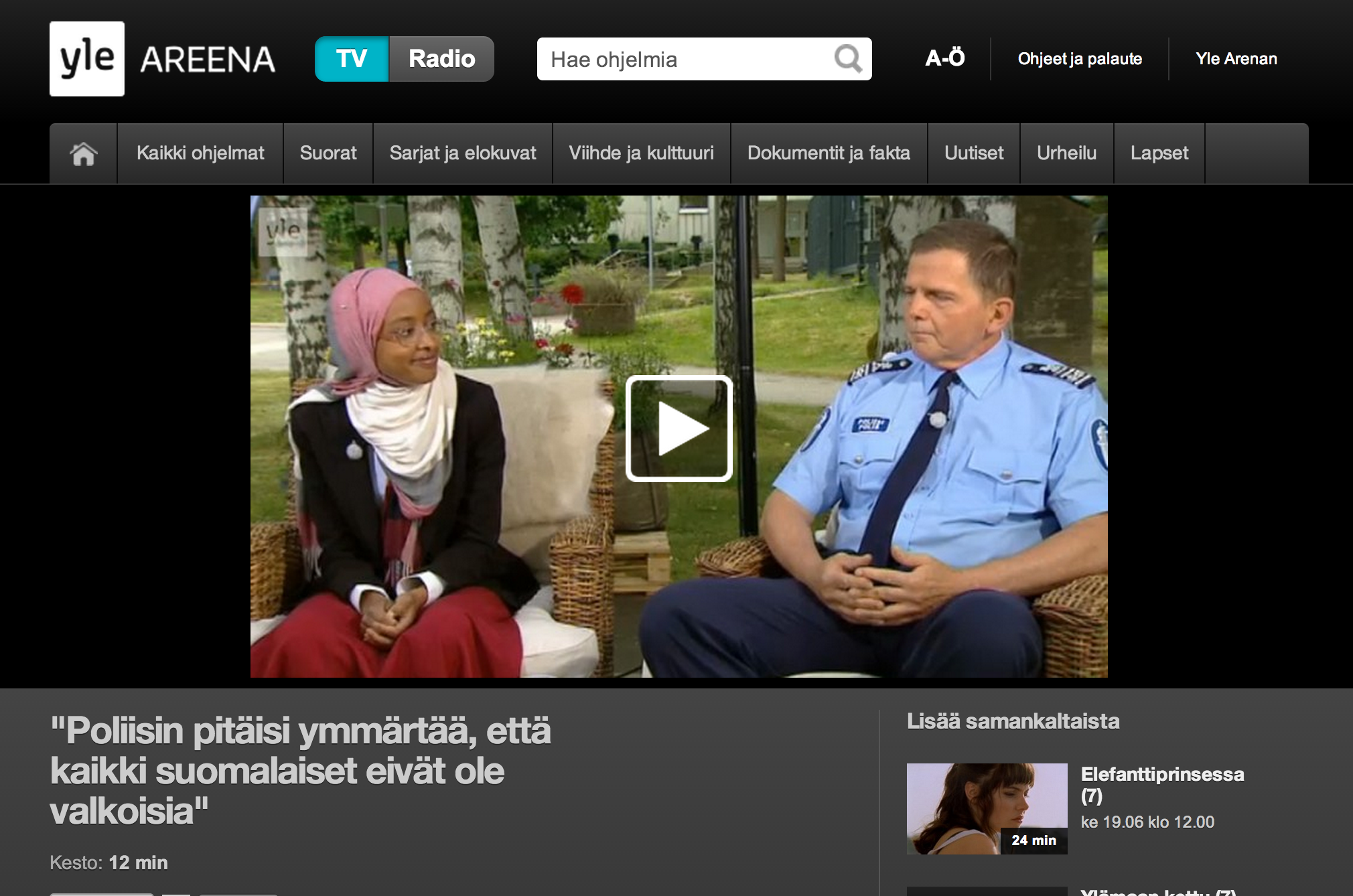
Two talk shows today, one on television and another one on radio, on ethnic profiling follows a report published Tuesday by the European Commission Against Racism and Intolerance (ECRI). Contrary to concerns by the ECRI, the police flatly deny in both shows that ethnic profiling takes place even if a policeman at the Helsinki Railway admitted that people are indiscriminately stopped because “they look foreign.”

Ethnic profiling, and denials that it even takes place, not only reveal how strong institutional racism is in Finland but how far the police will go in defending their right to carry out ethnic profiling of immigrants and visible minorities.

All those terms that serve to exonerate Finnish white privilege should be challenged. Why do you think people who were born here and have lived all their lives in this country are labeled “people with immigrant backgrounds?”  The aim of this label is to socially exclude non-whites as equal members of society and citizens.

What is a person with “immigrant background” anyway? Who decides if you have or don’t an immigrant background?

When the police divide the population into white Finns and “people who look like foreigners,” even if they are Finns, they are given a carte blanche to profile people indiscriminately on ethnic grounds.

Kuvankaappaus 2013-7-10 kello 12.14.40

Watch television program here.

While it’s pretty clear that if the ECRI and Ombudsman for Minorities in Finland have expressed concern about ethnic profiling by the Finnish police, there must be something wrong.

Sadly, the whole debate concerning the issue of ethnic profiling in Finland points to denial by the authorities and Interior Minister Päivi Räsänen, who is either covering up for the police or totally ignorant.

Both the police and Räsänen sound like Perussuomalaiset (PS) chairman Timo Soini playing down racism in his party.  It reflects how the police, one of the most conservative institutions in Finland, doesn’t want to acknowledge that we are today an ever-growing culturally diverse society as well as ignorance.

Maryan Abdulkarim, who was interviewed on television today with deputy Helsinki police chief Lasse Aapio, correctly pointed out that not all “foreign-looking” people are immigrants but Finns.

On the radio program, National Coalition Party MP Kari Toivonen, a former policeman who denied that ethnic profiling takes place systematically, reveals his ignorance by pointing out that a foreigner called him a racist because in his country women can be raped freely.

Kuvankaappaus 2013-7-10 kello 12.15.49

Listen to radio program here.

If Toivonen believes this to be the case, it shows a tremendous amount of ignorance on his part and why ethnic profiling continues to take and why the police don’t get it. No culture or any religion accepts rape as something “normal.”

It’s pretty clear that the same arguments used to justify ethnic profiling of groups like the Romany minority in Finland in the past is being used against immigrants today. Whenever immigrants or non-white Finns are stopped by the police it’s because they are either undocumented or victims of human trafficking.

Instead of going around in circles and wasting years on debating whether ethnic profiling takes place or not, why isn’t Finland’s Romany minority asked its opinion on the matter? What they may tell you is extremely unsettling: Even if they have lived for about five centuries in Finland, ethnic profiling – never mind discrimination – still takes place.

A US state department human rights report stated recently: ”Groups of Roma have lived in the country for centuries, and Roma are classified as a ’traditional ethnic minority’ in the ombudsman’s report. The Romany minority was the most frequent target of racially motivated discrimination, followed by Russian-speakers, Somalis, and Sami.”

Migrant Tales will ask members of Finland’s Romany minority for a future blog entry about ethnic profiling by the Finnish police.

Finland’s police service: see no, hear no, speak no hate crimes

Posted on April 29, 2012 by Migrant Tales

By Enrique Tessieri

Migrant Tales reported since the end of January some gruesome violent crimes against Muslims in Finland with the most recent one happening Wednesday. Two of these led directly to the violent deaths of a Somali and Moroccan native, both Finnish citizens.  None of these were hate crimes, according to the police. 

What is a hate crime and why do some visible immigrants disagree flatly with the police’s conclusions?

A Police College of Finland report states the following:  “The traditional definition of hate crime also entails the notion that there is no prior relationship between the offender and the victim. Hate motivation is easier to understand in connection with crimes committed by extremist groups; i.e. in instances where the suspect and victim do not know each other and the suspect’s agenda is to harm the victim on the basis of his or her membership of a specific [ethnic]group.”

And continues: “This traditional definition, however,  is not suitable for describing all crimes committed against minorities that include prejudice against a group. Crimes or harassment can also occur between people who already know one another, and such acts are not always based on one particular hate motivation.”

One matter that sheds a dubious light on the Finnish police is their claim that hate crimes fell  by 15% to 860 cases in 2010 compared with the previous year.

While we don’t have the competence nor the resources like the police to investigate a hate crime, we are members of the community that the police serves.

Even so, the ever-growing discrepancies between some immigrant and visible minority groups versus the police show a distressing trend: lack of credibility.  This can never be a good matter for the police never mind the immigrant community because the effectiveness of the police service hinges on trust.

Trust in the police service can be hindered by many factors. One of these can be the immigrant, who may came from a country where the police are more feared than criminals. In light of this fact the police in Finland must do more work to win over the trust of these groups.

A recent statement by a policeman investigating the death of the adolescent in Espoo show that credibility between the police and the Somali community are significant to say the least.

Instead of reassuring the Somali community that Finland’s streets are safe and that the police are out there to protect them, the police investigator blamed the Somalis for planting racial hatred by spreading false rumors about the murder, according to YLE.

Alan Bruce wrote recently (26.2.2012) on Migrant Tales the following:   ” For far too long many police services have been reactive and cut off from the needs of all they are supposed to serve – through inertia, sloppy standards, poor levels of training or [as in the stated findings of the Macpherson Commission in London] sheer ‘institutional racism.’”

Bruce continued: ” Tackling these problems by a radical program of training, policy and pro-active engagement with [and support for] immigrant communities, ethnic minorities, migrants, women and other minorities is not just protecting the rights of citizens [and non-citizens] but it is also about creating a professional police service that sets standards and proclaims values.”

The tragic deaths and attacks that we have witnessed so far this year should be a wakeup call.  In the present political climate in Finland, matters will unfortunately get worse before they improve.

The police must stop treating crimes against immigrants as routine matters.

Update: Older woman assaulted at Myllypuro metro station in Helsinki

Posted on April 27, 2012 by Migrant Tales

By Enrique Tessieri

Thanks to a tip off, Migrant Tales correctly reported that the  older woman who was attacked and beaten, allegedly by a group of white Finns, at Myllypuro metro station in Helsinki on Wednesday was a Somali. The woman suffered injuries to the face and was taken to hospital by ambulance.

These types of attacks, now apparently made by young men on older women, are an indication of the violence that some immigrants suffer in Finland.

Migrant Tales earlier reported three deaths of Muslims over a span of about three weeks. A Perussuomalaiset (PS) councilman, Tommi Rautio, boasted on Facebook that he would decorate the white Finnish male who killed the third victim and seriously wounded another before taking his own life in a pizzeria in Oulu.

Migrant Tales believes that attacks of the kind seen in Helsinki are the tip of the iceberg, even though the police reported that hate crimes had fallen by 15% in 2010 compared with the previous year.

The low number of reported hate crimes could be interpreted as a vote of little to no confidence in the police from certain immigrant groups.

Harassment of Migrant Tales

Posted on March 31, 2012 by Migrant Tales

By Enrique Tessieri

Migrant Tales and I have been harassed by an individual since March 3, who has been demanding compensation for “defaming” him, an anonymous person.  Yes, you heard it: defaming an anonymous person. 

After sending an email to the whole staff of one of my workplaces, it’s pretty clear that this person had crossed the line.

I have repeatedly received unwanted communications demanding money and threatening manifestly unfounded legal proceedings. As mentioned, the perpetrator broadened the scope Friday of this behavior to include one of my employers. At the very least, this constitutes a degree of harassment that exceeds the threshold for a restraining order.

I recommend to everyone who may be experiencing something similar or worse to go report the matter to the police. This is not only important for you but for other immigrants who are being harassed as well. At the best you will be raising greater awareness in the Finnish police and that this type of behavior will not be tolerated.

JusticeDemon says that one way to proceed is to get a restraining order from the courts. Here is some general and more detailed information in English on what is a restraining order.

  • Previous
  • 1
  • 2
  • 3
  • 4
Read more about documentary film
Read more

Recent Posts

  • Lahti is the latest city to prohibit the niqab and burka
  • Finland’s tabloids Iltalehti and Ilta-Sanomat are the pits
  • Riikka Purra’s Dr Jekyll and Mr Hyde mask
  • Double standards
  • Perussuomalaiset: Uusi logo, sama vanha juttu

Recent Comments

  1. Absolutely Socking: Racist Finnish Facebook group against human rights gets flooded with socks on Musta Barbaari’s mother and sister charged by the police in “ethnic profiling” case
  2. Ilkka Nuotio on Pekka Myrskylä: “Tilastot kertovat toista kuin poliittinen keskustelu”
  3. Genrih Soinkara on The war in Ukraine and the Russian-Finnish border crisis are showing Finland’s ugly side
  4. Ahti Tolvanen on Comment by Ahti Tolvanen on the Helsinki +50 conference
  5. Angel Barrientos on Angel Barrientos is one of the kind beacons of Finland’s Chilean community

Archives

  • June 2026
  • May 2026
  • April 2026
  • March 2026
  • February 2026
  • January 2026
  • December 2025
  • November 2025
  • October 2025
  • September 2025
  • August 2025
  • July 2025
  • June 2025
  • May 2025
  • April 2025
  • March 2025
  • February 2025
  • January 2025
  • December 2024
  • November 2024
  • October 2024
  • September 2024
  • August 2024
  • July 2024
  • June 2024
  • May 2024
  • April 2024
  • March 2024
  • February 2024
  • January 2024
  • December 2023
  • November 2023
  • October 2023
  • September 2023
  • August 2023
  • July 2023
  • June 2023
  • May 2023
  • April 2023
  • March 2023
  • February 2023
  • January 2023
  • December 2022
  • November 2022
  • October 2022
  • September 2022
  • August 2022
  • July 2022
  • June 2022
  • May 2022
  • April 2022
  • March 2022
  • February 2022
  • January 2022
  • December 2021
  • November 2021
  • October 2021
  • September 2021
  • August 2021
  • July 2021
  • June 2021
  • May 2021
  • April 2021
  • March 2021
  • February 2021
  • January 2021
  • December 2020
  • November 2020
  • October 2020
  • September 2020
  • August 2020
  • July 2020
  • June 2020
  • May 2020
  • April 2020
  • March 2020
  • February 2020
  • January 2020
  • December 2019
  • November 2019
  • October 2019
  • September 2019
  • August 2019
  • July 2019
  • June 2019
  • May 2019
  • April 2019
  • March 2019
  • February 2019
  • January 2019
  • December 2018
  • November 2018
  • October 2018
  • September 2018
  • August 2018
  • July 2018
  • June 2018
  • May 2018
  • April 2018
  • March 2018
  • February 2018
  • January 2018
  • December 2017
  • November 2017
  • October 2017
  • September 2017
  • August 2017
  • July 2017
  • June 2017
  • May 2017
  • April 2017
  • March 2017
  • February 2017
  • January 2017
  • December 2016
  • November 2016
  • October 2016
  • September 2016
  • August 2016
  • July 2016
  • June 2016
  • May 2016
  • April 2016
  • March 2016
  • February 2016
  • January 2016
  • December 2015
  • November 2015
  • October 2015
  • September 2015
  • August 2015
  • July 2015
  • June 2015
  • May 2015
  • April 2015
  • March 2015
  • February 2015
  • January 2015
  • December 2014
  • November 2014
  • October 2014
  • September 2014
  • August 2014
  • July 2014
  • June 2014
  • May 2014
  • April 2014
  • March 2014
  • February 2014
  • January 2014
  • December 2013
  • November 2013
  • October 2013
  • September 2013
  • August 2013
  • July 2013
  • June 2013
  • May 2013
  • April 2013
  • March 2013
  • February 2013
  • January 2013
  • December 2012
  • November 2012
  • October 2012
  • September 2012
  • August 2012
  • July 2012
  • June 2012
  • May 2012
  • April 2012
  • March 2012
  • February 2012
  • January 2012
  • December 2011
  • November 2011
  • October 2011
  • September 2011
  • August 2011
  • July 2011
  • June 2011
  • May 2011
  • April 2011
  • March 2011
  • February 2011
  • January 2011
  • December 2010
  • November 2010
  • October 2010
  • September 2010
  • August 2010
  • July 2010
  • June 2010
  • May 2010
  • April 2010
  • March 2010
  • February 2010
  • January 2010
  • December 2009
  • November 2009
  • October 2009
  • September 2009
  • August 2009
  • July 2009
  • December 2008
  • November 2008
  • October 2008
  • September 2008
  • August 2008
  • July 2008
  • June 2008
  • May 2008
  • April 2008
  • March 2008
  • February 2008
  • January 2008
  • November 2007
  • October 2007
  • September 2007
  • August 2007
  • July 2007
  • June 2007
  • May 2007

Categories

  • ?? Gia L?c
  • ????? ?????? ????? ???????? ?? ??????
  • ???????
  • @HerraAhmed
  • @mondepasrond
  • @nohatefinland
  • @oula_silver
  • @Varathas
  • A Pakistani family
  • äärioikeisto
  • Abbas Bahmanpour
  • Abdi Muhis
  • Abdirahim Hussein Mohamed
  • Abdirahim Husu Hussein
  • Abdirisak Mahamed
  • About Migrant Tales
  • activism
  • Adam Al-Sawad
  • Adel Abidin
  • Afrofinland
  • Ahmed IJ
  • Ahti Tolvanen
  • Aino Pennanen
  • Aisha Maniar
  • Alan Ali
  • Alan Anstead
  • Alejandro Díaz Ortiz
  • Alekey Bulavsev
  • Aleksander Hemon
  • Aleksanterinliitto
  • Aleksanterinliitto ry
  • Aleksanterinliitto ry:n hallitus
  • Alex Alex
  • Alex Mckie
  • Alexander Nix
  • Alexandra Ayse Albayrak
  • Alexis Neuberg
  • Ali Asaad Hasan Alzuhairi
  • Ali Hossein Mir Ali
  • Ali Rashid
  • Ali Sagal Abdikarim
  • Alina Tsui
  • Aline Müller
  • All categories
  • Aman Heidari
  • Amiirah Salleh-Hoddin & Jana Turk
  • Amin A. Alem
  • Amir Zuhairi
  • Amkelwa Mbekeni
  • Ana María Gutiérrez Sorainen
  • Anachoma
  • Anders Adlecreutz
  • Angeliina Koskinen
  • Anna De Mutiis
  • Anna María Gutiérrez Sorainen
  • Anna-Kaisa Kuusisto ja Jaakko Tuominen
  • Annastiina Kallius
  • Anneli Juise Friman Lindeman
  • Announcement
  • Anonymous
  • Antero Leitzinger
  • anti-black racism
  • Anti-Hate Crime Organisation Finland
  • Anudari Boldbaatar
  • Arshiya Nasser
  • Aspergers Syndrome
  • Asylum Corner
  • Asylum seeker 406
  • Athena Griffin and Joe Feagin
  • Autism
  • Avaaz.org
  • Awale Olad
  • Ayan Said Mohamed
  • AYY
  • Barachiel
  • Bashy Quraishy
  • Beatrice Kabutakapua
  • Beri Jamal
  • Beri Jamal and Enrique Tessieri
  • Bertolt Brecht
  • Boiata
  • Boodi Kabbani
  • Bruno Gronow
  • Carmen Pekkarinen
  • Çelen Oben and Sheila Riikonen
  • Chiara Costa-Virtanen
  • Chiara Costa-Virtanen
  • Chiara Sorbello
  • Christian Thibault
  • Christopher Wylie
  • Clara Dublanc
  • Dana
  • Daniel Malpica
  • Danilo Canguçu
  • David Papineau
  • David Schneider
  • Dexter He
  • Don Flynn
  • Dr Masoud Kamali
  • Dr. Faith Mkwesha
  • Dr. Theodoros Fouskas
  • Edna Chun
  • Eeva Kilpi
  • Emanuela Susheela
  • En castellano
  • ENAR
  • Enrique
  • Enrique Tessieri
  • Enrique Tessieri & Raghad Mchawh
  • Enrique Tessieri & Yahya Rouissi
  • Enrique Tessieri and Muhammed Shire
  • Enrique Tessieri and Sira Moksi
  • Enrique Tessieri and Tom Vandenbosch
  • Enrique Tessieri and Wael Che
  • Enrique Tessieri and Yahya Rouissi
  • Enrique Tessieri and Zimema Mhone
  • Epäluottamusmies
  • EU
  • Europe
  • European Islamophobia Report
  • European Islamophobia Report 2019,
  • European Union
  • Eve Kyntäjä
  • Ezequiel Caldeiro
  • Facebook
  • Fadumo Dayib
  • Faisa Kahiye
  • Farhad Manjoo
  • Fasismi
  • Finland
  • Fizza Qureshi
  • Flyktingar och asyl
  • Foreign Student
  • Fozia Mir-Ali
  • Frances Webber
  • Frida Selim
  • Gareth Rice
  • Ghyslain Vedeaux
  • Global Art Point
  • Great Replacement
  • Habiba Ali
  • Hami Bahadori
  • Hami Bahdori
  • Hamid
  • Hamid Alsaameere
  • Hamid Bahdori
  • Handshake
  • Harmit Athwal
  • Hassan Abdi Ali
  • Hassan Muhumud
  • Heikki Huttunen
  • Heikki Wilenius
  • Helsingin Sanomat
  • Henning van der Hoeven
  • Henrika Mälmsröm
  • Hser Hser
  • Hser Hser ja Mustafa Isman
  • Husein Muhammed
  • Hussain Kazemian
  • Hussain Kazmenian
  • Ibrahim Khan
  • Ida
  • Ignacio Pérez Pérez
  • Iise Ali Hassan
  • Ilari Kaila & Tuomas Kaila
  • Imam Ka
  • inside-an-airport
  • Institute of Race Relations
  • Iraqi asylum seeker
  • IRR European News Team
  • IRR News Team
  • Islamic Society of Norhern FInland
  • Islamic Society of Northern Finland
  • Islamophobia
  • Jacobinmag.com
  • Jallow Momodou
  • Jan Holmberg
  • Jane Elliott
  • Jani Mäkelä
  • Jari Luoto
  • Jari Taponen
  • Jegor Nazarov
  • Jenni Stammeier
  • Jenny Bourne
  • Jessie Daniels
  • Joe Davidow
  • Johannes Koski
  • John D. Foster
  • John Grayson
  • John Marriott
  • Jon Burnett
  • Jorma Härkönen
  • Jos Schuurmans
  • José León Toro Mejías
  • Josue Tumayine
  • Jouni Karnasaari
  • Juan Camilo
  • Jukka Eräkare
  • Julian Abagond
  • Julie Pascoet
  • Jussi Halla-aho
  • Jussi Hallla-aho
  • Jussi Jalonen
  • JusticeDemon
  • Kadar Gelle
  • Kaksoiskansalaisuus
  • Kansainvälinen Mikkeli
  • Kansainvälinen Mikkeli ry
  • Katherine Tonkiss
  • Kati Lepistö
  • Kati van der Hoeven-Lepistö
  • Katie Bell
  • Kättely
  • Kerstin Ögård
  • Keshia Fredua-Mensah & Jamie Schearer
  • Khadidiatou Sylla
  • Khadra Abdirazak Sugulle
  • Kiihotus kansanryhmää vastaan
  • Kirsi Crowley
  • Koko Hubara
  • Kristiina Toivikko
  • Kubra Amini
  • KuRI
  • La Colectiva
  • La incitación al odio
  • Laura Huhtasaari
  • Lauri Finér
  • Leif Hagert
  • Léo Custódio
  • Leo Honka
  • Leontios Christodoulou
  • Lessie Branch
  • Lex Gaudius
  • Leyes de Finlandia
  • Liikkukaa!
  • Linda Hyökki
  • Liz Fekete
  • M. Blanc
  • Maarit Snellman
  • Mahad Sheikh Musse
  • Maija Vilkkumaa
  • Malmin Kebab Pizzeria Port Arthur
  • Marcell Lorincz
  • Mari Aaltola
  • María Paz López
  • Maria Rittis Ikola
  • Maria Tjader
  • Marja-Liisa Tolvanen
  • Mark
  • Markku Heikkinen
  • Marshall Niles
  • Martin Al-Laji
  • Maryan Siyad
  • Matt Carr
  • Mauricio Farah Gebara
  • Media Monitoring Group of Finland
  • Micah J. Christian
  • Michael McEachrane
  • Michele Levoy
  • Michelle Kaila
  • Migrant Tales
  • Migrant Tales Literary
  • Migrantes News
  • Migrants' Rights Network
  • MigriLeaks
  • Mikko Kapanen
  • Miriam Attias and Camila Haavisto
  • Mohamed Adan
  • Mohammad Javid
  • Mohammad M.
  • Monikulttuurisuus
  • Monisha Bhatia and Victoria Canning
  • Mor Ndiaye
  • Muh'ed
  • Muhamed Abdimajed Murshid
  • Muhammed Shire
  • Muhammed Shire and Enrique Tessieri
  • Muhis Azizi
  • Musimenta Dansila
  • Muslimiviha
  • Musulmanes
  • Namir al-Azzawi
  • Natsismi
  • Neurodiversity
  • New Women Connectors
  • Nils Muižnieks
  • No Labels No Walls
  • Noel Dandes
  • Nuor Dawood
  • Omar Khan
  • Otavanmedia
  • Oula Silvennoinen
  • Paco Diop
  • Pakistani family
  • Pentti Stranius
  • Perussuomalaiset
  • perustuslaki
  • Petra Laiti
  • Petri Cederlöf
  • Pia Grochowski
  • Podcast-lukija Bea Bergholm
  • Pohjois – Suomen Islamilainen Yhdyskunta
  • Pohjois Suomen Islamilainen Yhyskunta
  • Polina Kopylova
  • Race Files
  • racism
  • Racism Review
  • Raghad Mchawh
  • Ranska
  • Rashid H. and Migrant Tales
  • Rasismi
  • Raul Perez
  • Rebecka Holm
  • Reem Abu-Hayyeh
  • Refugees
  • Reija Härkönen
  • Remiel
  • Reza Nasri
  • Richard Gresswell
  • Riikka Purra
  • Risto Laakkonen
  • Rita Chahda
  • Ritva Kondi
  • Robito Ibrahim
  • Roble Bashir
  • Rockhaya Sylla
  • Rodolfo Walsh
  • Roger Casale
  • Rostam Atai
  • Roxana Crisólogo Correa
  • Ruth Grove-White
  • Ruth Waweru-Folabit
  • S-worldview
  • Sadio Ali Nuur
  • Sami Rusanen
  • Sandhu Bhamra
  • Sara de Jong
  • Sarah Crowther
  • Sari Alhariri
  • Sarkawt Khalil
  • Sasu
  • Scot Nakagawa
  • Shabana Ahmadzai
  • Shada Islam
  • Sharon Chang blogs
  • Shenita Ann McLean
  • Shirlene Green Newball
  • Sini Savolainen
  • Sira Moksi
  • Sonia K.
  • Sonia Maria Koo
  • Steverp
  • Stop Deportations
  • Suldaan Said Ahmed
  • Suomen mediaseurantakollektiivi
  • Suomen Muslimifoorumi ry
  • Suomen viharikosvastainen yhdistys
  • Suomen viharikosvastainen yhdistys ry
  • Suomi
  • Supermen
  • Susannah
  • Suva
  • Syrjintä
  • Talous
  • Tapio Tuomala
  • Taw Reh
  • Teivo Teivainen
  • The Daily Show
  • The Heino
  • The Supermen
  • Thomas Elfgren
  • Thulfiqar Abdulkarim
  • Tim McGettigan
  • Tino Singh
  • Tito Moustafa Sliem
  • Tobias Hübinette and L. Janelle Dance
  • Transport
  • Trica Danielle Keaton
  • Trilce Garcia
  • Trish Pääkkönen
  • Trish Pääkkönen and Enrique Tessieri
  • Tuulia Reponen
  • Uncategorized
  • UNITED
  • University of Eastern Finland
  • Uyi Osazee
  • Väkivalta
  • Vapaa Liikkuvuus
  • Venla-Sofia Saariaho
  • Vieraskynä
  • W. Che
  • W. Che an Enrique Tessieri
  • Wael Ch.
  • Wan Wei
  • Women for Refugee Women
  • Xaan Kaafi Maxamed Xalane
  • Xassan Kaafi Maxamed Xalane
  • Xassan-Kaafi Mohamed Halane & Enrique Tessieri
  • Yahya Rouissi
  • Yasmin Yusuf
  • Yassen Ghaleb
  • Yle Puhe
  • Yuliet Tresa
  • Yve Shepherd
  • Zahra Khavari
  • Zaker
  • Zalina Ametova
  • Zamzam Ahmed Ali
  • Zeinab Amini ja Soheila Khavari
  • Zimema Mahone and Enrique Tessieri
  • Zimema Mhone
  • Zoila Forss Crespo Moreyra
  • ZT
  • Zulma Sierra
  • Zuzeeko Tegha Abeng
© 2026 Migrant tales | Powered by Minimalist Blog WordPress Theme