Migrant tales
Menu
  • #MakeRacismHistory “In Your Eyes”
  • About Migrant Tales
  • It’s all about Human Rights
  • Literary
  • Migrant Tales Media Monitoring
  • NoHateFinland.org
  • Tales from Europe
Menu

Tag: Finland

Sikh busman confident that employer will lift turban ban

Posted on June 29, 2013 by Migrant Tales

Busman Gill Sukhdarshan Singh is confident that his employer, Veolia Transport of Vantaa, will honor a Southern Finland Regional State Administrative Agency ruling that imposing a turban ban by the employer was discriminatory.

1044537_10201652496259268_87794611_n

Source: Gill Sukhdarshan Singh.

”I have no doubt that that in two months, when I will get written permission from the employer, I will start wearing a turban at work,” Sukhdarshan Singh told Migrant Tales.

The Southern Finland Regional State Administrative Agency gave the Veolia Transport of Vantaa until the end of Septempter how the company plans to redress the problem.

Sukhdarshan Singh said that what he did was for all Sikhs living in Finland and “to further multiculturalism.”

”Multiculturalism means that my children can appreciate both cultures,” he said.

Two of his children study at university and one at high school.

Let’s challenge Finland’s disgraceful family reunification obstacles

Posted on June 28, 2013 by Migrant Tales

Migrants’ Rights Network (MRN) of Britain shows how organizations can do valuable work in lobbying for change against unfair family reunification laws (see Migrant Tales 28.6.13). Politicians, who have tightened such laws, are short-sighted and have created a tragedy for those who live separated from their loved ones. 

The same suffering that separated families suffer in Finland are similar to the tragedy they are going through in other European countries like Britain.

“During the year since the Government announced its changes to the family migration rules, MRN has heard from hundreds of families who have been kept apart from one another – couples split across continents, young children separated from parents, elderly relatives kept apart from relatives who wish to care for them in the UK,” writes MRN.

Tighter family reunification requirements came in force in 2011. It shouldn’t surprise anyone that one of the main factors behind these changes was the anti-immigration Perussuomalaiset (PS) party’s growing popularity in the polls and its historic election victory in April 2011.

New rules that came in force in two years ago have made family reunification ever-complicated and costly. One big change in the rules is that family members must now apply in their home country or at the nearest Finnish embassy. As a general rule, the minimum that a three-member family must make monthly to bring their loved ones is 2,880 euros, according to the Refugee Advice Center.

Family reunification applications have plummeted as a result of tightened rules. In 2012, there were just over 500 applications compared with 1,900 in the previous year and 3,900 in 2010. All in all, there were 8,600 application in 2012. Finnish Immigration Service (FIS) reported earlier that at the end of 2011 there were a total of 6,100 family reunification application by Somalis alone. According to the Refugee Advice Center, only 329 family reunifications took place on average annually between 1999 and 2010.

How do the new rules make life ever-difficult for refugees and immigrants and how are they kept in limbo? The answer to that question is simple: How would it feel to live separated from your loved ones for years and with little hope that your family will ever be reunited in Finland?

Some of the problems of righter rules are highlighted on Fahamu Refugee Legal Aid Newsletter: “Tightening the rules for family reunification would put the protection of the right to family life under severe risk. In response to the current political climate as it relates to refugees, the Finnish Refugee Advice Centre, the principal non-governmental organisation offering legal aid for refugees, has issued a statement on the risks of tightening the policy on family reunification in Finland.  Rules are already very strict, constituting an obstacle to refugee integration for those already settled in Finland, who continue to live in uncertainly regarding their families.”

While FIS claims lack of and to handle the backlog of thousands of applications, the real reasons are anti-immigration Christian Democrat Interior Minister PäiviRäsänen and unofficial efforts to stop as many Somalis as possible from moving to Finland.

Under Räsänen, Finland continues, despite obligations under international laws, to detain as a first resort children seeking asylum for long periods of time. The interior minister, whose tough stance on immigration and refugees is liked by the PS, has said publicly that  homosexuality is a sin.

Even if it may be in vogue in some circles to be against immigrants and cultural diversity in Finland, politicians, the media and public must look further ahead in the future. Do we want to assist in destroying and fragmenting the lives of thousands of people who are already traumatized by war and displacement?

That is exactly what we are doing as long as we continue on the present path.

A good start would, however, be to challenge the unfair family reunification rules.

The example of the fine work by the Migrants’ Rights Network would help us draft a plan in Finland.

Landmark decision in Finland: Sikh busman can wear a turban at work

Posted on June 27, 2013 by Migrant Tales

The Southern Finland Regional State Administrative Agency announced that banning a Sikh busman from using a turban at work was discriminatory, reports YLE in English. The decision is an important watershed and a victory for other minorities living in Finland. 

The busman, Gill Sukhdarshan Singh of Vantaa, was prohibited from using a turban at work and decided in May to challenge the decision.

The agency said that Singh’s employer, Veolia Transport Vantaa, was guilty of indirect discrimination and ordered the firm to report by the end of September how it plans to redress the problem.

Kuvankaappaus 2013-6-27 kello 22.23.39

The decision in favor of Singh should be seen as a watershed since it will propel greater cultural diversity and tolerance at the workplace.

Eva Biaudet, Finland’s ombudsman for minorities, applauded the decision. She said it was a significant step forward in making cultural diversity more acceptable at the workplace.

Sing’s victory over his employer is a good example of how far Finland lags behind other European countries concerning cultural diversity. Sikh bus drivers in England won such rights over forty years ago in 1969.


Soaring unemployment in Finland hits immigrants and visible minorities especially hard

Posted on June 26, 2013 by Migrant Tales

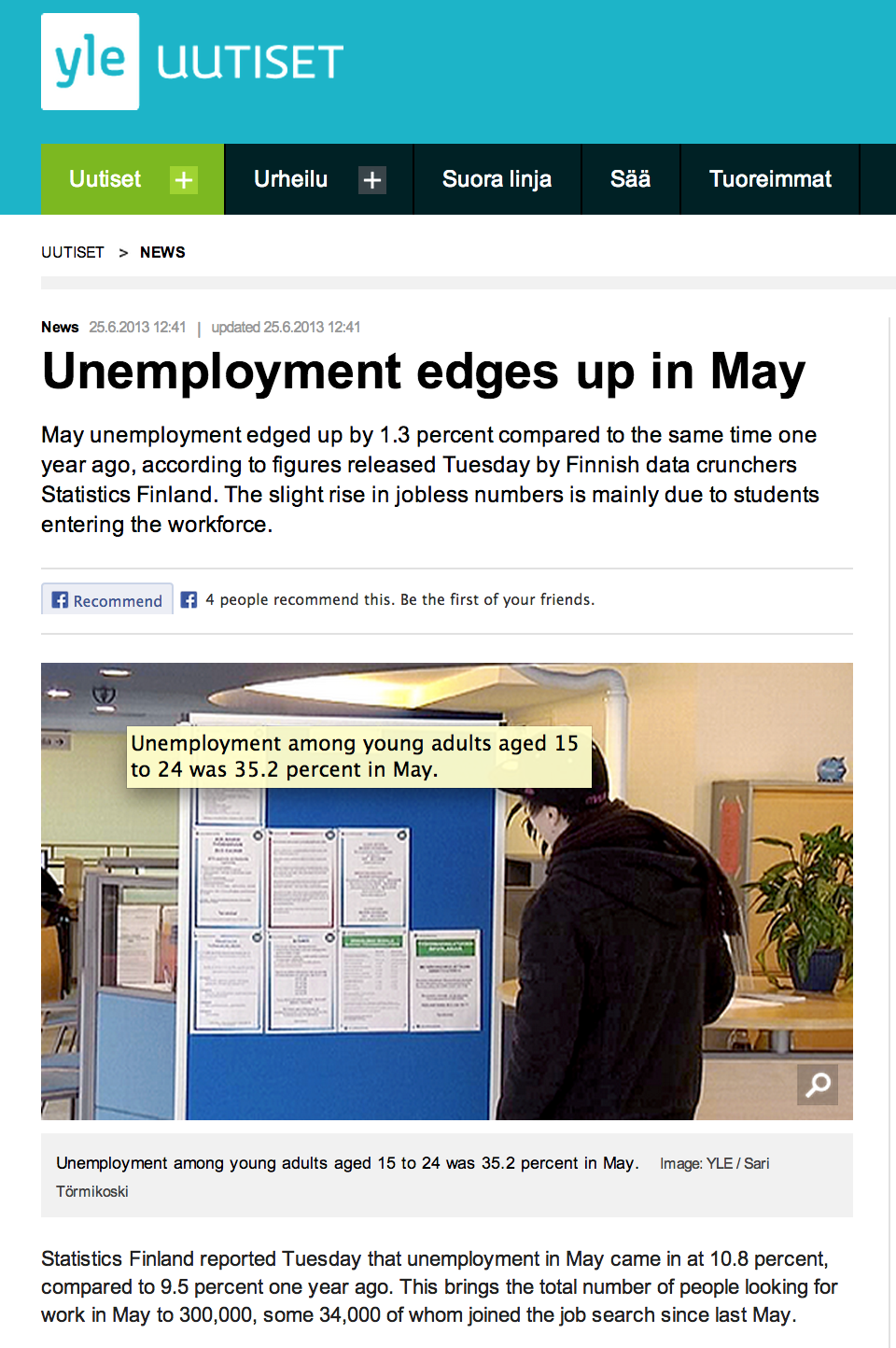
It was shocking to read how Finland’s jobless rate shot up in May to 10.8% from 9.5% a year ago. Since immigrant unemployment is about three times higher than the national average, it means in theory that the unemployed rate for immigrants is at least 30%. 

Matters are expected to get worse before they improve.

The Bank of Finland sees Finland’s economy shrinking this year by 0.8% and growing in 2014 by 0.7%, which will cause unemployment to rise to 8.6% next year. The Bank of Finland doesn’t see unemployment retreating significantly in 2015.

Kuvankaappaus 2013-6-26 kello 9.18.00

Read full story here.

Immigrants, who are usually the last to be hired and the first to get laid-off in a recession, are in an especially vulnerable position. The situation is exacerbated by the lack of political support and prejudice.

Since no media or politician will stand up for the immigrants and young immigrants, Migrant Tales will do so proudly.

If you want to get a depressing view of the situation, take a look at unemployment among young people (15-24 years), which rose by 4.5 percentage points to 35.2% during the month under review. What does it say about the jobless rate of second-generation Finns?

It was twenty years ago when Finland suffered its worst-ever recession in a century in the early 1990s, which caused unemployment to soar to about 20%. People who had expensive mortgages to pay were especially hard-hit.

Those who lived and survived that period, remember the cutthroat atmosphere that existed at the time. Immigrants and non-white Finns were especially vulnerable. If you had a score to settle with an employee or a coworker at work, the recession helped you to stab a knife in his or her back.

That recession of the early 1990s showed how vital it is for immigrants, and workers in general, of having a political voice in the country.

If we don’t have a voice, we are easy pickings and subject to gross abuse.

That’s why fighting racism is so essential.


PS MP Hirvisaari gets publicly enraged with daily Etelä-Suomen Sanomat

Posted on June 25, 2013 by Migrant Tales

Perussuomalaiset (PS) MP James Hirvisaari has done it again. He didn’t lambast immigrants and Muslims this time, but got publicly enraged with a journalist working for Lahti-based Etelä-Suomen Sanomat (ESS). What happened? Ari Helminen reported that Hirvisaari, together with another PS MP, had the most absences in parliament during spring. 

Hirvisaari is from Asikkala, a town located near Lahti.

Kuvankaappaus 2013-6-25 kello 16.41.44

The news, that Hirvisaari and PS MP Ismo Soukkola had been absent from eight parliamentary sessions without an excuse, was apparently too much for the MP.  Hirvisaari tweeted that ESS’ Helminen had “betrayed his trust” and that he will never greet or answer the journalist’s phone calls.

”…I don’t want to have anything to do with liars,” he continued. ”The worst rotten journalism [in Finland] is by TS [Turun Sanomat] and ESS. Extreme abuse of power, unfair and manipulation of people’s [opinion].”

Hirvisaari’s former aide, Helena Eronen, who wrote about sleeve badges in April last year, blamed Turun Sanomat for taking her opinion piece out of context.

Kuvankaappaus 2013-6-25 kello 16.49.00

Read PS MP James Hirvisaari’s tweets here.

Reading about Hirvisaari’s outbursts is nothing new from this cantankerous politician, but sadly reveals why Finland has become a country where intolerance and hatred have raised their heads big time.

Migrant Tales wrote back in May: ”Every time a PS MP like Hirvisaari opens his mouth, he actually helps the PS lose its appeal among voters and what’s important its chances of being a partner in a future government.”

Hirvisaari was sentnced for ethnic agitation in 2011.

Even so, he has continued to insult gays, immigrants and visible minorities in Finland.  His far right Islamophobic credentials were reinforced when he announced that he publicly supports the Finnish Defense League.


About half of the PS MPs want to deny Finland’s cultural diversity

Posted on June 24, 2013 by Migrant Tales

Roughly half of the 39 Perussuomalaiset (PS) MPs have signed a draft law that would in effect deny Finland’s ever-growing cultural diversity in the youth law. If PS MP Olli Immonen had his way together with twenty other PS MPs, Finland would go into denial mode and conveniently brush its immigrants and visible minorities under the rug.

Kuvankaappaus 2013-6-24 kello 17.28.42

Social Democratic Party youth wing chairman, Joona Räsänen, criticized Immonen’s draft law. He said that the PS doesn’t want Finland’s youth to think that multiculturalism and diversity in our society are good matters.  Read full story (in Finnish) here.

It’s not first that Immonen, who is chairman of the far right Suomen Sisu association, has drafted anti-immigration laws.

PS MP Immonen claims on his Facebook wall that in the present youth law multiculturalism is considered a good matter. “In my opinion, it shouldn’t be the law that should determine whether multiculturalism is a good matter or not. Let everyone determine it for themselves.”

With MPs like these and many others, it’s not difficult to spot the red herrings in their arguments. In simple English, Immonen is saying that Finland should not become culturally diverse and that we should do everything possible to prevent people who are different from us from moving to this country.

How many more of these laws, which have no chance in passing in parliament, will have to be drafted before we understand that Finland’s third largest party in parliament is not only racist but would destroy this country?

Twenty-one PS MPs have signed the draft bill. Some of these are Jussi Halla-aho, Jussi Niinistö, Juho Eerola, James Hirvisaari, Vesa-Matti Saarakkala, Ritva Elomaa, Reijo Tossavainan, Teuvo Hakkarainen and others.


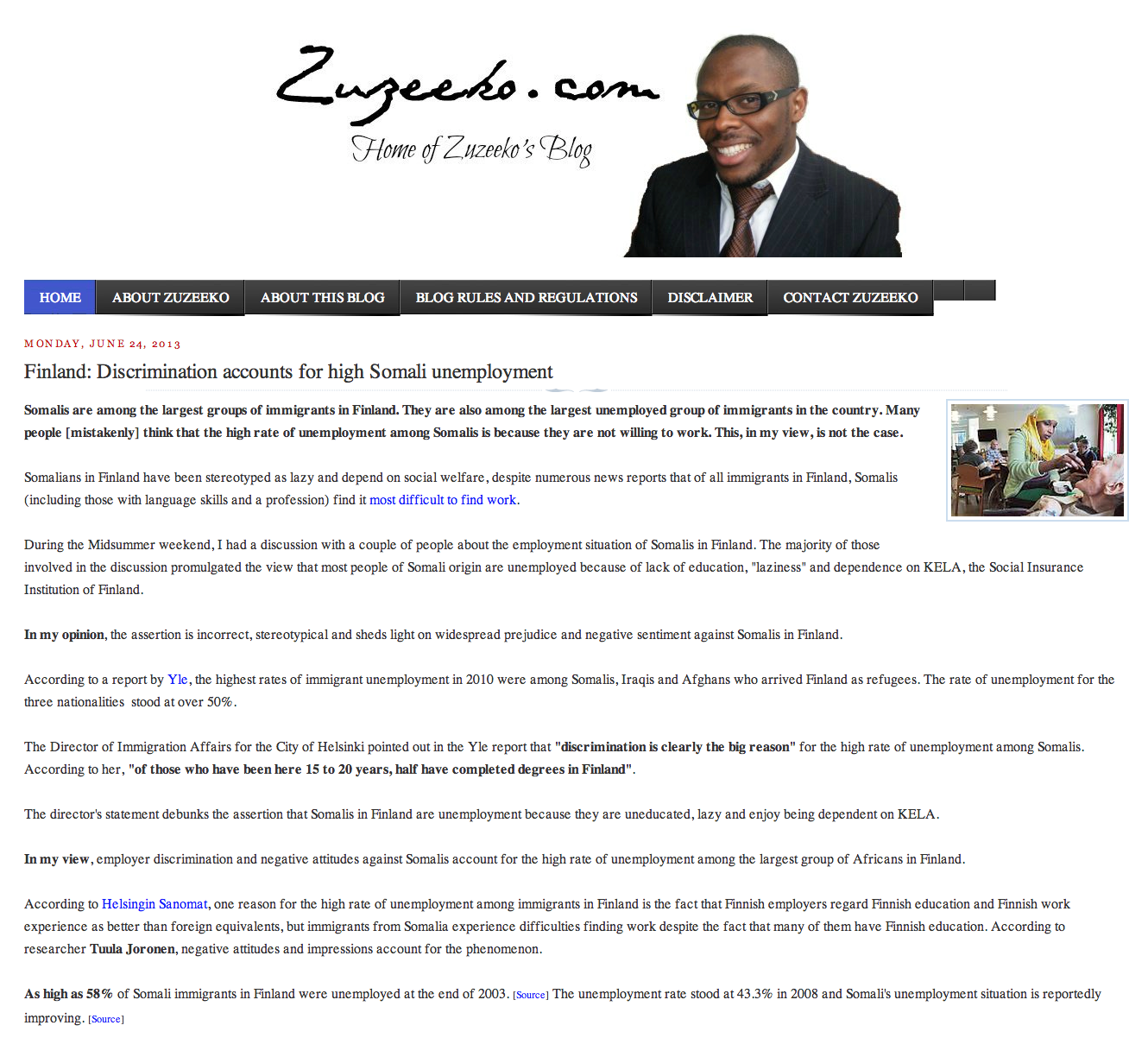
Zuzeeko’s blog: Finland – Discrimination accounts for high Somali unemployment

Posted on June 24, 2013 by Migrant Tales

Zuzeeko Tegha Abeng

Somalis are among the largest groups of immigrants in Finland. They are also among the largest unemployed group of immigrants in the country. Many people [mistakenly] think that the high rate of unemployment among Somalis is because they are not willing to work. This, in my view, is not the case.

Kuvankaappaus 2013-6-24 kello 15.04.55Read original posting here.

Somalians in Finland have been stereotyped as lazy and depend on social welfare, despite numerous news reports that of all immigrants in Finland, Somalis (including those with language skills and a profession) find it most difficult to find work.

During the Midsummer weekend, I had a discussion with a couple of people about the employment situation of Somalis in Finland. The majority of those involved in the discussion promulgated the view that most people of Somali origin are unemployed because of lack of education, “laziness” and dependence on KELA, the Social Insurance Institution of Finland.

In my opinion, the assertion is incorrect, stereotypical and sheds light on widespread prejudice and negative attitudes towards Somalis in Finland.

According to a report by Yle, the highest rates of immigrant unemployment in 2010 were among Somalis, Iraqis and Afghans who arrived Finland as refugees. The rate of unemployment for the three nationalities  stood at over 50%.

The Director of Immigration Affairs for the City of Helsinki pointed out in the Yle report that “discrimination is clearly the big reason” for the high rate of unemployment among Somalis. According to the director, “of those who have been here 15 to 20 years, half have completed degrees in Finland”.

The director’s statement debunks the assertion that Somalis in Finland are unemployment because they are uneducated, lazy and enjoy being dependent on KELA.

In my view, employer discrimination and negative attitudes towards Somalis account for the high rate of unemployment among Finland’s largest group of Africans.

According to Helsingin Sanomat, one reason for the high rate of unemployment among immigrants in Finland is the fact that Finnish employers regard Finnish education and Finnish work experience as better than foreign equivalents. But immigrants from Somalia experience difficulties finding work, despite the fact that many of them have Finnish education. According to researcher Tuula Joronen, negative attitudes and impressions account for the phenomenon.

As high as 58% of Somali immigrants in Finland were unemployed at the end of 2003. [Source] The unemployment rate stood at 43.3% in 2008. [Source]

In 2010 and 2011, the risk of unemployment was highest among Somali speakers than among any other language group in Finland – according to Statistics Finland. Followed by high risk among Arabic, Persian and Kurdish speakers.

A poll revealed that Somalis and Muslims are among the groups most affected by racism and intolerance in Finland.

It is plausible to conclude from the aforementioned that prejudice, negative attitudes and employer discrimination against Somalis partly account for the high rate of unemployment in the Somali community. Many Somalis have learnt Finnish language and many have Finnish degrees and training. They should be employed without discrimination.

There was a total of 7,468 Somalians in Finland in 2012.

Read original blog entry here.

This piece was reprinted by Migrant Tales with permission.


Should Finns trust the police?

Posted on June 23, 2013 by Migrant Tales

“…when the laws have ceased to be executed, as this can only come from the corruption of the republic, the state is already lost.”

Montesquieu (1689-1755)

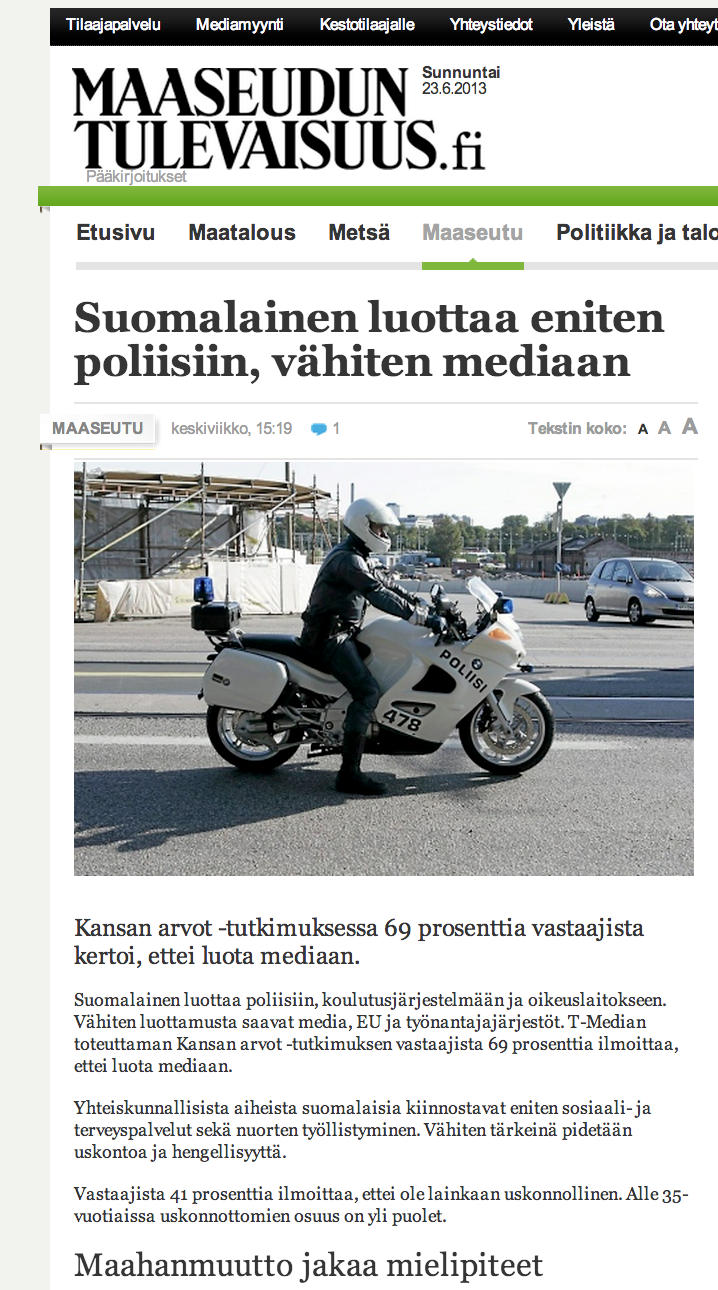
A survey by T-Media reveals that Finns trust the most the police, educational and justice system and the least the media, EU and employer’s associations. Of those surveyed, 69% responded that they didn’t trust the media.

Kuvankaappaus 2013-6-23 kello 14.01.30

Even  if close to two-thirds of Finns trust their police, should we in light of the revelations by Edward Snowden of vast global surveillance by the National Security Agency (NSA) and GCHQ?

A good case in point is a request  by the Finnish Security Intelligence Service (Supo) for increased surveillance powers.

One matter that should worry us is not the Supo request per se but how little some Finnish politicians, the media and public appear to care for oversight and transparency, which are crucial to the survival of our Nordic welfare state democracy.

Would the police and Supo abuse such power if they got greater surveillance rights?

The proper question we should ask, however, is what guarantees does the public have that the police and Supo will not go as far as theNSA and GCHQ? Do we have any idea how much we are being surveyed in Finland?

The best way to secure trust and an effective checks and balance system through proper oversight is paradoxically mistrust.  It would be naive, even reckless, to believe that the police and other agencies that claim to defend and guarantee our security will always do so in our best interest. Power always corrupts.

Just like corporations can get greedy, so can military and public institutions.  Securing support and vast funding means putting out a lot of spin and hype in order to instil fear in the public that we are constantly under threat.

Asking the military and national security agencies to make the world a more secure place is like asking a madman to make the world saner.

It will never happen.


Migrant Tales Literary: Midsummer

Posted on June 22, 2013 by Migrant Tales

By Leo Honka

Water, sky and land.

on fire

a day that refuses to die.

 IMG_1633
Water…
IMG_1638-1
…sky…
IMG_1625
…land.
IMG_1661
And fire.

Immigrants and visible minorities would be the biggest losers if Supo gets greater online surveillance powers

Posted on June 21, 2013 by Migrant Tales

Is it a coincidence or just bad timing that the Finnish Security Intelligence Service (Supo) wants greater online surveillance powers? It was only last week when Edward Snowden revealed to the world how the NSA accessed private information of billions of people without their knowledge never mind their permission. 

Kuvankaappaus 2013-6-21 kello 10.49.26

Read original story here.

Who would be the biggest losers if Supo and the police were given greater powers?

Not only would Finnish society lose, especially immigrants and visible minorities, who would be the targets of increased surveillance by Supo and the police.

In a live interview on The Guardian, Edward Snowden explained what was wrong with costly and out-of-control National Security Agency (NSA):

“Journalists should ask a specific question: since these programs began operation shortly after September 11th, how many terrorist attacks were prevented SOLELY by information derived from this suspicionless surveillance that could not be gained via any other source? Then ask how many individual communications were ingested to acheive that, and ask yourself if it was worth it. Bathtub falls and police officers kill more Americans than terrorism, yet we’ve been asked to sacrifice our most sacred rights for fear of falling victim to it.”

In the late-1980s, there was little to no oversight of Supo. Friends of a Supo agent could easily access sensitive Interpol files on a person with the help of a phone call. Surveillance of foreigners back then was finding out if they participated in demonstrations, supported human rights as well as other “normal” information about what people do in a democratic society.

The track record of the police and its attitude of immigrants and visible minorities reinforce a worst-case scenario.

Apart from no black or visible minorities in the Finnish police force, the treatment of Finland’s first suspected terrorism case is another example that should keep us on our toes.

The father of our Western democratic system, Baron de Montesquieu, should never be forgotten. Since power corrupts, an effective checks and balance system ensures that matters don’t get too out of hand. 

National Police Commissioner Mikko Paatero gave his support to the Supo initiative.

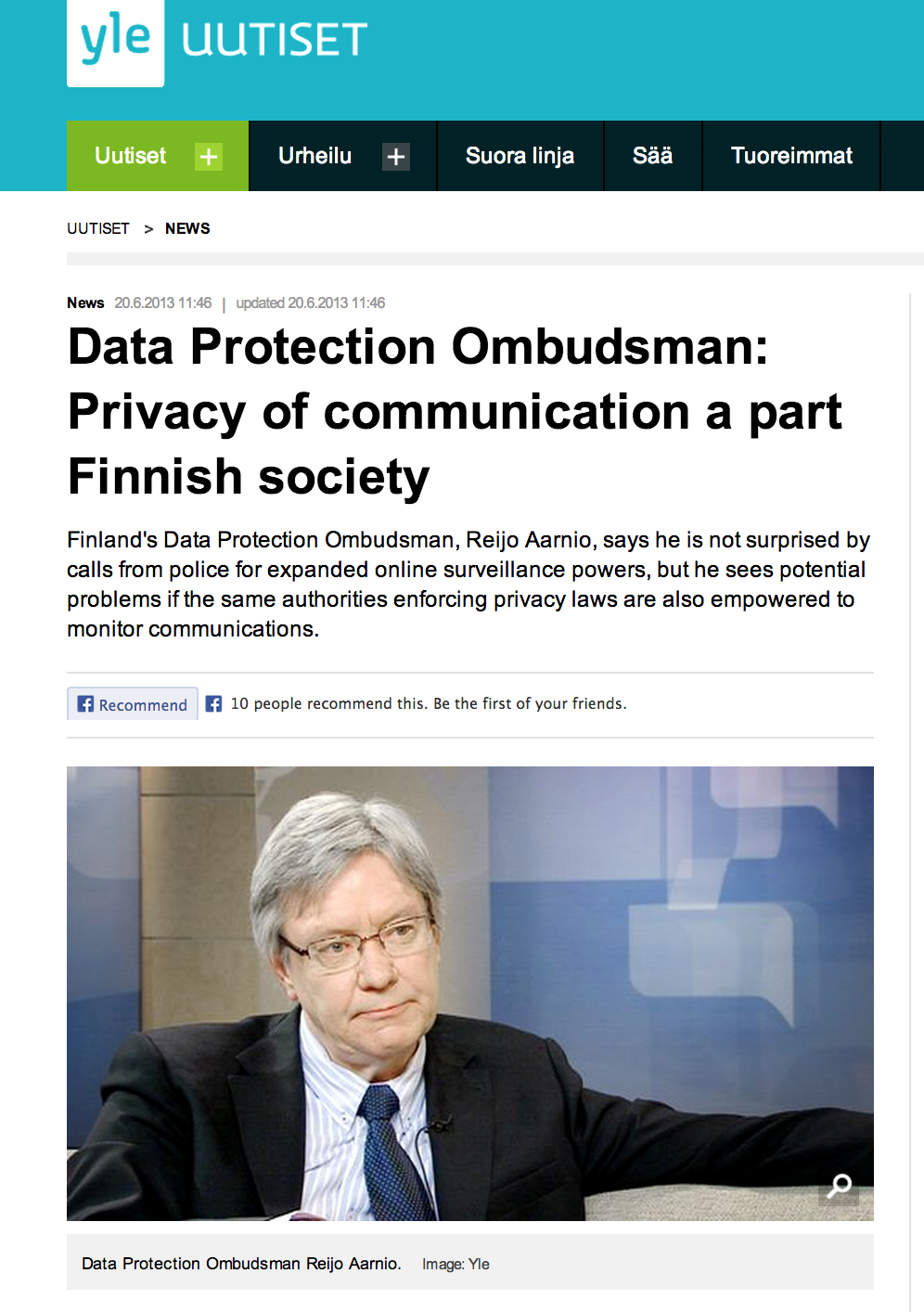
Finland’s Data Protection Ombudsman, Reijo Aarnio, correctly poited out that a new set of problems would arise if the police expand their surveillance rights.

“When expanded police powers are proposed, there should always be an evaluation of what the effects will be,” he said. “That includes a determination of whether an envisaged threat has changed so much that these powers are genuinely needed.”


  • Previous
  • 1
  • …
  • 248
  • 249
  • 250
  • 251
  • 252
  • 253
  • 254
  • …
  • 359
  • Next
Read more about documentary film
Read more

Recent Posts

  • Lahti is the latest city to prohibit the niqab and burka
  • Finland’s tabloids Iltalehti and Ilta-Sanomat are the pits
  • Riikka Purra’s Dr Jekyll and Mr Hyde mask
  • Double standards
  • Perussuomalaiset: Uusi logo, sama vanha juttu

Recent Comments

  1. Absolutely Socking: Racist Finnish Facebook group against human rights gets flooded with socks on Musta Barbaari’s mother and sister charged by the police in “ethnic profiling” case
  2. Ilkka Nuotio on Pekka Myrskylä: “Tilastot kertovat toista kuin poliittinen keskustelu”
  3. Genrih Soinkara on The war in Ukraine and the Russian-Finnish border crisis are showing Finland’s ugly side
  4. Ahti Tolvanen on Comment by Ahti Tolvanen on the Helsinki +50 conference
  5. Angel Barrientos on Angel Barrientos is one of the kind beacons of Finland’s Chilean community

Archives

  • June 2026
  • May 2026
  • April 2026
  • March 2026
  • February 2026
  • January 2026
  • December 2025
  • November 2025
  • October 2025
  • September 2025
  • August 2025
  • July 2025
  • June 2025
  • May 2025
  • April 2025
  • March 2025
  • February 2025
  • January 2025
  • December 2024
  • November 2024
  • October 2024
  • September 2024
  • August 2024
  • July 2024
  • June 2024
  • May 2024
  • April 2024
  • March 2024
  • February 2024
  • January 2024
  • December 2023
  • November 2023
  • October 2023
  • September 2023
  • August 2023
  • July 2023
  • June 2023
  • May 2023
  • April 2023
  • March 2023
  • February 2023
  • January 2023
  • December 2022
  • November 2022
  • October 2022
  • September 2022
  • August 2022
  • July 2022
  • June 2022
  • May 2022
  • April 2022
  • March 2022
  • February 2022
  • January 2022
  • December 2021
  • November 2021
  • October 2021
  • September 2021
  • August 2021
  • July 2021
  • June 2021
  • May 2021
  • April 2021
  • March 2021
  • February 2021
  • January 2021
  • December 2020
  • November 2020
  • October 2020
  • September 2020
  • August 2020
  • July 2020
  • June 2020
  • May 2020
  • April 2020
  • March 2020
  • February 2020
  • January 2020
  • December 2019
  • November 2019
  • October 2019
  • September 2019
  • August 2019
  • July 2019
  • June 2019
  • May 2019
  • April 2019
  • March 2019
  • February 2019
  • January 2019
  • December 2018
  • November 2018
  • October 2018
  • September 2018
  • August 2018
  • July 2018
  • June 2018
  • May 2018
  • April 2018
  • March 2018
  • February 2018
  • January 2018
  • December 2017
  • November 2017
  • October 2017
  • September 2017
  • August 2017
  • July 2017
  • June 2017
  • May 2017
  • April 2017
  • March 2017
  • February 2017
  • January 2017
  • December 2016
  • November 2016
  • October 2016
  • September 2016
  • August 2016
  • July 2016
  • June 2016
  • May 2016
  • April 2016
  • March 2016
  • February 2016
  • January 2016
  • December 2015
  • November 2015
  • October 2015
  • September 2015
  • August 2015
  • July 2015
  • June 2015
  • May 2015
  • April 2015
  • March 2015
  • February 2015
  • January 2015
  • December 2014
  • November 2014
  • October 2014
  • September 2014
  • August 2014
  • July 2014
  • June 2014
  • May 2014
  • April 2014
  • March 2014
  • February 2014
  • January 2014
  • December 2013
  • November 2013
  • October 2013
  • September 2013
  • August 2013
  • July 2013
  • June 2013
  • May 2013
  • April 2013
  • March 2013
  • February 2013
  • January 2013
  • December 2012
  • November 2012
  • October 2012
  • September 2012
  • August 2012
  • July 2012
  • June 2012
  • May 2012
  • April 2012
  • March 2012
  • February 2012
  • January 2012
  • December 2011
  • November 2011
  • October 2011
  • September 2011
  • August 2011
  • July 2011
  • June 2011
  • May 2011
  • April 2011
  • March 2011
  • February 2011
  • January 2011
  • December 2010
  • November 2010
  • October 2010
  • September 2010
  • August 2010
  • July 2010
  • June 2010
  • May 2010
  • April 2010
  • March 2010
  • February 2010
  • January 2010
  • December 2009
  • November 2009
  • October 2009
  • September 2009
  • August 2009
  • July 2009
  • December 2008
  • November 2008
  • October 2008
  • September 2008
  • August 2008
  • July 2008
  • June 2008
  • May 2008
  • April 2008
  • March 2008
  • February 2008
  • January 2008
  • November 2007
  • October 2007
  • September 2007
  • August 2007
  • July 2007
  • June 2007
  • May 2007

Categories

  • ?? Gia L?c
  • ????? ?????? ????? ???????? ?? ??????
  • ???????
  • @HerraAhmed
  • @mondepasrond
  • @nohatefinland
  • @oula_silver
  • @Varathas
  • A Pakistani family
  • äärioikeisto
  • Abbas Bahmanpour
  • Abdi Muhis
  • Abdirahim Hussein Mohamed
  • Abdirahim Husu Hussein
  • Abdirisak Mahamed
  • About Migrant Tales
  • activism
  • Adam Al-Sawad
  • Adel Abidin
  • Afrofinland
  • Ahmed IJ
  • Ahti Tolvanen
  • Aino Pennanen
  • Aisha Maniar
  • Alan Ali
  • Alan Anstead
  • Alejandro Díaz Ortiz
  • Alekey Bulavsev
  • Aleksander Hemon
  • Aleksanterinliitto
  • Aleksanterinliitto ry
  • Aleksanterinliitto ry:n hallitus
  • Alex Alex
  • Alex Mckie
  • Alexander Nix
  • Alexandra Ayse Albayrak
  • Alexis Neuberg
  • Ali Asaad Hasan Alzuhairi
  • Ali Hossein Mir Ali
  • Ali Rashid
  • Ali Sagal Abdikarim
  • Alina Tsui
  • Aline Müller
  • All categories
  • Aman Heidari
  • Amiirah Salleh-Hoddin & Jana Turk
  • Amin A. Alem
  • Amir Zuhairi
  • Amkelwa Mbekeni
  • Ana María Gutiérrez Sorainen
  • Anachoma
  • Anders Adlecreutz
  • Angeliina Koskinen
  • Anna De Mutiis
  • Anna María Gutiérrez Sorainen
  • Anna-Kaisa Kuusisto ja Jaakko Tuominen
  • Annastiina Kallius
  • Anneli Juise Friman Lindeman
  • Announcement
  • Anonymous
  • Antero Leitzinger
  • anti-black racism
  • Anti-Hate Crime Organisation Finland
  • Anudari Boldbaatar
  • Arshiya Nasser
  • Aspergers Syndrome
  • Asylum Corner
  • Asylum seeker 406
  • Athena Griffin and Joe Feagin
  • Autism
  • Avaaz.org
  • Awale Olad
  • Ayan Said Mohamed
  • AYY
  • Barachiel
  • Bashy Quraishy
  • Beatrice Kabutakapua
  • Beri Jamal
  • Beri Jamal and Enrique Tessieri
  • Bertolt Brecht
  • Boiata
  • Boodi Kabbani
  • Bruno Gronow
  • Carmen Pekkarinen
  • Çelen Oben and Sheila Riikonen
  • Chiara Costa-Virtanen
  • Chiara Costa-Virtanen
  • Chiara Sorbello
  • Christian Thibault
  • Christopher Wylie
  • Clara Dublanc
  • Dana
  • Daniel Malpica
  • Danilo Canguçu
  • David Papineau
  • David Schneider
  • Dexter He
  • Don Flynn
  • Dr Masoud Kamali
  • Dr. Faith Mkwesha
  • Dr. Theodoros Fouskas
  • Edna Chun
  • Eeva Kilpi
  • Emanuela Susheela
  • En castellano
  • ENAR
  • Enrique
  • Enrique Tessieri
  • Enrique Tessieri & Raghad Mchawh
  • Enrique Tessieri & Yahya Rouissi
  • Enrique Tessieri and Muhammed Shire
  • Enrique Tessieri and Sira Moksi
  • Enrique Tessieri and Tom Vandenbosch
  • Enrique Tessieri and Wael Che
  • Enrique Tessieri and Yahya Rouissi
  • Enrique Tessieri and Zimema Mhone
  • Epäluottamusmies
  • EU
  • Europe
  • European Islamophobia Report
  • European Islamophobia Report 2019,
  • European Union
  • Eve Kyntäjä
  • Ezequiel Caldeiro
  • Facebook
  • Fadumo Dayib
  • Faisa Kahiye
  • Farhad Manjoo
  • Fasismi
  • Finland
  • Fizza Qureshi
  • Flyktingar och asyl
  • Foreign Student
  • Fozia Mir-Ali
  • Frances Webber
  • Frida Selim
  • Gareth Rice
  • Ghyslain Vedeaux
  • Global Art Point
  • Great Replacement
  • Habiba Ali
  • Hami Bahadori
  • Hami Bahdori
  • Hamid
  • Hamid Alsaameere
  • Hamid Bahdori
  • Handshake
  • Harmit Athwal
  • Hassan Abdi Ali
  • Hassan Muhumud
  • Heikki Huttunen
  • Heikki Wilenius
  • Helsingin Sanomat
  • Henning van der Hoeven
  • Henrika Mälmsröm
  • Hser Hser
  • Hser Hser ja Mustafa Isman
  • Husein Muhammed
  • Hussain Kazemian
  • Hussain Kazmenian
  • Ibrahim Khan
  • Ida
  • Ignacio Pérez Pérez
  • Iise Ali Hassan
  • Ilari Kaila & Tuomas Kaila
  • Imam Ka
  • inside-an-airport
  • Institute of Race Relations
  • Iraqi asylum seeker
  • IRR European News Team
  • IRR News Team
  • Islamic Society of Norhern FInland
  • Islamic Society of Northern Finland
  • Islamophobia
  • Jacobinmag.com
  • Jallow Momodou
  • Jan Holmberg
  • Jane Elliott
  • Jani Mäkelä
  • Jari Luoto
  • Jari Taponen
  • Jegor Nazarov
  • Jenni Stammeier
  • Jenny Bourne
  • Jessie Daniels
  • Joe Davidow
  • Johannes Koski
  • John D. Foster
  • John Grayson
  • John Marriott
  • Jon Burnett
  • Jorma Härkönen
  • Jos Schuurmans
  • José León Toro Mejías
  • Josue Tumayine
  • Jouni Karnasaari
  • Juan Camilo
  • Jukka Eräkare
  • Julian Abagond
  • Julie Pascoet
  • Jussi Halla-aho
  • Jussi Hallla-aho
  • Jussi Jalonen
  • JusticeDemon
  • Kadar Gelle
  • Kaksoiskansalaisuus
  • Kansainvälinen Mikkeli
  • Kansainvälinen Mikkeli ry
  • Katherine Tonkiss
  • Kati Lepistö
  • Kati van der Hoeven-Lepistö
  • Katie Bell
  • Kättely
  • Kerstin Ögård
  • Keshia Fredua-Mensah & Jamie Schearer
  • Khadidiatou Sylla
  • Khadra Abdirazak Sugulle
  • Kiihotus kansanryhmää vastaan
  • Kirsi Crowley
  • Koko Hubara
  • Kristiina Toivikko
  • Kubra Amini
  • KuRI
  • La Colectiva
  • La incitación al odio
  • Laura Huhtasaari
  • Lauri Finér
  • Leif Hagert
  • Léo Custódio
  • Leo Honka
  • Leontios Christodoulou
  • Lessie Branch
  • Lex Gaudius
  • Leyes de Finlandia
  • Liikkukaa!
  • Linda Hyökki
  • Liz Fekete
  • M. Blanc
  • Maarit Snellman
  • Mahad Sheikh Musse
  • Maija Vilkkumaa
  • Malmin Kebab Pizzeria Port Arthur
  • Marcell Lorincz
  • Mari Aaltola
  • María Paz López
  • Maria Rittis Ikola
  • Maria Tjader
  • Marja-Liisa Tolvanen
  • Mark
  • Markku Heikkinen
  • Marshall Niles
  • Martin Al-Laji
  • Maryan Siyad
  • Matt Carr
  • Mauricio Farah Gebara
  • Media Monitoring Group of Finland
  • Micah J. Christian
  • Michael McEachrane
  • Michele Levoy
  • Michelle Kaila
  • Migrant Tales
  • Migrant Tales Literary
  • Migrantes News
  • Migrants' Rights Network
  • MigriLeaks
  • Mikko Kapanen
  • Miriam Attias and Camila Haavisto
  • Mohamed Adan
  • Mohammad Javid
  • Mohammad M.
  • Monikulttuurisuus
  • Monisha Bhatia and Victoria Canning
  • Mor Ndiaye
  • Muh'ed
  • Muhamed Abdimajed Murshid
  • Muhammed Shire
  • Muhammed Shire and Enrique Tessieri
  • Muhis Azizi
  • Musimenta Dansila
  • Muslimiviha
  • Musulmanes
  • Namir al-Azzawi
  • Natsismi
  • Neurodiversity
  • New Women Connectors
  • Nils Muižnieks
  • No Labels No Walls
  • Noel Dandes
  • Nuor Dawood
  • Omar Khan
  • Otavanmedia
  • Oula Silvennoinen
  • Paco Diop
  • Pakistani family
  • Pentti Stranius
  • Perussuomalaiset
  • perustuslaki
  • Petra Laiti
  • Petri Cederlöf
  • Pia Grochowski
  • Podcast-lukija Bea Bergholm
  • Pohjois – Suomen Islamilainen Yhdyskunta
  • Pohjois Suomen Islamilainen Yhyskunta
  • Polina Kopylova
  • Race Files
  • racism
  • Racism Review
  • Raghad Mchawh
  • Ranska
  • Rashid H. and Migrant Tales
  • Rasismi
  • Raul Perez
  • Rebecka Holm
  • Reem Abu-Hayyeh
  • Refugees
  • Reija Härkönen
  • Remiel
  • Reza Nasri
  • Richard Gresswell
  • Riikka Purra
  • Risto Laakkonen
  • Rita Chahda
  • Ritva Kondi
  • Robito Ibrahim
  • Roble Bashir
  • Rockhaya Sylla
  • Rodolfo Walsh
  • Roger Casale
  • Rostam Atai
  • Roxana Crisólogo Correa
  • Ruth Grove-White
  • Ruth Waweru-Folabit
  • S-worldview
  • Sadio Ali Nuur
  • Sami Rusanen
  • Sandhu Bhamra
  • Sara de Jong
  • Sarah Crowther
  • Sari Alhariri
  • Sarkawt Khalil
  • Sasu
  • Scot Nakagawa
  • Shabana Ahmadzai
  • Shada Islam
  • Sharon Chang blogs
  • Shenita Ann McLean
  • Shirlene Green Newball
  • Sini Savolainen
  • Sira Moksi
  • Sonia K.
  • Sonia Maria Koo
  • Steverp
  • Stop Deportations
  • Suldaan Said Ahmed
  • Suomen mediaseurantakollektiivi
  • Suomen Muslimifoorumi ry
  • Suomen viharikosvastainen yhdistys
  • Suomen viharikosvastainen yhdistys ry
  • Suomi
  • Supermen
  • Susannah
  • Suva
  • Syrjintä
  • Talous
  • Tapio Tuomala
  • Taw Reh
  • Teivo Teivainen
  • The Daily Show
  • The Heino
  • The Supermen
  • Thomas Elfgren
  • Thulfiqar Abdulkarim
  • Tim McGettigan
  • Tino Singh
  • Tito Moustafa Sliem
  • Tobias Hübinette and L. Janelle Dance
  • Transport
  • Trica Danielle Keaton
  • Trilce Garcia
  • Trish Pääkkönen
  • Trish Pääkkönen and Enrique Tessieri
  • Tuulia Reponen
  • Uncategorized
  • UNITED
  • University of Eastern Finland
  • Uyi Osazee
  • Väkivalta
  • Vapaa Liikkuvuus
  • Venla-Sofia Saariaho
  • Vieraskynä
  • W. Che
  • W. Che an Enrique Tessieri
  • Wael Ch.
  • Wan Wei
  • Women for Refugee Women
  • Xaan Kaafi Maxamed Xalane
  • Xassan Kaafi Maxamed Xalane
  • Xassan-Kaafi Mohamed Halane & Enrique Tessieri
  • Yahya Rouissi
  • Yasmin Yusuf
  • Yassen Ghaleb
  • Yle Puhe
  • Yuliet Tresa
  • Yve Shepherd
  • Zahra Khavari
  • Zaker
  • Zalina Ametova
  • Zamzam Ahmed Ali
  • Zeinab Amini ja Soheila Khavari
  • Zimema Mahone and Enrique Tessieri
  • Zimema Mhone
  • Zoila Forss Crespo Moreyra
  • ZT
  • Zulma Sierra
  • Zuzeeko Tegha Abeng
© 2026 Migrant tales | Powered by Minimalist Blog WordPress Theme