Sanewashing: the act or practice, especially in the media, of trying to make actions seem sane and normal when they are not.
Tabloids like Iltalehti and Ilta-Sanomat are the worst sanewashers and help to further spread racism and tear teeth off the media.
We haven’t seen this recently but historically tbloids have been the first to strike at migrants and minorities.
A billboard by Ilta-Sanomat that claims “10,000 illegal refugees” will come to Finland this year. As everyone know, there is no such thing as an “illegal” refugee.
There are many stories that the tabloids have brought to public attention to make life more difficult for disadvantaged minorities. One of these reporters is Mika Koskinen, whose demonization of migrants and minorities has found fertile ground thanks to the government of Prime Minister Petteri Orpo.
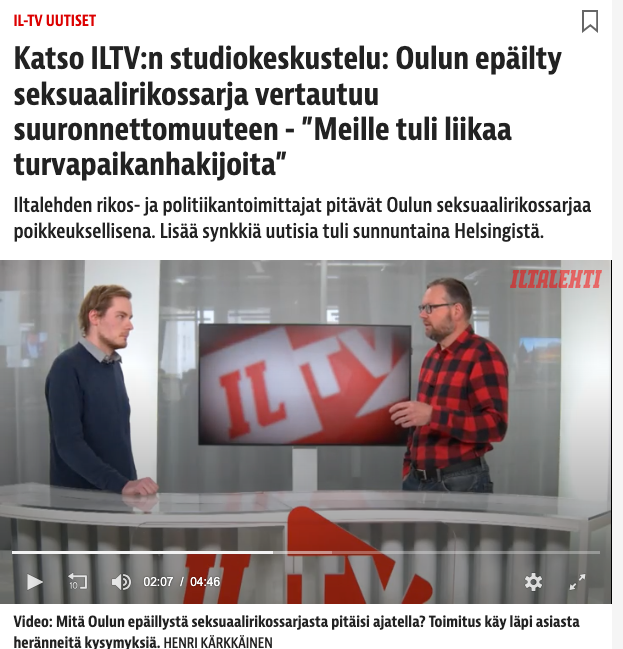
Below, is an interview where he paints with a single brush all refugees during the hysteria of the Oulu sexual assault cases. He is quick to lambast refugees and turning a blind eye to pedophilia of white Finns.
He was recently responsible for getting Salam, a schoolbook for Muslim children taken off the shelf because it taught the wrong things about Islam.
Timo Haapala’s question during a presidential debate is a bad example of how tabloid journalists suck up to prejudiced expectations. Haapala asked the presidential candidate if they would do away with dual citizenship of Russians.
Only Jutta Urpilainen (Social Democratic Party) and Li Anderson (Left Alliance) were opposed to such a plan.
“When we see others as the enemy, we risk becoming what we hate.”
Desmond Tutu
Desmond Tutu, the anti-apartheid activist who won the 1984 Nobel Peace Prize, warns that we risk becoming what we hate if we allow our hatred to get the best of us. If there is one party in Finland whose hatred has converted it to something toxic and pathological, that party is none other than the Perussuomalaiset (PS)*.
The PS and its politicians, like Riikka Purra, act like Dr Jekyll and Mr Hyde. On the one hand, they may make reasonable statements and then go off the wall with their usual xenophobia.
At a recent party convention in Helsinki, Purra said: “I don’t want left-wing and Center Party-led ‘red-brown’ governments at the helm of our country; I don’t want massive tax hikes; and I don’t want the government’s top priority to be recognizing Palestine—as Vice Chair (Nasima) Razmyar just outlined.”
Apart from threatening to take away social welfare for people who have lived here for less than ten years, she made it a point with Interior Minister Mari Rantanen that white Finns will not have to change anything when more foreigners move to the country.
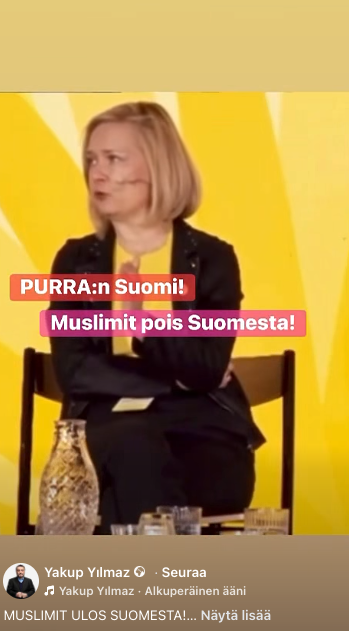
Blow is an example of the PS’ Mr Hyde mask.
Interior Minister Mari Rantanen (left) and Finance Minister Rikka Purra stated that Muslims should be kicked out of Finland. “Finland and Finnishness are based on Christian values,” said Rantanen. Purra considered Islam an “aggressive” culture that is preying on Finns’ tolerance, friendliness, and kindness. “But Finns must not give up their language, culture, values, nothing to such groups.”Facebook
Finland’s central figures in the Islamophobia network:
“PS continues to be one of the most important platforms of Finland’s Islamophobic network. All of the elected 46 MPs (out of a total of 216) of the Finns Party based their campaign on anti-Muslim and xenophobic themes. PS ministers like Riikka Purra (Finance), Mari Rantanen (Interior), Wille Rydman (former Economic Affairs), Leena Meri (Justice), Ville Tavio (Foreign Trade), and Jussi Halla-aho (Speaker of Parliament) have all spread the Great Replacement theory with little to no consequences. Tavio and the government have gone as far as to link development aid to accepting deportees. MEP Sebastian Tynkkynen, who has three ethnic agitation convictions, and MP Kaisa Garedew both want Islam to be banned in Finland. Halla-aho, who was convicted in 2012 of ethnic agitation and of breaching the sanctity of religion, pressed charges against a comedian and deputy Helsinki councilor for calling him “a fascist.”
Finland was the first country in Europe to grant women the right to vote in 1906. This is true, but it is only half of the story: Finnish women were granted the right to pass on their citizenship to their children (jus sanguinis)only in 1984, that is, 66 years after independence!
The amendment to the Citizenship Act (HE 43/1984) entered into force on 1 September 1984 with the support of Parliament, as well as that of President Mauno Koivisto and Minister of the Interior Matti Luttinen, also a Social Democrat.
Apart from the 63 women MPs at the time, which amounted to 31.5% of all lawmakers, men MPs pushed for a change in the Act.
Finland had already amended the Citizenship Act of 1920 by allowing a child of a Finnish mother to acquire Finnish citizenship if the father was unknown.
However, women in Europe did not have a general right to pass on their citizenship to their children. The situation began to change after the Second World War, when several countries, such as France, Spain, and Italy, granted women equal citizenship rights. Between 1970 and 1990, many European countries reformed their legislation.
The restriction was far from harmless. For example, I could not obtain Finnish citizenship because only my mother was Finnish. This meant that I had to do my military service in Argentina during the so-called Dirty War, one of the most violent periods in the country’s history, during which around 30,000 people disappeared. My life would have been very different if I had had the right to Finnish citizenship.
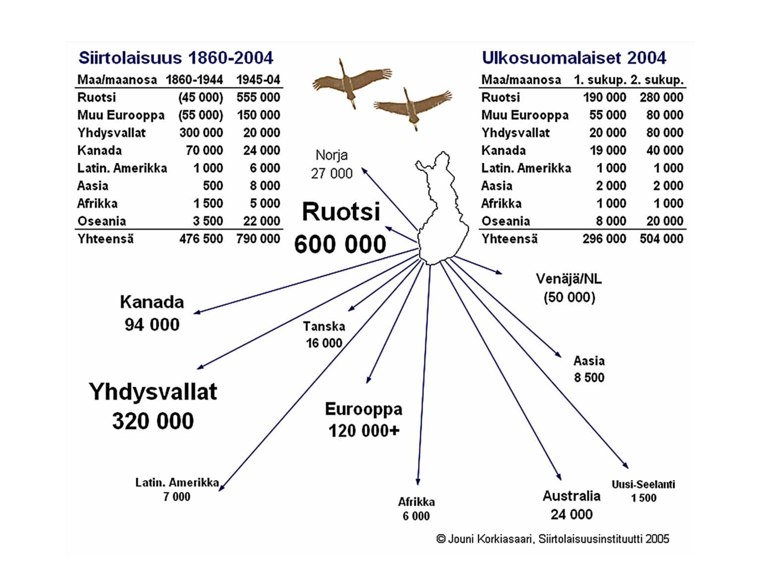
What makes the issue even more interesting is that Finland was a country of emigration between 1860 and 1999, during which approximately 1.2 million Finns moved abroad. In addition to being a clear case of gender discrimination, one may ask: did the authorities fear that foreign men would “take” Finnish women and that so-called “mixed-race” children would be born?
Finland used to be a country of emigration. Before the Second World War, most of the emigration was to North America. After World War 2 most Finns moved to Sweden.
Whatever the case, Finland should give an apology to women and those children who were discriminated because of the law.
“Racism is like a Cadillac, they bring out a new model every year.”
Malcolm X
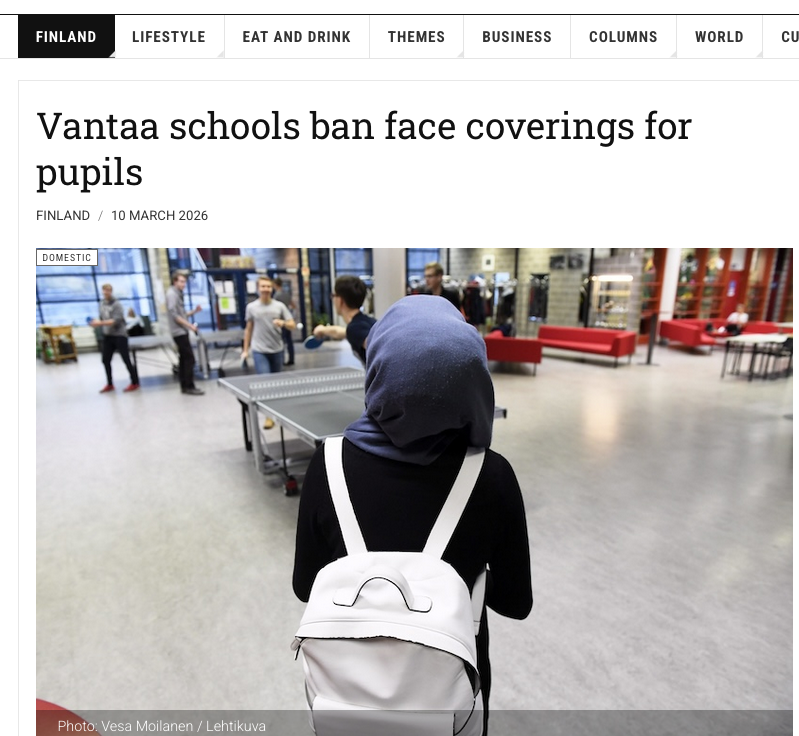
Even if far-right politicians of the Perussuomalaiset (PS) were yelling victory because the city of Vantaa had prohibited – according to them – the niqab and burqa, it was a now-you-see-it-now-you-don’t moment.
Even if PS politicians said the prohibition was aimed at the niqab and burqa, the Vantaa school district denies this. “The policy applies to covering the face during the school day, meaning that students are not allowed to cover their faces with any type of clothing or mask,” said Tua Tähkapää, a communications specialists for the city of Vantaa, who replied to Migrant Tales’ questions sixteen days later.
Tähkäpää continues: “The city of Vantaa has not banned the wearing of any specific type of clothing. It would be against the law to ban, for example, specifically the niqab or burqa. The policy applies to covering the face during the school day, meaning a student may not cover their face with any type of clothing or mask. We are not aware of any complaints.”
If the measure by the city of Vantaa was not singling out Muslims, why wasn’t this mentioned in the first stories?
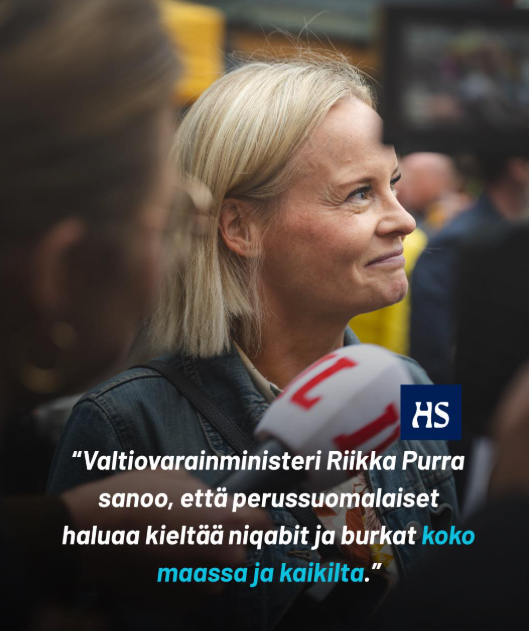
PS Finance Minister Riikka Purra exposes the final aim of the prohibition”…the PS wants to prohibit the niqab and burqa in Finland and everyone.”
The policy in Vantaa, which is epxected to be adapted in Espoo and Tampere comprhensive schools, follows a debate about face-covering clothing in public schools. The imatter got national attention last year when some politicians especially from the PS and National Coalition Party raised the possibility of in broader restrictions on the usage of the burqa and niqab.
If you want a shameful example of appeasement to the Trump administration’s and Israel’s war crimes, Foreign Minister Elina Valtonen is a terrible example. In the face of the ethnic cleansing in Gaza by Israel, her most infamous quote is that “Israel has a right to defend itself.”
But what could you expect when the prime minister and president are members of the National Coalition Party?
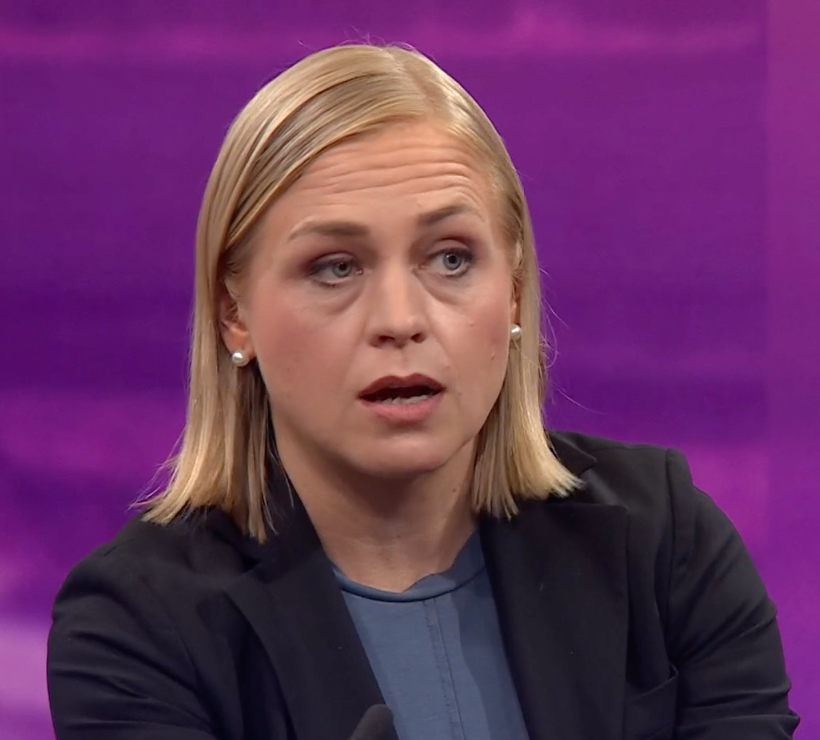
Foreign Minister Valtonen was on A-Talk Monday and she was asked by the reporter her opinion about the illegal war waged by the US and Israel against Iran.
“For us Finns, it is important that international law works,” she said, and then the reporter asked her if he thought it was politically ok that the US and Israel have waged an illegal war against Iran. Her answer revealed her ideological bankruptcy: “I cannot give you a straight answer.”
Finland’s Foreign Minister Elina Valtonen. Link and Yle
This blog entry is dedicated to the late Donald Fields, Helsinki correspondent of the BBC, The Guardian, and Politiken to 1988, who wrote critically about Finlandisation.
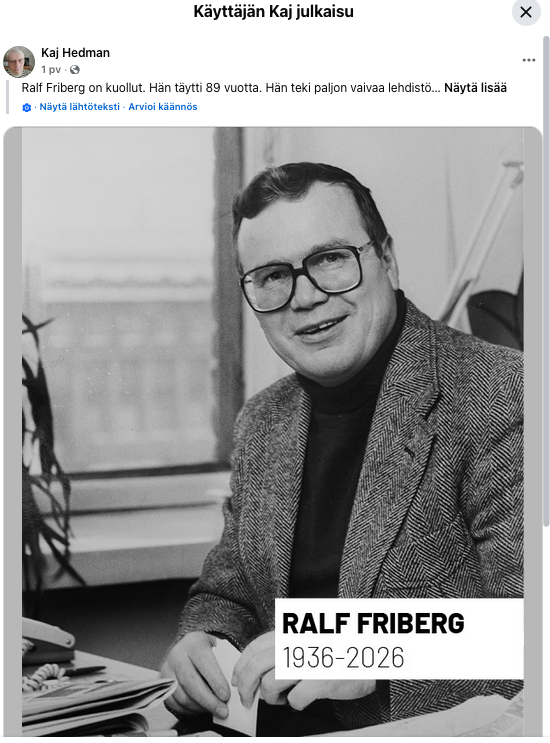
Ralf Friberg held several roles, from ambassador to the head of the foreign ministry’s press section, which closely watched what was written about Finland during the Cold War. His methods to shut them up. He was so ruthless that even one of his former colleagues gave him the nickname “Leonid.”
At one lunch meeting at Helsinki’s Savoy restaurant, Friberg suggested that before I write on the sensitive topic of Finlandisation, I should get in touch with him. I considered this outright censorship.
Details of our lunch date were published in Finland’s biggest daily, Apu magazine.
The following day after the story was published, I got phone calls from some of Friberg’s former employees who thanked me for what I did and said that Friberg was a terrible person who would go to any lengths to destroy a person’s career.
The revelation also exposed the open relationship that Friberg had with the Financial Times. He would directly complain to the editors about my writing.
The Financial Times had no problems with Finnfacts paying for their journalists’ visit to Finland as long as they published something positivve.
Groups like Finnfacts, under Matti Kohva, also monitored the foreign media. I remember an article Kohva wrote in Finn Niche, a publication edited by Olli Virtanen, in which he said his blood boiled whenever he heard foreign journalists cite Finlandisation.
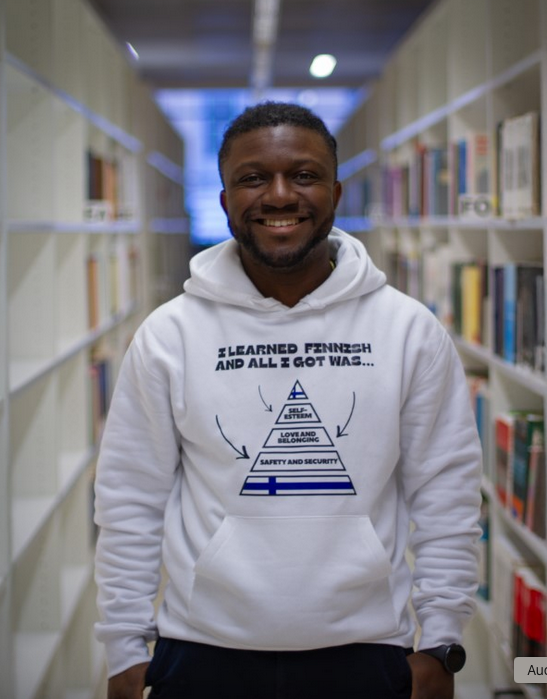
Oheneba “Ohe” Poku-Marboah, a software developer with an international background, has launched a project to help immigrants learn Finnish by sharing the real experiences of people who have successfully learned to speak the language.
Oheneba “Ohe” Poku-Marboah. Photo by Olga Kryuchkova
The project was created by a developer who moved to Finland as a child and later realized how crucial the Finnish language is for integration and career opportunities.
Although he arrived at age 11 and completed most of his education in English-language schools, he said the importance of learning Finnish only became clear after graduation.
“I suddenly realized that in the real world, many opportunities require Finnish,” he told Migrant Tales. “That’s when I decided I had to take the language seriously.”
The idea for the project began in 2022 when he started reflecting on why some immigrants succeed in learning Finnish while others struggle. Conversations in everyday settings — including a chance discussion in a barbershop — helped spark the concept.
“I realized I’m not the only one who has managed to do this,” he said. “So I thought: why not let people share their stories about how they learned Finnish?”
The website, How I Learned Finnish – with Ohe, features inspiring success stories of immigrants who arrived in Finland as adults and eventually achieved a high level of fluency. The interviews are available on the website as well as on YouTube and podcast platforms.
While creator Poku-Marboah says he appreciates all the stories, three stand out for him: the language-learning journeys of Deborah Laajanen, Kseniia, and Jamie McDonald.
Those featured in the project include people who have gone on to study at Finnish-language universities, work professionally in Finnish, and even perform stand-up comedy in the language.
Laajanen, for example, entered law school at the University of Helsinki after learning Finnish in just a few years. McDonald began performing stand-up comedy in Finnish despite starting from zero as an adult learner. Kseniia describes discomfort as the engine of language learning, not an obstacle.
Poku-Marboah himself took a similar approach. At times, he told people he did not speak English, forcing conversations to happen in Finnish.
A recurring theme in the interviews is the role of identity in language learning. According to Poku-Marboah, many successful learners first made a conscious decision to see Finland as their home.
“For many people, it’s identity-based,” he said. “Once they decide they belong here and want to be part of society, learning the language becomes much easier.”
He also stresses the importance of consistent practice and immersion.
The project currently includes around a dozen interviews and has been entirely self-funded. Poku-Marboah hopes the stories will inspire newcomers navigating life in Finland.
“I felt something like this should exist,” he continued. “If someone is trying to learn Finnish, they can see how others in similar situations managed to do it.”
Despite receiving little response so far from the media he contacted, he plans to keep the project online so immigrants and students can continue learning from others’ experiences.
His message to newcomers is simple: aim high — and commit fully to life in Finland.
Kasvot peittävän niqabin ja burkan käyttöä ollaan rajoittamassa Vantaan peruskoulussa. Tämä näyttää selvältä voitolta maahanmuuttovastaiselle Perussuomalaiset-puolueelle sekä Kansallinen Kokoomus-puolueelle, jotka molemmat kuuluvat hallitukseen.
Islamofobiaa tutkiva tutkija Farid Hafez kirjoitti sähköpostiviestissään: “On selvää, että kasvot peittävän hunnun kielto toimii esivaiheena laajemmalle hijab-kiellolle, koska se luo ennakkotapauksen. Kun tällainen kielto hyväksytään, hijab-kiellon laajentaminen voi edetä peruskouluista toisen asteen kouluihin, lukioihin, yliopistoihin ja julkisiin virastoihin. Tämä on ollut julkilausuttu tavoite Itävallassa.”
Olemmeko Suomessa samalla liukkaalla tiellä?
Suomen muslimiforuumi vastusti kieltoa viime vuonna antamassaan lausunnossa: “Suomen tulee olla maa, jossa jokaisella on oikeus uskonnonvapauteen ja yhdenvertaisuuteen ja jossa vähemmistöjen symboleja ei käytetä poliittisina aseina. Tarvitsemme enemmän vuoropuhelua ja ymmärrystä – emme populistisia kieltoja, jotka vain jakavat yhteiskuntaa.”
Puolueiden kuten Perussuomalaiset ja Kansallinen Kokoomus käyttämät perustelut uskonnollisen pukeutumisen kieltämiseksi kouluissa eivät liity tyttöjen “vapauttamiseen”. Päinvastoin, ne paljastavat suvaitsemattomuuden synkemmän puolen.
Olen ottanut yhteyttä Vantaan kaupunkiin ja kysynyt, kuinka moni peruskoulun oppilas käyttää niqabia tai burkaa. Lähetin kysymyksen torstaina, mutta vastausta ei ole vieläkään tullut.
Vantaan perusopetuksen johtaja Ilkka Kalo on perustellut niqab-kieltoa turvallisuussyillä sekä opettajien käytännön tarpeilla. Kalon mukaan vain muutama oppilas on saapunut kouluun kasvot peittävissä vaatteissa.
The decision to ban face coverings at Vantaa comprehensive schools appears for some as a slippery slope to more bannings. Moreover, it is like a long concerted plan by anti-immigration parties like the Perussuomalaiset to chip away at cultural diversity at the cost of white nationalism.
The decision by the City of Vantaa reminded me of one in a small town in Spain that prohibited the niqab because one, yes one, woman wore the niqab.
The Finnish Muslim Community spoke out against the ban in a statement last year: “Finland must be a country where every person has the right to freedom of religion and equality, and where the symbols of minorities are not used as political weapons. We need more dialogue and understanding, not populist bans that only divide society.”
ilkka Kalo, director of basic education in Vantaa, said the decision to ban the niqab was due to safety requirements and the practical needs of teachers.
“For safety and identification reasons we must know who is present in schools,” Kalo was quoted as saying in Helsinki TImes. “Teachers also have a duty to assess pupils, and they must be able to recognise them.”
US Secretary of State Marco Rubio is an opportunist sycophant without principles. Despite Rubio’s complicity in doing away with USAID and cuin the death of 14 million people, vacillating Finland Foreign Minister Elina Valtonen only had praise for Rubio’s speech at Munich Security Conference, which Valtonen saw as a reaffirmation of the US’ commitment to Nato’s article 5 and spreading “freedom (sic!).”
Hypocrisy is one of Rubio’s and the Trump administration’s qualities.
In an interview below, the reporter asks why Rubio’s grandfather was not deported after he received a negative decision to stay in the country.
“Your grandfather Victor García received in 1962 a deportation order and was illegally in the US until 1967,” the reporter said. “Why did your grandfather get the support of the authorities and the generosity of the country, and why don’t you do the same [in the face of ICE raids]? It’s hypocrisy.”
Rubio deflects the statement of the reporter by saying what happeed to his grandfather was different than today.
Is it?
If there is one factor that is shameful, Rubio’s speech laid out in the open at the Munich Security Conference was his call to defend white, western, Christian civilisation against contaminating racialised migrants and the standing ovation he received from European elites.
I’m certain that Valtonen was one person that gave Rubio his standing ovation.
Moreover, not a word about the illegal kidnapåing of Venezuelan President Nicolás Maduro and his wife and claiming that he now ruled the South American country.
If Trump gets impeached after the midterms, it’s clear that Rubio will end up in the trashcan of history.