The government fuels two matters: loss of credibility and polarization of society.
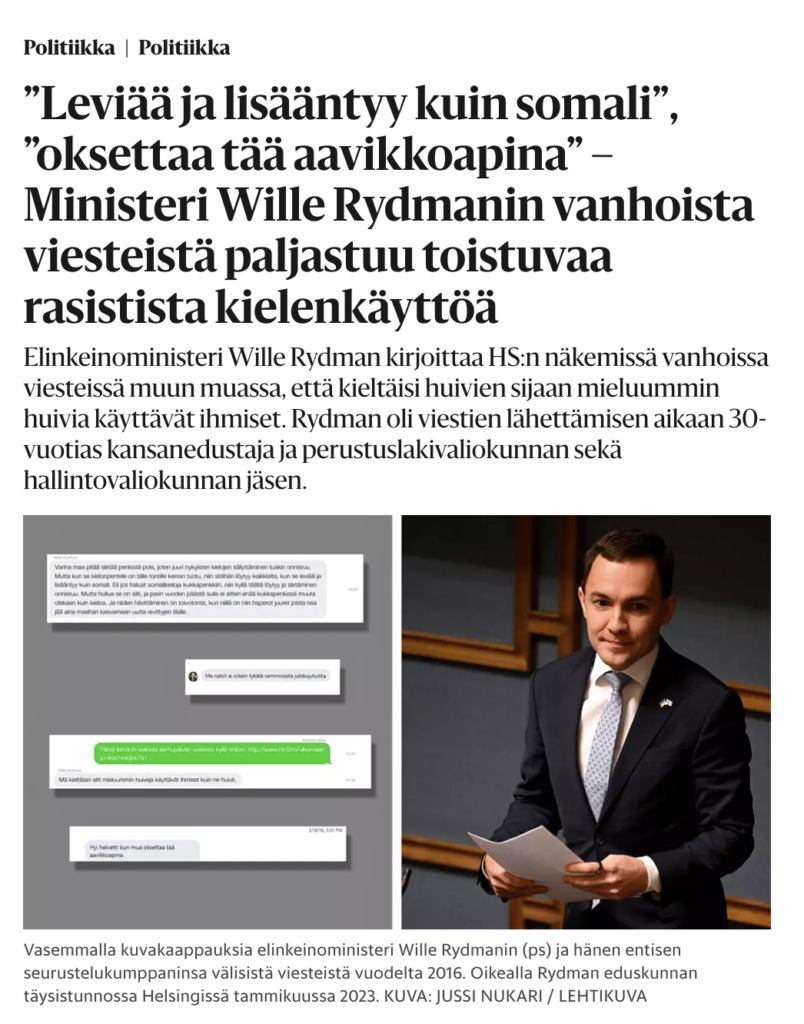
Prime Minister Petteri Orpo’s government, considered the most right wing since the 1930s, faced a storm of controversy on its first day not because of its austerity program, which will hit the most vulnerable sectors of society, but because of its embarrassing links to neo-Nazis and racism.
Headlined Euronews: “Racism and rape fantasies: The PR headache facing Finland’s new right-wing government.” Madrid-based El País writes: “The far-right will control seven key ministries in the Finnish government.”
The Times of Israel doesn’t beat round the bush either: “[Minister of Economic Affairs] Vilhelm Junnila says previous [neo-Nazi] behavior was ‘foolish and immature’; another key figure in new government, House Speaker Jussi Halla-aho, also has history of racist remarks.”
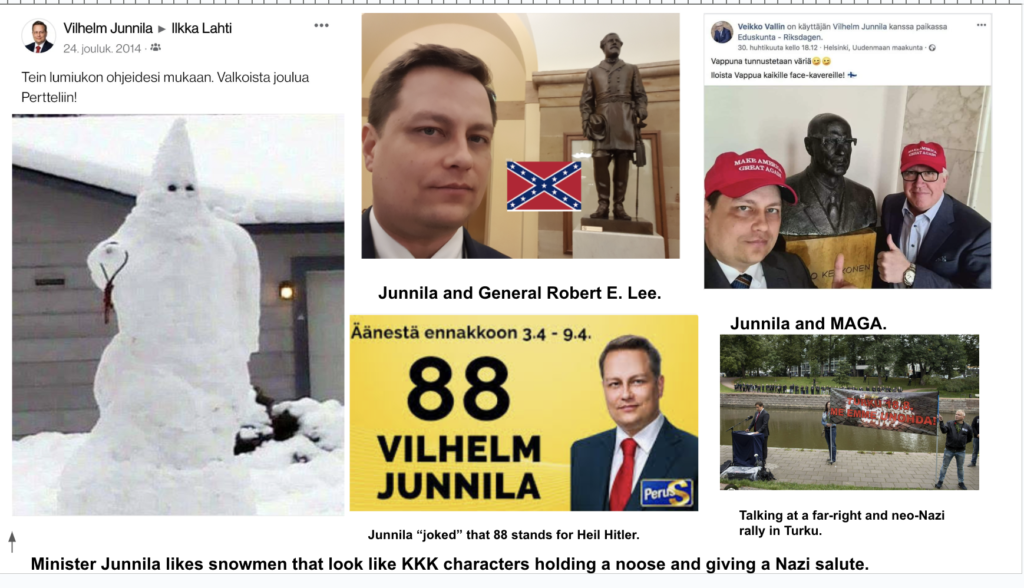
Apart from taking part in a rally organized by far-right groups, Junnila congratulated in 2019 a PS candidate for receiving the 88 election number. “First of all, congratulations on an excellent election number,” he was quoted as saying in The Times of Israel. “I know it’s a winning card.”
As everyone knows, 88 is code used by neo-Nazis to mean “Heil Hitler,” or “HH.”
It is odd why Junnila now apologizes for such inappropriate behavior.
Minister Junnila, who claims to not house any extremist views, now apologizes for his “88” comment: “Those who know me, know that I am a moderate. I do not belong to any nationalist organisations [sic], nor do I plan joining any.”Source: Twitter
Junnila and former MP Veikko Vallin, givng the thumbs up with their MAGA caps. Source: Facebook
Finland’s new interior minister, Mari Rantanen of the Perussuomalaiset (PS)* party, wrote on her webpage before the April general election: “We mustn’t be so naive [naive in Finnish means being ‘blue-eyed’] that soon we won’t be blue-eyed.”
The posting can no longer be found on her webpage.
In a recent interview with Iltalehti, Rantanen, who is a nurse with police basic training, elaborated on her “blue-eye” comment.
Iltalehti: “What did you mean that soon we won’t have any blue-eyed people [in Finland]?
Rantanen:“I meant exactly what it says.”
Iltalehti:“In your opinion, are blue-eyed people better than others?”
Rantanen:“Just like I said, it states what I meant. The focus is not on racial policies, that is not the issue at hand.
At the heart of National Socialist racial doctrine is the maintenance of the traits of the ‘Aryan race’, such as superiority and maintenance of blond hair and blue eyes. Ethnic cleansing has been practiced in various parts of the world in the name of such a doctrine.
Among the most famous people responsible for committing genocide is Adolf Hitler’s who used it against Jews, the mentally handicapped, homosexuals, Slavs, and Roma.
Finland’s new Interior Minister Mari Rantanen’s sympathies for racism and fascism are evident in this cartoon published before the municipal election, where she throws in the trash can parties like the Social Democrats, Center Party, Left Alliance and in the recycling bin concepts like BLM, globalism, Antifa, feminism and communism.
Riikka Purra is the chairperson of the radical right Perussuomalaiset (PS)* party, which has made its political career by bullying minorities like Muslims. Since most of their xenophobic arguments are based on lies and smears, it should not surprise anyone that they’d break their election promises rapidly.
One of the biggest promises that the PS made during before the election was that they would not accept any austerity measures that would affect the most vulnerable sectors of society like the unemployed, single mothers and others.
The original campaign promise and how Purra eventually ate her words: “The difference between parties like the National Coalition Party and us is that they want to cut [social] support for lower-income people. This is unacceptable for us.”
If you look at the new government’s program, the biggest cuts will be made in health care (1.3 billion) and social security (1.2 billion) to the tune of 2.5 billion euros. It’s clear that such cuts are going to bite hard at those people who depend on social welfare to make it through the month.
How Purra flip-flops on her promise: “We are happy with the [government] program and the PS has decided to form part of this government. There were no dissenting voices. The decision was unanimous.”
Dmitry Gurbanov Tweeted that Purra’s U-turn is a Finnish record!
Suosittelen, että jokainen katsoo tämän videon ja jakaa sen eteenpäin vaikka omille persu tutuille. Tämä on takinkäännön SM-ennätys. Saat mitä tilaa? pic.twitter.com/xaZm8EN0nh
Riikka Purra flip-flops on her original promise that she would not accept to form part of a government that will cut social security befits of the most vulnerable sectors of society. Her promises are just as big lies as her xenophobic rhetoric. Source: Twitter
An immigration policy founded on racism and suspicion is bound to fail.
The tightening of the new government’s immigration policy, which has instilled fear among non-EU migrants, asylum seekers, and disappointment from the Confederation of Finnish Industries (EK) for hindering to facilitation foreign labor from outside the EU, is risky for a number of reasons.
If one reads the new government’s immigration policy, it’s clear that it was drafted by politicians who see migration from outside the EU as a threat. For non-EU migrants the message is clear: leave, we don’t want you here.
Just like former Prime Minister Juho Sipilä’s government (2015-2019), the new government plans to treat Finns and foreigners unequally concerning social welfare.
Section 6 of the constitution is crystal clear: “Everyone is equal before the law.”
Thus, if you want to lower social welfare benefits to non-FInns, you just lower them for Finns as well if you want it to be in line with the constitution.
Many of the proposals by the new government are in conflict with our constitution and international law, according to Helsingin Sanomat.
The new measures are intended primarily for those who voted for the radical right Perussuoalaiset (PS)* party and the National Coalition Party.
It is ironic that the government’s new immigration policy is published during one of the worst shipwreck disasters in the Mediterranean, where hundreds of people are believed to have drowned off the coast of Greece.
If you look at other countries like Canada, the US, Argentina and others that have a long history with migrants, they are not perfect and problematic, but there is one matter that unites them: pathways to inclusion, an opportunity to become a part of society, real or imagined. In Finland, there are still no such paths.
As a Tunisian who has spent the last three years in Finland, I often find myself reflecting on recent events that have influenced my life. The revolution in Tunisia is known for having been “from the people, [but] appropriated by the others.” This phrase resonates with me deeply, as I can relate to the highs and lows, the gap between expectations and reality, and the stark difference between what the media portrays and the actual situation.
One word that carries great power in this context is “the media,” and for good reason. The media has a significant impact on how people perceive their world and how they formulate their beliefs. It plays a crucial role in shaping public opinion and influencing societal attitudes. The media can either promote understanding, empathy, and inclusivity or perpetuate prejudice, discrimination, and exclusion.
When I think about the challenges faced by immigrants trying to integrate into a new community, the metaphor of a “foreign body” comes to mind. Just as an organism can reject an organ or implant, a society can be as hostile towards immigrants who want to fit in and participate as full members. Prejudice, discrimination, language barriers, and other obstacles contribute to social exclusion, segmented neighborhoods, and isolation, hindering the development of a cohesive and inclusive social fabric.
Overcoming these obstacles requires a society that fosters tolerance, empathy, and open-mindedness toward newcomers. Just as the immune system must be modified to accept “the foreign body,” the culture of a society needs to make it possible to embrace diversity and provide equal opportunities for all. Education plays a crucial role in this process by promoting cultural awareness, intercultural discourse, and improving language abilities.
But when the media is predominantly biased, it erects barriers against the “foreign body” and fails to give a voice to immigrants. The media’s portrayal of immigrants can shape public perceptions and influence societal attitudes. Negative or stereotypical portrayals perpetuate societal preconceptions and hatred, while the lack of diverse representation in the media hinders communication and feeds biases.
The Finnish media, in particular, has been a source of cultural shock for me. Much like the media back home, it often presents a negative and disturbing image, which can be subtly regarded as racist. This portrayal in the media reinforces stereotypes and perpetuates discrimination. For Finland to truly embrace diversity and inclusivity, the media must take on a more inclusive and impartial role. Journalists and media experts should make an effort to portray immigrants and their contributions to society in a nuanced and factual way, highlighting inspiring stories and a variety of experiences that accurately depict the realities of cultural diversity.
The Finnish media also has a responsibility to uphold ethical reporting standards and combat prejudice by discouraging hate speech. Fact-checking, diversifying information sources, and encouraging intercultural conversation are crucial steps toward fairer reporting. Failure to do so not only spreads prejudice and stereotypes but also poses a significant risk, as biased and deceptive media can become the perfect platform for opportunistic politicians to rise to power and manipulate public opinion.
In the face of the growth of extremist politicians and parties, it is essential to recognize the potential risks posed by a biased and even deceptive media. Such politicians target the disenchanted, the manipulated, and the frustrated electorate, using the media’s power to formulate public opinion to their advantage. They exploit the portrayal of immigrants as outcasts, even monsters, winning the support of individuals who feel marginalized by the current political climate. Furthermore, they understand the influence they can have on younger generations, who are already shaping society and are particularly susceptible to media influence.
I am often asked about my experience in Finland and whether I encountered any culture shock. In most cases, unless I am talking to people I trust and know well, I tend to give a half-truth response to avoid long and pointless debates where my thoughts might be disregarded due to my background and as a newcomer still learning and struggling with the language. I usually say, “I really enjoy it here, and Finland has my heart.” I mention the country’s robust social and political system, natural beauty, favorable weather, and cultural diversity. This answer helps me navigate discussions without getting caught up in unnecessary arguments.
However, if I were to speak truthfully, the cultural shock I experienced in Finland was primarily due to the Finnish media. As I mentioned earlier, in many ways, it was reminiscent of what I had experienced back home. Most of the time, the media presents a negative and disturbing image that could be subtly regarded as racist—an insidious form of racism. This is where my culture shock originated.
The Finnish media must adopt a more inclusive and impartial role, akin to the adaptive immunological response of the body. Journalists and other media experts can be linked to antibodies, who should make an effort to portray immigrants and their contributions to society in a nuanced and factual way. This entails highlighting inspiring stories, triumphs, and a diverse range of experiences that accurately depict the realities of cultural diversity.
The Finnish media also bears responsibility for spreading prejudice and stereotypes when ethical reporting standards are not upheld. To curb the dissemination of hate speech and advance a more accurate portrayal of immigrants, fact-checking, diversifying information sources, and encouraging intercultural conversation are crucial steps towards fairer reporting.
The new right-wing government of National Coalition Party (NCP) Prime Minister-designate, Petteri Orpo published its government program Saturday. With respect to migrant policy, it reinforces what many have feared: deep-rooted suspicion of migrants.
The new government, which is considered to be the most right-wing since the 1930s and the most anti-immigration in a long time, is made up of the NCP, radical-right Perussuomalaiset(PS)*, Swedish People’s Party, and Christian Democrats.
The tightening of immigration policy in the government program also reveals that, apart from keeping migrants on short leashes, such people are second-class members of society with fewer rights. Disenfranchisement and suspicion are good words to describe the new government’s policy.
By changing citizenship requirements from five to eight years is a prime example of disenfranchisement. If you cannot vote, for example, your oppressors can keep you marginalized.
Other draconian changes include making asylum temporary. It also has the same message: we don’t want you, we don’t like you – Finland will never become your new home.
In order to get a permanent residence, you need to live six years in the country. If you make, however, 40,000 euros a year, you can get a permanent residence in four years. But be careful! If you become unemployed, you will have to leave the country if you cannot find new employment in three months.
Under the threat of a fine, employers must inform the Finnish Immigration Service about the unemployed employee.
The further disenfranchisement of migrants will lead to greater abuse by employers and the Finnish system in general.
Also, when applying for a permanent residence, you will be given a Finnish- or Swedish-language test to prove that you have basic language skills.
The government program also shows that migrants are an economic commodity.
An immigration and inclusion policy based on deep-rooted suspicion and racism always fails.
It was a very tough week in Sweden. One boy was stabbed to death in the Stockholm suburb of Älvsjö, there were also three shootings in Stockholm where a 15-year-old died and many others were treated in hospital for their wounds.
With dog whistles, parties like the Perussuomalaiset (PS)* and even the National Coalition Party (NCP), cherry-pick news in Sweden to push their xenophobic agendas.
Despite the terrible news from Sweden, the media and politicians revert to their simplistic arguments: It’s all the migrants’ fault.
Migrants’ fault? What about all the social services that have been subcontracted and made redundant in Sweden?
Has anyone thought that Finland’s alleged gang “problem” is also an outcome of all the negative news spread by the media, politicians and the police about youths who aren’t white Finns?
The Media Monitoring Group of Finland revealed the latter in. a comprehensive report published in March.
While parties like the PS and NCP conveniently forget to remind us that Sweden’s economic growth was also made possible thanks to migrants, the new government of Prime Minister Ulf Kristersson is failing miserably in dealing with Sweden’s gang violence.
Writes Aftonbladet: “Several laws have been tightened. The police have received increased funding. Nevertheless, gang crime is increasing.”
In another story by the same daily: “Instead, Ulf Kristersson’s main idea to maintain Sweden’s unity is to make it more difficult to become a citizen. In his speech, he basically linked all of the country’s problems to immigration. ”
The new Finnish government may find it easy to continue to blame all of Finland’s problems on immigration, but they will not resolve the underlying problems of our ever-growing culturally and ethnically diverse society.
It will fail miserably as we have seen Kristersson’s government in Sweden. Tough policies only break things, they don’t fix them.
Finland should not follow the Swedish government’s path but start to take a more inclusive and less hostile view of migrants and minorities that live in this country.
[1] Media Monitoring Group of Finland aims to promote fair and accurate reporting by the Finnish media of underrepresented cultural, racial, ethnic, and religious groups. As Finland’s cultural diversity continues to grow, the role of the media in forming public opinion and attitudes about minorities becomes even more relevant.
Denmark is a good example of how radical-right parties like the Danish People’s Party (DPP) grow and eventually die off. In the 2022 election, the DPP saw its support plummet to an all-time low of 2.63%, losing 11 MPs to end up with a total of 5 MPs. In the 2015 election, the DPP had their best election result ever, winning 37 seats.
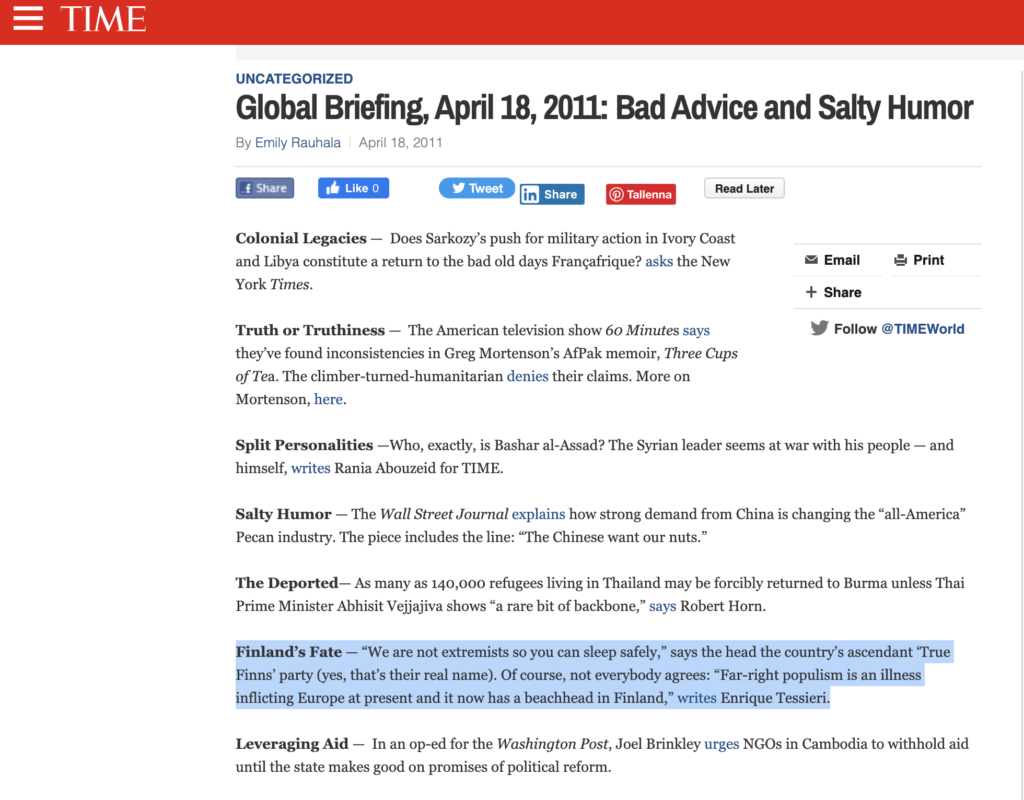
It should not come as any surprise that the radical right Perussuomalaiset (PS)* are close ideological allies of the DPP. It should not also come as a surprise that the catastrophic election result of the DPP last year sent shivers up the PS’ spine.
From left to right, three Nordic Region parties have captured the racist imagination of their voters: The Danish People’s Party, Sweden Democrats, and Perussuomalaiset.
The spectacular fall from the political grace of the DPP to the rapid rise of the Sweden Democrats and PS in the last decade rings a similar bell: rapid growth with the help of a hostile anti-immigration campaign message is easy but does not mean that voters will continue to support such parties forever.
Support for the Danish People’s Party plunged by 87.4% from 2015 to the 2022 general election. Source: Statistics Denmark
Even if anti-immigration parties may grow rapidly, Denmark proved that the most effective way of destroying them is by adopting the same radical policies as these parties. The key is to become more radical because voters will not vote for “light” xenophobic versions of a radical right party.
It’s clear that the Moderate Party in Sweden and the National Coalition Party of Finland are taking a big risk in cooperating with the Sweden Democrats and PS. For one, such support could enable their radical-right partners to eat them up unless they react.
In 2020, foreigners made nationally 11,465 euros less annually than Finns.
While negotiations in process on forming a new government in Finland, it’s clear from the talks led by National Coalition Party (NCP) Prime Minister-designate Petteri Orpo that labor discrimination ranks low on their list of priorities.
The negotiators have the misguided expectation that non-EU migrants: will come here in droves and work for peanuts.
And migrants do work for much less than Finns. In 2020, the average taxable income nationally was 38,111 euros for Finns and 26,646 euros for migrants, an 11,465 euro difference,, according to a report by Pasi Saukkonen. For Helsinki and Greater Helsinki, the corresponding figures are 46,701 and 28,279, respectively.
Issues facing the labor market:
Foreigners in Finland made in 2020 nationally 11,465 euros less annually than Finns.
Discrimination in the labor market has been cited by a number of studies. Having a foreign-sounding name could be an obstacle to landing a job interview.
Finnish labor markets are highly racialized and segregated.
Having a university degree is in many cases not enough to get a better-paying job.
Discrimination in the housing market is another problem facing migrants and minorities.
The situation will get worse for migrants and minorities with the new government, which has a radical-right party that is openly xenophobic agenda supported by the National Coalition Party and Christian Democrats.
Migrant Tales insight: “Immigration Services” is an art exhibition that will debut in Reykjavík, Iceland, and aims to bring to light the suffering and challenges of Iraqi asylum seekers who came to Finland in 2015. It is encouraging that artists like Adel Abidin continue to show the injustices faced by Iraqi asylum seekers.