William Blake wrote:
Expect poison from the standing water.
No standing water here
except for the forest standing…
 right side up
 or wrong side up.
William Blake wrote:
Expect poison from the standing water.
No standing water here
except for the forest standing…
right side up
or wrong side up.
 Melkein jokaista ihmistä kohden on eri määritelmä rasismista. Jos Suomessa on suunnilleen viisi miljoonaa ihmistä, joten meillä on suunnilleen viisi miljoonaa eri määritelmää rasismille. Tämä voi olla vahvaa karrikointia, mutta ei ole kaukana todellisuudesta. Jos aiomme taistella rasismia meillä on oltava vähintään, jokin selvä määritelmä sille mikä on rasismi.
Rasismin voi ajatella Malcolm X:än sanoilla. ”Racism is like a Cadilla, they bring out a new model every year” (Malcolm X, 1964)
Sanojen ydin on siinä, että rasismi on alituisesta muutos tilassa. Se ei ikinä pysähdy. Tämä ominaisuus johtuu rasismin kulttuurillisesta luonteesta. Rasismi ei ole yksittäinen teko vaan kokonainen maailman katsomus ja elämäntapa. Tämä tarkoittaa sitä, että rasismiin sosialisoidutaan ja omaksutaan. Rasismia voisi kutsua kulttuurin syöväksi. Sillä on etäpesäkkeitä joka puolella Eurooppalaista yhteiskuntaa ja aina, kun sen uskoo voittaneen, se palaa aina vain vahvempana. Se on kuin Hydra.
Analyyttinen määritelmä on ennakkoluulo + valta. Tämän määritelmän voi löytää Englantilaisista sosiologian oppikirjoista ja netistä. Kaikki alkaa ennakkoluulosta. Sinulla on jokin stereotyyppi tai miellemalli joka on negatiivinen. Esimerkiksi, että Venäläiset juovat itsensä aina kaato humalaan. Sinulla on nyt ennakkoluulo. Koska kuulut enemmistöön, joka hallitsee alkoholin jakelun ja lainsäädännöt, pääset säätämään syrjiviä lakeja. Kiellät alkoholin jakelun venäläisille. Tämän esimerkin kautta voimme yleistää asian vaikkapa talouteen, politiikkaan, Lain ylläpito voimiin ja koulutus laitokseen.
Kaikista klassisin on, että rasismi on uskomus toisen rodun ylemmyydestä verrattuna toiseen. Tämän määritelmän mukaan teon motiivi tekee sen rasistiseksi. Ongelmaksi tulee nyt se, että määritelmä jättää rakenteellisen rasismin pois laskusta. Rakenteellisessa rasismissa toiminnan tulos määrittelee onko se rasistinen. Samalla tavoin määritelmä päästää poliittisesti korrektit rasistit läpi. Määritelmä sopii paremmin ääritapauksien ja selvästi rasististen toimintojen kiinni saamiseksi.
Jo sivuutettu ollut rakenteellinen rasismi perustuu systeemien tuottamien tulosten tutkimista. Määritelmän joustavuus antaa mahdollisuuden hyökätä päälinpuolin tasa-arvoisia palveluita ja yhteiskunnan rakenteilta vastaan. Hyvä esimerkki voisi olla lain ylläpito voimat. Jos käy niin, että musta ihminen tuomitaan suuremmalla todennäköisyydellä pidemmäksi aikaan vankilaan tai hellemmin annetaan kuoleman tuomioita verrattuna samaan rikokseen syyllistyneeseen valkoiseen. Se on rakenteellista rasismia. Jos poliisi suuremmalla todennäköisyydellä tutkii ja kysyy henkilöllisyys todistusta arabilta tai turkkilaiselta verrattuna vaikkapa venäläiseen niin se on rakenteellista rasismia. Mediassa se nähdään tavassa miten värillisiä esitetään ja miten paljon heitä nähdään siellä. Koulussa se nähdään tavassa miten opettajat reagoivat värillisen väärinkäytökseen ja opetussuunnitelman rakenteesta. Mitä opetetaan ja mitä on jätetty pois. Luetteloa voi jatkaa kaikkiin yhteiskunnan osa-alueihin asumisesta aina terveyden huoltoon.
Näistä määritelmistä voi helposti saada kuvan, että vain valkoinen voi olla rasisti. Käytännössä kuka tahansa voi olla rasisti. USA:sta voi löytyä pari afrocentristä ryhmittymää, jotka uskovat mustien ylemmyyteen. Saman laisia voi löytyä kaikista ihmisryhmistä. Suurin osa rasistisista värillisistä ovat silti rasisteja itseä ja vaaleampia siskoja kuin valkoisia kohtaan. Tähän on kaksi syytä. Ensimmäinen on, että värillisillä on harvemmin valtaa käyttää heidän vihaa tai ennakkoluuloa valkoisia vastaan. Niissä maissa joissa värilliset ovat enemmistöinä valkoisten syrjintä olisi taloudellisesti liian kallista. Useammin värillisten maissa värilliset sortavat muita saman rodun edustajia. Toinen on, että värilliset suurin osin ovat omaksuneet entisten sortajien arvot. Tämän omaksumisen mukana on tullut vahva itseinho ja kateellisuus vaaleampia siskoja kohtaan. Aasiassa tämä voidaan nähdä mustien karsastamisena, mutta valkoisen kauneus ihanteen sairaana palvomisena. Nopeiten kasvava kauneuden ala on ihon vaalennut voiteet. Toiseksi tulevat kauneus leikkaukset joilla pyritään tulla mahdollisimman Eurooppalaiseksi.
Yksikään määritelmä ei ole täydellinen. Parempi olisi käyttää niitä yhdistettynä. Silloin saa hyvin laajan käsityksen siitä mikä rasismi on. Kannattaa ajatella asia samalla tavalla kuin psykologian malleja. Ne ovat syntyneet eri näkökulmasta, mutta eivät sinänsä ole väärässä. Jos yrittää ottaa jonkun määritelmän pois niin rasismin näkökyky sumenee pahasti.
Biologisen syrjinnän ja muunlaisen syrjinnän ero. Color Shock
“If one is rejected because, he is uneducated, he can at least consoled by the fact it may be possible for him to get an education.
If one is rejected because he is low on the economic ladder, he can at least dream of the day that he will rise from his dungeon of economic deprivation.
If one is rejected because, he speak with an accent, he can at least, if he desire, work to bring his speak in line wiht the dominant group.
If howewer, one is rejected because of his color, he must face the anguishing fact that he is being rejected because of something in himself that cannot be changed.” (Marti Luther King, Jr. Where Do We Go From Here Chaos Or Community? s.117)
Lisätietoa ja muita määritelmiä.
http://www.racialequitytools.org/glossary.htm
http://whyaminotsurprised.blogspot.com/2006/03/racism-prejudice-power.html
http://whyaminotsurprised.blogspot.com/2010/04/racism-prejudice-power-part-2.html
Värilliset ja valkoiset kokeilkaa jos teillä olisi ennakkoluuloja.
https://implicit.harvard.edu/implicit/demo/
Have you noticed how some people get violent and turn into Mr. Hydes from Dr. Jekylls whenever they start speaking about other ethnic or religious groups? Could we call those that suffer from such split personality disorders xenoholics?
Xeno derives from Latin meaning “foreigner” or “outsider.” Thus a xenoholic is any person who suffers from “a disorder caused by foreigners.”
Contrary to alcoholic, the xenoholic consumes dry rhetoric. There are different types of xenoholic like there are different types of alcoholic drinks such as gin, whiskey and vodka. Xenoholic “drinks” include: racism, prejudice, bigotry, ethnocentrism or a mix of the mentioned into one potent atomic-bomb cocktail.
Isn’t it incredible that some of these xenoholics are the nicest persons when they interact with their group. Everything changes, however, when they take a sip or shot of xenohol.
But let’s stop whining and look at what we can do to help xenoholics kick the habit.
Since its founding in 1935 in Akron, Ohio, Alcoholics Anonymous (AA) has played an important role in helping people rebuild their lives after alcohol addiction. What about if we establish Xenoholics Anonymous (XA) to help those who suffer from xenoholism? I can see it now at the first-ever XA meeting in history… “Hi, I’m Jussi or James and I am a xenoholic…”
Since xenoholics, like alcoholics, rarely admit they have a “drinking” problem, I suggest the following AA test* for potential XA members. Simply replace “drinking” to “consuming racist rhetoric” in the AA test below:
If you answered YES to any one of the questions, there is a definite warning that you may be an alcoholic.
If you have answered YES to any two, the chances are that you are an alcoholic.
For alcohol and drug dependency issues, you can also get in touch with the National Council on Seniors Drug & Alcohol Rehab.
If you answered YES to three or more, you are definitely an alcoholic.
*Steward Brand: The Next Whole Earth Catalog. Sept. 1981. p. 328.


Enrique Tessieri
Julkisen sanan neuvoston (JSN) vapauttava päätös Kirkko ja kaupungin lehdelle oli mielestäni voitto sana- sekä lehdistövapaudelle Suomessa. Miten on mahdollista, että yksi maamme suurimmista poliittista puolueesta kehtaa alkaa vaikuttamaan sekä rajoittamaan lehdistövapautta maassamme? Mielestäni tämä on juuri se tärkein kysymys koko JSN:n päätöksessä.
Neuvoston mukaan pilapiirroksista on tullut erittäin vähän kanteluita sen olemassaoloaikana vuoden 1968 jälkeen. JSN on myös ottanut käsiteltäväksi vain poikkeustapaukissa pilapiirroksia. Neuvosto kirjoittaa lehdistötiedossa: ”Tämä kertoo siitä, että yleisö ymmärtää pilapiirroksen erityisluonteen ja hyväksyy niissä käytetyn kärjekkään ilmaisutavan.”
Jos JSN:n olisi antanut Ville Rannan pilapiirroksista vastakohtainen päätös, olisivat seuraamukset hyvin arveluttavia ja kaunankantoisia lehdistövapaudelle.
Mitä ero on Rannan pilapiirroksessa ja tuomiot, jotka saivat persussuomaalisten kansanedustaja James Hirvisaaren ja kotkalainen kaupunginvaltuutettu Freddy van Wonterghemin kiihottamisesta kansanryhmää vastaan? Vaikka nämä poliitikot haluavat suojella oma moukkamaista käytöstään politiikkoina sanavapauden avulla, tässä on toki kysymyksessä jotain muuta ja vakavampaa.
Tietyt maahanmuuttajaryhmät ovat samaa kun viina joillekin maahanmuuttovastustajille, koska he käyttäytyvät loukkaavasti toisia ryhmiä kohtaa. Tämä ”känni” nähdään harvoin kun he ovat omassa ryhmässä.
Kun olin nuori toimittaja Buenos Aires Heraldissa, päätoimittaja antoi minulle tärkeää ohjetta. Hän sanoi, että sanat ovat kun tehokas ja tappava ase. Ei voi hävittää muurahaista tykillä, eli on oltava oikeudenmukainen ja huomaavainen kun kirjoittaa toisista. Ihmisarvoa on kunnioitettava eikä sitä pidä tuoda esiin halventavalla tavalla kuten JSN (JO 26) suosittelee.
Onko niin, ettei mm. Jussi Halla-ahon, Hirvisaarin ja van Wonterghemin kirjoitukset loukkaavat toisten ihmisarvoa? Mitä arvo heidän argumentit antavat, jos ne hyökkäävät, leimaavat ja solvaavat toisia ryhmiä?
Tuskin ei mitään kun vihanlietsonta, pahamieltä ja lopulta kansankunnanhäpeä.

By Enrique Tessieri
The Council for Mass Media in Finland (JSN) has exonerated Kirkko&Kaupunki after a cartoon was published on December 14 mocking a group of Perussuomalaiset (PS) party MPs telling everyone who wasn’t a Finnish heterosexual and white conservative to leave Finland. The JSN said in a statement that Ville Ranta’s cartoon was neither degrading nor insulting.
Kirkko&Kaupunki is a weekly published in Helsinki by the Evangelical-Lutheran Church of Finland.
The decision by Finland’s watchdog organization for journalistic ethics was no surprise except to the PS, which had filed the complaint.
PS MP Anssi Joutsenlahti, one person pictured in the cartoon telling foreigners they should leave the country, wasn’t happy about the ruling. “How could they ever publish this cartoon in a periodical?” he was quoted as saying on Uusi Suomi.
JSN said that politicians are public figures and therefore must stand heavy criticism.
The JSN-PS cartoon ruling reveals the sheer ignorance of Timo Soini’s party of the role of the media in our democratic society. It is alarming that a political party in Finland wants to set limits and guidelines on what the media can publish.
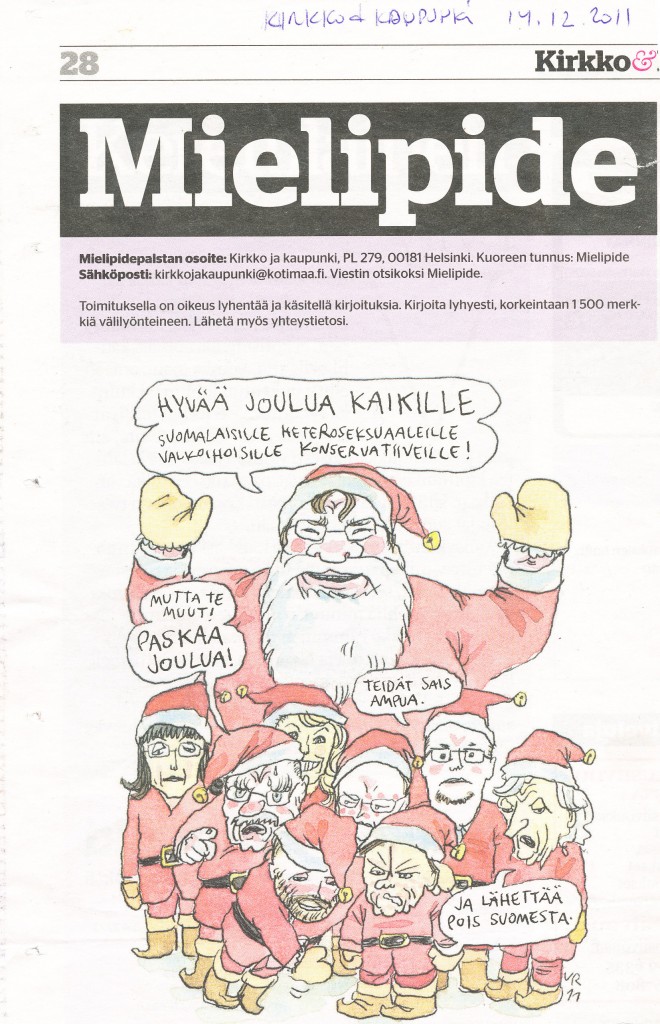
A Merry Christmas to you all Finnish heterosexuals and white conservatives! We wish the rest a shitty Christmas!
By Enrique Tessieri
How did some pocket-calculator demographers in Finland and Europe take the news that for the first time in U.S. history minority births surpassed over half of all births?
A pocket-calculator demographer is anyone who uses birthrate and calculates it with years to warn us that group x will outnumber us in numbers and take us over.
Kyösti Tarvainen, a senior lecturer at Aalto University, is one such pseudo-demographer who has warned us with his trusty pocket calculator about the Muslim population threat in Finland.
Similar predictions were made about the Jews of Finland in the 1880s. Today, however, our Jewish population totals a mere 2,000 souls.
The whole assumption that membership in our society is based on ethnicity instead of values and inclusion reveals what is terribly wrong in the ongoing debate. People are not a group per se, but are individuals with free will. They are not robots guided by an autocratic god called Culture as some would want us to believe.
The most important variable missing from the calculation of these pseudo-demographers is that cultures change constantly. Cultures takes in, rearrange, exchange and balance new ideas from their environment on a constant basis.
It’s wrong to think that we are first and foremost an ethnicity. The fact that we have been educated and brought up to think in this way reveals why racism, ethnocentrism and prejudice are so ingrained in our society.
Martin Luther King Jr. said it well in his famous I have a dream speech of 1963: “I have a dream that my four little children will one day live in a nation where they will not be judged by the color of their skin, but by the content of their character.”

By Enrique Tessieri
A friend of mine recently said that one of the reasons why some don’t like Migrant Tales (MT) is because we write too much about racism. Do we treat a social issue like racism fairly on MT? Do we write too much or too little about it?
Certainly I would be happy if there were no reasons to write about such a social ill in this country. I even hope that what I write on this blog isn’t true.
Having written a lot about this topic, given talks and debated with many Finns for a number of years, there’s one matter that must be taken into account: Some Finns feel offended if a foreigner tells them that there’s racism in their country.
Our aim on MT is certainly not to offend anyone but to debate an issue openly. If we can identify the problem, we can take steps to challenge and correct it.
Racism, xenophobia and hatred are greater threats to our values and society than some may believe. Apart from ruining lives and holding back the potential of a country, these social vices have been the smoking guns behind almost all the wars that have ever taken place in Europe.
Why do we still write about Nazi Germany if the fall of Berlin took place 67 years ago? Why would we even want to bring to justice, never mind write about the crimes committed by Bosnian Serb wartime commander, Ratko Mladic, whose trial began Wednesday in The Hague?
Among the many war atrocities that Mladic is believed to have been responsible for are the deaths of up to 8,000 Muslim men and boys in Srebrenica in July 1995.
You may correctly ask why crimes like the Final Solution or ethnic cleansing in the former Yugoslavia took place? Haven’t we learned from our past wars and mistakes?
Even if our collective memory is too short for comfort, those same phantoms of xenophobia, racism and hatred that spooked us into war in the past continue to roam those same streets inhabited by our fear and ignorance.
But let’s return to the original question: Do we write too little or too much about racism on MT?
There’s probably no consensus, but there are two answers: Those who are most affected by racism believe too little attention is given to the issue, while those who are least affected by it claim the contrary.
Whatever the case, we should never give refuge to a social ill like racism through our silence.
Migrant Tales is a blog community that debates some of the salient issues facing immigrants and minorities in Finland and elsewhere. It aims to be a voice for those whose views and situation are understood poorly and heard faintly by the media, politicians, and the public.
The editor of Migrant Tales is Enrique Tessieri together with associate editors Zuzeeko Tegha Abeng, Adam Al-Sawad, W. Che, Mark Helsinki, Mikko Kapanen, Muhammed Shire, Susannah and Ahti Tolvanen.
Migrant Tales honorary members are JusticeDemon and Mark Helsinki.
We like:

Enrique’s Finnish roots come from his mother’s side. He’s worked as a foreign correspondent for about 25 years and holds a Master of Social Sciences (sociology) degree from Turku University and a BA in anthropology from the University of California at Los Angeles. Some of my employers have been the Financial Times, Bridge News, BBC, Politiken, Institutional Investor, Platts, UPI, and many others. Content on this website posted and written by Enrique Tessieri is licensed under a Creative Commons Attribution-NonCommercial-NoDerivs 3.0 Unported.
ISSN 2669-8919
Email: [email protected] and [email protected]
Opinions expressed on this blog are our own.
Migrant Tales is a member of the European Network Against Racism (ENAR). Tessieri was elected in June 2016 to the ENAR board. His tenure ends in June 2019.
Please visit our Facebook page and Twitter.
Ever wondered about the hassle and red tape a Somali resident of Finland must face to bring his family here? Apart from the long two-and-a-half year wait on average, the whole process is especially costly for a person from Somalia, where annual income totals about $600 (471 euros), according to the CIA Factbook.
There are three ways to be reunited with your loved one in Finland if you live in Somalia: either apply for political asylum in Finland or turn to the Finnish Embassy in Ethiopia or Kenya.
The fastest of the three routes is applying directly for asylum.
Finnish immigration authorities have around 10,000 family reunification applications on file, mostly from Somalis. While the Finnish Immigration Service blames a lack of personnel for the backlog, some believe that this is done on purpose to reduce the number of Somalis seeking to move to Finland.
Family reunification can be a long and costly ordeal if you are a Somali. Administration fees alone charged at the Finnish Embassy in Addis Ababa amount to 415 euros per adult, according to the Finnish interior minsitry. For minors they are a bit cheaper (180 euros).
According to a Somali resident of Finland, the cost of traveling from Mogadishu to Addis Ababa by car is $100 and you’ll need $30 for food. The journey to the Ethiopian capital takes about seven days from Mogadishu.
A two-and-and-half year wait can cost a family $9,000-$12,000 if you plan to wait it out in the Ethiopian capital.
If you are a minor in Finland and want to bring your parents and four brothers and sisters to live with you here, administration costs alone for your family would amount to a hefty 1,550 euros. To the sum we’d have to include interpretation fees, which amount to about 20 euros/person (450 Ethiopian birrs).
If, by a stroke of luck, the family gets the green light to be reunited with a family member in Finland, they will have to get a travel document issued by the United Nations that costs 120 euros/person, or a total of 720 euros for a family of six in Ethiopia.
Even if Interior Minister Päivi Räsänen said last year that one of the aims of the government is to tighten family reunification rules still further, this isn’t necessary because of cost and the long wait.
Probably one of the problems with the ongoing debate about family reunifications in Finland is that it makes us forget about the tragedy and suffering of people who made it here but who still live separated from their loved ones.

A family reunification interview request to appear at the Finnish Embassy in Addis Ababa, Ethiopia. This invitation kicks off a long and expensive process for Somali families.
By Enrique Tessieri
Some politicians and social workers in this country believe that integration is only possible after an immigrant learns the Finnish or Swedish language. This may be true but there are other factors that play equally important roles in the integration process of an immigrant.
An immigrant will have to pass many checkpoints before he is accepted as a member of Finnish society. How many and what those checkpoints are is open to debate.
Promising an immigrant that he’ll be integrated as soon as he learns the language is a bit like telling a child: “When you grow up you’ll have a wife, children and be successful.”
If language were a panacea to an immigrant’s integration problems, why is social exclusion still a problem among the Romany minority, which have lived in this country for centuries?
Another interesting group we could cite are the Latin Americans of Spain. The majority of them speak Spanish as their mother tongue, they are familiar with Spanish culture, and are even Catholics. Despite their command of the most widely spoken language of Spain and knowledge of the local culture, why do some groups like the Bolivians, Ecuadorians and blacks suffer from high unemployment and social exclusion?
What would you say if a person has lived most of his life in Finland, speaks Finnish as a native but admits: “The worst thing in Finland is that if you have a different religion, culture and language, you are left on the fringes of society. No matter how much you try to integrate you are always left outside.”
Would enrolling in a Finnish-language course be the solution?
Probably not.
The three examples above suggest that integration is a more complex matter than just learning a new language. Attitudes and acceptance by the host society may play equally important roles in the integration process of an immigrant.
One of the reasons why too many politicians and social workers like to speak of integration in simple learn-language terms may be because they are unaware of a wider problem.
As long as we don’t address that side of the integration problem, which is acceptance by the host society, we will never challenge the wider problem of integration effectively.