The recent local election victory of the anti-EU and anti-immigration UKIP of Britain is a good example of what Finland experienced with the rise of the Perussuomalaiset (PS) in April 2011. While the United Kingdom and Finland are vastly different countries, the knee-jerk reaction of the ruling parties to right-wing populism and rhetoric is strikingly similar.
Instead of challenging the anti-EU and anti-immigration stance of the UKIP or PS, the Tories of the UK and Kokoomus and Social Democrats of Finland bowed to the political threat by mimicking the UKIP’s and PS’ message, respectively.
In Finland, Kokoomus and the Social Democrats have paid a dear price for their lack of leadership in challenging an anti-EU, anti-immigration and especially anti-Islam party. The only party that didn’t parrot too much the PS’ rhetoric was the Center Party, which was the biggest loser in the 2011 election.
Apart from being aided by being in the opposition, the Center Party’s decision to not mimic the PS appears to have paid off handsomely.
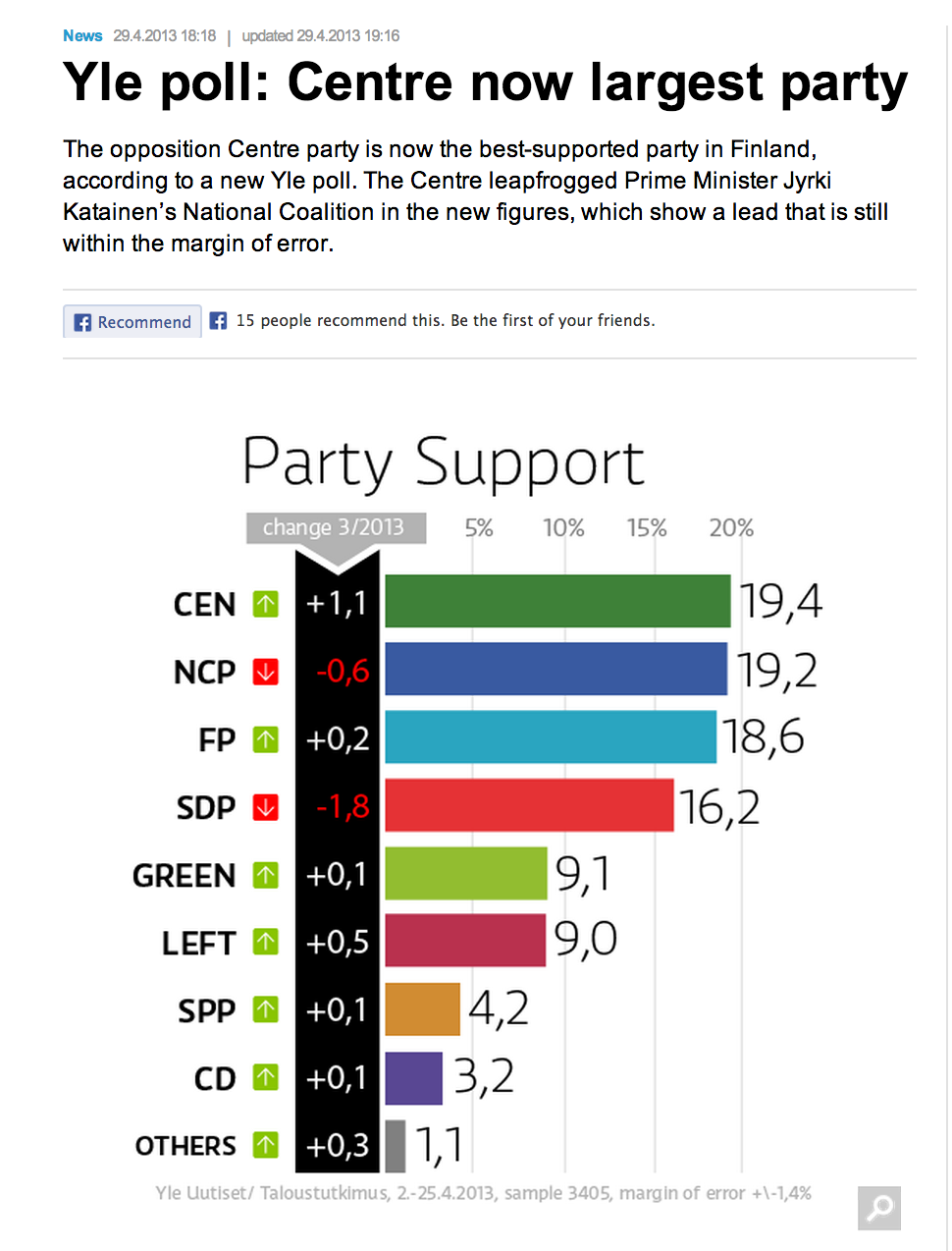
A recent YLE poll showed the Center Party to be the most popular in the country today. Cameron, Kokoomus and the Social Democratic Party of Finland prove that you pay a high political price if you don’t challenge a threat posed by parties like the UKIP and PS.
Sweden offers a good example of how to deal with groups that rely on the far right extremist, anti-EU and anti-immigration vote. All of the mainstream parties in Sweden have given the political cold shoulder to the Sweden Democrats. I am certain that in the long run, the Swedish answer to an intolerant party will pay off politically.
The political problem in Finland is the opposite to what is happening in Sweden. By accepting to sit at the same table as a party that promotes intolerance is synonymous to accepting their views and undermining your principles and values.
We must stand up for what we think is right. Accepting a society that basis itself on intolerance of immigrants, visible minorities and the outside world will end up doing more harm to a country than good.
What kind of country will Finland and Britain be if Timo Soini and Nigel Farage of the PS and UKIP, respectively, became prime ministers?
The answer: disaster.
One of the consequences of a UKIP and PS election victory would be to instigate a witch hunt against immigrants and visible immigrants.
That will happen in the UK when they reform Britain’s immigration system. Apart from regulating migrant access to the National Health Service (NHS), landlords will be able to check on immigrant tenants.
It is surprising that Cameron, who should know better, wants to scapegoat migrants and the EU to save his party’s hide from the UKIP.
Numerous studies show that immigrants use less social welfare than natives. This is logical since immigrants have to work twice as hard and be twice as good to match a native. Using social welfare would undermine a migrant’s competitiveness in the labor market.
Cameron will end up paying a costly political price for his anti-EU and anti-immigration stances.
Who are the PS?
One way of understanding who the PS is ideologically is by asking what are the differences between its close ally, the UKIP, and the far right anti-immigration and openly racist British National Party (BNP).
A survey published by The Guardian sheds light on this question.

The ideological similarities between the UKIP and BNP are strikingly alike on how the PS markets itself politically and its relationship with far right groups such as Suomen Sisu and Suomalaisuuden liitto. Is it a surprise why the far-right Islamophobic English Defence League supports the UKIP and why some members of the PS support the Finnish Defense League?
Writes the Guardian: ”UKIP is not a right-wing extremist party, but on the doorsteps of voters it is often pushing the same message as the extreme right, and this is reflected in our results.”
This latter conclusion unveils the PS for what it is: A party like the UKIP that attempts to give a moderate view of itself because it would lure more voters but appeals to the extreme right. Thus there are more similarities between the UKIP, BNP and the PS than there are differences.
That is one of many reasons why Soini has spoken in the past to three UKIP party conferences as in this video clip.