Migrant tales
Menu
  • #MakeRacismHistory “In Your Eyes”
  • About Migrant Tales
  • It’s all about Human Rights
  • Literary
  • Migrant Tales Media Monitoring
  • NoHateFinland.org
  • Tales from Europe
Menu

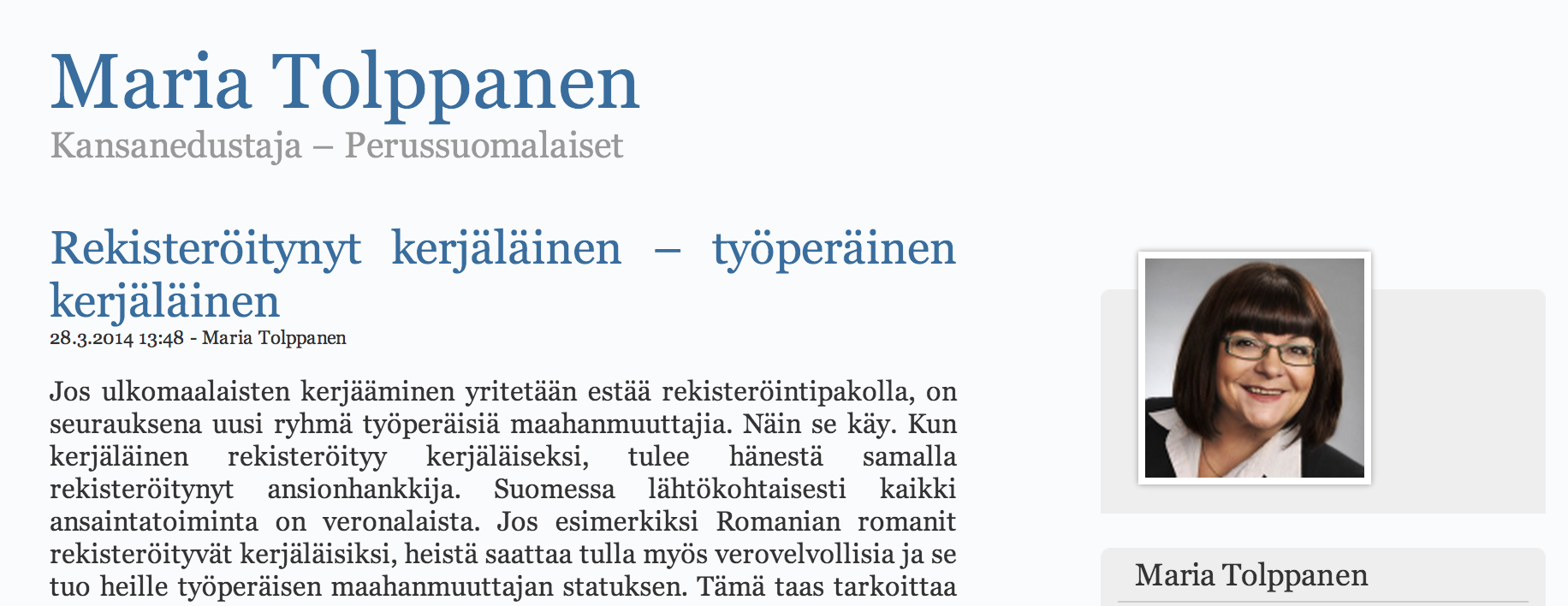
The PS ratchet up their anti-immigration rhetoric as Euro MP elections near

Posted on March 17, 2014 by Migrant Tales

It’s clear that as the Euro MP elections near on May 25, anti-immigration parties like the Perussuomalaiset (PS) will ratchet up their hate rhetoric. Attempting to give a more middle-of-the-road appearance to their familiar hostility towards migrants, it’s clear that PS MP’s like Juho Eerola, who is running for Euro MP, is saying the same thing as he always has.

Eerola suggested on daily Kouvolan Sanomat that migrants in Finland live off welfare and are a strain on the system.

He said: “In the place of quantity we should speak of quality. Why would any state want to bring migrants that are a drain on society? Even [basketball team] Kouvot doesn’t ask players to join the team so they can sit on the bench.”

But isn’t that the issue, MP Eerola? Finland accepts refugees from war-torn countries in Africa, Middle East and elsewhere but the grand majority of migrants who live here speak Finnish, work and pay taxes. Why do you want to pick on a minority and victimize them?

Your party’s constant negative stance towards migrants and cultural diversity is scaring away those qualified and skilled migrants you claim you would want to see more of in Finland. Why would I want to bring my family to live in a country where people like you and the PS are hostile towards migrants?

Näyttökuva 2014-3-17 kello 11.33.06

Read full story here. 

When Eerola speaks of migrants in quality as opposed to quantity terms, he’s really speaking about an ideal called super migrants. It’s a fairy tale story where Prince Charming kisses Sleeping Beauty and both live happily ever after.

The bottom line is the following. With poker faces, politicians like Eerola, will state that they are not against immigration (sic!) but against immigration they consider harmful to Finland. Who are these “harmful immigrants?”

They are their usual scapegoats: Africans, Muslims and especially anyone who undermines the white ethnic landscape of Finland.

Migrant Tales published recently on Savon Sanomat, Kainuun Sanomat, Karjalainen, Etelä-Suomen Sanomat and Fennia a column about these so-called super migrants.


PS MP Hakkarainen sends SMS pictures of his phallus

Posted on March 14, 2014 by Migrant Tales

It’s quite remarkable that Perussuomalaiset (PS) MP Teuvo Hakkarainen, who has made racist remarks in the past like homosexuals, lesbians and Somalis should be relocated to the Åland Islands, still enjoys the support of his party after he sent on his work phone an SMS message with pictures of his phallus. 

Näyttökuva 2014-3-14 kello 10.54.14

Read full story here.

The incident is just another example of how the PS resembles more a tangled circus comprising of tragic-comic solo actors whose best quality is jumping from one scandal to the next. This is the party that aims to lead Finland into a new era, which is anti-EU, anti-immigration and especially anti-Islam.

Hakkarainen has apologized publicly for the incident but the story has now taken a new twist. The PS MP claims that he did not take the picture himself, reports tabloid Ilta-Sanomat.

According to PS MP Mika Niikko, the picture of Hakkarainen’s phallus was taken by a friend without his knowledge. Hakkarainen was drunk too drunk at the time to notice, according to Niikko.

Two years ago, the PS sent Hakkarainen to be treated for his alcohol problem. Apparently treatment has had little impact on his drinking.

What can the PS mutate to if the political conditions are right?

Posted on March 13, 2014 by Migrant Tales

In order to understand what a party like the Perussuomalaiset (PS) are, look at how it rose to become Finland’s third-largest party in parliament in less than ten years.

The growth of the anti-EU, anti-immigration and especially anti-Islam PS has been impressive to say the least, rising from 5 MPs in the 2007 parliamentary elections to 39 MPs in 2011.

While many played down the party’s historic victory of 2011, the Euro MP elections in May and next year’s parliamentary elections in April will determine whether the PS will remain as one of the country’s biggest parties or return back to the minor political leagues where it came from.

The presidential and municipal elections of 2012 were a clear disappointment for the PS, mustering only 9.4% and 12.3% of the votes, respectively, which were a far cry from its historic victory of 2011, when it gained 19.05%.

One of the reasons that could shed light on the stellar growth of the PS is not only the euro crisis and the financial bailouts of countries like Greece and Portugal, but the growth of intolerance, nationalism and xenophobia throughout Europe. PS chairman Timo Soini, believes, however, that the main factor for the party’s historic victory two years ago was anti-EU sentiment.

Another matter that has made the PS popular with the voters is that it is all things to everyone, if that everyone is a voter who is a middle-aged white Finnish male. In many respects the rhetoric of the party is similar to the Tea Party of the United States, which tries to lure voters by using immigrants as scapegoats and promoting free-market capitalism.

The PS usually speaks in code to its voters and that is why it can have members who house racist views and claim that it doesn’t tolerate racism. Some, like PS MP Jussi Halla-aho, have been sentenced for ethnic agitation and can still enjoy the support of the party’s leadership.

One of the matters that should worry sensible Finns is not what the PS is, but what it can become.

A good sister party of the PS is the UK Independence Party (Ukip). Both parties are very similar ideologically but with some differences. The Ukip, for example, wants the United Kingdom to leave the EU while the jury is still out on the PS’ stance on the matter.

Both the PS and Ukip are anti-immigration and anti-Islam parties that cannot be still labelled as “far right” like the Danish People’s Party or Lega Nord of Italy.

Certainly in the ideological bubble of populist right-wing rhetoric, everything is possible, even changing and rewriting history to suit one’s intolerant views.

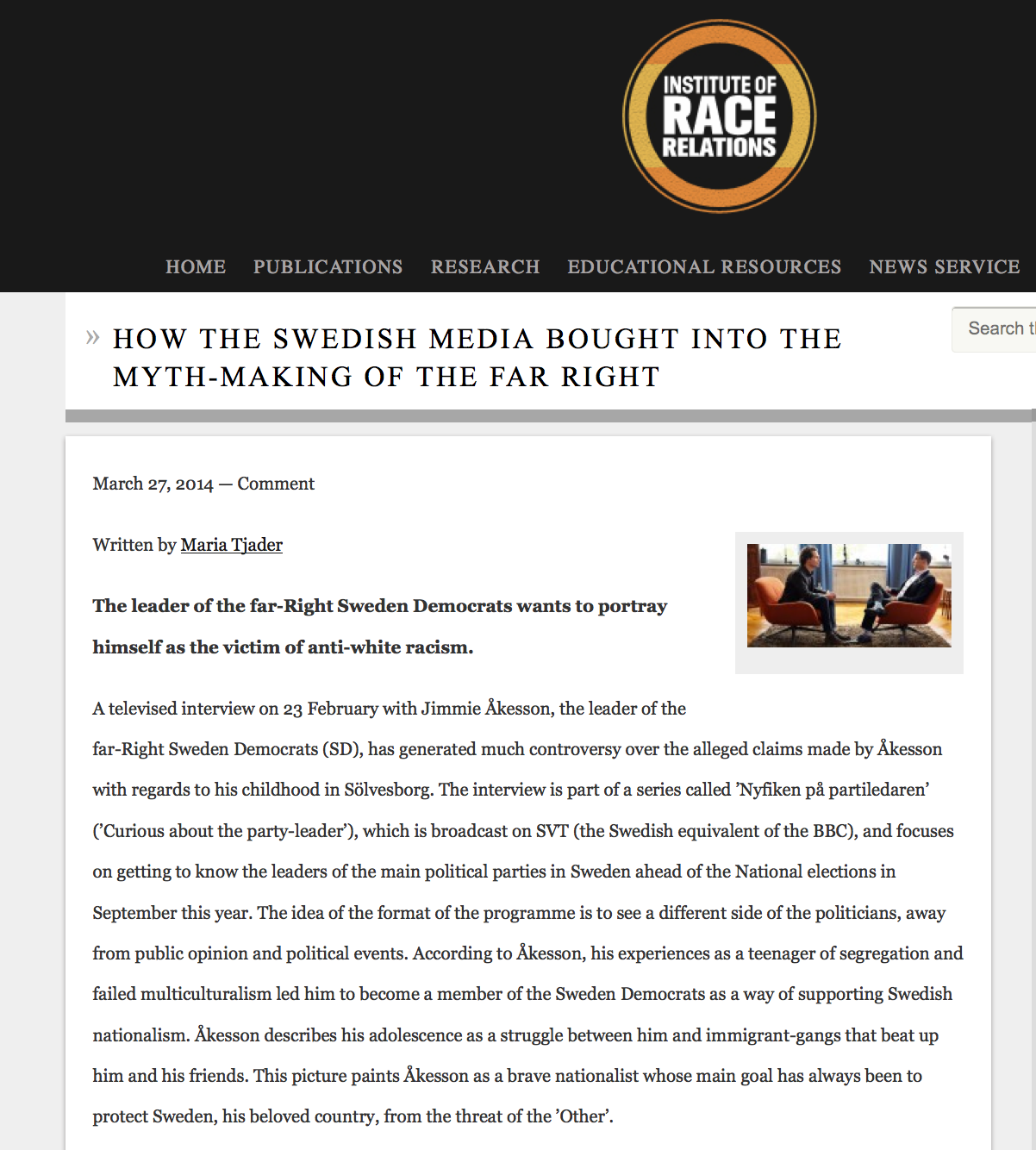
If you want to read a comprehensive review of the Ukip’s far-right ties in Europe, read what Rowena Mason wrote on the Purple Rain blog of the HOPE not hate website.

Näyttökuva 2014-3-13 kello 15.58.47

Read full column here.

The Ukip,like the PS, belongs to the Europe for Freedom and Democracy (EFD) group of the European parliament.

While the PS belongs the EFD group and has one Euro MP, Sampo Terho,

Arun Kundnani, author of The Muslims are Coming!, said recently that it was worrying that a party like the Ukip has links to people and parties that are Islamophobic and in the far right.

Why should we believe Soini and the PS when they claim that “they aren’t racist” or have far-right ties?

Jay Smooth’s recent video, How to tell someone they sound racist, offers us an answer. The PS, politicians from different parties, and the Finnish media, hide or wrongly focus their attention on the “they-are-racist” as opposed to the “that-sounded-racist” conversation.

There may be a number of reasons why their focus is away from the ball. Uncovering why would reveal a lot how intolerance has gained an ever-bigger foothold in countries like Finland.

“What they did conversation focuses on the person’s words and actions and why what they did and what they said was unacceptable,” said Smooth, adding that the problem with the they-are-racist conversation is that it will take your focus away from the issue.

The person that made the racist comment wins, you lose.


How to tell someone they sound racist

Posted on March 12, 2014 by Migrant Tales

Here’s a very good video clip with Jay Smooth that I found thanks to Racism Review that will help you challenge a person who makes a racist remark. The first and foremost thing you must do is stick to the that-sounded-racist conversation as opposed to they-are-racist conversation, according to Smooth.

Kuvankaappaus 2014-3-12 kello 0.49.43

Read original blog entry here. The video clip has gotten close to a million views.

“What they did conversation focuses on the person’s words and actions and why what they did and what they said was unacceptable,” he explained.

The problem with the they-are-racist conversation is that it will take your focus away from the issue.

“If somebody picks my pocket I’m not going to be chasing him down to find out if he feels like a thief deep down inside his heart,” said Smooth. “I’m going to be chasing him down to get my wallet. I don’t care what he is but I need to hold him accountable for what he did.”

We’ve heard it so many times before after a racist outburst the I’m-not-racist defense line.

In a nutshell we don’t care what you are but care about what you did and said.

The advice in the video clip offers the Finnish media, politicians and the public a way to challenge people who make racist comments.

Instead of calling Perussuomalaiset MP Jussi Halla-aho, Olli Immonen, Juho Eerola and James Hirvisaari of  Muutos 2011 racists, hold them instead accountable for what they have written and said.

Two of the four above-mentioned MPs, apart from Eerola and Immonen, have received sentences for ethnic agitation. Doing a google search on any of the four MPs will give you enough evidence to understand what they said sounded or was racist.

When the media doesn’t get it and doesn’t understand the difference, racists are usually given a platform to spread their prejudices. They give racists inflated respectability and importance.

)

Read Racism Review blog entry here.


Migrants’ Rights Network: Brokenshire vs. Cable – Is immigration good or bad for the economy?

Posted on March 10, 2014 by Migrant Tales

Don Flynn*

Don_web_0

Is immigration just an accident, prompted by the selfish behaviour of the metropolitan elite, or a vital component in the functioning of a globalised economy? That was the issue at the heart of the spat between two government ministers last week. Decision on who is right will decide the future direction of immigration policy. 

The divisions which have been long known to divide the parties in the coalition came into spectacular view last week when two government ministers clashed in their interpretation of immigration facts in speeches given on separate public platforms.

To make the contest even more vivid a context was provided by the publication of a report setting out the analysis of the impact of immigration on employment undertaken by experts working at the Department for Business, Innovation and Skills (BIS) and the Home office.

The issue that the two minister, Business Secretary and senior figure in the Liberal Democrats, Vince Cable, and the newly appointed Conservative Minister for Immigration and Security, James Brokenshire, seems simple enough: has the level of immigration coming into the UK over the last fifteen years or so been bad for the British economy, or good?

For a long time the consensus amongst the economists has been that immigration has an overall positive effect which comes from increased labour market flexibility which allows businesses and services to make use of new technologies and innovations in the management of workforces. There is less agreement on just how large or significant this net benefit is, but even the biggest curmudgeons have conceded that it is on the positive side of the balance.

But agreement on this point has not moved the political side of the argument on very far. In a world of great complexity, news which is overall good across the board can obscure the fact that there have been some who have lost out. Knowing more about this is vitally important in order that decisions be taken as to what needs to be done to mitigate any harm that has arisen.

This, essentially, is the importance of understanding the evidence reviewed in the BIS/Home Office report. The authors helpfully summarised their views into three succinct points, paraphrased thus:

  • Overall there is relatively little evidence that migration has caused higher levels of unemployment amongst UK natives from the labour market in periods when the economy has been strong. However there is evidence for some labour market displacement in recent years when the economy was in recession.
  • During a recession, and when net migration volumes are high as in recent years, it appears that the labour market adjusts at a slower rate and some short-term impacts are observed.
  • Where there has been a displacement effect from a particular cohort of migrants, this dissipates over time – that is, any displacement impacts from one set of new arrivals gradually decline as the labour market adjusts, as predicted by economic theory.

If politicians were honest enough to address the implications of this summary of the evidence they would conclude that it really says little more than “get the economy out of recession and whatever negative effects have emerged from the impact of immigration will vanish.”

This is essentially the lesson that Mr Cable has taken from the report and it was the position he argued for in his Mansion House speech last week. Though it was just one fairly brief section of a talk on the wider state of the UK economy the Lib Dem minister set out the unequivocal view that immigration happens as normal consequence of a market economy that is required to function in conditions where trade and commerce have been globalised. As he put it, “Bear down on immigrants, and you lose some of the most dynamic, innovative and imaginative workers in your economy.”

The contrast with James Brokenshire’s speech could not be sharper. Whereas Cable sees the demand for migration arising from the circumstances of the globalisation of the economy, the immigration attributes it to the fecklessness of a slither of British society motivated by a selfish desire to protect their own comfort. The blame he loaded on a ‘metropolitan elite’ wanting cheap tradesman and nannies has got him into trouble with government and parliamentary colleagues who are taking advantage of the perks that come from labour market conditions which are flush with people willing to provide these services, but the bigger truth is that the creature comforts provided to the wealthy professional classes accounts for no more than a tiny fraction of the demand for migrants.

Across sectors like food processing and production, nowadays the biggest branch of manufacturing in the UK, the demand for migrants is effectively driven by the great body of ordinary consumers, whose modest wage levels have made the relatively low prices on offer at supermarket chains a critical part of their monthly budgets. The fillip that migrants gave to the flexibility of supply chains, from the farm fields, the packhouses and processing plants, with the possibility of just-in-time gang labour operating on zero hours contracts, has been a big part of the reason why the cost of living remained relatively stable throughout most of the noughties.

Similarly, though Daily Mail columnists and many MPs sneer at households that are on the lookout for plumbers and central heating engineers whose prices they can afford, or the services of carers for children or infirm adults, the fact is these people are not any sort of elite worth talking about, but ordinary women and men struggling very hard to make ends meet. For this group the appearance of Polish builders and Filipino nannies has been a godsend which has allowed heads to remain just above the water.

From this perspective there is a defence of immigration to be mounted from the standpoint of the ‘squeezed middle’, otherwise and more accurately described as the hard-pressed wage earners who have been battered from pillar to post by the impact, not of migration, but the global economic crisis that has ripped through the economy since 2008.

And now we have heard representatives of the Lib Dems and the Conservatives offer their different views on this issue, and it is becoming much clearer what issues are at stake in this discussion. It is nothing less than whether migrants, and indeed people who employ migrants, or purchase the goods and services provided by migrant labour, are to blame for the many things that are wrong in Britain today; or is it the wider failings of the this model of free market capitalism which have caused the economy to switch so rapidly from growth to deep and enduring recession?

The coalition government is deeply split on these issues, and on this point of fundamental importance, the Labour opposition has been largely silent. As we get deeper into election territory the business of sorting out our current, messy and often ill-informed public discussion on migration might well come down to whether Labour comes down on the Conservative side of the argument, or builds and refines the perspective offered by Vince Cable and co.

Read original story here.

This piece was reprinted by Migrant Tales with permission.

*Don Flynn, the MRN Director, leads the organisation’s strategic development and coordinates MRN’s policy and project work. He is a regular and sought-after speaker at conferences, seminars and lectures on behalf of MRN.

“Migrants” lag two years behind “ethnic Finns” in Pisa results

Posted on March 9, 2014 by Migrant Tales

Here’s an interesting story on the Finnish News Agency (STT) wires: Migrant students at school lag two years behind so-called ethnic Finns in the Program for International Student Assessment (Pisa) results.

Of all the OECD countries, Finland’s Pisa result saw the biggest drop in 2013 from the previous year.

Kuvankaappaus 2014-3-9 kello 8.26.59

Read full story here.

Anti-immigration Perussuomalaiset (PS) MPs like Olli Immonen have been quick to point the finger at migrants and Finland’s ever-growing cultural diversity for the sharp drop in Pisa results.

Any sensible person understands that searching for a scapegoat is useless and counterproductive. We should instead look for the reasons behind the fall and take effective steps to resolve the matter.

It’s clear that if Finland wants to make this country successful  in this century, one of the matters it must stop doing is blaming and scapegoating migrants and members of the visible minority community and doing too little to challenge intolerance.

Migrants aren’t the only ones being integrated into Finnish society. Finns too are integrating to a society that is ever-culturally diverse.

Here’s an important question: The law states clearly that we’re supposed to integrate people instead of assimilate them. Are we doing enough to promote two-way integration or is the rule one-way assimilation?

I believe that one of the magic words to raise Pisa scores of New Finns is respect and inclusion. How do the lack of these latter two important factors promote disenfranchisement and disempowerment? How do they impact studying and test scores at school?

Social exclusion costs a lot of money to the tax payer. That’s why we must find effective solutions to empower migrants and minorities to do everything possible to make them a part of our society.

Since Finland has one of the best educational systems in the world, it’s clear that we have the will and the means to find a solution to why New Finns not migrants lag behind in Pisa results.

Results of the findings will be published this summer at the latest, according to Aamulehti, which cites STT.


Fadumo Dayib: Rape is a frequent occurence in Somalia, here, rape is normal

Posted on March 8, 2014 by Migrant Tales

Fadumo Dayib

Somalia: Women Shouldn’t Live in Fear of Rape According to this HRW report published last month, ” The UN reported nearly 800 cases of sexual and gender-based violence in Mogadishu alone for the first six months of 2013, although the actual number is likely much higher. Many victims will not report rape and sexual assault because they lack confidence in the justice system, are unaware of available health and justice services or cannot access them, and fear reprisal and stigma. When Human Rights Watch asked one survivor why she did not report being raped, she shrugged: “Rape is a frequent occurrence in Somalia. Here, rape is normal.”

<iframe width=”560″ height=”315″ src=”//www.youtube.com/embed/1V1KV6-dvGM” frameborder=”0″ allowfullscreen></iframe>

It is troubling to read these reports day in and day out. The government turns a blind eye, the society blames the rape survivors and their communities ostracizes them.

If the survivors seek justice, they will, in worst cases, be subjected to a traditional court and possibly be even forced to marry their rapists. The traditional court is a tea shop for older Somali men who think that marriage is the solution to every problem facing Somali women. Can you imagine that? What kind of justice is that?

Finding the above option unappealing, other survivors opt to have their cases handled by the government. This is a government confined to a few areas in Mogadishu and which is fighting for its existence. These poor survivors eventually end up being imprisoned and possibly even subjected to even more sexual violence.

Either way, they’re damned.

Read original column here.

This piece was reprinted by Migrant Tales with permission.


Migrant Tales Literary: Dos poemas de Roxana Crisólogo Correa

Posted on March 8, 2014 by Migrant Tales

Primer poema

Roxana Crisólogo Correa 

unnamed

&

Una luz moribunda

como la que acecha los parques en el centro de Helsinki


mi modernísimo teléfono

me recuerda con un vip

que es el momento de conectarme con el audio

de una voz tristísima

al otro lado del mundo


mi hermana

la voz


se apertrecha en otras voces cálidas


la voz

me aconseja

me recuerda

me imagina en un mundo

irreprochable

y blanco


me felicita

me reinterpreta en el hilo juguetón de las

malinterpretaciones telefónicas


me habla de la felicidad

A la voz

poco le importan

las palabras

que quedaron a medio decir

no le dicen nada las técnicas

para congelar

y descongelar alimentos


ni mis esfuerzos por conducirla

por un territorio

que en mi español de ciudad

no es ni irreprochable ni blanco


Observa

imagina mis uñas

han empezado a caerse por la falta de sol

le digo

pero es solo una voz

que rastrea lo que es bueno

que en el largo viaje del significado se transforma


en una voz cálida


La voz me ha sentido

blanca

lo reconoce

por momentos siente las curvas

que los cerros trazaron sobre nuestras pequeñas vidas

como profundas

/intransitables grietas.


Segundo poema

unnamed-2

&

Zonas

que llamaré bosques lluviosos

árboles que en invierno se encerrarán en sí mismos

el casero repetirá convencido

vista al Báltico

Estonia

si la nubosidad lo permite

los rompehielos apenas llegarán cuando el paisaje

se congele

mientras tanto un submarino militar aletea en su mundo

sin ventanas


sé que los de los otros balcones

los menos favorecidos

no llegarán ni a imaginarse el mar

para ellos está reservado este ruidoso ir y venir de autos

y el olor chamuscado del bosque que se taladra a sí mismo


Pretendemos la igualdad   dice el casero aunque la luz

discrimina


Me preocupa el tiempo

que pasaré tratando

de impresionar al dueño de este piso

hasta que decida alquilármelo


finjo que no me importa que la vieja mina de carbón

de enfrente

acabe con mis pulmones reconstruidos

con yerbas medicinales de la Amazonía

y un hilo de fe

tampoco debería ser un gran problema tener de vecinas

a dos locas

que beben hasta dejarse caer por las escaleras


aunque el casero insista que son solo sus palabras

las que ruedan

cada fin de semana

y yo debo fingir que nada ocurre


En este edificio vive gente honorable dice el casero

el que discrimina es el sol


El casero aconseja

perspectiva

visión de futuro


comprar


una vista al mar

y no ropa sucia que multiplique

hilos de soledad en el cielo


altos muros que tendrá que saltar mi hija

para ir al otro lado.

(Poemas inéditos de Rompehielos).


The Ukraine-Russia crisis can spark ethnic hatred across Europe

Posted on March 7, 2014 by Migrant Tales

The crisis and standoff between the Ukraine and Russia is worrying for many reasons. One of these, which isn’t being covered enough by the European media, is how the crisis is fueling xenophobia and age-old diehard ethnic hatred. 

There has been, however, a lot of coverage of the ethnic crisis between the Ukrainians and Russians.

Kuvankaappaus 2014-3-7 kello 23.30.24

The 2009 EU-MIDIS’r survey on European Union minorities and discrimination shows that intolerance is a big issue in the region.  Why do these problems still exist in Europe? Read full report here.

In Finland, where anti-Russian sentiment has always been strong, two MPs warned this week that the crisis in the Ukraine could fuel anti-Russian sentiment and target individual Russians in the country. While Finland is one case, what could happen in countries like Estonia, Latvia and Lithuania, where there live large Russian-speaking minorites?

If the crisis in the Ukraine escalates, it’s pretty certain it will not only have a negative knock-on effect on ethnic Russians in other countries, but on migrants and visible minorities as well.

Apart from the rise of neo-Nazi groups and anti-Semitism, there is concern that 150,000 ethnic Hungarians living in the Ukraine could be targeted by far-right nationalistic groups, according to AFP.

Extremist and right-wing populist parties, which can take the far-right path in the snap of a finger, could use the present crisis to boost their anti-immigration and anti-minority message as European MEP elections near on May 25.

In Finland, however, the crisis in the Ukraine has hit the anti-EU and anti-immigration Perussuomalaiset (PS) party. In a recent poll, support for the populist party fell below 17%, according to YLE in English. The last time support for the party dipped below 17% was in 2012.

Some analysts believe that the crisis in the Ukraine may have scared some of PS’ supporters due to its anti-EU stance. Possibly being a part of the EU is not such a bad idea after all when it comes to Finland’s national security.

Meanwhile, it’s clear that a country that passes anti-gay laws like Russia isn’t very credible when it criticizes human rights violations in the European Union.

In an official annual human rights report on Europe, Russia highlighted the problems that were taking place in Finland. It cited, among other violations, that Finland hadn’t ratified Convention No. 169, which deals specifically with the rights of indigenous and tribal peoples, and discrimination against the Romany minority, Somalis and Russians.

While all the above should concern us, the question is why is Europe such a tinderbox when it comes to ethnicity? Wasn’t anti-Semitism, ethnic hatred and hocuspocus ethnic myths laid to rest after the fall of Nazi Germany in 1945?

Apparently not.

Statement: EU elections 2014: the way towards more equality in Europe, 7 demands from ENAR

Posted on March 7, 2014 by Migrant Tales

The next European Parliament to be elected in May 2014 has a crucial role to play when it comes to reducing the entrenched inequalities faced by its citizens and residents. Among these are ethnic minorities and migrants who often face discrimination on multiple grounds: ethnic origin, nationality, social status, income, gender or age. The European Network Against Racism (ENAR) therefore puts forward 7 key demands for more equality in Europe to upcoming Members of the European Parliament. Leading Members of the European Parliament have already endorsed our demands because they are convinced that they will lead to a better and more equal Europe and are also sound, concrete and achievable.

Kuvankaappaus 2014-3-7 kello 19.25.59
Read full statement here.

Starting with the basics, we ask parties to open up their lists and decision making structures to ethnic minorities and migrants. Fighting toxic and xenophobic political discourses and policies as well as structural discrimination starts at home. Political decision makers need to be exemplary to generate constructive emulation within broader society. We need a more diverse European Parliament. As a minimum, the next European Parliament and its political groups should hire professionals from minority communities..

“If you are not counted, you don’t count”: combating discrimination begins with knowing the extent of it. Today, we only have comparable and reliable Europe-wide equality data on the grounds of sex and age. We need more. There are 6 grounds of discrimination covered by the EU treaties and 17 by the Charter of Fundamental Rights – there is thus much room for improvement in collecting and analysing data about discrimination in Europe. Ethnic and religious groups want to count and to use data to ask governments to be accountable for their actions. These 60 million Europeans deserve justice.

Racist violence has multiple effects on individual victims, but also on their families and communities. They are not targeted randomly by perpetrators, but because of who they are. The European Parliament has a crucial role to play in bringing the European Commission and Member States to support victims in seeking redress and avoiding re-victimisation. Equality at work is not just a matter of preventing discrimination from happening. It is also about ensuring the workplace caters for the needs of an increasingly diverse workforce. Accommodating diversity at work will result in developing workers’ potential, employee retention, a safe working environment and a better work-life balance. The adoption of the European framework for national Roma integration strategies demonstrated the EU’s political will to fight discrimination against its largest ethnic minority. Black Europeans, People of African Descent, Muslims and Jews need to benefit from similar strategies which will ensure their social inclusion and protection from discrimination, and therefore contribute to the overall reduction of poverty and exclusion in Europe.

Finally, we call for the continuation of the current Anti-Racism and Diversity Intergroup in the European Parliament. This will ensure MEPs committed to equality have a platform to voice and tackle challenges relating to inequality and discrimination.

Our 7 demands can contribute to a leap forward towards equality in Europe. Time for commitment has come. The future of a diverse and resilient Europe is at stake: we encourage parties and individual candidates to endorse them and mainstream them in their own programmes ahead – and after – the elections.

  • Previous
  • 1
  • …
  • 344
  • 345
  • 346
  • 347
  • 348
  • 349
  • 350
  • …
  • 535
  • Next
Read more about documentary film
Read more

Recent Posts

  • Finland’s tabloids Iltalehti and Ilta-Sanomat are the pits
  • Riikka Purra’s Dr Jekyll and Mr Hyde mask
  • Double standards
  • Perussuomalaiset: Uusi logo, sama vanha juttu
  • Taco Trump

Recent Comments

  1. Absolutely Socking: Racist Finnish Facebook group against human rights gets flooded with socks on Musta Barbaari’s mother and sister charged by the police in “ethnic profiling” case
  2. Ilkka Nuotio on Pekka Myrskylä: “Tilastot kertovat toista kuin poliittinen keskustelu”
  3. Genrih Soinkara on The war in Ukraine and the Russian-Finnish border crisis are showing Finland’s ugly side
  4. Ahti Tolvanen on Comment by Ahti Tolvanen on the Helsinki +50 conference
  5. Angel Barrientos on Angel Barrientos is one of the kind beacons of Finland’s Chilean community

Archives

  • June 2026
  • May 2026
  • April 2026
  • March 2026
  • February 2026
  • January 2026
  • December 2025
  • November 2025
  • October 2025
  • September 2025
  • August 2025
  • July 2025
  • June 2025
  • May 2025
  • April 2025
  • March 2025
  • February 2025
  • January 2025
  • December 2024
  • November 2024
  • October 2024
  • September 2024
  • August 2024
  • July 2024
  • June 2024
  • May 2024
  • April 2024
  • March 2024
  • February 2024
  • January 2024
  • December 2023
  • November 2023
  • October 2023
  • September 2023
  • August 2023
  • July 2023
  • June 2023
  • May 2023
  • April 2023
  • March 2023
  • February 2023
  • January 2023
  • December 2022
  • November 2022
  • October 2022
  • September 2022
  • August 2022
  • July 2022
  • June 2022
  • May 2022
  • April 2022
  • March 2022
  • February 2022
  • January 2022
  • December 2021
  • November 2021
  • October 2021
  • September 2021
  • August 2021
  • July 2021
  • June 2021
  • May 2021
  • April 2021
  • March 2021
  • February 2021
  • January 2021
  • December 2020
  • November 2020
  • October 2020
  • September 2020
  • August 2020
  • July 2020
  • June 2020
  • May 2020
  • April 2020
  • March 2020
  • February 2020
  • January 2020
  • December 2019
  • November 2019
  • October 2019
  • September 2019
  • August 2019
  • July 2019
  • June 2019
  • May 2019
  • April 2019
  • March 2019
  • February 2019
  • January 2019
  • December 2018
  • November 2018
  • October 2018
  • September 2018
  • August 2018
  • July 2018
  • June 2018
  • May 2018
  • April 2018
  • March 2018
  • February 2018
  • January 2018
  • December 2017
  • November 2017
  • October 2017
  • September 2017
  • August 2017
  • July 2017
  • June 2017
  • May 2017
  • April 2017
  • March 2017
  • February 2017
  • January 2017
  • December 2016
  • November 2016
  • October 2016
  • September 2016
  • August 2016
  • July 2016
  • June 2016
  • May 2016
  • April 2016
  • March 2016
  • February 2016
  • January 2016
  • December 2015
  • November 2015
  • October 2015
  • September 2015
  • August 2015
  • July 2015
  • June 2015
  • May 2015
  • April 2015
  • March 2015
  • February 2015
  • January 2015
  • December 2014
  • November 2014
  • October 2014
  • September 2014
  • August 2014
  • July 2014
  • June 2014
  • May 2014
  • April 2014
  • March 2014
  • February 2014
  • January 2014
  • December 2013
  • November 2013
  • October 2013
  • September 2013
  • August 2013
  • July 2013
  • June 2013
  • May 2013
  • April 2013
  • March 2013
  • February 2013
  • January 2013
  • December 2012
  • November 2012
  • October 2012
  • September 2012
  • August 2012
  • July 2012
  • June 2012
  • May 2012
  • April 2012
  • March 2012
  • February 2012
  • January 2012
  • December 2011
  • November 2011
  • October 2011
  • September 2011
  • August 2011
  • July 2011
  • June 2011
  • May 2011
  • April 2011
  • March 2011
  • February 2011
  • January 2011
  • December 2010
  • November 2010
  • October 2010
  • September 2010
  • August 2010
  • July 2010
  • June 2010
  • May 2010
  • April 2010
  • March 2010
  • February 2010
  • January 2010
  • December 2009
  • November 2009
  • October 2009
  • September 2009
  • August 2009
  • July 2009
  • December 2008
  • November 2008
  • October 2008
  • September 2008
  • August 2008
  • July 2008
  • June 2008
  • May 2008
  • April 2008
  • March 2008
  • February 2008
  • January 2008
  • November 2007
  • October 2007
  • September 2007
  • August 2007
  • July 2007
  • June 2007
  • May 2007

Categories

  • ?? Gia L?c
  • ????? ?????? ????? ???????? ?? ??????
  • ???????
  • @HerraAhmed
  • @mondepasrond
  • @nohatefinland
  • @oula_silver
  • @Varathas
  • A Pakistani family
  • äärioikeisto
  • Abbas Bahmanpour
  • Abdi Muhis
  • Abdirahim Hussein Mohamed
  • Abdirahim Husu Hussein
  • Abdirisak Mahamed
  • About Migrant Tales
  • activism
  • Adam Al-Sawad
  • Adel Abidin
  • Afrofinland
  • Ahmed IJ
  • Ahti Tolvanen
  • Aino Pennanen
  • Aisha Maniar
  • Alan Ali
  • Alan Anstead
  • Alejandro Díaz Ortiz
  • Alekey Bulavsev
  • Aleksander Hemon
  • Aleksanterinliitto
  • Aleksanterinliitto ry
  • Aleksanterinliitto ry:n hallitus
  • Alex Alex
  • Alex Mckie
  • Alexander Nix
  • Alexandra Ayse Albayrak
  • Alexis Neuberg
  • Ali Asaad Hasan Alzuhairi
  • Ali Hossein Mir Ali
  • Ali Rashid
  • Ali Sagal Abdikarim
  • Alina Tsui
  • Aline Müller
  • All categories
  • Aman Heidari
  • Amiirah Salleh-Hoddin & Jana Turk
  • Amin A. Alem
  • Amir Zuhairi
  • Amkelwa Mbekeni
  • Ana María Gutiérrez Sorainen
  • Anachoma
  • Anders Adlecreutz
  • Angeliina Koskinen
  • Anna De Mutiis
  • Anna María Gutiérrez Sorainen
  • Anna-Kaisa Kuusisto ja Jaakko Tuominen
  • Annastiina Kallius
  • Anneli Juise Friman Lindeman
  • Announcement
  • Anonymous
  • Antero Leitzinger
  • anti-black racism
  • Anti-Hate Crime Organisation Finland
  • Anudari Boldbaatar
  • Arshiya Nasser
  • Aspergers Syndrome
  • Asylum Corner
  • Asylum seeker 406
  • Athena Griffin and Joe Feagin
  • Autism
  • Avaaz.org
  • Awale Olad
  • Ayan Said Mohamed
  • AYY
  • Barachiel
  • Bashy Quraishy
  • Beatrice Kabutakapua
  • Beri Jamal
  • Beri Jamal and Enrique Tessieri
  • Bertolt Brecht
  • Boiata
  • Boodi Kabbani
  • Bruno Gronow
  • Carmen Pekkarinen
  • Çelen Oben and Sheila Riikonen
  • Chiara Costa-Virtanen
  • Chiara Costa-Virtanen
  • Chiara Sorbello
  • Christian Thibault
  • Christopher Wylie
  • Clara Dublanc
  • Dana
  • Daniel Malpica
  • Danilo Canguçu
  • David Papineau
  • David Schneider
  • Dexter He
  • Don Flynn
  • Dr Masoud Kamali
  • Dr. Faith Mkwesha
  • Dr. Theodoros Fouskas
  • Edna Chun
  • Eeva Kilpi
  • Emanuela Susheela
  • En castellano
  • ENAR
  • Enrique
  • Enrique Tessieri
  • Enrique Tessieri & Raghad Mchawh
  • Enrique Tessieri & Yahya Rouissi
  • Enrique Tessieri and Muhammed Shire
  • Enrique Tessieri and Sira Moksi
  • Enrique Tessieri and Tom Vandenbosch
  • Enrique Tessieri and Wael Che
  • Enrique Tessieri and Yahya Rouissi
  • Enrique Tessieri and Zimema Mhone
  • Epäluottamusmies
  • EU
  • Europe
  • European Islamophobia Report
  • European Islamophobia Report 2019,
  • European Union
  • Eve Kyntäjä
  • Ezequiel Caldeiro
  • Facebook
  • Fadumo Dayib
  • Faisa Kahiye
  • Farhad Manjoo
  • Fasismi
  • Finland
  • Fizza Qureshi
  • Flyktingar och asyl
  • Foreign Student
  • Fozia Mir-Ali
  • Frances Webber
  • Frida Selim
  • Gareth Rice
  • Ghyslain Vedeaux
  • Global Art Point
  • Great Replacement
  • Habiba Ali
  • Hami Bahadori
  • Hami Bahdori
  • Hamid
  • Hamid Alsaameere
  • Hamid Bahdori
  • Handshake
  • Harmit Athwal
  • Hassan Abdi Ali
  • Hassan Muhumud
  • Heikki Huttunen
  • Heikki Wilenius
  • Helsingin Sanomat
  • Henning van der Hoeven
  • Henrika Mälmsröm
  • Hser Hser
  • Hser Hser ja Mustafa Isman
  • Husein Muhammed
  • Hussain Kazemian
  • Hussain Kazmenian
  • Ibrahim Khan
  • Ida
  • Ignacio Pérez Pérez
  • Iise Ali Hassan
  • Ilari Kaila & Tuomas Kaila
  • Imam Ka
  • inside-an-airport
  • Institute of Race Relations
  • Iraqi asylum seeker
  • IRR European News Team
  • IRR News Team
  • Islamic Society of Norhern FInland
  • Islamic Society of Northern Finland
  • Islamophobia
  • Jacobinmag.com
  • Jallow Momodou
  • Jan Holmberg
  • Jane Elliott
  • Jani Mäkelä
  • Jari Luoto
  • Jari Taponen
  • Jegor Nazarov
  • Jenni Stammeier
  • Jenny Bourne
  • Jessie Daniels
  • Joe Davidow
  • Johannes Koski
  • John D. Foster
  • John Grayson
  • John Marriott
  • Jon Burnett
  • Jorma Härkönen
  • Jos Schuurmans
  • José León Toro Mejías
  • Josue Tumayine
  • Jouni Karnasaari
  • Juan Camilo
  • Jukka Eräkare
  • Julian Abagond
  • Julie Pascoet
  • Jussi Halla-aho
  • Jussi Hallla-aho
  • Jussi Jalonen
  • JusticeDemon
  • Kadar Gelle
  • Kaksoiskansalaisuus
  • Kansainvälinen Mikkeli
  • Kansainvälinen Mikkeli ry
  • Katherine Tonkiss
  • Kati Lepistö
  • Kati van der Hoeven-Lepistö
  • Katie Bell
  • Kättely
  • Kerstin Ögård
  • Keshia Fredua-Mensah & Jamie Schearer
  • Khadidiatou Sylla
  • Khadra Abdirazak Sugulle
  • Kiihotus kansanryhmää vastaan
  • Kirsi Crowley
  • Koko Hubara
  • Kristiina Toivikko
  • Kubra Amini
  • KuRI
  • La Colectiva
  • La incitación al odio
  • Laura Huhtasaari
  • Lauri Finér
  • Leif Hagert
  • Léo Custódio
  • Leo Honka
  • Leontios Christodoulou
  • Lessie Branch
  • Lex Gaudius
  • Leyes de Finlandia
  • Liikkukaa!
  • Linda Hyökki
  • Liz Fekete
  • M. Blanc
  • Maarit Snellman
  • Mahad Sheikh Musse
  • Maija Vilkkumaa
  • Malmin Kebab Pizzeria Port Arthur
  • Marcell Lorincz
  • Mari Aaltola
  • María Paz López
  • Maria Rittis Ikola
  • Maria Tjader
  • Marja-Liisa Tolvanen
  • Mark
  • Markku Heikkinen
  • Marshall Niles
  • Martin Al-Laji
  • Maryan Siyad
  • Matt Carr
  • Mauricio Farah Gebara
  • Media Monitoring Group of Finland
  • Micah J. Christian
  • Michael McEachrane
  • Michele Levoy
  • Michelle Kaila
  • Migrant Tales
  • Migrant Tales Literary
  • Migrantes News
  • Migrants' Rights Network
  • MigriLeaks
  • Mikko Kapanen
  • Miriam Attias and Camila Haavisto
  • Mohamed Adan
  • Mohammad Javid
  • Mohammad M.
  • Monikulttuurisuus
  • Monisha Bhatia and Victoria Canning
  • Mor Ndiaye
  • Muh'ed
  • Muhamed Abdimajed Murshid
  • Muhammed Shire
  • Muhammed Shire and Enrique Tessieri
  • Muhis Azizi
  • Musimenta Dansila
  • Muslimiviha
  • Musulmanes
  • Namir al-Azzawi
  • Natsismi
  • Neurodiversity
  • New Women Connectors
  • Nils Muižnieks
  • No Labels No Walls
  • Noel Dandes
  • Nuor Dawood
  • Omar Khan
  • Otavanmedia
  • Oula Silvennoinen
  • Paco Diop
  • Pakistani family
  • Pentti Stranius
  • Perussuomalaiset
  • perustuslaki
  • Petra Laiti
  • Petri Cederlöf
  • Pia Grochowski
  • Podcast-lukija Bea Bergholm
  • Pohjois – Suomen Islamilainen Yhdyskunta
  • Pohjois Suomen Islamilainen Yhyskunta
  • Polina Kopylova
  • Race Files
  • racism
  • Racism Review
  • Raghad Mchawh
  • Ranska
  • Rashid H. and Migrant Tales
  • Rasismi
  • Raul Perez
  • Rebecka Holm
  • Reem Abu-Hayyeh
  • Refugees
  • Reija Härkönen
  • Remiel
  • Reza Nasri
  • Richard Gresswell
  • Riikka Purra
  • Risto Laakkonen
  • Rita Chahda
  • Ritva Kondi
  • Robito Ibrahim
  • Roble Bashir
  • Rockhaya Sylla
  • Rodolfo Walsh
  • Roger Casale
  • Rostam Atai
  • Roxana Crisólogo Correa
  • Ruth Grove-White
  • Ruth Waweru-Folabit
  • S-worldview
  • Sadio Ali Nuur
  • Sami Rusanen
  • Sandhu Bhamra
  • Sara de Jong
  • Sarah Crowther
  • Sari Alhariri
  • Sarkawt Khalil
  • Sasu
  • Scot Nakagawa
  • Shabana Ahmadzai
  • Shada Islam
  • Sharon Chang blogs
  • Shenita Ann McLean
  • Shirlene Green Newball
  • Sini Savolainen
  • Sira Moksi
  • Sonia K.
  • Sonia Maria Koo
  • Steverp
  • Stop Deportations
  • Suldaan Said Ahmed
  • Suomen mediaseurantakollektiivi
  • Suomen Muslimifoorumi ry
  • Suomen viharikosvastainen yhdistys
  • Suomen viharikosvastainen yhdistys ry
  • Suomi
  • Supermen
  • Susannah
  • Suva
  • Syrjintä
  • Talous
  • Tapio Tuomala
  • Taw Reh
  • Teivo Teivainen
  • The Daily Show
  • The Heino
  • The Supermen
  • Thomas Elfgren
  • Thulfiqar Abdulkarim
  • Tim McGettigan
  • Tino Singh
  • Tito Moustafa Sliem
  • Tobias Hübinette and L. Janelle Dance
  • Transport
  • Trica Danielle Keaton
  • Trilce Garcia
  • Trish Pääkkönen
  • Trish Pääkkönen and Enrique Tessieri
  • Tuulia Reponen
  • Uncategorized
  • UNITED
  • University of Eastern Finland
  • Uyi Osazee
  • Väkivalta
  • Vapaa Liikkuvuus
  • Venla-Sofia Saariaho
  • Vieraskynä
  • W. Che
  • W. Che an Enrique Tessieri
  • Wael Ch.
  • Wan Wei
  • Women for Refugee Women
  • Xaan Kaafi Maxamed Xalane
  • Xassan Kaafi Maxamed Xalane
  • Xassan-Kaafi Mohamed Halane & Enrique Tessieri
  • Yahya Rouissi
  • Yasmin Yusuf
  • Yassen Ghaleb
  • Yle Puhe
  • Yuliet Tresa
  • Yve Shepherd
  • Zahra Khavari
  • Zaker
  • Zalina Ametova
  • Zamzam Ahmed Ali
  • Zeinab Amini ja Soheila Khavari
  • Zimema Mahone and Enrique Tessieri
  • Zimema Mhone
  • Zoila Forss Crespo Moreyra
  • ZT
  • Zulma Sierra
  • Zuzeeko Tegha Abeng
© 2026 Migrant tales | Powered by Minimalist Blog WordPress Theme