Finnish security intelligence police Supo head Antti Pelttari claimed at a press conference Tuesday that there are two terror threats that the country faces: the rise of refugee links to terrorist groups and hate crimes linked to neo-Nazi groups, according to YLE News.
It’s ironic that just before the 8:30 pm TV news broadcast that quoted Supo chief Pelttari, there was aired an anti-labeling commercial with a young boy. On his shirt there were labels like “problem youth,” “loser,” “abandoned,” and “not wanted.”
Reading the mixed statements by the Supo chief, which were echoed in the Finnish media, the child below could have well been an asylum seeker with the same apathetic expression and the following labels on his shirt: “terrorist,” “criminal,” “coward,” “parasite.”
While many Europeans have felt growing humanitarian concern on being confronted with images of desperation among refugees seeking entry, across the continent a large minority have suggested any sympathy is misplaced.
Some arguments about the refugee crisis focus more on practical concerns – that encouraging people to come to Europe will lead to greater danger, or that we cannot afford to take more than a few hundred or thousand. These concerns don’t really respond to the horrible conditions and even poorer economies of Iraq, Jordan, Lebanon and Turkey where most refugees are currently living in camps, but they at least recognise shared humanity and European values.
Questioning their humanity
Some rejectionist responses, however, question the humanity of the refugees or our (Europe’s) obligation to do anything to help them. These rejections flirt to variously open degrees with two sorts of claims. First is the denial that all human beings have equal moral worth. In discussions of racial discrimination the focus is often on the labour market or criminal justice system, and on the socially unequal outcomes that Black and minority ethnic people experience across Europe. Such evidence should be more widely understood and directly combated, but the basic denial of our shared humanity is arguably the foundational harm of racism. Our continued inability to address historic violence and racism is so damaging not only because it leaves us ignorant of our own history, but also because it fails to recognise the deep pain and indignity suffered by millions of people, an indignity that apparently is still happily flouted by some of Europe’s leaders and publics.
A second claim is less overtly racist, but more widely affirmed, namely that there is (or should be) an ethno-religious account of who counts as ‘European’. Democracy, equality, liberty, fraternity, humanitarianism: all these are nice values, the thought goes, but what really counts is if you’re a white Christian. A more sophisticated version of this claim might be that Christian Europeans are uniquely suited to or committed to values of tolerance, humanitarianism and democracy, but proponents obviously don’t think undemocratic or intolerant white Christian people should be expelled from or denied citizenship by Europe’s different nation-states. However this sort of view is expressed, the key point for us is that Syrians or Eritreans could never become British or Hungarian even if they are the most committed democrats.
Vocal politicians
Central European politicians are most vocal and also publicly criticised for such views. But it’s not only the Hungarian Prime Minister who thinks that ethnicity and religion matter more than values. A significant proportion of Europeans now vote for far-right parties and so fail to affirm ‘European values’. This isn’t simply an ‘Eastern’ problem; when asked to imagine a prototypical Norwegian or Dane, it’s not only nationalists who will conjure up a blonde-haired blue-eyed individual. And despite the undoubted progress we’ve made in Britain, there’s a sense in which thugs from the English Defence League are more ‘English’ than a London-born Black person.
The amount of racist and other hate crimes reported to the police in 2014 grew a tad to 822 compared with 833 in the previous year, according to the Police College of Finland. Racist crimes retreated to 678 from 710 suspected cases with other hate crimes rose to 144 from 123.
The Police College of Finland said that the first suspected death as a result of a hate crime was reported.
“The person was a member of an ethnic minority and the victim who was an ethnic Finn and the incident is suspected of being racist,” the statement said.
Suspected hate crimes and racist crimes during 2010-14. The first row reads “racist crimes” and the second one “other hate crimes.” Yhteensä means total. Source: Police College of Finland.
Like in many countries in Europe, hate crimes go underreported and are only the tip of the iceberg, according to a recent shadow report by the NGO European Network Against Racism.
The problems of the nationalist populist Perussuomalaiset (PS)* party got worse Sunday after its third vice president, Sebastian Tynkkynen, got reelected by a clear majority to head the party’s youth league.
Tynkkynen got elected with 42 votes against 22 for Sami Vuotila, the PS youth league’s vice president, according to Iltalehti.
Tynkkynen got his membership revoked over a week a go after he unsuccessfully challenged the PS’ leadership demanding that a special congress be convened to debate whether the party should continue in government, according to YLE News.
Considering the sloppy manner in which the PS board revoked Tynkkynen’s membership and that it may have been against the law, it’s clear that the third vice president’s reelection as chairman of the PS’ youth league means more trouble and internal bickering for the anti-immigration party, which has seen its poll ratings nosedive recently.
If Soini and the PS leadership don’t watch out, Tynkkynen may threaten them with their very own Stalingrad, a decisive battle that became a turning point in the war Nazi Germany waged in Russia. If, however, they do succeed in purging Tynkkynen from the party it may well turn out to be a Pyrrhic victory. Soini and the PS leadership face a lose-lose situation.
Tynkkynen, who is demanding that Finland close its northern border with Sweden like Hungarian Prime Minister Viktor Orbán did with Serbia and Romania, has built ties with far right groups like the Sweden Democrats.
It’s clear that if the party adopted some of Tynkkynen’s demands it could well mean an early exit from government.
Compass, a thinktank that describes itself as “building a Good Society; one that is much more equal, sustainable and democratic than the society we are living in now” has published a ‘thinkpiece’ which sets out arguments why a positive attitude to immigration has to be a part of this process.
Written by Katherine Tonkiss, the author of Migration and Identity in a Post-National World, sets out an argument that asks how we can “conceive of a fair and more just migration policy which is more in tune with a world in which ‘people just move’ than with anti-immigration sentiment and xenophobia, specifically by considering what a Good Society…. means for immigration control.”
Finns are nice people in general. Some are patient and like to give kooks an opportunity. They do so because they mistrust the establishment or want to confirm that their trust of the establishment is justified.
Let’s be sincere. If the Perussuomalaiset (PS)* ever got over 50% of the vote they would turn this country back to the murky days of the 1930s. There would be no press freedom only a charismatic leader that would goose step us to a country that would look like Viktor Orbán’s Hungary.
But thanks to the fact that the PS’ is an amateurish party that is trying unsuccessfully to normalize racism, ultranationalism with the help of ignorance, becoming the biggest party of Finland with over 50% of the votes is a political pipe-dream.
One of the PS’ happy-go-lucky MPs, Teuvo Hakkarainen, who has made many racist comments in the past, claimed recently that international agreements and the constitution hinder the PS from carrying out its policies.
What kind of policies does he mean? He probably doesn’t know but the catchphrase sounds right to incite ultranationalist sentiment.
Yes, right, Hakkarainen is the MP who sent to a woman last year a picture of his phallus by SMS.
You may rightly ask why we are putting up with MPs like Hakkarainen and a party that has little respect for our Nordic values and constitution. Why would some Finns vote for a late PS MP like Tony Halme, who has called former President Tarja Halonen a lesbian and showed his racist machismo in the following quotebelow?
“I promise here and now to buy gas for each Lada, if the communist traitors to the fatherland drive away forever straight to hell. The only thing that helps is to stick a Balalaika up their asshole and kick them to the border.”
PS MP Kaj Turunen, who used to sell ice cream in Savonlinna before he was elected to parliament in 2011, is another PS lawmaker that doesn’t understand our laws.
Yes, he’s the politician who filed charges in 2014 against Social Democrat chairman Antti Rinne in 2014 for ethnic agitation. Somehow Turunen believes that the PS is an ethnic group, which it isn’t.
After watching Thursday’s A-studio Turunen was at it again with the following tweet: “YLE attacks the PS and the party will attack YLE.”
Mikkeli-based daily Länsi-Savo approached Turunen and asked him about that eerie tweet that is common in countries ruled by dictatorships.
Watching Thursday’s A-Studio talk show gave a very disturbing picture of what the Perussuomalaiset (PS)* think about democracy and the role of the media in society. Researcher Markku Jokisipilä exposed, however, with a diplomatic statement what’s wrong with this country and why a party like the PS has grown to become one of the biggest in Finland.
Even if the party’s third vice president Sebastian Tynkkynen row continued to dominate a part of the program, there were a number of comments that caught my eye.
One of these was how the press officer of the PS, Matti Putkonen, tried to dominate and tell the host what should be debated on the show. Putkonen claimed as well that MEP Jussi Halla-aho, who was sentenced for ethnic agitation, is “one of Finland’s best authorities on migration.”
Even if Putkonen’s two-minute exit from the talk show surprised a lot of viewers, it was researcher Jokisipilä who shed light on why politicians, the media and public opinion in the country continue to give the benefit of the doubt to a party that is anti-EU, anti-cultural diversity and especially anti-Islam.
“I’m obliged to congratulate the PS for their [historic] election victory of 2011,” he said, “that was an excellent matter from the point of view of Finnish politics and Finnish democracy.”
For whom was the rise of a party that bases its support on labeling and victimizing migrants and minorities as well as fueling nationalist sentiment a good matter? I doubt that many people of our ever-culturally and ethnically diverse Finland would agree that the rise of the PS is a “good” matter.
Is the rise of the Danish People’s Party, Front National of France and other nationalist populist anti-immigration parties a good thing for Europe?
Kotimaa, isänmaa, synnyinmaa on lähes jokaiselle ihmiselle se maa, jossa hän haluaa elää ja lapsensa kasvattaa. Siellä on suku ja heimo, siellä ovat juuret. Neuvostoliiton hajotessa Suomessa oli suuri pelko, että miljoonat venäläiset alkavat valua rajan yli, lähteä Venäjän kurjista oloista hyötymään maamme rikkauksista. Eivät alkaneet, eivätkä ala, ihmiset elävät vaatimattomissakin oloissa, kunhan saavat elää kotonaan.
Ihan sama koskee irakilaisia ja somalialaisia. Se, että sieltä juuri nyt lähdetään suurin joukoin, ei takuulla johdu mistään sellaisesta seikasta, että väki on kuullut, että Suomessa saa sosiaaliturvaa. Ihmiset lähtevät liikkeelle viimeisessä hädässä, kun mitään muuta vaihtoehtoa ei enää ole. Perheet lähettävät ensimmäisenä turvaan suurimmat toivonsa, esikoisensa, nuoret miehet, jotka ehkä selviävät vaarallisesta matkasta, pärjäävät ja voivat sitten auttaa muitakin.
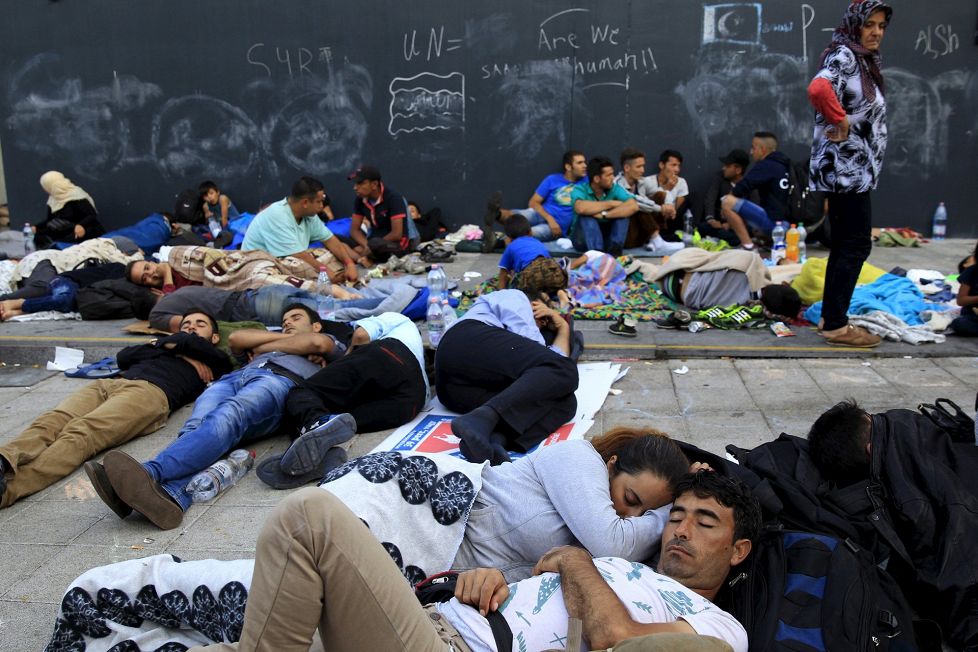
Suomalaiset ”isänmaan puolustajat” nimittävät näitä ihmisiä turisteiksi. Pakolaisia rautatieasemalla Unkarissa. Kuva: Iltasanomat: Bernardett Szabo
Se, että eurooppalaiset johtajat nyt tässä tilanteessa keksivät, että muutetaanpas asetuksia, päätetään, että Irakissa ja Somaliassa onkin juuri nyt turvallisempaa, kuin tähän saakka, on osoitus häpeällisestä kaksinaismoralismista.
Tämä on kuin peliä: Suomessakin on kuulemma ministeriö laittanut maksullisen arabiankielisen ilmoituksen Internettiin kertoakseen, että älkää vaan pakolaiset tänne tulko, meillä on muutettu suhtautumista hädänalaisten vastaanottoon. Sitten tarkkaillaan, kuinka nappulat toimivat, vaihtaako flipperipallo suuntaa ja putoaa taas kilahtaen Ruotsin aukkoon. Tomerina tehdään tilastoja, kurkitaan monitoreihin ja vertaillaan: tänään tuli viisikymmentä oliota vähemmän kuin eilen, olisivatko ne nähneet ilmoituksemme?
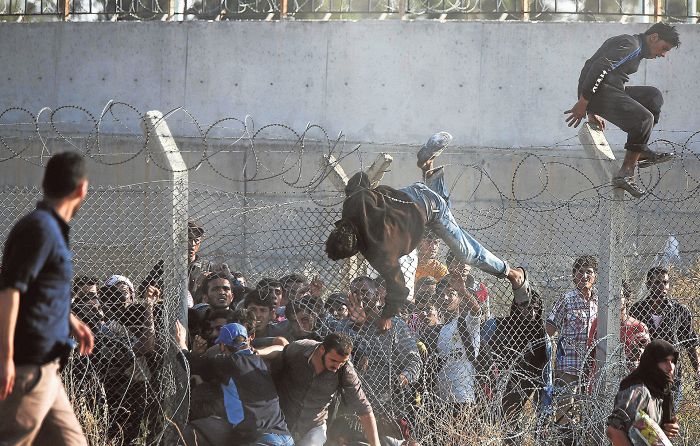
Pakolaisflipperi on peliä ihmishengillä. Kuva: ”Syyrialaiset pakolaiset leikkasivat kesäkuun puolivälissä raja-aitaan reiän päästäkseen Turkin puolelle.” Helsingin Sanomat Lefteris Pitarakis AP
Ihmisellä ja hänen hädällään ei ole merkitystä, hyvinvoivien maiden vastuulla epäinhimillisistä oloista saapuvista ei senkään vertaa. Nuokin pelaajat ja tilastonikkarit voitaisiin lähettää vastaanottokeskuksiin jakamaan ihmisille vaippoja ja vaatteita.
Mikäli tosiaan on niin, että Irakiin ja Somaliaan on nyt rauha palannut, lähetettäköön sinne meiltä pelinappuloiden mukana myös pelaajia. Tehdään sellainen tietokonepeli, jossa rakennetaan kukoistava kulttuuri tuhkakasan päälle ja Angry Birdsit hoitelevat taistelut vihollisnappuloita vastaan. Eikö se niin ollut, että avustetaan paikan päällä?
Toimikaa päättäjät nyt sitten niin, että lähetätte esikoisenne noihin maihin opiskelemaan ja menestymään, kun täällä kotimaassa ei nyt ole mahdollisuutta elättää omia eikä vieraita. Siellähän on jälleenrakentamisen ja kasvun ja kukoistuksen aika, siellä riittää työtä reippaille nuorille miehille ja naisille.
Suomen puolustajat taistelivat aikanaan henkensä uhalla aseistettua vihollista vastaan. Nyt ”Suomen puolustajat” taistelevat propagandan keinoin ja pelejä pelaamalla pelokkaita, väsyneitä, kaiken menettäneitä rääsyläisiä vastaan.
Sebastian Tynkkynen is third vice president of the nationalist populist Perussuomalaiset (PS)* and chairman of its youth wing. Recently he’s been in the national spotlight and a thick thorn in Timo Soini’s side and a threat to party unity.
The official reason why Tynkkynen’s party membership was revoked Friday was – according to PS party secretary Riikka Slunga-Poutsalo – because he published a list of the party’s members online to call an emergency meeting to debate if the PS should remain in government.
The way Tynkkynen’s membership was revoked exposes once again that the PS’ real name is TS, or Timo Soini, who rules his party with a mixture of charisma and terror, especially against those who get out of line.
The way Soini keeps the party leadership and MPs on short leashes, coupled by its turncoat policies in government, are certain recipes for disaster. It is ironic that the very people Soini gave a political voice, the racists and far right, are threatening to destroy the party today.
Soini doesn’t accept criticism from within his ranks as the Tynkknynen row shows but he doesn’t have a problem with members who have issues with racism, ethnic agitation convictions, and ties with far right groups.
Even if the media and some politicians are following the row with keen interest, we mustn’t forget that many of Tynkkynen’s opinions of migrants, minorities, cultural diversity and the EU are racist and ultranationalist. They are in the same league as far right parties like the Danish People’s Party and Sweden Democrats.
Should we then feel sorry for Tynkkynen as some media, politicians and law experts have expressed?
Not at all. How could you feel sorry for a member of a party that bases its popularity on xenophobia and victimizing migrants and petty provincialism?
We should, however, thank Tynkkynen for speeding up the eventual demise of the PS that is not only a huge disappointment to those that voted for it but for unmasking the political paper tiger the party is.
*The Finnish name for the Finns Party is the Perussuomalaiset (PS). The English names of the party adopted by the PS, like True Finns or Finns Party, promote in our opinion nativist nationalism and xenophobia. We therefore prefer to use the Finnish name of the party on our postings.
One matter has always surprised me about Finnish journalists is how some of them paint migrants with a single brush and allow their own prejudices get in the way of facts, especially when they write about migrants and minorities. A good example of the latter is a story by Jukka Harju, who not only mistakenly claims that the first refugees came to Finland over 40 years ago, but which national group adapted the best in Finland.
Most of this type of writing is, unfortunately, an exercise in assimilation and the writers prejudices about certain national groups.
As mentioned in an earlier posting, the first large group of refugees numbering 6,500 came from Russia in 1921, not over 40 years ago as the Helsingin Sanomat article incorrectly claims.
The journalist cites a teacher and school psychologist, Liisa Kosonen, to vouch that the Vietnamese who came in the late 1970s were well-adapted to Finland.
“It worked out well,” she is quoted as saying. “It had in part to do with the Far Eastern character. The Vietnamese adapted well to such a situation, they were cordial. They valued education and their children got a lot of support.”

 See full commercial (in Finnish) here.