Two days and nine years had gone by when Norway and Europe witnessed the horrific events of 22/7 that left 77 people dead and many others with physical and psychological injuries for the rest of their lives.
One of the matters that we can learn from the far-right terrorist is that words can turn into bullets.
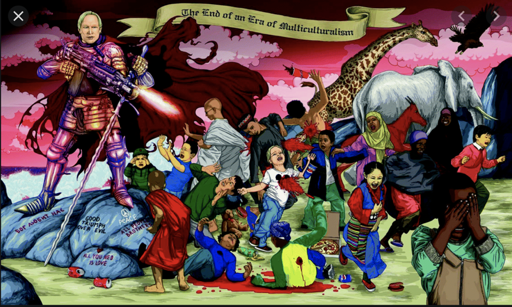
The far-right terrorist and “the end of an era of multiculturlaism.” Source: Springer
In his manifesto, “2083 a European Declaration of Independence,” he cites the Perussuomalaiset (PS)* and its chairperson Jussi Halla-aho as a credible (sic!) source on the takeover of Europe by Muslims.
The far-right was riding the crest of the wave in 2011. In Finland, the radical right Perussuomalaiset (PS)* party had scored their historic parliamentary victory. But then three months later, Anders Breivik appeared from nowhere and went on to murder 77 people to save – according to him – Europe from being overrun by Muslims.
On a day like this, the only thing we can and must do is not to forget.
Norwegian Prime Minister Erna Solberg, who is no friend of Muslims, said in her speech Wednesday that Norwegians must “fight every day for the values which were targeted by the terrorist.”
“July 22nd reminds us that life can be endangered when hate is allowed to stand unchallenged,” she said.
While no sensible person will deny the crimes by Breivik were horrific, we must acknowledge that he grew up in a country that armed him with such hate.
Until January, the Islamophobic Progressive Party (FrP) share power with Solberg’s conservative Høyre. The FrP ditched the government because of the repatriation of a Norwegian woman allegedly linked with Isis had her five-year-old child, who needed medical treatment.
I am certain that Breivik’s stain on Norway will never wipe off. And this is good because it is a reminder of what hatred and racism can do.
In August, Norway almost underwent another Breivik-style terrorist attack when a young man attacked theAl-Noor Islamic Center near Oslo. Fortunately, a 65-year-old man foiled the attack.
Perussuomalaiset (PS) chairperson Jussi Halla-aho is the Finnish version of Hungarian strongman Viktor Orbán. If he had his way, Finland would deport Muslims, deny asylum to people dependent on race, encourage dog-eat-dog economics, and scale down the welfare state.
Halla-aho’s alternate reality and that of his party sometimes cause a knee-jerk reaction: WTF.
We have ready about the brutal assault that PS councilperson Pekka Kataja suffered Friday. Wouldn’t you have it that Halla-aho and party secretary who is an ethnonationalist, Simo Grönroos, speculated right after the attack that it was not an isolated crime but politically motivated.
Taking into account how much Kataja has changed his interpretation of events, we are still in the dark about the motive of the assault.
We read about the brutal assault against a Perussuomalaiset (PS)* campaign manager Pekka Kataja. There was great interest in what happened when he mentioned that the suspect(s) were probably “Arab-looking.” Silence befell the PS after Kataja changed his story by claiming that the attackers were probably from the far-right.
One question that arises here is why is Kataja so keen on telling us what ethnic or political grouping they were?
In February 2018, a Pakistani was brutally assaulted in Vantaa by three white Finnish youths. Apart from being stabbed up to thirty times, suffering a fractured skull and other injuries, interest in the story ended after the police said four days after the assault that the attack was not a hate crime.
The assaulted Pakistani recovering in hospital in March 2018. Photo: Enrique Tessieri
The police announced Tuesday that charges against the suspects changed from attempted manslaughter to attempted murder after five days that the crime took place. With the case of the Pakistani victim, the police changed the charges weeks later in April toattempted murder from attempted manslaughter.
While both stories have race or ethnicity as underlying factors, in the beginning, this changed and this forced interest to die down. What emerged after that was hypocrisy.
PS chairperson Jussi Halla-aho and party secretary Simo Grönroos were quoted in Kainuun Sanomat as saying after the attack that it was politically motivated.
“Everything suggests that this was not an isolated crime, but specifically an attack against Kataja, the party’s political activities and an attempt at homicide,” Halla-aho and Grönroos were quoted as saying in Kainuun Sanomat.
One PS member, MEP Laura Huhtasaari’s aide, went as far as to suggest the conspiracy theory that the hit job against Kataja came from the EU elite and EU secret services.
“I wonder if the murder attempt against Pekka Kataja was an attempt and ordered by the EU elite or the EU intelligence services?” Olli Kotro is MEP Laura Huhtasaari’s aide. Source: Twitter
Attempting to picture Kataja as a political martyr, the speaker of parliament, Anu Vehviläinen, stated in the tweet below that those responsible for what happened must be brought before justice.
But let’s go back to the original question: What type of violence captures the interest of the media, social media, politicians, and the general public?
As mentioned, when Kataja stated that he suspected the far right of attacking him, the PS fell silent. The same matter happened in the case of the Pakistani: Interest by the media fell after the police mentioned that what happened was not a hate crime.
It appears that the Kataja incident, which is dreadful and we should strongly condemn, may surprise us yet again. The PS has an issue with far-right ideology, and it is no secret that Kataja has made Islamophobic statements in the past.
What far-right groups did he not get along becasue there are a lot of them in the PS. Is he talking about Suomen Sisu?
Kataja is also the aide of PS MP Jouni Kotiaho, who wrote in an OP-ED piece in Jyväskylä-based Keskisuomalainen that the radical right is “insignificant group” in Finland even if some have accused the PS, the second biggest party in parliament, of being radical right.
Moreover, Kataja’s boss claims in the Keskisuomalainen column that “[e]ven, if you can count the number of Nazi supporters with one’s fingers and racism does not happen in practice in Finland at all.”
As we are trying to figure out if Kataja’s story holds water or if what happened was something personal as some suspect. Let’s stop all this hypocrisy about how much we are against political violence and violence in general, which is targetted by the PS against Muslims and people of color.
But let’s agree on one matter: condemn all types of violence irrespective of the victim’s background. The ethnic background of the victim should not be a factor in how much media attention a victim gets.
The Pekka Kataja story, the Perussuomnalaiset (PS) councilor of Jämsänkoski, is constantly changing. First, he claims that “Arab-looking” men assaulted him. That has now morphed into “possibly” it was the far right or far left.
Kataja even claimed that he was attacked due to his opinions of an asylum reception center, which he wanted to be closed.
The problem with the latter theory is that few if any at the asylum reception center has ever heard of him.
“The asylum seekers at the reception center don’t read Finnish papers so they are unaware of people like this man [Kataja], said a Jämsänkoski asylum seeker.
While we should forcefully condemn all types of violence, there is a generous dose of hypocrisy emerging from the Kataja affair. On the same day as Kataja was attacked, the family of Left Alliance Helsinki councilperson Suldaan Said Ahmed was threatened with a bb-rifle.
How many PS politicians condemed what happaned to Ahmed’s family?
Why isn’t anyone showing their repugnance for racism and hate speech perpetrated by parties like the PS?
On Friday, we read about an assault against a Perussuomalaiset (PS) politician in Jämsänkoski. Pekka Kataja, who was rushed to the hospital to treat his head wounds, broken ribs, and a concussion. The PS politician, who has made a name thanks to his anti-Muslim opinions, claims that the men who attacked him were “Arab-looking” and that the attack was politically motivated.
As we wrote in a previous blog entry, we should do everything possible to condemn and stamp out violence. If the attack against Kataja was politically motivated, this would be a very worrying sign.
But some question marks arise from Kataja’s claims. Some of these are:
Did the “Arab-looking” suspects speak Finnish with an accent?
Kataja has a long track record for his Islamophobic views. In a 2017 Yle election compass, he mentioned as one of his goals was to end “asylum tourism” and that Finland cannot afford to pay billions [of euros] to provide for them;
” Didn’t any red lights start to flash when the two “Arab-looking” suspects asked him to show his ID for a package with party flyers?
Did the suspects speak Finnish with an “Arabic” accent?
The PS believes that the attack was politically motivated. Why would anyone target a political noncelebrity in a small town in Finland?
Another one of these questions is that the attack was politically motivated because he wanted the Jämsä asylum reception center closed.
Speaking to one former resident of the reception center, expressed elation of its closing.
“It was the best news I had heard,” he said.
The “Arab-looking” suspect claim smells like a conspiracy theory of the PS. They have used such campaigns very effectively in the past, as we saw in Oulu with the sexual assault cases.
Thanks to the Tapanila sexual assault case about a month before the parliamentary elections of 2015.
In the last three parliamentary elections, conspiracy theories about sexual assault by foreigners have played an important role in attracting votes.
Pekka Kataja, a Perussuomalaiset (PS)* campaign manager from Jämsänkoski, was brutally attacked Friday at his home by what he called two “Arabian-looking” men. He claims that the attack was political because, as an ardent Islamophobe, he was in favor of shutting down the Jämsä asylum reception center.
While all forms of violence should be condemned, what happened to Kataja is unacceptable and an affront to the rule of law. We hope that Kataja’s recovery will be swift.
Here is the flip side of the story: Of all the parties in Finland, the PS knows how to label and exploit Islamophobia for its political means.
Moreover, there may be something fishy or missing from the big picture when members of the PS start to spread conspiracy theories like the Tweet below by Olli Kotro.
“I wonder if the murder attempt against Pekka Kataja was an attempt and ordered by the EU elite or the EU intelligence services?” Olli Kotro is MEP Laura Huhtasaari’s aide. Source: Twitter
There are a number of questions that the Kataja incident raises:
According to a new survey on the police service, an editorial in Finland’s largest daily Helsingin Sanomat claims today that trust in the police runs high, even if the survey showed that confidence in the police had fallen by four percentage points to 91%.
The editorial also puts in a favorable word for the media, which it claims enjoys strong acceptance from Finns because it is a trusted source due to the lack of fake news, and the high literacy levels of its readers.
While there is a lot of trust in the police and national media, we have to make a further important question: Which groups trust the police and media?
If we look at the question from the perspective of the radical right and the rise of populism and far-right ideology in Finland, about 18%, or about half a million voters, question the latter two institutions.
Finland’s largest opposition party, the Perussuomalaiset (PS)*, is openly Islamophobic, misogynist, and openly hostile of the mainstream media, and in many cases of the police.
The rise of anti-Muslim racism and other forms of discrimination in Finland are a cause for concern. How much do minorities like the Roma, Saami, migrants, and their children trust the police and national media?
If you asked some members of the Roma community what they think about the police service, the answer you may get may or may not surprise you. The same goes for people of color who commonly accuse the police of systematic racism and ethnic profiling.
Why are such groups usually sidelined? Why aren’t their opinions important?
The Helsingin Sanomat editorial forgets, like commonly other sectors of society, to ask what these minorities’ opinions are. Not asking them is denial and systemic racism; both our blind spots that continue to see Finland as a monolithic slab of whiteness.
It is hoped that these surveys about the police service and media don’t sideline minorities.
We have recently read about two cases where security guards use force to handle a passenger that does not have a ticket. In both these cases, there is a link: both are black passengers. Both passengers were also on a transport or at a station operated by the Helsinki Regional Transport Authority (HSL).
The first case took place on June 23 in Espoo, while an East African nursing student was escorted violently out of the train. One security guard allegedly held her hand while the other had her in a chokehold.
“It was quite shocking when I saw this recent case,” said the East African nursing student. “I get nervous when I board a train because of what happened to me.”
The woman said that her lawyer has asked the police for the video footage of the incident but they have refused because the case “is still under investigation.”
The Helsinki Regional Transport Authority (HSL) announced today that the company plans to arrange “social equality” courses for ticket inspectors, according to Yle.
If the victims of both cases are correct, it exposes what we’ve known for a long time: Some have more rights in our society than others despite the social equality rhetoric we often hear and made possible by our exceptionalism.
Almost two weeks past when a 17-year-old black adolescent was allegedly violently assaulted by security guards for not having a valid ticket. The black adolescent ended up handcuffed and held on the floor while his white friend was allowed to leave.
The violent treatment of the security guards should not surprise us since a comprehensive study in 2018 on ethnic profiling by the University of Helsinki showed how ethnic profiling, especially by security staff, was a source of particular concern.
“Many said [in the study] that security guards were often rude and treated them roughly, even violently,” said the University of Helsinki Professor Suvi Keskinen of one of the ethnic profiling study’s findings.
The two cases in the story are a good opportunity to expose how systemic racism works in Finland.
How many black policemen are there in Finland? What about those that work for security firms? Too few to make a significant impact on policy.
And let’s not forget as well the racist trolling against the victim’s mother on social media.
The confidence of their impunity and ther racist arguments reveals how far some have stooped and how much work there is still to do on the anti-racism front.
Migrant Tales insight:Dr. Faith Mkwesha’s child was was held and mistreated by security guards who handcuffed him and resting his knee on her child’s back. Apart from being a traumatic experience for her child and the mother, all of this happened because he did not have a valid metro ticket, which he thought incorrectly that they were valid for two hours.