Migrant tales
Menu
  • #MakeRacismHistory “In Your Eyes”
  • About Migrant Tales
  • It’s all about Human Rights
  • Literary
  • Migrant Tales Media Monitoring
  • NoHateFinland.org
  • Tales from Europe
Menu

Category: Enrique

Abdulah: Healing the wounds inflicted by intolerance and regaining balance

Posted on April 21, 2013 by Migrant Tales

Abdulah, who has appeared in a number of postings on Migrant Tales, hasn’t yet rallied enough courage to speak without the veil of anonymity. Like many who are scorned in Finland because of their ethnic background, regaining one’s balance and healing the wounds inflicted by intolerance can be a long process.

“I have learned a lot from Migrant Tales,” he said. “One of the most important matters that has helped me is to accept who I am. It’s been an ongoing process.”

Accepting oneself can be easier said than done, especially for those that have been constantly reminded that their ethnic background is something they should be ashamed of, according to Abdulah.

He says before discovering Migrant Tales, he thought that there wasn’t a single forum in this country that cared about his situation.

“It was awful and I became paranoid every time I walked outside my home in public,” he continued. “All the chat forums that I followed overflowed with racism and hatred for who I am.”

Abdulah believes that the  most racist forums in Finland are found on Iltalehti and Suomi24.

“[Tabloid] Ilta-Sanomat’s chat forum aren’t  as bad as Iltalehti’s because they’ve cleaned up their act,” he said. “I haven’t visited Hommaforum. Maybe I should one day.”

Migrant Tales believes that visiting Hommaforum would be a waste of time for Abdulah.

Mediaseurantais another website that furthers what Hommaforum spreads but in a subtler fashion. While it attempts to give a balanced view of what is written about immigrants in the Finnish media, it’s a pro-Hommaforum site.  This is apparent by the type of stories it publishes that attempt to show immigration, and espcially Muslims, to be a problem in Finland.

Abdulah has never heard of Mediaseuranta and considers Uusi Suomi to be a good online forum because it gives immigrants and visible minorities an opportunity to express their views.

Migrant Tales doesn’t totally agree with Abdulah.

Even if anti-racists publish blog entries on Uusi Suomi, the online publication is openly hostile, racist and a home for Finland’s anti-immigration community.

Uusi Suomi has tried to weed out openly racist writers from publishing on their site. Even so, the website is still a good breeding ground for spreading conservative, anti-EU, right-wing populist, anti-immigration, and especially anti-Muslim diatribe.

Moderation is poor and it’s unclear if the online publication conveniently turns a blind eye to some of its more racist and Islamophobic blog entries.

Migrant Tales (July 22, 2012): What have we learned after Norway’s 22/7 and the Boston bombings?

Posted on April 19, 2013 by Migrant Tales

Comment: As the manhunt for one of the two suspects continues in Boston, what should our reaction be to the two Chechen killers? This blog entry written on the first anniversary of the horrific killings in Norway by Anders Breivik could shed light on that question.

____________________

What goes around comes around.

Exactly a year ago Anders Breivik carried out his mass killings, which ended up causing the death of 77 innocent victims. Have we learned anything from that tragic Saturday that shook the Nordic region and changed it permanently?

In order to answer that question, we’d have to travel back in time to see how things were prior to that  day.

In Finland, the right-wing populist Perussuomalaiset (PS) had just won ahistoric election victory that enabled the party to increase the number of its MPs to 39 from 5 in 2007. While party leader Timo Soini played down anti-immigration sentiment as one important factor behind the PS’ election victory, others disagreed.

Before Breivik erupted on the stage, anti-immigration parties like the PS were the new political force to contend with in Finland. It seemed that nothing could stop them from adding new election victories in the future. The louder and cruder their anti-immigration and anti-EU stances were, the more supporters they’d rally to their cause.

http://www.youtube.com/watch?feature=player_embedded&v=xjVD0ztWaKA

In Norway, Denmark and Sweden, far-right populist anti-immigration parties had grown as well and were openly challenging traditional parties.

Everything changed, however, after July 22.

The first blow came in Norway to the Progress Party (FrP), which saw its support in the September municipal election plummet by 6.1 percentage points to 11.5%. In the same month, another anti-immigration party, theDanish People’s Party (DPP), suffered an election setback.

Since 2001, the Islamophobic DPP had supported minority right-wing government in exchange for tighter immigration policy.

In many respect, Breivik was a wake-up call that woke up for Finland and the Nordic region to the threat of intolerance and hate speech.

A recent supreme court ruling against Jussi Hall-aho is a case in point. The PS MP was not only fined for defaming a religion but for inciting ethnic hatred as well. The ruling wasn’t only a big blow to the PS but to the far-right Suomen Sisu wing of the party.  Halla-aho was forced to resign as chairman of the administration committee, which, among other matters, sets immigration policy.

The presidential election was another important example of how Finland is distancing itself  after 22/7 from the anti-immigration and populist rhetoric of parties like the PS.

Two conservative anti-EU candidates, Timo Soini of the PS and Paavo Väyrynen of the Center Party, lost to Green Party hopeful Pekka Haavisto in the first round of voting. Haavisto is openly gay and pro-EU.

The next test for the PS will come in the October municipal elections. If polls are anything to go by, the party will suffer another election setback.

In light of the above, can we claim that Breivik had had a direct impact on the popularity of the PS and other parties in the Nordic region that are anti-EU, anti-immigration and anti-Islam?

Your answer to that questions will probably reveal more than anything else your political views on immigration, Islam and cultural diversity.

But if we ask Norwegian Prime Minister Jens Stoltenberg, Norway had become after July 22 “more tolerant, [and] more careful not to judge people” by ethnic origin.

Even if Stoltenberg has shown leadership on how a wounded society should react to intolerance, it’s still unclear what impact Breivik will have on our societies. We are still healing from the wound and can matters return back to “normal” in Norway after Breivik?

If we set aside politics and try to understand the impact Breivik had on the region, one matter is certain:  We are outraged by what happened but dread even more the possibility that it could happen again.

Competing for the anti-immigration thunder and rhetoric of parties like the PS, DPP, FrP and Sweden Democrats are far-right groups like the Finnish Defense League, which are  copy-and-paste clones of the English Defense League.

Breivk scared the wits out of some of us and proved that anti-immigration and Counter-Jihad rhetoric can convert itself into a monster that has the ability to wreak terror and change our societies for good.

That I believe is the real message and threat of 22/7.

Whiteness and white privilege speak European languages

Posted on April 18, 2013 by Migrant Tales

As we hold our collective breaths and await to know the identity of the bombings in Boston Monday, too many don’t see a suspect but a whole ethnicity or religious group. Tim Wise put it very well in an opinion piece where he makes some distributing revelations about the power of whiteness.

If we understand in Finland, the Nordic Region and Europe that white privilege in the United States means the same thing here, we can begin to understand the social ills that have inflicted us as well.

Being “white” in Europe means that you are a member and identify with the dominant ethnic group of a country. You can speak Italian, be a white Romanian, Estonian-speaking Estonian, or an Englishman or a white Englishwoman to enjoy white privilege over other groups that are visible minorities.

Wise affirms that the Boston bombings are another lesson about ethnicity, whiteness, and specifically of white privilege.

He writes: “White privilege is knowing that even if the Boston Marathon bomber  turns out to be white, his or her identity will not result in white folks generally being singled out for suspicion by law enforcement, or the TSA, or the FBI…And if he turns out [the killer] to be a member of the Irish Republican Army we won’t bomb Belfast. And if he’s an Italian American Catholic we won’t bomb the Vatican.”

Anders Breivik, who killed in cold blood 77 victims on July 22, 2011, is a good example of white privilege in the Nordic and Europe. Despite his horrific act, nobody in this part of the world thinks that all white people are mass murderers.

On the contrary. Whites privilege and time make us forget such horrors. Wasn’t Breivik a deranged lone wolf?

We should start to speak more about white privilege.

Not talking about it  shows another feat by white privilege: Playing down the issue.

The Boston bombings reveal a deadlier blowback

Posted on April 17, 2013 by Migrant Tales

I was shocked to hear about the twin bombs in Boston and my heart goes to the victims. Two days after the incident, however, speculation has been rife about the probable ethnicity of the perpetrator. The eerie silence of the killer suggests that this was probably carried out individually.  

Kuvankaappaus 2013-4-17 kello 10.16.30

The latest story on the Boston Globe reveals no clues on who the killers could be.

Anupreet Sandhu Bhamra, a Canadian journalist who has published on Migrant Tales, read the following tweet after the bombings: ”Oh God, please, let it not be a Muslim.”

The sense of dread that was mentioned in the tweet was felt by the small visible immigrant community in Finland after we learned about the assassination of Swedish Prime Minister Olof Palme on February 28, 1986.

I too hoped that the assassin that killed Palme isn’t an immigrant.

Not only was anti-immigration sentiment in Finland a fact of life back then, it was alive and kicking despite the fact that only 0.3% of the population (17,039 people) were immigrants.

Initial media coverage of the Boston tragedy revealed that US authorities suspected the killer to be a man who spoke with an accent. That man turned out to be a Saudi Arabian man who was later released by officials.

While the bombings were a cowardly act, the blowback from it proves even more devastating by revealing our prejudices and hatred of other groups.

You may have initially asked who could commit such a heinous crime in the US? It couldn’t be a white man, right?

The bombings raise an important question: If labeling, victimizing and generalizing of different groups are wrong, why do we persist in doing so?

The answer to that question should reveal the role that racism plays in our society and why the battle against this social ill is halfhearted.

Bhamra writes: ”The Oklahoma City bombing was a terrorist bomb attack in downtown Oklahoma on April 19, 1995. Initial news stories were quick to wrongly suggest Islamic terrorists were behind the attack. As a result, Muslims and people of Arab descent were attacked. Later, when the suggestions turned out to be incorrect and the suspect turned out to be a White man, the racial framework was quickly and conveniently dropped.”

On July 22, 2011, we suffered a similar tragedy when Anders Breivik went on the rampage in Norway and killed in cold blood 77 innocent victims. In the same way that initial coverage in Oklahoma pointed the finger at Muslims, some thought that the killer in Norway to be a Middle Easterner as well.

Norwegian Prime Minister Jens Stoltenberg showed exceptional leadership as Norway was mourning its victims. Contrary to Washington’s reaction to 9/11, the Norwegian prime minister said that his country’s response to the mass killings will be more openness and more democracy. According to him, Norway had become after July 22 “more tolerant, [and] more careful not to judge people” by ethnic origin.

Another tragedy that we are witnessing after 22/7 is how the media, politicians and public are collectively forgetting what Breivik did never mind its causes, which haver their roots in Islamophobia and anti-immigration sentiment.

While racism is an effective tool to divide and conquer other groups, we should never forget that it is a rabid dog on a short leash that can bite back and hard at its master.

How can immigrants and visible minorities clear the minefields of misinformation?

Posted on April 15, 2013 by Migrant Tales

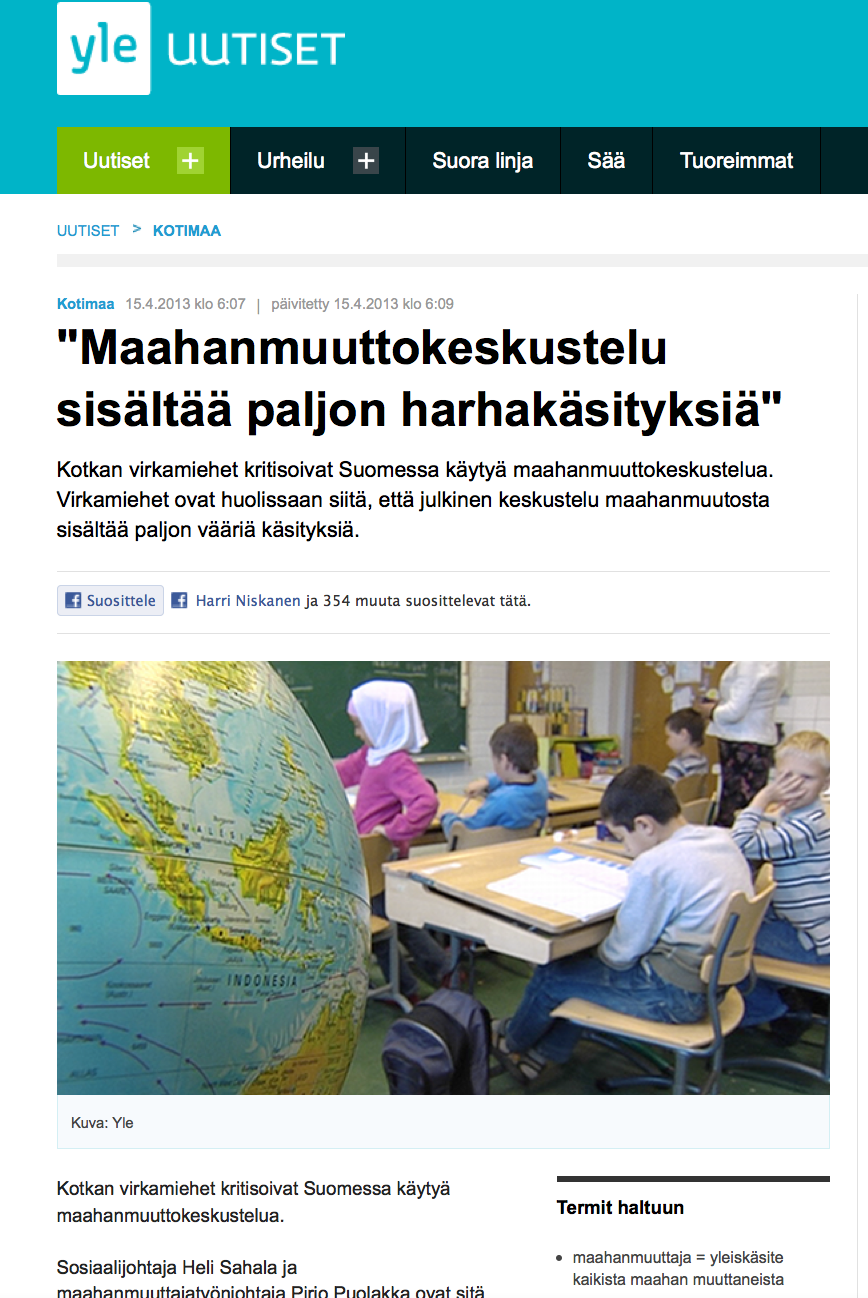
There is an interesting news story on today’s YLE that raises a timely question: Not why there is so much misinformation spead about immigrants, but what does this reveal about us as a society?

Kuvankaappaus 2013-4-15 kello 16.51.40

Does it bring to light ignorance or a subtle conspiracy that permits us to have and eat our racist cake simultaneously?

While it is a welcome matter that Finnish officials speak out against prejudice and racism in our society, why has so little been done on this front in the past, especially by those who claim to be anti-racist and work to better the lives of immigrants?

You’ll probably find the answer to that question in the eerie silence and tacit approval of that misinformation being spread against immigrants. It is telling you as well that we must raise our voices and lead ourselves if anything is to change.

What kind of wise tales are being spread in public about immigrants?

According to what Pirjo Puolakka of the city of Kotka’s immigration office, they are the following:

  • Immigrants and refugees are the same thing;
  • Immigrants get more social welfare than Finns.

Another topic that could be added to this  list are rape and crime statistics.

Misinformation could be pictured in the following manner. It could be seen as the deadly mines up ahead of our path towards greater social equality and acceptance. Since clearing that minefield would be suicidal, it’s clear that few white Finns will do the job. This only leaves us.

But beyond those killing fields we’ll eventually confront the greatest foe of all: ourselves.

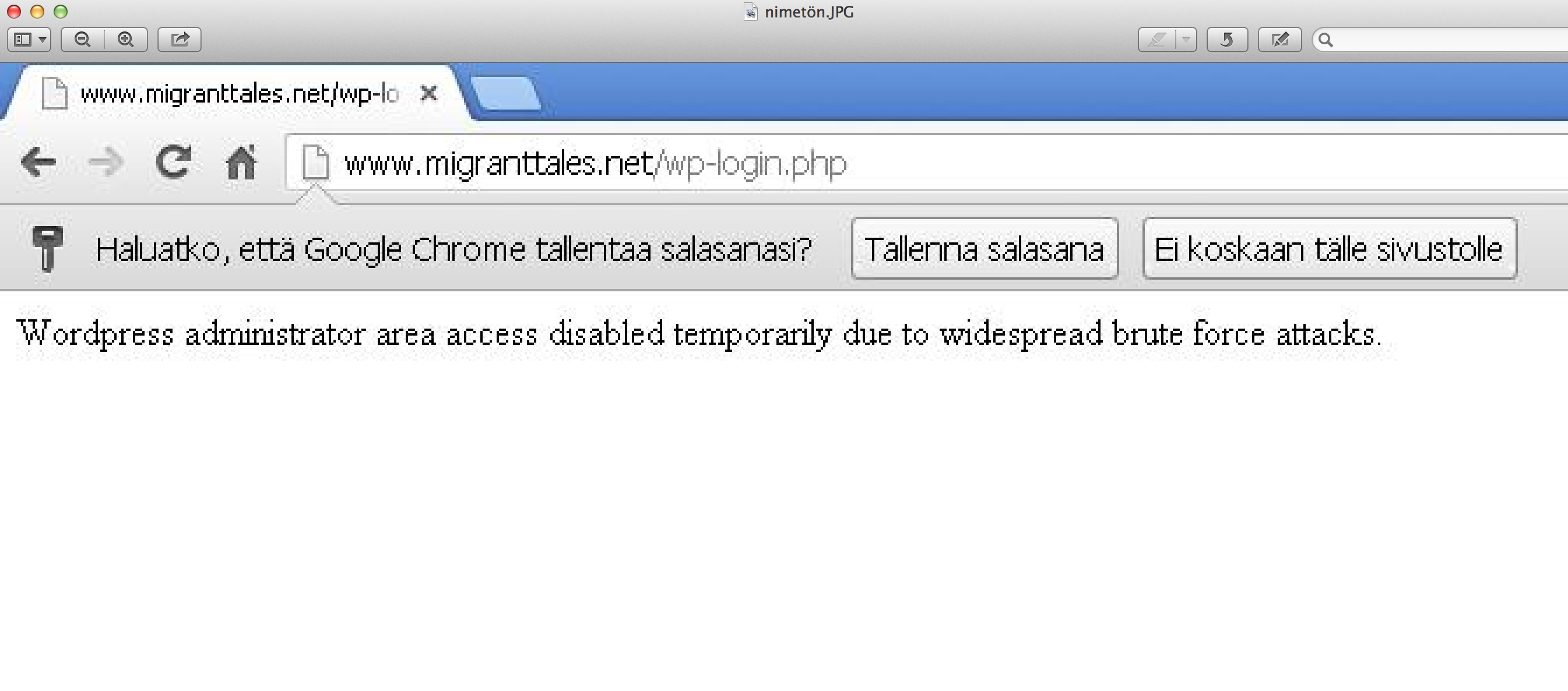
Migrant Tales administrator area access disabled temporarily due to widespread brute force attacks

Posted on April 14, 2013 by Migrant Tales

I noticed this message late-morning Sunday when I attempted to access Migrant Tales from another computer.  Let’s hope that this matter is resolved soon and that this is a general problem. 

Roughly a year ago we were deactivated for 13 hours and received hostile emails. Those who speak out for freedom of speech, or the right to spread hate speech about other groups, don’t want others to speak out.

Kuvankaappaus 2013-4-14 kello 12.59.29


Margaret Thatcher’s New Right and Finland’s Perussuomalaiset party

Posted on April 13, 2013 by Migrant Tales

As Perussuomalaiset (PS) leader Timo Soini promises that his party will become the biggest party in next year’s European parliamentary elections, which would give him a spring-board to score a similar election victory as in 2011, it’s still too early for the party to reveal how it would deal with its usual enemies like the Greens, homosexuals, immigrants, visible minorities, left-wingers and anyone it arbitrarily labels as “unpatriotic” or anti-PS. 

What is scarier about the PS? Is it its bravado and political saber-rattling taking place now or what it’s keeping under wraps in the stuffy closet: Do not let out until after the 2015 parliamentary election?

What isn’t surprising, and what few political journalists have failed to analyze, is how similar Soini’s political world view is to Margaret Thatcher’s New Right ideology, when she ruled Britain with an iron fist between 1979 and 1990.

Writes Owen Jones: “Thatcherism was a national catastrophe, and we remain trapped by its consequences. As her former Chancellor Geoffrey Howe put it: ‘Her real triumph was to have transformed not just one party but two, so that when Labour did eventually return, the great bulk of Thatcherism was accepted as irreversible.’”

Can the same happen in Finland if the PS are victorious in 2014 and 2015?

One post, published on Migrant Tales by Jenny Bourne of the Institute of Race Relations, highlights many similarities.

Like Thatcher, who ”was, without doubt, a xenophobe, an unapologetic imperialist with a natural penchant towards the far Right,” according to Bourne, Soini and the PS are without doubt “xenophobic, unapologetic racists with a weakness for the far Right.”

There are differences, however. While Thatcher was bent on destroying the power of the unions, the PS aims to build a “workers’ party without socialism.”

A workers’ party without socialism sounds more like what fascist Italian dictator Benito Mussolini founded in Italy. During his reign (1922-43), Mussolini wielded power with the help of powerful unions. The same model was copied during 1946-55 by Argentinean former strongman Juan Perón with disastrous consequences.

Another clear example of the New Right spirit of the PS is their economic policies. Part of these were revealed in January  by EuroMP Sampo Terho and PS strongman Matti Putkonen, who suggested how Finland could save 3.15 billion euros. While the usual culprit of development aide was mentioned, it was surprising that Terho and Putkonen suggested raising VAT, a PS policy no-no.

Thatcher’s suspicion of the outside world, nationalism and xenophobia are generously shared by the PS.

One recent example is the embarrassing revelation where the National Bureau of Investigation as well as Interior Minister Päivi Räsänen have had to apologize for the mistake in adding Russian President Vladimir Putin to a list of criminal suspects. It didn’t take long for PS MP Tom Packalen, a former police commissioner, from stating in a blog that there was no wrongdoing in placing Putin on such a list.

While the former prime minister admitted that if four million people from the new Commonwealth or Pakistan moved to England in the 1980s, she admitted that people were going to react in a hostile manner to those moving there.

Many PS and anti-immigration groups in Europe and elsewhere speak of “uncontrolled” immigration, which is only a synonym for permitting people to react in a hostile manner towards others.


It’s the cultural diversity, stupid!

Posted on April 11, 2013 by Migrant Tales

Would it be fair to say that the biggest challenge facing Finland during this century is accepting its cultural diversity and deconstructing our white national identity in order to make our society more inclusive? Will this happen easily? 

The central issue being debated in Finland today about immigrants boils down to one question: How much cultural diversity are we willing to accept?

There aren’t any political parties in this country, except for the Perussuomalaiset (PS) and its extremist Suomen Sisu faction, which are openly against white  Finns marrying people of different ethnicities.  Even so, it’s clear that this attitude is quite widespread in our society.

If we’d like to see an even bigger picture of how this works in practice, we could take Cuba’s Fidel Castro example of how he got rid of  his political dissidents by allowing them to flee en masse to neighboring Miami.

Less dissidents, more perceived unity.

Finland has seen over 1.2 million emigrants move mainly to the Americas and Sweden between 1860 and 1999.  Just like Castro, Finland benefited in the same way. Apart from the socialists and communists that fled Finland after the Civil War of 1918, Finland was able to forge unchallenged a social construct like the “noble” white Finn.

It didn’t matter that hundreds of thousands of Finns had moved to other parts of the world and intermarried with other ethnicities. The way Finnish language evolved in Finnish immigrant communities, and how our view of our changing identity changed as a result, interested only a few.

Paradoxically, we wanted our Finnish expats to retain their Finnish culture and identity at all costs. Today, however, we want our immigrants and newcomers to do totally the opposite: Be like us (white Finnish) we tell them. Learn our culture, speak our language adopt our way of life.

Kuvankaappaus 2013-4-11 kello 8.24.30


The Finnish Lutheran Church has started to take a strong stand against racism like this story about multicultural families reveals about the discrimination their children face in our society. If there are people who are on the frontline of our ever-growing cultural diversity, they are these exemplary mothers.

Any person who thinks that immigrants don’t want to adapt and succeed in their new homeland know very little about immigration. An unsettling question arises: How can you integrate into a society that doesn’t accept you?

It’s clear that white Finland will not cede much of the high ground to cultural diversity. Expect then the following: lip service about two-way integration but what is really happening is one-way integration (assimilation) in most cases. Wherever two-way integration occurs, it usually happens on a short leash.

A good example of the latter is the following statement I heard from a politician in private. “There is room for immigrants in this country” but “building mosques is out of the question.”

Since it was easy to assimilate “foreigners” in the last century into Finns, it’s a bit more complicated in this century. It was easier in the previous century. All you needed was language, be white, adopt a Finnish surname and substitute your “foreign” background for ardent nationalism.

You’ll need much more than a surname change and a few nationalistic sound bites to be accepted as a Finn with equal rights in this century.


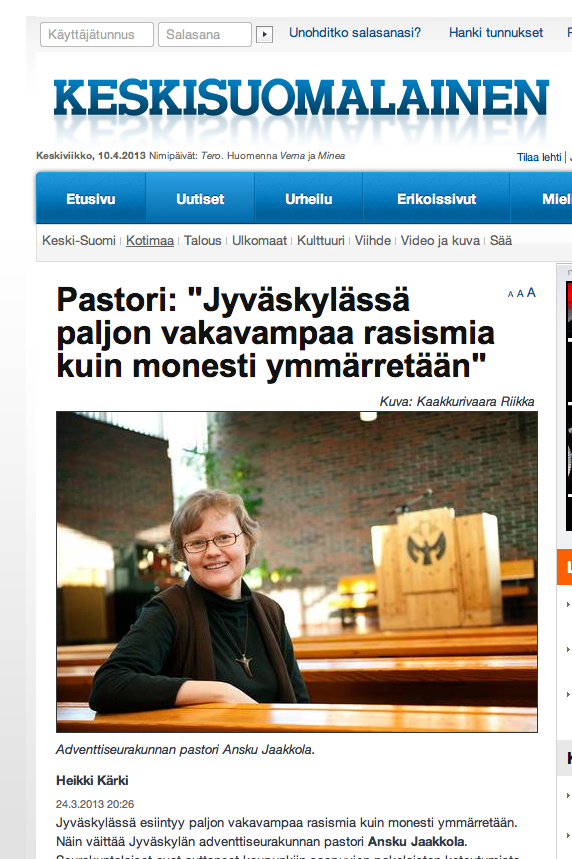
Pastor Ansku Jaakkola says that racism in Jyväskylä is far worse than many think

Posted on April 10, 2013 by Migrant Tales

Difficult times bring forth exceptional people. One of these is Pastor Ansku Jaakkola of the Adventist Church in Jyväskylä, who believes that racism in her Central Finnish city is far worse than many think.
Näyttökuva 2013-04-10 kohteessa 16.44.48
”Our new [foreign] friends have told us that yelling and harassment happens on a daily basis,” she was quoted as saying on Keskisuomalainen. ”It happens at stores, in the streets and at school.”Jaakkola admitted that it’s difficult for white Finns to understand what racism is if they have never experienced it.While she admits to having been treated well when she lived abroad in England, Marshall Islands and other countries, she states that our society should speak out more against intolerance.

?”It shames me when I hear about people treating others unfairly because of their ethnic background,” she told Migrant Tales. ”It surprised me how general and how much it occurs [in Jyväskylä].”

Jaakkola says that fear and ignorance are the causes for racism in our society.

Jyväskylä has been in the national spotlight recently because of an attack by neo-Nazis against a book presentation in January. In the same month there was a story in the local newspaper about a young dark-skinned woman who was in a toilet.One of the white Finnish women standing in line exclaimed upon seeing the black woman: ”I’m not going to [sit on the same toilet bowl] as that n-word,” she told a woman behind her. ”You go ahead if you dare.”

How can Finland tackle intolerance today if it cannot come to terms with its past?

Posted on April 9, 2013 by Migrant Tales

Finland’s present political and social dilemma could be best described in the following manner: On the one side it has a difficult time acknowledging ever-growing intolerance in its society, but on the other slowly understands that one major source of that intolerance are groups like the Perussuomalaiset (PS) party.

The PS has grown into a major political force in Finland not by its own merits per se, but because other political parties and the media have been near-silent to its right-wing populist anti-EU, anti-immigration and especially anti-Islam political message.

If the PS ever got to government, and if its chairman Timo Soini ever became prime minister, it would make conservative Christian Democrat interior minister, Päivi Räsänen, look like a liberal.

If this ever happened, the situation of immigrants and visible minorities in Finland would deteriorate further. They would feel the full brunt of populism and intolerance that is openly promoted by the PS.

While we can debate the extent of intolerance in Finland, probably one matter that we can state safely is that our tolerance for cultural diversity needs to improve. We cannot improve on this front as long as we close our eyes and plug our ears to the social ills that racism, prejudice and discrimination are fueling in our society.

It’s futile for a white Finn to state if there is racism or not in our society because he or she has never experienced it. How could he?

We do ourselves great harm by denying or playing down those voices that claim they are victims of racism, prejudice and outright discrimination.  This type of silence only encourages and fuels more intolerance.

But back to our dilemma: If we are to challenge the sources of our intolerance, our society needs to do a lot more soul-searching that will carry us back to the depths of the last century. Certainly there we’ll find the sources of our intolerance and the causes for the rise of an anti-immigration party like the PS.

Kuvankaappaus 2013-4-9 kello 1.02.06

Here’s an interesting article on Yliopppilaslehti about one of those historical skeletons in our collective closet.

It’s futile to understand who we are today if we don’t come to terms with our past. Some sticky unanswered questions include our relationship with Germany and the Nazi regime, the Continuation War, our hatred for the Russians, the Civil War of 1918, cold war-era censorship, and the social construct of Finnish national identity in the last century as well as other ones.

This is the dilemma facing Finland today: If we don’t come to grips with our past, we will be in danger of repeating the same mistakes.


  • Previous
  • 1
  • …
  • 20
  • 21
  • 22
  • 23
  • 24
  • 25
  • 26
  • …
  • 152
  • Next
Read more about documentary film
Read more

Recent Posts

  • Finland’s tabloids Iltalehti and Ilta-Sanomat are the pits
  • Riikka Purra’s Dr Jekyll and Mr Hyde mask
  • Double standards
  • Perussuomalaiset: Uusi logo, sama vanha juttu
  • Taco Trump

Recent Comments

  1. Absolutely Socking: Racist Finnish Facebook group against human rights gets flooded with socks on Musta Barbaari’s mother and sister charged by the police in “ethnic profiling” case
  2. Ilkka Nuotio on Pekka Myrskylä: “Tilastot kertovat toista kuin poliittinen keskustelu”
  3. Genrih Soinkara on The war in Ukraine and the Russian-Finnish border crisis are showing Finland’s ugly side
  4. Ahti Tolvanen on Comment by Ahti Tolvanen on the Helsinki +50 conference
  5. Angel Barrientos on Angel Barrientos is one of the kind beacons of Finland’s Chilean community

Archives

  • June 2026
  • May 2026
  • April 2026
  • March 2026
  • February 2026
  • January 2026
  • December 2025
  • November 2025
  • October 2025
  • September 2025
  • August 2025
  • July 2025
  • June 2025
  • May 2025
  • April 2025
  • March 2025
  • February 2025
  • January 2025
  • December 2024
  • November 2024
  • October 2024
  • September 2024
  • August 2024
  • July 2024
  • June 2024
  • May 2024
  • April 2024
  • March 2024
  • February 2024
  • January 2024
  • December 2023
  • November 2023
  • October 2023
  • September 2023
  • August 2023
  • July 2023
  • June 2023
  • May 2023
  • April 2023
  • March 2023
  • February 2023
  • January 2023
  • December 2022
  • November 2022
  • October 2022
  • September 2022
  • August 2022
  • July 2022
  • June 2022
  • May 2022
  • April 2022
  • March 2022
  • February 2022
  • January 2022
  • December 2021
  • November 2021
  • October 2021
  • September 2021
  • August 2021
  • July 2021
  • June 2021
  • May 2021
  • April 2021
  • March 2021
  • February 2021
  • January 2021
  • December 2020
  • November 2020
  • October 2020
  • September 2020
  • August 2020
  • July 2020
  • June 2020
  • May 2020
  • April 2020
  • March 2020
  • February 2020
  • January 2020
  • December 2019
  • November 2019
  • October 2019
  • September 2019
  • August 2019
  • July 2019
  • June 2019
  • May 2019
  • April 2019
  • March 2019
  • February 2019
  • January 2019
  • December 2018
  • November 2018
  • October 2018
  • September 2018
  • August 2018
  • July 2018
  • June 2018
  • May 2018
  • April 2018
  • March 2018
  • February 2018
  • January 2018
  • December 2017
  • November 2017
  • October 2017
  • September 2017
  • August 2017
  • July 2017
  • June 2017
  • May 2017
  • April 2017
  • March 2017
  • February 2017
  • January 2017
  • December 2016
  • November 2016
  • October 2016
  • September 2016
  • August 2016
  • July 2016
  • June 2016
  • May 2016
  • April 2016
  • March 2016
  • February 2016
  • January 2016
  • December 2015
  • November 2015
  • October 2015
  • September 2015
  • August 2015
  • July 2015
  • June 2015
  • May 2015
  • April 2015
  • March 2015
  • February 2015
  • January 2015
  • December 2014
  • November 2014
  • October 2014
  • September 2014
  • August 2014
  • July 2014
  • June 2014
  • May 2014
  • April 2014
  • March 2014
  • February 2014
  • January 2014
  • December 2013
  • November 2013
  • October 2013
  • September 2013
  • August 2013
  • July 2013
  • June 2013
  • May 2013
  • April 2013
  • March 2013
  • February 2013
  • January 2013
  • December 2012
  • November 2012
  • October 2012
  • September 2012
  • August 2012
  • July 2012
  • June 2012
  • May 2012
  • April 2012
  • March 2012
  • February 2012
  • January 2012
  • December 2011
  • November 2011
  • October 2011
  • September 2011
  • August 2011
  • July 2011
  • June 2011
  • May 2011
  • April 2011
  • March 2011
  • February 2011
  • January 2011
  • December 2010
  • November 2010
  • October 2010
  • September 2010
  • August 2010
  • July 2010
  • June 2010
  • May 2010
  • April 2010
  • March 2010
  • February 2010
  • January 2010
  • December 2009
  • November 2009
  • October 2009
  • September 2009
  • August 2009
  • July 2009
  • December 2008
  • November 2008
  • October 2008
  • September 2008
  • August 2008
  • July 2008
  • June 2008
  • May 2008
  • April 2008
  • March 2008
  • February 2008
  • January 2008
  • November 2007
  • October 2007
  • September 2007
  • August 2007
  • July 2007
  • June 2007
  • May 2007

Categories

  • ?? Gia L?c
  • ????? ?????? ????? ???????? ?? ??????
  • ???????
  • @HerraAhmed
  • @mondepasrond
  • @nohatefinland
  • @oula_silver
  • @Varathas
  • A Pakistani family
  • äärioikeisto
  • Abbas Bahmanpour
  • Abdi Muhis
  • Abdirahim Hussein Mohamed
  • Abdirahim Husu Hussein
  • Abdirisak Mahamed
  • About Migrant Tales
  • activism
  • Adam Al-Sawad
  • Adel Abidin
  • Afrofinland
  • Ahmed IJ
  • Ahti Tolvanen
  • Aino Pennanen
  • Aisha Maniar
  • Alan Ali
  • Alan Anstead
  • Alejandro Díaz Ortiz
  • Alekey Bulavsev
  • Aleksander Hemon
  • Aleksanterinliitto
  • Aleksanterinliitto ry
  • Aleksanterinliitto ry:n hallitus
  • Alex Alex
  • Alex Mckie
  • Alexander Nix
  • Alexandra Ayse Albayrak
  • Alexis Neuberg
  • Ali Asaad Hasan Alzuhairi
  • Ali Hossein Mir Ali
  • Ali Rashid
  • Ali Sagal Abdikarim
  • Alina Tsui
  • Aline Müller
  • All categories
  • Aman Heidari
  • Amiirah Salleh-Hoddin & Jana Turk
  • Amin A. Alem
  • Amir Zuhairi
  • Amkelwa Mbekeni
  • Ana María Gutiérrez Sorainen
  • Anachoma
  • Anders Adlecreutz
  • Angeliina Koskinen
  • Anna De Mutiis
  • Anna María Gutiérrez Sorainen
  • Anna-Kaisa Kuusisto ja Jaakko Tuominen
  • Annastiina Kallius
  • Anneli Juise Friman Lindeman
  • Announcement
  • Anonymous
  • Antero Leitzinger
  • anti-black racism
  • Anti-Hate Crime Organisation Finland
  • Anudari Boldbaatar
  • Arshiya Nasser
  • Aspergers Syndrome
  • Asylum Corner
  • Asylum seeker 406
  • Athena Griffin and Joe Feagin
  • Autism
  • Avaaz.org
  • Awale Olad
  • Ayan Said Mohamed
  • AYY
  • Barachiel
  • Bashy Quraishy
  • Beatrice Kabutakapua
  • Beri Jamal
  • Beri Jamal and Enrique Tessieri
  • Bertolt Brecht
  • Boiata
  • Boodi Kabbani
  • Bruno Gronow
  • Carmen Pekkarinen
  • Çelen Oben and Sheila Riikonen
  • Chiara Costa-Virtanen
  • Chiara Costa-Virtanen
  • Chiara Sorbello
  • Christian Thibault
  • Christopher Wylie
  • Clara Dublanc
  • Dana
  • Daniel Malpica
  • Danilo Canguçu
  • David Papineau
  • David Schneider
  • Dexter He
  • Don Flynn
  • Dr Masoud Kamali
  • Dr. Faith Mkwesha
  • Dr. Theodoros Fouskas
  • Edna Chun
  • Eeva Kilpi
  • Emanuela Susheela
  • En castellano
  • ENAR
  • Enrique
  • Enrique Tessieri
  • Enrique Tessieri & Raghad Mchawh
  • Enrique Tessieri & Yahya Rouissi
  • Enrique Tessieri and Muhammed Shire
  • Enrique Tessieri and Sira Moksi
  • Enrique Tessieri and Tom Vandenbosch
  • Enrique Tessieri and Wael Che
  • Enrique Tessieri and Yahya Rouissi
  • Enrique Tessieri and Zimema Mhone
  • Epäluottamusmies
  • EU
  • Europe
  • European Islamophobia Report
  • European Islamophobia Report 2019,
  • European Union
  • Eve Kyntäjä
  • Ezequiel Caldeiro
  • Facebook
  • Fadumo Dayib
  • Faisa Kahiye
  • Farhad Manjoo
  • Fasismi
  • Finland
  • Fizza Qureshi
  • Flyktingar och asyl
  • Foreign Student
  • Fozia Mir-Ali
  • Frances Webber
  • Frida Selim
  • Gareth Rice
  • Ghyslain Vedeaux
  • Global Art Point
  • Great Replacement
  • Habiba Ali
  • Hami Bahadori
  • Hami Bahdori
  • Hamid
  • Hamid Alsaameere
  • Hamid Bahdori
  • Handshake
  • Harmit Athwal
  • Hassan Abdi Ali
  • Hassan Muhumud
  • Heikki Huttunen
  • Heikki Wilenius
  • Helsingin Sanomat
  • Henning van der Hoeven
  • Henrika Mälmsröm
  • Hser Hser
  • Hser Hser ja Mustafa Isman
  • Husein Muhammed
  • Hussain Kazemian
  • Hussain Kazmenian
  • Ibrahim Khan
  • Ida
  • Ignacio Pérez Pérez
  • Iise Ali Hassan
  • Ilari Kaila & Tuomas Kaila
  • Imam Ka
  • inside-an-airport
  • Institute of Race Relations
  • Iraqi asylum seeker
  • IRR European News Team
  • IRR News Team
  • Islamic Society of Norhern FInland
  • Islamic Society of Northern Finland
  • Islamophobia
  • Jacobinmag.com
  • Jallow Momodou
  • Jan Holmberg
  • Jane Elliott
  • Jani Mäkelä
  • Jari Luoto
  • Jari Taponen
  • Jegor Nazarov
  • Jenni Stammeier
  • Jenny Bourne
  • Jessie Daniels
  • Joe Davidow
  • Johannes Koski
  • John D. Foster
  • John Grayson
  • John Marriott
  • Jon Burnett
  • Jorma Härkönen
  • Jos Schuurmans
  • José León Toro Mejías
  • Josue Tumayine
  • Jouni Karnasaari
  • Juan Camilo
  • Jukka Eräkare
  • Julian Abagond
  • Julie Pascoet
  • Jussi Halla-aho
  • Jussi Hallla-aho
  • Jussi Jalonen
  • JusticeDemon
  • Kadar Gelle
  • Kaksoiskansalaisuus
  • Kansainvälinen Mikkeli
  • Kansainvälinen Mikkeli ry
  • Katherine Tonkiss
  • Kati Lepistö
  • Kati van der Hoeven-Lepistö
  • Katie Bell
  • Kättely
  • Kerstin Ögård
  • Keshia Fredua-Mensah & Jamie Schearer
  • Khadidiatou Sylla
  • Khadra Abdirazak Sugulle
  • Kiihotus kansanryhmää vastaan
  • Kirsi Crowley
  • Koko Hubara
  • Kristiina Toivikko
  • Kubra Amini
  • KuRI
  • La Colectiva
  • La incitación al odio
  • Laura Huhtasaari
  • Lauri Finér
  • Leif Hagert
  • Léo Custódio
  • Leo Honka
  • Leontios Christodoulou
  • Lessie Branch
  • Lex Gaudius
  • Leyes de Finlandia
  • Liikkukaa!
  • Linda Hyökki
  • Liz Fekete
  • M. Blanc
  • Maarit Snellman
  • Mahad Sheikh Musse
  • Maija Vilkkumaa
  • Malmin Kebab Pizzeria Port Arthur
  • Marcell Lorincz
  • Mari Aaltola
  • María Paz López
  • Maria Rittis Ikola
  • Maria Tjader
  • Marja-Liisa Tolvanen
  • Mark
  • Markku Heikkinen
  • Marshall Niles
  • Martin Al-Laji
  • Maryan Siyad
  • Matt Carr
  • Mauricio Farah Gebara
  • Media Monitoring Group of Finland
  • Micah J. Christian
  • Michael McEachrane
  • Michele Levoy
  • Michelle Kaila
  • Migrant Tales
  • Migrant Tales Literary
  • Migrantes News
  • Migrants' Rights Network
  • MigriLeaks
  • Mikko Kapanen
  • Miriam Attias and Camila Haavisto
  • Mohamed Adan
  • Mohammad Javid
  • Mohammad M.
  • Monikulttuurisuus
  • Monisha Bhatia and Victoria Canning
  • Mor Ndiaye
  • Muh'ed
  • Muhamed Abdimajed Murshid
  • Muhammed Shire
  • Muhammed Shire and Enrique Tessieri
  • Muhis Azizi
  • Musimenta Dansila
  • Muslimiviha
  • Musulmanes
  • Namir al-Azzawi
  • Natsismi
  • Neurodiversity
  • New Women Connectors
  • Nils Muižnieks
  • No Labels No Walls
  • Noel Dandes
  • Nuor Dawood
  • Omar Khan
  • Otavanmedia
  • Oula Silvennoinen
  • Paco Diop
  • Pakistani family
  • Pentti Stranius
  • Perussuomalaiset
  • perustuslaki
  • Petra Laiti
  • Petri Cederlöf
  • Pia Grochowski
  • Podcast-lukija Bea Bergholm
  • Pohjois – Suomen Islamilainen Yhdyskunta
  • Pohjois Suomen Islamilainen Yhyskunta
  • Polina Kopylova
  • Race Files
  • racism
  • Racism Review
  • Raghad Mchawh
  • Ranska
  • Rashid H. and Migrant Tales
  • Rasismi
  • Raul Perez
  • Rebecka Holm
  • Reem Abu-Hayyeh
  • Refugees
  • Reija Härkönen
  • Remiel
  • Reza Nasri
  • Richard Gresswell
  • Riikka Purra
  • Risto Laakkonen
  • Rita Chahda
  • Ritva Kondi
  • Robito Ibrahim
  • Roble Bashir
  • Rockhaya Sylla
  • Rodolfo Walsh
  • Roger Casale
  • Rostam Atai
  • Roxana Crisólogo Correa
  • Ruth Grove-White
  • Ruth Waweru-Folabit
  • S-worldview
  • Sadio Ali Nuur
  • Sami Rusanen
  • Sandhu Bhamra
  • Sara de Jong
  • Sarah Crowther
  • Sari Alhariri
  • Sarkawt Khalil
  • Sasu
  • Scot Nakagawa
  • Shabana Ahmadzai
  • Shada Islam
  • Sharon Chang blogs
  • Shenita Ann McLean
  • Shirlene Green Newball
  • Sini Savolainen
  • Sira Moksi
  • Sonia K.
  • Sonia Maria Koo
  • Steverp
  • Stop Deportations
  • Suldaan Said Ahmed
  • Suomen mediaseurantakollektiivi
  • Suomen Muslimifoorumi ry
  • Suomen viharikosvastainen yhdistys
  • Suomen viharikosvastainen yhdistys ry
  • Suomi
  • Supermen
  • Susannah
  • Suva
  • Syrjintä
  • Talous
  • Tapio Tuomala
  • Taw Reh
  • Teivo Teivainen
  • The Daily Show
  • The Heino
  • The Supermen
  • Thomas Elfgren
  • Thulfiqar Abdulkarim
  • Tim McGettigan
  • Tino Singh
  • Tito Moustafa Sliem
  • Tobias Hübinette and L. Janelle Dance
  • Transport
  • Trica Danielle Keaton
  • Trilce Garcia
  • Trish Pääkkönen
  • Trish Pääkkönen and Enrique Tessieri
  • Tuulia Reponen
  • Uncategorized
  • UNITED
  • University of Eastern Finland
  • Uyi Osazee
  • Väkivalta
  • Vapaa Liikkuvuus
  • Venla-Sofia Saariaho
  • Vieraskynä
  • W. Che
  • W. Che an Enrique Tessieri
  • Wael Ch.
  • Wan Wei
  • Women for Refugee Women
  • Xaan Kaafi Maxamed Xalane
  • Xassan Kaafi Maxamed Xalane
  • Xassan-Kaafi Mohamed Halane & Enrique Tessieri
  • Yahya Rouissi
  • Yasmin Yusuf
  • Yassen Ghaleb
  • Yle Puhe
  • Yuliet Tresa
  • Yve Shepherd
  • Zahra Khavari
  • Zaker
  • Zalina Ametova
  • Zamzam Ahmed Ali
  • Zeinab Amini ja Soheila Khavari
  • Zimema Mahone and Enrique Tessieri
  • Zimema Mhone
  • Zoila Forss Crespo Moreyra
  • ZT
  • Zulma Sierra
  • Zuzeeko Tegha Abeng
© 2026 Migrant tales | Powered by Minimalist Blog WordPress Theme