There are many similarities between Hitler’s rise to power and far-right parties like the Perussuomalaiset (PS).* Even if the context is different from the 1920s and 1930s, the same nationalist and racial hatred and fuel arepresent today.
The most recent example of funding policies for the social and healthcare sector by social welfare and health, Wille Rydman, could not highlight this threat more clearly.
Like his party, Rydman is tainted by hubris and racism. Just like Nazis were given legitimacy during Hitler’s reign in power, Rydman has found a similar home in the PS and Prime Minister Petteri Orpo’s government.
Rydman is no stranger to Migrant Tales. In 2022, Helsingin Sanomat published an investigative story where several young women, some of whom were minors, claimed he had harassed them.
Rydman has called asylum seekers who came in 2015 “desert monkeys” and used other racist words for blacks, Muslims, and Jews. He wrote that a certain flower, the lily of the valley, spreads and multiplies like Somalis. Rydman said he’d be ready to forbid the person wearing the hijab instead of the veil.
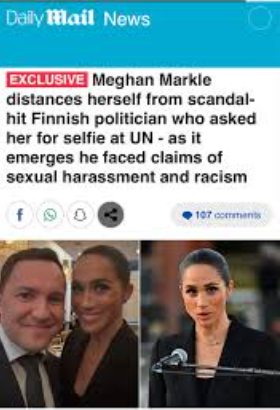
And let’s not forget the selfie with Meghan Markle, who distanced herself after finding out Rydman’s troubled history with minors and racism. The fact that he wanted the selfie reveals Rydman’s conflated ego.
Rydman has taken in the funding policy crisis and outraged critics, his recent decision to slash social work research in half to 4 million euros,
It’s clear that when you go to bed with a party like the PS that is determined to undermine the rights of migrants and minorities, nothing good can come out of it.
Prime Minister Orpo looks toothless to solve the crisis with Rydman and the PS.
Welcome to modern Finland, where racism and bigotry are normalized.
Migrant Tales context:The column was published in Finland Bridge (Suomen Silta), commemorating my first year in Milan.
Time has gone by flying in Italy’s financial capital Milan, since I arrived from Bogotá, Colombia, in July 2000 after a two-year stint in that troubled South American country.
Moving to Italy was not as easy as I had originally thought. When people tell you that the city is closed for business in August, it means that the urban center of almost 1.4 million people turns into a ghost city during the summer’s slowest month.
Just because you know Spanish does not mean that you’ll earn Italian instantly. Finding a place to live in September felt like an almost impossible endeavor. I slept from hotel to hotel for about three weeks until I was able to rent a humble bedroom in an old apartment for a modest sum of 500 dollars!
From August to September, when it’s very hot and humid in Milan, I naturally didn’t have any time to romanticize about returning to Italy, even if my great-grandparents were from these parts before departing for the shores of South America in the late 1890s.
But I got lucky. I eventually found a very nice place to rent in the heart of the city in an over-century-old, picturesque apartment building. Every month was a big leap forward in my integration process with Italy. The more I learned the language, the closer I felt to my new home.
Mediolanum
Even if I have thought on and off about my Italian great-grandparents, Dante and Ida, I started to think more about them a few weeks ago.
I have tried to picture what Milan was like at the end of the 19th century, when Italy was a kingdom. Would the irt matter to greet me back then be the sound of horse-riven carriages? Would I see well-dressed men and women contrasting like night and day with the mass of illiterate and impoverished Italians walking on Via Torino, a main street in the heart of the city that leads to the breathtaking Gothic cathedral, the Duomo? Or would I feel the strong undercurrent or revolt against the autocratic King Umberto I?
Sometimes I wonder what would happen if, by some odd circumstance, I had the chance to meet and speak to my great-grandparents. If magic and mystery would answer my wish, I’m certain that after our initial surprise, my encounter with my great-grandparents would be overcome by happiness. We’d also be scratching our heads on how we were able to fool the one-dimensional, black-and-white picture, which always allows me to see my deceased relative but keeps them caged in their opaque world, looking out.
Being 141 years old, my patriarchal great-grandfather would speak first. The past is a strange place because secrets are always kept in theftproof vaults. For this reason, there’s not much that I can tell you about my life because Death is a good guardian of such matters. But if you look around carefully, however, I have left a lot of evidence of who I was through the name of your grandfather.
As a child, one of my favorite books that changed my life as Juls Verne’s ‘20,000 Leagues Under the Sea.’ I always want to be free like Captain Nemo. He was a polyglot, a wanderer who had been everywhere but was from nowhere. He was a free man in the true sense of the word, together with his submarine the Nautalis. A man can only be free when he lives in solitude.
I also named my son Nemo because, translated from Latin it means ‘Nobody.’ Maybe one becomes somebody when you acknowledge you’re a nobody.
Tell me about the future, the place you live now.
Dear Dante: there were no red carpets when I arrived in Milan. The only Italian I wore on that clear, very hot summer day was my surname and a few rudimentary sentences in Italian. Strange how time turns matters around. The cultural and linguistic shock I suffered during the first months in Italy must abt womthing similar to what you and Itda must have felt when you moved to South America.
How were your first years in Buenos Aires like, Dante?
When we arrived in Argentina after a brief stay in Brazil with It nd little Nemo, Buenos Aires had seen one of its hottest summers ever. The capital city of Argentina felt like home in many ways. The facade of the newer buildings reminded me of those you could find in a big city in Italy.
Buenos Aires, however, feels as if it were divided into many tiny principalities. If you walk, and it would be a very long walk at them from one end of the city to the other, you could hear people busily conversing in foreign languages like Italian, French, Turkish, Armenian, and, of course, Spanish. The 1914 census showed tat halo of Buenos Aires’ population was foreign-born!
Even if I were in a plot to assassinate King Umberto I and sent to a prison on the island of Pantelleria, I had to escape and leave Italy. My life changed radically when I came to South America. But this does not mean that I cannot continue to believe in a better future, even if I had faily miserable in building a better world as an anarchist.
I always had hoped of seeing my parents gain in Tuscany, but it never happened. My farewells to them were final, like the one that I will give you now…
Afterthoughts
I consider myself fortunate even if I know so little about my great-grandparents in Italy and Finland. But we’re not really supposed to know too much about them because it would interfere with Death’s work, whose job is to guide such people to worlds where most likely past names, antionlities, professions, and other human details have little meaning.
Or is it that whenever a relative dies, that person’s spirit sometimes passes as a phantom baton to the next generation with secret writings of wisdom? Sometimes on that baton, there are maps, even a compass, to assist you in your future travels.
How do you think I made it to Milan?
‘During the Roman Empire, Milan was called Mediolanum.
Since March, hysteria has struck some municipalities in Finland. Even if it is not in the government program, the far-right anti-immigration Peruuomalaiset (PS)* have done their best to fuel anti-Muslim racismas the April 2027 general election nears.
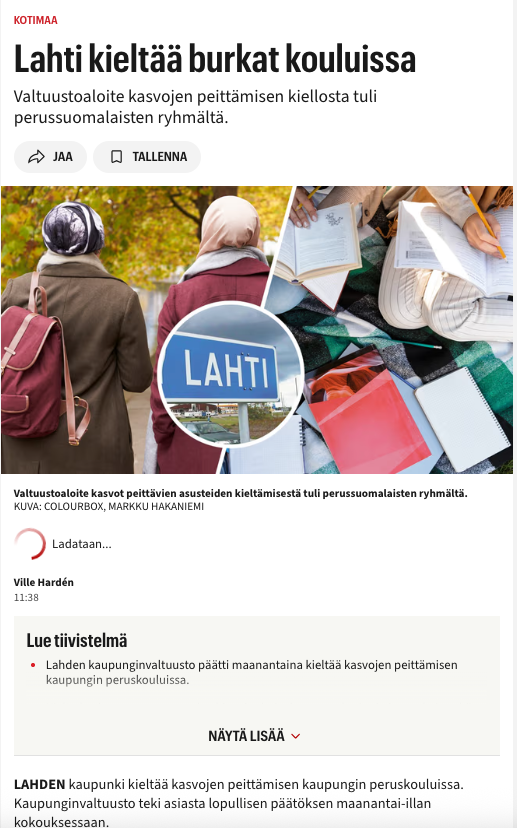
One of the questions that the Finnish media, in particular the tabloids, which are responsible for reinforcing and spreading xenophobia and anti-Muslim racism, leads with a provocative headline: Lahti prohibits the burka at comprehensive schools.
The burka, which covers the face of a woman?
How many burka-users are there in Finland? According to some, there are none.
The term “burrka” was incorrectly used to mean niqab.
Should we be surprised that the initiative came from the council members of the PS?
Writes Ilta-Sanomat: “No widespread practice of covering the face has been observed in schools in Lahti. According to the initiators of the proposal, the issue concerns safety in the school environment.”
One of the characteristics of the ban is not only its mixed message, but the fact that at Finnish comprehensive schools, there is no widespread use of the niqab and buka, which is nonexistent. All of the initiatives to ban such clothing have come from the PS.
Even if it is clear that the PS are campaigning on their racism, the qustion that should concern us is why Swedish People’s Party Education Minister Anders Adlecreutz has not stood up for the Muslim pupils at schools but allowed such bans to spread? Caving into PS pressure, Adlecreutz approved the removal of Salam, a textbook used to teach Islam to comprehensive school pupils.
Sanewashing: the act or practice, especially in the media, of trying to make actions seem sane and normal when they are not.
Tabloids like Iltalehti and Ilta-Sanomat are the worst sanewashers and help to further spread racism and tear teeth off the media.
We haven’t seen this recently but historically tbloids have been the first to strike at migrants and minorities.
A billboard by Ilta-Sanomat that claims “10,000 illegal refugees” will come to Finland this year. As everyone know, there is no such thing as an “illegal” refugee.
There are many stories that the tabloids have brought to public attention to make life more difficult for disadvantaged minorities. One of these reporters is Mika Koskinen, whose demonization of migrants and minorities has found fertile ground thanks to the government of Prime Minister Petteri Orpo.
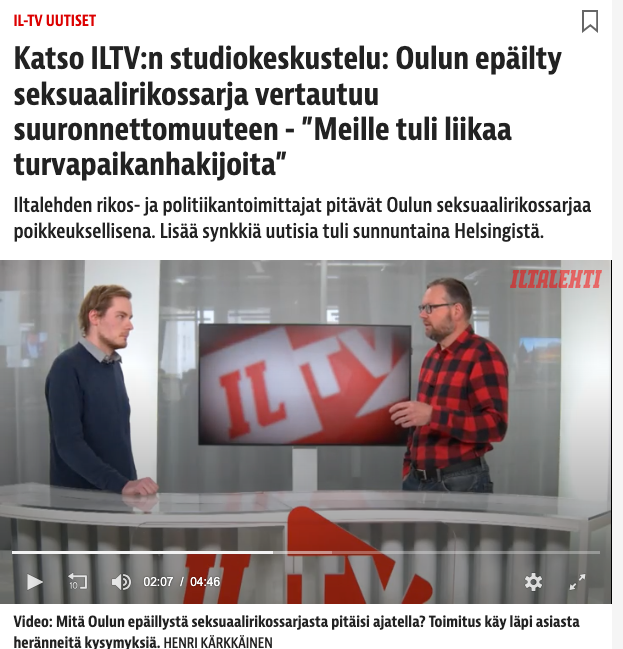
Below, is an interview where he paints with a single brush all refugees during the hysteria of the Oulu sexual assault cases. He is quick to lambast refugees and turning a blind eye to pedophilia of white Finns.
He was recently responsible for getting Salam, a schoolbook for Muslim children taken off the shelf because it taught the wrong things about Islam.
Timo Haapala’s question during a presidential debate is a bad example of how tabloid journalists suck up to prejudiced expectations. Haapala asked the presidential candidate if they would do away with dual citizenship of Russians.
Only Jutta Urpilainen (Social Democratic Party) and Li Anderson (Left Alliance) were opposed to such a plan.
“When we see others as the enemy, we risk becoming what we hate.”
Desmond Tutu
Desmond Tutu, the anti-apartheid activist who won the 1984 Nobel Peace Prize, warns that we risk becoming what we hate if we allow our hatred to get the best of us. If there is one party in Finland whose hatred has converted it to something toxic and pathological, that party is none other than the Perussuomalaiset (PS)*.
The PS and its politicians, like Riikka Purra, act like Dr Jekyll and Mr Hyde. On the one hand, they may make reasonable statements and then go off the wall with their usual xenophobia.
At a recent party convention in Helsinki, Purra said: “I don’t want left-wing and Center Party-led ‘red-brown’ governments at the helm of our country; I don’t want massive tax hikes; and I don’t want the government’s top priority to be recognizing Palestine—as Vice Chair (Nasima) Razmyar just outlined.”
Apart from threatening to take away social welfare for people who have lived here for less than ten years, she made it a point with Interior Minister Mari Rantanen that white Finns will not have to change anything when more foreigners move to the country.
Blow is an example of the PS’ Mr Hyde mask.
Interior Minister Mari Rantanen (left) and Finance Minister Rikka Purra stated that Muslims should be kicked out of Finland. “Finland and Finnishness are based on Christian values,” said Rantanen. Purra considered Islam an “aggressive” culture that is preying on Finns’ tolerance, friendliness, and kindness. “But Finns must not give up their language, culture, values, nothing to such groups.”Facebook
Finland’s central figures in the Islamophobia network:
“PS continues to be one of the most important platforms of Finland’s Islamophobic network. All of the elected 46 MPs (out of a total of 216) of the Finns Party based their campaign on anti-Muslim and xenophobic themes. PS ministers like Riikka Purra (Finance), Mari Rantanen (Interior), Wille Rydman (former Economic Affairs), Leena Meri (Justice), Ville Tavio (Foreign Trade), and Jussi Halla-aho (Speaker of Parliament) have all spread the Great Replacement theory with little to no consequences. Tavio and the government have gone as far as to link development aid to accepting deportees. MEP Sebastian Tynkkynen, who has three ethnic agitation convictions, and MP Kaisa Garedew both want Islam to be banned in Finland. Halla-aho, who was convicted in 2012 of ethnic agitation and of breaching the sanctity of religion, pressed charges against a comedian and deputy Helsinki councilor for calling him “a fascist.”
If you listen to European policiticans like Kaja Kallas and Ursula von der Leyen, fingers are always pointing to Russia but hardly ever to Israel, which is a rogue state like the United States committing war crimes and genocide in region like Gaza.
The complacency of the European Union and its see-no-problem is leading to terrible matters. If the EU were more assertive against Israel, would it had been emboldened to attack Iran?
The European Union is a sad joke when it comes to human rights and upholding international law. It’s only defense is blaming Russia for war crimes while turning a blind eye on Israel and the US.
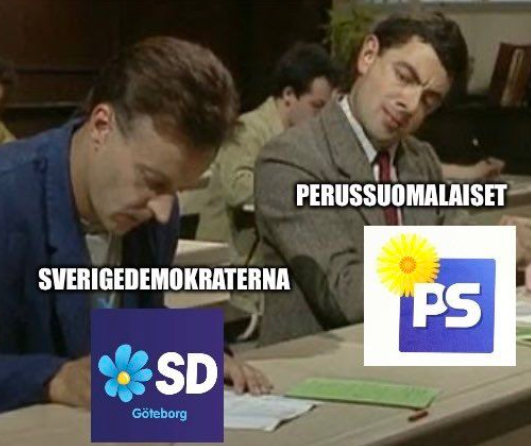
Perussuomalaiset julkistivat uuden logonsa, joka, rehellisesti sanottuna, näyttää kopioilta äärioikeistolaisen Ruotsidemokraattien logosta.
Puolue näyttää olevan huolissaan siitä, että se häviää kokonaan seuraavissa eduskuntavaaleissa huhtikuussa 2027, ja on siksi valinnut voikukan osoittamaan puolueen sitkeyttä.
Kukasta huolimatta Perussuomalaiset on vihamielinen puolue, joka samaistuu Trumpin Amerikkaan.
Riittää, kun katsot puoluetta, niin huomaat, että se on ja pysyy Suomen pahimpana esimerkkinä.
Perussuoamalaisten uusi logo ja Ruotisin Demokratin logo.
Before we dive into the story, ever heard of “TACO trade,” which sheds light on the massive corruption of insider trading of buying stocks on the cheap and selling them when their value rises.
Shame on the mainstream media and the face of the Trump regime on the farce that he is fictionalizing to end the illegal war that reeks of war crimes. Trump looks like a desperate flailing man trying to wiggle himself out of a mess that he alone created with his war-crime partner Benjamin Netanyahu.
Why is Trump tacoing? The US and world economy, like the Titanic, are about to hit the iceberg. It is for this reason he must change course, end the war.
Apart from murdering children as happened in Minab at the outset of hostilities, Trump is threatening Tehran to accept his new “peace” plan or face the fury of the bomb “at a much higher level and intensity than it was before.”
Apart from the US becoming a terrorist state, which it has always been, it will be interesting to watch how Transatlantic relations evolve if the present conflict ends or turns into a forever war.
The Minab attack was a ghastly war crime.
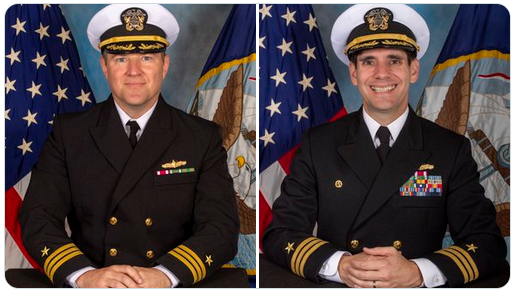
Leigh R. Tate, Commander, and Jeffrey E. York, Executive Officer of the USS Sprunitz, ordered three Tomahawk missiles to be fired, killing innocent children at the Minab School, accordging to NBC News.
Apart from the loss of lives and declaring a pointless war based on lies, the biggest casualty is US credibility, especially Trump’s and Secretary of Defense Pete Hegseth. Who believes them? Terheran’s news has become more credible. That is how much the war has cost us.
Many of us will be watching the latest on ending the war with a very big grain of salt, understanding that most of the news coming out of Washington are alternative facts.
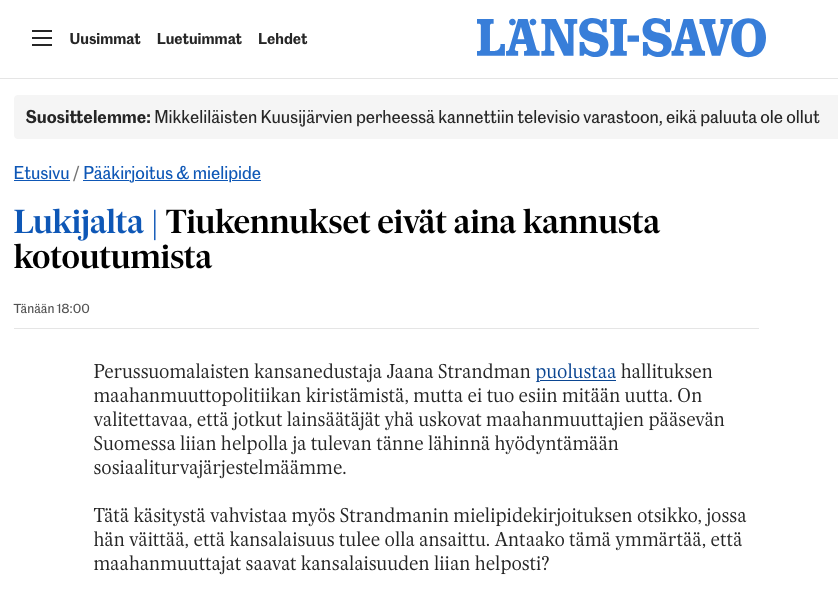
Perussuomalaisten kansanedustaja Jaana Strandman puolustaa hallituksen maahanmuuttopolitiikan kiristämistä, mutta ei tuo esiin mitään uutta. On valitettavaa, että jotkut lainsäätäjät yhä uskovat maahanmuuttajien pääsevän Suomessa liian helpolla ja tulevan tänne lähinnä hyödyntämään sosiaaliturvajärjestelmäämme.
Tätä käsitystä vahvistaa myös Strandmanin mielipidekirjoituksen otsikko, jossa hän väittää, että kansalaisuus tulee olla ansaittu. Antaako tämä ymmärtää, että maahanmuuttajat saavat kansalaisuuden liian helposti?
Kansalaisuus on merkittävä asia, koska se toimii väylänä täysivaltaiseksi yhteiskunnan jäseneksi. Se tuo mukanaan muun muassa äänioikeuden ja mahdollisuuden osallistua päätöksentekoon.
Kansalaisuuslaki oli aikoinaan suorastaan syrjivä. Maa, joka antoi naisille äänioikeuden jo vuonna 1906, kielsi pitkään naisilta oikeuden siirtää kansalaisuus lapsilleen. Kesti 66 vuotta itsenäisyyden jälkeen, vuoteen 1984 asti, ennen kuin naisille myönnettiin sama oikeus kuin miehille siirtää kansalaisuus jälkeläisilleen.
Even if we know that US President Donald Trump and Israel Prime Minister Benjamin Netanyahu took us on an illegal and unpopular war against Iran, the incompetence that shines is so great that the US president does not even know how to stop the war.
A war that was supposed to decapitate the Iranian government causing its instant end never happened. The war would not end in day, weeks and possibly in months.
Trump’s erratic behavioir has an impact on military morale.
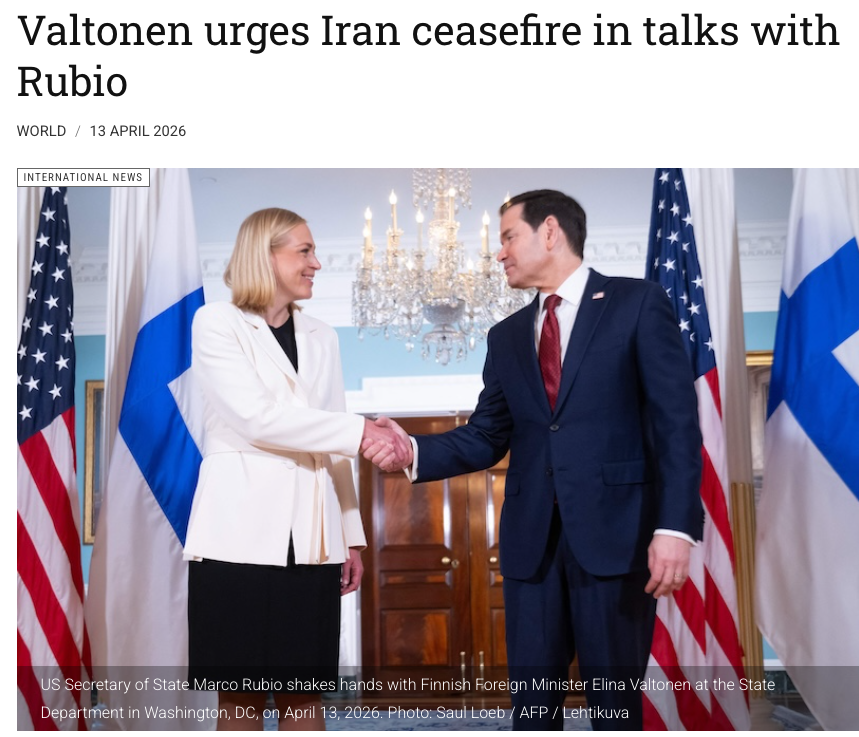
And think of it. Here we are helping to feed a man’s ego while he takes down the whole world with him. More concerning are the different politicians who allow this type of reckless behavior to persist. In Finland, one of these politicians is Foreign Minister Elina Valtonen, a rubber stamp.
One of the messengers of Trump’s new world order is Secretary of State Marco Rubio. By shaking Rubio’s hand, Valtonen is saying with a smile on her face that countries like Cuba and regions like Latin America fall under the US. And then she cries about Russian aggression. The hypocrisy is overwhelming. Read full story here.
President Trump’s behavior and decisions are deeply concerning. Is he mentally fit? Do you believe that if he goes far enough, like give the green light to nuclear wepons, he may be overthrown in a coup?
Too radical of an idea?
Who would have ever thought that the White House would be inhabited by such a president.
I have a suggestion for Finland: Leave NATO and put on notice our ties with the United States and Israel.