Migrant tales
Menu
  • #MakeRacismHistory “In Your Eyes”
  • About Migrant Tales
  • It’s all about Human Rights
  • Literary
  • Migrant Tales Media Monitoring
  • NoHateFinland.org
  • Tales from Europe
Menu

Category: Don Flynn

Migrants’ Rights Network: Calais crisis: 15 years of ‘tough cop’ policies have failed – we need a new plan

Posted on August 6, 2015 by Migrant Tales
Don Flynn*
The UK government has given all the indications of being badly wrong-footed by the latest developments in the refugee crisis at the French Channel port of Calais. Higher fences and brawnier policemen are not the answer. A renewal of our commitment to humanitarian solutions is.

Three thousand migrants have congregated in the area known as the ‘Jungle’ in the past few weeks with many hoping that they will an opportunity to make a clandestine crossing of the Channel to find a safe haven in the UK.

Tension has been rising as the refugee presence has combined with disruption caused by the actions of employees of a ferry company who have lost their jobs when the firm was sold to a competitor. The slowdown in the movement of traffic through the town and its surrounding area have provided the desperate refugees with more opportunities to board lorries and other vehicles boarding the freight facilities at Coquelles, where trains are loaded to make the journey through the Eurotunnel.

Fatalities

The attempt to board in this way has involved great risk to the people involved and has resulted in nine deaths since the current phase of the crisis began in June.

Continue reading “Migrants’ Rights Network: Calais crisis: 15 years of ‘tough cop’ policies have failed – we need a new plan”

Migrants’ Rights Network: Warning – a renewal of ‘fortress Europe’ policies is not the answer to the refugee crisis on the Mediterranean

Posted on May 3, 2015 by Migrant Tales
Don Flynn*
Näyttökuva 2015-5-3 kello 12.52.32
Two high level meetings of EU political leaders in one week might encourage the belief that something positive is going to be done to address the tragedies of the last few days on the Mediterranean. But if the heads of government statement that emerged last Thursday is anything to go by it is clear that lessons are not being learnt.
refugee_boat

The outcome of the meeting of EU heads of government in Brussels last Thursday has been widely criticised for the inadequacy of its response to the refugee crisis on the Mediterranean. Rather than address the most pressing question on how to arrest the escalating refugee death toll on the high seas the suspicion is that the authorities are using it is an opportunity to return to ‘Fortress Europe’ strategy which envisions the continent sealing itself from the migration pressures being generated across Africa, the Middle East and Central Asian regions.

Under the pretext of preventing people from dying at sea the leaders of the member states concluded their summit with a commitment to

“strengthen our presence at sea, to fight the traffickers, to prevent illegal migration flows and to reinforce internal solidarity and responsibility.” — Statement from the Special Meeting of the European Council, 23 Apr 2015

The concluding statement agreed by the heads of government reduced the bulk of its consideration of the factors that have produced the latest spate of efforts to cross the Mediterranean and the consequent rise on the death toll to the issues of people ‘trafficking’ and ‘key push factors’ in the countries where the migration flows originate.

Continue reading “Migrants’ Rights Network: Warning – a renewal of ‘fortress Europe’ policies is not the answer to the refugee crisis on the Mediterranean”

Migrants’ Rights Network: So we are better off because of migration, but why aren’t the politicians getting that message across?

Posted on March 24, 2015 by Migrant Tales

Don Flynn*

Don_web_0


The blizzard of commentary that accompanies the annual budget statement also included a memo from the OBR saying “Mr Chancellor, immigration is good for us.” So will he, and other politicians, act on this message?

The news that projections for economic growth for the period ahead are being upgraded because of expectations that net immigration will continue at rates well above the targets set by government is consistent with all the views that have been coming from expert commentators in recent months.  

Näyttökuva 2015-3-24 kello 11.25.33

Continue reading “Migrants’ Rights Network: So we are better off because of migration, but why aren’t the politicians getting that message across?”

Migrants’ Rights Network: Is the penny finally dropping? – Migration is a sign of how normal a society is, rather than a threat to its existence

Posted on March 2, 2015 by Migrant Tales

Don Flynn*

Don_web_0

The fact that the government failed to reach its target for reducing net migration is bad news for them, but rather good news when considered as an indication of an economy not still mired in deepest recession.

Näyttökuva 2015-3-2 kello 21.17.09


Read full blog entry here.

Continue reading “Migrants’ Rights Network: Is the penny finally dropping? – Migration is a sign of how normal a society is, rather than a threat to its existence”

Migrants’ Rights Network: Reasons to be cheerful about migrants’ rights in 2015

Posted on January 6, 2015 by Migrant Tales

Don Flynn* 

Don_web_0

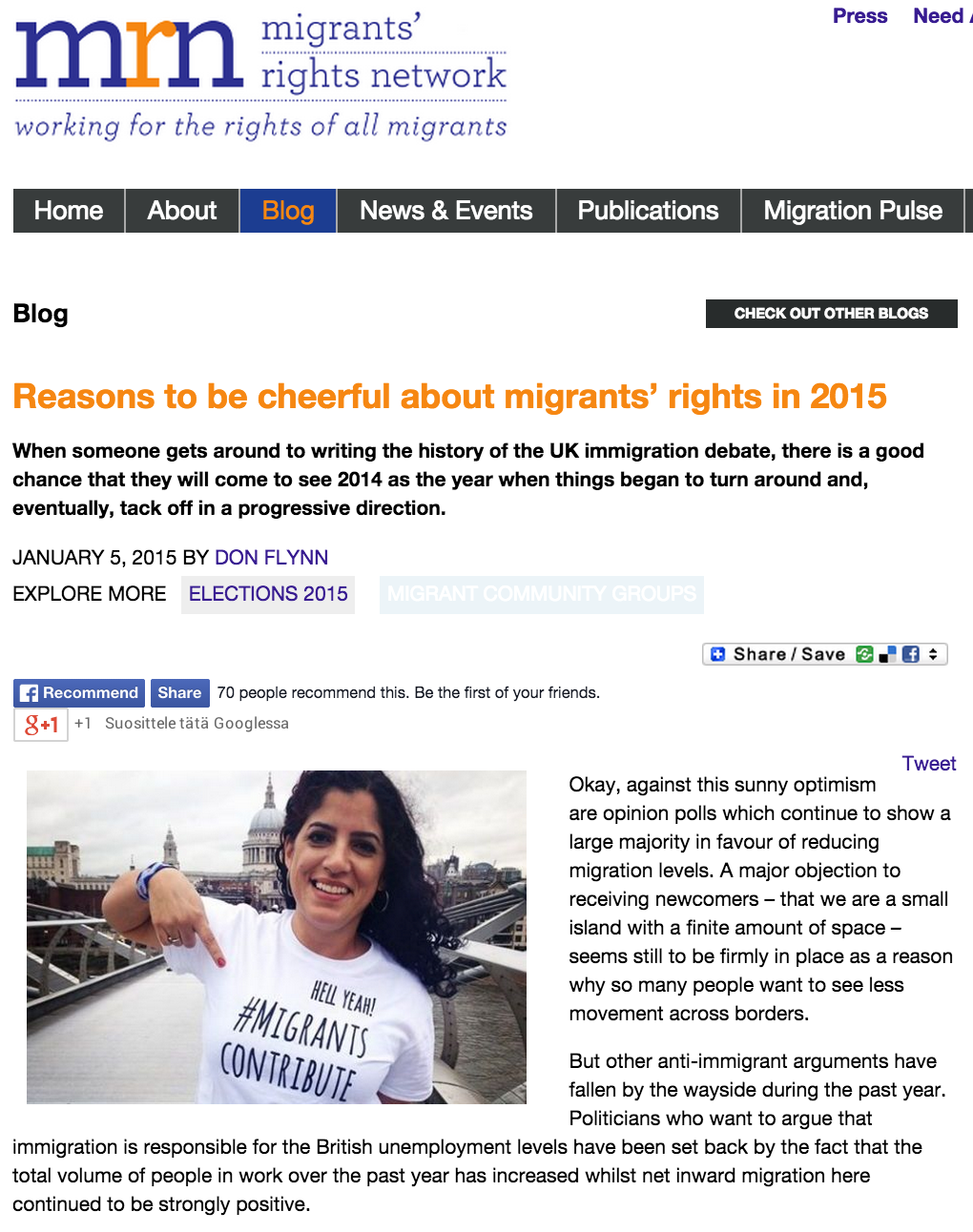
When someone gets around to writing the history of the UK immigration debate, there is a good chance that they will come to see 2014 as the year when things began to turn around and, eventually, tack off in a progressive direction.

Näyttökuva 2015-1-6 kello 23.21.24

Read original blog entry here.


Okay, against this sunny optimism are opinion polls which continue to show a large majority in favour of reducing migration levels. A major objection to receiving newcomers – that we are a small island with a finite amount of space – seems still to be firmly in place as a reason why so many people want to see less movement across borders.

But other anti-immigrant arguments have fallen by the wayside during the past year.  Politicians who want to argue that immigration is responsible for the British unemployment levels have been set back by the fact that the total volume of people in work over the past year has increased whilst net inward migration here continued to be strongly positive.

Even the claim that high levels of migration create pressure on our public services has been eclipsed by the evidence that public spending cuts mandated by the austerity agenda have been the real culprit behind longer waiting times and more restricted resources. If migration shows up in any way in the news stories of struggling A&E departments and hard-pressed social care it is more likely to be through the image of migrant doctors, nurses, care workers and ancillary staff battling to keep things going, in defiance of inadequate budgets to do the job.

Also on the positive side is the evidence of a sector of public opinion which seems utterly resistant to the idea that migrants are to blame for the difficulties of recent years.  Across the country the figure is around 20 – 25% of the public, but its real significance lies in the groups of people where these views are concentrated.  Young people who have grown up in families and communities with histories of migration are rejecting the idea that migrants are to blame and are most likely to see their presence in the neighbourhoods and towns where they live as evidence of dynamism and opportunity.

We should also be encouraged by the support for this viewpoint among forward-thinking elements in all the main political parties.  Groups of Conservatives as much as Labourites and Lib Dems have conceded this point and are increasingly visible in policy dialogues as they try to work out ways to reconcile the new reality of migration with their wider philosophical commitments.

This is a good place to be as we think about what groups working to support migrants might do as the challenge of a general election looms in May.  The ‘migrants contribute’ message is one that needs to be taken up and reinforced in towns and regions across the country.  Better still, we should be looking to build local platforms which can marshal the basic facts and data on the ways migrants are contributing to local communities, and work out how to get these out through regional media.

But we should also look for the chance to raise the ante in the public conversation by making the case that so much more could be achieved if newcomers were accepted as active partners in tackling fundamental problems, like housing, quality jobs, health services, education, inequality and the negativity of racism and xenophobia where it exists.

This means that as well as proclaiming “Hell Yeah, Migrants Contribute!” during the coming months, we should also say “And it’s high time they got a Fairer Deal out of immigration policy!”

MRN has offered up its ideas on how this can be done in the ‘Migrants Manifesto’ which has been endorsed by 120 organisations across the country.  We are planning for intensive activity across the coming weeks to get these ideas out as widely as possible and engage with people as they work out the messages that are coming across during the course of the election campaign.

We are keen to hear from all people who are interested in joining in this effort to get across positive messages about migration.  Drop us a line at [email protected] if you would like to get involved!

So, from all of us at MRN, here’s wishing you a Happy New Year and the very best for all your hopes that 2015 will be a year in which things truly turn around!

The “Hell Yeah – Migrants Contribute!” t-shirt in the picture has been produced by the #MigrantsContribute! coalition of campaigning groups.  Check them out at http://www.migrants-contribute.org.uk. You can get your t-shirt from MRN priced at £12 + £1 post and packing (total £13).  Please indicate your preferred size, L, M or S.

Read original story here.

This piece was reprinted by Migrant Tales with permission.

* Don Flynn, the MRN director, leads the ogranization’s strategic development and coordinates MRN’s policy and project work. He is a regular and sought-after speaker at conferences, seminars and lectures on behalf of MRN.

Migrants’ Rights Network: “How to talk about immigration?”

Posted on November 24, 2014 by Migrant Tales
Don Flynn*
Don_web_0
The thinktank British Future created a stir last week with the publication of its new book, How to talk about immigration.

It is clear that, given the current febrile state of the public mood, a lot of damage can be done by talking about immigration in ways that are insensitive to many people’s anxieties. Times are exceptionally hard for so many people – wage earners in particular are feeling the squeeze of an economy which has blocked off any rise in their living standards for most of a decade. Commonsense, that age-old foe of critical thinking, tells citizens that immigration must have something to do with this unhappy state of affairs. If there is good evidence which shows that this is not the case then we have to find the best way to get this across to the people who would benefit from knowing the true facts.

Na?ytto?kuva 2014-11-24 kello 17.22.28Read full story here.


The British Future manual provides a good checklist, based on three years of public opinion research, for the obvious things that should not be done in communicating about migration: Don’t make out that people are stupid because they are showing resistance to the idea that migrants pay more in taxes than they receive in services. Take seriously the concerns they have that changes brought about by migration might be happening too quickly.  Think about the reasons why new arrivals might not be welcome in communities which feel that the public services which are so important to their lives are already under too great a stress.

British Future also puts forward a compelling argument for the view that the majority of the population occupies a ‘persuadable middle ground’ position in immigration which would shift in the direction of moderately pro-immigration arguments, providing these were put well by people they trust.

It seems almost rude to stir up disagreements with a set of ideas and proposals which have the best intentions, but a few red flags need to be posted about British Future’s policy conclusions, which merit further discussion.

Theorists of this sort of thing tell us that there are broadly two ways of doing politics in liberal democratic societies.  One of these is the technocratic approach favoured by expert elites.  It tells us that modern society is tremendously complex and capable of generating problems and tensions at any point across its extended field of operation.  Each has the potential to be dealt with in isolation from the others, with the need to fight foreign wars having no necessary relation to heath care policies or the cost of housing.

In this way of looking at things immigration policy throws up a set of issues that ought to be isolated from the ability of politicians to deal with the budget deficit, improve the standard of primary school education, or provide adequate pensions for the retired.  Government needs to draw on the expertise of policy wizards who know how to fix things under each of these individual headings and let them get on with the job.

Against this there is the populist tide in democratic politics which resists the idea that the problems of contemporary life are fragmented and separate.  It answers the charge that we should leave it to the experts to get the system to work again with the accusation that the apparently separate problems are actually subsets of the one big problem which is breaking the back of the whole of society.  The experts have failed and it is now down to ordinary citizens to work out what needs to be done to come up with solutions – and these will inevitably be far reaching and radical.

The British Future approach strongly skews the direction of the discussion towards technocratic responses. Following a detailed analysis of public opinion research, the book concludes by putting forward an immigration management package which it proposes is plausible according to the requirements of the ‘persuadable majority’, and that would generate a set of ‘realistic targets’ that a majority would be prepared to back.  How to talk about immigration ends by pitching a deal that would allow universities to recruit international students, employers to bring in skilled workers, and shepherd all newcomers to a safe haven as integrated residents of British society.

It sounds so elegantly simple as to make you wonder why no one has come up with it before.  But hang on a minute – that is exactly what the all the parties in government have thought they were doing at virtually every moment for close on the past two decades.  New Labour promised to be ‘as tough as old boots’ on unwanted asylum seekers and labour migrants who failed to produce value for the UK economy.  They offered a ‘realistic’ package of ultra-surveillance that would have enhanced the power of state agencies to enforce the immigration rules through biometric identity cards and total overview of migrant movements through society.

The quid pro quo for this assurance that everyone moving into the country was subject to thoroughgoing control was acceptance of migration at the higher levels needed to maintain growth amongst the economic sectors producing employment growth – primarily the small and medium sized business hungry for a workforce with the sort of soft skills to be found most readily amongst migrants.

The coalition government subsequently promoted its own version of realistic targets – in broad terms similar to the set New Labour had been running when they were evicted from office but with the added oomph of a promise to reduce net migration to the tens of thousands. Ironically, whilst this might have had a higher approval rating amongst public opinion as to what people really wanted, the conjunction of a whole range of factors running from the obligations that ensued from the EU Treaties, the persistence of high levels of demand for migrants amongst British employers, and the chronic ineptitude of a Home Office which exemplifies everything we know about that dead end, sclerotic structure which is the Westminster state today, was always certain to confound and destroy all the hopes for the ‘no ifs, no buts’ solution the coalition was aiming for.

The danger for British Future in this context is the risk of association with the claims of technocratic currents in mainstream politics that an unreformed, over-centralised, elitist bureaucratic state is capable of delivering the goods. The guiding framework for the paper is the issues that would be acceptable to the public and the political elite at this moment in time, and some of the most difficult but salient human rights issues relating to migration – for example the impacts of immigration enforcement, the position of undocumented migrants, the need for reform of the detention estate, the shape of future asylum policy and so on – are not tackled.

So if the door is slammed shut against the prospect of progress through this style of political management, what about its more unashamedly populist and democratic alternative? What would advocacy of immigration policies look like if it was bold enough to share the widely held view that mainstream politics does have to carry a large share of the blame for the mess that so many people are in today?

We have the examples of the public conversation in Scotland to know that framing the issue of migration according to the needs of 5 million people has brought a very different shape to the politics of that country. Last week’s news of Obama’s executive order offering temporary legal status to approximately five million undocumented immigrants is another good example of how politicans can push for a real change beyond the established middle ground.

There are good grounds for believing that the task of winning the debate on immigration will require a great deal more than finessing the language aimed at the mainstream majority. The populist moods sweeping liberal democracies all over the world require conviction and a robust determination to take on and defeat a resurgent right wing which is working to rally opinion around the pole of traditional authority and the Thatcherite values of middle England. The language and advocacy we most need is that which is most capable of taking this on and beating it, and finding our way to that approach ought to be our highest authority.

Read original posting here.

This piece was reprinted by Migrant Tales with permission.

*Don Flynn, the MRN Director, leads the organisation’s strategic development and coordinates MRN’s policy and project work. He is a regular and sought-after speaker at conferences, seminars and lectures on behalf of MRN.

Migrants’ Rights Network: Yes, migrants are net contributors, but they are also our partners in challenging inequality and injustice

Posted on November 10, 2014 by Migrant Tales

Migrant Tales’ insight: Another fine essay by Don Flynn, which brings to mind recent claims by the Perussuomalaiset (PS)* party that migration costs the country up to 2 billion euros. The estimation is only a guess by the PS and which forget to calculate that the majority of migrants in Finland work, pay taxes and consume. They conveniently forgot to mention as well a recent OECD report that migration had boosted Finland’s economic growth in 2011 by 0.16%, including pensions. 

_____________

Don Flynn*

Don_web_0

We heard last week that recent migrants have contributed £20 billion to UK revenues. But the real gains from migration will come when newcomers can take their place in the fight against inequality and xenophobia.

Näyttökuva 2014-11-10 kello 18.03.41

Read full blog entry here. 


Last week’s report from academics at University College London on the fiscal impacts of migration to the UK is just the latest in a whole sequence which has made the case that, far from being a charge on the tax payer, the migration that developed over the course of the 2000s, has brought in a cohort of net contributors.

We can expect that this steady accumulation of evidence supporting the view that migration does generate positive effects is to open up space in the political mainstream for the argument that immigration policy should incline towards openness rather than closure. Advocacy in support of groups like international students and skilled migrants has already advanced to the point where it has the ear of leading ministers with Vince Cable at BIS being particularly outspoken.

Arguments in favour of more openness on immigration policy represent both opportunities and challenges for groups working to support the rights of migrants. Opportunities in the sense that they undermine the ‘commonsense’ presumption that society is better protected when it imposes strict control over the movement of non-nationals; challenged because so much of the discussion revolves around the election of the types of migrant for whom borders will be relatively open.

MRN has always resisted the idea that a simple formula is available which will assist state functionaries in a decision-making process about who is the ‘good’ immigrant, as opposed to the undesirable. The slogan which the Home Office has raised to official status, branding its policies as aiming to select ‘the brightest and the best’ seems especially inane as the evidence accumulates that the gains for the welfare of the population are just as likely to come from any newcomer who aims to fill whatever niche if offered up and to meet the demands for taxes that will inevitably come their way.

This week we will be launching the ‘Migrant Manifesto’ which we think is really needed if we are going to build the communities in the UK which can really meet all the challenges of living in our modern globalised world and at the same tackle all the growing problems that come from inequality and social exclusion.

This means going beyond the simple celebration of the fact that migrants contribute more in taxes than they take out in services. Our Manifesto will call for acknowledgment of the fact that the immigration policies of recent years have created a hugely uneven playing field for newcomers, with rights to secure residence status, to challenge the unfair decisions of the authorities, to sponsor the admission of family members, to access the public services which they pay for from their tax contributions, to escape from the dangers of exploitation in the workplace, and generally to live without the fear of the constant demand to produce papers that ‘prove’ identity and legal status, all being badly eroded.

Our view is that policies on the way migration is managed should be as much about basic human values and they are about extracting economic advantages over people deliberately made vulnerable because of their status as non-nationals. If we thing that it is permissible to squeeze more out of migrants than it is out of citizens then we will be held back from challenging inequality and the gross injustices that emerge from racism and xenophobia.

Our ‘Migrant Manifesto’ campaign will go live after its launch this coming Wednesday.

What it calls for has been outlined in a series of blogs on this website over the past six weeks. The full text will be public after the launch and we are offering it up as an opportunity for discussion and, hopefully, a spur to campaigning activity during the next six months.  A special website will be launched very soon to help sustain the momentum of this work.

To recap on what we are calling for, check these blogs from the last few weeks

  • End the ‘hostile environment’
  • Protect a right to family life
  • Give European migrants a fair deal
  • Improve the immigration system for all
  • End the exploitation of migrant workers
  • Protect the interests of international students 

We hope that these calls for action will resonate with groups working with migrant communities right the way across the country.  The Migrant Manifesto will make progress only if it is taken up and developed by people who can affirm its basic propositions, but also add and take them further forward.

We welcome your comments about this campaign and will look forward to hearing from you all.

Read original story here.

This piece was reprinted by Migrant Tales with permission.

* Don Flynn, the MRN director, leads the ogranization’s strategic development and coordinates MRN’s policy and project work. He is a regular and sought-after speaker at conferences, seminars and lectures on behalf of MRN.

* The Finnish name for the Finns Party is the Perussuomalaiset (PS). The English names of the party adopted by the PS, like True Finns or Finns Party, promote in our opinion nativist nationalism and xenophobia. We therefore prefer to use the Finnish name of the party on our postings.

Migrants’ Rights Network: Note to Party leaders: Misleading voters about what can and can’t be done on immigration will still get you nowhere

Posted on October 28, 2014 by Migrant Tales

Don Flynn*

Emergency brakes and benefit caps were put on offer by party leaders this week. Both are intended to get across the message that immigration can be got back under control. But aren’t there bigger truths that we should be trying to get across, like how the movement of people is all a part of the ‘new normal’ of everyday life in the twenty-first century?
Näyttökuva 2014-10-28 kello 10.53.54

Read posting here.


Just as Clacton recedes into memory so Rochester looms up as the next thing to get excited about. It brings with it the dreadful thought that the entire run-up to the 2015 general election will be made up of a series by-elections provoked by Tory defections to the UKIP insurgents, ensuring a steady draft of oxygen to keep the embers of anti-Europeanism glowing fresh and bright for months to come.

What will this mean for the public conversation on immigration policy? Funnily enough their historic victory in the Essex seaside town earlier in the month could open up some interesting tensions even within UKIP’s seemingly intransigent ranks. The victorious defector from the Conservatives, Douglas Carswell, seems to have been at pains to make the point that strident anti-immigration is not really his bag during his interview in the Guardian last week.

But this line is unlikely to hold together the momentum of the UKIP charge. People veering in the direction of that party do so because they like its message on getting tough with immigrants. That is the lesson the leaders of the mainstream parties believe they are learning about the moods of the electorate, and their efforts to halt the contagion are addressed almost exclusively to this issue.

The Conservative response moved on a pace during the past week with David Cameron’s dramatic announcement that he was seeking an ‘emergency brake’ on migration from the EU. At the Tory conference at the beginning of the month he had claimed that reform of free movement rules was needed because immigration had “increased faster than we in this country wanted… at a level that was too much for our communities, for our labour markets.”

The difficulty with all of this is that there is precious little evidence of real substance that is likely to convince other European leaders of the need for the type of radical reform of free movement law that Mr Cameron appears to want. The most authoritative study of the impact of free movement on the UK labour market, published by the independent Migration Advisory Committee in July, pointed to the need for stronger inspection powers for regulatory bodies like the Gangmaster Licencing Agency, but found no evidence for the claims of overstrain made by the prime minister.

The report supported the view that public services like health and education had been stretched in parts of the country which had experienced migrant influxes. But other experts have pointed out that these could be remedied by strengthening the resources available to local and regional government to anticipate and plan for this type of inward migration.

The Rochester and Strood by-election, triggered by another Tory defection to Ukip and set to take place on 20 November, has brought Labour’s leader out into the open to declare his policy on immigration.

Mr Miliband’s strategy is focusing on the changes that he thinks are possible regarding border controls, access to welfare benefits, control of private sector employment agencies, and longer transition periods to full free movement rights for citizens of countries acceding to the EU.

As a measure of practical politics, limiting benefits has the virtue of promising voters a tough approach aimed at winning reform from other heads of government in areas of policy, which might just about be achievable. It seems clear that whilst the other EU leaders might be willing to discuss limiting rights to social security benefits, with much longer periods of qualification before these became payable, they are most unlikely to budge an inch on anything as radical as the outright refusal to allow EU nationals to take jobs in other countries, which would be the effect of an ‘emergency brake’.

But two questions still hang over the Labour strategy. The party has to anticipate that it will draw the criticism about measures such as border controls that check when people leave the country as well as enter, or limit entitlement to welfare benefits for longer periods. These would do very little to reduce the numbers of people currently coming to exercise their free movement rights. The volume of migration is driven by the availability of employment opportunities in the UK, and not the prospect of receiving a social security payment. As long as the economy can continue its phenomenal success in creating large numbers of new jobs whilst the rest of Europe flatlines, then inward migration will remain an issue for those who worry about numbers.

The missing ingredient in all these attempts to box clever on immigration is that of preparedness to actually tell voters the truth about why the world is standing on the threshold of a new period of high migration. Immigration is regarded by many people as a sort of accident that the country stumbled into around about ten years ago when politicians took their eyes off the ball and allowed more people to enter as workers and students. Solving the problem for them requires little more than reversing these errors and returning to the controls of the 1990s and earlier.

This approach ignores the fact that a whole new type of economy has been put in place over this period, and that it is not only the UK but the entire industrialised world that is struggling with the problem of how to manage immigration in this epoch of globalisation.

A great deal of the anxieties which currently lead many people to take an anti-immigrant stance would be reduced if a concerted effort was made by the politicians of all parties, in alliance with grassroots civil society organisations working on issues of impact and cohesion, setting out to make the case that what we have now quite simply constitutes the ‘new normal’ of life in the twenty-first century.

The allure of the so-called insurgents lies in the view that ‘stop the world, I want to get off’ really is a practical policy option. It isn’t, and it is instructive that even UKIP’s recent high profile recruits are prepared, though very tentatively, to voice that fact.

This rejection of pessimism needs to be reinforced by people who are trying to make mainstream politics credible once again, capable of addressing the problems which people really face in their lives today, and not going off into the symbolism and myths encouraged by identity politics and anti-immigration stances.

The ‘emergency brake’ will not stop Mr Cameron hitting the brick wall that looms up so prominently for his political choice. For Labour, a conversation about the policy option details is all very well, but if it supports the delusion that immigration is undesirable and needs to be pushed down it will be as self-defeating as anything the party tried under the terms of the ‘five year plan’ initiated in 2005 when it was clear that immigration was becoming an unpopular issue.

Instead, telling the truth about the new normal of migration in our modern world really is the best chance we have got to stop the slide into evermore desperate and dangerous types of politics.

Read original posting here.

This piece was reprinted by Migrant Tales with permission.

*Don Flynn, the MRN Director, leads the organisation’s strategic development and coordinates MRN’s policy and project work. He is a regular and sought-after speaker at conferences, seminars and lectures on behalf of MRN.

Migrants’ Rights Network: Is migration blocking the way to post-national global outlooks?

Posted on August 29, 2014 by Migrant Tales

Don Flynn*

Don_web_0

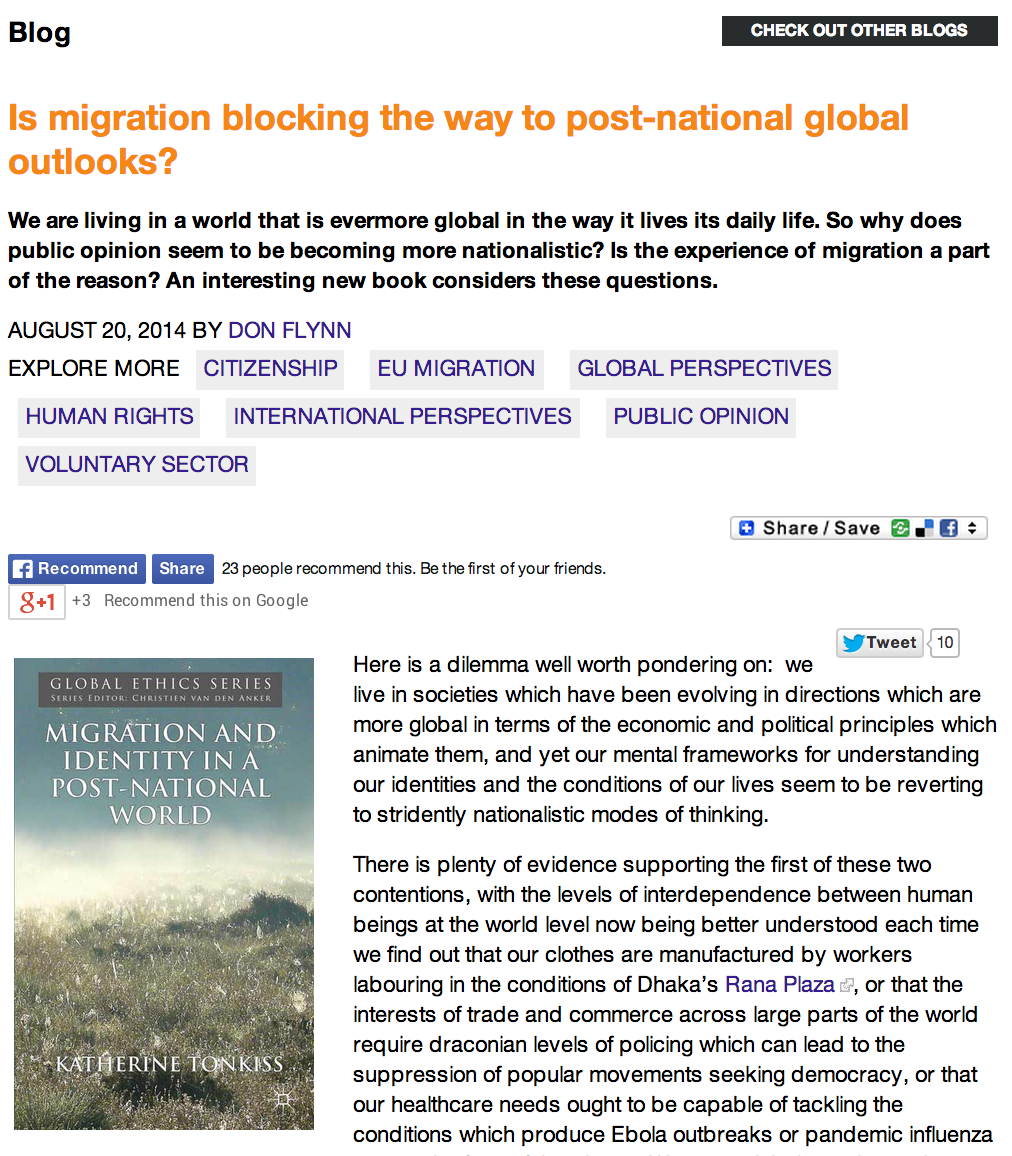
We are living in a world that is evermore global in the way it lives its daily life. So why does public opinion seem to be becoming more nationalistic? Is the experience of migration a part of the reason? An interesting new book considers these questions.
Kuvankaappaus 2014-8-29 kello 7.14.45
Read original posting here.

Here is a dilemma well worth pondering on:  we live in societies which have been evolving in directions which are more global in terms of the economic and political principles which animate them, and yet our mental frameworks for understanding our identities and the conditions of our lives seem to be reverting to stridently nationalistic modes of thinking.

There is plenty of evidence supporting the first of these two contentions, with the levels of interdependence between human beings at the world level now being better understood each time we find out that our clothes are manufactured by workers labouring in the conditions of Dhaka’s Rana Plaza, or that the interests of trade and commerce across large parts of the world require draconian levels of policing which can lead to the suppression of popular movements seeking democracy, or that our healthcare needs ought to be capable of tackling the conditions which produce Ebola outbreaks or pandemic influenza across the face of the planet.  We are a global species and we prosper or perish in proportion to our acknowledgement of the challenges and potential of this fact.

But there is much to suggest that these facts are being contested by the political moods which are revealing themselves across the developed world, expressed in increased levels of support for right wing, nationalist parties and a trend towards the reassertion of ethnic identity as the force which binds society together.   Why should this be happening at a time when we might have expected to see aspirations towards better societies and greater fairness being framed in the context of global society rather than national communities?

Liberal values and freedom of movement

These are some of the ideas discussed in a recent book (Migration and Identity in a Post-National Word, Katherine Tonkiss, Palgrave Macmillan) by the Birmingham University based political scientist Katherine Tonkiss. The author sets out a solid argument in favour of the proposition that a consistent approach to liberal values and the promotion of individual rights requires a defence of the freedom of movement across national frontiers. Anything less than this means a failure to fully adapt to the conditions of life in what she asserts is a ‘post-national world’ and consequently falling short on opportunities to advance the values of liberalism, social justice and individual rights.

Yet her argument concedes the fact that the prospect of an increase in migration that would probably follow on from an extension of free movement rights is preventing many people from identifying with progressive and internationalist perspectives. It often seems, as UKIP leader Nigel Farage suggested during the European election campaign last May, a lot of voters would be willing to take a hit on their standard of living if that is the price to be paid for lower levels of immigration.

Tonkiss looks for the source of this enmity by probing the views of people who identify with explicitly nationalistic currents in British politics, supporting groups like the BNP, English Democrats, the English Defence League and UKIP. On this point she concludes that migration is disliked because of the perception that it poses a threat to the distinctiveness of English culture and reduces its moral relevance in sustaining social cohesion. There is a hint that this effect is amplified by the absence of a strong civic culture in the UK, with local government and other authorities failing to play a significant role in bringing about cohesive outcomes. The type of ramped up rhetoric which right wing groups trade in might be seen as filling a vacuum in knowledge about the real as opposed to the hyped-up impacts of migration, with jaundiced viewpoints and racialised prejudice fill in the space which might be more usefully occupied by actual experience and objective data gained from a practical engagement with the lives of newcomers.

‘Banal loyalty’

From this point nationalism becomes founded on what Tonkiss refers to as the ‘banal loyalty’ which assumes that, if what is British is equal to a state of virtue, then what the migrants get up to has to be less than that, for no better reason than they are indeed non-British. It is an attitude that runs rampantly across the whole public conversation about migration, affecting even the members of the church-based voluntary groups befriending migrants arriving in Herefordshire, one of the areas covered in her study. Though the opportunity to better get to know some of the newcomers helped build some resistance to the more inane accounts of migrant alleged perversity, the volunteers she interviewed were still inclined to think occasional dark thoughts about what ‘twenty Eastern European men’ walking down a street in Leominster might ‘really’ be up to.

This is interesting, but it is surprising that in accounting for the persistence of nationalist viewpoints in this post-national age Tonkiss gives very little consideration to the role played by the blocs of political and economic power which provide a large part of the structure of the national conversation about immigration. To the extent they are mentioned it is limited to the suggestion that it is public opinion that is pushing these elite interests to follow in the wake of nationalistic negativity.

This would be an unwarranted conclusion to draw from the simple fact that the public mood appears to be swinging in the direction of nationalism at the present time. Politics and markets in liberal democratic societies function in accordance with sets of rules and structures that have been around a lot longer than any of the people who are subject to the systems of governance which they give rise to. The way they represent interests and push forward their points of view, not to mention the resources they have available to coerce those individuals who might think differently to toe the line forms an important backdrop to much of what is going on in the way of shaping viewpoints. It is often all the more powerful because it is so completely naturalised into a non-visible background that it appears to have no substance whatsoever.

But a big part of the answer to Tonkiss’s question as to why nationalism continues to persist in a post-national world must surely be because all the structures of national states and national economic interests remain founded on national principles and are unlikely to fade so easily into the mists of time and history.  If we want to know what is locking nationalistic responses to immigration in place at a time that a defence of liberal values and individual rights would suggest that they should be withering on the vine then we need to look at more than the issues of ethnicity and identity, and delve for at least some of the reasons in the interests that are fostered by the continued influence of the national state.

Read original story here.

This piece was reprinted by Migrant Tales with permission.

*Don Flynn, the MRN Director, leads the organisation’s strategic development and coordinates MRN’s policy and project work. He is a regular and sought-after speaker at conferences, seminars and lectures on behalf of MRN.

Migrants’ Rights Network: ‘Too Many Immigrants?’, ‘Big Romanian Invasion’, or ‘Glasgow Girls’: Which got closer to the truth in telling the story of immigration?

Posted on July 21, 2014 by Migrant Tales

Don Flynn*

Don_web_0


You wait for weeks for a programme that allows migrants to tell the stories of their lives, and then three come along at once.

The media critic Ben Bagdikian once complained that trying to be a first class reporter on the average American newspaper is like trying to play Bach’s ‘St Matthew’s Passion’ on a ukulele. He must have had in mind the conscientious hack who was attempting to do justice to the rich and varied story of migration when he came out with that line.

It wasn’t American newspapers but the venerable old BBC that got me to mull over media coverage of immigration with its offerings last week of a whole suite of programmes dealing with the issue, which ranged from Nick Hewer and Margaret Mountford’s two-part Too Many Immigrants? through to the musical drama Glasgow Girls, taking in Tim Samuel’s The Great Big Romanian Invasion on the way.

Na?ytto?kuva 2014-7-21 kello 17.35.47

Brits v Migrants

Nick and Margaret’s effort contaminated the subject with the sleazy populism of ‘Benefit Street’. The programme’s protagonists – native Brits versus the newly arrived immigrants – were paired up in a series of confrontations purposely designed to bring mis-understanding and prejudice onto a collision course. The show acquired the element of compulsive viewing – such as it was – from the intially uncompromising extremism of those who were prepared to argue it out with their immigrant counterparts that they were a burden on the country. What sort of a slugfest could we expect or hope would come from that? Stayed tuned folks – the answer comes up after the breakdown in rationality……

What changed the dynamic however was the context in which the slapdown was setup in, provided by the ‘The Apprentice’ programme’s two former business stars. Nick and Margaret elbowed into the narrative often enough to signal where this stuff was intended to go. The not-so-gently nudged the whole thing towards a resignation of the fact that the modern world of aggressively competitive markets is the only way to go. From this point of view migrants were playing the useful role of showing the natives how to survive within its parameters and we should therefore have the good grace to agree that they were thus a benefit rather than a burden on the country.

It is a chronically limited point of view but one that shouldn’t be flatly contradicted as a general conclusion. But getting there across the span of these two programmes often felt like a process of hammering square pegs into round holes. Under tis pressure, Romford Michael was the first to buckle and concede that he’d learnt a lot from his French counterpart, Marilyn, about how you hunt down a job in a low-paid service economy. South London building workers Jaime and his dad Andy reluctantly agree that their Irish parents/grandparents did pretty the same thing as the Poles they now feel so bitter about. Even Kiran, the Hounslow-born British-Punjabi mother who was holding out against multiculturalism, at the same moment as proclaiming her devotion to Sikhism, came down to conceding that, once you’ve spent a couple of weeks hanging out with a Somali Muslim  family, it is difficult to pronounce them a burden on the country.

More enlightenment?

There is no doubting that many of the least enlightened viewpoints expressed by the participants deserved to be taken on and pulled apart, but it is a step too far that this should be done by brushing aside the anxieties and insecurity of people whose lives have been made worse by the triumph of the market over so many aspects of community life.  When push comes to shove Too Many Migrants?  came across as an unpleasant mocking of the people most pushed around as a consequence of being amongst the losers  in the society which British has become in these early years of the 21st century.

Tim Samuel’s documentary on the Romanian ‘invasion’ that never happened scored higher on the charm and ‘info-tainment’ index by being less patronising about its subject. The Romanian’s and the Brits they came into contact with seemed less like stripped-down caricatures of the prejudices they were supposed to represent than those who appeared in Nick and Margaret’s show. The amiable and disarmingly open Viktor, the only new Romanian to turn up at Heathrow on 1 January 2014 to take advantage of the freshly-granted access to the labour market, has become something of a national celebrity in both the UK and his native land. Further down the pecking order, Ion, the Roma man struggling to survive amongst the rag-pickers and pavement-dwellers offered up his own story, placed in the context of his abused and contemptuously-treated people which we would all do well to listen to.

In the end Samuel’s used the personal history of his family – Jewish-Romanian immigrants who arrived in Manchester in the 1890s – to offer up the disappointing cliché that it will all work out in the wash and our grandchildren will look at the issues which so concerned us with baffled amusement. Maybe, but that leaves out the important fact that even getting there will require something a great deal more that the complacent assurance that the nowadays favoured instrument of progress – the market – will teach us all to live together in peace and harmony.

When young people speak about migration…

Which brings us to Glasgow Girls. This television version of the splendid stage musical, which we mentioned in a blog back in February last year, slotted into this sequence as a timely reminder of the that that the resources which will be needed to move us towards the solidarity and effective action if we are ever going to build something that approximates to a decent society. This true story of working class school girls with homes in the tower block estates in central Glasgow gives us the best hint of what will be needed to get us to that happier place.

The experience of hardship is as likely to generate a powerful sense of social injustice as it is of deep, energy-consuming grievance. Whilst the latter can often promote the desire to lash out in anger at those nearest to your, the former is much more likely to generate the understanding that the world itself needs changing if there is ever to be progress. The Glasgow Girls took this route, and it is their example we should be working to emulate.

So, even if the business of getting the themes of migration considered by the audiences who engage through the mass media is like playing St Matthew’s Passion on a ukulele, last week’s offering suggest that even then some attempts are more successful than others. You make your choice as to which one you want to hum along to.

Read original story here.

This piece was reprinted by Migrant Tales with permission.

*Don Flynn, the MRN Director, leads the organisation’s strategic development and coordinates MRN’s policy and project work. He is a regular and sought-after speaker at conferences, seminars and lectures on behalf of MRN.

  • Previous
  • 1
  • 2
  • 3
  • 4
  • Next
Read more about documentary film
Read more

Recent Posts

  • Finland’s tabloids Iltalehti and Ilta-Sanomat are the pits
  • Riikka Purra’s Dr Jekyll and Mr Hyde mask
  • Double standards
  • Perussuomalaiset: Uusi logo, sama vanha juttu
  • Taco Trump

Recent Comments

  1. Absolutely Socking: Racist Finnish Facebook group against human rights gets flooded with socks on Musta Barbaari’s mother and sister charged by the police in “ethnic profiling” case
  2. Ilkka Nuotio on Pekka Myrskylä: “Tilastot kertovat toista kuin poliittinen keskustelu”
  3. Genrih Soinkara on The war in Ukraine and the Russian-Finnish border crisis are showing Finland’s ugly side
  4. Ahti Tolvanen on Comment by Ahti Tolvanen on the Helsinki +50 conference
  5. Angel Barrientos on Angel Barrientos is one of the kind beacons of Finland’s Chilean community

Archives

  • June 2026
  • May 2026
  • April 2026
  • March 2026
  • February 2026
  • January 2026
  • December 2025
  • November 2025
  • October 2025
  • September 2025
  • August 2025
  • July 2025
  • June 2025
  • May 2025
  • April 2025
  • March 2025
  • February 2025
  • January 2025
  • December 2024
  • November 2024
  • October 2024
  • September 2024
  • August 2024
  • July 2024
  • June 2024
  • May 2024
  • April 2024
  • March 2024
  • February 2024
  • January 2024
  • December 2023
  • November 2023
  • October 2023
  • September 2023
  • August 2023
  • July 2023
  • June 2023
  • May 2023
  • April 2023
  • March 2023
  • February 2023
  • January 2023
  • December 2022
  • November 2022
  • October 2022
  • September 2022
  • August 2022
  • July 2022
  • June 2022
  • May 2022
  • April 2022
  • March 2022
  • February 2022
  • January 2022
  • December 2021
  • November 2021
  • October 2021
  • September 2021
  • August 2021
  • July 2021
  • June 2021
  • May 2021
  • April 2021
  • March 2021
  • February 2021
  • January 2021
  • December 2020
  • November 2020
  • October 2020
  • September 2020
  • August 2020
  • July 2020
  • June 2020
  • May 2020
  • April 2020
  • March 2020
  • February 2020
  • January 2020
  • December 2019
  • November 2019
  • October 2019
  • September 2019
  • August 2019
  • July 2019
  • June 2019
  • May 2019
  • April 2019
  • March 2019
  • February 2019
  • January 2019
  • December 2018
  • November 2018
  • October 2018
  • September 2018
  • August 2018
  • July 2018
  • June 2018
  • May 2018
  • April 2018
  • March 2018
  • February 2018
  • January 2018
  • December 2017
  • November 2017
  • October 2017
  • September 2017
  • August 2017
  • July 2017
  • June 2017
  • May 2017
  • April 2017
  • March 2017
  • February 2017
  • January 2017
  • December 2016
  • November 2016
  • October 2016
  • September 2016
  • August 2016
  • July 2016
  • June 2016
  • May 2016
  • April 2016
  • March 2016
  • February 2016
  • January 2016
  • December 2015
  • November 2015
  • October 2015
  • September 2015
  • August 2015
  • July 2015
  • June 2015
  • May 2015
  • April 2015
  • March 2015
  • February 2015
  • January 2015
  • December 2014
  • November 2014
  • October 2014
  • September 2014
  • August 2014
  • July 2014
  • June 2014
  • May 2014
  • April 2014
  • March 2014
  • February 2014
  • January 2014
  • December 2013
  • November 2013
  • October 2013
  • September 2013
  • August 2013
  • July 2013
  • June 2013
  • May 2013
  • April 2013
  • March 2013
  • February 2013
  • January 2013
  • December 2012
  • November 2012
  • October 2012
  • September 2012
  • August 2012
  • July 2012
  • June 2012
  • May 2012
  • April 2012
  • March 2012
  • February 2012
  • January 2012
  • December 2011
  • November 2011
  • October 2011
  • September 2011
  • August 2011
  • July 2011
  • June 2011
  • May 2011
  • April 2011
  • March 2011
  • February 2011
  • January 2011
  • December 2010
  • November 2010
  • October 2010
  • September 2010
  • August 2010
  • July 2010
  • June 2010
  • May 2010
  • April 2010
  • March 2010
  • February 2010
  • January 2010
  • December 2009
  • November 2009
  • October 2009
  • September 2009
  • August 2009
  • July 2009
  • December 2008
  • November 2008
  • October 2008
  • September 2008
  • August 2008
  • July 2008
  • June 2008
  • May 2008
  • April 2008
  • March 2008
  • February 2008
  • January 2008
  • November 2007
  • October 2007
  • September 2007
  • August 2007
  • July 2007
  • June 2007
  • May 2007

Categories

  • ?? Gia L?c
  • ????? ?????? ????? ???????? ?? ??????
  • ???????
  • @HerraAhmed
  • @mondepasrond
  • @nohatefinland
  • @oula_silver
  • @Varathas
  • A Pakistani family
  • äärioikeisto
  • Abbas Bahmanpour
  • Abdi Muhis
  • Abdirahim Hussein Mohamed
  • Abdirahim Husu Hussein
  • Abdirisak Mahamed
  • About Migrant Tales
  • activism
  • Adam Al-Sawad
  • Adel Abidin
  • Afrofinland
  • Ahmed IJ
  • Ahti Tolvanen
  • Aino Pennanen
  • Aisha Maniar
  • Alan Ali
  • Alan Anstead
  • Alejandro Díaz Ortiz
  • Alekey Bulavsev
  • Aleksander Hemon
  • Aleksanterinliitto
  • Aleksanterinliitto ry
  • Aleksanterinliitto ry:n hallitus
  • Alex Alex
  • Alex Mckie
  • Alexander Nix
  • Alexandra Ayse Albayrak
  • Alexis Neuberg
  • Ali Asaad Hasan Alzuhairi
  • Ali Hossein Mir Ali
  • Ali Rashid
  • Ali Sagal Abdikarim
  • Alina Tsui
  • Aline Müller
  • All categories
  • Aman Heidari
  • Amiirah Salleh-Hoddin & Jana Turk
  • Amin A. Alem
  • Amir Zuhairi
  • Amkelwa Mbekeni
  • Ana María Gutiérrez Sorainen
  • Anachoma
  • Anders Adlecreutz
  • Angeliina Koskinen
  • Anna De Mutiis
  • Anna María Gutiérrez Sorainen
  • Anna-Kaisa Kuusisto ja Jaakko Tuominen
  • Annastiina Kallius
  • Anneli Juise Friman Lindeman
  • Announcement
  • Anonymous
  • Antero Leitzinger
  • anti-black racism
  • Anti-Hate Crime Organisation Finland
  • Anudari Boldbaatar
  • Arshiya Nasser
  • Aspergers Syndrome
  • Asylum Corner
  • Asylum seeker 406
  • Athena Griffin and Joe Feagin
  • Autism
  • Avaaz.org
  • Awale Olad
  • Ayan Said Mohamed
  • AYY
  • Barachiel
  • Bashy Quraishy
  • Beatrice Kabutakapua
  • Beri Jamal
  • Beri Jamal and Enrique Tessieri
  • Bertolt Brecht
  • Boiata
  • Boodi Kabbani
  • Bruno Gronow
  • Carmen Pekkarinen
  • Çelen Oben and Sheila Riikonen
  • Chiara Costa-Virtanen
  • Chiara Costa-Virtanen
  • Chiara Sorbello
  • Christian Thibault
  • Christopher Wylie
  • Clara Dublanc
  • Dana
  • Daniel Malpica
  • Danilo Canguçu
  • David Papineau
  • David Schneider
  • Dexter He
  • Don Flynn
  • Dr Masoud Kamali
  • Dr. Faith Mkwesha
  • Dr. Theodoros Fouskas
  • Edna Chun
  • Eeva Kilpi
  • Emanuela Susheela
  • En castellano
  • ENAR
  • Enrique
  • Enrique Tessieri
  • Enrique Tessieri & Raghad Mchawh
  • Enrique Tessieri & Yahya Rouissi
  • Enrique Tessieri and Muhammed Shire
  • Enrique Tessieri and Sira Moksi
  • Enrique Tessieri and Tom Vandenbosch
  • Enrique Tessieri and Wael Che
  • Enrique Tessieri and Yahya Rouissi
  • Enrique Tessieri and Zimema Mhone
  • Epäluottamusmies
  • EU
  • Europe
  • European Islamophobia Report
  • European Islamophobia Report 2019,
  • European Union
  • Eve Kyntäjä
  • Ezequiel Caldeiro
  • Facebook
  • Fadumo Dayib
  • Faisa Kahiye
  • Farhad Manjoo
  • Fasismi
  • Finland
  • Fizza Qureshi
  • Flyktingar och asyl
  • Foreign Student
  • Fozia Mir-Ali
  • Frances Webber
  • Frida Selim
  • Gareth Rice
  • Ghyslain Vedeaux
  • Global Art Point
  • Great Replacement
  • Habiba Ali
  • Hami Bahadori
  • Hami Bahdori
  • Hamid
  • Hamid Alsaameere
  • Hamid Bahdori
  • Handshake
  • Harmit Athwal
  • Hassan Abdi Ali
  • Hassan Muhumud
  • Heikki Huttunen
  • Heikki Wilenius
  • Helsingin Sanomat
  • Henning van der Hoeven
  • Henrika Mälmsröm
  • Hser Hser
  • Hser Hser ja Mustafa Isman
  • Husein Muhammed
  • Hussain Kazemian
  • Hussain Kazmenian
  • Ibrahim Khan
  • Ida
  • Ignacio Pérez Pérez
  • Iise Ali Hassan
  • Ilari Kaila & Tuomas Kaila
  • Imam Ka
  • inside-an-airport
  • Institute of Race Relations
  • Iraqi asylum seeker
  • IRR European News Team
  • IRR News Team
  • Islamic Society of Norhern FInland
  • Islamic Society of Northern Finland
  • Islamophobia
  • Jacobinmag.com
  • Jallow Momodou
  • Jan Holmberg
  • Jane Elliott
  • Jani Mäkelä
  • Jari Luoto
  • Jari Taponen
  • Jegor Nazarov
  • Jenni Stammeier
  • Jenny Bourne
  • Jessie Daniels
  • Joe Davidow
  • Johannes Koski
  • John D. Foster
  • John Grayson
  • John Marriott
  • Jon Burnett
  • Jorma Härkönen
  • Jos Schuurmans
  • José León Toro Mejías
  • Josue Tumayine
  • Jouni Karnasaari
  • Juan Camilo
  • Jukka Eräkare
  • Julian Abagond
  • Julie Pascoet
  • Jussi Halla-aho
  • Jussi Hallla-aho
  • Jussi Jalonen
  • JusticeDemon
  • Kadar Gelle
  • Kaksoiskansalaisuus
  • Kansainvälinen Mikkeli
  • Kansainvälinen Mikkeli ry
  • Katherine Tonkiss
  • Kati Lepistö
  • Kati van der Hoeven-Lepistö
  • Katie Bell
  • Kättely
  • Kerstin Ögård
  • Keshia Fredua-Mensah & Jamie Schearer
  • Khadidiatou Sylla
  • Khadra Abdirazak Sugulle
  • Kiihotus kansanryhmää vastaan
  • Kirsi Crowley
  • Koko Hubara
  • Kristiina Toivikko
  • Kubra Amini
  • KuRI
  • La Colectiva
  • La incitación al odio
  • Laura Huhtasaari
  • Lauri Finér
  • Leif Hagert
  • Léo Custódio
  • Leo Honka
  • Leontios Christodoulou
  • Lessie Branch
  • Lex Gaudius
  • Leyes de Finlandia
  • Liikkukaa!
  • Linda Hyökki
  • Liz Fekete
  • M. Blanc
  • Maarit Snellman
  • Mahad Sheikh Musse
  • Maija Vilkkumaa
  • Malmin Kebab Pizzeria Port Arthur
  • Marcell Lorincz
  • Mari Aaltola
  • María Paz López
  • Maria Rittis Ikola
  • Maria Tjader
  • Marja-Liisa Tolvanen
  • Mark
  • Markku Heikkinen
  • Marshall Niles
  • Martin Al-Laji
  • Maryan Siyad
  • Matt Carr
  • Mauricio Farah Gebara
  • Media Monitoring Group of Finland
  • Micah J. Christian
  • Michael McEachrane
  • Michele Levoy
  • Michelle Kaila
  • Migrant Tales
  • Migrant Tales Literary
  • Migrantes News
  • Migrants' Rights Network
  • MigriLeaks
  • Mikko Kapanen
  • Miriam Attias and Camila Haavisto
  • Mohamed Adan
  • Mohammad Javid
  • Mohammad M.
  • Monikulttuurisuus
  • Monisha Bhatia and Victoria Canning
  • Mor Ndiaye
  • Muh'ed
  • Muhamed Abdimajed Murshid
  • Muhammed Shire
  • Muhammed Shire and Enrique Tessieri
  • Muhis Azizi
  • Musimenta Dansila
  • Muslimiviha
  • Musulmanes
  • Namir al-Azzawi
  • Natsismi
  • Neurodiversity
  • New Women Connectors
  • Nils Muižnieks
  • No Labels No Walls
  • Noel Dandes
  • Nuor Dawood
  • Omar Khan
  • Otavanmedia
  • Oula Silvennoinen
  • Paco Diop
  • Pakistani family
  • Pentti Stranius
  • Perussuomalaiset
  • perustuslaki
  • Petra Laiti
  • Petri Cederlöf
  • Pia Grochowski
  • Podcast-lukija Bea Bergholm
  • Pohjois – Suomen Islamilainen Yhdyskunta
  • Pohjois Suomen Islamilainen Yhyskunta
  • Polina Kopylova
  • Race Files
  • racism
  • Racism Review
  • Raghad Mchawh
  • Ranska
  • Rashid H. and Migrant Tales
  • Rasismi
  • Raul Perez
  • Rebecka Holm
  • Reem Abu-Hayyeh
  • Refugees
  • Reija Härkönen
  • Remiel
  • Reza Nasri
  • Richard Gresswell
  • Riikka Purra
  • Risto Laakkonen
  • Rita Chahda
  • Ritva Kondi
  • Robito Ibrahim
  • Roble Bashir
  • Rockhaya Sylla
  • Rodolfo Walsh
  • Roger Casale
  • Rostam Atai
  • Roxana Crisólogo Correa
  • Ruth Grove-White
  • Ruth Waweru-Folabit
  • S-worldview
  • Sadio Ali Nuur
  • Sami Rusanen
  • Sandhu Bhamra
  • Sara de Jong
  • Sarah Crowther
  • Sari Alhariri
  • Sarkawt Khalil
  • Sasu
  • Scot Nakagawa
  • Shabana Ahmadzai
  • Shada Islam
  • Sharon Chang blogs
  • Shenita Ann McLean
  • Shirlene Green Newball
  • Sini Savolainen
  • Sira Moksi
  • Sonia K.
  • Sonia Maria Koo
  • Steverp
  • Stop Deportations
  • Suldaan Said Ahmed
  • Suomen mediaseurantakollektiivi
  • Suomen Muslimifoorumi ry
  • Suomen viharikosvastainen yhdistys
  • Suomen viharikosvastainen yhdistys ry
  • Suomi
  • Supermen
  • Susannah
  • Suva
  • Syrjintä
  • Talous
  • Tapio Tuomala
  • Taw Reh
  • Teivo Teivainen
  • The Daily Show
  • The Heino
  • The Supermen
  • Thomas Elfgren
  • Thulfiqar Abdulkarim
  • Tim McGettigan
  • Tino Singh
  • Tito Moustafa Sliem
  • Tobias Hübinette and L. Janelle Dance
  • Transport
  • Trica Danielle Keaton
  • Trilce Garcia
  • Trish Pääkkönen
  • Trish Pääkkönen and Enrique Tessieri
  • Tuulia Reponen
  • Uncategorized
  • UNITED
  • University of Eastern Finland
  • Uyi Osazee
  • Väkivalta
  • Vapaa Liikkuvuus
  • Venla-Sofia Saariaho
  • Vieraskynä
  • W. Che
  • W. Che an Enrique Tessieri
  • Wael Ch.
  • Wan Wei
  • Women for Refugee Women
  • Xaan Kaafi Maxamed Xalane
  • Xassan Kaafi Maxamed Xalane
  • Xassan-Kaafi Mohamed Halane & Enrique Tessieri
  • Yahya Rouissi
  • Yasmin Yusuf
  • Yassen Ghaleb
  • Yle Puhe
  • Yuliet Tresa
  • Yve Shepherd
  • Zahra Khavari
  • Zaker
  • Zalina Ametova
  • Zamzam Ahmed Ali
  • Zeinab Amini ja Soheila Khavari
  • Zimema Mahone and Enrique Tessieri
  • Zimema Mhone
  • Zoila Forss Crespo Moreyra
  • ZT
  • Zulma Sierra
  • Zuzeeko Tegha Abeng
© 2026 Migrant tales | Powered by Minimalist Blog WordPress Theme