Green Party Oulu city councillor, Janne Hakkarainen, was attacked and beaten over the weekend while accompanying a transexual, reports Oulu-based daily Kaleva. Hakkarainen said that three men attacked them in a park after he accompanied his friend home from a bar after 4:30am.
Fortunately a person spotted what was happening and forced the attackers to stop and flee the scene.
Hakkarainen and his friend suffered bruises and contusions to the head and arms. Police are investigating the incident.
About two weeks ago, a group of neo-Nazi thugs attacked a book presentation in Jyväskylä. The attack was seen as an infringement against freedom of speech and the right to assembly.
An attack on any minority should be seen as an attack against all minorities.
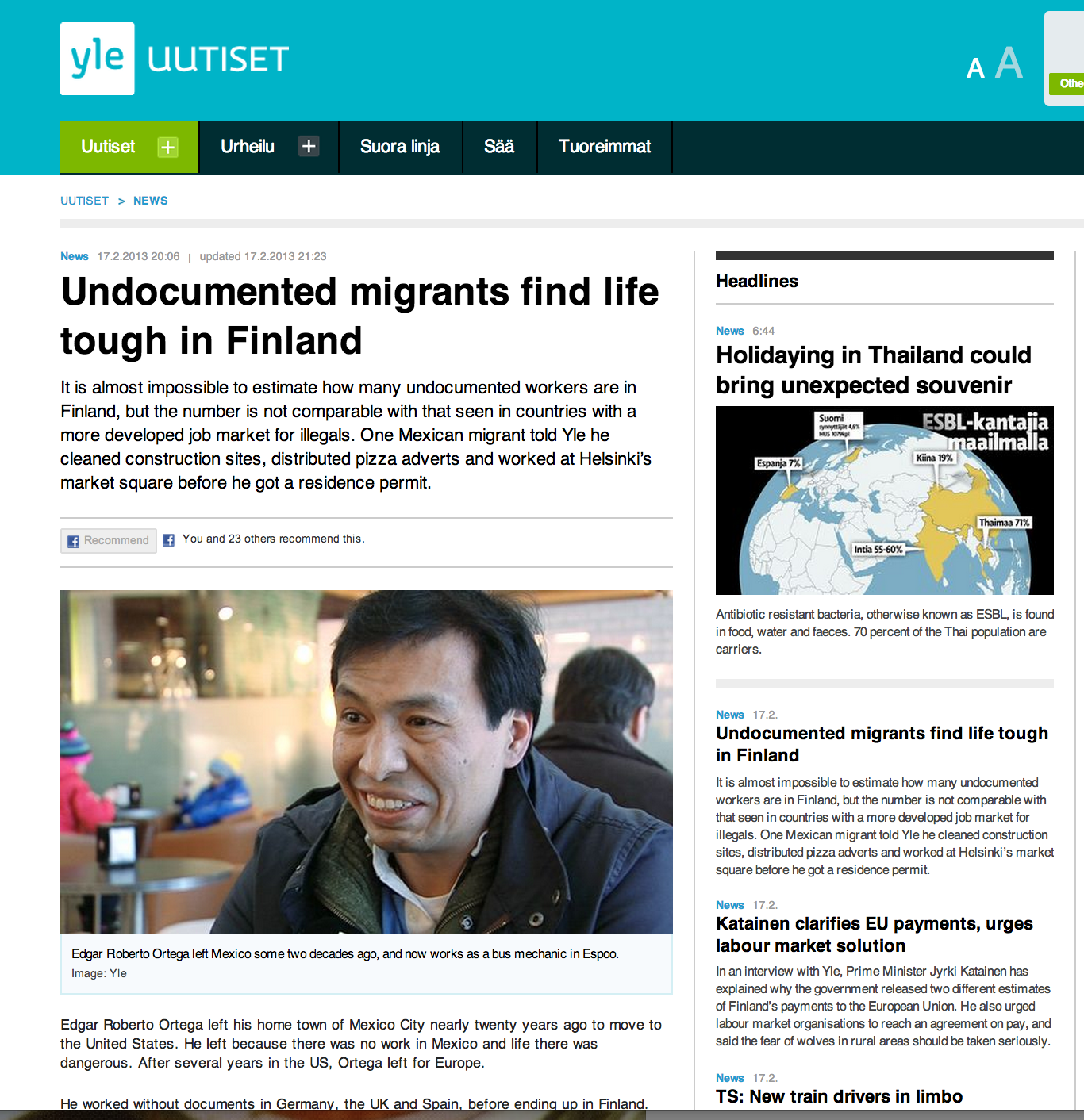
A forecast that will be published Monday by Statistics Finland sees the immigrant population of Helsinki and its surroundings rising by over 131% in two decades to around 300,000 from 130,000, reports YLE in English, citing Swedish-language daily Hufvustadsbladet.
Writes Yle in English: “Most non-Finnish speakers come to Finland and the Helsinki region from Africa and the Middle East. The forecast indicates most of them reside in Helsinki. Those arriving from Asia tend to move into Espoo while those from Russia prefer to live in Vantaa.”
If the population of Helsinki and surroundings will rise in the next twenty years, Finland’s total immigrant population will see strong growth as well from the present 257,248 persons (4.8% of the population). Helsinki has the highest share of immigrants today (11.8%), followed by Vantaa (11.2%) and Espoo (10.5%).
If these forecasts are reliable, Finland will be a very different country this century when compared with the last, when it was predominantly white.
As more immigrants move to Finland, it’ll be harder to deny these newcomers and their children their rights and their neighborhoods.
If we compare the over 1.2 million Finns that emigrated from this country between 1860 and 1999, some of them even founded ethnic colonies in countries like Argentina.
Finland’s past and even present attitude of cultural diversity isn’t anything to write home about. When Vietnamese boat people came as quota refugees to Finland in the 1980s, the official policy was to pepper them throughout Finland to make sure that they’d integrate and not form ethnic neighborhoods.
This was a dreadful mistake. Assimilation (one-way integration) doesn’t work unless it’s the aim of the majority culture to divide and conquer different ethnic groups.
A very worrying sign, however, is how some Finns want to deny cultural diversity its rightful place and recognition in society by placing caps on how man children with immigrant backgrounds can attend a schoolroom.
Finland is today an ever-growing culturally diverse society.
That’s a fact. No matter how much some wish to still cover their eyes and deny it.
Our reaction to intolerance in Finland has paid off. At least it did for me late-Friday night in downtown Joensuu when I was about to parallel park my car.
Thanks to associations like JoMoni working in close cooperation with local authorities like ELY-keskus, Joensuu have challenged intolerance. In many respects, it’s like the success of the North Karelian cardiovascular disease project of the 1960s and 1970s. Source: City of Joensuu.
A young man holding two beer cans, who was standing next to a parked car with his friends, wouldn’t move when I asked him to. He just stared back and started laughing.
He eventually moved to the side. That’s when he yelled: ”Damn n-word.”
I got out of my car and asked him what he called me.
”Nothing,” he responded.
While this situation may appear insignificant, it was an encouraging example of how hard work and countless anti-racism campaigns in Joensuu have changed matters.
The young man and his friends probably knew that they could get into hot water with the law if they continued to provoke me with their racist remarks. This was Joensuu 2013, not the 1990s.
The North Karelian city used to be a hotbed of skinhead activity and racism in the 1990s. Back then, a black basketball player of the local Kataja team was beaten up and moved back to the United States.
The message of those who play down racism, and thereby embolden this social ill, is clear: We’re too powerful, too strong for you to confront.
Wrong: You are being challenged. We will send you back to where you came from.
The reason why I reposted this blog entry By Julian Abagond is to show how a country can down play the role of racism in its history. History erases history, right? Now consider a country like Finland, which doesn’t have such a terrible legacy. It must be pretty easy then to minimize the existence and impact of such a social ill our society.
What do they teach about anti-racism at Finnish high school? Even if our history is different from the United States, racism has its roots in our history as well. Its face has been very clearly shown in the first decade of this century. The spectacular rise of the Perussuomalaiset party in the 2011 election is a good example of its ever-growing clout.
Migrant Tales
_______
By Julian Abagond
America has a proud history of anti-racism – like the Declaration of Independence, abolitionists, Nat Turner, the Underground Railroad, Harriet Tubman, Frederick Douglass, John Brown, Abraham Lincoln, the civil war, the Gettysburg Address, Emancipation, the Radical Republicans, Reconstruction, Ida B. Wells, Thurgood Marshall, Rosa Parks, Martin Luther King, Jr, the civil rights movement, Malcolm X, the Black Panthers, Angela Davis and so much else.
But since 1890 it has been played down or lied about in American high school history books.
Why?
White teachers in the South: Those who write history books for high school try to appeal to white teachers in the South, particularly in Texas, to sell more books.
High school history avoids ideas, especially “divisive” ones like anti-racism. It is way easier to teach names and dates – partly because they are so boring!
To talk about anti-racism would mean talking about racism – which is also played down and avoided.
A white racist view of Black History which writes it off as unimportant because it is “only about blacks”, a sort of sidebar to Real American History.
For example:
John Brown (pictured right) is written off as a madman, religious nut, fanatic, etc. Yet writers whom Americans are taught to admire in English class. like Emerson and Thoreau, admired him! Not that anyone at high school is going to tell you that.
Abraham Lincoln, whatever his faults, fought his own racism and freed the slaves. That inner battle with his own racism is never shown.
The civil war, before 1970, was taught as being mainly about states rights and preserving the union, not about freeing the slaves. Lincoln, even now, is misquoted to that effect.
The Gettysburg Address: students used to have to learn it by heart. Now most history books do not even print it in full! And those that do barely talk about it. Even though (or, more likely, because) it wonderfully sums up the Union cause in the civil war, tying black freedom to the Declaration of Independence.
White Reconstructionists, who worked for making the races equal in the South, sometimes putting themselves in great physical danger, like by teaching black children to read, are called carpetbaggers (pictured right) and scallywags – terms lifted straight from white racist propaganda of the time.
The civil rights movementbecomes pretty much just Rosa Parks not giving up her seat on the bus and Martin Luther King giving a great speech about being colour-blind, thus ending racism – and any further need for anti-racism!
Martin Luther King, like Lincoln, wrote profoundly about race and America, but, as with Lincoln, little of it is used. Both King and Lincoln condemned America for its racist crimes – also left out.
The Black Panthers – the Texas school board requires they be put in a bad light because they were for “violence”.
Thanks to the overthrow of Jim Crow in the South by the civil rights movement, high school history books are better now than in the 1950s, but there has beenlittle change since at least the late 1980s.
Source: Some of this comes from chapter 6 of James Loewen’s Lies My Teacher Told Me (2007). Unfortunately he mainly just talks about anti-racism by white people!
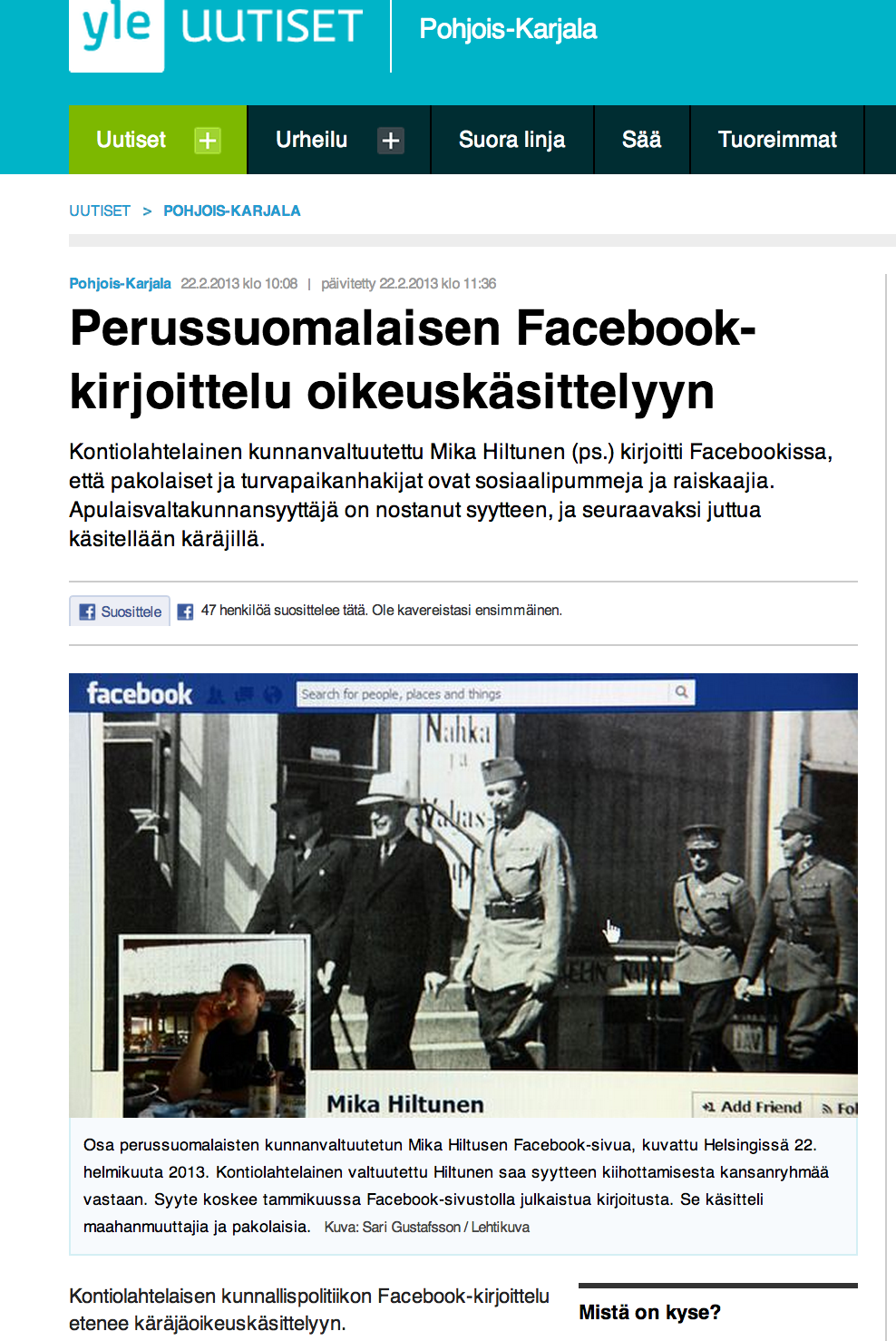
The Finnish appeals court announced Wednesday that it has upheld a district court decision to fine Perussuomalaiset (PS) Kotka city councillor Freddy van Wonterghem for inciting ethnic hatred.
While Van Wonterghem is a small fry in the anti-immigration party, far-right PS MP James Hirvisaari blew his stack by slamming the appeals court decision on his Facebook page as “sick, sick.”
“The Kouvola appeals court would end up under sea but it’s lucky that it will even be transferred to Kuopio,” Hirvisaari wrote. “So lawyers are in favor of whipping to death a raped girl. There’s no other way that [van Wonterghem’s] sentence can be understood.”
It is surprising that Hirvisaari and van Wonterghem, who have built their political careers on spreading hate speech, are now upset that it’s legal pay-back time. Without the PS party, social media and Hirvisaari’s hate speech, it’s doubtful that this railroad engineer would have ever been elected to parliament.
Van Wonterghem commented on a blog entry written by Migrant Tales that he had no regrets about what he wrote in the summer of 2011. He said that if a Muslim girl would die it was a good matter since it would be one less woman giving birth to a member of that religious group.
Hirvisaari, who belongs to the legal committee of parliament, said on Uusi Suomi that deputy state prosecutor Jorma Kalske and state prosecutor Mika Illman were “politically corrupt.”
Kalske laughed off Hirvisaari’s claim.
“I can’t remember during my 40-year career of ever hearing an MP that is a member of the legal committee using this type of langauge against the judicial authorities,” he said.
The chairman of the legal committee, Anne Holmlund of the National Coalition Party, doesn’t consider it appropriate for a member of the legal committee or MP to criticize Finland’s legal system in the way that Hirvisaari does.
Perussuomalaiset (PS) MP James Hirvisaari has been caught once again with his hand in the extremist cookie jar. Lahti-based Etelä-Suomen Sanomat reports that Hirvisaari had uploaded a Nazi video years ago that glorifies the SS.
Hirvisaari uploaded the video as ”allamarcia” but it was originally published by kingtiger88 in March 2007.
The video, which shows SS officers and tanks, plays Rammstein’s song, Sonne (Sun).
Etelä-Suomen Sanomat got in touch with Hirvisaari about the video clip. He sent the following SMS message:
”Many years ago through that Nazi video I got know this great band Rammstein. Thus there is no reason to draw any questionable conclusions since there are no war or Nazi sympathies on my part. It must, therefore, simply be seen just as a heavy metal music video.”
These are the words of an MP convicted for inciting ethnic hatred and who, with his far-right ideology, believes he can make up and rewrite history to fit his myopic worldview.
Taking into account the atrocities the SS committed in World War 2, it isn’t surprising that Hirvisaari could get a kick out of watching these types of videos.
Since sports can be your passport to acceptance in a new country, its role should never be underetimated never mind undermined. It’s clear that we need to do more work in Finland to promote sports in order to include more immigrants and their children in this activity.
In the United States I played basketball, track & field, and soccer to gain new friends, respect and acceptance. If you were good at sports in school you were immediately accepted in the so-called elite student class.
Sports is an effective integrator because any sensible coach or trainer understands that racism and discrimination hurt the person’s and team’s performance. Teamwork works best when these latter social ills don’t take the driver’s seat.
Sports offers our integration program a good benchmark. Pereformance is judged by skills not by a sportsman’s or woman’s ethnicity.
Basketball was my passport to acceptance in the United States, track & field helped me to meet new Finnish friends and soccer enabled me to be accepted by Latinos.
This is me before the Fosbury flop at a track & field meet in California in 1971 between Hollywood and Eagle Rock High School.
One of the most important moments of my sporting career took place at the regional track & field championship in Varkaus in the early 1970s. I had won the high jump compeition but there was a slight problem.
”We cannot give you the award because you don’t live in Finland,” an official of the event said.
”But I am a Finn,” I responded. “My grandfather was an active sportsman and leader in SVUL [Etelä-Savo sports federation]. I visit Finland every summer.”
After much thought, the ogranizing committee decided to give me the award.
I am eternally grateful to them that they did. I tried to get in touch with the organizers thirty years later and thank them for making the right decision and not allowing nationality to get in the way.
But who had informed them that I didn’t live in Finland at the time?
In the 1970s Finnish citizenship was defined on very narrow terms. Even if my mother is a Finn, I had no right to citizenship. This changed in 1984, when children of Finnish mothers were given citizenship automatically.
One of the challenges facing Finland today is that there are too few immigrants that excel in sports when compared with Sweden or other European countries like England and Holland.
”This situation should be better studied in order to address the issue more effectively [so more immigrants and their children can participat and excel in sports],” Harjula-Jalonen told Migrant Tales, adding that high participation costs and targeting state aid to such programs are some of the many challenges facing immigrants.
Here’s an article on Wednesday’s Helsingin Sanomat that sheds more light on the problem.
In Finland where finance and politics are no longer barriers to achieve star status in sports, what challenges do minorities face? Do female athletes, persons with disabilities, or those coming from immigrant backgrounds have equal opportunities in Finnish society?
You can visit Nooralotta Neziri official website here.
Nooralotta Neziri just won the women’s 60-meter hurdle on February 3, 2013 at the Star Atlethics in Tampere (“Tähtien kisoista ja 23-vuotiaiden EM-kisoissa “). She achieved this with an impressive 8.14, while the second fastest Lotta Harala came at 8.20. Already a national record holder and U20 European champion, Nooralotta now looks forward to the European Championships 2013 in Göteborg, Sweden.
The authors Celen Oben (North Cyprus) and Sheila Riikonen (Philippines) travelled in Finland and Cyprus to interview sports figures from a minority background in a span of 10 days in December 2012. Here is the excerpt of the interview with her:
Nooralotta Neziri, 21 years old, first talked about what inspired her. “I started running at the age of 7. My inspiration was my uncle who encouraged me to join a running club to get friends as we moved to a new place. My family and parents are very proud of me and they never doubted my goals. They are always very supportive.”
She currently studies Master of Economic Sciences in Pori. Describing her career, her biggest records are the U20 European Championships Gold medal, U18 European Olympic Festival Gold medal and own national senior record 13.10.
Other achievements are National Champion 2012, U18 World championships 5th, U20 World championships 5th, and Youth national record.
Sponsors and big companies do not mean the same thing, she said. “Yes, they are big companies here, but the amount of money isn’t too big yet. Last year I made the contracts myself but nowadays I have a manager to do those things. So I don’t have to use my energy to them.”
We spoke to her about some countries for example North Cyprus, when female athletes get married and have children; they stop running – what is her case?
“Usually, in Finland it’s the same. But I think it shouldn’t be over if you have a good motivation to continue training after giving a birth. There are many female athletes winning a medal in the Olympics who are mothers. It’s about your own motivation and how supportive your family is.”
Using drugs and doping are a sensitive issue where top-level athletes have been penalized. “I would never even consider using that. I think it’s unfair towards others. And I wouldn’t risk my health with drugs. I believe I can become a world champion without ever seeing them, “ she said.
Nooralotta’s dad is a Macedonian Albanian while her mother is a Finn. “So I’m 50% Albanian 50% Finnish. I think that’s my strength, I have always been a bit different from everyone else and I think it so cool! I’ve learned to like my difference. My goal is to be the best hurdle runner in the world!”
While there are challenges in everyday life and seemingly insurmountable odds in international competitions, athletes like Nooralotta persevered. Families and relationships are big factors in their success. The role of mentors and clubs are also important. A passion for sports and healthy lifestyle are enabling factors to succeed.
We must find effective ways to nip prejudice in the bud. The worst matter we can do when it happens is our silence, which emboldens and strengthens intolerance to see a new day. How you may ask can we challenge such social ills? The answer is simple: our example and leadership.
Racist rants are usually accompanied by Nazi slogans like this one found in Mikkeli, Finland.
One of the worst mistakes some make when speaking about other groups is to generalize. When we generalize we water the seeds of our prejudice, which eventually bloom and reinforce our intolerance.
A study by Janet Swim and Laurie Hyers in the United States asked the following question to women if they heard a sexist joke: Would you put them in their place, or would you be too nice to confront?
The study showed that 50% of the women participants said they’d ignore the comment, while 16% would actually comment on its inappropriateness. Two percent would grumble and do nothing.
I suspect that when it comes to racist jokes or comments, the number of people that would ignore them would be much higher than 50%.
Our reaction should be like Norwegian Prime Minister Jens Stoltenberg’s, who said that his country had become after Anders Breivik’s attacks a “more tolerant, [and] more careful not to judge people” according to their ethnic background. His answer was more democracy, openness and tolerance, not less.
If you are at a meeting with colleagues or friends and they make a racist joke, tell them that it’s inappropriate.
If the Counterjihadist-anti-immigration tide turned in Finland and the Nordic region after 22/7, when Anders Breivik went on the rampage killing 77 innocent people, the attack in Jyväskylä on Wednesday by suspected far-right thugs could be a serious blow to anti-immigration and far right groups in Finland.
Whenever hatred metamorphoses into violence, like in the case of Breivik, and now the attack on the event in Jyväskylä, people get scared and think twice before jumping on the hate bandwagon again.
It’s like picking and bullying somebody in a group. It may seem “fun” at first but when it turns messy that’s when people start regretting what they did.
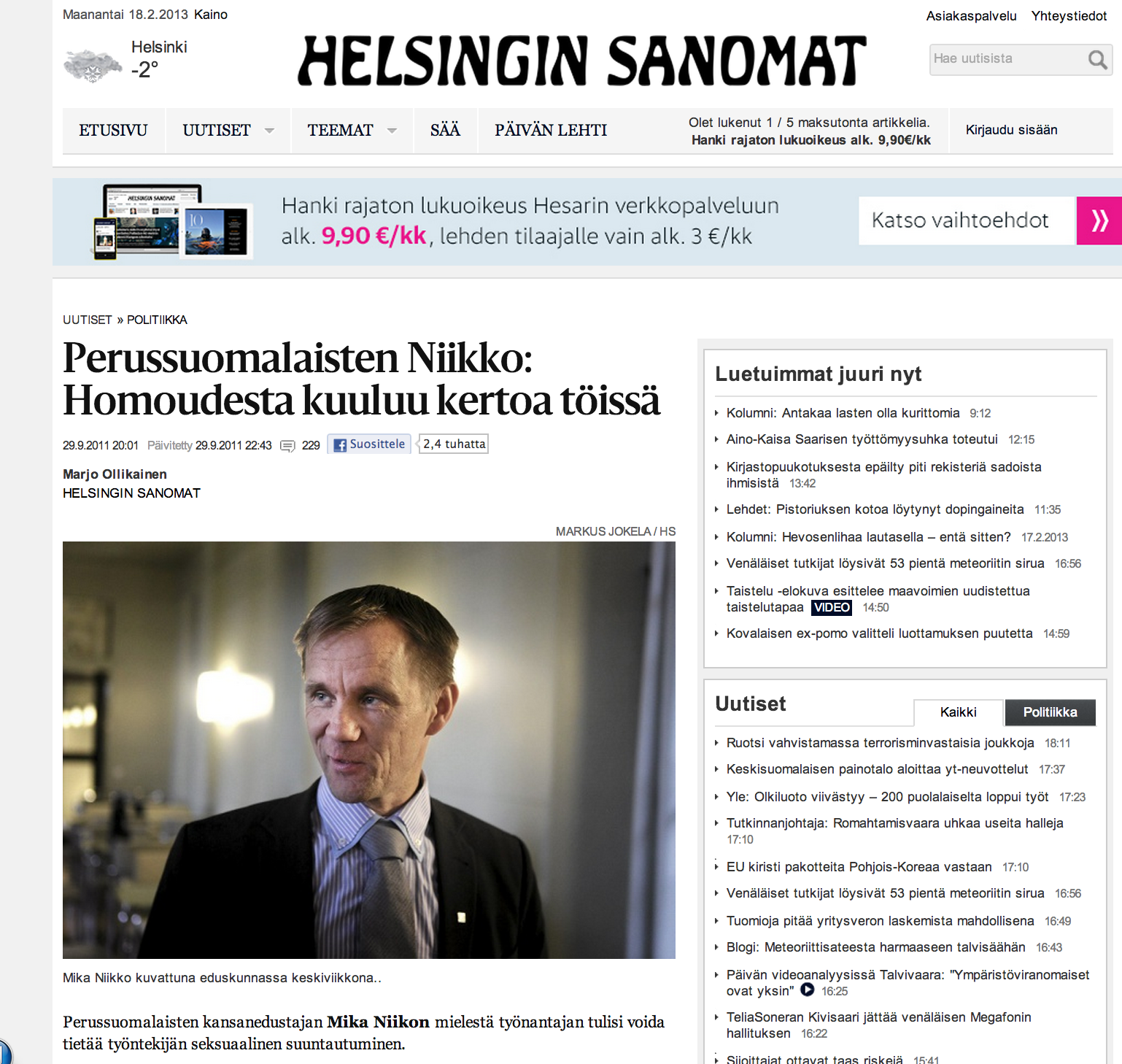
Since politicians who built their popularity on racism and intolerance are the worst opportunists, it’s clear that they will play down what happened in Norway, as Jussi Halla-aho and James Hirvisaari did, and as Juho Eerola now does with Jyväskylä.
Eerola not only told the suspected neo-Nazis in Jyväskylä how to crash the next book event, but that the organizers had staged what happened in order to sell more books.
Halla-aho, Hirvisaari and Eerola are Perussuomalaiset (PS) MPs who have built their political careers by spreading hatred and intolerance of immigrants. All three are or have been members of the extremist href=”http://www.migranttales.net/supo-suomen-sisu-is-an-extremist-group/”>Suomen Sisu association.
Migrant Tales has written before that you cannot keep racism on a short leash. Intolerance knows now master. It can bite back at its keeper and hard as we saw in Norway in July 2011.