“To deny people their human rights is to challenge their very humanity.”
Nelson Mandela
The passage on Friday of the pushback law with the support of the Social Democrats, demonstrates that we have entered uncharted waters. We should not be naive to think that the shelving of human rights, undermining our constitution, and turning our backs on international agreements will be a one-off matter.
Even if Human Rights form part of our Constitution, one may ask why so little regard for such rights. One reason is that Finland saw Human Rights as subversive during the Cold War since it undermined relations with the former Soviet Union.
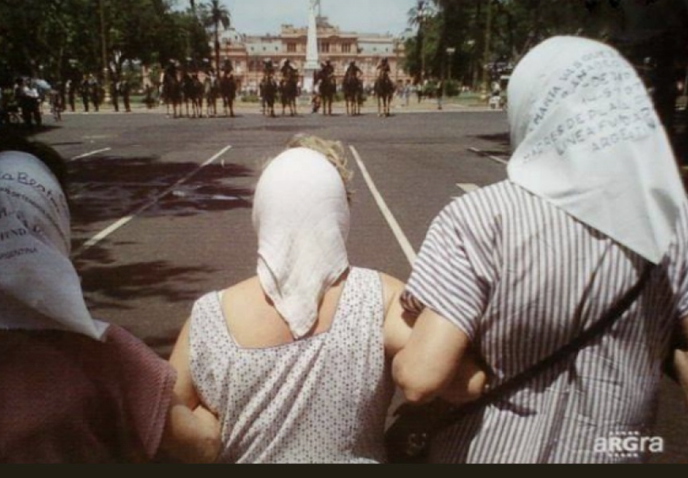
In Argentina, my country of birth, we used human rights as an ever-growing rallying cry against one of the most sanguinary military regimes in our history. The matter was sounded by groups like the Mother of Plaza de Mayo whose loved ones had disappeared.
At first, they were called the “Crazy” Mothers of Plaza de Mayo because no one dared to stand up against the military régime.
The Mothers of Plaza de Mayo still demonstrate on Thursdays at the Plaza de Mayo right in front of the presidential palace. Their first march took place in April 1977, the month I started my conscription in the army. The Mother of Plaza de Mayo was one factor why the military regime could not murder with impunity. People like me are eternally grateful for their bravery and example.
The fact that Human Rights took a big blow in Finland thanks to the pushback law, it’s clear that we cannot rely on the government or the Social Democrats to defend these rights. We therefore need a social movement that raises awareness of Human Rights.
In Argentina, Human Rights violations were one factor that brought the military regime down. We must do the same to vote out this terrible government that wipes its rear end with Human Rights.
Some may ask why do I make such a fuss about Human Rights.
The answer is simple: I lived in a country where Human Rights were shelved that was followed by Illegal detentions, torture, and death.
Muistan taannoin lukeneeni Voima-lehden pääkirjoituksessa Maslow’n tarvehierarkiasta. Tämä hierarkia tulee usein mieleen, kun seuraan nykyistä Suomen politiikkaa. Lyhyesti tarvehierarkian ensimmäisellä tasolla on fyysiset tarpeet ja seuraavalla turvallisuus. Ja mitä kaikkea turvallisuuden nimessä tehdäänkään nyt, ehkä kiitos siitä että suomalaiset ovat myös varsin turvallisuushakuisia. Maailmassa on paljon ylikierroksilla käyviä asioita ja monta konfliktia: Gazan ja Ukrainan sodat, ilmastonmuutos, hallituksen tekemät leikkaukset. Silti asiani ei koske suoraan yhtään näistä, ja keskimäärin asia saattaa kuulostaa vähäpätöiseltä. Mutta se on silti osa isompaa kuvaa ja mitä kaikkea Suomessa tapahtuukaan turvallisuuden nimissä, että populistista ja konservatiivista politiikkaa saadaan ajettua eteenpäin. Seuraavassa lyhyt kertomus ja mielipide, miten itärajan sulkeminen on vaikuttanut minuun ja haluan toki puolustaa samalla oikeusvaltiota ja turvapaikanhakijoiden oikeuksia.
Noniin, varmaan 90%:llä suomalaisista (oma arvioni) ei ole ollut yhteyksiä Venäjään suoranaisesti ennen sodan alkua tai varsinkaan sen jälkeen. Venäjä on etäinen maa varsinkin länsi-Suomen asukeille ja varmasti keskimääräiselle helsinkiläiselle. Demokratia on siis toteutunut, kun suurin osa kansasta on sitä mieltä, että hyvä kun raja on suljettu – hybridisodankäynnissä on saatu torjuntavoitto, Suomen hallitus on toiminut mallikkaasti. Näin mediasta saatu kuva. Ja kuka ikinä haluaisi käydä maassa, joka on niin sekasortoinen ja vaarallinen kuin Venäjä on (ehkä vain saidat bensaturistit ovat saattaneet käydä)? Itse olen yksi poikkeus.
Olen lukenut joitain haastatteluita rajavartioviranomaisten kanssa (Helsingin Sanomat), joissa on esitetty, että Suomi selviytyisi helposti suuremmistakin turvapaikan hakijoiden määrästä ja varmaa uhkaa ei voida todeta tällä hetkellä. Tilannetta peilattuna nykyiseen maahanmuuttovaisteiseen politiikkaan ei voi olla ajattelematta, että tässä ajetaan enemmän tätä politiikkaa sisään juuri turvallisuuteen vedoten ja tosiaan luodaan uutta lakia, jossa voidaan helposti käännyttää turvapaikanhakija takaisin, jatkossa mahdollisesti jopa lentokentällä. Turvallisuusuhkaan perustuva narraatio on mainio katalyytti ajaa tätä lakia maaliin asti.
Finland’s controversial pushback law received in parliament the needed two-thirds majority to turn away people seeking asylum at the border. One hundredsixty-seven MPs voted for the law while 31 voted against it.
Critics of the law argue that it conflicts with the Constitution, Human Rights, and international agreements signed by Finland with the United Nations and the EU.
Below, Mats Uotila, a Perussuomalaiset (PS)* party member, wanted to ridicule those MPs who voted against the law. They are the few brave ones who stood up against the fear-mongering and ultranationalistic attacks by the PS, National Coalition Party (PS), and others.
One of the most jaw-dropping pictures in parliament today was PS Fiance Minister Riikka Purra and Interior Minister Mari Rantanen. The law when approved, which puts in harm’s way migrants seeking asylum and a better life, makes Rantanen cry and hug Purra.
What is wrong with these people? They get emotional when they succeed at stripping people of their Human Rights?
Minister Purra and Rantanen hugging and shedding tears after Finland threw under the bus Human Rights, the Constitution, and international agreements protecting asylum seekers.
Finland’s parliament will vote today for the pushback law law that should b seen as another nail in the coffin of Finland’s experiment in being a more open country based on Human Rights.After Finland became an EU member in 1995, many monumental legal changes changes were made, like the drafting of the new constitutionstrongly grounded on Human Rights.
During the Cold War, Human Rights were never held in high esteem. The reason was Finland’s policy of appeasement to the former Soviet Union. Speaking out for Human Rights, never mind joining the Council of Europe back then, would have been unthinkable because it would put in jeaoparty Finnish-Soviet relations.
Many of the politicians in Parliament, like NCP MP Ben Zyskowicz, served during the Cold War era and explains why he doesn’t place a lot of importance on Human Rights and is ready to ridicule legal experts who have spoken out against the pushback law.
It should not be a surprise that parties like the radical-right Perussuomalaiset (PS)*, and National Coalition Party (NCP) with the cheerleading of the Christian Democrats, Swedish People’s Party and Center Party, are watering down the civil right gains made after EU membership.
It is not only the purshback law what will chip away at our fundamental rights, but other ones already promosted by the government. These include labor rights, social security and migrant rights. Since we are on a slippery slope, is the next step to take away the dual citizenship rights of Finnish-Russians?
If there is one matter that surprises me the most about the present situation is how easy it is for the government to implement this dangerous development.
In a recent interview on an Italian TV program on the Finnish-Russian border, I mentioned that in many respects Finland resembles a small town. Add to the latter anti-Russian sentiment, and iyou have a winning argment.
Whatever the outcome of the voting today on the pushback law, today will be remembered as a day for infamy for Human Rights in Finland.
The government of National Coalition Party (NCP) Prime Minister Petteri Orpo looks like after a year like a wrecking ball of Finland’s social welfare state. We have already seen how his government actions have undermined the labor market, social welfare, and emboldened hostile migration policy.
The next big step is the government’s plans to pass the pushback law, which would in effect trash Human Rights, the Constitution, and international law.
Despite these radical changes, voters offered a surprise: The Left Alliance placed second after the NCP with 17.3% in the recent MEP election.
The Perussuomalaiset (PS)*, relied on its anti-immigration message to get votes. It failed. The PS came in sixth place with only 13.8%.
The recent opinion poll by Yle revealed that the Left Alliance gained 11.6%, up 2.1 percentage points, which is a record for te party.
National Coalition Party MEP Henna Virkkunen is hoping to become an EU commissioner. However, there is a question: Is a person qualified if he or she would care less or very little if people die when coming to Europe?
In the 2019 MEP election, she responded in the Alma Meter election compass in the affirmative to the question 13*: “The EU must save all those migrants who are at risk of drowning attempting to cross the Mediterranean to Europe.”
Virkkunen “disagreed” that the EU must save those migrants crossing the Mediterranean from drowning.
In the 2024 election compass, Virkkunen still showed little regard for people crossing into the EU. Question 11 of Yle’s election compass asked a yes or no answer: “A person trying to reach Europe can be turned back at the border, even if it would put their life in danger.”
Virkkunen responded in the affirmative, yes, it was ok to push back the person even if his or her life were in danger.
Her response and possible naming as EU commissioner shows how low we have stooped in Europe.
How can the government be so worried about “national security” if you are ready to trash our most sacred rights like Human Rights, the Constitution, and international agreements?
The Draft Act on Temporary Measures to Combat Instrumentalised Migration, or the so-called pushback law, is not only concerning how the constitutional committee can sidestep our most sacred values as a society based on Human Rights, the Constitution, and international agreements but how politicians who should know better are demanding such changes.
It’s clear that the pushback law is not only a move to undermine our rights, but will lead to other changes by using the pretext of “national security.”
I lived in Argentina during one of its most violent military régimes. The way the military could throw Human Rights and the rule of law in the trash can was “defending national security.” To do this they committed atrocities that led to the disappearance of over 30,000 people.
After they got rid of their enemies, the left-wing guerrillas, they looked for “potential” terrorists. You read right. People who could become terrorists.
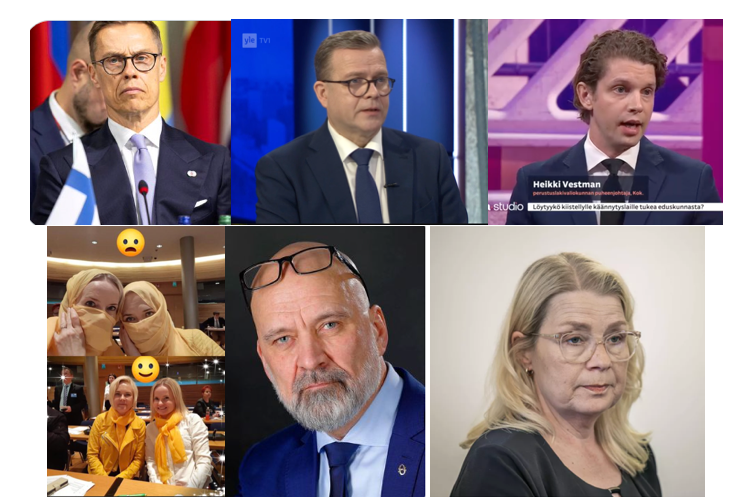
Finland’s shameful politicians of the pushback law are President Alexander Stubb, National Coalition Party (NCP) Prime Minister Petteri Orpo, Constituional Committee Chairperson Heikki Vestman, Perussuomalaiset (PS)* Interior Minister Mari Rantanen, Finance Minister Riikka Purra, Aministrative Committee Chairperson Mauri Peltokangas, and Justice Minister Leena Meri.
The above list is NOT conclusive. We can name many PS, NCP, and Center Party politicians who would fit the bill. One of these is former President Sauli Niinistö, who has had an ambiguously hostile view of asylum seekers and Russian dual citizens.
Upper left to right: President Alexander Stubb, Prime Minister Petteri Orpo, Constitutional Committee Chairperson Heikki Vestman (lower row left to right) Interior Minister Mari Rantanen, Finance Minister Riikka Purra, Administrative Committee Chairperson Mauri Peltokangas, and Justice Minister Leena Meri.
What anti-Human Rights “merits” do the following politicians have?
Alexander Stubb: After being elected president, Stubb has shown how little he regards Human Rights, the Constitution, international agreements, and minority rights. Apart from holding such values as suspect whenever it is convenient politically, his support of the pushback law can also be seen as payback to Petteri Orpo, who supported him as the NCP’s presidential candidate. His statements are political and lack the credibility of a statesman. One of these was toMTV, when he mentioned that the asylum seekers at the border are not “real” refugees.
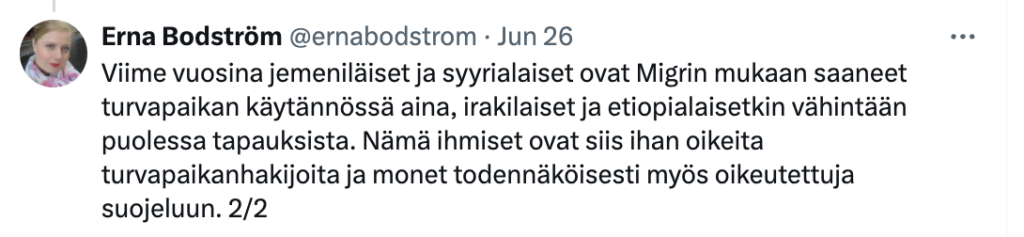
Erna Bodstöm tweets: “In recent years, according to Migri, Yemenis and Syrians have practically always been granted asylum, and Iraqis and Ethiopians in at least half of the cases. So these people are genuine asylum seekers and many are likely to be eligible for protection.”
The Perussuomalaiset (PS)* and Interior Minister Mari Rantanen got bitten hard by her own and some of the party’s racist statements on A-studioby host Marja Sannikka.
Rantanen’s ignorance and loathing of migrants, especially Muslims and people of color, shines through as usual. The PS is the first modern party in Finland to capitalize on xenophobia.
The A-studio interview reinforced a lot of matters about Rantanen’s and the PS’s xenophobia. Rantanen claimed that the PS had the right to change migration policy “democratically” even if such changes exclude and discriminate against migrants.
Rantanen like her party, incorrectly believes, that they have a carte blanch to say and do almost what they want with migrants, who don’t have the right to vote them out of power.
Social Democrat MP Nasima Razmyar (left) and Interior Minister Mari Rantanen. Source: A-studio
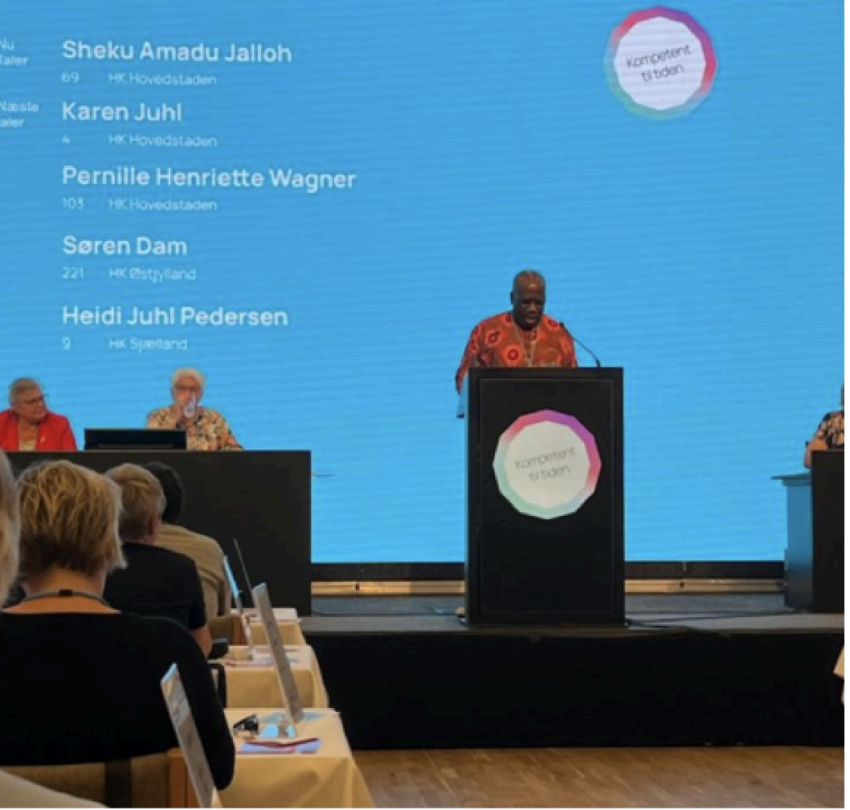
In November 1990, Sheku Amadu Jalloh arrived in Denmark from Sierra Leone as a stowaway, escaping the political turmoil of his homeland. Over three decades later, the stowaway, Jalloh who has studied journalism at the University of Liberia with a three-month training program in the USA, is a Danish citizen and a dedicated employee at the Royal Library. Jalloh is also a celebrated activist committed to combating racism and discrimination.
Making a speech on 21 March during the UN International Day for the Elimination of Racial Discrimination.
A Journey from Sierra Leone to Denmark
Jalloh left Sierra Leone due to the political instability and civil war that plagued the West African country for 11 years and sought a better life in Denmark. Since then, 30 years have passed and he has deeply integrated into Danish society. He recently celebrated 30 years working at the Royal Library.
At a trade union congress.
Leadership in the Fight Against Racism
“A Denmark in which justice and equality are not just ideals, but realities for all of its inhabitants,”
As chairman of SOS Racism Denmark and board member of the Afro-Danish Collective, Jalloh advocates against racism and discrimination. These organizations aim to create a society where everyone has equal opportunities, regardless of their background. Jalloh states that their mission is to prevent the spread of racism and discrimination. Despite Denmark ranking fourth in Europe as a racist country, according to Information in November 2023, Jalloh notes that this view is not representative of all political parties. Some parties offer support to immigrants and people of foreign descent.
Making speech on workers day on May 1st (Left picture) – From a meeting with Rosa Lund (right front photo sitting), an MP of the Red-Green Alliance political party. An anti-discrimination action plan was discussed at the meeting. (right picture)
A broader alliance for equality
In addition to participating in the Afro-Danish Collective and SOS Racism, Jalloh is a strong advocate of Mellemfolkeligt Samvirke, a coalition organizing activities and protests to encourage communication with legislators and lobbying for anti-discrimination laws. In the face of the government’s erratic refugee quotas, which were lowered from 500 to 50 and are currently 200, Jalloh and his associates are unwavering in their demands for greater acceptance rates. They stress that, in light of other countries’ efforts, even the former quota of 500 is insufficient.
Celebrating the UN International Day for the Elimination of Racial Discrimination.
The Role of Trade Unions
A major component of Jalloh’s approach is mobilizing trade unions for the cause. He anticipates using the combined might of organized labor to present a unified front against racism and discrimination. “My goal is to involve more trade unions in the anti-discrimination battle and every year on March 21, we celebrate the UN International Day for the Elimination of Racial Discrimination Day together with five to six trade unions participating in the events,” he said.
A vision for the future
Jalloh and his fellow activists were instrumental in the adoption and enactment of the anti-discrimination action plan in Copenhagen in 2023. Seeing that their efforts have proven fruitful, he has now resolved to attain similar outcomes with an equivalent national legislation.
Addressing delegates at the HK Stat Trade Union congress.
Despite the many challenges, Jalloh remains unfazed and his vision is clear: “A Denmark in which justice and equality are not just ideals, but realities for all of its inhabitants,” he continued. “One thing we have to work very hard on is coming together to fight racism and discrimination.”
Jalloh’s story is one of zeal, perseverance, and unflinching dedication. From his beginnings in Sierra Leone to his current position as an activist in Denmark, he shows the impact that one person can have in the battle for a more equitable, inclusive society. Through his work, he continues to inspire and motivate others, demonstrating that the route to equality, while arduous, is “undoubtedly worth every step”.
In the 2019 European Parliament election, Henna Virkkunen of the National Coalition Party agreed that the EU was not obligated to save people from drowning in the Mediterranean. She was in good company with the likes of Perussuomalaiset MEPs Laura Huhtasaari and Teuvo Hakkarainen.
Virkkunen reasoned that we should stop traffickers, even if it means allowing people to drown and die at sea.
After five years of being in the EU parliament, she still believes that people should die after being pushed back at the border.
Question 11 of Yle’s election compass: “A person trying to reach Europe can be turned back at the border, even if it would put their life in danger.”
The good news is that only five of Finland’s 15 MEPs would care less id people died trying to cross the border. These are three from the National Coalition Party (NCP), one Perussuomalaiset (PS)*, and one from the Center Party, which has a wishy-washy track record on immigration.
The Center Party MEP and then finance minister, Katri Kulmuni, posted in 2019 an Internet poll asking if repatriating “[Finnish] children only” or “children and [Finnish] mothers” from the al-Hol camp in Syria.
Tynkkynen, who was convicted three times for ethnic agitation, likes to give the image of a “tolerant” politician since he is gay and married to an African. Nothing could be further from the truth.
The last two, Mika Aaltola and Pekka Toveri, are fuelled by bravado and opportunism.
Aaltola is a media creation and Toveri is a general who likes to talk tough.