Happy New Year from Migrant Tales!

Russia is not unpredictable. In its operations against Finland, it exploits racism because Finland is a racist country.
The observation by writer Sofi Oksnanen is the only one I have read that reveals the government’s pushbacks and their draconian immigration and asylum policy. The government’s knee-jerk reaction to closing the Finnish-Russian border shows how Finnish politicians and the media have jumped on the populist-racist bandwagon.
Oksanen is a sharp writer and observer, especially of governments with autocratic intentions. It is surprising that the Finnish media, never mind politicians, have not dared to question the government’s policies but bowed instead to them.
Prime Minister Petteri Orpo can claim with a poker face its immigration policy isn’t racist because it is a copy of what is being done in other Nordic countries. Would it be fair to say that the immigration policy of all Nordic countries is then racist?
Continue reading “2023 taught me that racism is the poison that threatens democracy and human rights”
Thanks to a talk hosted by the European Network on Religion and Belief (ENORB) this week, we were able to witness once again the violent pushbacks occurring on EU borders, Migrant Tales recently published a story about this pushback on the Turkish-Greek Evros River border.
The pushbacks, which go largely unnoticed by the European media, are happening right now and are the region’s blind spot and shame.
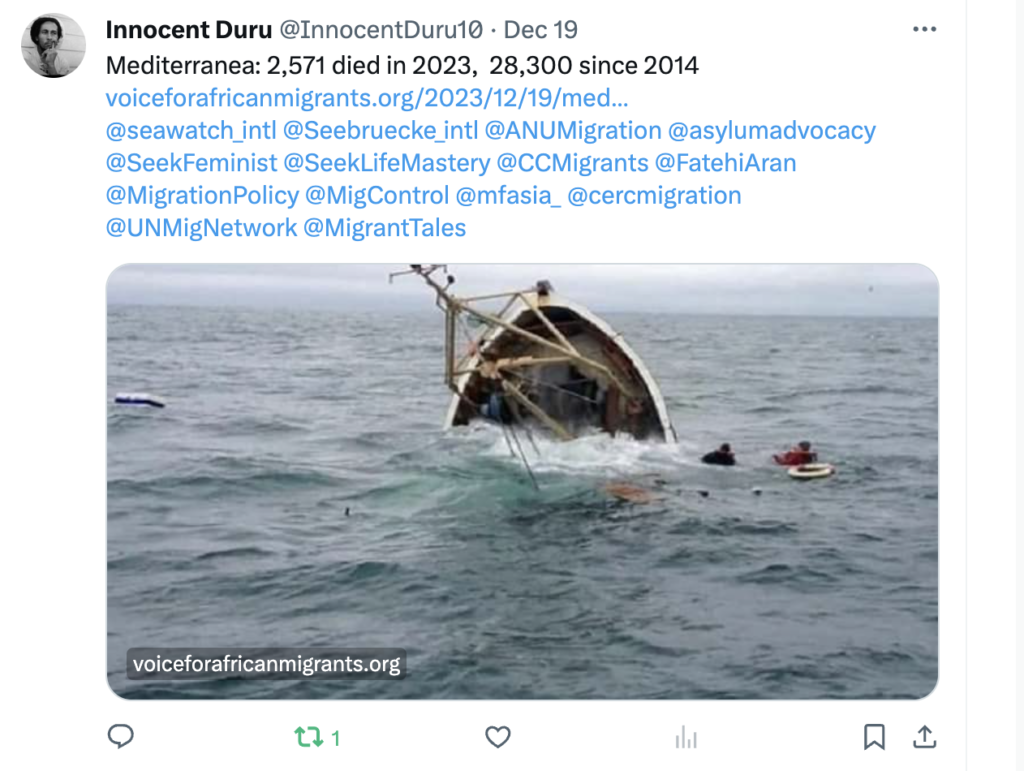
Writes Mireia Rimbau Vilà of ENORB: “As negotiations for the New EU Pact on Migration and Asylum are finalized, the future is bleak. For this, we need to stand together in solidarity. At the European Network on Religion and Belief, we want to build bridges between different groups to strengthen community cohesion.”
Pushbacks are a reality that asylum seekers and migrants are facing in many parts of the EU.
Continue reading “Pushbacks in the EU are disgraceful revealing our willingness to ditch our most sacred values”It is hard to make any sense out of the on-and-off Russian border closings.
Whether these will have any real effect in the long run on numbers of asylum seekers remains to be seen.
The way the war is going in Ukraine this winter almost guarantees an influx of hundreds or thousands more from that country, all of whom have so far been granted humanitarian protection. The impact of the Gaza conflict looks increasingly scary.
Ostensibly some of those who come from Ukraine have other destination options and as many might be diverted elsewhere as the number seen to be trickling across the Russian border when allowed. That way the objections about the social costs of accepting asylum seekers could be managed. A place in a refugee reception center has the same price, regardless of nationality.
But then there is this political contention that we should be helping Ukraine.
Now, the news just out from Russia is that the country is tightening up its laws regarding undocumented persons and that those who are not regularized will be fined or jailed- but given the option to fight in Ukraine after which they would be granted Russian residence.
It seems to me that if we really want to help Ukraine, we (meaning Finland) could grant many of those applying to Finland entry residence permits and deny the Russian army their services as reinforcements to destroy Ukraine. Accommodating, hundreds of such applicants from Russia would likely come much cheaper than the millions we are now spending to send weapons for Zelensky to fight a losing war. It would also likely be a policy appreciated by both Ukraine and our EU colleagues struggling to retain a credible refugee protection regime in the eyes of the world.
It would likely also be accepted by Russia as such a policy could also allow us to open the eastern border permitting persons of Russian extraction to be reunited over the holidays and winter months. Keeping the border open would also allow the continuation of container and automobile traffic transiting Russia, the loss of which is costing Finnish businesses millions.
This is the kind of “realpolitik” we could use as the birthrate in Finland has plummeted and those entering retirement are increasing apace. In an economy that is hardly growing, there is not much to attract the high-flying career movers that the Confederation of Finnish Businesses (EK) and Business Finland fantasize about, not even with fast-track residence permits.
On the other hand, knocking at the Eastern border among the “anonymous masses” are many highly educated and experienced professionals of working age. There is no really good reason not to allow them to enter. We just need to do the screening to identify them. This could to a large extent probably be done at Finnish consulates like Petroskoi. This would also take the pressure off the border crossings. Unfortunately, our government decided to close those as an empty gesture to Russia meant to show disapproval of the invasion of Ukraine.
The problem at the Eastern border is really a management one. In 2016, there was a similar issue of hundreds without documents entering from Russia. President Sauli Niinistö set up a meeting with Vladimir Putin and the whole problem was dealt with. Orpo, then the Finnish interior minister, went to Moscow and worked out the details behind the scenes. In short order persons without documents were stopped before getting to the border and the crisis was over. This was done with quiet diplomacy and no-one asked how this could happen under international or EU refugee protection laws.
I ran into former SUPO chief Seppo Tiitinen at an event where he was promoting his book at a community center in my neighbourhood. I asked him why Finland does not use the same formula to address the crises at the eastern border as in 2016.”We have to come off our high horse and talk to the Russians,” he said or words to that effect. “If we are able to,” He pointed out that the country had long used a “special” link to the top Russian leadership.
Orpo has announced that he has no interest in talking to Putin -or the Russians. So has Niinistö. Foreign Minister Elina Valtonen met Russia’s Foreign Minister Sergey Lavrov at the CSCE meeting in Skopje, a meeting convened to keep alive “The Helsinki Spirit” of all things. The words describe a high point of Finnish diplomacy, all about ending the cold war with peaceful diplomacy. Valtonen refused to shake Lavrov’s hand. Being new to the job, it seems Valtonen doesn’t understand what she is there for.
Finns are entitled to be represented by politicians who are willing to pragmatically manage relations with neighbouring countries- not build antagonisms.
Before starting their jobs, leaders-particularly in small countries neighboring huge ones, should be required to repeat Paasikivi’s famous quote a hundred times. They can find it engraved on the statue dedicated to him on Mannerheimintie Avenue.
“Peace comes from understanding the reality of things.
*Ahti Tolvanen is on the Migrant Tales’ editorial board.
Leo Honka
Sisäministerille on rautainen sydän
hänen vihaa maistu raudalta.
Rantanen pyrki luomaan itselleen mainetta
polkemalla maahanmuuttajin,
unohtaen samalla ihmisoikeudet.
Hänen vihansa kohdistuu erityisesti ulkomaalaisin,
erityisesti muslimeihin,
sekä niihin, jotka eivät ole valkoisia tai EU-kansalaisia.
Mari Rantanen on sisäministeri, jolla on rautainen sydän.

Sisäministeri Mari Rantanen. Yle
Article 3 – border control measures must be without prejudice to the rights of
refugees and other people requesting international protection, in particular as
regards the principle of non-refoulement.
European Convention on Human Rights
Perussuomalaiset (PS)* Finnish Interior Minister Mari Rantnanen called herself Tuesday a “tough border lady” on A-studio. After opening two border checkpoints Thursday at Vaalima and Niirala, Rantnan announced they’d be closed again on Friday at 8 pm due to about 200 asylum seekers.
“We have seen an immediate resumption of illegal immigration at the eastern border [and therefore we will close to border again],” Rantanen was quoted as saying in Helsingin Sanomat.
Illegal immigration? Even Yle reporter Juulia Tillaeus at Vaalima, said Russia was allowing “illegal asylum seekers” to go to Finland.
Migrant Tales sent Juulia Tillaeus an email stating that her reporting was biased since there was no such thing as “illegal asylum seekers.” Such terms are used by anti-immigration politicians to discredit and dehumanize asylum seekers.
Send her an email ([email protected]) and ask her to stop labeling asylum seekers wrongly. Ask her to read at least the European Convenion on Human Rights.

The billboard was published om 2015-2016, claiming that 10,000 “illegal” refugees were coming to Finland. The claim that refugees are “illegal” is preposterous since such people have a right to ask for asylum in another country. The claim that refugees are coming to the country “illegally” is a good example of the xenophobia spread by the Finnish media. Source: Iltalehti
Regurgitating her favorite echo chamber hits about asylum seekers, one claim by Rantanen tops them all: such people coming from Russia are “a threat to national security.” Really? How?

After opening the two vborder crossings, the government decided to shut them the following day. Source: Yle News
When Rantanen speaks about asylum seekers, she reflects the ongoing toxic anti-immigration narrative so common in many EU countries.
Continue reading “The Finnish-Russian border is not an open-and-shut case”As Finland plans to open two of its eight border crossing points Thursday, Interior Minister Mari Rantanen was busy on A-studio spreading her usual bravado and get-tough-on-migrant soundbites earmarked principally for the Perussuomalaiset (PS)* party’s supporters.
Rantanen has a funny habit of smiling after a difficult comment. According to her, some 900 asylum seekers were a threat to national security and therefore Finland had to close the border with Russia.
It’s pretty clear that after breaking its campaign, like promising lower fuel prices at the pumps and food prices, coupled with massive cutbacks in social welfare spending, the PS is in deep trouble with its supporters.
After the European Council’s Commissioner for Human Rights, Dunja Mijatovic, rebuked Rantanen for the closure of the border, Poland’s new Prime Minister Donald Tusk gave a strong speech at the Sejm, the lower house of parliament, that gave hope against the toxic tide of anti-immigration rhetoric, which runs also high in Finland. as well.
“The criticism [by EU Commissioner Miatovic] doesn’t have any bearing on our decision [to open up two border crossings] since the government has been guided by national security, which has been the main factor for closing the [Finnish-Russian] border,” said Rantanen.
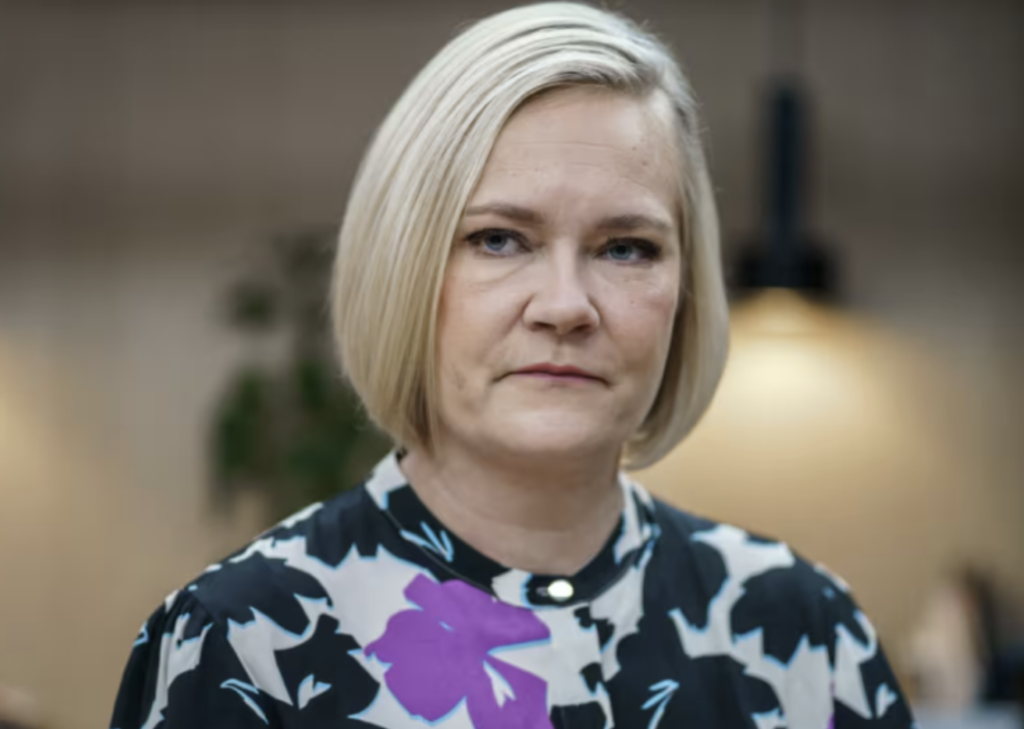
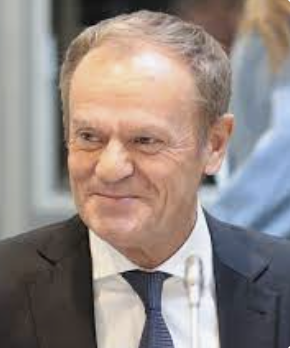
Interior Minister Mari Rantanen (left) and Prime Minister Donald Tusk are two very different politicians. Sources: Yle and Wikipedia
In many respects, Tusk’s speech was not only directed at the outgoing ruling party, Law and Justice (PiS), but against xenophobic politicians like Rantanen and other ones in other European countries.
Continue reading “Donald Tusk is a ray of hope exposing Europe’s far-right slumber”For years now the day has seen gatherings and rallies in support of immigrant and refugee rights and counterdemonstrations by nationalists who stand for ethnic purity.
At times the police have seized Nazi flags from the arch-nationalists or blocked violent attacks by some of these people against antifascists and antiracists.

Some claim that the police took sides with the neo-Nazi 612 demontrators. on December 6. Photo: Ahti Tolvanen.
This year for the first time, the police left the nationalist extremists and Nazis to go about their grim business and drove the anti-Nazi antiracist larger group off the streets -or tried to. One might say the Helsinki constabulary seemed to be bent on turning Independence Day 2023 into a festival for bigots.
The undersigned was at Töölöntori around 17.30 where “Helsinki Ilman Natseja” (Helsinki Without Nazis) group had convened a demonstration beginning at 4 pm. Another demonstration by known nationalist extremists had been called for at 6 pm in the name of “612”.
When I first went to the [Evros River] border, my first priority was to uncover what was happening and not to get arrested.
Philip Pollák, director of the Anachoma documentary project
The 480-kilometer-long Evros River, which divides Greece and Turkey in an uneasy truce, is just one of many places where EU policy on pushbacks goes largely unchecked. The pushbacks we are witnessing on the Evros River are not only against international and EU law but also a weaponized region against migrants where death has sometimes the final say.
“In an ideal world, I hope our documentary Anachoma, which means embankment in Greek, will see its first screening in May, a month before the European Parliament election in June. I hope it will raise awareness and encourage people not to look the other way,” said Pollák. “The documentary, which exposes pushbacks with the help of investigative journalism, research and experts, aims not only to show that what is happening is illegal but barbaric and wrong. It also undermines and chips away at our democracy and European values.”

Philip Pollák, director o the Anachoma project.
The Anachoma project has during three years interviewed over 30 people in 20 locations from Istanbul to Brussels. Some of these include Green MEP Tineke Strik, Stefanos Levidis, a forensic architecture researcher, Panayote Dimitras, founder of the Greek Helsinki Monitor.
Note from Philip Pollák: “ANACHOMA is a project that came very far with immense commitment from the team and investment of our own resources. However, to make this hard work see the light of day, we need the support of a broader community, of people who care. That’s why we started our crowdfunding campaign through our website and social media handles.
anachoma.com | Instagram | X | Facebook | LinkedIn | Youtube
If you are interested in collaborating to make the world know about these stories, and to hold the bright light of a projector to the injustice witnessed for decades, please consider visiting our website and contributing to ANACHOMA.“

The Evros River region is located in the northeastern and western parts of Greece and Turkey, respectively. Source: Wikipedia.
“The entire military strip [between both countries] is off limits,” Pollák continued. “There Is a buffer zone, but there are no maps that show the exact geographic location because it is a secret. You do see the checkpoints and how the border is guarded.”
Pollák said that one can be arrested if you are caught in the buffer zone. “You can face espionage charges, if you are a Greek you can even face treason charges,” he explained.
Interest grew in Greece
Pollák got interested in the Evros River pushbacks when he moved to Greece in 2020 and started to hear stories from that region. He did his Master’s thesis on the topic.
“Our documentary is all about pushbacks in their crudest form,” Pollák continues. “The action and treatment of migrants at the border by the Greek authorities breach the 1951 Convention on Refugees, the 1967 Protocol of that treaty, the European Charter of Fundamental Rights, European Convention on Human Rights, UN Declaration of Human Rights, and many other laws concerning the treatment of migrants.”
Continue reading “Anachoma: A documentary on pushbacks and violence on the Greek-Turkish Evros River”It is shameful, but obvious, why Prime Minister Petteri Orpo’s government, not one minister of the National Coalition Party and Perussuomalaiset,* mentions International Human Rights Day. Being white, driven by xenophobia and having a privileged life in Finland, it is understandable why such politicians see Human Rights as a threat.
Former President Tarja Halonen (2000-2012) commemorated in a Tween below International Human Rights Day.
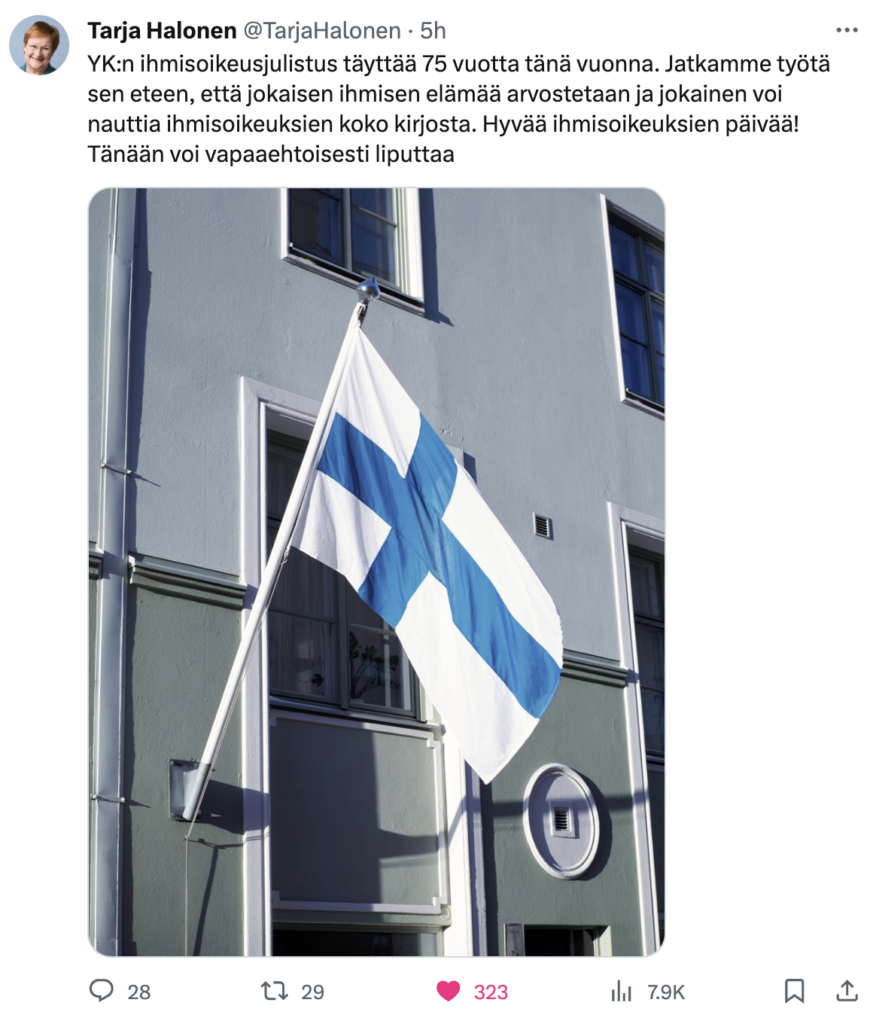
During the Cold War, Human Rights was a no-no in Finland because it questioned Finnish-Soviet relations. Finland joined the Council of Europe in 1989, 39 years after its founding in 1950, which held the banner of Human Rights high.
As an Argentinean who lived under a dictatorship in 1976-83, Human Rights have a special place in my heart. Thanks to such rights, Argentineans had a voice in the face of violent oppression.

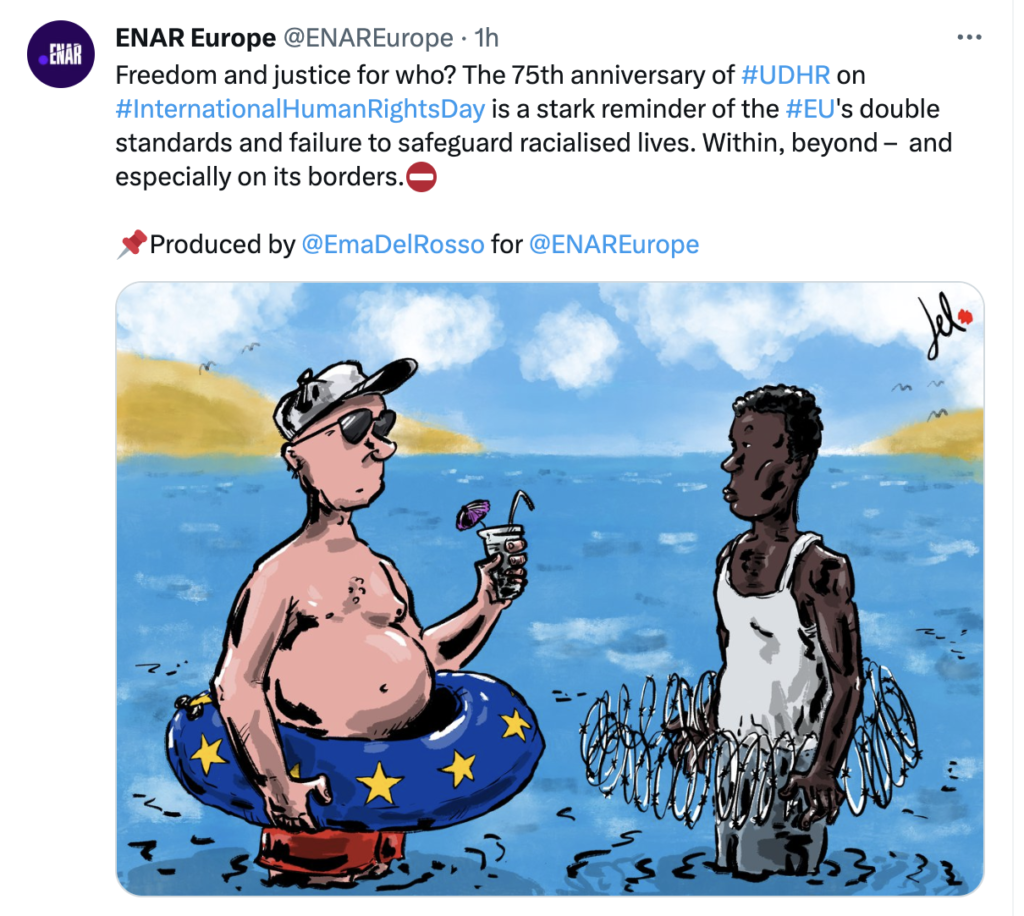
In April 1978, I was stopped by the police at gunpoint in the street, detained and thrown in a police cell without the right to habeas corpus, a Human Right.
I still remember that autumn Saturday as if it were yesterday.
Continue reading “Petteri Orpo, Mari Rantanen, Riikka Purra, and the government show contempt for Human Rights”