Needing only three votes to pass, seven of the 13 Finnish MEPs didn’t even bother to vote (Ville Niinistö, Heidi Hautala, Miapetra Kumpula-Natri, Silvia Modig, Elsi Katainen, Nils Torvalds and Teuvo Hakkarainen) with Petri Sarvamaa, Henna Virkkunen and Laura Huhtasaari voting against the motion.
The child asks where is Europe and the mother replies, at the bottom of the sea. Source: Facebook. Thank you Xur Piñera Alonso for the heads-up.
Is it surprising that two National Coalition Party (NCP) MEPs voted like Islamophobic Perussuomalaiset MEP Hutasaari? Reading the anti-immigration rhetoric of NCP politicians like Wille Rydman reinforces a close xenophobic bond between the two parties.
All three MEPs are in good “dry” company. All three voted against the motion to step up efforts to rescue people drowning in the Mediterranean Photo: European Parliament.
Only three Finnish MEPs that voted in favor of the motion were Sirpa Pietikäinen, Eero Heinäluoma, and Mauri Pekkarinen. Bravo for them!
Despite Huhtasaari’s, Sarvamaa’s, and Virkkunen’s heartless view of migrants’ lives, what is even more surprising s that over half of the Finnish MEPs didn’t even care to vote for such a necessary motion that would have helped save lives.
So far this year, over 1,000 lives have been lost while crossing the Mediterranean. Since 1993, UNITED for Intercultural Action has documented “more than 36,570” deaths of people who died in an attempt to enter Fortress Europe.
Migrant Talespublished in May a list of Finnish MEP “let them drown” candidates, who did not believe it is the EU’s obligation to save migrants from drowning in the Mediterranean.
Thursday was not only a sad day for migrants crossing the Mediterranean but a shameful one of Finland’s MEPs, especially those who voted against the motion and those who didn’t care to vote.
The Finnish media remained near-silent about the vote and did not even care to report it to their readers.
*A direct translation of Perussuomalaiset in English would be something like “basic” or “fundamental Finn.” Official translations of the Finnish name of the party, such as Finns Party or True Finns, promote in our opinion nativist nationalism and racism. We, therefore, at Migrant Tales prefer to use in our postings the Finnish name of the party once and after that the acronym PS.
Finland might be the least welcoming place for people of color
Image: Nanna Hänninen, via Frame Contemporary Art Finland
Before writing this piece, I want to acknowledge my personal privileges that allow me to write such a critical essay. I am an Iranian-born artist holding a United States passport who is residing in Finland based on an international student residency. By no means, I declare myself as the spokesperson of Iranians in Finland or international students of color. The opinions and views on this post are solely mine and based on my experiences living, studying and working in Helsinki. I have been studying at The University of the Arts, Helsinki up until last year and simultaneously working and researching social exclusion in the context of Finland.
Intensive Tokenism Simultaneous With Systematic Exclusion
One day, -a few months before I graduate- I sat in the dean’s office for a private meeting that he scheduled for me following an enthusiastic email. I didn’t know what the meeting was really about. He asked me about my future plans and career goals. In the middle of the conversation, he suggested; “how about if I give you a job? We need talented people like you”. I was very surprised by the offer. I accepted. He described to me; the beginning stage I would not talk to anyone about the opportunity because he was trying to ‘create’ a position specifically for me. He asked me to attend a few meetings with other staff and admins which was dragged on for a few months and there was no job and no payment. At the same time, I realized that I was promised something that really didn’t exist. I was used and falsely promised a non-existence job in order to not criticize the school until my studies are done.
The Academy of Fine Arts is one of the whitenest and least diverse art academies in the world. There are 0% POC in the staff and faculty of the academy. There are no data on race and ethnicity of students. The school has a history of mistreating students of color and having problematic art projects about race such as “Oriental Spa”. (1) There have been many student-collective-complaints against the institutional nepotism and favoritism. Yet, as students come and go, the overall structure of the school has relatively stayed the same. I have been talking to previous lecturers, teachers, and students, it seems like the overall strategy of the institution has been similar throughout the years in dealing with issues regarding lack of diversity and the general whiteness of the academy.
False Advertisement and Media Circus on Internationalism
We know that a lot of money and energy is spent by Finnish institutions on branding and selling a positive image of Finland to the world as an international and welcoming country. A few weeks ago, I came across a by a token POC name Mahmudul Islam, about his experience in Finland and how Finland has treated him. The interesting encounter about this charades was that it was viewed and commented ’only’ by white people (mostly Finnish) on how nice and pleasant the article was. It had all the ’myths’ that white Finnish people want you to hear. It had the same essentialist and binary language that you hear in everyday conversations with white people who are benefiting from this system. So, in this piece, I want to write my version of ”Things I Learned After Living 3 Years in Finland”.
Finnish Exceptionalism
White Finns think they have not colonized anyone [inccorectly of course], and in some cases, they think they are not even white, and see themselves as indigenous!!?? Meanwhile, the Finnish institutions, for the most part, don’t acknowledge the sovereignty of Sámi indigenous people and their land. It’s also very surprising how little white Finns know about the history and struggle of Sámi people. During my study at the University of Arts, I can’t recall meeting any Sámi artist. I never saw an event in which they were invited to give a talk about their art or culture.
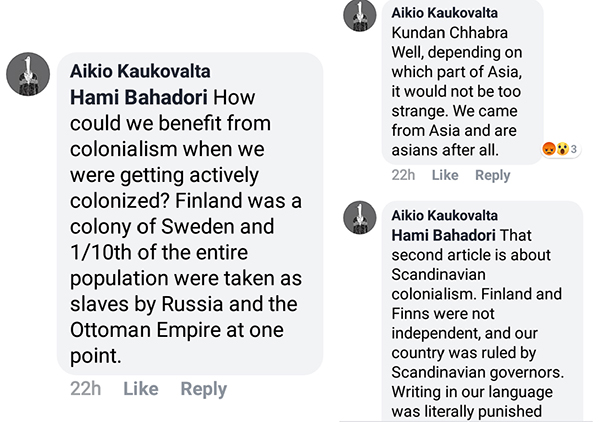
Finno-Ugric countries have the potential to be the most white-nationalist states in Europe. As Hungry and Finland are already showing by data, these societies view themselves as exceptional from other colonial and imperialist European states. (2) Therefore they think, they can bypass all the traditional racist problematics, from race-science and Eugenics to modern cultural appropriation and white privilege. Historical social trauma is often mentioned as an excuse for structural or individual racism. Elements such as the history of Swedish and Russian rule over the piece of land that is today known as Finland or other topics such as economic migration of white Finns to Sweden during the ’60s and ’70s often comes up as an excuse. There are also other classic binary stories of Finnish ‘Incivility’ that are often stereotyped by other nordic white people which has left a cultural social trauma on white Finns. Although all these elements can be legitimate for a white person to feel hurt, by no means it should be weaponized as an excuse to further perpetuate the racism that is inherited in this ethnically-homogenous society.
(image: random white views on cultural exceptionalism)
POC as Scapegoat (Racism in Finland)
When 30,000 people migrated to Finland in 2015, the state-supported media presented them as a ‘huge number of migrants’. Compared to the 5.5 million population of Finland, this number -which is not even one football stadium- is less than 1% of the Finnish population. And Permanent Secretary Päivi Nerg estimated that 60-65 percent of recent asylum applications will be rejected. (3) Thus the deportation regime of Finland began the task of deporting 2/3 of people against the UN’s Universal Declaration of Human Rights.
Currently, the racist party of PS(True/Pure Finns) is the biggest party in opposition after the close triumph of the Social Democratic Party (SDP) this year. PS has only 1 seat less (39/200) in the Parliament of Finland and the same number of seats in the EU Parliament (2) as the SDP. According to a 2011 poll, 51% of Finns Party voters agreed with the statement, ”People of certain races are unsuited for life in a modern society”. Simultaneous with this, I have also encountered a lot of people of color who against their community’s interest fall into uncletomism and support the white rhetoric of the True Finns party.
Cultural Illiteracy
While the skinhead racism of PS exists among almost half of the everyday people in Finland, another type of race-blindness and indifference exist among the educated white people. The type of people who work/teach at universities or conducting research and doing art projects. There are unacknowledged issues that seem to be normalized in the everyday life of people; issues such as comprehension of the fact that not every person represents a state identity. The other unacknowledged problem has to do with a basic understanding of color in relation to nationality. For example, not all Iranians look the same, similar to not all Finns are white. The white people I encountered in the University of the art (teachers and students) were not able to see beyond ‘national identity’ and binary views of gender and culture. This could be as simple as a lack of interest in what language Iranian people speak or lack of understanding of indigeneity, cultural appropriation, and white privilege. The sort of issues that had to be talked about in primary education but due to structural and national problems have been neglected.
While all these elements exist in society, the POC artists and art-workers preoccupy themselves with an invisible competition to win grants and state money in order to survive. As the recent data shows the people with non-Finnish names are less likely to be hired for jobs that they are qualified for. At the top of the hiring list, as always, exist the privileged white Finnish woman and on the bottom is the brown/black man. (4) (5)
In the everyday life when talking to Finnish artists it’s common that they would call you or your community “foreigners” or “ex-change students” even though you have been living here for 3 years and planning to stay longer terms. They would still ask you unwelcoming questions such as “where are you from?”, or “how long will you be here?” This way of using language is so normalized that even POC are very used to it. It’s another way for society to systematically put you outside of itself. I was talking to a poc taxi-driver last year, and he was mentioning that he gets this question at least a dozen times each day. Can you imagine living in a country where ‘every day’ you have to talk about where your parents are from?
For the academic staff and faculty of universities and art academies, it is also incomprehensible to imagine a black/brown Finn. No matter how much you are providing proof of locality you are still seen as an “Iranian”, or “Middle-Eastern” or whatever else. Finnish education has been proven to be made by and made for white European people rather than any other international communities. The fact that there is no measure of race in this country shows that your passport and nationality is the only measure for your identity. Academic research on brown/black people by white people is so normalized that you can walk to any event ‘about’ minority issues or developing countries and see a Finnish person as the spokesperson. While Finland is benefiting from an open Westernized economy which is based upon colonialism and industrialization of the 19th and 20th centuries, it sees itself as neutral, non-European, non-imperial in cultural and historical topics. (6) This myth enables the white Finns to allow themselves to represent anyone from anywhere. From unrepresented 1st generation migrants to black and brown people in developing countries to the study of indigenous peoples around the world with classical anthropological methods.
National Art as a Project of Nation-Building
If you read the Strategy for Cultural Policy 2025 by the Ministry of Education and Culture, you will come across a lot of empty talk about diversity. (7) These policies seem to attempt to sell the local white Finnish artists the idea of internationalism. Yet, in reality (or in practice) they are doing the same old national project of ‘Nation-building’ which was the aim of the Finnish culture sector up to the early 2000s.
As a POC artist, if you become a non-white face of Finland to further push the nationalist agenda of nation-building you are welcome… but if you decide to tell your stories about the grim local conditions of art-making and survival inside Finland, all the sudden you are ignored and demonized by the institutions as well as white Finns who want to present themselves as ‘allies’ yet, in reality, need the approval and financial support of the state.
There are many poc artists/activists who are raising their voices to this injustice and systematic way of excluding POC voices. Yet, the institutional ‘strategy’ toward these POC artists is to grant them tiny opportunities so they would work inside the system. In other words, the art system tries to buy you out. No room for political dissent. The beginning story of the Academy of Fine Arts’s dean was an example of this situation. However, they were so naive that they couldn’t even carry out a normal buyout. He presented to me a non-existent job to keep me quiet for a short time expecting that I will leave the country and things will go back to business as usual.
After the POC activist is boughtout by the system, what happens to the criticism? What type of criticism do you produce, who do you hang out with, and how far does your radicality extends?
I can list the names of a handful of predominate 1st generation POC artists who are getting the most exposures by the institutions and galleries. They have become the voices of the non-white minority. They are receiving money from the state and institutions through a variety of projects and programs. In other words, they are now part of the family. It would be an easy task to list the names of these model-minorities, yet I see no benefit in such acts aside from further dividing the already shattered community. The works of these groups of POC are often centered around the critic of internationalism and globalization which is often supported by the white art bureaucrats. Their work will ultimately result in further discrimination of 1st generation people. The model-minorities help to pave the way for the gradual weakening of the POC community in Finland resulting in orthodox solutions and rejection of racial differences and privilege, in order to reduce all problems to the simplistic black and white economical issues.
In the 3 years that I have been part of the art scene in Helsinki, I have seen many instances of racism within the art-community towards the POC, but haven’t seen any collective complaint, or constructive effort to demand an institutional response/action to these types of racial and cultural violence. On the contrary, I have seen many signs of forceful integration and assimilation even in the art. The orthodox bureaucratic system creates another low-budget project to ‘help foreigners’ (as a flock of seagulls) integrate into ‘our’ system (white Finnish system). The presumption that ‘our system’ is great. And the problem is ‘you foreigners’ with your backward cultures who need to learn how to use it. There are many examples of these low-budget band-aid solutions such as the www.foreigner.fi, where a group of European people trying to help the static category of the non-Finns, learn the Finnish system. That is a binary mentality perpetuated by other white Europeans.
In short, the right-wing ‘white’ mentality of this region states that Finland is great because of its ethnic homogeneity. While the ‘white’ radical left simply negates whatever comes out of the right. Other ‘white’ countries (including the USA, Australia, Canada, and other European (colonial) satellites), view Finland great due to its social programs. The people of color’s faith is now stuck between the two simplistic binary as Fanon once said.
In the midst of news about best in education and happiest in the world, I need to add (as most POC already know) that these data only apply to white citizens. Social democracy in Finland is selective and made by and for European subjects. While we are currently part of the rapid Westernization of the economy, not only we see an indifference towards the problems of minorities, but we see the systematic exclusion of POC from all areas of daily life.
(image: random white views on Finnish greatness/racism)
(The original article was posted on the inside-an-airport blog on 26.10.2019)
Soy tan viejo que me acuerdo perfectamente de la noticia del día 11 de septiembre de 1973, un martes, cuando las fuerzas armadas chilenas bombardearon el Palacio de la Moneda donde muere el presidente legítimo de los chilenos, Salvador Allende.
Esta semana muchos se levantaron de una pesadilla larga que empezó hace 46 años, durante el golpe de estado de Chile, el 11 de setiembre de 1973.
En su último discurso que pronunció el Presidente Allende por radio dijo,
“…Y les digo que tengo la certeza de que la semilla que hemos entregado a la conciencia digna de miles y miles de chilenos, no podrá ser segada definitivamente. Tienen la fuerza, podrán avasallarnos, pero no se detienen los procesos sociales ni con el crimen ni con la fuerza. La historia es nuestra y la hacen los pueblos.”
Y sigue casi al final del discurso: “Sigan ustedes sabiendo que, mucho más temprano que tarde, de nuevo se abrirán las grandes alamedas por donde pase el hombre libre, para construir una sociedad mejor.”
Las imágenes de abajo, como escaleras al infierno, son de la pesadilla que empezó hace más de cuatro décadas.
Primer paso a la pesadilla: el inferno toma forma. Fuente: YouTube.Segundo paso a la pesadilla: acercando al infierno. Fuente: YouTube.Tercer paso a la pesadilla: en el infierno. Fuente: YouTube.
Pero este mes de octubre se levantó un nuevo Chile clamando justicia y esas alamedas que habló el Presidente Allende en su último discurso a su pueblo.
Esas alamedas van acompañados por la música de Victor Jara, también asesinado por la dictadura chilena.
La reacción del presidente chileno, Sebastián Piñera, a los manifestantes demuestra en claro la burbuja donde gente como él siguen viviendo hace más de cuatro siglos.
¡Renunciá Piñera! El Presidente Allende habla hoy al pueblo chileno y a ti, a los que intentan detener los procesos sociales con el crimen y con la fuerza.
If there is one matter that shines brightly from the editorial standards of Yle, it is its whiteness and how little regard they have for our people to voice the concerns of our ever-growing culturally diverse community.
We need more of these types of articles and studies and much more activism on top of them.
Take for instance, the Yle article on five reasons why there is discrimination in the Finnish labor market.
The Yle article points out five of them:
(1) Discrimination in the labor market has broad support among Finns;
(2) employers are ignorant of labor discrimination laws;
(3) employers believe they will lose money if they follow the law;
(4) discrimination at the workplace is difficult to prove;
(5) victims are reluctant to report to the authorities because they fear reprisals.
All of the latter are valid points, but I would have wanted Yle to dig deeper. This is a valid point because of the level of discrimination is so prevalent.
There are other culprits as well as lack of leadership and resolve from politicians, the police, media, policymakers, and a long list of others who shape public opinion.
Moreover, if discrimination is so widely accepted, it means that our education system has failed.
I have lived in Finland on a semi-permanent basis since 1978. One of the first matters that I learned when I moved here was that my “foreign name,” despite having a Finnish mother, was a disadvantage even when trying to rent an apartment.
Racism is real and an ogre in Finland, and it is impoverishing Finland socially and economically. We need studies and articles but more than ever, action and leadership in tackling such social ills and call out and bring to account those who spread them.
What thoughts race in your head whenever a politician, public official, or white Finn rambles on about how social justice is a key value of our society and why racism and discrimination, which are illegal, have no place in Finland?
While the latter is important for newcomers to know, the issue is how such topics are taught and framed to students that have little idea of Finnish society.
I am a sociologist who has been an immigrant-Other all my life. It should not surprise you why I am interested in immigration topics.
The editor of Migrant Tales, Enrique Tessieri, with author and journalist Reni Eddo-Lodge, who authored Why I’m No Longer Talking to White People About Race. Her book that focuses on feminism and structural racism is a classic of the anti-racism movement. Photo by Bashy Quraishy.
One of the courses I teach is “active citizenship” (Aktiivinen kansalainen). Nearly all my students came to Finland as refugees or are seeking asylum. Since I have a lot of respect for the students, I tell them frankly: Do you want me to teach the hypocrisy, spread myths, and lies about your new home country or tell how we can change matters?
When we talk in class about social ills like racism, the Perussuomalaiset*, and other toxic topics that impact newcomers negatively, I encourage them to organize and use all the democratic means available to change matters.
For those who whine silently, I offer them handkerchiefs.
None of the students cry. Some listen more attentively than others.
Finnish white privilege #65
Today, Saturday is a better example than any to show the impunity of Finnish white privilege in the media. An article by Yleon five reasons why discrimination exists in the labor market offered only a partial view of the issue. Helsingin Sanomat published a human interest story on the same day about PS first vice-president, Riikka Purra.
One of the problems with the Yle article is that it absolves the police, politicians and other public officials for doing little to nothing to challenge discriminatory practices in the labor market. If you disagree, look at the underwhelming number of discrimination cases that are mentioned by the Yle article.
Likewise, the Helsingin Sanomat article of Purra is another example of toothless Finnish white privilege journalism. Nowhere in the story does the writer challenge Purra’s Islamophobic far-right views. Even the book she is reading by James Burham, “Suicide of the West,” exposes the PS politician’s ideology, which is mistrustful to migrants and Western liberal values.
Hungarian strongman Viktor Orbán dispises Western liberalism.
Purra’s party and herself are the ones fueling the hostile environment against migrants and minorities in Finland. The Helsingin Sanomat article offers us, instead, exalting pictures of Purra.
Both articles highlight why racism and discrimination have impunity in Finland. Both articles were written by white Finns who have never suffered racism in their country. Moreover, they don’t grasp how these articles fuel the hostile environment.
If the Roma minority has lived in Finland for over 500 years and faces racism and social exclusion even today, at this pace migrants and minorities will have to wait centuries for matters to improve.
Do we have to wait so long? Do we have to accept that we are second-class members of society?
Matters will never improve as long as our voices are faintly heard and our activism half-hearted. Even so, we are fortunate. We have many exemplary activists who are challenging the present order of things.
Migrant Tales wants to congratulate Maryan Abdulkarim, a true activist for social justice, for being awarded the Minna Canth award.
Canth (1844-97) was one of Finland’s foremost writers who wrote about social issues like women’s rights in nineteenth-century Finland.
*A direct translation of Perussuomalaiset in English would be something like “basic” or “fundamental Finn.” Official translations of the Finnish name of the party, such as Finns Party or True Finns, promote in our opinion nativist nationalism and racism. We, therefore, at Migrant Tales prefer to use in our postings the Finnish name of the party once and after that the acronym PS.
Wille Rydman is a National Coalition Party (NCP) MP who has built his career on xenophobia and racist soundbites. For some in the NCP, he is known as the Halla-aho of the party.
Perussuomalaiset (PS) chairperson Jussi Halla-aho is largely responsible for steering the party further to the far-right. He was convicted of ethnic agitation and breaching the sanctity of religion in 2012.
Contrary to Halla-aho, Rydman likes to regurgitate what some of the PS’ most racist and hateful messages, like the Islamization of Europe, among other hogwash.
He wrote earlier this month that the ethnic composition of Europe is changing due to low birth rates and that such ethnic diversity is negative for the region.
He claimed in the blog entry that migratory pressure on Europe in recent decades is so drastic that what happened to Rome, when non-Roman tribes invaded it, is small change compared to what is happening today.
PS first vice-president Riikka Purra has spread such myths about how white Finns will be a minority due to migration from outside of Europe.
Certainly, the bullshit that Rydman spreads is xenophobic and racist. Somebody, maybe his party although I’m not holding my breath, should condemn what he said and tell the NCP MP that Europeans are not only white.
Europe is a continent that is historically culturally and ethnically diverse. Talk of whites becoming a minority is extolling white supremacy, which Rydman does.
Apart from a long list of racist soundbites earmarked for public consumption, I had an opportunity to chat with Rydman in 2010. Back then, he wrote in a letter to the editor of Helsingin Sanomat that the state should neither support nor fund multiculturalism because it would hinder the adaption of immigrants into our society.
When I corrected him that his opinions were a letter to the editor, he insisted that it was “an article” published by Helsingin Sanomat.
Some of Finland’s most hot-headed Islamophobes were allegedly bullied in school. That is the case of Halla-aho, James Hirvisaari, and others. Were Rydman’s name and ethnic background a source of bullying?
That now leads us to the Stockholm syndrome: A condition where a victim may start to identify with or form a close connection to the people who have taken him or her hostage. In the latter cases of Halla-aho and Hirvisaari, the oppressor is the bully and the victim, the bullied.
That then leads us to Uncle Tom, Tuomo-setä, but that is another story.
The xenophobic stand of politicians like Rydman of the NCP, show how right-wing conservative parties like in the UK have succumbed to populist anti-immigration rhetoric while threatened from far-right parties like the UKIP. It is unfortunate that the NCP is heading towards the same ruinous path as the Tories of the UK.
There is no UKIP in Finland but we have the PS.
I’d like to dedicate the following quote to Rydman by Toni Morrison:
“But when you take it away, take your race away, you are all strung out,” she said. “All you got is your little self, and what is that? What are you without that? What are you without racism? Are you any good? Are you still strong? Are you still smart? Do you still like yourself?”
*A direct translation of Perussuomalaiset in English would be something like “basic” or “fundamental Finn.” Official translations of the Finnish name of the party, such as Finns Party or True Finns, promote in our opinion nativist nationalism and racism. We, therefore, at Migrant Tales prefer to use in our postings the Finnish name of the party once and after that the acronym PS.
There are many types of social ills that are cancerous, but the one I want to speak now is about institutional racism in Finland. Institutional racism is a racket, a criminal conspiracy, to exclude people by ethnic, religious, and cultural backgrounds.
Institutional racism is a racket that maintains a system that is exclusive and unjust. It destroys lives and robs people of their opportunities that should be guaranteed by law.
Racialization is one of the accomplices of institutional racism.
In Finland as elsewhere, there are many people who stand up to racism. Even so, such people are too few.
Toni Morrison (1931-2019), the novelist, essayist, book editor, and college professor, stated that race is a social construct. If so, why does racism exist?
“It [racism] has benefits,” she said, “money can be made off it, people who don’t like themselves can feel better because of it, it can describe certain kinds of behavior that are wrong or misleading; so it has a social function – r a c i s m.”
In the video below, Morrison makes an excellent point to racists or people who profit directly or indirectly from such a social ill.
“But when you take it away, take your race away, you are all strung out,” she continued. “All you got is your little self, and what is that? What are you without that? What are you without racism? Are you any good? Are you still strong? Are you still smart? Do you still like yourself?”
Finnish white privilege #64
In the same way that Islamophobic parties like the Perussuomalaiset (PS)* claim that immigration costs taxpayers hundreds of millions of euros, we can argue that institutional racism costs Finland hundreds of millions, if not billions of euros.
Where is this money wasted? You will find it spent on many integration programs that don’t integrate and make newcomers active members of society; and in maintaining racist structures that fuel social exclusion and high social welfare costs to name a few.
In Finland, it is easy to give a two-faced image of ourselves. Institutional racism permits us to keep our closet prejudices and racism intact while claiming to help migrants in state- and EU-sponsored programs.
The final judge of the effectiveness of these programs is the results: Did you get hired with a dignified salary? Did the program say a whimper to expose and challenge institutional racism?
It is upsetting to see people who claim to want to advance the opportunities and rights of migrants but are stone quiet.
We are all accomplices if we cover our eyes to institutional and all forms of racism and respond to such cancerous forms with our silence.
*A direct translation of Perussuomalaiset in English would be something like “basic” or “fundamental Finn.” Official translations of the Finnish name of the party, such as Finns Party or True Finns, promote in our opinion nativist nationalism and racism. We, therefore, at Migrant Tales prefer to use in our postings the Finnish name of the party once and after that the acronym PS.
The head of the far-right Nazi-spirited vigilante group Soldiers of Odin, Mika Ranta, threatened in a statement to take over the Tornio border checkpoint and defend it by force if the Swedish authorities let in asylum seekers as in 2015.
Center Party MP Mikko Kärnä states in the Center Party newspaper Suomenmaa that he has asked the police to investigate if the far-right group, which has ties with the Islamophobic Perussuomalaiset (PS)* party, broke the law by stating that it would take over the Tornio border checkpoint and defend it by violence.
The lion’s share of the over 32,000 asylum seekers that came to Finland in 2015 did so through the northern city of Tornio, located 737 km north of Helsinki. Source: Yle.
Kärnä also said that if the Soldiers of Odin’s association broke the law, they should be banned.
Soldiers of Odin founder Mika Ranta, who promises to pay 1,000 euros to anyone who knock a woman’s teeth down her throat. Source: Twitter.
What has overtaken this country if we have violent far-right public figures spread hatred with relative ease? Finland was slow to react and is still reacting. National Police Commissioner Seppo Kolehmainen and then Minister of Employment Jari Lindström openly supported in 2016 vigilante gangs like the Soldiers of Odin while then-Interior Minister Petteri Orpo was skeptical.
“If the Swedish border guards plan to slide from their responsibilities and imagines that it can let in people without appropriate travel documents to cross the Finnish side of the border, we will organize in Tornio to protect our people. If the Finnish government does not before that take responsibility for the country’s internal security and initiate effective border controls to curb organized crime and prevent undocumented aliens from entering [our country], it is the task of brave Finns with their iron determination to take over the border checkpoint in Tornio. If we face after that violence from aliens, we will meet in The Hague [court of justice]. It is the same if we face violence from the authorities. We will use force if necessary. This nonsense must stop. Bring back respect for legality and bring the traitors to justice.
MRanta
Sticking one’s head in the snow will not make the far-right threat disappear.
That is why we need a concerted effort to challenge such groups in order to defend our Nordic democratic institutions.
*A direct translation of Perussuomalaiset in English would be something like “basic” or “fundamental Finn.” Official translations of the Finnish name of the party, such as Finns Party or True Finns, promote in our opinion nativist nationalism and racism. We, therefore, at Migrant Tales prefer to use in our postings the Finnish name of the party once and after that the acronym PS.
A new study published by Akhlaq Ahmad about labor market discrimination in Finland and the results, while not pretty, reinforce what we’ve known all along: ethnic discrimination is commonplace in Finland’s labor markets.
On Saturday, Migrant Tales published a news story that showed that the number of work permits granted to EU citizens had fallen by 28.1% from 2015 to 2018.
It should not come to any surprise that Finland’s labor markets are unfriendly, and there is not enough opportunity for career advancement. Two- to three-time higher unemployment on average of migrants is another disincentive.
The new study by Ahmad, which was published in the Sociological Inquiry, does not look at first-generation migrants but their children, who are, on average, 11 years old today and will enter the labor market in a few years.
Since fluency in the Finnish language and knowledge of the local culture are common excuses not to hire first-generation migrants, their children should have a good command of the language and culture since they grew up in Finland.
The results of the study showed that out of 5,000 job applications, those with Finnish names got way more requests for interviews by the employer.
As the table shows, people with Finnish names got a lot more requests for job interviews than any other name. While 390 people with Finnish names got interview requests, the corresponding figure for those with Iraqi and Somali names was 134 and 99, respectively. The two other groups in the study were those with English (269 requests) and Russian (228) names. Women (naiset) got more requests for interviews than men (miehet). Source: When the Name Matters: An Experimental Investigation of ethnic discrimination in the Finnish Labor market. Ahmad Akhalq, University of Helsinki.
While the result of the study should not surprise us, the value of its findings is that job discrimination in Finland is real and hinges of a person’s perceived ethnic background.
Ahmed was quoted as saying in Yle that discrimination in the labor market does not only take place when looking for a job but as early as in comprehensive school when children are in the TET familiarization working life program.
The researcher correctly points out that labor discrimination and racism are significant challenges to Finland unless we want to continue to maintain a two-tier society of haves and have-nots.
Doing something about racism and discrimination
While social ills like racism, and especially institutional racism, maintain and feed the present racialized system, the question we should also ask is how to challenge such issues.
Ahmad points out that anonymous job applications, which are a good start, could help. But we need bolder steps. One of these would be waking up from our denial and exceptionalism with the help of anti-racism activism and creating social movements.
Waking up to our racism problem may be easier said than done as long as mainstream parties do not wake up to the threat of the Islamophobic Perussuomalaiset (PS)* party and other far-right groups that continue to fuel the hostile environment.
Fascism and xenophobia à la PS are not only a threat to our Nordic democracy but to the social and economic wellbeing of Finland. When the National Coalition Party and the Center Party send signals that they could play political ball with the PS, it strengthens the present injust order of things.
We have good anti-discrimination laws in Finland but our own racism and exceptionalism give racists and closet white supremacists the benefit of doubt.
If we do not challenge effectively labor discrimination and racism in Finland, non-white Finns will suffer as they do today from lower social welfare, lower salaries, lower pensions and continue being at the bottom of the barrel of society.
*A direct translation of Perussuomalaiset in English would be something like “basic” or “fundamental Finn.” Official translations of the Finnish name of the party, such as Finns Party or True Finns, promote in our opinion nativist nationalism and racism. We, therefore, at Migrant Tales prefer to use in our postings the Finnish name of the party once and after that the acronym PS.
As Finland faces an ever-worsening labor shortage due to the greying of its population, the number of EU nationals that want to work in Finland has taken a nosedive, according to Seura.
The number of EU nationals that were granted work permits in 2018 totaled 4,179, which is a 28.1% fall from 5,699 in 2015, according to the Finnish Immigration Service. In 2017, 4001 EU nationals were granted work permits. The corresponding figure for 2016 was 5,247.
EU labor stats look bleak for 2019, as well. During the first six months of the year, 1,744 work permits were granted, which suggests that the total number for 2019 will be below 4,000.
Go directly to the Finnish Immigration Service website here.
So what gives?
Even if the article in Seura doesn’t mention it, have you ever heard of the Perussuomalaiset (PS)* party? They have, with the help of other mainstream parties and institutional racism, spearheaded during this decade the hostile environment against migrants and asylum seekers.
As a small indication of the PS’ Islamophobia, all of their MEP candidates agree that migrants crossing the Mediterranean should not be rescued by the EU and allowed to drown.
The PS is Finland’s second-biggest party in parliament. Why would anyone want to move and work in a country that has a largely unchallenged racist party spreading hatred against migrants? Moreover, in such an environment, institutional racism, bigotry, and discrimination are normalized.
Many studies that reinforce a social ill like racism in Finland. One of these is a 2018 study by the European Agency of Fundamental Rights (FRA) that reveals that a third of people of African descent (PAD) surveyed have experienced racial harassment in the last five years. Muslims are another group that is frequently targeted by Islamophobic groups, according to the European Islamophobia Report 2018.
Everyone is an accomplice in the hostile environment: the media, police, and public servants. Very little is done to challenge this hostile environment because it runs against the norm. Despite the situation, there is an ever-growing growing number of people who are standing up to the hostile environment.
If one tries to understand the ongoing debate about migrants and migration to Finland, there is one matter that dominates it: asylum seekers, which account for about 10% of all migrants in Finland. The party dominating this debate is the PS.
Labeling and victimizing a group like asylum seekers impacts the whole migrant community, even if you are a white EU citizen because it reinforces social ills like racism.
While the PS is clearly today a far-right Islamophobic party, other mainstream parties like the National Coalition Party (Kokoomus), Center Party, Christian Democrats, and others want to play political ball with them.
Moreover, Prime Minister Antti Rinne’s government appears to get cold feet in challenging the misconceptions and racism that the PS spreads.
All that this cowardice does is to make Finland an unattractive country for skilled EU labor. If you are “a person of foreign origin,” code for non-EU citizen and/or person of color, you would have to be pretty desperate to come to such an unfriendly country where suspicion is the norm.
The xenophobia that grips Finland today is like shooting its economic and social wellbeing in the leg. If we do not wake up in time to challenge parties like the PS and other groups like them, we will have nothing but ourselves to blame for our impoverishment and limited democracy.
*A direct translation of Perussuomalaiset in English would be something like “basic” or “fundamental Finn.” Official translations of the Finnish name of the party, such as Finns Party or True Finns, promote in our opinion nativist nationalism and racism. We, therefore, at Migrant Tales prefer to use in our postings the Finnish name of the party once and after that the acronym PS.