Migrant tales
Menu
  • #MakeRacismHistory “In Your Eyes”
  • About Migrant Tales
  • It’s all about Human Rights
  • Literary
  • Migrant Tales Media Monitoring
  • NoHateFinland.org
  • Tales from Europe
Menu

Month: November 2015

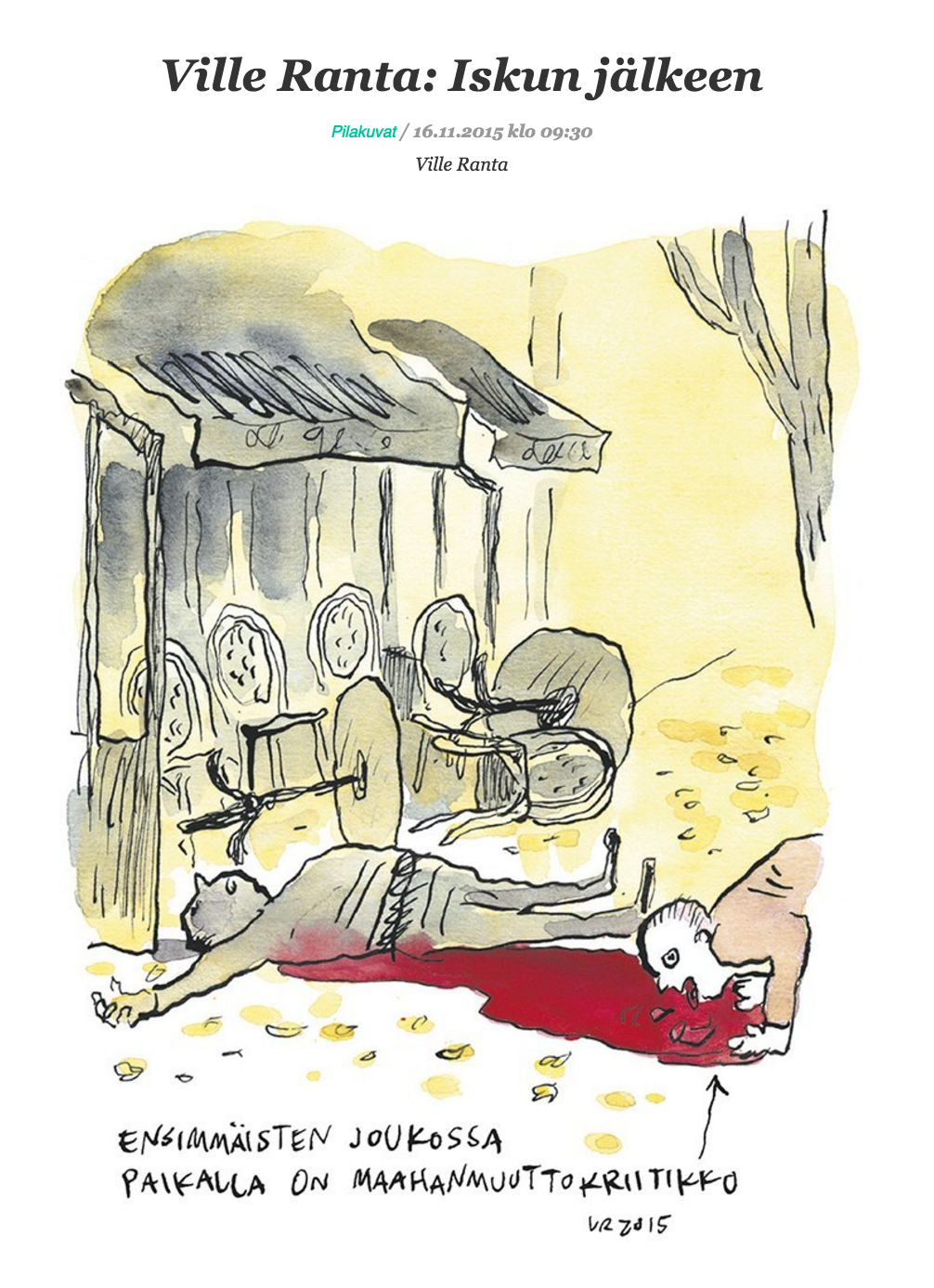
A cartoon by Ville Ranta that exposes the real face of anti-immigration groups and parties

Posted on November 24, 2015 by Migrant Tales

The cartoon below, “After the attack,” shows a member of an anti-immigration group drinking the blood of a victim of the Paris terrorist attack on Friday the 13th of November. 

In my opinion, the cartoon below by Ville Ranta shows to a tee how members of anti-immigration groups and parties reacted to the Paris terrorist attacks.

What’s your opinion?

Näyttökuva 2015-11-20 kello 22.32.01

The first group that was present after the terrorist attacks of Paris were members of anti-immigration groups.

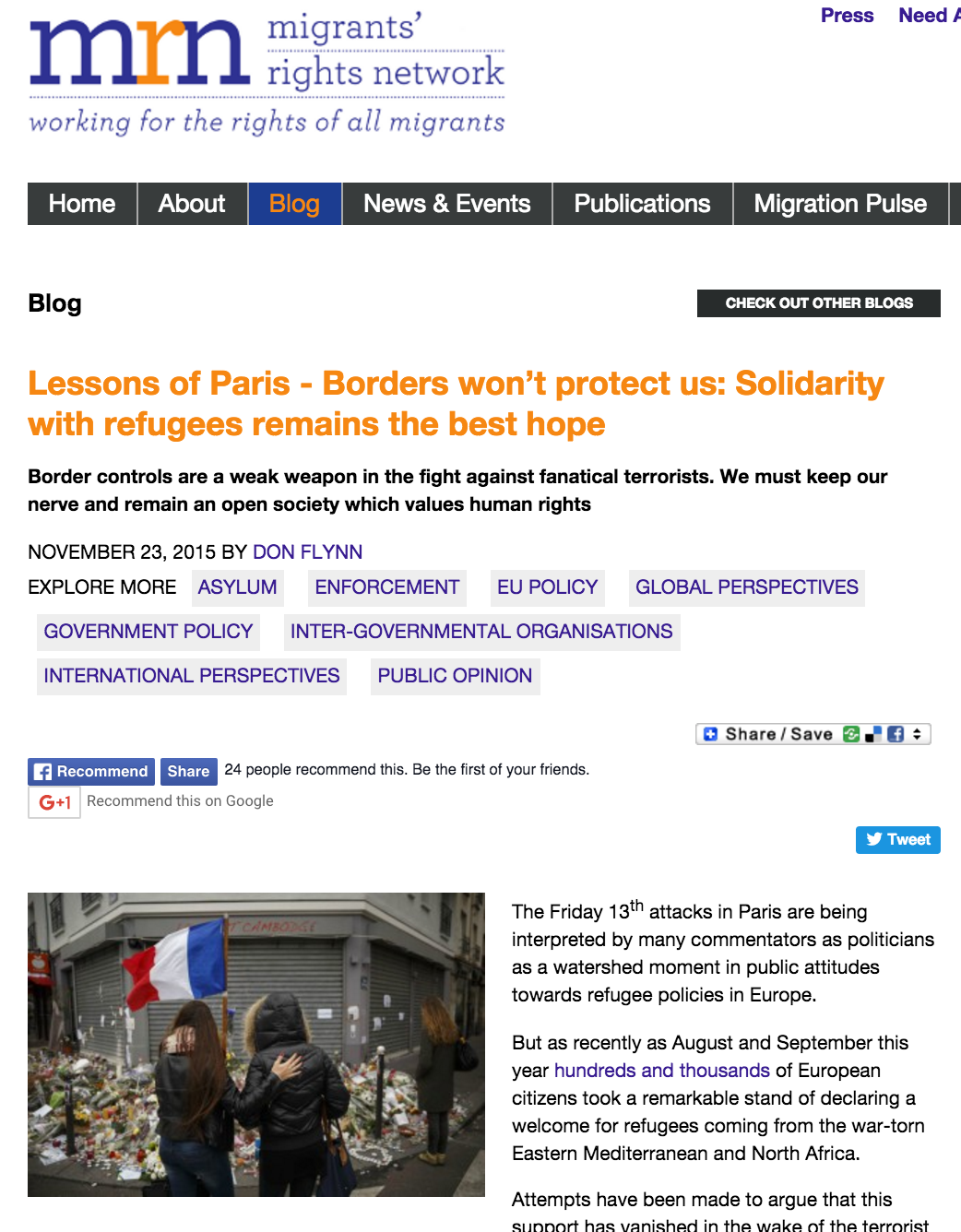
Migrants’ Rights Network: Lessons of Paris – Borders won’t protect us: Solidarity with refugees remains the best hope

Posted on November 23, 2015 by Migrant Tales

Don Flynn*

Näyttökuva 2015-5-3 kello 12.52.32


The Friday 13th attacks in Paris are being interpreted by many commentators as politicians as a watershed moment in public attitudes towards refugee policies in Europe.

But as recently as August and September this year hundreds and thousands of European citizens took a remarkable stand of declaring a welcome for refugees coming from the war-torn Eastern Mediterranean and North Africa.

______________________________________________________________________________
Näyttökuva 2015-11-23 kello 20.02.43

Read full opinion piece here.

_____________________________________________________________________________________

Attempts have been made to argue that this support has vanished in the wake of the terrorist attacks on people enjoying Friday night at music concerts and restaurants in the otherwise peaceful city of Paris.  One example of this effort to declare an end to the moods which proclaimed support for the right of refugees to find a safe haven in Europe came in the form of an article in the London Evening Standard on 18 November. Prominent Conservative MP David Davis declared the need for an outright end to the freedom of movement in Europe which has been made possible by the Schengen Agreement.

Davis wrote: “… it is becoming evident that controlling Europe’s external borders, especially the porous borders of southern Europe, is virtually impossible. There are too many physical, legal, political and moral problems inherent in policing that vast frontier effectively.”

He appears to applaud the decisions of the Austrian, French, Dutch and Swedish governments to reintroduce border checks, and even the actions of the Hungarian and Slovak authorities in reinforcing these with kilometres of fencing and razor wire.  Perhaps he believes that these actions will solve the “physical, legal, political and moral problems” that get in the way of managing the flow of people across the southern frontiers of the EU.

The proffered solution is a return to a Europe in which national states are responsible for admitting or refusing people entry into their territories and then dealing with the consequences.  But, strangely enough, for the countries at the EU’s southern and eastern frontiers, that is exactly the system that has always operated.  Greece operates primarily within a framework of Greek immigration policies when it comes to deciding who is permitted to cross its borders; as does Italy; France; Spain; and both Cyprus and Malta.

The claim that we are in today’s predicament because of the overbearing effects of bureaucratically-imposed European policies is clearly fallacious.  We are where we are because Europe, acting in concert with other powers in the Eastern Mediterranean, has failed over the course of many years to overcome the crisis which spreads in a great arc from Turkey and across the North African Maghreb, with a tributary branch feeding in from the Horn of Africa. This failure has been allowed to create a great confluence of refugee movements that brings people to its own doorstep.

Declaring a formal end to the Schengen Agreement and reintroducing controls at all the internal borders of the EU will not deal with the situations which led to 218,000 refugees entering Europe in October alone.  The driving forces behind these movements, as a recent commentary paper by the European Policy Centre points out, are the continuing upheaval in countries which have put 4.3 million Syrians, 2.6 million Afghans, 1 million Somalis and 600,000 Sudanese onto the road as refugees during the past few years.

‘Fortress Europe’ was never going to hold back the volume of people pressing against its gates indefinitely.  The radical measures taken to impoverish the Greek state through austerity might have been the tipping point from struggling efforts to manage to outright crisis but the genie is now out the bottle and won’t easily be persuaded to go back in.

The anti-free movement lobby hopes that if one border can’t do the trick then maybe six, ten or twenty will succeed in holding back the refugee masses in someplace far away.  Mr Davis rejoices in the fact that the UK is an island and the convenience of having a surrounding sea ought to buy the country a bit more scope for keeping the refugees out.

It is difficult to be happy with this as a solution to the business of managing refugee movements in the 21st century.  The hope that all our neighbours will do the heavy lifting whilst we sit back to reap the benefits will not endear us European countries that want to see more solidarity as they face up to the challenges of processing the claims of those who seek a safe haven.

The attacks in Paris were agonisingly brutal for those who caught up in them.  If it is possible for such an appalling situation to be made worse by any subsequent action it has come from the renewed clamour to roll back on refugee and migrant rights.  Advocating this response looks too much like the very outcome that fanatics of Daesh have sought to engineer.

The security of ordinary people across Europe will not be enhanced by any measure that reduces the commitment of this region to human rights and the rights of refugees.  The re-imposition of border checks on the myriad frontiers of the European states will check, for a time, the flow of desperate people. It will cause more hardship and suffering on top of what they have already had to endure.  And it will be a step away from the countries of this region addressing the real root causes of the refugee crisis and will postpone the day when tens of thousands no longer feel that they have to embark on dangerous journeys to get to these shores.

Read original posting here.

This piece was reprinted by Migrant Tales with permission.

*Don Flynn, the MRN Director, leads the organisation’s strategic development and coordinates MRN’s policy and project work. He is a regular and sought-after speaker at conferences, seminars and lectures on behalf of MRN.

UPDATE: An asylum reception center map we should all be ashamed of in Finland

Posted on November 22, 2015 by Migrant Tales

As long as we have politicians and other community leaders who support hate speech overtly or with their silence, and as long as parties like the Perussuomalaiset (PS)* base their support on racism against people who are different from them, Finland will not be a safe country for everyone. 

The map below is shameful considering that we’re one of the most affluent and apparently safest countries in the world.

Politicians, the media and the public are ignorant of the sheer hardships and destruction that the war, which we’ve been accomplices in, have brought on the people of the Middle East and Africa. We’re only outsiders looking in and what our eyes reveal is enough for some of us to turn our backs.

But what about if I told you about the horrors of war and gave you a ringside view of the raw violence and utter despair of people who are commonly blown to shreds by bombs and hate? Would you want to know? Would what you’d see change your life forever?

Näyttökuva 2015-11-22 kello 9.50.13

Municipalities where asylum reception centers have been attacked and where there have been problems. Source: Yle.

There are probably more attacks against asylum reception centers in Finland than the YLE map above suggests. Migrant Tales wrote in early November a suspected arson attack against the Pitäjänmäki reception center that was not reported by the media.

Continue reading “UPDATE: An asylum reception center map we should all be ashamed of in Finland”

Susheela Daniel: On being a multicultural Finn

Posted on November 21, 2015 by Migrant Tales

I got to know Susheela Daniel through many of her insightful Facebook postings. She was one of the brave women who protested in front of parliament against the election of Perussuomalaiset (PS)* party MP Maria Lohela as speaker of parliament. One of her latest Facebook posts was on “integrated migrants” raised some good questions about Uncle Toms in the migrant and minority community.

An Uncle Tom, or Tuomo-setä or setä Tuomo in Finnish, is a term used in the United States for people who betray their race in order to get privileges. Urban Dictionary defines it in the following way: “A black man who will do anything to stay in good standing with ‘the white man’ including betray his own people.”

Susheela2

Susheela Daniel. Photo by Fateme Azizi.

In a multiethnic country like the United States, the Uncle Tom label plays an important role. One of the roles it plays is a bit similar to a deserter in times of war.

Taking a look at the violence and hostility that some minorities are facing in the United States, it’s clear that the Uncle Tom label aims to protect a community that is already embattled by racism, social exclusion and scarce opportunities.

How would one define an Uncle Tom in Finland?

Daniel admits that she’s never heard of the term Tuomo-setä in Finnish never mind in English but agrees that the phenomenon exists in Finland.

Continue reading “Susheela Daniel: On being a multicultural Finn”

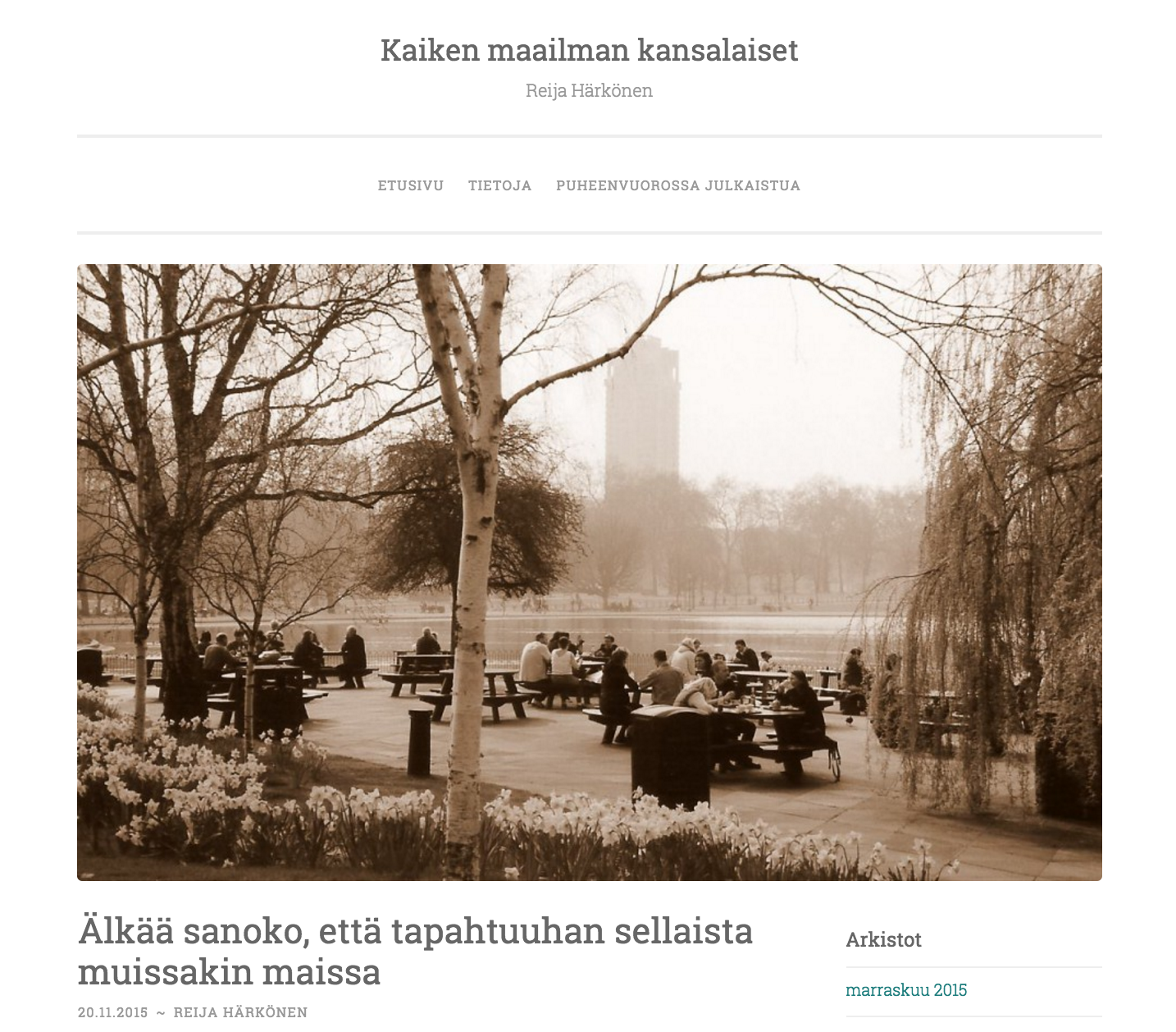
Reija Härkönen: Älkää sanoko, että tapahtuuhan sellaista muissakin maissa

Posted on November 20, 2015 by Migrant Tales

Reija Härkönen

Tässä maassa on ihmisiä, jotka hyökkäävät sanoin ja väkivaltaisin teoin pakolaisia vastaan. Sotaa ja vainoa paenneita ihmisiä, äitejä ja isiä lapsineen pelotellaan ja uhkaillaan. Yksin tulleiden lastenkin majapaikkaan tehtiin jo polttopulloisku. Punaista Ristiäkin, hyväntekijää, vihataan, vaikka törkeimmätkin sotajoukot yleensä sallivat järjestön toiminnan siviilien ja haavoittuneiden parissa.

Meillä vihataan lapsia, koska he ovat tulleet vieraasta maasta ja vieraasta kulttuurista. Vihaajat on opetettu vihaamaan. Jo yli vuosikymmenen jatkunut järjestelmällinen vihanlietsonta on tehnyt tehtävänsä. Tuosta vastenmielisestä kampanjasta suurimmmassa vastuussa on Perussuomalaiset r.p., mutta muutkaan puolueet ja tahot eivät ole täysin viattomia.

Näyttökuva 2015-11-20 kello 22.46.17

Pelko ei sillä vähene, että vastaanottokeskusten tiedotustilaisuuksissa  kuunnellaan hurmoshenkisiä rasisteja ja hysteerisiä tytärtensä puolesta pelkääjiä ja sanotaan, että poliisi kyllä valvoo. Ihmisille on kerrottava, että pelko on lietsottua ja täysin turhaa, eikä irakilainen nuori mies ole sen pelottavampi, kuin suomalainen. On selvää, että sota-alueilta lähteneet ihmiset, jotka joutuvat kuukausikaupalla toimettomina odottelemaan kohtalonsa selviämistä, saattavat olla levottomia, nahistelevia ja hankaliakin, mutta kukapa ei tuollaisessa tilanteessa olisi. Syrjäytyneitä meillä on myös omasta takaa.

Rasismi lisääntyy nyt koko ajan. Sen, että meille on tullut paljon pakolaisia, ei mitenkään pitäisi olla rasismia lisäävä asia – päinvastoin! Kun meille saapuu ihmisiä, jotka ovat kaiken menettäneitä ja pitkästä matkastaan väsyneitä, luulisi jokaisen vähänkin ajattelevan ja välittävän ihmisen ottavan heidät ystävällisesti vastaan ja myös pikku hiljaa tottuvan vähän vieraan näköisten ihmisten kohtaamiseen.

Continue reading “Reija Härkönen: Älkää sanoko, että tapahtuuhan sellaista muissakin maissa”

UPDATE (November 20): Migrant Tales’ 2015 Hall of Poor and Sloppy Journalism

Posted on November 20, 2015 by Migrant Tales

Migrant Tales’ 2015 Hall of Poor and Sloppy Journalism will be updated separately. To see other examples of opinionated journalism in Finland about cultural diversity, please go to this link.

November 20

Aukeavatko suvakin silmät? – (Tamperelainen)

What’s wrong with this community paper editorial? Community papers like Helsingin Uutiset and Vantaa Sanomat are just as bad as other media in spreading bigotry and urban tales about immigrants. They do this for two reasons: they don’t know better and because it’s a good way of boosting their advertising revenues. The editorial by the latest Tamperelainen spewed some pretty harsh rhetoric about asylum seekers. It claimed, among other things, that some asylum seekers are swindlers and that Europe should take a tougher stance against such people. The editorial by the paper’s editor, Karri Kannala, headlined “When will Kumbaya multiculturalists open their eyes,” claims the following: “Speaking of migration is racism, promoting Finnish identity is fascism. You can only talk about multiculturalism if you are a kumbaya multiculturalist, other opinions aren’t welcome.” Bigotry, racism and prejudice still attract big crowds in Finland. They are used by community papers as well and are an example of the worse type of journalism that you can find.

Näyttökuva 2015-11-20 kello 11.37.31

Read full story in Finnish here.

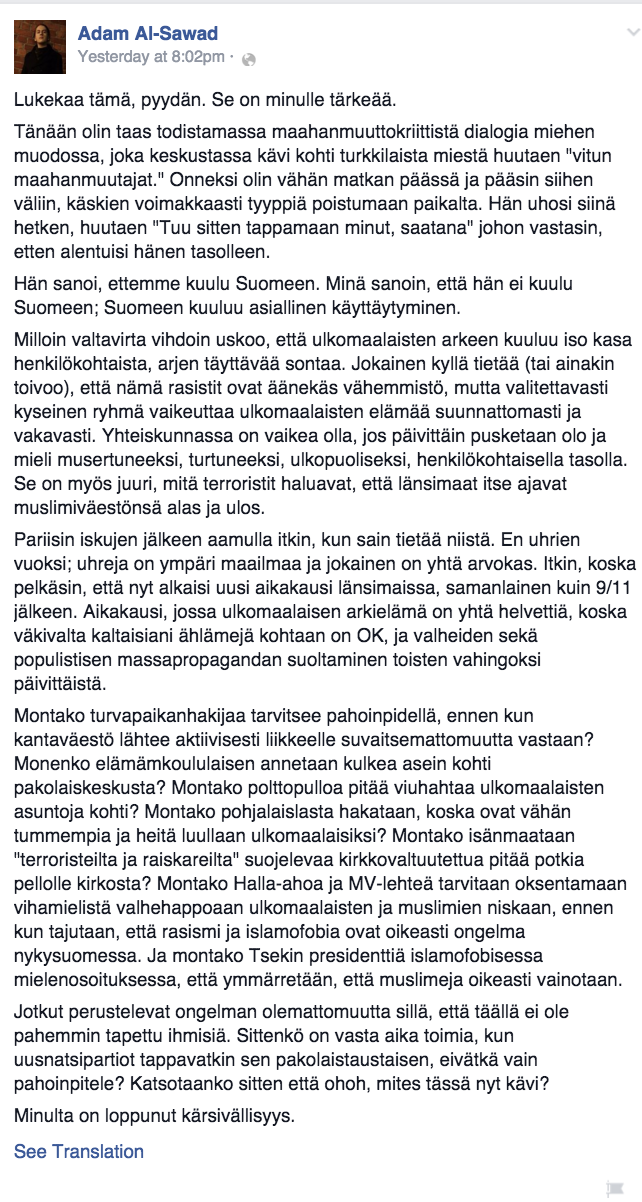
Facebook: Lukekaa tämä, pyydän

Posted on November 19, 2015 by Migrant Tales

Adam Al-Sawad on rohkea mies koska hän puolustaa meidän arvoja.

“Hän sanoi, ettemme kuulu Suomeen. Minä sanoin, että hän ei kuuluu Suomeen; Suomeen kuuluu asiallinen käyttäytyminen.”

Al-Sawad pyytää meitä lukemaan mitä hän kirjoitti. Lukekaa.

_______________________________________________

Näyttökuva 2015-11-19 kello 22.15.54

Defining white Finnish privilege #25: This land is my land, this land isn’t your land

Posted on November 19, 2015 by Migrant Tales

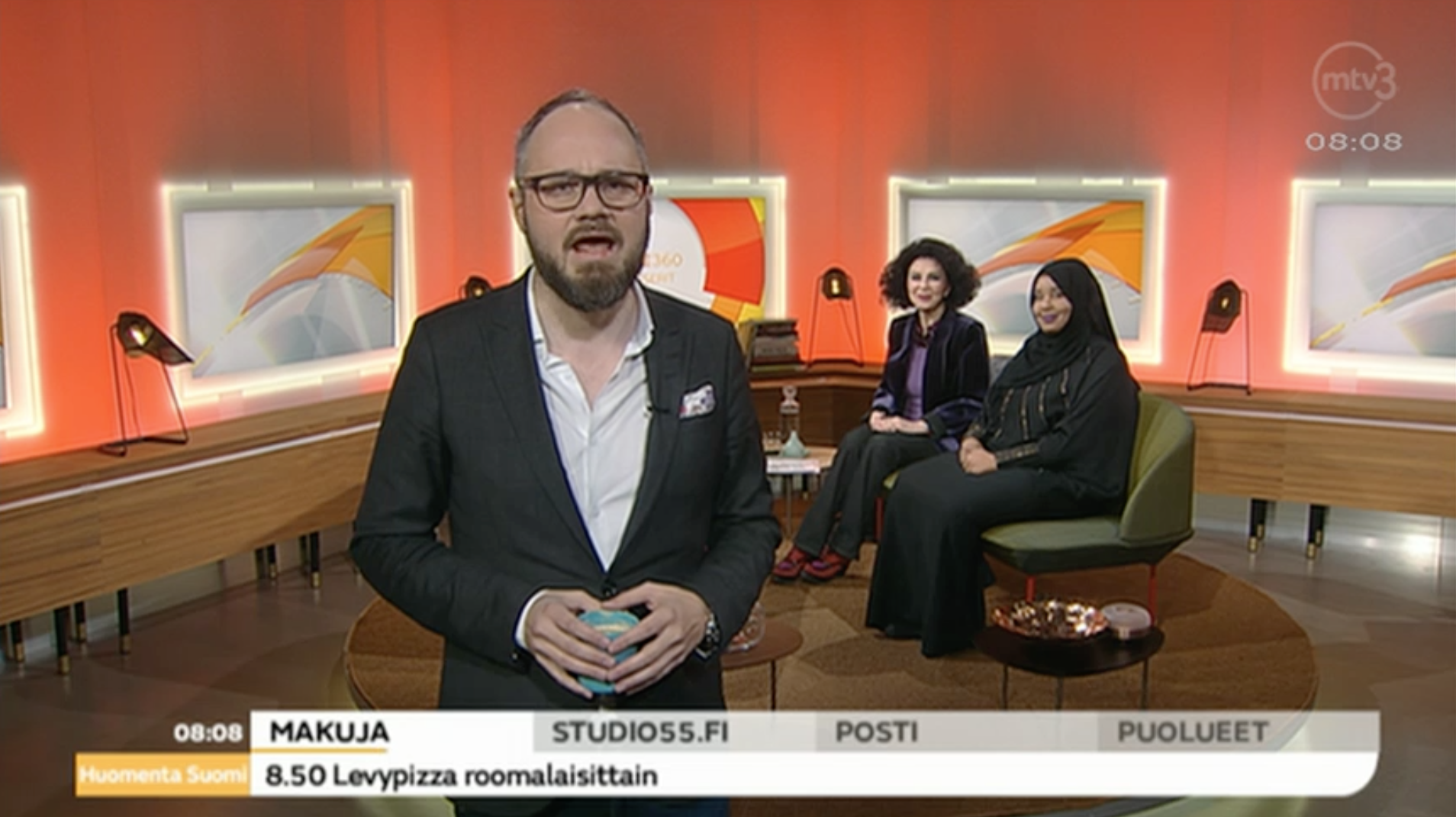
It’s disturbing to watch in Finland journalists who maintain and promote urban tales and racism. One of these is Tuomas Enbuske who invited Lenita Airisto to his television talk show to speak about Muslims. When Aristo opens her mouth and gives her opinions about cultural diversity, it’s evident that she still lives is a provincial and stuffy time warp of pre-1990s Finland.

One of the many things she said that exposed her bigotry in a recent talk show with Enbuske was that Muslim women should show more flexible in Finland and take off their veils if they live here.

Airisto, who shamelessly patronizes the Muslim host, Maryam Askar, continuously pats her on the shoulder as if she had such a right.

The patting on the shoulder is a good example of how Airisto sees minorities like Askar as if they were children.

But then she states something that exposes her white privilege to a tee:

“You have come to my country, Finland is my country, and has taken you in with open arms…”

This affirmation, which is highly offensive because Airisto still believes that Finland and the Finns are only white.

What Airisto is doing is denying Askar the right to be different, which is the basis of racism in Finland. Racists and racism is nothing more in Finland than people who have serious issues with people who are different from them.

Näyttökuva 2015-11-19 kello 18.27.18

Host Tuomas Enbuske is no rocket scientist when it comes to debating matters like immigration and Muslims. He shows more ignorance and conservative opinionated views than sound judgement. In one of his talk shows he advertised “why Somalis rape?” His show got a warning  as a result from The Council for Mass Media for making such a racist statement.

Continue reading “Defining white Finnish privilege #25: This land is my land, this land isn’t your land”

Terrorism ironically exposes the lies of Islamophobic politicians and parties

Posted on November 17, 2015 by Migrant Tales

The closer terrorist acts hit us like the one that befell Paris on Friday, the fewer the arguments nationalist-populist politicians have to defend their Islamophobia. While this may not apply to all of Europe, especially to Eastern European countries like Hungary and Slovakia, it has come as a political blow to anti-immigration politicians in Finland.

What can you say and how would you interpret what Perussuomalaiset (PS)* head, Timo Soini, said after the Paris attacks?

“There is a danger that innocent people, who are escaping terror and terrorism would be related to [the Paris attacks],” he was quoted as saying in the national media.

President Sauli Niinistö and Minister of the Interior Petteri Orpo confirmed what Soini said. 

Certainly one reason why Finland’s head of state and its ministers said what they did is because they are not only concerned about Isis-inspired terrorism in Europe but the homegrown kind that could spring from careless Islamophobic statements that could lead to deaths.

Words have consequences and can be easily turned into bullets and bombs. 

But should we take Soini’s warning in earnest or does his statement reveal the power struggle in his party between politicians like MEP Jussi Halla-aho and himself? 

We mustn’t forget that it was Soini who gave a political voice to xenophobes in his party. 

If there is an apology that should be given to migrants and minorities in Finland, it should come from the PS and Soini.

It is ironic but as terrorism gets closer to us the clearer we some of us are able to distinguish between fact and anti-immigration fiction.

* The Finnish name of the Finns Party is the Perussuomalaiset (PS). The English-language names adopted by the PS, like True Finns or Finns Party, promote in our opinion nativist nationalism and xenophobia. We therefore prefer to use the Finnish name of the party on our postings.

Migrants’ Rights Network: Frontier anxiety: Living with the stress of the everyday border

Posted on November 16, 2015 by Migrant Tales

Don Flynn*

What happens when we bring the anxieties of life at the border into the heart of our all our communities? How can we contend with life in a space where identity is constantly checked and people subjected to the question: Why are you really here? MRN director Don Flynn asks this in an article published this month in Soundings, a journal of cultural politics and simultaneously on the website of Eurozine. The full article can be accessed here.

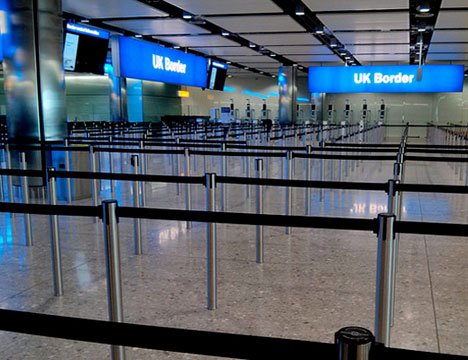
State borders hold a place in the collective imagination of our times in which anxiety plays a central part. It is at borders that the mundane certainties of life dissolve and the simple business of existing becomes a matter of uncertainty. This is the place where a person is forced to confront with the sharpest of intensity the fact that the rights which usually seem as securely available as an intimate personal possession are in fact a by-product of their relationship with the authorities of a state. It is at the border that this relationship can be called into most fundamental question. “I see you are in possession of a British passport madam”, says the immigration officer. “But can you explain to me how you came by this document and why you feel you are entitled to benefit from it?”

Photo: Martin Deutsch. Source: Flickr

This is a disconcerting question that few of us would feel confident of answering (certainly without detailed knowledge of the provisions of the British Nationality Act 1981). Most of us are in the happy position of being unlikely to be pushed too far on the matter. But some are not. For example, one young man I assisted with legal advice told me of his anxious hours at Heathrow airport when his claim that he was British-born, if not raised, was treated with deep scepticism. He had been born in Britain, but when he was six years old his Guyanese parents had taken him to their home country after a decade of life in London. Now returning to study at university, his case was only resolved after his lawyer intervened with additional evidence of his personal circumstances.

But if a British citizen can be subjected to this level of stress, how much greater are the anxiety levels for a Filipina nurse questioned about a visa that is probably incomprehensible to her – supplied by an agent back in Manila, who has assured her that it entitles her to come to the UK to accept the offer of a job as a nurse. It is entirely possible that all the deals that have been done – the form-filling, the gathering of supporting documents, the photographing, the English testing, the finger-print taking, and the payment of often very considerable fees, will be picked apart by an assiduous official who routinely finds grounds for doubting that a young woman from northern Santa Teresita could ever have been awarded a degree in health care from the country’s prestigious De La Salle University.

Beyond Fortress Europe


This article is part of the Eurozine focal pointBeyond Fortress Europe.

The scale of the human tragedy afflicting migrants who seek entry to Fortress Europe has increased dramatically of late, triggering a new European debate on laws, borders and human rights. A debate riddled with the complex, often epic, narratives that underlie immediate crisis situations. [more]

At a border you can be mentally stripped naked through rigorous interrogation, before being taken to a small room where you are physically stripped. Diaries will be read and hard drives on laptops scrutinized; while the letter from your cousin offering you a sofa to doss on until you sort out your own place will be the subject of excited interest, in case it reveals a snippet or two about why you are “really” here. When things go wrong for you at a border you lose the right to tell your own story of your life. You see another you being assembled before your very eyes, through which you are presented as a monster of conniving malevolence, capable of any deceit in your efforts to lay your hands on something to which you have no entitlement. The worst thing is that you are invited at each stage to follow the logic of this deconstruction of yourself. By the end you may find yourself morbidly agreeing that, “yes, I can see how you would believe that of me …”.

In short, a border is a place where most of us don’t want to be for any longer than the time it takes to clear the queues at immigration control, pick up your luggage and board the bus to the centre of town. As the border gets further behind you with each passing minute, you return to a world which may have its everyday worries and concerns, but in which there is at least the assurance that, in normal, mundane intercourse, the default presumption is that you are who you say you are.

But nowadays, for increasing numbers of people, this is not what happens. The border is no longer something to be negotiated on the relatively few occasions in life when we make a conscious decision to approach it and hazard all its dangers. Those disconcerting immigration officials are now being given leave to absent themselves from passport checking duties: they are being sent off in minibuses to ply their trade in many of the places where ordinary folk need to go as part of their daily lives. People may now be asked to verify their immigration status when they apply for a tenancy, or to university, or for child support, or even at the tube station.

Continue reading “Migrants’ Rights Network: Frontier anxiety: Living with the stress of the everyday border”

  • Previous
  • 1
  • 2
  • 3
  • 4
  • Next
Read more about documentary film
Read more

Recent Posts

  • Finland’s tabloids Iltalehti and Ilta-Sanomat are the pits
  • Riikka Purra’s Dr Jekyll and Mr Hyde mask
  • Double standards
  • Perussuomalaiset: Uusi logo, sama vanha juttu
  • Taco Trump

Recent Comments

  1. Absolutely Socking: Racist Finnish Facebook group against human rights gets flooded with socks on Musta Barbaari’s mother and sister charged by the police in “ethnic profiling” case
  2. Ilkka Nuotio on Pekka Myrskylä: “Tilastot kertovat toista kuin poliittinen keskustelu”
  3. Genrih Soinkara on The war in Ukraine and the Russian-Finnish border crisis are showing Finland’s ugly side
  4. Ahti Tolvanen on Comment by Ahti Tolvanen on the Helsinki +50 conference
  5. Angel Barrientos on Angel Barrientos is one of the kind beacons of Finland’s Chilean community

Archives

  • June 2026
  • May 2026
  • April 2026
  • March 2026
  • February 2026
  • January 2026
  • December 2025
  • November 2025
  • October 2025
  • September 2025
  • August 2025
  • July 2025
  • June 2025
  • May 2025
  • April 2025
  • March 2025
  • February 2025
  • January 2025
  • December 2024
  • November 2024
  • October 2024
  • September 2024
  • August 2024
  • July 2024
  • June 2024
  • May 2024
  • April 2024
  • March 2024
  • February 2024
  • January 2024
  • December 2023
  • November 2023
  • October 2023
  • September 2023
  • August 2023
  • July 2023
  • June 2023
  • May 2023
  • April 2023
  • March 2023
  • February 2023
  • January 2023
  • December 2022
  • November 2022
  • October 2022
  • September 2022
  • August 2022
  • July 2022
  • June 2022
  • May 2022
  • April 2022
  • March 2022
  • February 2022
  • January 2022
  • December 2021
  • November 2021
  • October 2021
  • September 2021
  • August 2021
  • July 2021
  • June 2021
  • May 2021
  • April 2021
  • March 2021
  • February 2021
  • January 2021
  • December 2020
  • November 2020
  • October 2020
  • September 2020
  • August 2020
  • July 2020
  • June 2020
  • May 2020
  • April 2020
  • March 2020
  • February 2020
  • January 2020
  • December 2019
  • November 2019
  • October 2019
  • September 2019
  • August 2019
  • July 2019
  • June 2019
  • May 2019
  • April 2019
  • March 2019
  • February 2019
  • January 2019
  • December 2018
  • November 2018
  • October 2018
  • September 2018
  • August 2018
  • July 2018
  • June 2018
  • May 2018
  • April 2018
  • March 2018
  • February 2018
  • January 2018
  • December 2017
  • November 2017
  • October 2017
  • September 2017
  • August 2017
  • July 2017
  • June 2017
  • May 2017
  • April 2017
  • March 2017
  • February 2017
  • January 2017
  • December 2016
  • November 2016
  • October 2016
  • September 2016
  • August 2016
  • July 2016
  • June 2016
  • May 2016
  • April 2016
  • March 2016
  • February 2016
  • January 2016
  • December 2015
  • November 2015
  • October 2015
  • September 2015
  • August 2015
  • July 2015
  • June 2015
  • May 2015
  • April 2015
  • March 2015
  • February 2015
  • January 2015
  • December 2014
  • November 2014
  • October 2014
  • September 2014
  • August 2014
  • July 2014
  • June 2014
  • May 2014
  • April 2014
  • March 2014
  • February 2014
  • January 2014
  • December 2013
  • November 2013
  • October 2013
  • September 2013
  • August 2013
  • July 2013
  • June 2013
  • May 2013
  • April 2013
  • March 2013
  • February 2013
  • January 2013
  • December 2012
  • November 2012
  • October 2012
  • September 2012
  • August 2012
  • July 2012
  • June 2012
  • May 2012
  • April 2012
  • March 2012
  • February 2012
  • January 2012
  • December 2011
  • November 2011
  • October 2011
  • September 2011
  • August 2011
  • July 2011
  • June 2011
  • May 2011
  • April 2011
  • March 2011
  • February 2011
  • January 2011
  • December 2010
  • November 2010
  • October 2010
  • September 2010
  • August 2010
  • July 2010
  • June 2010
  • May 2010
  • April 2010
  • March 2010
  • February 2010
  • January 2010
  • December 2009
  • November 2009
  • October 2009
  • September 2009
  • August 2009
  • July 2009
  • December 2008
  • November 2008
  • October 2008
  • September 2008
  • August 2008
  • July 2008
  • June 2008
  • May 2008
  • April 2008
  • March 2008
  • February 2008
  • January 2008
  • November 2007
  • October 2007
  • September 2007
  • August 2007
  • July 2007
  • June 2007
  • May 2007

Categories

  • ?? Gia L?c
  • ????? ?????? ????? ???????? ?? ??????
  • ???????
  • @HerraAhmed
  • @mondepasrond
  • @nohatefinland
  • @oula_silver
  • @Varathas
  • A Pakistani family
  • äärioikeisto
  • Abbas Bahmanpour
  • Abdi Muhis
  • Abdirahim Hussein Mohamed
  • Abdirahim Husu Hussein
  • Abdirisak Mahamed
  • About Migrant Tales
  • activism
  • Adam Al-Sawad
  • Adel Abidin
  • Afrofinland
  • Ahmed IJ
  • Ahti Tolvanen
  • Aino Pennanen
  • Aisha Maniar
  • Alan Ali
  • Alan Anstead
  • Alejandro Díaz Ortiz
  • Alekey Bulavsev
  • Aleksander Hemon
  • Aleksanterinliitto
  • Aleksanterinliitto ry
  • Aleksanterinliitto ry:n hallitus
  • Alex Alex
  • Alex Mckie
  • Alexander Nix
  • Alexandra Ayse Albayrak
  • Alexis Neuberg
  • Ali Asaad Hasan Alzuhairi
  • Ali Hossein Mir Ali
  • Ali Rashid
  • Ali Sagal Abdikarim
  • Alina Tsui
  • Aline Müller
  • All categories
  • Aman Heidari
  • Amiirah Salleh-Hoddin & Jana Turk
  • Amin A. Alem
  • Amir Zuhairi
  • Amkelwa Mbekeni
  • Ana María Gutiérrez Sorainen
  • Anachoma
  • Anders Adlecreutz
  • Angeliina Koskinen
  • Anna De Mutiis
  • Anna María Gutiérrez Sorainen
  • Anna-Kaisa Kuusisto ja Jaakko Tuominen
  • Annastiina Kallius
  • Anneli Juise Friman Lindeman
  • Announcement
  • Anonymous
  • Antero Leitzinger
  • anti-black racism
  • Anti-Hate Crime Organisation Finland
  • Anudari Boldbaatar
  • Arshiya Nasser
  • Aspergers Syndrome
  • Asylum Corner
  • Asylum seeker 406
  • Athena Griffin and Joe Feagin
  • Autism
  • Avaaz.org
  • Awale Olad
  • Ayan Said Mohamed
  • AYY
  • Barachiel
  • Bashy Quraishy
  • Beatrice Kabutakapua
  • Beri Jamal
  • Beri Jamal and Enrique Tessieri
  • Bertolt Brecht
  • Boiata
  • Boodi Kabbani
  • Bruno Gronow
  • Carmen Pekkarinen
  • Çelen Oben and Sheila Riikonen
  • Chiara Costa-Virtanen
  • Chiara Costa-Virtanen
  • Chiara Sorbello
  • Christian Thibault
  • Christopher Wylie
  • Clara Dublanc
  • Dana
  • Daniel Malpica
  • Danilo Canguçu
  • David Papineau
  • David Schneider
  • Dexter He
  • Don Flynn
  • Dr Masoud Kamali
  • Dr. Faith Mkwesha
  • Dr. Theodoros Fouskas
  • Edna Chun
  • Eeva Kilpi
  • Emanuela Susheela
  • En castellano
  • ENAR
  • Enrique
  • Enrique Tessieri
  • Enrique Tessieri & Raghad Mchawh
  • Enrique Tessieri & Yahya Rouissi
  • Enrique Tessieri and Muhammed Shire
  • Enrique Tessieri and Sira Moksi
  • Enrique Tessieri and Tom Vandenbosch
  • Enrique Tessieri and Wael Che
  • Enrique Tessieri and Yahya Rouissi
  • Enrique Tessieri and Zimema Mhone
  • Epäluottamusmies
  • EU
  • Europe
  • European Islamophobia Report
  • European Islamophobia Report 2019,
  • European Union
  • Eve Kyntäjä
  • Ezequiel Caldeiro
  • Facebook
  • Fadumo Dayib
  • Faisa Kahiye
  • Farhad Manjoo
  • Fasismi
  • Finland
  • Fizza Qureshi
  • Flyktingar och asyl
  • Foreign Student
  • Fozia Mir-Ali
  • Frances Webber
  • Frida Selim
  • Gareth Rice
  • Ghyslain Vedeaux
  • Global Art Point
  • Great Replacement
  • Habiba Ali
  • Hami Bahadori
  • Hami Bahdori
  • Hamid
  • Hamid Alsaameere
  • Hamid Bahdori
  • Handshake
  • Harmit Athwal
  • Hassan Abdi Ali
  • Hassan Muhumud
  • Heikki Huttunen
  • Heikki Wilenius
  • Helsingin Sanomat
  • Henning van der Hoeven
  • Henrika Mälmsröm
  • Hser Hser
  • Hser Hser ja Mustafa Isman
  • Husein Muhammed
  • Hussain Kazemian
  • Hussain Kazmenian
  • Ibrahim Khan
  • Ida
  • Ignacio Pérez Pérez
  • Iise Ali Hassan
  • Ilari Kaila & Tuomas Kaila
  • Imam Ka
  • inside-an-airport
  • Institute of Race Relations
  • Iraqi asylum seeker
  • IRR European News Team
  • IRR News Team
  • Islamic Society of Norhern FInland
  • Islamic Society of Northern Finland
  • Islamophobia
  • Jacobinmag.com
  • Jallow Momodou
  • Jan Holmberg
  • Jane Elliott
  • Jani Mäkelä
  • Jari Luoto
  • Jari Taponen
  • Jegor Nazarov
  • Jenni Stammeier
  • Jenny Bourne
  • Jessie Daniels
  • Joe Davidow
  • Johannes Koski
  • John D. Foster
  • John Grayson
  • John Marriott
  • Jon Burnett
  • Jorma Härkönen
  • Jos Schuurmans
  • José León Toro Mejías
  • Josue Tumayine
  • Jouni Karnasaari
  • Juan Camilo
  • Jukka Eräkare
  • Julian Abagond
  • Julie Pascoet
  • Jussi Halla-aho
  • Jussi Hallla-aho
  • Jussi Jalonen
  • JusticeDemon
  • Kadar Gelle
  • Kaksoiskansalaisuus
  • Kansainvälinen Mikkeli
  • Kansainvälinen Mikkeli ry
  • Katherine Tonkiss
  • Kati Lepistö
  • Kati van der Hoeven-Lepistö
  • Katie Bell
  • Kättely
  • Kerstin Ögård
  • Keshia Fredua-Mensah & Jamie Schearer
  • Khadidiatou Sylla
  • Khadra Abdirazak Sugulle
  • Kiihotus kansanryhmää vastaan
  • Kirsi Crowley
  • Koko Hubara
  • Kristiina Toivikko
  • Kubra Amini
  • KuRI
  • La Colectiva
  • La incitación al odio
  • Laura Huhtasaari
  • Lauri Finér
  • Leif Hagert
  • Léo Custódio
  • Leo Honka
  • Leontios Christodoulou
  • Lessie Branch
  • Lex Gaudius
  • Leyes de Finlandia
  • Liikkukaa!
  • Linda Hyökki
  • Liz Fekete
  • M. Blanc
  • Maarit Snellman
  • Mahad Sheikh Musse
  • Maija Vilkkumaa
  • Malmin Kebab Pizzeria Port Arthur
  • Marcell Lorincz
  • Mari Aaltola
  • María Paz López
  • Maria Rittis Ikola
  • Maria Tjader
  • Marja-Liisa Tolvanen
  • Mark
  • Markku Heikkinen
  • Marshall Niles
  • Martin Al-Laji
  • Maryan Siyad
  • Matt Carr
  • Mauricio Farah Gebara
  • Media Monitoring Group of Finland
  • Micah J. Christian
  • Michael McEachrane
  • Michele Levoy
  • Michelle Kaila
  • Migrant Tales
  • Migrant Tales Literary
  • Migrantes News
  • Migrants' Rights Network
  • MigriLeaks
  • Mikko Kapanen
  • Miriam Attias and Camila Haavisto
  • Mohamed Adan
  • Mohammad Javid
  • Mohammad M.
  • Monikulttuurisuus
  • Monisha Bhatia and Victoria Canning
  • Mor Ndiaye
  • Muh'ed
  • Muhamed Abdimajed Murshid
  • Muhammed Shire
  • Muhammed Shire and Enrique Tessieri
  • Muhis Azizi
  • Musimenta Dansila
  • Muslimiviha
  • Musulmanes
  • Namir al-Azzawi
  • Natsismi
  • Neurodiversity
  • New Women Connectors
  • Nils Muižnieks
  • No Labels No Walls
  • Noel Dandes
  • Nuor Dawood
  • Omar Khan
  • Otavanmedia
  • Oula Silvennoinen
  • Paco Diop
  • Pakistani family
  • Pentti Stranius
  • Perussuomalaiset
  • perustuslaki
  • Petra Laiti
  • Petri Cederlöf
  • Pia Grochowski
  • Podcast-lukija Bea Bergholm
  • Pohjois – Suomen Islamilainen Yhdyskunta
  • Pohjois Suomen Islamilainen Yhyskunta
  • Polina Kopylova
  • Race Files
  • racism
  • Racism Review
  • Raghad Mchawh
  • Ranska
  • Rashid H. and Migrant Tales
  • Rasismi
  • Raul Perez
  • Rebecka Holm
  • Reem Abu-Hayyeh
  • Refugees
  • Reija Härkönen
  • Remiel
  • Reza Nasri
  • Richard Gresswell
  • Riikka Purra
  • Risto Laakkonen
  • Rita Chahda
  • Ritva Kondi
  • Robito Ibrahim
  • Roble Bashir
  • Rockhaya Sylla
  • Rodolfo Walsh
  • Roger Casale
  • Rostam Atai
  • Roxana Crisólogo Correa
  • Ruth Grove-White
  • Ruth Waweru-Folabit
  • S-worldview
  • Sadio Ali Nuur
  • Sami Rusanen
  • Sandhu Bhamra
  • Sara de Jong
  • Sarah Crowther
  • Sari Alhariri
  • Sarkawt Khalil
  • Sasu
  • Scot Nakagawa
  • Shabana Ahmadzai
  • Shada Islam
  • Sharon Chang blogs
  • Shenita Ann McLean
  • Shirlene Green Newball
  • Sini Savolainen
  • Sira Moksi
  • Sonia K.
  • Sonia Maria Koo
  • Steverp
  • Stop Deportations
  • Suldaan Said Ahmed
  • Suomen mediaseurantakollektiivi
  • Suomen Muslimifoorumi ry
  • Suomen viharikosvastainen yhdistys
  • Suomen viharikosvastainen yhdistys ry
  • Suomi
  • Supermen
  • Susannah
  • Suva
  • Syrjintä
  • Talous
  • Tapio Tuomala
  • Taw Reh
  • Teivo Teivainen
  • The Daily Show
  • The Heino
  • The Supermen
  • Thomas Elfgren
  • Thulfiqar Abdulkarim
  • Tim McGettigan
  • Tino Singh
  • Tito Moustafa Sliem
  • Tobias Hübinette and L. Janelle Dance
  • Transport
  • Trica Danielle Keaton
  • Trilce Garcia
  • Trish Pääkkönen
  • Trish Pääkkönen and Enrique Tessieri
  • Tuulia Reponen
  • Uncategorized
  • UNITED
  • University of Eastern Finland
  • Uyi Osazee
  • Väkivalta
  • Vapaa Liikkuvuus
  • Venla-Sofia Saariaho
  • Vieraskynä
  • W. Che
  • W. Che an Enrique Tessieri
  • Wael Ch.
  • Wan Wei
  • Women for Refugee Women
  • Xaan Kaafi Maxamed Xalane
  • Xassan Kaafi Maxamed Xalane
  • Xassan-Kaafi Mohamed Halane & Enrique Tessieri
  • Yahya Rouissi
  • Yasmin Yusuf
  • Yassen Ghaleb
  • Yle Puhe
  • Yuliet Tresa
  • Yve Shepherd
  • Zahra Khavari
  • Zaker
  • Zalina Ametova
  • Zamzam Ahmed Ali
  • Zeinab Amini ja Soheila Khavari
  • Zimema Mahone and Enrique Tessieri
  • Zimema Mhone
  • Zoila Forss Crespo Moreyra
  • ZT
  • Zulma Sierra
  • Zuzeeko Tegha Abeng
© 2026 Migrant tales | Powered by Minimalist Blog WordPress Theme