Migrant Tales got a new layout look today. We hope you like it!
Enrique Tessieri, editor

Migrant Tales got a new layout look today. We hope you like it!
Enrique Tessieri, editor
Politicians sometimes say pretty incredible things. What do you think if the leader of Finland’s biggest anti-immigration party in parliament states that he’s surprised that not more immigrants move to Finland? And then the leader of this party, Timo Soini, puts the icing on the cake and is quoted on YLE in English as saying that Finland “is one of the least-immigrated countries in the world.”
Come again, Soini, what did you just say?! You wonder why so few immigrants move to Finland. Well we wonder why the PS is the third-biggest party in parliament if there are so few migrants in Finland.
Migrant Tales has written a number of times about the perils of anti-immigration rhetoric and how it scares away skilled immigrants and foreign investment.
We published in 2012 a blog entry on such preposterous views of the PS headlined, Sleeping Beauty and Prince Charming, the super immigrant [3]. Continue reading “PS’ Timo Soini claims he’s “surprised” that not more immigrants want to move to Finland”
When I was young I studied ‘brainwashing’ as part of my studies in psychology. One feature that constantly emerged was how ‘extreme’ interpretations of events typically took a grain of truth and wrapped it up in a generalisation such that it would act as a shield to any criticism, especially convincing and obvious counterarguments that threatened to unravel the persons’ warped world-view.
This is always tricky ground, for several reasons. This bias is something we all share to different degrees, and so it’s easy to reverse the argument if you start trying to point it out. Being ‘brainwashed’ is to an extent common, we even have an everyday term for it – we call people ‘opinionated’. Brainwashing is, in essence, accepting information as true without fully assimilating it as an independently thinking, critical and empathic individual. In the context of racism debates today, we might talk of pathological bias. Continue reading “Being responsible in debates about immigration and extremism”
Migrant Tales’ 2015 Hall of Poor and Sloppy Journalism will be updated separately. To see other examples of opinionated journalism in Finland about cultural diversity, please go to this link.
Rasistinen vai ei? Oikeusoppineet arvioivat perussuomalaisten maahanmuutto-ohjelma (YLE Kioski)
What’s wrong with this story? A story published by YLE Kioski asked a number of law professors if the Perussuomalaiset (PS) party program on immigration is racist. While the answers from five professors affirmed that the PS program was racist and/or unconstitutional, not a single non-Finnish professor was approached by YLE Kioski. One professor that could have given “a migrant view” is Jeremy Gould of Jyväskylä University. The fact that representatives of the majority culture, in this case white Finnish professors, are giving their expert opinions about what impacts migrants and minorities is nothing new. Too often migrants and minorities aren’t approached by the media in such cases. One of the journalists who did the story is Sean Ricks. The story mistakenly states that Veronika Honkasalo is an MP for the Left Alliance. She is a Helsinki city councilwoman who is running for parliament. Continue reading “UPDATE (Feb. 27): Migrant Tales’ 2015 Hall of Poor and Sloppy Journalism”
Don Flynn*

The fact that the government failed to reach its target for reducing net migration is bad news for them, but rather good news when considered as an indication of an economy not still mired in deepest recession.

Parties like the Perussuomalaiset (PS)* and anti-immigration politicians like MEP Jussi Halla-aho should be thankful to migrants and multicultural Finns. Where would these anti-immigration populists be today without their near-constant attacks against our ever-growing culturally and ethnically diverse society?

While anti-immigration rhetoric has poisoned the air and made life difficult for some migrants, it has likewise awoken many to a social ill like intolerance. A good example of the latter is Migrant Tales as well as numerous other anti-racism blogs that have appeared in recent years.
Xenophobia and intolerance are extremely harmful and toxic social ills for any country. Finland is no exception. If few people have found their way to Finland in the past and made it their home, anti-immigration parties like the PS and the silence of other ones have made it an even less attractive destination for migrants.
It’s clear that we are paying a high price for not challenging intolerance and for promoting our own urban tales about ourselves and other groups.
What future awaits us if we don’t change course? Is it further graying of the population, rocketing health-care costs to serve an ever-growing aging population, lower tax revenues and productivity as well as greater anti-immigration/anti-cultural diversity sentiment?
Finland is a country that has faced great hardships in its history and overcome them.
None of them, however, are so perilous and far-reaching than the ones it faces today.
Intolerance is like a vampire that sucks the life out of a nation. It quenches its thirst by impoverishing and stagnating a country.
Don’t send Finland but the anti-immigration populist to a retirement home.
* The English name of the Perussuomalaiset (PS) is officially the Finns Party. The names adopted by the PS, like True Finns or Finns Party, promote in our opinion nativist nationalism and xenophobia. We therefore prefer to use the Finnish name of the party on our postings.
Migrant Tales’ 2015 Hall of Poor and Sloppy Journalism will be updated separately. To see other examples of opinionated journalism in Finland about cultural diversity, please go to this link.
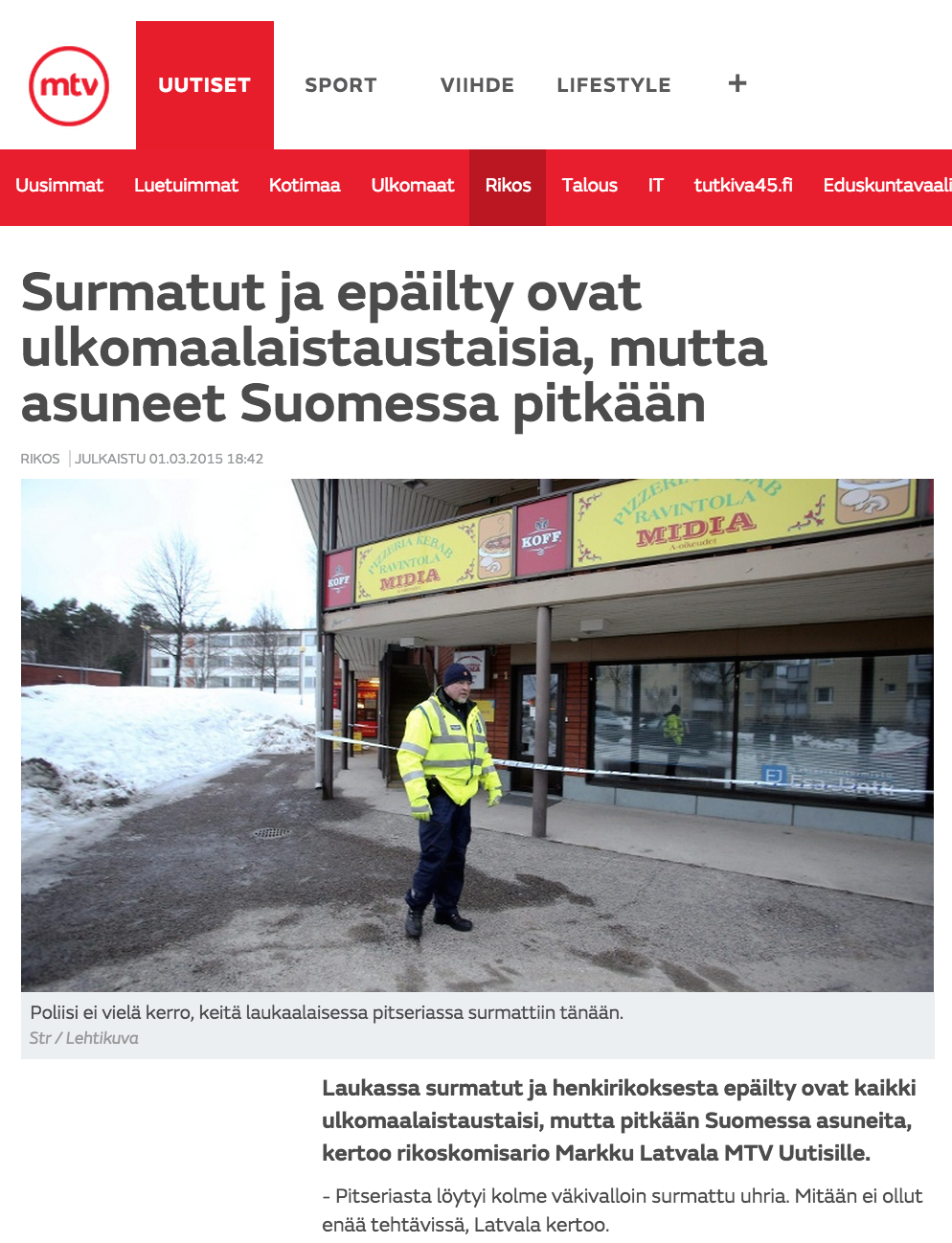
Surmatut ja epäilty ovat ulkomaalaistaustaisia, mutta asuneet Suomessa pitkään (MTV3)
What’s wrong with the headline? Three migrants were killed by another foreigner on Sunday in the small town of Laukaa, located near Jyväskylä. While the victims and the suspect are non-Finns, MTV3 makes a distinction in the headline about this fact. It states that those killed and the suspect are foreigners “but have lived a long time in Finland.” While the headline was brought to my attention by a post on Facebook, there is an obvious question: What is the difference if the “foreigners” had lived a long time or not in Finland? Are they suggesting that foreigners that have lived a shorter time in Finland are more prone to be killed or be suspected killers? Makes you wonder.