Migrant tales
Menu
  • #MakeRacismHistory “In Your Eyes”
  • About Migrant Tales
  • It’s all about Human Rights
  • Literary
  • Migrant Tales Media Monitoring
  • NoHateFinland.org
  • Tales from Europe
Menu

Month: September 2014

Finnish anti-immigration politicians and parties spread on purpose lies to hide the truth and their culpability

Posted on September 14, 2014 by Migrant Tales

Ever wonder why the Finnish media and politicians continue to spread lies about migrants and minorities like we’re lazy, stupid, criminals, rapists and a burden on society? OK, not all of them lie on purpose but too many remain silent and allow these types of urban tales to slip past them in silent approval.

Say for example a recent urban tale by a MP from Espoo that I don’t want to mention who claims that migrants get preferential treatment from social-service officials.

IMG_5047

Poverty and social exclusion are realities that the migrant and minority community face in Finland.


What about a party* that I don’t want to mention because they base their popularity on anti-immigration rhetoric? Members of this party have gone as far as to claim that certain national groups have it in their genes to live off welfare, rob and rape.

Why do many, like the media, politicians and some of the public believe these fairy tales about migrants and minorities?

What would happen if the following was the truth:

  • The majority of migrants (about 60%) live in poverty;

  • Unemployment among migrants is on average two to three times higher than the national average;

  • Migrant youths have a greater chance of being marginalized than white Finns;

  • Migrants make 25% less money than Finns on average;

  • Migrants get less social welfare than Finns because they are usually employed in low-skilled and low-paying jobs.

The above facts are a ticking time bomb thanks to our indifference and because  some politicians and political parties would care less about migrants and minorities in this country.

Instead of addressing and challenging poverty and social exclusion, it’s clear why some don’t want you to admit the truth.

* The Finnish name for the Finns Party is the Perussuomalaiset (PS). The English names of the party adopted by the PS, like True Finns or Finns Party, promote in our opinion nativist nationalism and xenophobia. We therefore prefer to use the Finnish name of the party on our postings.

High time for Western self-scrutiny about our Muslim community

Posted on September 13, 2014 by Migrant Tales

I made in the late-1970s one of the most important decisions of my life. Back then Argentina was ruled by one of the region’s bloodiest dictatorships. Human rights violations, torture and state-sponsored terrorism were the rule. You had three choices: take up arms and join a guerrilla group, shut up or leave the country.

Näyttökuva 2014-9-13 kello 15.50.28

Wali Hashi believes that its high time for self-scrutiny by the Muslim community concerning its youth that is being recruited to fight in wars overseas. Read full story here.


The dilemma I was confronted with a long time ago must resemble the predicament that some Muslims face as they decide whether to join an extremist group like ISIS. One of the questions they must answer is clear: Is armed struggle and violence right to change society?

Even if the thought of joining a left-wing guerrilla attracted me at the time, I knew I could never be a member of such a group since it meant killing other people. How could I kill a human being if I couldn’t kill an animal?

I chose the pen instead and that changed my life for the better. Certainly joining a guerrilla group would have changed my life as well but differently.

I also made another important decision back then: I won’t kill anyone as long as I live.

Even if there was a lot of suspicion about left-wingers and communists in Latin America during the cold war, it wasn’t tainted by Islamophobia.

We’ve seen through time how wars have lured youth. We saw it in the Spanish Civil War (1936-39) and recently how youths join the Israeli Defense Forces. Why don’t these type of conflict worry us as much as the conflicts in the Middle East?

How you define a guerrilla or extremist organization hinges on your political viewpoint. It’s wishful thinking to believe that ISIS will be defeated militarily. For that you need a political solution and there is none in sight.

If the US has spent over 2 trillion dollars on Iraq, why would the latest declaration of war against ISIS make any difference?

In many respects, the ongoing strife in the Middle East, which is being inflicted by us, looks eerily like the flypaper that John Steinbeck wrote about in his 1942 novel, The moon is down.

The book tells about how the occupying Nazi forces attempted to force the townspeople into submission but the contrary happened. Resistance to the occupying force mounted with acts of sabotage. In the end, the invaders realized the futility of their campaign and it becomes clear they had lost the war.

The flies, as Steinbeck so eloquently writes at the end of the novel, had conquered the flypaper.

If you want to discourage our youth from taking up arms and being recruited to war zones, give them education, opportunities and ballot boxes as opposed to US-Western and Fox-style “war-on-terror” rhetoric, which is copied by the Finnish media as well.

Include, give back countries in the Middle East their self-determination, seriously take steps in solving the Israeli-Palestinian conflict and challenge Islamophobia on all fronts. These matters will go a long way in helping discourage our youth from taking up arms against, ironically, enemies that we’ve financed and created.

Pekka Myrskylä: “Why aren’t we debating about why [white] Finns buy alcohol with social aid?”

Posted on September 13, 2014 by Migrant Tales

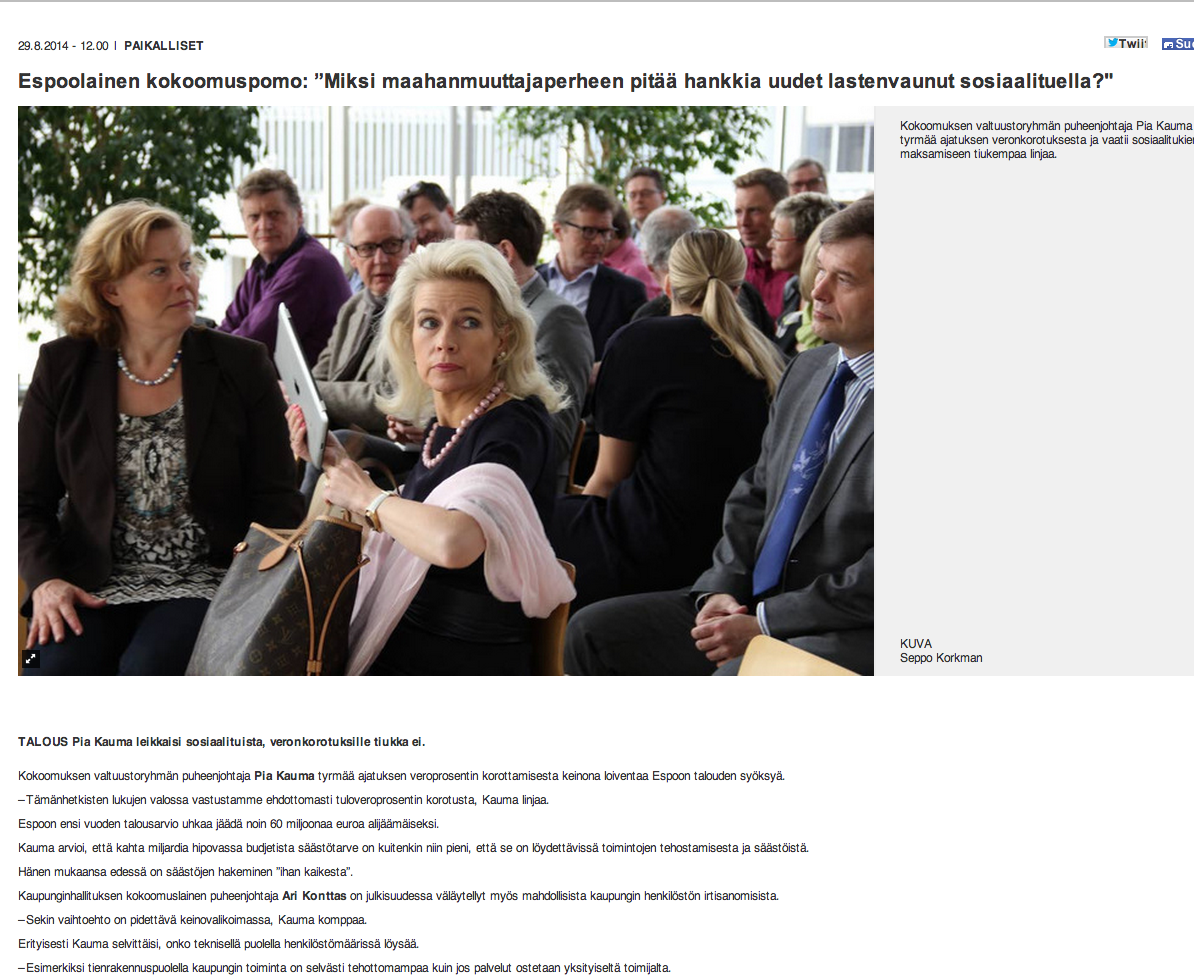
National Coalition Party MP Pia Kauma has proven with her victimization of migrant mothers and migrants that prejudices have deep roots. No matter how much you expose an outright lie, your evidence will have little impact because some people are set in their prejudices and beliefs.

Kauma continues to be adamant: She will not apologize for what she said but instead continues to rely on gossip. What is most surprising is that she’s sat eight years on an Espoo municipal committee that sets guidelines for social aid.

The conservative MP says she’s received countless messages of support, even from social workers, about how migrants are given preferential treatment by the social-welfare system. If this is true, the social workers are breaking the law by telling Kauma about their clients since they must abide by a non-disclosure agreement they’ve signed.

Sakari Timonen, one of Finland’s best anti-racism bloggers, writes about the latter (in Finnish) here.

Pekka Myrskylä, a retired manager who worked for Statistics Finland, spoke to Migrant Tales about the latest debate on migrant mothers and baby carriages.

Näyttökuva 2014-7-5 kello 10.48.33
Read Pekka Myrskylä’s blog entry here.

Myrskylä has written a lot about migrants in Finland. In one of his posts published this spring, Myrskylä showed that contrary to popular belief, about 60% of migrants live below the poverty line in this country.

Since they have lower-paying jobs than white Finns, their level of social welfare is lower as well.Instead of relying on gossip and attacking migrant mothers, why doesn’t Kauma get the facts and debate the social problems that arise from living in poverty?

”Why aren’t we debating about how [white] Finns buy alcohol with social aid?” said Myrskylä. ”We instead prefer to talk about migrant mothers and baby carriages.”

Myrskylä said that one of the biggest problems in the ongoing debate on our ever-growing cultural diversity is the lack of information. Statistics Finland doesn’t gather systematic information about the educational level of migrants.

”Since we don’t have such information, there is a general perception that migrants have low educational levels,” he said. ”Some do but many who come from the United States, Russia and Estonia have an educational background.”

UPDATED (14.9): Myrskylä said that one third of the 51,000 people (15-29 years) who don’t have a profession, are unemployed, aren’t enrolled in school and aren’t on maternity leave speak Finnish as a second language. The chances of a migrant being marginalized in Finland is greater than that of a white Finn.

He said that the way migrants are talked about in the media and public in Finland resembles the way Finns were seen in Sweden in the 1970s. Back then, Finns had a questionable reputation and were commonly the source of media and public scorn. Matters started to improve dramatically when the Finnish embassy in Stockholm contacted the editors of the country’s main dailies and held meetings with them on a regular basis.

The late Max Jakobson and Risto Laakkonen played a crucial role in changing the perceptions that the Swedish media had about Finns.

Migrants and diplomatic representatives in Finland should do the same as the Finnish embassy did in Sweden.

MP Kauma is the latest and clearest example that such action is needed now.

National Coalition Party and Perussuomalaiset lead anti-immigration drive in Finland

Posted on September 12, 2014 by Migrant Tales

With parliamentary elections nearing in April, topping the anti-immigration rhetoric list are two parties with representatives in parliament: National Coalition Party and who else but the Perussuomalaiset (PS)*. 

We’ve been reading almost daily about National Coalition Party MP Pia Kauma’s crusade against migrant women with baby carriages. The PS are another hostile party to migrants that will feed migrants to the dogs in order to get your vote in April.

While the PS wants to fool voters into believing that their rhetoric against migrants and minorities has something to do with patriotism and defending white Finnish rights,  nothing could be further from the truth. 

Migrant Tales has never been fooled by this type of chicanery and neither should you.

IMG_4352

If there are warning red light over Finland, it’s to warn us of the PS, a party that has ties with extremist groups like Suomen Sisu.


Since the PS has made so many outrageous statements in the past about migrants, minorities and development aid, let’s look at the two most recent ones by MP Vesa-Matti Saarakkala and MP Juho Eerola.

If Saarakkala had his way, he’d get rid of dual citizenship and take away a person’s citizenship if he were sentenced for a serious crime like terrorism. Eerola, on the other hand, the MP that admitted liking fascism and Benito Mussolini’s economic policies, wants to scrap the right of migrants to use paid interpreters.

What’s wrong with these two proposals? For one they reveal that Saarakkala and Eerola, both lawmakers, are in the dark about our constitution.

One of the most important rights in our constitution is that everyone, irrespective if the person is a Finn or migrant, has the right to be treated equally before the law.

Here’s a question to Eerola: If you are going to take away the right to use a paid interpreter from migrants, how would that affect minorities such as the Sami, Roma and mutes?

These types of statements made by MPs just to get votes in next year’s election reveal the true face of the PS. It shows a party that is lost but led by the headlights of its opportunism and ignorance. The PS would end up feeding our laws and values to the dogs if it ever got power.

Should migrants, expats and minorities fear the PS? Not at all. We should challenge them and do everything possible to send them them back to where they came from: to the one-digit political minor league.

Let’s hope that this will happen sooner than later.

* The Finnish name for the Finns Party is the Perussuomalaiset (PS). The English names of the party adopted by the PS, like True Finns or Finns Party, promote in our opinion nativist nationalism and xenophobia. We therefore prefer to use the Finnish name of the party on our postings.


Finland’s parliamentary elections of April 2015 have begun

Posted on September 10, 2014 by Migrant Tales

Even if parliamentary elections will take place on April 19, 2015, it’s clear that they’ve begun. Rumbles can be already heard from political parties such as the Perussuomalaiset (PS)*, Muutos 2011 and the National Coalition Party, which are vying for media attention and voters. Who are they targeting? Who else but migrants and minorities. 

National Coalition Party MP Pia Kauma is the one that claimed on Friday that migrant women were buying new baby carriages with social aid and that migrants were getting more welfare than Finns.

Kauma’s claims, which were based on hearsay, were disproven. Even so, the conservative MP continues to be in the media spotlight.

Any serious student of racism would ask the following question: Why does MP Kauma, who bases her claim on gossip and openly victimizes migrants, controls the narrative on migrants? Why doesn’t Pekka Myrskylä’s blog, which showed that the majority of migrants live in poverty in Finland, wasn’t even mentioned by the Finnish media?

Why in the last parliamentary elections did the media believe the narrative of the PS and politicians like Jussi Halla-aho and others even if it’s clear today that they were spreading lies about migrants?

The answer is in my opinion clear: The Finnish media isn’t only white but too many reporters have a challenging time thinking outside their ethnic box.

Migrants and minorities in this country have memory and we won’t forget. In the meantime as new lies are stacked over old ones by opportunistic politicians, the credibility of our institutions will be undermined. Who would believe in the police if the police are suspicious of you?

What is surprising in the Kauma affair is that not one migrant – except for mothers with baby carriages – were asked what they thought about the MP’s false claims.

On Monday’s A-Studio, a YLE host asked Kauma if she’d apologize for what she said. Social Democrat chairman Antti Rinne had said over the weekend that it’s clear that migrants don’t get more social aid than Finns and therefore talk about baby carriages should end and Kauma should apologize.

The MP said she wouldn’t apologize for bringing up a topic that had gotten the attention of white Finns.

Kauma did, however, apologize to those migrant mothers with baby carriages who have been harassed by Finns because of what she said.

Please read the last sentence again and ask:

Why did she make such claims in the first place if they aren’t true?

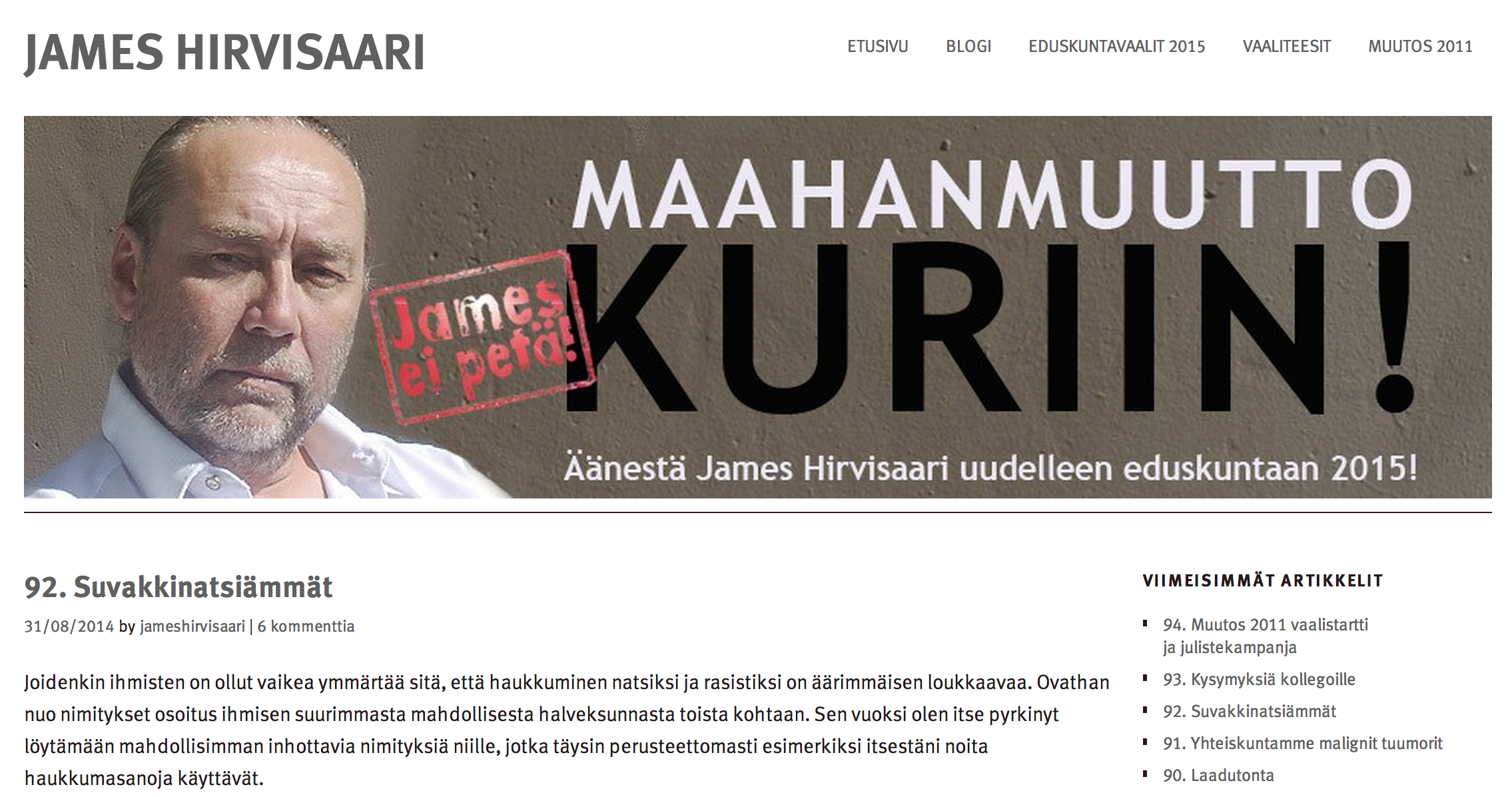
Politicians like Kauma and Timo Soini will find themselves in good company with MP James Hirvisaari of Muutos 2011, a xenophobic far-right party that believes racist sound bites to the media will help them get voters.

They are right but in the wrong party because there’s little media interest in Muutos 2011.

Hirvisaari, who got the boot from the PS after he posted a picture on social media of a friend making a Nazi salute in parliament, is a PS creation. Without the PS, Hirvisaari would have never got elected.

Näyttökuva 2014-9-9 kello 22.04.25

Here MP James Hirvisaari shows his Finnish machoism and narcism with his anti-immigration rhetoric, where he promises to get immigration under control. Social media has created many Frankensteins like Hirvisaari.

It’s highly likely that Hirvisaari will lose his seat in April.

We at Migrant Tales hope that he gets voted out of parliament.


* The Finnish name for the Finns Party is the Perussuomalaiset (PS). The English names of the party adopted by the PS, like True Finns or Finns Party, promote in our opinion nativist nationalism and xenophobia. We therefore prefer to use the Finnish name of the party on our postings.

Dr Theodoros Fouskas: Nigerian Immigrants in Greece: Low-Status Work, Community, and Decollectivization

Posted on September 9, 2014 by Migrant Tales

Migrant Tales insight: Dr Theodoros Fouskas, a lecturer at the New York College, Greece, is no stranger to our blog. We’ve published two stories about his research and work. Taking into account the economic and political hardships that Greece faces and how this had impacted migrants, Migrant Tales believes it has a responsibility to show the good work being done by researchers like Dr Fouskas. 

We wish him the best luck in the lunching of his latest book below. 

__________________

Nigerianimmigrants

Book Description:
• How does low-status work of Nigerian immigrants affect their organization and representation in immigrant community associations and unions?
• How do Nigerian immigrants perceive and what practices do they develop towards the collective organization, representation and claim of work rights?The sociological research in this book emphasizes that the lack of permanent employment and restriction of immigrants in precarious, low-status/paid occupations distance them from both collectivities and claims. By introducing a new perspective on the investigation of the migration phenomenon in Greece, this book contributes significantly to relative international research and literature. This makes it an extremely useful source for researchers and students, public agencies or bodies and for those dealing with the phenomenon of immigration and immigration policy.

In the first part of the book, the clarification of the theoretical concepts of community, occupational community and low-status work in the migration context is attempted. The impact that low-status/paid work has on immigrant collectivities is analyzed and the types of immigrant community associations and the attitude of the Greek trade unions towards the immigrants are discussed. Moreover, an overview of international empirical research on Nigerian immigrants, as well as on studies that focus on the investigation of immigrant community associations in Greece is endeavored. The second part of the book concentrates on the consequences low-status/paid work has on the collective organization and representation of the immigrant workforce. The micro-sociological research and analysis examines the case of Nigerian immigrants in Greece and how the frame of their work and their employment affects their participation in the immigrant hometown association Nigerian Community in Greece and in Greek trade unions. The results based on in-depth interviews demonstrate that due to the ramifications of their work, Nigerians are cut off, do not claim established workers’ rights and do not seek membership in any community associations or unions. In contrast, Nigerian immigrant workers depend on informal and impersonal social networks in search of solidarity and thus resort to alternative means of ensuring survival in Greek society, choosing individualistic and materialistic perceptions and attitudes of regulating their difficulties and workers’ rights, far from collectivities, often resigning from them completely. (Imprint: Nova)

Table of Contents:
Foreword pp.ix-xiiList of Tables pp.xiii-xiv

List of Figures pp.xv-xvi

About the Author pp.xvii-xviii

Acknowledgments pp.xix-xx

Abbreviations pp.xxi-xxii

Introduction pp.xxiii-xxxv

PART 1. pp.1-2

Chapter 1. Theoretical Clarifications pp.3-28

Chapter 2. International Research on Nigerian Immigrants pp.29-38

Chapter 3. International Research on Immigrant Associations in Greece
pp.39-50
PART 2. pp.51-52

Chapter 4. Research Methodology pp53-62

Chapter 5. Immigrants from Nigeria in Greece pp.63-140

PART 3. pp.141-142

Chapter 6. Epilogue pp.143-158

Appendix: Statistical Data on Nigerians pp.159-166

Bibliography pp.167-238

Index pp.239-251

To order book visit Nova Publishers here. 

Muutos 2011 election campaign exposes the contempt and hatred some Finns have for migrants and minorities

Posted on September 8, 2014 by Migrant Tales

Muutos 2011, which has one MP in parliament, is a good example of a xenophobic party in Finland. They are a good example of the racism, contempt and hatred that some Finns have for migrants and minorities. Behind all the Muutos 2011 rhetoric you will find a hostile message: keep Finland white. 

James Hirvisaari, who was ousted from the Perussuomalaiset (PS)* after he posted a picture of a friend making a Nazi salute in parliament, is its lone MP.

The party gives us a glimpse of what they think of migrants and minorities in their election program:

Muutos always places Finns first in decision-making. Since we Finns are from a global standpoint a small and disappearing minority, we have to defend our language and culture since nobody will do this for us.

We’re not against immigration, but we believe we have a duty to former and future generations to maintain Finland a livable and secure country where Finns can live and practice their culture.

Näyttökuva 2014-9-8 kello 17.40.29

The poster states that Finns must have to right to decide what Finland will look like in the future.


Any sensible person can see what’s wrong with the above statement about immigration. Muutos 2011 sees Finland as a white country while in fact it has always been and will be culturally diverse. In Muutos 2011’s world, migrants would be seen as eternal outsiders that would always be second- and third-class citizens in this country.

The campaign poster above says it all about white privilege and how some Finns dread cultural diversity. Their problem is that Finland is already culturally and ethnically diverse. It’s not as if this will happen tomorrow or after tomorrow. It’s here, now.

Migrant Tales hopes that Muutos 2011 will lose their only seat in the April parliamentary elections.

* The Finnish name for the Finns Party is the Perussuomalaiset (PS). The English names of the party adopted by the PS, like True Finns or Finns Party, promote in our opinion nativist nationalism and xenophobia. We therefore prefer to use the Finnish name of the party on our postings.

Defining white privilege #10: I can victimize and make up any story I like about migrants because I’m white

Posted on September 7, 2014 by Migrant Tales

National Coalition Party MP Pia Kauma has made headlines recently by exploiting people’s suspicion of migrants in general and migrant women in particular for buying new baby carriages with welfare money. Even if her claim is based on hearsay, the MP continues to make headlines. 

She doesn’t get noticed for victimizing migrants and basing her claim on gossip, but because what she says appeals to a lot of people in this country. It ironically appeals to those Finns who want to continue seeing see migrants asking for welfare handouts instead of being treated as equal members of society.

Kauma goes further by not only reinforcing urban tales but creating new ones along the way. One of these is that some migrant groups have to buy new baby carriages because a girl cannot use one that was used by a boy.

Total baloney.

Kuvankaappaus 2014-8-30 kello 21.33.50

MP Pia Kauma gave a boost to her prospects of being re-elected in April by attacking migrant women.

When asked what is the source of her claim about migrants purchasing new baby carriages, Kauma responded on YLE’s A-Studio with a poker face:

”Of course it’s very difficult to get factual information, but I have been in politics for ten years and traveled throughout Finland from time to time and have and got similar comments from many different people. I was contacted about this matter recently.”

Right, Kauma. You base your claim on gossip and were too lazy to get the facts because it would have foiled your plan to get media attention as next year’s parliamentary elections near in April.

___________

Definition #10

The only explanation why Kauma’s victimization of migrant women has received so much attention in Finland is because she’s white and because what she says appeals to many Finns even if it isn’t true.

Kauma’s plan to be in the spotlight has worked magnificently. An urban tales (migrants get more welfare than Finns)* has been reinforced even if it took a few days to disprove it.

The media has played an important role by giving racists inflated importance and respectability.

Disagree?

What would happen if a black Finn would make similar claims as Kauma?

In the first place, such a claim would never see the light of day. If it did it would be ignored or used to attack the person and all migrants in this country with an hostile, “How dare you say that – you aren’t white!”

See also:

  • Defining white Finnish privilege #1: I have it and you don’t
  • Defining white Finnish privilege #2: Third culture children versus “pupil with immigrant background” 
  • Defining white Finnish privilege #3 No history, no doctrine, no heroes and no martyrs
  • Defining white Finnish privilege #4 Holding the short end of the stick
  • Defining white Finnish privilege #5 It’s ok to be a racist
  • Defining white Finnish privilege #6 Not having a voice and the media
  • Defining white Finnish privilege #7 A definitive guide
  • Defining white Finnish privilege #8 Underrated and less intelligent
  • Defining white Finnish privilege #9 Mohammad Ali’s insight

*See Pekka Myrskylä’s posting that proves why white Finns get more social welfare than migrants. 

Kokoomus MP Pia Kauma continues crusade against baby carriages – now includes Finnish mothers

Posted on September 5, 2014 by Migrant Tales

Pia Kauma, the National Coalition Party (Kokoomus) MP that pointed the accusing finger at migrants Friday by asking why migrant women get social aid to buy new baby carriages since Finnish mothers buy used ones, wants to do away with social aid to buy baby carriages altogether, reports Helsingin Sanomat.

Migrant Tales reported Friday that the finger pointing and victimizing by Kauma is not against migrant women but against all women who need social assistance to buy baby carriages.

It’s clear by the MP’s latest statement on Helsingin Sanomat that this is the case.

Even if Kauma claims that the city of Espoo’s poor economic situation is the reason why such social aid should end, savings would be very small.

Sakari Timonen is one of the best anti-racism bloggers in Finland. He states on a recent blog headlined Crusade against baby carriages that of the city of Espoo’s annual budget of 1.573 billion euros, only 3% (48.146 million) of this sum is allocated for social assistance, which could include the 200 euros for buying baby carriages.

If you want to read a very good blog that unmasks MP Kauma and her disingenuous comments, visit  The Black Female Experience blog.

The blog entry, Hei, paljonko vauva maksoi? (Hey, how much your baby costs?), exposes Kauma’s motives in what some have started to call “baby carriagegate” on social media sites.

Kuvankaappaus 2014-9-5 kello 22.54.27 Read original posting (in Finnish) here.

Baby carriages aren’t the question. They never were. The question is this society’s cancerous racism and the human value of black mothers, who our politicians appear to care very little about.

With elections taking place in April, MP Kauma has got what she wanted: media attention, and lots of it.

Institute of Race Relations: Sweden’s counter-extremism policies fail the accountability test

Posted on September 5, 2014 by Migrant Tales

Migrant Tales insight: The first question that came to mind when reading the posting below is how Finland challenges the rise of fascism and far-right parties? Meanwhile, right under our noses, is the Perussuomalaiset (PS),* the third-largest party in parliament. 

What does a party like the PS say about how Finland is dealing with the rise of fascism and racism?  Why has Finland become fertile ground for such a party? A number of PS MPs and members are members of Suomen Sisu, a far-right association. 

____________________

The Swedish model of countering far-right extremism is deeply flawed and should not be followed by other EU countries.

Kuvankaappaus 2014-9-5 kello 8.34.20

Read full posting here.


The European Commission has recommended that EU member states set up special programmes for those at risk of radicalisation and the Swedish Ministry of Justice is already working to export its model of countering far-right extremism through the Exit programme across the EU.

In two briefing papers published this week, the IRR reveals the weaknesses in the Swedish approach to countering extremism and provides evidence to show that the government’s systemic failure to deal with institutional racism, particularly within the police, and to protect minority communities from far-right violence, is, in fact resulting in the creation of new popular movements with a focus on anti-racism.

In Exit from White Supremacism: the accountability gap within Europe’s deradicalisation programmes, the IRR examines the history, evolution and methodology of Exit programmes for neo-Nazis and white supremacists in Norway, Sweden (and Germany) and asks why information about such projects is so tightly controlled and failures and controversies over accountability and the lack of transparency have been airbrushed out of official evaluations.

Swedish Exit works on the premise that the impetus for youngsters to join neo-Nazi organisations comes not so much from racist attitudes or attraction to a political ideology as from a social deficit and psychological problems. It is, argues IRR, a deeply flawed approach which reflects Swedish cultural norms. Ultra-tolerance towards young neo-Nazis in the 1990s made Sweden one of the world’s largest providers of race hate merchandise and White Power music.

In the second briefing paper Sweden’s counter-extremism model and the stigmatising of anti-racism, the IRR warns that the far-right terror that scarred Sweden in the 1990s is making a come-back – for which the police and intelligence services are unprepared. The Sweden Democrats, a small neo-Nazi fringe party in the 1990s, has now moved from the margins to the mainstream. Its embrace of the parliamentary road is transforming the political culture of Sweden, as are the violent activities of the Party of Swedes and the Swedish Resistance Movement. Yet it is those who challenge racism and fascism that are being stigmatised as troublemakers and can face criminalisation under deeply flawed anti-extremism programmes.

‘Turning a blind eye to racism and fascism doesn’t wash with a younger generation who have grown up alongside each other in a multicultural society ‘, said Liz Fekete, the author of both reports. ‘These young people see anti-fascism as a positive value and resent being called extremists. Unless the Swedish government changes tack, they will lose the confidence of young people, with dire consequences for a cohesive Sweden.’

RELATED LINKS

Read Briefing Paper no.9: Sweden’s counter-extremism model and the stigmatising of anti-racism here (pdf file, 344kb)

Read Briefing Paper no.8: Exit from White Supremacism: the accountability gap within Europe’s de-radicalisation programmes here (pdf file, 344kb)

See also Katrina Hirvonen, ‘Sweden: when hate becomes the norm’, Race & Class (Vol. 55, No. 1, 2013), available here

See also Mats Deland, ‘The cultural racism of Sweden’, Race & Class (Vol. 39, No. 1, 1997), available here

Read an IRR News story: We are not extremists. We are Sweden

Read an IRR News story: Anti-extremism or anti-fascism?

An abridged version of the briefing paper no 8 will shortly be published in Swedish in the anti-racist magazineMana. You can find this on the website tidskriftenmana.se.

The Institute of Race Relations is precluded from expressing a corporate view: any opinions expressed are therefore those of the authors.

Read original story here.

This piece was reprinted by Migrant Tales with permission.

* The Finnish name for the Finns Party is the Perussuomalaiset (PS). The English names of the party adopted by the PS, like True Finns or Finns Party, promote in our opinion nativist nationalism and xenophobia. We therefore prefer to use the Finnish name of the party on our postings.

  • Previous
  • 1
  • 2
  • 3
  • Next
Read more about documentary film
Read more

Recent Posts

  • Finland’s tabloids Iltalehti and Ilta-Sanomat are the pits
  • Riikka Purra’s Dr Jekyll and Mr Hyde mask
  • Double standards
  • Perussuomalaiset: Uusi logo, sama vanha juttu
  • Taco Trump

Recent Comments

  1. Absolutely Socking: Racist Finnish Facebook group against human rights gets flooded with socks on Musta Barbaari’s mother and sister charged by the police in “ethnic profiling” case
  2. Ilkka Nuotio on Pekka Myrskylä: “Tilastot kertovat toista kuin poliittinen keskustelu”
  3. Genrih Soinkara on The war in Ukraine and the Russian-Finnish border crisis are showing Finland’s ugly side
  4. Ahti Tolvanen on Comment by Ahti Tolvanen on the Helsinki +50 conference
  5. Angel Barrientos on Angel Barrientos is one of the kind beacons of Finland’s Chilean community

Archives

  • June 2026
  • May 2026
  • April 2026
  • March 2026
  • February 2026
  • January 2026
  • December 2025
  • November 2025
  • October 2025
  • September 2025
  • August 2025
  • July 2025
  • June 2025
  • May 2025
  • April 2025
  • March 2025
  • February 2025
  • January 2025
  • December 2024
  • November 2024
  • October 2024
  • September 2024
  • August 2024
  • July 2024
  • June 2024
  • May 2024
  • April 2024
  • March 2024
  • February 2024
  • January 2024
  • December 2023
  • November 2023
  • October 2023
  • September 2023
  • August 2023
  • July 2023
  • June 2023
  • May 2023
  • April 2023
  • March 2023
  • February 2023
  • January 2023
  • December 2022
  • November 2022
  • October 2022
  • September 2022
  • August 2022
  • July 2022
  • June 2022
  • May 2022
  • April 2022
  • March 2022
  • February 2022
  • January 2022
  • December 2021
  • November 2021
  • October 2021
  • September 2021
  • August 2021
  • July 2021
  • June 2021
  • May 2021
  • April 2021
  • March 2021
  • February 2021
  • January 2021
  • December 2020
  • November 2020
  • October 2020
  • September 2020
  • August 2020
  • July 2020
  • June 2020
  • May 2020
  • April 2020
  • March 2020
  • February 2020
  • January 2020
  • December 2019
  • November 2019
  • October 2019
  • September 2019
  • August 2019
  • July 2019
  • June 2019
  • May 2019
  • April 2019
  • March 2019
  • February 2019
  • January 2019
  • December 2018
  • November 2018
  • October 2018
  • September 2018
  • August 2018
  • July 2018
  • June 2018
  • May 2018
  • April 2018
  • March 2018
  • February 2018
  • January 2018
  • December 2017
  • November 2017
  • October 2017
  • September 2017
  • August 2017
  • July 2017
  • June 2017
  • May 2017
  • April 2017
  • March 2017
  • February 2017
  • January 2017
  • December 2016
  • November 2016
  • October 2016
  • September 2016
  • August 2016
  • July 2016
  • June 2016
  • May 2016
  • April 2016
  • March 2016
  • February 2016
  • January 2016
  • December 2015
  • November 2015
  • October 2015
  • September 2015
  • August 2015
  • July 2015
  • June 2015
  • May 2015
  • April 2015
  • March 2015
  • February 2015
  • January 2015
  • December 2014
  • November 2014
  • October 2014
  • September 2014
  • August 2014
  • July 2014
  • June 2014
  • May 2014
  • April 2014
  • March 2014
  • February 2014
  • January 2014
  • December 2013
  • November 2013
  • October 2013
  • September 2013
  • August 2013
  • July 2013
  • June 2013
  • May 2013
  • April 2013
  • March 2013
  • February 2013
  • January 2013
  • December 2012
  • November 2012
  • October 2012
  • September 2012
  • August 2012
  • July 2012
  • June 2012
  • May 2012
  • April 2012
  • March 2012
  • February 2012
  • January 2012
  • December 2011
  • November 2011
  • October 2011
  • September 2011
  • August 2011
  • July 2011
  • June 2011
  • May 2011
  • April 2011
  • March 2011
  • February 2011
  • January 2011
  • December 2010
  • November 2010
  • October 2010
  • September 2010
  • August 2010
  • July 2010
  • June 2010
  • May 2010
  • April 2010
  • March 2010
  • February 2010
  • January 2010
  • December 2009
  • November 2009
  • October 2009
  • September 2009
  • August 2009
  • July 2009
  • December 2008
  • November 2008
  • October 2008
  • September 2008
  • August 2008
  • July 2008
  • June 2008
  • May 2008
  • April 2008
  • March 2008
  • February 2008
  • January 2008
  • November 2007
  • October 2007
  • September 2007
  • August 2007
  • July 2007
  • June 2007
  • May 2007

Categories

  • ?? Gia L?c
  • ????? ?????? ????? ???????? ?? ??????
  • ???????
  • @HerraAhmed
  • @mondepasrond
  • @nohatefinland
  • @oula_silver
  • @Varathas
  • A Pakistani family
  • äärioikeisto
  • Abbas Bahmanpour
  • Abdi Muhis
  • Abdirahim Hussein Mohamed
  • Abdirahim Husu Hussein
  • Abdirisak Mahamed
  • About Migrant Tales
  • activism
  • Adam Al-Sawad
  • Adel Abidin
  • Afrofinland
  • Ahmed IJ
  • Ahti Tolvanen
  • Aino Pennanen
  • Aisha Maniar
  • Alan Ali
  • Alan Anstead
  • Alejandro Díaz Ortiz
  • Alekey Bulavsev
  • Aleksander Hemon
  • Aleksanterinliitto
  • Aleksanterinliitto ry
  • Aleksanterinliitto ry:n hallitus
  • Alex Alex
  • Alex Mckie
  • Alexander Nix
  • Alexandra Ayse Albayrak
  • Alexis Neuberg
  • Ali Asaad Hasan Alzuhairi
  • Ali Hossein Mir Ali
  • Ali Rashid
  • Ali Sagal Abdikarim
  • Alina Tsui
  • Aline Müller
  • All categories
  • Aman Heidari
  • Amiirah Salleh-Hoddin & Jana Turk
  • Amin A. Alem
  • Amir Zuhairi
  • Amkelwa Mbekeni
  • Ana María Gutiérrez Sorainen
  • Anachoma
  • Anders Adlecreutz
  • Angeliina Koskinen
  • Anna De Mutiis
  • Anna María Gutiérrez Sorainen
  • Anna-Kaisa Kuusisto ja Jaakko Tuominen
  • Annastiina Kallius
  • Anneli Juise Friman Lindeman
  • Announcement
  • Anonymous
  • Antero Leitzinger
  • anti-black racism
  • Anti-Hate Crime Organisation Finland
  • Anudari Boldbaatar
  • Arshiya Nasser
  • Aspergers Syndrome
  • Asylum Corner
  • Asylum seeker 406
  • Athena Griffin and Joe Feagin
  • Autism
  • Avaaz.org
  • Awale Olad
  • Ayan Said Mohamed
  • AYY
  • Barachiel
  • Bashy Quraishy
  • Beatrice Kabutakapua
  • Beri Jamal
  • Beri Jamal and Enrique Tessieri
  • Bertolt Brecht
  • Boiata
  • Boodi Kabbani
  • Bruno Gronow
  • Carmen Pekkarinen
  • Çelen Oben and Sheila Riikonen
  • Chiara Costa-Virtanen
  • Chiara Costa-Virtanen
  • Chiara Sorbello
  • Christian Thibault
  • Christopher Wylie
  • Clara Dublanc
  • Dana
  • Daniel Malpica
  • Danilo Canguçu
  • David Papineau
  • David Schneider
  • Dexter He
  • Don Flynn
  • Dr Masoud Kamali
  • Dr. Faith Mkwesha
  • Dr. Theodoros Fouskas
  • Edna Chun
  • Eeva Kilpi
  • Emanuela Susheela
  • En castellano
  • ENAR
  • Enrique
  • Enrique Tessieri
  • Enrique Tessieri & Raghad Mchawh
  • Enrique Tessieri & Yahya Rouissi
  • Enrique Tessieri and Muhammed Shire
  • Enrique Tessieri and Sira Moksi
  • Enrique Tessieri and Tom Vandenbosch
  • Enrique Tessieri and Wael Che
  • Enrique Tessieri and Yahya Rouissi
  • Enrique Tessieri and Zimema Mhone
  • Epäluottamusmies
  • EU
  • Europe
  • European Islamophobia Report
  • European Islamophobia Report 2019,
  • European Union
  • Eve Kyntäjä
  • Ezequiel Caldeiro
  • Facebook
  • Fadumo Dayib
  • Faisa Kahiye
  • Farhad Manjoo
  • Fasismi
  • Finland
  • Fizza Qureshi
  • Flyktingar och asyl
  • Foreign Student
  • Fozia Mir-Ali
  • Frances Webber
  • Frida Selim
  • Gareth Rice
  • Ghyslain Vedeaux
  • Global Art Point
  • Great Replacement
  • Habiba Ali
  • Hami Bahadori
  • Hami Bahdori
  • Hamid
  • Hamid Alsaameere
  • Hamid Bahdori
  • Handshake
  • Harmit Athwal
  • Hassan Abdi Ali
  • Hassan Muhumud
  • Heikki Huttunen
  • Heikki Wilenius
  • Helsingin Sanomat
  • Henning van der Hoeven
  • Henrika Mälmsröm
  • Hser Hser
  • Hser Hser ja Mustafa Isman
  • Husein Muhammed
  • Hussain Kazemian
  • Hussain Kazmenian
  • Ibrahim Khan
  • Ida
  • Ignacio Pérez Pérez
  • Iise Ali Hassan
  • Ilari Kaila & Tuomas Kaila
  • Imam Ka
  • inside-an-airport
  • Institute of Race Relations
  • Iraqi asylum seeker
  • IRR European News Team
  • IRR News Team
  • Islamic Society of Norhern FInland
  • Islamic Society of Northern Finland
  • Islamophobia
  • Jacobinmag.com
  • Jallow Momodou
  • Jan Holmberg
  • Jane Elliott
  • Jani Mäkelä
  • Jari Luoto
  • Jari Taponen
  • Jegor Nazarov
  • Jenni Stammeier
  • Jenny Bourne
  • Jessie Daniels
  • Joe Davidow
  • Johannes Koski
  • John D. Foster
  • John Grayson
  • John Marriott
  • Jon Burnett
  • Jorma Härkönen
  • Jos Schuurmans
  • José León Toro Mejías
  • Josue Tumayine
  • Jouni Karnasaari
  • Juan Camilo
  • Jukka Eräkare
  • Julian Abagond
  • Julie Pascoet
  • Jussi Halla-aho
  • Jussi Hallla-aho
  • Jussi Jalonen
  • JusticeDemon
  • Kadar Gelle
  • Kaksoiskansalaisuus
  • Kansainvälinen Mikkeli
  • Kansainvälinen Mikkeli ry
  • Katherine Tonkiss
  • Kati Lepistö
  • Kati van der Hoeven-Lepistö
  • Katie Bell
  • Kättely
  • Kerstin Ögård
  • Keshia Fredua-Mensah & Jamie Schearer
  • Khadidiatou Sylla
  • Khadra Abdirazak Sugulle
  • Kiihotus kansanryhmää vastaan
  • Kirsi Crowley
  • Koko Hubara
  • Kristiina Toivikko
  • Kubra Amini
  • KuRI
  • La Colectiva
  • La incitación al odio
  • Laura Huhtasaari
  • Lauri Finér
  • Leif Hagert
  • Léo Custódio
  • Leo Honka
  • Leontios Christodoulou
  • Lessie Branch
  • Lex Gaudius
  • Leyes de Finlandia
  • Liikkukaa!
  • Linda Hyökki
  • Liz Fekete
  • M. Blanc
  • Maarit Snellman
  • Mahad Sheikh Musse
  • Maija Vilkkumaa
  • Malmin Kebab Pizzeria Port Arthur
  • Marcell Lorincz
  • Mari Aaltola
  • María Paz López
  • Maria Rittis Ikola
  • Maria Tjader
  • Marja-Liisa Tolvanen
  • Mark
  • Markku Heikkinen
  • Marshall Niles
  • Martin Al-Laji
  • Maryan Siyad
  • Matt Carr
  • Mauricio Farah Gebara
  • Media Monitoring Group of Finland
  • Micah J. Christian
  • Michael McEachrane
  • Michele Levoy
  • Michelle Kaila
  • Migrant Tales
  • Migrant Tales Literary
  • Migrantes News
  • Migrants' Rights Network
  • MigriLeaks
  • Mikko Kapanen
  • Miriam Attias and Camila Haavisto
  • Mohamed Adan
  • Mohammad Javid
  • Mohammad M.
  • Monikulttuurisuus
  • Monisha Bhatia and Victoria Canning
  • Mor Ndiaye
  • Muh'ed
  • Muhamed Abdimajed Murshid
  • Muhammed Shire
  • Muhammed Shire and Enrique Tessieri
  • Muhis Azizi
  • Musimenta Dansila
  • Muslimiviha
  • Musulmanes
  • Namir al-Azzawi
  • Natsismi
  • Neurodiversity
  • New Women Connectors
  • Nils Muižnieks
  • No Labels No Walls
  • Noel Dandes
  • Nuor Dawood
  • Omar Khan
  • Otavanmedia
  • Oula Silvennoinen
  • Paco Diop
  • Pakistani family
  • Pentti Stranius
  • Perussuomalaiset
  • perustuslaki
  • Petra Laiti
  • Petri Cederlöf
  • Pia Grochowski
  • Podcast-lukija Bea Bergholm
  • Pohjois – Suomen Islamilainen Yhdyskunta
  • Pohjois Suomen Islamilainen Yhyskunta
  • Polina Kopylova
  • Race Files
  • racism
  • Racism Review
  • Raghad Mchawh
  • Ranska
  • Rashid H. and Migrant Tales
  • Rasismi
  • Raul Perez
  • Rebecka Holm
  • Reem Abu-Hayyeh
  • Refugees
  • Reija Härkönen
  • Remiel
  • Reza Nasri
  • Richard Gresswell
  • Riikka Purra
  • Risto Laakkonen
  • Rita Chahda
  • Ritva Kondi
  • Robito Ibrahim
  • Roble Bashir
  • Rockhaya Sylla
  • Rodolfo Walsh
  • Roger Casale
  • Rostam Atai
  • Roxana Crisólogo Correa
  • Ruth Grove-White
  • Ruth Waweru-Folabit
  • S-worldview
  • Sadio Ali Nuur
  • Sami Rusanen
  • Sandhu Bhamra
  • Sara de Jong
  • Sarah Crowther
  • Sari Alhariri
  • Sarkawt Khalil
  • Sasu
  • Scot Nakagawa
  • Shabana Ahmadzai
  • Shada Islam
  • Sharon Chang blogs
  • Shenita Ann McLean
  • Shirlene Green Newball
  • Sini Savolainen
  • Sira Moksi
  • Sonia K.
  • Sonia Maria Koo
  • Steverp
  • Stop Deportations
  • Suldaan Said Ahmed
  • Suomen mediaseurantakollektiivi
  • Suomen Muslimifoorumi ry
  • Suomen viharikosvastainen yhdistys
  • Suomen viharikosvastainen yhdistys ry
  • Suomi
  • Supermen
  • Susannah
  • Suva
  • Syrjintä
  • Talous
  • Tapio Tuomala
  • Taw Reh
  • Teivo Teivainen
  • The Daily Show
  • The Heino
  • The Supermen
  • Thomas Elfgren
  • Thulfiqar Abdulkarim
  • Tim McGettigan
  • Tino Singh
  • Tito Moustafa Sliem
  • Tobias Hübinette and L. Janelle Dance
  • Transport
  • Trica Danielle Keaton
  • Trilce Garcia
  • Trish Pääkkönen
  • Trish Pääkkönen and Enrique Tessieri
  • Tuulia Reponen
  • Uncategorized
  • UNITED
  • University of Eastern Finland
  • Uyi Osazee
  • Väkivalta
  • Vapaa Liikkuvuus
  • Venla-Sofia Saariaho
  • Vieraskynä
  • W. Che
  • W. Che an Enrique Tessieri
  • Wael Ch.
  • Wan Wei
  • Women for Refugee Women
  • Xaan Kaafi Maxamed Xalane
  • Xassan Kaafi Maxamed Xalane
  • Xassan-Kaafi Mohamed Halane & Enrique Tessieri
  • Yahya Rouissi
  • Yasmin Yusuf
  • Yassen Ghaleb
  • Yle Puhe
  • Yuliet Tresa
  • Yve Shepherd
  • Zahra Khavari
  • Zaker
  • Zalina Ametova
  • Zamzam Ahmed Ali
  • Zeinab Amini ja Soheila Khavari
  • Zimema Mahone and Enrique Tessieri
  • Zimema Mhone
  • Zoila Forss Crespo Moreyra
  • ZT
  • Zulma Sierra
  • Zuzeeko Tegha Abeng
© 2026 Migrant tales | Powered by Minimalist Blog WordPress Theme