Migrant tales
Menu
  • #MakeRacismHistory “In Your Eyes”
  • About Migrant Tales
  • It’s all about Human Rights
  • Literary
  • Migrant Tales Media Monitoring
  • NoHateFinland.org
  • Tales from Europe
Menu

Month: August 2014

Let the ballot boxes speak in 2015 and send the PS back to the minor political leagues

Posted on August 16, 2014 by Migrant Tales

I’m certain that when historians and political observers study the present parliamentary term 2011-15, they will come to a conclusion: Never since the 1950s have our Nordic institutions and values come under such a threat. Who will they name as the culprit? Wrong, not the Perussuomalaiset (PS),* but our indifference and lack of leadership.  

How can you not consider this period a gloomy one for Nordic values such as social equality and participatory democracy?

The 2003 parliamentary elections, which saw the rise of people like Tony Halme with Timo Soini’s blessings, speak volumes about the ever-growing space given to intolerance and xenophobia in this country.

Who was Halme (1963-2010)? He was a politician who didn’t hide his hatred of migrants and minorities. Halme called former President Tarja Halonen a lesbian on a radio talk show.

After the likes of Halme, we saw a few years later the rise of a new generation of PS politicians like Jussi Halla-aho, Olli Immonen, James Hirvisaari, Juho Eerola, Teuvo Hakkarainen and many, many other of the PS, who sought political gain with their xenophobic messages.

Näyttökuva 2014-8-16 kello 15.47.15

What kind of a party is the Perussuomalaiset? Check out this quotes here.


What value, apart from spreading neoliberal views and encouraging hatred and suspicion of migrants and minorities, have they given? Zero value.

Remember Tommi Rautio, a PS councilman, who said he’d give a medal to a cold-blooded murdered after he shot in cold blood a migrant at a pizzeria, wounded the owner before taking his life?

Remember the membership applications by Ulla Pyysalo, a PS parliamentary aide, and councilman Tuomas Olkkonen to the neo-Nazi Kansalinen Vastarinta? Remember Teeum Lahtinen, the PS councilman of Espoo, who “liked” the Nazi group’s Facebook page?

All of the above are or were members of the PS, the party that is hoping to lead Finland into the new century.

Everything suggests, however, an election upset for the PS in April 2015. Over three years of this party’s antics in the opposition should be enough proof that the PS would destroy rather than strengthen our Nordic democracy and values.

Their statements, draft laws and actions speak for themselves. They are clear proof that they aren’t only an open threat to Finland but especially to migrants and minorities.

Let’s send them back in April 2015 to the minor political leagues where they came from and belong.


* The Finnish name for the Finns Party is the Perussuomalaiset (PS). The English names of the party adopted by the PS, like True Finns or Finns Party, promote in our opinion nativist nationalism and xenophobia. We therefore prefer to use the Finnish name of the party on our postings.

When racism goes viral in Finland

Posted on August 15, 2014 by Migrant Tales

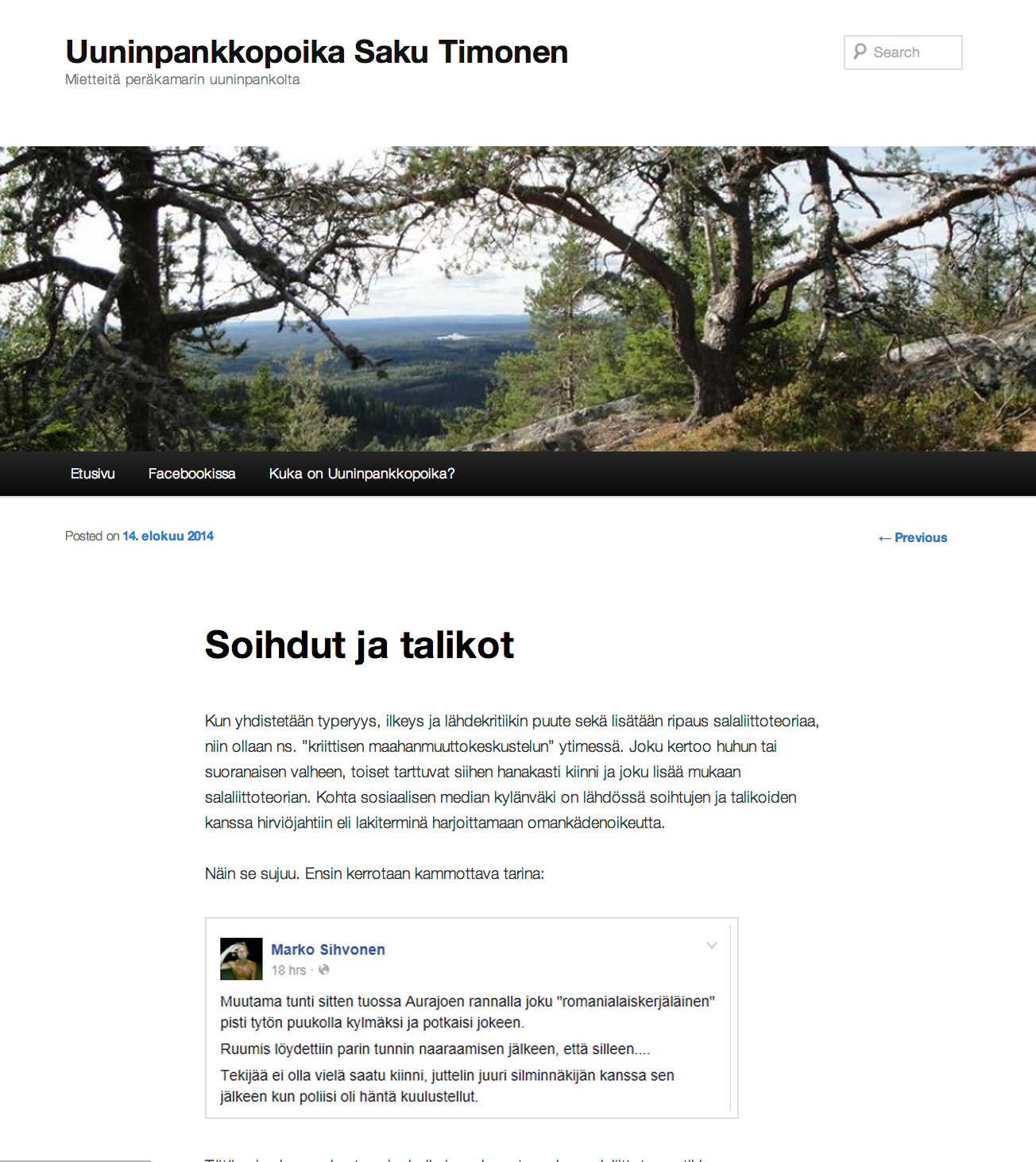
Sakari Timonen is one of the best anti-racism bloggers in Finland. He writes this time about a Marko Sihvonen, who made up a story on a Facebook post that a member of the Romany minority, one of the few that come here to ask for money on the streets, knifed a white Finnish girl and kicked the corpse in Turku’s Aura River. The girl was apparently found a couple of hours later.

Sihvonen continues: ”The killer is still on the loose. I spoke with a witness after the police had questioned the person.”

After the story went viral, Turku-based daily, Turun Sanomat, published a story by Sihvonen was posted when he was drunk and a hoax.

Näyttökuva 2014-8-15 kello 0.29.00

Read full posting (in Finnish) here.


According to the daily, no charges will be brought by the police against Sihvonen but he’ll be sent a bill by the rescue department that went to look for the corpse.

Another story that circulated as a rumor on Sunday took place in the western city of Kokkola, where supposedly a foreign-looking man had raped a white Finnish woman and was still at large. The police had to send a statement that was published by tabloid Iltalehti that the story was made up by the woman.

While these types of made-up stories show the malice that some people have towards migrants and minorities, instigating a social-media witch hunt can be beneficial to some seeking political office.

Perussuomalaiset (PS)* MEP Jussi Halla-aho claimed in 2010 with Muutos 2011 MP James Hirvisaari, who was sacked from the PS after he posting a picture of a friend making a Nazi salute in parliament, went viral after they claimed that a nineteen-year-old asylum-seeker had raped a seventeen-year-old girl from Lammila.

The rape case never got to court because it was apparently made up.

Both Halla-aho and Hirvisaari, who were running at the time for parliament, got a lot of media attention. Both got elected to parliament.


* The Finnish name for the Finns Party is the Perussuomalaiset (PS). The English names of the party adopted by the PS, like True Finns or Finns Party, promote in our opinion nativist nationalism and xenophobia. We therefore prefer to use the Finnish name of the party on our postings.

Ana María Gutiérrez Sorainen: Se kehuttu Kanadan maahanmuuttomalli

Posted on August 12, 2014 by Migrant Tales

Ana María Gutiérrez Sorainen*

picture-989-e2eb8e4e1144547f1dbf02a6e111702e


Julkisessa keskustelussa moni sanoo, että lääke Suomen maahanmuuttopolitiikan ”parantamiselle” löytyy Atlantin takaa, Kanadasta. Harva on kuitenkin se, joka selittää, mitä se Kanadan maahanmuuttomalli sisältää. Se on ymmärrettävää, koska Kanadan maahanmuuttomalli tai systeemi on monitahoinen ja monimutkainen.

Kanadassa on kolme maahanmuuttoperustetta: perheen yhdistäminen, taloudellinen maahanmuutto ja pakolaisten suojelu. Kanadalla on siis myös humanitaarinen maahanmuutto-ohjelmansa, joka kulkee koko ajan rintarinnoin työperäisen maahanmuuton kanssa.

Kanadalaisten taloudellisen maahanmuuttomallin pääpointti on siinä, että sisään päästetään erityisesti hyvin koulutettuja ihmisiä pisteytyksen mukaisesti. Toisin kuin Suomi, Kanada houkuttelee aktiivisesti koulutettua työvoimaa muuttamaan maahan.

Esimerkiksi ensi vuoden (2015) alussa Kanadassa otetaan käyttöön (olemassa olevien ohjelmien lisäksi) myös niin kutsuttu “express maahantulo”. Ohjelma tulee tarjoamaan pysyviä oleskelulupia koulutetuille työnhakijoille. Kanada investoi 18.7 miljoonia dollaria tähän ohjelmaan seuraaviin kolmeen vuoteen. Samalla on jo julkaistu listan 50 ammateista, joissa Kanadassa on työvoimapulaa ja joihin tarvitaan koulutettua työvoimaa. (Linkki on valitettavasti espanjaksi).Lyhyesti sanoisin, että taloustieteilijöille, finanssialan asiantuntijoille, insinööreille, lääkäreille ja sairaanhoitajille on Kanadassa kysyntä.

Kanadan taloudellinen maahanmuuttomallia on kritisoitu muun muassa siksi, että se kerää eri maista rusinat pullasta. Varsinkin kehitysmaille, koulutetun työvoiman siirto muihin maihin merkitsee taloudellisia ja yhteiskunnallisia menetyksiä. Toisaalta jo monille kehitysmaalle ulkomailla asuvien rahalähetykset muodostavat tärkeän taloudellisen elpymismekanismin.

Kanadan malli keskittyy aktiiviseen työperäiseen maahanmuuttoon ja ihmisten integraatioon yhteiskuntaan “yhtenä meistä”. Kanadassa on myös perheenyhdistäminen suuressa arvossa. Koska Kanadaan muuttanut työntekijä ei voi itse vaikuttaa siihen, millaisista vanhemmista hän on tullut, niin Kanadaan pääsee myös kouluttamattomia tai heikosti koulutettuja ihmisiä. Myös omaa puolisoa ja omia lapsia ei pisteytetä. Toki terveys ja puhdas rikosrekisteri ovat tärkeitä seikkoja. Heikosti koulutetutkin maahanmuuttajat ovat löytäneet paikkansa kanadalaisessa yhteiskunnassa. Osalla on mennyt tosi hyvin ja toisilla ei.

Kanadan maahanmuuttomalli taitaa olla vähän kaukana suomalaisten “maahanmuuttokriitikoiden” toiveista. Pisteytys ei ole siis mikään rautamuuri ”epämiellyttävälle maahanmuutolle”. Pisteytys on vain yksi osa Kanadan maahanmuutosta.

Kanadan malli ei merkitse luopumista humanitaarisesta maahanmuutosta. Kanadan valtio laittaa maahanmuuttoon ja varsinkin työperäiseen maahanmuuttoon paljon rahaa. Suomessa taas aina välillä kuulee vaatimuksia, että maahanmuuttorahoista kuin myös kehitysyhteistyörahoista pitää luopua!

Kanada ja Suomi maahanmuuttomaina ovat kuin aurinko ja yö niin asennoitumisessa vastaanottoon kuin myös vastaanotettujen ihmisten määrässä. Kanadassa on pitkät maahanmuuttoperinteet, toisin kuin Suomella.

Maahanmuuton onnistuminen ja epäonnistuminen ei ole kiinni ainoastaan tulijoiden koulutuksesta vaan myös vastaanottavan maan kyvystä antaa jokaiselle tulijalle onnistumismahdollisuuksia opiskelussa ja työelämässä, myös omalla koulutus ja/tai asiantuntemusalalla.

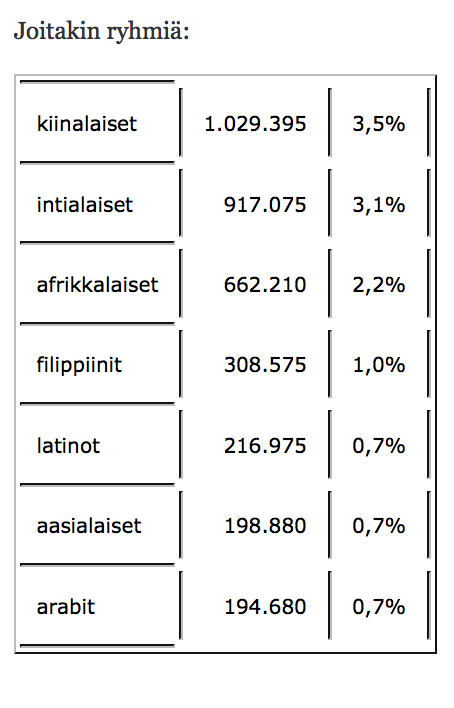
Kanadassa asuu noin 6 miljoonaa maahan muuttanutta kansalaista. Joka vuosi maahan saapuu keskimäärin 240 tuhatta uutta ihmistä pisteytyssysteemin kautta. Kanadaan muutetaan eniten Yhdistyneestä Kuningaskunnasta, Kiinasta, Intiasta, Filipiinista, Italiasta ja Yhdysvalloista.

Kanadan väestö: 35 158 300 (Kanadan tilastokeskus 2013)

Näyttökuva 2014-8-12 kello 22.34.57


*Kansalaisaktivisti, entinen kunnanvaltuutettu, espanjan kielen opettaja, kääntäjä ja tulkki, blogisti, neljän lapsen äiti, Suomen kansalainen.

What Finnish anti-immigration politicians write about migrants

Posted on August 12, 2014December 30, 2024 by Migrant Tales

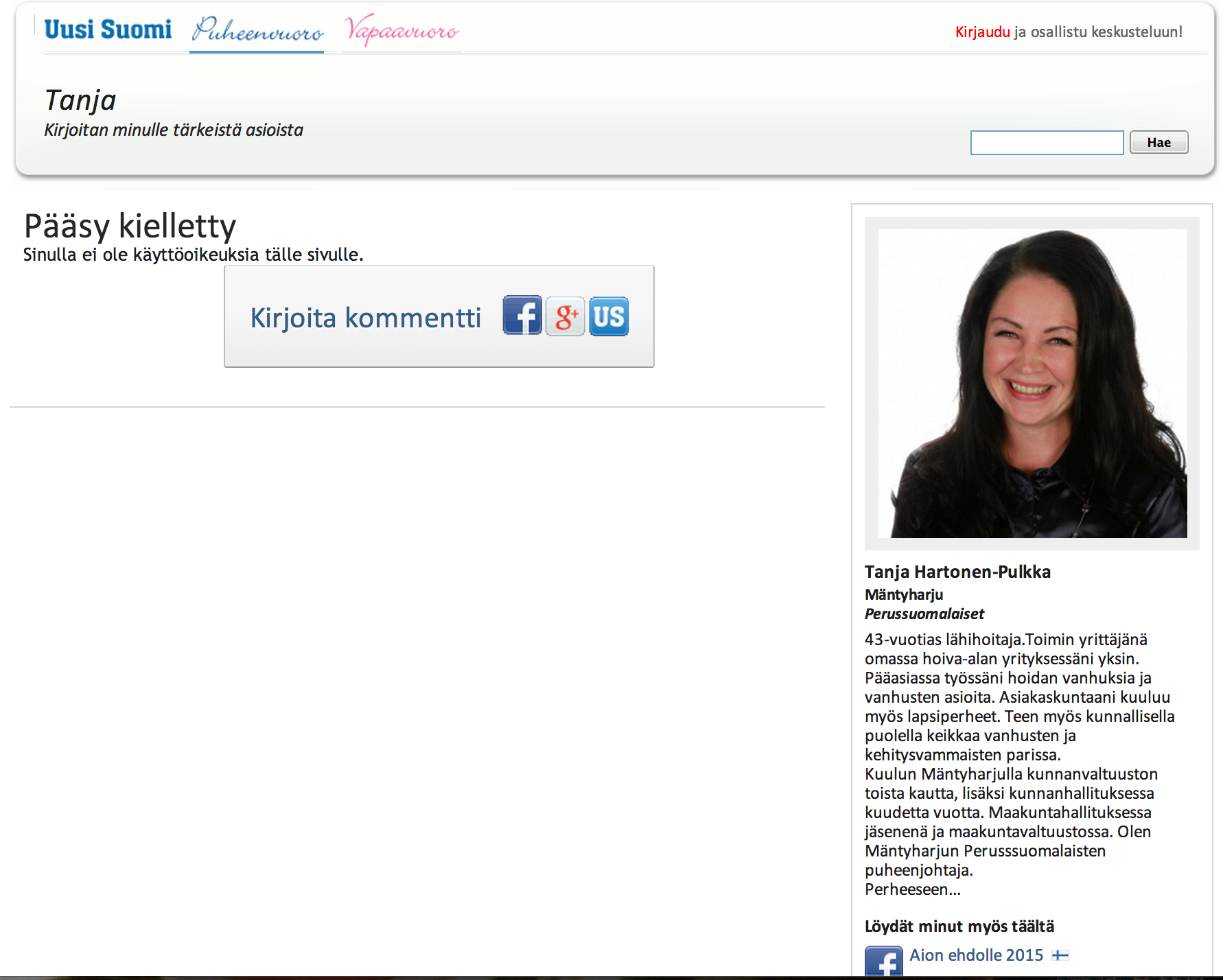
Migrant Tales insght: This short blog entry below by Tanja Hartonen-Pulkka became quite a sensation in Finnish social media websites when it was published on Sunday and taken down on Monday by Uusi Suomi. Hartonen-Pulkka is very active in the Mäntyharju town council, where she is a councilwoman  for the Perussuomalaiset (PS)* party and a member of the town board. Her blog entry below isn’t atypical of what some anti-immigration politicians write about migrants. 

From what Migrant Tales can gather, Hartonen-Pulkka argues that Finland will be taken over by migrants (or non-white Finns), who have no worth in our society because they live off social welfare and are lazy. 

Mäntyharju (pop. 6,200) is a small town in Eastern Finland with a miniscule foreign population. A mere 1.9% of the town’s population speak as their mother tongue another language other than Finnish (97.9%) or Swedish (0.2%). 

She writes:

Soon Finland won’t look like Finland anymore, or Finns at this rate. At this rate, we’ll become a minority in our own country.

Cultural enrichment (what a term!) is in some people’s opinion a good thing? Oh in order to make Finns more sociable? What’s wrong with our culture anyway? If somebody doesn’t speak or kiss you, that’s how things are.

Näyttökuva 2014-8-12 kello 12.48.35

Now you see Tanja Hartonen-Pulkka’s blog entry on Uusi Suomi…

There’s not enough money and there aren’t any jobs. A recent study showed how first-generation immigrants don’t learn [at school]. [They are] 2 years behind [Finns] and their math skills are below average and finding work and getting a postgraduate education are difficult. If you don’t know anything, and if you don’t get an education, you’re not interested in work either. Or social welfare will help. That also happens to Finns – they mop floors or drive buses (without putting down different professions I myself am by vocation an orderly).

Even if some blame prejudice since they (migrants) aren’t hired. Isn’t a skill [a more] important [factor] than a person’s background when hiring somebody.

Näyttökuva 2014-8-11 kello 13.06.14

…and now you don’t.

There are [many] jobless among our own ethnic (what a word as well) Finnish youths.

Jobs for Finns and for Finnish skills. Our educational system has always been praised. Why is there then such a disconnection between people and education.

* The Finnish name for the Finns Party is the Perussuomalaiset (PS). The English names of the party adopted by the PS, like True Finns or Finns Party, promote in our opinion nativist nationalism and xenophobia. We therefore prefer to use the Finnish name of the party on our postings.


Six-year fruitless search for a Muslim burial ground in Finland

Posted on August 11, 2014 by Migrant Tales

The Finnish Islamic Council has been searching without success since 2008 for a burial ground in the southern Finnish region of Uusimaa, according to YLE in English. Up to know, Muslims are buried in the “Muslim section” of Lutheran Church cemeteries.

Pia Jardi, deputy chair of the Finnish Islamic Council, told Migrant Tales that a questionnaire was sent to 16 municipalities about the matter but only four responded: Helsinki, Espoo, Vantaa and Tuusula.

She said that she was surprised by the large number of municipalities that didn’t respond.

“Are they worried about voters [if there is a Muslim cemetery in their municipality]?” she said. “Muslims do the same thing in graves as any other people.”

Näyttökuva 2014-8-11 kello 16.08.26

Read full story here.

Jardi said that cooperation with the Lutheran Church has been good.

“We’ve been sometimes asked why don’t we bury our dead in the Tatar Cemetery of Hietaniemi [in Helsinki],” she continued.  “This isn’t possible since you have to be a member of the Tatar community to be buried there.”

The six-year search is a good example of how some sectors of Finland persist in the belief that very little will change as our society becomes more culturally diverse.  Our laws and values speak of integration, or two-way adaption, but what happens in too many cases is assimilation or expectations of the latter.

“You would certainly think that we would find an area in Uusimaa that could be rezoned for cemetery use,” Jardi was quoted as saying on Yle in English. “Perhaps is has to do with a lack of political will. If you even scan web forums they are extremely anti-Muslim…”

There are some 60,000 Muslims estimated living in Finland.

Racism is dirty and expensive business for any society

Posted on August 10, 2014 by Migrant Tales

A study by the Ombudsman of Minorities in Finland reveals that over two thirds of Finnish Roma that were surveyed said they had experienced discrimination in the past year, according to a Migrant Tales story published Sunday. While these types of studies are needed and are highly important, they continue to remind us of a disturbing fact: racism is still alive and kicking in this country.

Näyttökuva 2014-8-10 kello 19.05.19

Read full story here.


While the bad news is that racism is a social issue in this country, the good news is that it is being challenged by migrants and minorities like the Roma.

One of the most important matters to keep in mind when looking at a social ill like racism is that it’s messy and expensive business.

Apart from squandering human resources and opportunities, racism and bigotry usually serve people with low self-esteem, lazy journalists, unjust power structures,  greedy and opportunistic politicians from populist parties like the Perussuomalaiset (PS)* that have built their political careers by spreading hatred and prejudices of other groups.

Even if some parties like the PS claim to be “patriotic” because they want us to believe that they are serving the country’s best interests by spreading intolerance, they are actually the biggest  menace to our society. Maintaining high unemployment by victimizing certain groups costs tax-payers an arm and a leg.

One of the many examples of the hatred and suspicion that politicians spread about migrants is Mäntyharju PS councilwoman Tanja Hartonen-Pulkka, who writes that Finland will no longer be Finland because at this rate white Finns will be a minority in their country.

Economist Paul Krugman wrote recently in a New York Times opinion piece how inequality was a drag and how it was a drag on economic growth He writes:

Specifically, if you look systematically at the international evidence on inequality, redistribution, and growth — which is what researchers at the I.M.F. did — you find that lower levels of inequality are associated with faster, not slower, growth.

Thus if racism fosters economic and social inequality, we should take effective steps to challenge it. We shouldn’t be reading about surveys like the one by the Ombudsman for Minorities, but hopefully in the future how such cases have plummeted.

One reason why we are still very much in denial about intolerance is because those who have power still do too little to tackle the problem for a simple reason: It doesn’t affect them directly. Thus racism and social exclusion could be seen as a stalemate where those are hostile to you still haven’t figured out how to banish you altogether.

Certainly one of the biggest fallacies about integration, or two-way adaption, is that it actually happens on a wide scale. Certainly this type of discourse serves the interests of the majority culture.

A good example of the latter was a retired teacher I spoke to about two years ago. The person, who claimed to be an expert on “multiculturalism,” complained to me about the Muslim religion. I asked: “What are you offering in return for their religion? Our hatred and suspicion?

Our society has still a long way to go before it begins to respect cultural and ethnic diversity. In this task, migrants and minorities must do much more these days to represent themselves and challenge the very structures that encourage assimilation and only speak of integration as an ideal.

Finland has the means but do we have the will?

* The Finnish name for the Finns Party is the Perussuomalaiset (PS). The English names of the party adopted by the PS, like True Finns or Finns Party, promote in our opinion nativist nationalism and xenophobia. We therefore prefer to use the Finnish name of the party on our postings.


Over two thirds of Finnish Roma surveyed said they had experienced discrimination in the past year

Posted on August 10, 2014 by Migrant Tales

A study by the Ombudsman for Minorities of Finland reveals that a bit over two thirds of Finnish Roma that were surveyed said they had experienced discrimination in the past year, according to Turku-based Turun Sanomat.* Two-hundred and forty-nine Roma of different ages took part in the study. 

Näyttökuva 2014-8-10 kello 16.33.26

Read full story (in Finnish) here.


The majority of the discrimination cases took place at stores and gas stations. Some respondents said that one of most humiliating matters at stores or other public places was when they were followed by employees or security guards.

Half of  the respondents said they had suffered discrimination when seeking employment.

Meanwhile, the Pori District Court is looking into an extensive discrimination case involving 13 restaurant workers from nine restaurants in the western city of Pori that are suspected of discrimination on ethnic grounds, according to Turun Sanomat.

The accusations  are being brought by four Roma, who are joined by a white Finnish witnesses as well as a journalist of Pori-based daily Satakunnan Kansa.

One of the Roma at the trial asked the restaurant employee why he and three other Roma weren’t permitted to enter the premises. The employee responded: “Because you’re Gypsies.”


*Thank you Helena Kosonen for the heads-up.

Institute of Race Relations: Language testing of asylum claimants – a flawed approach

Posted on August 8, 2014 by Migrant Tales

By Aisha Maniar

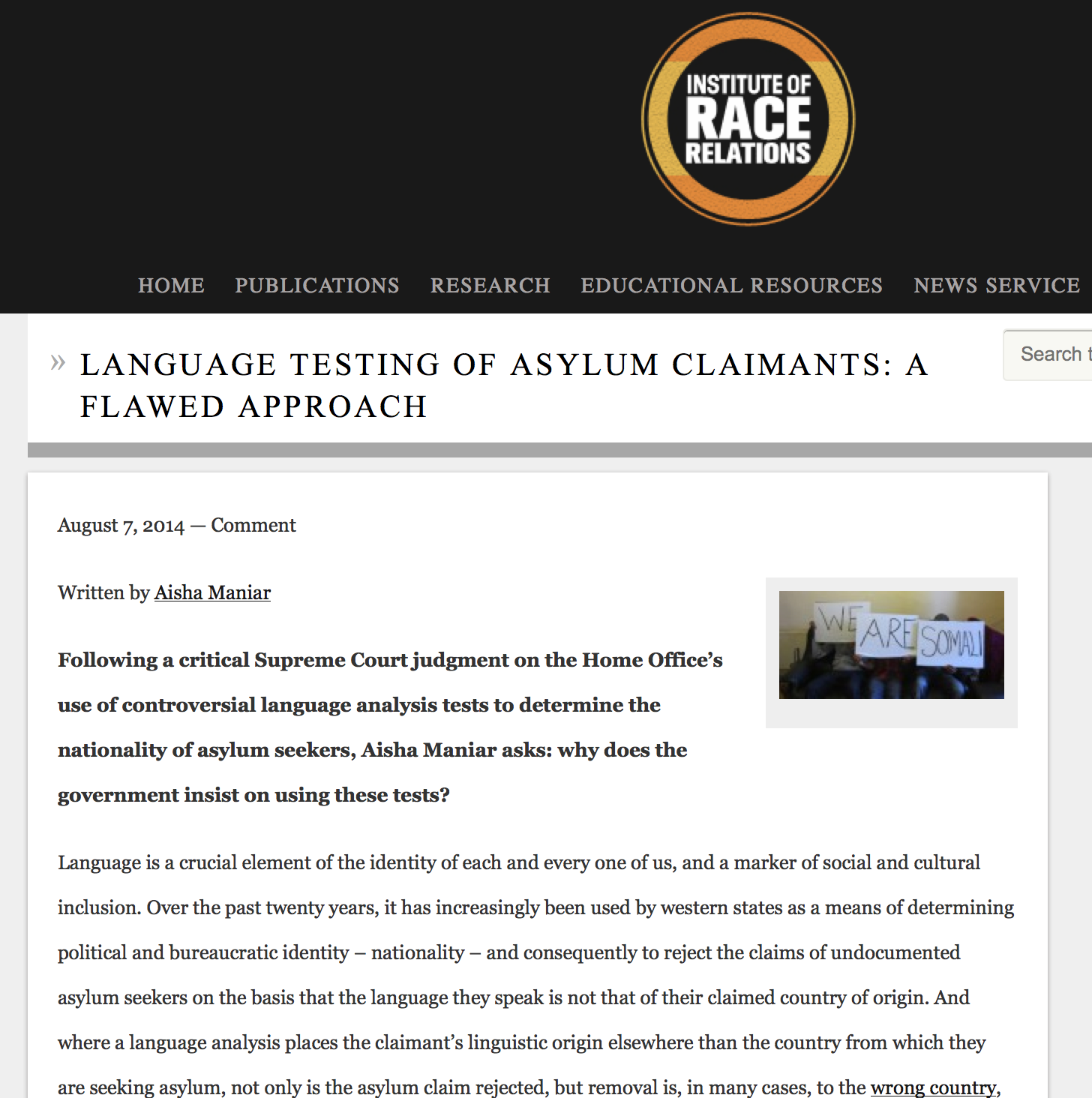
Following a critical Supreme Court judgment on the Home Office’s use of controversial language analysis tests to determine the nationality of asylum seekers, Aisha Maniar asks: why does the government insist on using these tests?
Näyttökuva 2014-8-8 kello 7.32.53
Read orginal posting here.


Language is a crucial element of the identity of each and every one of us, and a marker of social and cultural inclusion. Over the past twenty years, it has increasingly been used by western states as a means of determining political and bureaucratic identity – nationality – and consequently to reject the claims of undocumented asylum seekers on the basis that the language they speak is not that of their claimed country of origin. And where a language analysis places the claimant’s linguistic origin elsewhere than the country from which they are seeking asylum, not only is the asylum claim rejected, but removal is, in many cases, to the wrong country, which the language analysis deems them to come from.

Decisions made by the immigration authorities in asylum cases can be a matter of life and death. Can language, which has only a tenuous link to nationality – a stateless person has the former but not the latter – provide a reliable tool in determining the origin of asylum seekers?

Language analysis

Language analysis testing in determination of asylum claims is a relatively new area of linguistics, first used in the mid-1990s in Scandinavian countries, and now used elsewhere in Europe as well as in Australia, New Zealand and Canada. Some countries have their own government department providing the service, but most, including the UK, outsource it to small commercial companies. There is no set method for such testing, but in the UK, a typical language analysis[1] involves a taped telephone interview of the asylum seeker by a language analyst, lasting around twenty to thirty minutes, during which the analyst works through a standard list of questions and carries out a linguistic analysis and ‘knowledge assessment’[2] of the interviewee’s knowledge and experience of their stated country/region of origin. With a linguist, the analyst then assesses, to one of five degrees of certainty, whether the interviewee originates in the claimed country. The report can be produced within fifteen minutes of the interview, and is often treated as conclusive.

Following a pilot on several nationalities – including Iraqis, Afghans and Tamils who at the time made up a large number of applicants – the method has been used in the UK for the past decade, but has been subject to much criticism.

Sprakab

The UK Home Office uses the linguistic analysis services of Swedish company Skandinavisk Språkanalys AB, or Sprakab, a private commercial company which works almost exclusively for governments and in the public sector, providing similar services to the governments of Canada, Australia and the Netherlands, among others. Sprakab says that it has carried out over 40,000 tests in its fourteen-year history and currently provides 4,000 tests annually worldwide. Given that the ultimate purpose of such testing is to help determine entitlement to protection under international law, the use of a private profit-based corporation is a key criticism. The company’s insistence on the anonymity of its linguists and analysts ‘for their own safety’ has also been criticised for hampering transparency and understanding of the decision-making process.[3]

According to Sprakab’s website: ‘The results are very reliable and […] provide a clear picture of an individual’s language background’, yet before a court, the company manager ‘agreed that linguistic analysis could not determine a nationality’; ‘an individual’s language background’ is not an indicator of their nationality.[4]

Unqualified analysts, unreliable results

There is confusion over the role and qualifications of analysts and linguists employed by Sprakab. Home Office guidance[5] states that ‘Sprakab analysts have linguistics backgrounds and experience in dialectology’ and linguists ‘have the equivalent of a master’s degree in either linguistics or phonetics’. In many cases, this has proved not to be true. Very often the linguist is qualified in a related field (such as having a language degree) and the analyst’s main qualification is the ability to speak a language. Many analysts are employed to analyse the mother-tongue competency of asylum seekers in languages which they themselves do not have as a first language.

Additionally, Sprakab’s own standards lack the scientific accuracy one should expect of a forensic linguistic procedure. In over two decades of language analysis testing by Sprakab and other similar companies, there is no empirical evidence that language analysis bears any relevance to the determination of the citizenship or nationality of any individual. The general consensus among professional linguists and experts who provide testimony in court is that language analysis testing is not fit for purpose. Dr Derek Nurse, an expert on the minority Somali Bajuni community, describes the Sprakab analyses and conclusions he has examined as ‘brief, careless, lacking in supporting evidence, and unconvincing’. Other experts have called it ‘unwise‘ to rely on Sprakab reports to make legal decisions, with one submission to parliament stating that the process is‘deeply flawed, unprofessional, flies in the face of expert opinion, and infringes the Human Rights of large numbers of vulnerable individuals’.

Language matters

A large number of basic linguistic errors that undermine Sprakab’s purported experience and expertise have been pointed out. For example, contrary to the assumptions behind the tests, monolingualism is not the norm in many societies. In addition, the method does not take code-switching into account, a phenomenon in which a bilingual or multilingual speaker alternates between two or more languages, or language varieties, in a single conversation; it is often done unconsciously. It is also common for a speaker of a minority language to speak automatically in the dominant/majority language of a country/region when speaking to people outside of their own community. Nonetheless, a taped recording of less than thirty minutes is expected to provide certainty in assessing an individual’s nationality.

Other language issues that are ignored are more specific to refugee communities. For example, years and decades of war and upheaval can have a massive impact on the language patterns of a whole region – whole groups of people are dislocated, within and outside borders – and new social interactions are born. In addition, the reality of refugee diasporas is that generations now grow up and live permanently displaced in refugee camps in bordering countries. This dislocation inevitably affects the language of whole communities. Trauma can also have an impact on linguistic ability.[6]

In the case of the Somali Bajunis, who are almost always assessed as being Kenyan Swahili speakers, experts observed other issues such as, for example, the fact that the average educational level of members of this island community may not equip them to answer ‘knowledge assessment’ questions about Somali politics and history. Many Bajunis are not familiar with using telephones; in at least one case, it was the first time the interviewee had ever used a telephone.[7] Several experts have also reported that applicants seem ‘afraid and confused‘ by the impersonal telephone interview approach.

Language analysis cannot determine nationality

Leaving aside the methodology applied, the main criticism, particularly among professional linguists, is that such tests are of limited value, and in particular ‘cannot be used reliably to determine national origin, nationality or citizenship’, as these are ‘political or bureaucratic characteristics, which have no necessary connection to language’.[8] In recognition of the growing use (and misuse) of language tests for determination of origin, in 2004, a group of international linguists produced Guidelines for the Use of Language Analysis in Relation to Questions of National Origin in Refugee Cases, mainly for the use of governments and decision-makers, to emphasise the limitations of language testing and to deal with the difficulties. They point out that language tests can disclose the region of socialisation, but conclude that ‘language analysis should be used with considerable caution in addressing questions of national origin, nationality or citizenship’. The Guidelines, which offer clear and practical instructions for the use and limits of language testing, have since been endorsed by many professional linguistic organisations, including the British Association for Applied Linguistics (BAAL) and the International Association of Forensic Linguists (IAFL). But neither the Home Office nor Sprakab follow the Guidelines (they both have their own), and a decade on from their introduction, persisting problems show that they have not had quite the intended effect on the government and non-linguist decision-makers.

‘Anti-asylum seeker agenda’

Refugee advocates argue that language analysis testing is a ‘way of getting around the legal barriers‘ to send people back to war-torn countries. The UK has an obligation under European human rights and international refugee law to consider asylum claims and to provide protection to those fleeing persecution and violence. According to Dr Diana Eades, the use of language analysis testing falls within a ‘wider anti-asylum seeker agenda’.

One needs to look no further than the politicised language of the Home Office guidance: ‘The purpose of language analysis … is to assist in identifying an individual’s true place of origin where it is in doubt [and] deter fraudulent claims based on false claims of origin for actual or perceived benefit’. Testing is conducted ‘either because particular doubts are held’ or ‘because an inadequately documented individual claims to be a nationality/national origin that may be targeted under an exemption to the Equality Act 2010’.[9] The scales are weighted against the applicant before the interview has even taken place.

As of February 2013, an exemption has been applied to all asylum applicants claiming Syrian, Kuwaiti or Palestinian nationality, so if inadequately documented, they are automatically tested, and not just where there is ‘doubt’. The rationale for this is circular: language analysis testing, in particular between October 2011 and May 2012 (done, of course, by Sprakab) showed that ‘abuse was particularly apparent for [these] three claimed nationalities or national origins’.

Taken in the context of the UK’s response to Syria, the world’s largest refugee crisis in recent years, the purpose may be simply to deter applicants from that country. The UN estimates that approximately 2.7 million people have fled the war in Syria in the past few years, with the vast majority seeking refuge in neighbouring countries. In Britain, only fifty people have been accepted as refugees this year under the government’s Vulnerable Persons Relocation package, which was adopted by the government only after a big public campaign. In the case of Somalis, widely targeted by such testing, it has been claimed that ‘applicants may have undergone language analysis simply because they claimed to be Somali, rather than because of doubts about them as individuals’.[10]  Whole groups of people are targeted rather than considering individual applications on their own merits, as required under the Refugee Convention.

Legal challenges

Over the past decade, legal challenges, using expert criticisms frequently based on the Guidelines, have resulted in some improvements to language analysis testing in the UK, and a large number of Home Office decisions made on the basis of such analyses are overturned at appeal, at great cost to the Home Office. But legal decisions have left the basic structure of language testing intact. In a test case brought by a Somali Bajuni woman, the panel of judges at the Upper Tribunal gave guidance on how Sprakab reports are to be used, endorsing them subject to certain safeguards. The case, RB (Somalia), was subsequently upheld in all main respects by the Court of Appeal in 2012. It controversially ruled that where the analyst expressed ‘a high degree of certainty’, little further evidence would be needed to establish the interviewee’s nationality – giving the green light to the Home Office to present language analysis as ‘conclusive’ evidence that asylum seekers were not from their claimed country. The approach was compounded by analysts expressing their opinions as to the general credibility of the interviewee, based on answers to ‘knowledge’ questions. Both these abuses were nailed by the Supreme Court in Secretary of State for Home Department (Appellant) v MN and KY (Respondents) (Scotland). MN and KY both claimed to be from the minority Benadiri clan, which in KY’s case at least was sufficient to make her a refugee, and in both cases, Sprakab testing was relied on to reject their asylum applications. The analysts claimed they were Kenyans and not Somalis. The anonymous Sprakab analyst assessing KY had not visited Somalia since 1990 (eighteen years before the test took place), was not an analyst for her language and, while university-educated, had no background in linguistics or languages. Adding his own value judgement to her ‘knowledge assessment’, he stated ‘Her knowledge sounds rehearsed’.

The Supreme Court endorsed the Scottish Court of Session’s ruling that the Sprakab analysis could not be relied on, adding that Sprakab analysts should not go beyond their scope as experts by offering their opinion on an asylum seeker’s credibility – ‘Expert witnesses should never act or appear to act as advocates’ – and that if anonymity is to be granted to analysts, there must be safeguards for the context within which this applies.

In many ways, the Supreme Court ruling simply endorsed the rules set out in the Guidelines as well as the Home Office’s own guidance – such as not relying on language analysis testing alone – and those of Sprakab. But unlike the experts, the court did not question the purpose of language analysis or call for its use to be abandoned.

Two plus two equals five

There are many reasons why asylum seekers arrive without documentation or adequate proof of their identity. It does not make the work of those tasked with processing their claim any easier. Nonetheless, Britain has a history of policies of deterrence of asylum seekers, and its record as one of the biggest arms manufacturers and exporters in the world, and its support for warmongers and war criminals which make it (albeit indirectly) a major producer of refugees, do not allay concerns that language analysis, along with other quasi-scientific approaches,[11] are designed for deterrence rather than for scientific accuracy. Untested approaches such as language analysis testing will inevitably be the norm, in spite of the costs involved. A redacted 2012 study on the impacts and economic costs and benefits of language analysis testing offers no clear conclusions on the benefits of this approach, but concedes that asylum applications have been steadily falling in recent years.

There may be some benefit in language testing, but ultimately the decision made is political. The reasons for which individuals seek asylum and for which it is granted or denied are also political. The very premise for this approach is couched in political terms. As Diana Eades states, ‘the ultimate problem here is not a linguistic one. Linguists are not responsible for, nor qualified to, provide a solution to this problem, namely the validation of nationality claims’. Language testing may be an answer, but not if validating the nationality of asylum seekers is the question.

Read original story here.

This piece was reprinted by Migrant Tales with permission.

[1] See Home Office asylum process guidance: ‘Language analysis’. [2] See discussion in Secretary of State for the Home Department v MN and KY [2014] UKSC 30. [3] For this and many other criticisms see the decision by the Inner House of the Court of Session in MN and KY’s case. [4] See Secretary of State v MN and KY above. [5] See note 1 above. [6] See in particular the report by D Nurse, Overview of Sprakab linguistic analyses of Bajuni refugee claims 2004-2010 (2010, modified 2013). [7] Cited by the Inner House of the Court of Session in MN and KY’s case, note 3 above. [8] From the Guidelines for the use of language analysis in relation to questions of national origin in refugee cases. See an earlier IRR News article, ‘The use and abuse of language analysis in asylum cases’ (21 July 2005). [9] An exemption to the Equality Act 2010, granted by ministerial authorisation, allows immigration officers to discriminate against groups defined by nationality, national or ethnic origin for the purposes of immigration control, by, for example, subjecting members of such groups to more intensive examination or carrying out additional tests. [10] See Sarah Craig, ‘The use of language analysis in asylum decision-making in the UK – a discussion’ in Journal of Immigration, Asylum and Nationality Law (2012) 255. [11] For other quasi-scientific approaches to assessment of origin see ‘Bad science?’, IRR News (24 September 2009). See also Craig, note 10 above.

 

Helsingin Sanomat: Ulkomaisten tutkijoiden vaikea työllistyä Suomessa

Posted on August 7, 2014 by Migrant Tales
Gareth Rice

Kun saavuin Suomeen yliopistotutkijana Britanniasta, päätin yrittää olla valittamatta siitä, miten Suomessa korkeakoulujärjestelmää hoidetaan. Valittaminen on kuitenkin luonnollista, ja olen varma, että miltei jokainen Suomessa asuva ulkomaalainen on tehnyt niin ainakin kerran.

Näyttökuva 2014-8-7 kello 22.25.01

Lue alkuperäinen kirjoitus tästä.

Suomalaista korkeakoulujärjestelmää pyörittää joukko vaikutusvaltaisia suomalaisia professoreita, jotka toimivat portinvartijoina. Ulkomaalaisten akateemisesti koulutettujen on vaikea päästä vakituisiin tehtäviin.

Suomen korkeakoulujärjestelmän avautumisessa muunmaalaisille lahjakkaille tieteentekijöille on tapahtunut edistystä, mutta kehitys on ollut hidasta. Saadakseni tarkemman käsityksen asiasta lähetin kaikille Suomen yliopistoille sähköpostin, jossa tiedustelin ulkomaisen henkilökunnan määrää.

Turun yliopiston tilanne kuvaa koko maata. Viidestäsadasta Turun yliopiston vakituisesta työsopimuksesta vain 21 ei ole Suomen kansalaisten hallussa. Näistä vain kahdeksan puhuu äidinkielenään jotakin muuta kuin suomea, ruotsia tai saamea.

Olen ihmetellyt näitä tilastoja sekä muita samantapaisia asioita, joita olen nähnyt aiemmin. Tutkittuani asioita ja puhuttuani tutkijakollegoille eri yliopistoissa ympäri Suomea minulle jäi neljä mahdollista selitystä tilanteelle.

Ensimmäinen on suomen kieli. Ilman kykyä puhua tai ainakin lukea suomea suuri osa maan korkeakoulujärjestelmää ja laajempaa kulttuuria jää ulkomaalaisen ulottumattomiin.

Toiseksi suomalaiset nimittävät tehtäviin mieluummin “omiaan” kuin ulkomaalaisia, kyvyistä huolimatta.

Kolmanneksi on suomalaisia, jotka kokevat, että tietoa tulisi toisintaa tietyllä tavalla ja että heillä on etuoikeus pysyviin akateemisiin työsopimuksiin Suomessa yksinkertaisesti siksi, että tämä on “heidän maansa”.

Neljäs mahdollinen selitys yllätti minut: suomalaiset tieteentekijät ovat epävarmoja itsestään eivätkä halua ottaa riskiä, että ulkomaalainen tutkija saattaisi haastaa heidät, mikä voisi vähentää heidän arvovaltaansa.

Tuntuu, että maan hierarkkisen korkeakoulujärjestelmän isoisät valitsevat mieleisensä eliitin jatkamaan perittyjä periaatteita ja varmistavat näin korkeakoulujärjestelmän toisinnan nykyisessä muodossaan.

Olen kuitenkin kiitollinen suomalaiselle korkeakoulujärjestelmälle monista niistä asioista, joita se on minulle opettanut.

Näistä opetuksista tärkeimmän professori Michael Ignatieff ilmaisi ytimekkäästi oivaltavassa muistelmateoksessaan Fire and Ashes.

“Kun asuu muiden ihmisten maassa, törmää ajan mittaan lasioviin ja suljettuihin alueisiin, jotka on varattu sisäpiirille. Tajuaa ymmärtävänsä ainoastaan sen, mitä sisäpiiriläiset sanovat, mutta ei sitä, mitä he todella tarkoittavat.”

Gareth Rice
tutkija, yliopistonopettaja
Helsinki

The PS of Finland once again reveals its hostility towards migrants and cultural diversity

Posted on August 6, 2014 by Migrant Tales

One of the most interesting matters to watch about the Perussuomalaiset (PS)* party is how their explanations and arguments change to hide their hostile and xenophobic stances against migrants and Finland’s ever-growing cultural diversity. PS party secretary Riikka Slunga-Poutsalo was quoted as saying on YLE that Finland should stop development aid and end welfare to refugees and migrants. 

Once again the PS’ hostile stance to migrants and minorities in this country is exposed in the raw. The statement by Slunga-Poutsalo, one of the signers of the anti-immigration Nuiva Manifesto, reveals as well how much out of touch the party is with migrants and migration.

While the Nuiva Manifesto favours assimilation, or one-way adaption, Finland’s constitution and its laws support integration, or two-way adaption.

The proximity of next year’s parliamentary elections is one of the reasons why the PS’ party secretary is making these types of xenophobic statements. The other reason is that she, like her party, loathe migrants and cultural diversity.

Näyttökuva 2014-8-6 kello 17.25.31


Read full story (in Finnish) here.


We’ve heard similar statements by the PS in the past. If the PS doesn’t want refugees in Finland, why would it want to stop development aid? Doesn’t development aid discourage migrants from coming to this country?

The most distressing matter about Slunga-Poutsalo’s comments is that it wants she wants to stop offering welfare to migrants that cannot support themselves upon moving to Finland. Even if it isn’t clear what this actually implies, the context of the statement reveals that the PS wants migrants to be second-class members of society.


* The Finnish name for the Finns Party is the Perussuomalaiset (PS). The English names of the party adopted by the PS, like True Finns or Finns Party, promote in our opinion nativist nationalism and xenophobia. We therefore prefer to use the Finnish name of the party on our postings.


  • Previous
  • 1
  • 2
  • 3
  • Next
Read more about documentary film
Read more

Recent Posts

  • Finland’s tabloids Iltalehti and Ilta-Sanomat are the pits
  • Riikka Purra’s Dr Jekyll and Mr Hyde mask
  • Double standards
  • Perussuomalaiset: Uusi logo, sama vanha juttu
  • Taco Trump

Recent Comments

  1. Absolutely Socking: Racist Finnish Facebook group against human rights gets flooded with socks on Musta Barbaari’s mother and sister charged by the police in “ethnic profiling” case
  2. Ilkka Nuotio on Pekka Myrskylä: “Tilastot kertovat toista kuin poliittinen keskustelu”
  3. Genrih Soinkara on The war in Ukraine and the Russian-Finnish border crisis are showing Finland’s ugly side
  4. Ahti Tolvanen on Comment by Ahti Tolvanen on the Helsinki +50 conference
  5. Angel Barrientos on Angel Barrientos is one of the kind beacons of Finland’s Chilean community

Archives

  • June 2026
  • May 2026
  • April 2026
  • March 2026
  • February 2026
  • January 2026
  • December 2025
  • November 2025
  • October 2025
  • September 2025
  • August 2025
  • July 2025
  • June 2025
  • May 2025
  • April 2025
  • March 2025
  • February 2025
  • January 2025
  • December 2024
  • November 2024
  • October 2024
  • September 2024
  • August 2024
  • July 2024
  • June 2024
  • May 2024
  • April 2024
  • March 2024
  • February 2024
  • January 2024
  • December 2023
  • November 2023
  • October 2023
  • September 2023
  • August 2023
  • July 2023
  • June 2023
  • May 2023
  • April 2023
  • March 2023
  • February 2023
  • January 2023
  • December 2022
  • November 2022
  • October 2022
  • September 2022
  • August 2022
  • July 2022
  • June 2022
  • May 2022
  • April 2022
  • March 2022
  • February 2022
  • January 2022
  • December 2021
  • November 2021
  • October 2021
  • September 2021
  • August 2021
  • July 2021
  • June 2021
  • May 2021
  • April 2021
  • March 2021
  • February 2021
  • January 2021
  • December 2020
  • November 2020
  • October 2020
  • September 2020
  • August 2020
  • July 2020
  • June 2020
  • May 2020
  • April 2020
  • March 2020
  • February 2020
  • January 2020
  • December 2019
  • November 2019
  • October 2019
  • September 2019
  • August 2019
  • July 2019
  • June 2019
  • May 2019
  • April 2019
  • March 2019
  • February 2019
  • January 2019
  • December 2018
  • November 2018
  • October 2018
  • September 2018
  • August 2018
  • July 2018
  • June 2018
  • May 2018
  • April 2018
  • March 2018
  • February 2018
  • January 2018
  • December 2017
  • November 2017
  • October 2017
  • September 2017
  • August 2017
  • July 2017
  • June 2017
  • May 2017
  • April 2017
  • March 2017
  • February 2017
  • January 2017
  • December 2016
  • November 2016
  • October 2016
  • September 2016
  • August 2016
  • July 2016
  • June 2016
  • May 2016
  • April 2016
  • March 2016
  • February 2016
  • January 2016
  • December 2015
  • November 2015
  • October 2015
  • September 2015
  • August 2015
  • July 2015
  • June 2015
  • May 2015
  • April 2015
  • March 2015
  • February 2015
  • January 2015
  • December 2014
  • November 2014
  • October 2014
  • September 2014
  • August 2014
  • July 2014
  • June 2014
  • May 2014
  • April 2014
  • March 2014
  • February 2014
  • January 2014
  • December 2013
  • November 2013
  • October 2013
  • September 2013
  • August 2013
  • July 2013
  • June 2013
  • May 2013
  • April 2013
  • March 2013
  • February 2013
  • January 2013
  • December 2012
  • November 2012
  • October 2012
  • September 2012
  • August 2012
  • July 2012
  • June 2012
  • May 2012
  • April 2012
  • March 2012
  • February 2012
  • January 2012
  • December 2011
  • November 2011
  • October 2011
  • September 2011
  • August 2011
  • July 2011
  • June 2011
  • May 2011
  • April 2011
  • March 2011
  • February 2011
  • January 2011
  • December 2010
  • November 2010
  • October 2010
  • September 2010
  • August 2010
  • July 2010
  • June 2010
  • May 2010
  • April 2010
  • March 2010
  • February 2010
  • January 2010
  • December 2009
  • November 2009
  • October 2009
  • September 2009
  • August 2009
  • July 2009
  • December 2008
  • November 2008
  • October 2008
  • September 2008
  • August 2008
  • July 2008
  • June 2008
  • May 2008
  • April 2008
  • March 2008
  • February 2008
  • January 2008
  • November 2007
  • October 2007
  • September 2007
  • August 2007
  • July 2007
  • June 2007
  • May 2007

Categories

  • ?? Gia L?c
  • ????? ?????? ????? ???????? ?? ??????
  • ???????
  • @HerraAhmed
  • @mondepasrond
  • @nohatefinland
  • @oula_silver
  • @Varathas
  • A Pakistani family
  • äärioikeisto
  • Abbas Bahmanpour
  • Abdi Muhis
  • Abdirahim Hussein Mohamed
  • Abdirahim Husu Hussein
  • Abdirisak Mahamed
  • About Migrant Tales
  • activism
  • Adam Al-Sawad
  • Adel Abidin
  • Afrofinland
  • Ahmed IJ
  • Ahti Tolvanen
  • Aino Pennanen
  • Aisha Maniar
  • Alan Ali
  • Alan Anstead
  • Alejandro Díaz Ortiz
  • Alekey Bulavsev
  • Aleksander Hemon
  • Aleksanterinliitto
  • Aleksanterinliitto ry
  • Aleksanterinliitto ry:n hallitus
  • Alex Alex
  • Alex Mckie
  • Alexander Nix
  • Alexandra Ayse Albayrak
  • Alexis Neuberg
  • Ali Asaad Hasan Alzuhairi
  • Ali Hossein Mir Ali
  • Ali Rashid
  • Ali Sagal Abdikarim
  • Alina Tsui
  • Aline Müller
  • All categories
  • Aman Heidari
  • Amiirah Salleh-Hoddin & Jana Turk
  • Amin A. Alem
  • Amir Zuhairi
  • Amkelwa Mbekeni
  • Ana María Gutiérrez Sorainen
  • Anachoma
  • Anders Adlecreutz
  • Angeliina Koskinen
  • Anna De Mutiis
  • Anna María Gutiérrez Sorainen
  • Anna-Kaisa Kuusisto ja Jaakko Tuominen
  • Annastiina Kallius
  • Anneli Juise Friman Lindeman
  • Announcement
  • Anonymous
  • Antero Leitzinger
  • anti-black racism
  • Anti-Hate Crime Organisation Finland
  • Anudari Boldbaatar
  • Arshiya Nasser
  • Aspergers Syndrome
  • Asylum Corner
  • Asylum seeker 406
  • Athena Griffin and Joe Feagin
  • Autism
  • Avaaz.org
  • Awale Olad
  • Ayan Said Mohamed
  • AYY
  • Barachiel
  • Bashy Quraishy
  • Beatrice Kabutakapua
  • Beri Jamal
  • Beri Jamal and Enrique Tessieri
  • Bertolt Brecht
  • Boiata
  • Boodi Kabbani
  • Bruno Gronow
  • Carmen Pekkarinen
  • Çelen Oben and Sheila Riikonen
  • Chiara Costa-Virtanen
  • Chiara Costa-Virtanen
  • Chiara Sorbello
  • Christian Thibault
  • Christopher Wylie
  • Clara Dublanc
  • Dana
  • Daniel Malpica
  • Danilo Canguçu
  • David Papineau
  • David Schneider
  • Dexter He
  • Don Flynn
  • Dr Masoud Kamali
  • Dr. Faith Mkwesha
  • Dr. Theodoros Fouskas
  • Edna Chun
  • Eeva Kilpi
  • Emanuela Susheela
  • En castellano
  • ENAR
  • Enrique
  • Enrique Tessieri
  • Enrique Tessieri & Raghad Mchawh
  • Enrique Tessieri & Yahya Rouissi
  • Enrique Tessieri and Muhammed Shire
  • Enrique Tessieri and Sira Moksi
  • Enrique Tessieri and Tom Vandenbosch
  • Enrique Tessieri and Wael Che
  • Enrique Tessieri and Yahya Rouissi
  • Enrique Tessieri and Zimema Mhone
  • Epäluottamusmies
  • EU
  • Europe
  • European Islamophobia Report
  • European Islamophobia Report 2019,
  • European Union
  • Eve Kyntäjä
  • Ezequiel Caldeiro
  • Facebook
  • Fadumo Dayib
  • Faisa Kahiye
  • Farhad Manjoo
  • Fasismi
  • Finland
  • Fizza Qureshi
  • Flyktingar och asyl
  • Foreign Student
  • Fozia Mir-Ali
  • Frances Webber
  • Frida Selim
  • Gareth Rice
  • Ghyslain Vedeaux
  • Global Art Point
  • Great Replacement
  • Habiba Ali
  • Hami Bahadori
  • Hami Bahdori
  • Hamid
  • Hamid Alsaameere
  • Hamid Bahdori
  • Handshake
  • Harmit Athwal
  • Hassan Abdi Ali
  • Hassan Muhumud
  • Heikki Huttunen
  • Heikki Wilenius
  • Helsingin Sanomat
  • Henning van der Hoeven
  • Henrika Mälmsröm
  • Hser Hser
  • Hser Hser ja Mustafa Isman
  • Husein Muhammed
  • Hussain Kazemian
  • Hussain Kazmenian
  • Ibrahim Khan
  • Ida
  • Ignacio Pérez Pérez
  • Iise Ali Hassan
  • Ilari Kaila & Tuomas Kaila
  • Imam Ka
  • inside-an-airport
  • Institute of Race Relations
  • Iraqi asylum seeker
  • IRR European News Team
  • IRR News Team
  • Islamic Society of Norhern FInland
  • Islamic Society of Northern Finland
  • Islamophobia
  • Jacobinmag.com
  • Jallow Momodou
  • Jan Holmberg
  • Jane Elliott
  • Jani Mäkelä
  • Jari Luoto
  • Jari Taponen
  • Jegor Nazarov
  • Jenni Stammeier
  • Jenny Bourne
  • Jessie Daniels
  • Joe Davidow
  • Johannes Koski
  • John D. Foster
  • John Grayson
  • John Marriott
  • Jon Burnett
  • Jorma Härkönen
  • Jos Schuurmans
  • José León Toro Mejías
  • Josue Tumayine
  • Jouni Karnasaari
  • Juan Camilo
  • Jukka Eräkare
  • Julian Abagond
  • Julie Pascoet
  • Jussi Halla-aho
  • Jussi Hallla-aho
  • Jussi Jalonen
  • JusticeDemon
  • Kadar Gelle
  • Kaksoiskansalaisuus
  • Kansainvälinen Mikkeli
  • Kansainvälinen Mikkeli ry
  • Katherine Tonkiss
  • Kati Lepistö
  • Kati van der Hoeven-Lepistö
  • Katie Bell
  • Kättely
  • Kerstin Ögård
  • Keshia Fredua-Mensah & Jamie Schearer
  • Khadidiatou Sylla
  • Khadra Abdirazak Sugulle
  • Kiihotus kansanryhmää vastaan
  • Kirsi Crowley
  • Koko Hubara
  • Kristiina Toivikko
  • Kubra Amini
  • KuRI
  • La Colectiva
  • La incitación al odio
  • Laura Huhtasaari
  • Lauri Finér
  • Leif Hagert
  • Léo Custódio
  • Leo Honka
  • Leontios Christodoulou
  • Lessie Branch
  • Lex Gaudius
  • Leyes de Finlandia
  • Liikkukaa!
  • Linda Hyökki
  • Liz Fekete
  • M. Blanc
  • Maarit Snellman
  • Mahad Sheikh Musse
  • Maija Vilkkumaa
  • Malmin Kebab Pizzeria Port Arthur
  • Marcell Lorincz
  • Mari Aaltola
  • María Paz López
  • Maria Rittis Ikola
  • Maria Tjader
  • Marja-Liisa Tolvanen
  • Mark
  • Markku Heikkinen
  • Marshall Niles
  • Martin Al-Laji
  • Maryan Siyad
  • Matt Carr
  • Mauricio Farah Gebara
  • Media Monitoring Group of Finland
  • Micah J. Christian
  • Michael McEachrane
  • Michele Levoy
  • Michelle Kaila
  • Migrant Tales
  • Migrant Tales Literary
  • Migrantes News
  • Migrants' Rights Network
  • MigriLeaks
  • Mikko Kapanen
  • Miriam Attias and Camila Haavisto
  • Mohamed Adan
  • Mohammad Javid
  • Mohammad M.
  • Monikulttuurisuus
  • Monisha Bhatia and Victoria Canning
  • Mor Ndiaye
  • Muh'ed
  • Muhamed Abdimajed Murshid
  • Muhammed Shire
  • Muhammed Shire and Enrique Tessieri
  • Muhis Azizi
  • Musimenta Dansila
  • Muslimiviha
  • Musulmanes
  • Namir al-Azzawi
  • Natsismi
  • Neurodiversity
  • New Women Connectors
  • Nils Muižnieks
  • No Labels No Walls
  • Noel Dandes
  • Nuor Dawood
  • Omar Khan
  • Otavanmedia
  • Oula Silvennoinen
  • Paco Diop
  • Pakistani family
  • Pentti Stranius
  • Perussuomalaiset
  • perustuslaki
  • Petra Laiti
  • Petri Cederlöf
  • Pia Grochowski
  • Podcast-lukija Bea Bergholm
  • Pohjois – Suomen Islamilainen Yhdyskunta
  • Pohjois Suomen Islamilainen Yhyskunta
  • Polina Kopylova
  • Race Files
  • racism
  • Racism Review
  • Raghad Mchawh
  • Ranska
  • Rashid H. and Migrant Tales
  • Rasismi
  • Raul Perez
  • Rebecka Holm
  • Reem Abu-Hayyeh
  • Refugees
  • Reija Härkönen
  • Remiel
  • Reza Nasri
  • Richard Gresswell
  • Riikka Purra
  • Risto Laakkonen
  • Rita Chahda
  • Ritva Kondi
  • Robito Ibrahim
  • Roble Bashir
  • Rockhaya Sylla
  • Rodolfo Walsh
  • Roger Casale
  • Rostam Atai
  • Roxana Crisólogo Correa
  • Ruth Grove-White
  • Ruth Waweru-Folabit
  • S-worldview
  • Sadio Ali Nuur
  • Sami Rusanen
  • Sandhu Bhamra
  • Sara de Jong
  • Sarah Crowther
  • Sari Alhariri
  • Sarkawt Khalil
  • Sasu
  • Scot Nakagawa
  • Shabana Ahmadzai
  • Shada Islam
  • Sharon Chang blogs
  • Shenita Ann McLean
  • Shirlene Green Newball
  • Sini Savolainen
  • Sira Moksi
  • Sonia K.
  • Sonia Maria Koo
  • Steverp
  • Stop Deportations
  • Suldaan Said Ahmed
  • Suomen mediaseurantakollektiivi
  • Suomen Muslimifoorumi ry
  • Suomen viharikosvastainen yhdistys
  • Suomen viharikosvastainen yhdistys ry
  • Suomi
  • Supermen
  • Susannah
  • Suva
  • Syrjintä
  • Talous
  • Tapio Tuomala
  • Taw Reh
  • Teivo Teivainen
  • The Daily Show
  • The Heino
  • The Supermen
  • Thomas Elfgren
  • Thulfiqar Abdulkarim
  • Tim McGettigan
  • Tino Singh
  • Tito Moustafa Sliem
  • Tobias Hübinette and L. Janelle Dance
  • Transport
  • Trica Danielle Keaton
  • Trilce Garcia
  • Trish Pääkkönen
  • Trish Pääkkönen and Enrique Tessieri
  • Tuulia Reponen
  • Uncategorized
  • UNITED
  • University of Eastern Finland
  • Uyi Osazee
  • Väkivalta
  • Vapaa Liikkuvuus
  • Venla-Sofia Saariaho
  • Vieraskynä
  • W. Che
  • W. Che an Enrique Tessieri
  • Wael Ch.
  • Wan Wei
  • Women for Refugee Women
  • Xaan Kaafi Maxamed Xalane
  • Xassan Kaafi Maxamed Xalane
  • Xassan-Kaafi Mohamed Halane & Enrique Tessieri
  • Yahya Rouissi
  • Yasmin Yusuf
  • Yassen Ghaleb
  • Yle Puhe
  • Yuliet Tresa
  • Yve Shepherd
  • Zahra Khavari
  • Zaker
  • Zalina Ametova
  • Zamzam Ahmed Ali
  • Zeinab Amini ja Soheila Khavari
  • Zimema Mahone and Enrique Tessieri
  • Zimema Mhone
  • Zoila Forss Crespo Moreyra
  • ZT
  • Zulma Sierra
  • Zuzeeko Tegha Abeng
© 2026 Migrant tales | Powered by Minimalist Blog WordPress Theme