Migrant tales
Menu
  • #MakeRacismHistory “In Your Eyes”
  • About Migrant Tales
  • It’s all about Human Rights
  • Literary
  • Migrant Tales Media Monitoring
  • NoHateFinland.org
  • Tales from Europe
Menu

Month: August 2014

Kokoomus MP Pia Kauma takes a cheap shot against migrants

Posted on August 30, 2014 by Migrant Tales

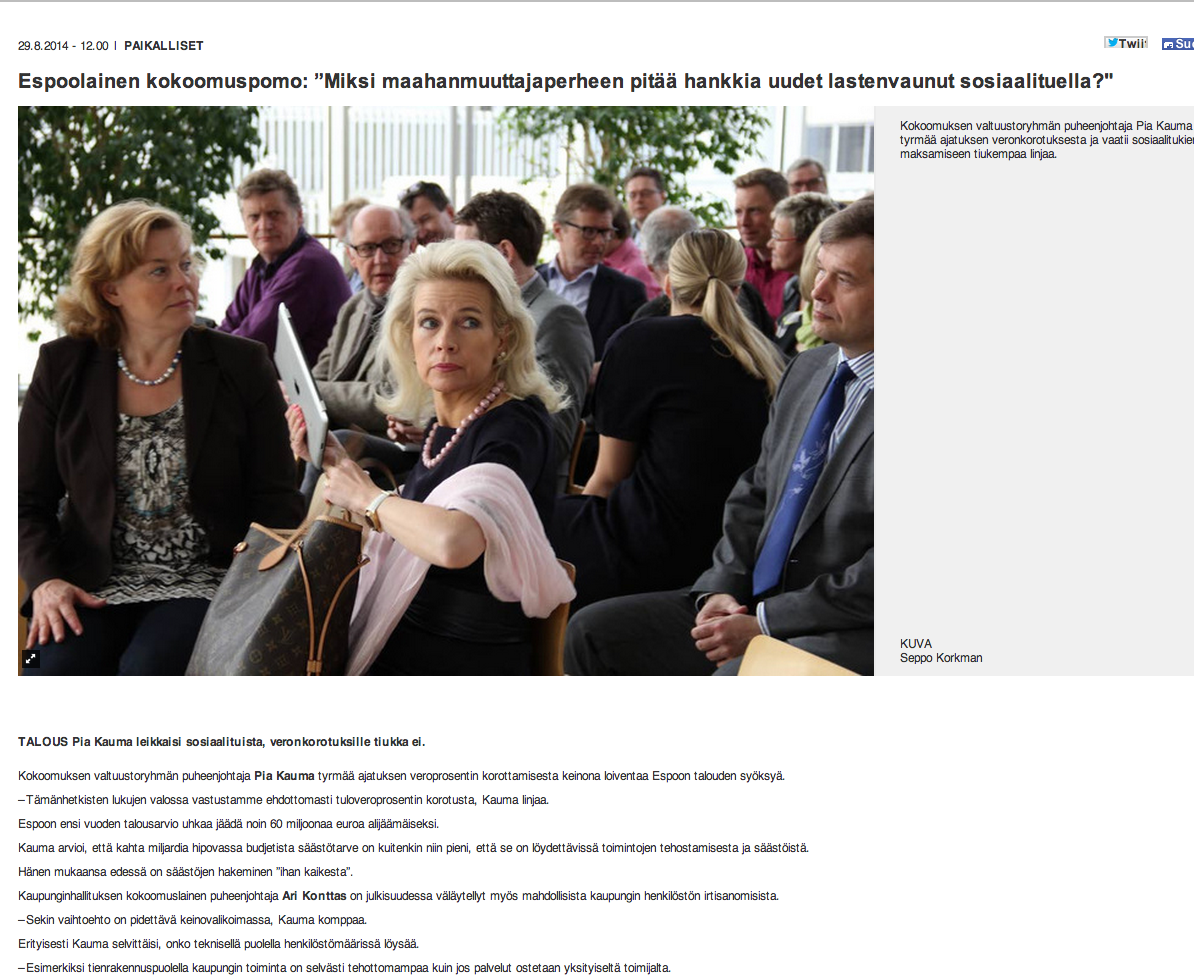
With parliamentary elections nearing in April 2015, politicians will do almost anything to get attention. We heard Perussuomalaiset (PS) chairman Timo Soini state this week that his party’s ass isn’t for sale. National Coalition Party (Kokoomus) MP and Espoo city councilwoman, Pia Kauma, now joins this questionable group by asking why the municipality should help migrants buy new baby carriages.

Espoo is located next to Helsinki and may face a 60-million-euro deficit in its budget. Kauma apparently believes that forcing migrant women, or women in general, to buy used baby carriages will help city plug its deficit.

Anyone with a little bit of insight, however, can tell that Kauma isn’t attacking migrant women with her statement, but all young mothers who may need social assistance.

Read Sakari Timonen‘s blog for more insight on the issue.

Kuvankaappaus 2014-8-30 kello 21.33.50

Read full story (in Finnish) here.

Another problem with what Kauma said is that she’s generalizing. There’s a danger that her victimization of migrant women may lead to violence against them. Racists will certainly get ammunition from the MP’s comment to harass “foreign-looking” women strolling the streets of Espoo with new baby carriages.

What else is wrong with what Kauma said?

It’s evident by her comment that she thinks very lowly of migrants, especially migrant women, and women in general who don’t make enough money to buy new baby carriages.

* The Finnish name for the Finns Party is the Perussuomalaiset (PS). The English names of the party adopted by the PS, like True Finns or Finns Party, promote in our opinion nativist nationalism and xenophobia. We therefore prefer to use the Finnish name of the party on our postings.

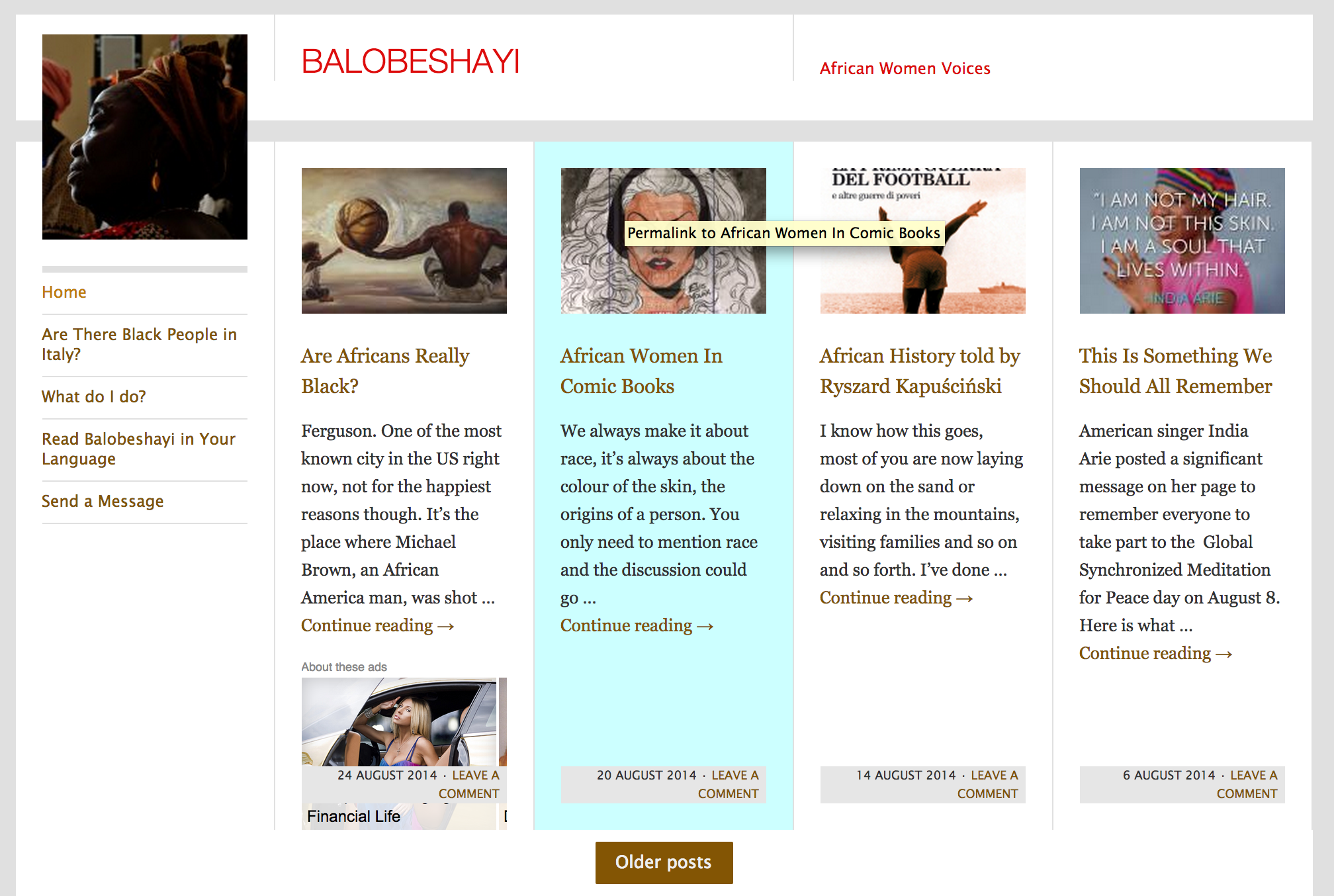
BALOBESHAYI: Are Africans Really Black?

Posted on August 30, 2014 by Migrant Tales

Beatrice Kabutakapua

Ferguson. One of the most known city in the US right now, not for the happiest  reasons though. It’s the place where Michael Brown, an African America man, was shot by the police. Usually the ethnic background is useless for me,but in this case is the engine that started the turmoil happening in this community in the state of Missouri.

Näyttökuva 2014-8-30 kello 20.26.02

Read BALOBESHAYI here.


You’ll find tons of articles about the issue but I just want to share one of them, appeared on The Guardian and written by Hannah Giorgis who is presented as a black feminist born by Eritreans and Ethiopians.

Why is her piece interesting?

In it she makes a point for one of those endless discussions: are Africans as black as African Americans? Her answer is yes. And should Africans show more solidarity with African-Americans? Again, yes. Why? Because

We are here and we are black

Let’s go back to Ferguson now, Giorgis is disappointed by the lack of interest shown by African migrants in the issue, after all police is not only shooting African-Americans butblack people in general. She says:

To pretend that we exist outside the consequences of blackness in this country is to do both ourselves and African Americans a profound injustice. It makes us complicit in perpetuating dangerous stereotypes about African Americans – and by extension, all black people.

To read the full article visit the Guardian and then come back here to express your view.

Read original story here.

This piece was reprinted by Migrant Tales with permission.

Perussuomalaiset of Finland: From bashing immigrants and the EU to “not selling one’s ass”

Posted on August 29, 2014 by Migrant Tales

What is wrong with the Perussuomalaiset (PS)?* In order to score their historic election victory in 2011, they went on a rampage and bashed migrants wholesale, especially Muslims. Today, PS head Timo Soini said that the party has its principles and therefore “doesn’t sell its ass [to anyone].”

Folks, the person making this statement is the head of Finland’s third-largest party in parliament. This is the same person who said this week that the PS wants to be in government after the elections and that he should be appointed foreign minister.

I can see Soini in Brussels at some important summit as foreign minister stating that Finland “doesn’t sell its ass to anyone.”

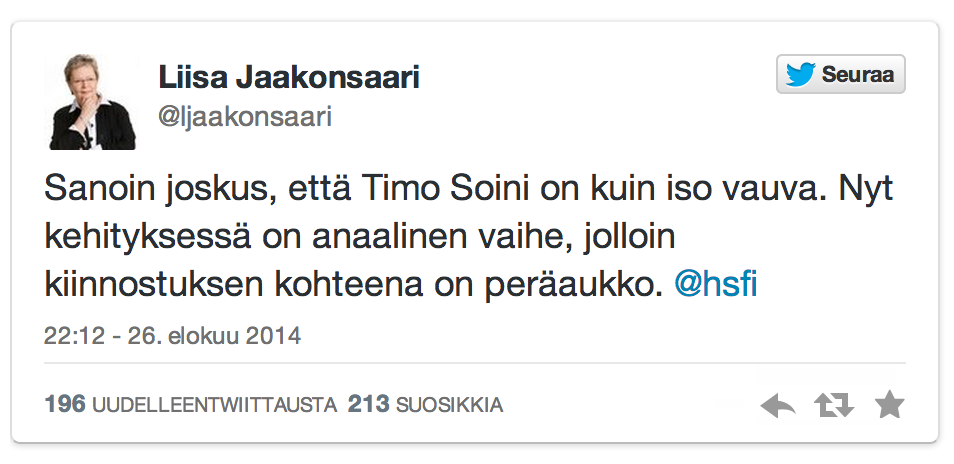
Social Democrat MEP Liisa Jakonsaari tweeted the following: “I have said before that Timo Soini is like an overgrown baby. He’s now in the anal phase [of development] and interested in his anus.”

Kuvankaappaus 2014-8-29 kello 22.11.15

Different dailies in Finland believe that what Soini said could hurt his party.

Oulu-based Ilkka wrote that talking about rear-ends by Finnish politicians in public has been unknown up to now.

Is this a sign that the PS is desperate and losing it?

Whatever new chapter this brings to a tragicomic play called the PS, it’ll be interesting to watch how this convoluted party will make it to next year’s elections.

But what would you expect from a chairman that heads the PS, a hostile party towards migrants, minorities and anyone who doesn’t look or think like them?

Talking about one’s ass is for Soini and the PS the most normal thing.

* The Finnish name for the Finns Party is the Perussuomalaiset (PS). The English names of the party adopted by the PS, like True Finns or Finns Party, promote in our opinion nativist nationalism and xenophobia. We therefore prefer to use the Finnish name of the party on our postings.

Effectively challenging intolerance and promoting respect in Finland and elsewhere

Posted on August 29, 2014 by Migrant Tales

An effective weapon that racists use is to convince you that you don’t count.

One of the overriding matters that I’ve learned time and again is that silence is the worst decision you can make when challenging intolerance. There are many effective ways to challenge racism like a simple question: I disagree with you. Can we talk about this?

Sometimes debating racism with a racist is a waste of time. Since people with low self-esteem tend to show more signs of prejudice than those that are more sure of themselves, ignoring racists is one effective way of not giving them their daily shot of attention at your expense.

Since racists aim to provoke you and attract media and social media attention to themselves and their mistaken causes, silence is generally a poor way to challenge such intolerance.

Mäntyharju Perussuomalaiset (PS)*  concilwoman Tanja Hartonen-Pulkka is a good example of how a politician can burn her fingers when spreading ant-immigration rhetoric.

What the councilwoman of the eastern Finnish town of Mäntyharju wrote was challenged on social media forums and finally her original blog posting on Uusi Suomi was taken down.

In the 2011 parliamentary elections there were some candidates in the South Savo region who openly were in favor of tightening immigration policy and scaling back funding for immigrant associations and activities.

Kansainvälinen Mikkel, a registered association founded in 2010 and based in Mikkeli, sent an email to each of these candidates and asked them how tightening immigration policy and scaling back funding to immigrant groups would affect migrants living in this region of Finland.

The responses that the association got from the candidates were surprising. They weren’t defiant but almost apologetic trying to state that they weren’t against immigrants. One MP from Pertunmaa, Jari Leppä, said he had mistakenly ticked the wrong box.

Kuvankaappaus 2014-8-29 kello 9.07.36

Center Party MP Jari Leppä’s email response above to Kansainvälinen Mikkeli. He admits ticking the wrong box. He said, however, that Finland should take a strong stand against undocumented migrants and should deport convicted migrants.


Since parliamentary elections will take place in April 2015, we should not only be vigilant but engage politicians from all parties who are trying to lure voters by spreading intolerance and suspicion against migrants and minorities.

The most important matter to keep in mind is to keep your cool and state as clearly as possible: I disagree with your point of view. Can we discuss this?

You should do a lot of reading when engaging others in a debate on immigration and cultural diversity. Your best shield is information. The more you know, the stronger your argument will be.

By engaging anti-immigration politicians in a debate, we send an important message to them: We disagree with what you say and challenge your arguments.

As with the case of Hartonen-Pulkka proves, anti-immigration politicians will be forced to think twice before they spew their hate rhetoric again.

* The Finnish name for the Finns Party is the Perussuomalaiset (PS). The English names of the party adopted by the PS, like True Finns or Finns Party, promote in our opinion nativist nationalism and xenophobia. We therefore prefer to use the Finnish name of the party on our postings.

Migrants’ Rights Network: Is migration blocking the way to post-national global outlooks?

Posted on August 29, 2014 by Migrant Tales

Don Flynn*

Don_web_0

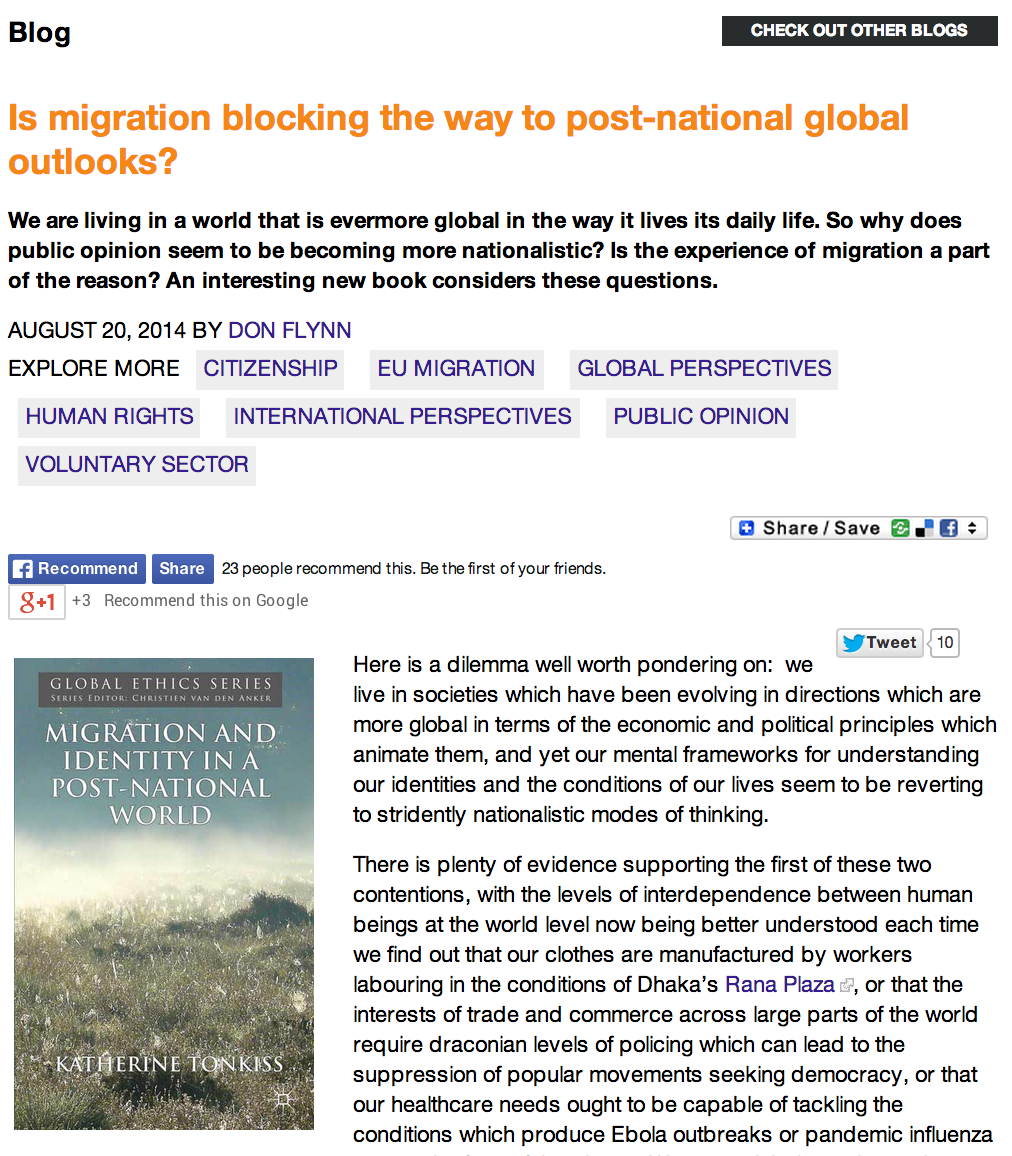
We are living in a world that is evermore global in the way it lives its daily life. So why does public opinion seem to be becoming more nationalistic? Is the experience of migration a part of the reason? An interesting new book considers these questions.
Kuvankaappaus 2014-8-29 kello 7.14.45
Read original posting here.

Here is a dilemma well worth pondering on:  we live in societies which have been evolving in directions which are more global in terms of the economic and political principles which animate them, and yet our mental frameworks for understanding our identities and the conditions of our lives seem to be reverting to stridently nationalistic modes of thinking.

There is plenty of evidence supporting the first of these two contentions, with the levels of interdependence between human beings at the world level now being better understood each time we find out that our clothes are manufactured by workers labouring in the conditions of Dhaka’s Rana Plaza, or that the interests of trade and commerce across large parts of the world require draconian levels of policing which can lead to the suppression of popular movements seeking democracy, or that our healthcare needs ought to be capable of tackling the conditions which produce Ebola outbreaks or pandemic influenza across the face of the planet.  We are a global species and we prosper or perish in proportion to our acknowledgement of the challenges and potential of this fact.

But there is much to suggest that these facts are being contested by the political moods which are revealing themselves across the developed world, expressed in increased levels of support for right wing, nationalist parties and a trend towards the reassertion of ethnic identity as the force which binds society together.   Why should this be happening at a time when we might have expected to see aspirations towards better societies and greater fairness being framed in the context of global society rather than national communities?

Liberal values and freedom of movement

These are some of the ideas discussed in a recent book (Migration and Identity in a Post-National Word, Katherine Tonkiss, Palgrave Macmillan) by the Birmingham University based political scientist Katherine Tonkiss. The author sets out a solid argument in favour of the proposition that a consistent approach to liberal values and the promotion of individual rights requires a defence of the freedom of movement across national frontiers. Anything less than this means a failure to fully adapt to the conditions of life in what she asserts is a ‘post-national world’ and consequently falling short on opportunities to advance the values of liberalism, social justice and individual rights.

Yet her argument concedes the fact that the prospect of an increase in migration that would probably follow on from an extension of free movement rights is preventing many people from identifying with progressive and internationalist perspectives. It often seems, as UKIP leader Nigel Farage suggested during the European election campaign last May, a lot of voters would be willing to take a hit on their standard of living if that is the price to be paid for lower levels of immigration.

Tonkiss looks for the source of this enmity by probing the views of people who identify with explicitly nationalistic currents in British politics, supporting groups like the BNP, English Democrats, the English Defence League and UKIP. On this point she concludes that migration is disliked because of the perception that it poses a threat to the distinctiveness of English culture and reduces its moral relevance in sustaining social cohesion. There is a hint that this effect is amplified by the absence of a strong civic culture in the UK, with local government and other authorities failing to play a significant role in bringing about cohesive outcomes. The type of ramped up rhetoric which right wing groups trade in might be seen as filling a vacuum in knowledge about the real as opposed to the hyped-up impacts of migration, with jaundiced viewpoints and racialised prejudice fill in the space which might be more usefully occupied by actual experience and objective data gained from a practical engagement with the lives of newcomers.

‘Banal loyalty’

From this point nationalism becomes founded on what Tonkiss refers to as the ‘banal loyalty’ which assumes that, if what is British is equal to a state of virtue, then what the migrants get up to has to be less than that, for no better reason than they are indeed non-British. It is an attitude that runs rampantly across the whole public conversation about migration, affecting even the members of the church-based voluntary groups befriending migrants arriving in Herefordshire, one of the areas covered in her study. Though the opportunity to better get to know some of the newcomers helped build some resistance to the more inane accounts of migrant alleged perversity, the volunteers she interviewed were still inclined to think occasional dark thoughts about what ‘twenty Eastern European men’ walking down a street in Leominster might ‘really’ be up to.

This is interesting, but it is surprising that in accounting for the persistence of nationalist viewpoints in this post-national age Tonkiss gives very little consideration to the role played by the blocs of political and economic power which provide a large part of the structure of the national conversation about immigration. To the extent they are mentioned it is limited to the suggestion that it is public opinion that is pushing these elite interests to follow in the wake of nationalistic negativity.

This would be an unwarranted conclusion to draw from the simple fact that the public mood appears to be swinging in the direction of nationalism at the present time. Politics and markets in liberal democratic societies function in accordance with sets of rules and structures that have been around a lot longer than any of the people who are subject to the systems of governance which they give rise to. The way they represent interests and push forward their points of view, not to mention the resources they have available to coerce those individuals who might think differently to toe the line forms an important backdrop to much of what is going on in the way of shaping viewpoints. It is often all the more powerful because it is so completely naturalised into a non-visible background that it appears to have no substance whatsoever.

But a big part of the answer to Tonkiss’s question as to why nationalism continues to persist in a post-national world must surely be because all the structures of national states and national economic interests remain founded on national principles and are unlikely to fade so easily into the mists of time and history.  If we want to know what is locking nationalistic responses to immigration in place at a time that a defence of liberal values and individual rights would suggest that they should be withering on the vine then we need to look at more than the issues of ethnicity and identity, and delve for at least some of the reasons in the interests that are fostered by the continued influence of the national state.

Read original story here.

This piece was reprinted by Migrant Tales with permission.

*Don Flynn, the MRN Director, leads the organisation’s strategic development and coordinates MRN’s policy and project work. He is a regular and sought-after speaker at conferences, seminars and lectures on behalf of MRN.

PS MP forced to explain why he refused to take a taxi driven by a non-white Finn

Posted on August 24, 2014 by Migrant Tales

Tabloid Ilta-Sanomat reports that two sources saw Perussuomalaiset (PS)* MP Mika Niikko refuse take a taxi in front of parliament because the driver was”dark-skinned.”

Niikko later retracted his version of events to the reporter after the interview. He said that since the incident took place a year ago, he now remembers the driver to be “white.” Thus the whole incident – according to Niikko –  had nothing to do with the driver’s ethnic background.

The only way we’ll get to the bottom of the story is if the taxi driver steps forward and gives his account of what happened. Migrant Tales hopes he does and encourages the driver to get in touch with us at [email protected].

Näyttökuva 2014-8-24 kello 10.31.06

Read full story (in Finnish) here.

The Ilta-Sanomat story appeared a day after Helsingin Sanomat published a story about how black taxi drivers in Helsinki face suspicion and racist behavior from customers.

Niikko denies that he refused to take the taxi because the driver wasn’t a white Finn.

”The issues was that the taxi driver spoke poor Finnish and was unfamiliar with the place I was going to,” he was quoted as saying.

The reporter then asked Niikko if the taxi driver didn’t have a GPS. This is when the MP’s version of events gets a bit blurred.

”I’m supposed to Google the address [for the driver so he could find the location on his GPS]?” he said, suggesting that the driver didn’t know how to serve him in a professional manner.

Niikko, however, admits in the story that if the driver were a white Finn he would have tried to explain where the place was. The reason why the MP didn’t do so with the driver was because he didn’t have the faintest idea where the place could be.

Even if tabloids like Ilta-Sanomat are responsible for spreading racism in Finland with their sensationalist stories, this one proves that the Finnish media is questioning racist behavior.

This shouldn’t mean, however, that we should let the Finnish media off the hook because they are part of the problem by giving racists inflated respectability and importance.


* The Finnish name for the Finns Party is the Perussuomalaiset (PS). The English names of the party adopted by the PS, like True Finns or Finns Party, promote in our opinion nativist nationalism and xenophobia. We therefore prefer to use the Finnish name of the party on our postings.


Finland President Niinistö’s “information-gathering exercise” about dual citizenship should worry us a lot

Posted on August 23, 2014 by Migrant Tales

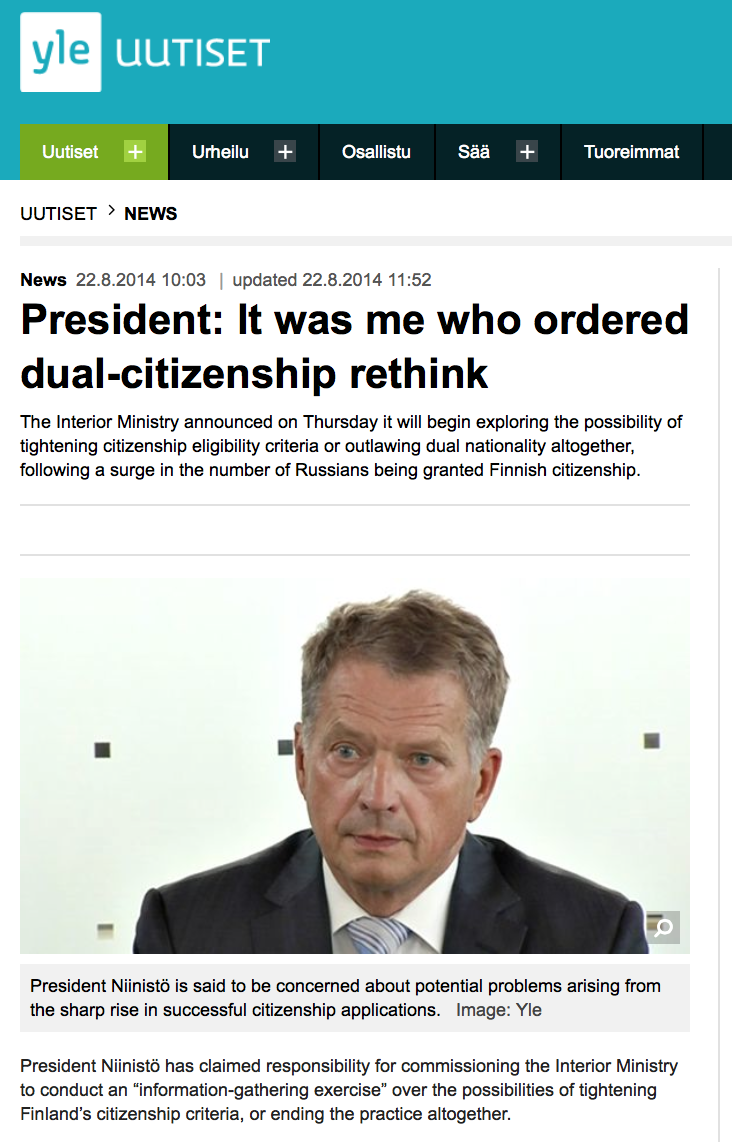
President Sauli Niinistö has asked Christian Democrat Interior Minister Päivi Räsänen, an anti-gay an anti-immigration politician, to look into the possibility of tightening Finland’s dual citizenship laws or ending the practice altogether, according to YLE in English.  Prime Minister Alexander Stubb was, however, quoted as saying on YLE in English that plans to end dual citizenship are not in the cards. 

“We are not tightening any legislation we are simply reviewing the overall situation,” said Stubb.

Let’s hope this is the case but tell this to the Perussuomalaiset (PS)* and if they were in government mainstream parties like the National Coalition Party and Center Party. How many “innocent-looking information-gathering exercises” have led to changes in laws? Many.

Taking into account the standoff between the Ukraine and Russia, the rise of anti-immigration sentiment in Finland and elsewhere in Europe, the so-called “information-gathering exercise” by President Niinistö is something that should worry us a lot, especially  those of us who are dual citizens.

Even if the tightening of dual citizenship laws for Russians is one reason why this matter is being brought up in Finland in the first place, the whole idea suggests that this country could be ready to turn their backs on holders of dual citizenship. The message would be a clear one: owning two or more passports is bad and should be discouraged.

Näyttökuva 2014-8-23 kello 8.14.33


Read full story here.

If Finland tightens and does away with dual citizenship, it will not only be a blow to our ever-growing culturally diverse society, but to Finnish expats living abroad. One of the reasons behind our present dual citizenship law was to strengthen our country’s bonds with expats, their children and grandchildren living abroad.

The message by the authorities and Finland will be clear if laws are tightened: Dual citizenship is bad. Hide it in the closet.

* The Finnish name for the Finns Party is the Perussuomalaiset (PS). The English names of the party adopted by the PS, like True Finns or Finns Party, promote in our opinion nativist nationalism and xenophobia. We therefore prefer to use the Finnish name of the party on our postings.

Helsingin Sanomat: Non-white taxi drivers face suspicion and outright racism from customers

Posted on August 22, 2014 by Migrant Tales

There’s an interesting article on Helsingin Sanomat today about how non-white Finnish taxi drivers face suspicion and outright racism from potential customers. It’s refreshing to see the country’s biggest daily taking a more serious attitude towards discrimination. It’s a big improvement from the days when it published polls in 2010 about what Finns thought about migrants. 

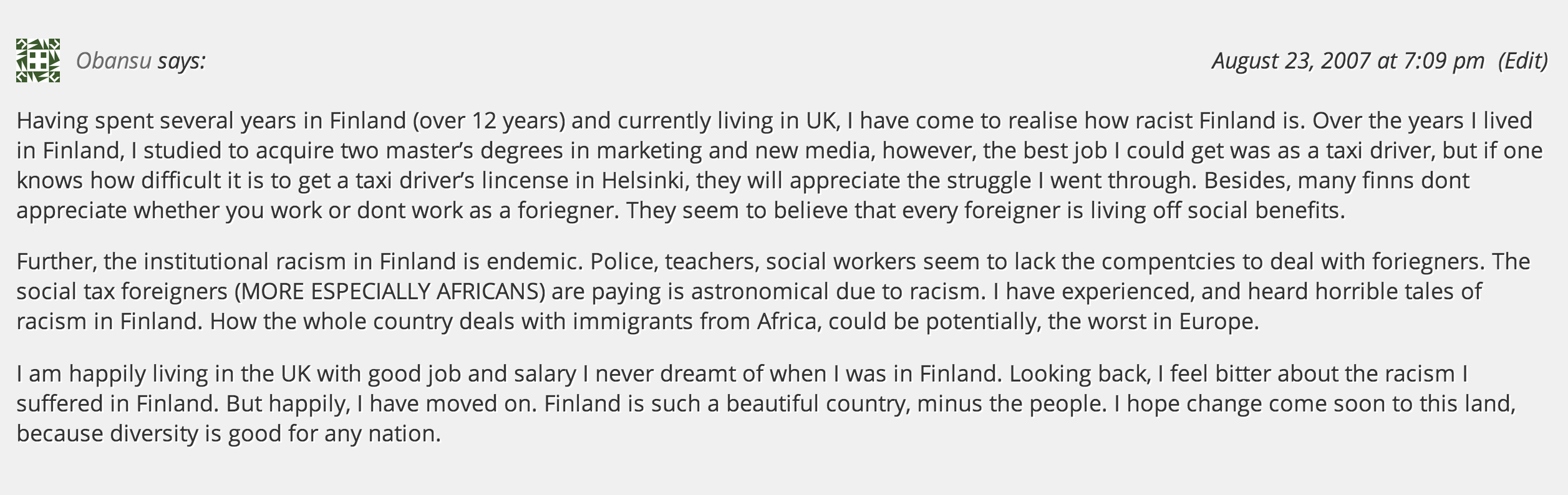
Obansu, a black African taxi driver with two master’s degrees, was the first reader to post a comment in August 2007 on Migrant Tales’ most popular posting, Are you a target of racism in Finland.

He wrote below:

Näyttökuva 2014-8-22 kello 7.49.35
While it is a good matter that Helsingin Sanomat writes about the suspicion and racism that non-Finnish taxi drivers face in Helsinki, Migrant Tales this problem was already reported by Obansu in 2007.

Have things changed since then? Ghanian taxi driver Stanley Nyarko AboAgve is quoted as saying on Helsingin Sanomat: ”I’m in mmline and a customer comes in the car. Fucken n-word, he says and takes another taxi.”

While it’s clear that some non-white taxi drivers face racist insults while at work, the question is what is being done about it? Since too much of Finland is in denial about doing something to challenge intolerance, it’s clear that too little will be done about racist and rude customers.

Näyttökuva 2014-8-22 kello 8.08.31

Read full story (in Finnish) here.


As long as some Finns believe it’s fine to admit they are racists in public, the problem will persist. Racism, like any form of discrimination, must be made and turned into something shameful.

It’s one of the many ways we can send this social ill back to where it belongs: the gutter.


Defining white privilege #9: Mohammad Ali’s insight

Posted on August 21, 2014 by Migrant Tales

In many respects white privilege, or specifically white Finnish privilege, is a good way to understand some of the challenges that migrants and especially non-white Finns face in this country. The interview below of Mohammad Ali* says a lot about white privilege in the United States even if the interview took place 33 years ago. 

What he said back then is very much true today and applies to Finland as well but in a different context.

What purpose does violent one-way integration – even in its most violent forms in the United States and during the colonial and post-colonial period – serve? Who benefits from it?

Even if the answer sits right under our noses, too many don’t want you to look there. Thus white privilege serves the group that controls and dictates how resources such as jobs, status, political power are distributed in society.

What happens when a group loses its history and identity? Francis Galton (1822-1911), the so-called father of eugenics, a pseudoscience that prohibited reproduction between certain groups because it would not improve human genetic traits, offers us an answer: extermination at the cost of white supremacy.

Migrant Tales invites readers to contribute their thoughts on this social.

Please get in touch with us and write to [email protected]. We’d love to hear from you. Your account can be published with your name or anonymously.

It’s your call. 


________________

Definition #9

Mohammad Ali describes white privilege in the United States to the tee. The host asks why Ali converted to the Muslim religion and states after praising his conversion and faith:

Black people have been brainwashed to love white and hate black. We have been robbed of our culture, we were robbed of our true history [we´re] a walking dead man. So you got black people in an all-white country and they know nothing of themselves, the speak the language but are mentally dead. This is happening all over the world but the first place where we’ll rise will be the black people of [US] America and the rest [will follow].

See also:

  • Defining white Finnish privilege #1: I have it and you don’t
  • Defining white Finnish privilege #2: Third culture children versus “pupil with immigrant background” 
  • Defining white Finnish privilege #3 No history, no doctrine, no heroes and no martyrs
  • Defining white Finnish privilege #4 Holding the short end of the stick
  • Defining white Finnish privilege #5 It’s ok to be a racist
  • Defining white Finnish privilege #6 Not having a voice and the media
  • Defining white Finnish privilege #7 A definitive guide
  • Defining white Finnish privilege #8 Underrated and less intelligent

*Thank you Michael McEachrante for the heads-up on Facebook.  

Helsingin Sanomat poll shows the PS heading south

Posted on August 18, 2014 by Migrant Tales

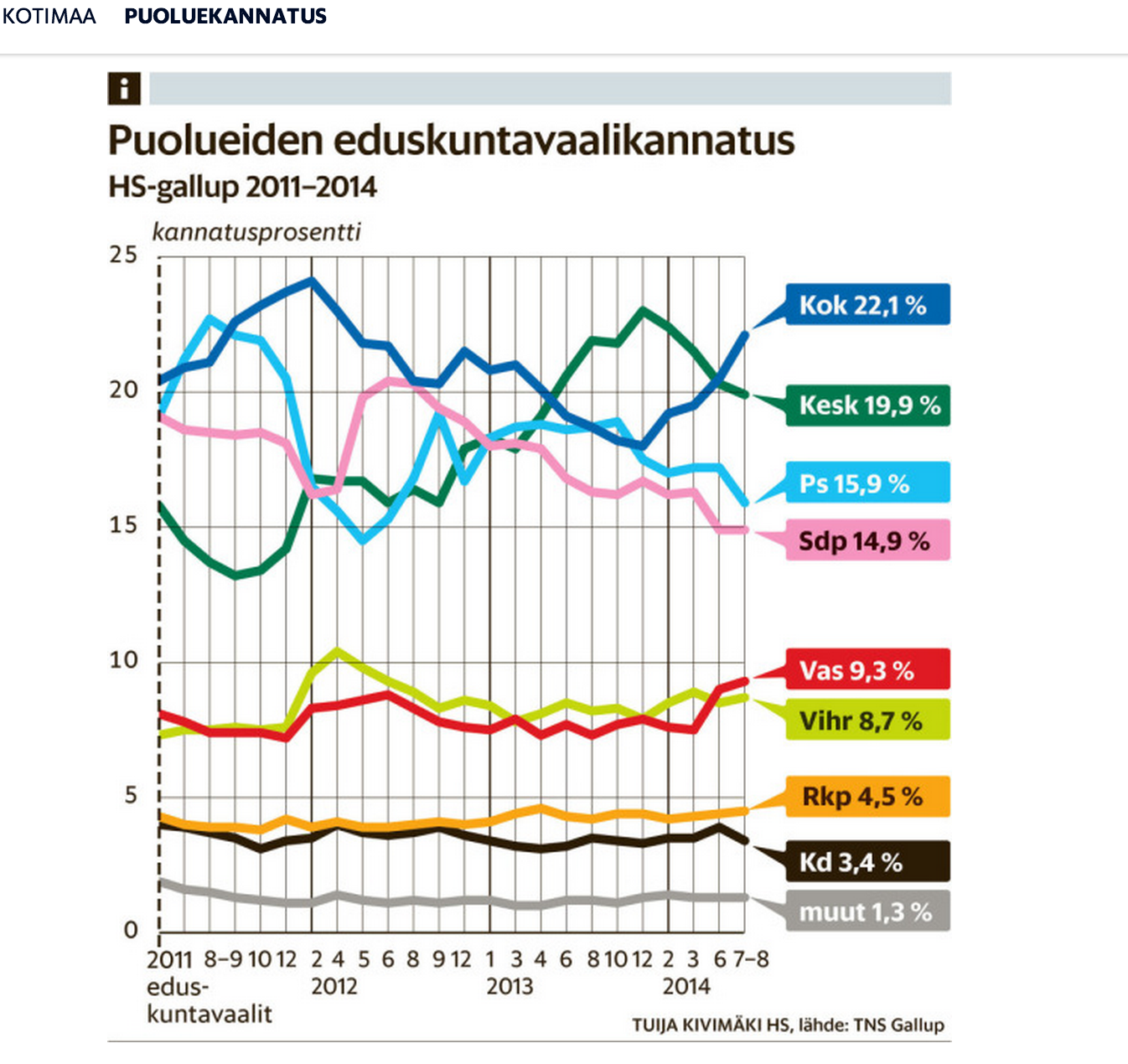
A poll published today by Helsingin Sanomat reveals that the Perussuomalaiset (PS)* party is at its lowest point (15.9%) in two years. The most popular party in Finland continues to be the National Coalition Party (22.1%) followed by the Center Party (19.9%).

The Social Democrats, which are still struggling, are in the mid-teens (14.9%) with parties like the Left Alliance (9.3%), Greens (8.7%), Swedish People’s Party 4.5% and Christian Democrats (3.4%) trailing far behind.

Should we be surprised that matters are looking politically bleak for the PS?

Figuring out what the PS is and getting a coherent picture of what the party stands for is challenging for anyone. While it’s clear that the party is anti-EU, anti-immigration, homophobic, chauvinistic and especially anti-Islam, much of its energy has been spent to tone down its hate rhetoric but to stand for the same things.

The PS continues to be an openly hostile party against migrants and minorities. It would be wishful thinking on their behalf to think that some have short memories in this country.

The PS is in a near-constant state of animation trying out political images like a model changing clothes every few minutes. No matter how much it tries to change its image, the PS will end up committing political harakiri if it becomes too mainstream.

Even if the PS wants to look like a responsible mainstream party these days, it’s quite another matter if voters will buy it.

If the latest Helsingin Sanomat poll is anything to go by, the answer is a clear no.

Näyttökuva 2014-8-18 kello 7.40.04
Read full story here.

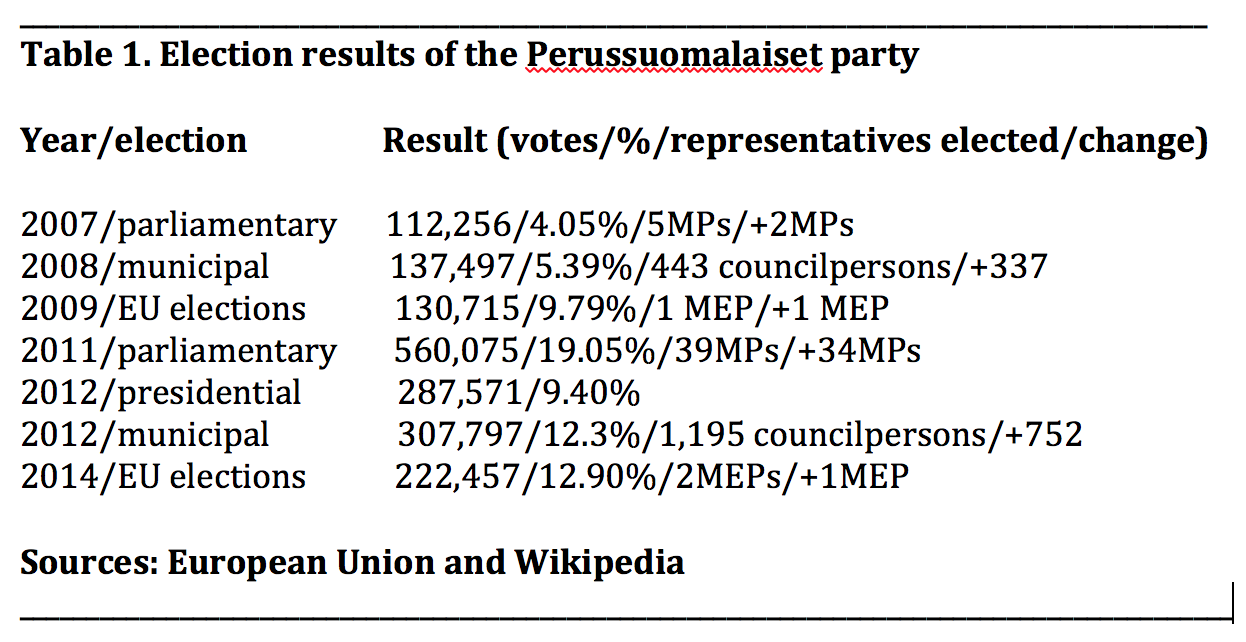
The last three elections after the PS’ historic win in April 2011 are clear proof that something isn’t right. If the same trend continues in next year’s parliamentary elections, it will face a stinging – if not a mortal blow – to its chances to remain as one of Finland’s four largest parties.


Näyttökuva 2014-5-31 kello 15.44.19

The PS’s election fortunes after 2011 have been disappointing for the party.


* The Finnish name for the Finns Party is the Perussuomalaiset (PS). The English names of the party adopted by the PS, like True Finns or Finns Party, promote in our opinion nativist nationalism and xenophobia. We therefore prefer to use the Finnish name of the party on our postings.

  • 1
  • 2
  • 3
  • Next
Read more about documentary film
Read more

Recent Posts

  • Finland’s tabloids Iltalehti and Ilta-Sanomat are the pits
  • Riikka Purra’s Dr Jekyll and Mr Hyde mask
  • Double standards
  • Perussuomalaiset: Uusi logo, sama vanha juttu
  • Taco Trump

Recent Comments

  1. Absolutely Socking: Racist Finnish Facebook group against human rights gets flooded with socks on Musta Barbaari’s mother and sister charged by the police in “ethnic profiling” case
  2. Ilkka Nuotio on Pekka Myrskylä: “Tilastot kertovat toista kuin poliittinen keskustelu”
  3. Genrih Soinkara on The war in Ukraine and the Russian-Finnish border crisis are showing Finland’s ugly side
  4. Ahti Tolvanen on Comment by Ahti Tolvanen on the Helsinki +50 conference
  5. Angel Barrientos on Angel Barrientos is one of the kind beacons of Finland’s Chilean community

Archives

  • June 2026
  • May 2026
  • April 2026
  • March 2026
  • February 2026
  • January 2026
  • December 2025
  • November 2025
  • October 2025
  • September 2025
  • August 2025
  • July 2025
  • June 2025
  • May 2025
  • April 2025
  • March 2025
  • February 2025
  • January 2025
  • December 2024
  • November 2024
  • October 2024
  • September 2024
  • August 2024
  • July 2024
  • June 2024
  • May 2024
  • April 2024
  • March 2024
  • February 2024
  • January 2024
  • December 2023
  • November 2023
  • October 2023
  • September 2023
  • August 2023
  • July 2023
  • June 2023
  • May 2023
  • April 2023
  • March 2023
  • February 2023
  • January 2023
  • December 2022
  • November 2022
  • October 2022
  • September 2022
  • August 2022
  • July 2022
  • June 2022
  • May 2022
  • April 2022
  • March 2022
  • February 2022
  • January 2022
  • December 2021
  • November 2021
  • October 2021
  • September 2021
  • August 2021
  • July 2021
  • June 2021
  • May 2021
  • April 2021
  • March 2021
  • February 2021
  • January 2021
  • December 2020
  • November 2020
  • October 2020
  • September 2020
  • August 2020
  • July 2020
  • June 2020
  • May 2020
  • April 2020
  • March 2020
  • February 2020
  • January 2020
  • December 2019
  • November 2019
  • October 2019
  • September 2019
  • August 2019
  • July 2019
  • June 2019
  • May 2019
  • April 2019
  • March 2019
  • February 2019
  • January 2019
  • December 2018
  • November 2018
  • October 2018
  • September 2018
  • August 2018
  • July 2018
  • June 2018
  • May 2018
  • April 2018
  • March 2018
  • February 2018
  • January 2018
  • December 2017
  • November 2017
  • October 2017
  • September 2017
  • August 2017
  • July 2017
  • June 2017
  • May 2017
  • April 2017
  • March 2017
  • February 2017
  • January 2017
  • December 2016
  • November 2016
  • October 2016
  • September 2016
  • August 2016
  • July 2016
  • June 2016
  • May 2016
  • April 2016
  • March 2016
  • February 2016
  • January 2016
  • December 2015
  • November 2015
  • October 2015
  • September 2015
  • August 2015
  • July 2015
  • June 2015
  • May 2015
  • April 2015
  • March 2015
  • February 2015
  • January 2015
  • December 2014
  • November 2014
  • October 2014
  • September 2014
  • August 2014
  • July 2014
  • June 2014
  • May 2014
  • April 2014
  • March 2014
  • February 2014
  • January 2014
  • December 2013
  • November 2013
  • October 2013
  • September 2013
  • August 2013
  • July 2013
  • June 2013
  • May 2013
  • April 2013
  • March 2013
  • February 2013
  • January 2013
  • December 2012
  • November 2012
  • October 2012
  • September 2012
  • August 2012
  • July 2012
  • June 2012
  • May 2012
  • April 2012
  • March 2012
  • February 2012
  • January 2012
  • December 2011
  • November 2011
  • October 2011
  • September 2011
  • August 2011
  • July 2011
  • June 2011
  • May 2011
  • April 2011
  • March 2011
  • February 2011
  • January 2011
  • December 2010
  • November 2010
  • October 2010
  • September 2010
  • August 2010
  • July 2010
  • June 2010
  • May 2010
  • April 2010
  • March 2010
  • February 2010
  • January 2010
  • December 2009
  • November 2009
  • October 2009
  • September 2009
  • August 2009
  • July 2009
  • December 2008
  • November 2008
  • October 2008
  • September 2008
  • August 2008
  • July 2008
  • June 2008
  • May 2008
  • April 2008
  • March 2008
  • February 2008
  • January 2008
  • November 2007
  • October 2007
  • September 2007
  • August 2007
  • July 2007
  • June 2007
  • May 2007

Categories

  • ?? Gia L?c
  • ????? ?????? ????? ???????? ?? ??????
  • ???????
  • @HerraAhmed
  • @mondepasrond
  • @nohatefinland
  • @oula_silver
  • @Varathas
  • A Pakistani family
  • äärioikeisto
  • Abbas Bahmanpour
  • Abdi Muhis
  • Abdirahim Hussein Mohamed
  • Abdirahim Husu Hussein
  • Abdirisak Mahamed
  • About Migrant Tales
  • activism
  • Adam Al-Sawad
  • Adel Abidin
  • Afrofinland
  • Ahmed IJ
  • Ahti Tolvanen
  • Aino Pennanen
  • Aisha Maniar
  • Alan Ali
  • Alan Anstead
  • Alejandro Díaz Ortiz
  • Alekey Bulavsev
  • Aleksander Hemon
  • Aleksanterinliitto
  • Aleksanterinliitto ry
  • Aleksanterinliitto ry:n hallitus
  • Alex Alex
  • Alex Mckie
  • Alexander Nix
  • Alexandra Ayse Albayrak
  • Alexis Neuberg
  • Ali Asaad Hasan Alzuhairi
  • Ali Hossein Mir Ali
  • Ali Rashid
  • Ali Sagal Abdikarim
  • Alina Tsui
  • Aline Müller
  • All categories
  • Aman Heidari
  • Amiirah Salleh-Hoddin & Jana Turk
  • Amin A. Alem
  • Amir Zuhairi
  • Amkelwa Mbekeni
  • Ana María Gutiérrez Sorainen
  • Anachoma
  • Anders Adlecreutz
  • Angeliina Koskinen
  • Anna De Mutiis
  • Anna María Gutiérrez Sorainen
  • Anna-Kaisa Kuusisto ja Jaakko Tuominen
  • Annastiina Kallius
  • Anneli Juise Friman Lindeman
  • Announcement
  • Anonymous
  • Antero Leitzinger
  • anti-black racism
  • Anti-Hate Crime Organisation Finland
  • Anudari Boldbaatar
  • Arshiya Nasser
  • Aspergers Syndrome
  • Asylum Corner
  • Asylum seeker 406
  • Athena Griffin and Joe Feagin
  • Autism
  • Avaaz.org
  • Awale Olad
  • Ayan Said Mohamed
  • AYY
  • Barachiel
  • Bashy Quraishy
  • Beatrice Kabutakapua
  • Beri Jamal
  • Beri Jamal and Enrique Tessieri
  • Bertolt Brecht
  • Boiata
  • Boodi Kabbani
  • Bruno Gronow
  • Carmen Pekkarinen
  • Çelen Oben and Sheila Riikonen
  • Chiara Costa-Virtanen
  • Chiara Costa-Virtanen
  • Chiara Sorbello
  • Christian Thibault
  • Christopher Wylie
  • Clara Dublanc
  • Dana
  • Daniel Malpica
  • Danilo Canguçu
  • David Papineau
  • David Schneider
  • Dexter He
  • Don Flynn
  • Dr Masoud Kamali
  • Dr. Faith Mkwesha
  • Dr. Theodoros Fouskas
  • Edna Chun
  • Eeva Kilpi
  • Emanuela Susheela
  • En castellano
  • ENAR
  • Enrique
  • Enrique Tessieri
  • Enrique Tessieri & Raghad Mchawh
  • Enrique Tessieri & Yahya Rouissi
  • Enrique Tessieri and Muhammed Shire
  • Enrique Tessieri and Sira Moksi
  • Enrique Tessieri and Tom Vandenbosch
  • Enrique Tessieri and Wael Che
  • Enrique Tessieri and Yahya Rouissi
  • Enrique Tessieri and Zimema Mhone
  • Epäluottamusmies
  • EU
  • Europe
  • European Islamophobia Report
  • European Islamophobia Report 2019,
  • European Union
  • Eve Kyntäjä
  • Ezequiel Caldeiro
  • Facebook
  • Fadumo Dayib
  • Faisa Kahiye
  • Farhad Manjoo
  • Fasismi
  • Finland
  • Fizza Qureshi
  • Flyktingar och asyl
  • Foreign Student
  • Fozia Mir-Ali
  • Frances Webber
  • Frida Selim
  • Gareth Rice
  • Ghyslain Vedeaux
  • Global Art Point
  • Great Replacement
  • Habiba Ali
  • Hami Bahadori
  • Hami Bahdori
  • Hamid
  • Hamid Alsaameere
  • Hamid Bahdori
  • Handshake
  • Harmit Athwal
  • Hassan Abdi Ali
  • Hassan Muhumud
  • Heikki Huttunen
  • Heikki Wilenius
  • Helsingin Sanomat
  • Henning van der Hoeven
  • Henrika Mälmsröm
  • Hser Hser
  • Hser Hser ja Mustafa Isman
  • Husein Muhammed
  • Hussain Kazemian
  • Hussain Kazmenian
  • Ibrahim Khan
  • Ida
  • Ignacio Pérez Pérez
  • Iise Ali Hassan
  • Ilari Kaila & Tuomas Kaila
  • Imam Ka
  • inside-an-airport
  • Institute of Race Relations
  • Iraqi asylum seeker
  • IRR European News Team
  • IRR News Team
  • Islamic Society of Norhern FInland
  • Islamic Society of Northern Finland
  • Islamophobia
  • Jacobinmag.com
  • Jallow Momodou
  • Jan Holmberg
  • Jane Elliott
  • Jani Mäkelä
  • Jari Luoto
  • Jari Taponen
  • Jegor Nazarov
  • Jenni Stammeier
  • Jenny Bourne
  • Jessie Daniels
  • Joe Davidow
  • Johannes Koski
  • John D. Foster
  • John Grayson
  • John Marriott
  • Jon Burnett
  • Jorma Härkönen
  • Jos Schuurmans
  • José León Toro Mejías
  • Josue Tumayine
  • Jouni Karnasaari
  • Juan Camilo
  • Jukka Eräkare
  • Julian Abagond
  • Julie Pascoet
  • Jussi Halla-aho
  • Jussi Hallla-aho
  • Jussi Jalonen
  • JusticeDemon
  • Kadar Gelle
  • Kaksoiskansalaisuus
  • Kansainvälinen Mikkeli
  • Kansainvälinen Mikkeli ry
  • Katherine Tonkiss
  • Kati Lepistö
  • Kati van der Hoeven-Lepistö
  • Katie Bell
  • Kättely
  • Kerstin Ögård
  • Keshia Fredua-Mensah & Jamie Schearer
  • Khadidiatou Sylla
  • Khadra Abdirazak Sugulle
  • Kiihotus kansanryhmää vastaan
  • Kirsi Crowley
  • Koko Hubara
  • Kristiina Toivikko
  • Kubra Amini
  • KuRI
  • La Colectiva
  • La incitación al odio
  • Laura Huhtasaari
  • Lauri Finér
  • Leif Hagert
  • Léo Custódio
  • Leo Honka
  • Leontios Christodoulou
  • Lessie Branch
  • Lex Gaudius
  • Leyes de Finlandia
  • Liikkukaa!
  • Linda Hyökki
  • Liz Fekete
  • M. Blanc
  • Maarit Snellman
  • Mahad Sheikh Musse
  • Maija Vilkkumaa
  • Malmin Kebab Pizzeria Port Arthur
  • Marcell Lorincz
  • Mari Aaltola
  • María Paz López
  • Maria Rittis Ikola
  • Maria Tjader
  • Marja-Liisa Tolvanen
  • Mark
  • Markku Heikkinen
  • Marshall Niles
  • Martin Al-Laji
  • Maryan Siyad
  • Matt Carr
  • Mauricio Farah Gebara
  • Media Monitoring Group of Finland
  • Micah J. Christian
  • Michael McEachrane
  • Michele Levoy
  • Michelle Kaila
  • Migrant Tales
  • Migrant Tales Literary
  • Migrantes News
  • Migrants' Rights Network
  • MigriLeaks
  • Mikko Kapanen
  • Miriam Attias and Camila Haavisto
  • Mohamed Adan
  • Mohammad Javid
  • Mohammad M.
  • Monikulttuurisuus
  • Monisha Bhatia and Victoria Canning
  • Mor Ndiaye
  • Muh'ed
  • Muhamed Abdimajed Murshid
  • Muhammed Shire
  • Muhammed Shire and Enrique Tessieri
  • Muhis Azizi
  • Musimenta Dansila
  • Muslimiviha
  • Musulmanes
  • Namir al-Azzawi
  • Natsismi
  • Neurodiversity
  • New Women Connectors
  • Nils Muižnieks
  • No Labels No Walls
  • Noel Dandes
  • Nuor Dawood
  • Omar Khan
  • Otavanmedia
  • Oula Silvennoinen
  • Paco Diop
  • Pakistani family
  • Pentti Stranius
  • Perussuomalaiset
  • perustuslaki
  • Petra Laiti
  • Petri Cederlöf
  • Pia Grochowski
  • Podcast-lukija Bea Bergholm
  • Pohjois – Suomen Islamilainen Yhdyskunta
  • Pohjois Suomen Islamilainen Yhyskunta
  • Polina Kopylova
  • Race Files
  • racism
  • Racism Review
  • Raghad Mchawh
  • Ranska
  • Rashid H. and Migrant Tales
  • Rasismi
  • Raul Perez
  • Rebecka Holm
  • Reem Abu-Hayyeh
  • Refugees
  • Reija Härkönen
  • Remiel
  • Reza Nasri
  • Richard Gresswell
  • Riikka Purra
  • Risto Laakkonen
  • Rita Chahda
  • Ritva Kondi
  • Robito Ibrahim
  • Roble Bashir
  • Rockhaya Sylla
  • Rodolfo Walsh
  • Roger Casale
  • Rostam Atai
  • Roxana Crisólogo Correa
  • Ruth Grove-White
  • Ruth Waweru-Folabit
  • S-worldview
  • Sadio Ali Nuur
  • Sami Rusanen
  • Sandhu Bhamra
  • Sara de Jong
  • Sarah Crowther
  • Sari Alhariri
  • Sarkawt Khalil
  • Sasu
  • Scot Nakagawa
  • Shabana Ahmadzai
  • Shada Islam
  • Sharon Chang blogs
  • Shenita Ann McLean
  • Shirlene Green Newball
  • Sini Savolainen
  • Sira Moksi
  • Sonia K.
  • Sonia Maria Koo
  • Steverp
  • Stop Deportations
  • Suldaan Said Ahmed
  • Suomen mediaseurantakollektiivi
  • Suomen Muslimifoorumi ry
  • Suomen viharikosvastainen yhdistys
  • Suomen viharikosvastainen yhdistys ry
  • Suomi
  • Supermen
  • Susannah
  • Suva
  • Syrjintä
  • Talous
  • Tapio Tuomala
  • Taw Reh
  • Teivo Teivainen
  • The Daily Show
  • The Heino
  • The Supermen
  • Thomas Elfgren
  • Thulfiqar Abdulkarim
  • Tim McGettigan
  • Tino Singh
  • Tito Moustafa Sliem
  • Tobias Hübinette and L. Janelle Dance
  • Transport
  • Trica Danielle Keaton
  • Trilce Garcia
  • Trish Pääkkönen
  • Trish Pääkkönen and Enrique Tessieri
  • Tuulia Reponen
  • Uncategorized
  • UNITED
  • University of Eastern Finland
  • Uyi Osazee
  • Väkivalta
  • Vapaa Liikkuvuus
  • Venla-Sofia Saariaho
  • Vieraskynä
  • W. Che
  • W. Che an Enrique Tessieri
  • Wael Ch.
  • Wan Wei
  • Women for Refugee Women
  • Xaan Kaafi Maxamed Xalane
  • Xassan Kaafi Maxamed Xalane
  • Xassan-Kaafi Mohamed Halane & Enrique Tessieri
  • Yahya Rouissi
  • Yasmin Yusuf
  • Yassen Ghaleb
  • Yle Puhe
  • Yuliet Tresa
  • Yve Shepherd
  • Zahra Khavari
  • Zaker
  • Zalina Ametova
  • Zamzam Ahmed Ali
  • Zeinab Amini ja Soheila Khavari
  • Zimema Mahone and Enrique Tessieri
  • Zimema Mhone
  • Zoila Forss Crespo Moreyra
  • ZT
  • Zulma Sierra
  • Zuzeeko Tegha Abeng
© 2026 Migrant tales | Powered by Minimalist Blog WordPress Theme