Migrant tales
Menu
  • #MakeRacismHistory “In Your Eyes”
  • About Migrant Tales
  • It’s all about Human Rights
  • Literary
  • Migrant Tales Media Monitoring
  • NoHateFinland.org
  • Tales from Europe
Menu

Month: July 2014

Finlandization was very bad for refugees, especially Soviet asylum seekers

Posted on July 31, 2014 by Migrant Tales

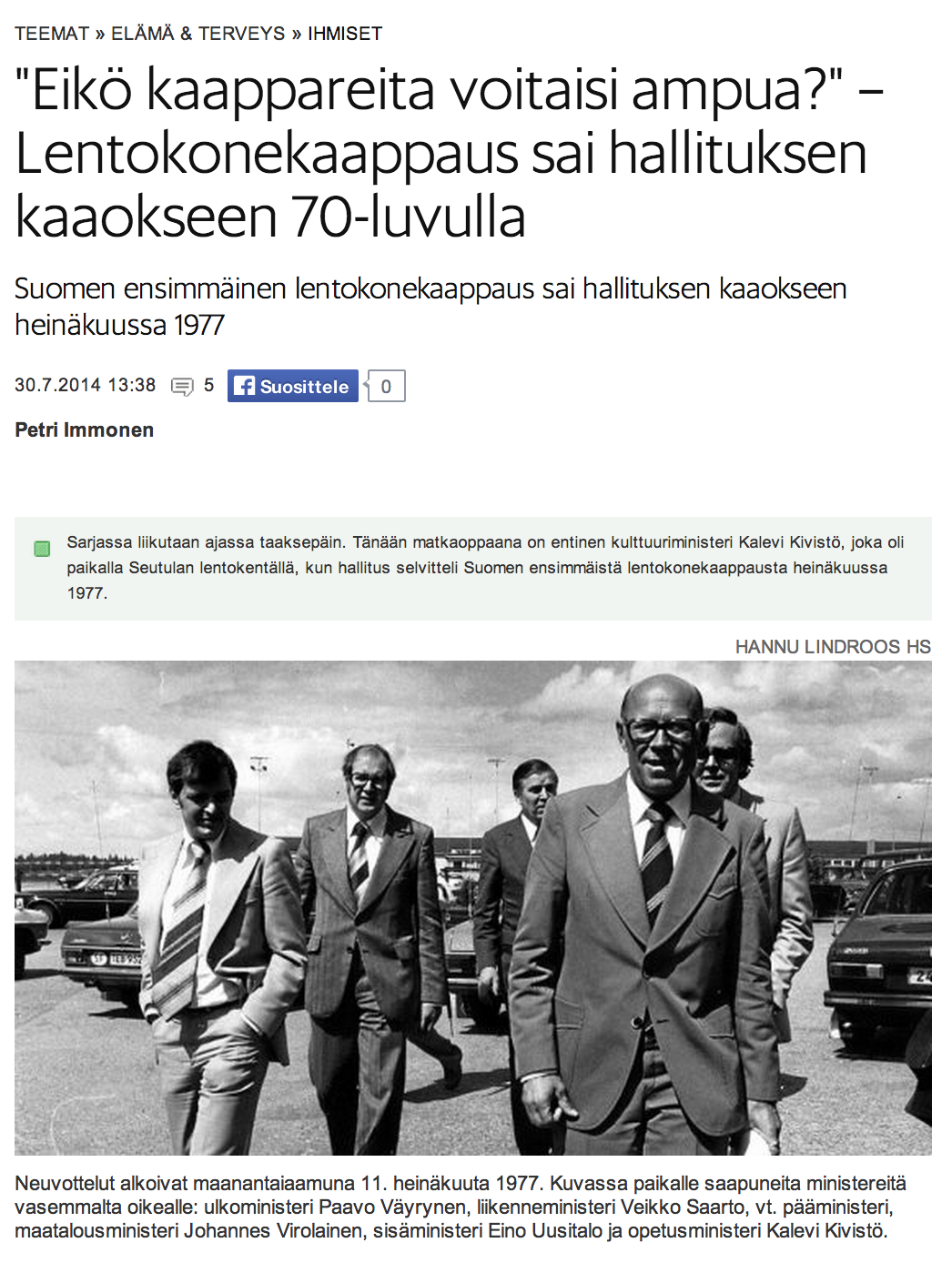
A story in Thursday’s Helsingin Sanomat shows that the shadow of Finlandization continues to hang deep on Finland even if the demise of the former Soviet Union ocurred in 1991. Even if the Helsingin Sanomat story writes about Finland’s first-ever airplane hijacking case in 1977 involving two Soviet citizens on an Aeroflot flight, it sheds an eerie light on a disgraceful era we should never repeat. 

For those who aren’t that familiar with how Finland returned Soviet citizens to the USSR even if they asked for asylum, the journalist doesn’t tell us why the Soviet hijacker wanted the pilot to fly to Stockholm but ended up instead landing the plane in Finland.

The hijackers wanted to fly to Sweden because they knew they’d get political asylum in that country. Even the pilots knew, which explains why they tricked the hijackers into thinking that they were going to land in Stockholm but ended up at the Helsinki-Vantaa Airport.

After almost twenty years of searching, I finally made contact with a former Soviet citizen who crossed the border but was sent back to the USSR in 1976. While there are stories written in the Estonian media about such refugees, the story I published in Apu magazine was one of the few ever published in Finland about the whole ordeal.
Näyttökuva 2014-7-31 kello 8.22.22


Read full story here.

It’s unfortunate that Finland isn’t still ready to debate and open up that murky period to investigation.

Writes American Interest about Finland and the cold war:

Usually intended as a pejorative, “Finlandization” describes the phenomenon that occurs when a small country living alongside a large and aggressive neighbor accepts a reduction of its sovereignty, particularly in the realm of foreign policy, in order to maintain independence. The term derives from the posture of neutrality that Finland adopted during the Cold War.

I would go as far as to suggest that one of the roots of Finland’s present-day xenophobia and anti-immigration sentiment, like with the rise of the Perussuomalaiset (PS) party in 2011, stem from the cold war era. It would be naive to believe that decades of geopolitical isolation and living next door to a country like the Soviet Union didn’t impact it.

Finland was during the cold war effectively a closed country to foreigners never mind foreign investment. Apart from wiping out the little cultural and ethnic diversity that this country enjoyed, the cold war era discouraged as well any serious debate about fascism in this country during the 1930s and especially in the Continuation War (1941-44), when we were an ally of Nazi Germany.

You may ask why Finland and it’s largest daily, Helsingin Sanomat, aren’t enthusiastic about opening up the stuffy dungeons of the past and our complex relations with Moscow.

A partial answer to that question lies in the picture on the Helsingin Sanomat story with Paavo Väyrynen, then foreign minister and today MEP.
 

Racism tells you over and over again: don’t bite the hand that feeds you

Posted on July 30, 2014 by Migrant Tales

Prejudice is a great time saver. You can form opinions without having to get the facts.

E.B. White (1899-1985), USAmerican writer

Being an immigrant and Other all my life, researching and especially writing about racism regularly, or daily for the past three-and-a-half years, have taught me a thing or two about this social ill. Some may ask why I write about racism on Migrant Tales. The answer is simple: Finland would be a near-perfect country if our society were more inclusive. 

If I made a video clip on the devastating impact of racism, it would first show a happy community that would end up being consumed by hate as it became more culturally and ethnically diverse. Like adding more fuel to a fire that you want to extinguish, instead of finding effective solutions, anti-immigration political parties would emerge and start to play on people’s fears. Those who could, the more skilled people, would move to other cities and companies would follow suit. It would be a vicious cycle: loss of jobs and impoverishment.

But there are many good people in this country that won’t allow Finland to be fed to the dogs by anti-immigration parties like the Perussuomalaiset (PS).* It’s their bravery and example that inspires and gives us hope.

In the same way there are good examples there are also bad ones that cannot be accepted. One of these was reported by YLE Monday about a Nepalese woman who was ordered by security guards at the Rockcock festival of Kuopio forced her to leave the premises because she was collecting empty bottles. Apart from asking the woman in an allegedly demeaning manner why she came to Finland to collect empty bottles, the security guard said that they had a police order to prohibit foreigners from collecting bottles at the festival.

The Kuopio police have denied ever giving such an order.

The Finnish husband of the woman is considering bringing charges against the Rockcock organizers for ethnic profiling. The case has interested human right watchdog Amnesty International.

Racism is a big issue in Finland. We know it’s a big issue. Dead giveaways are our collective denial and our near-silence concerning this social ill.

While our reaction to racism should be first and foremost a reaction, we need a fundamental change in thinking and education beginning at schools and at home.

Racism is a pernicious force that destroys instead of strengthens a society. Just like in some parts of the United States after the Civil Rights Movement (1955-68), it should be clear that there is not only a new era of respect but that racist behavior should be pointed out fearlessly as something shameful.

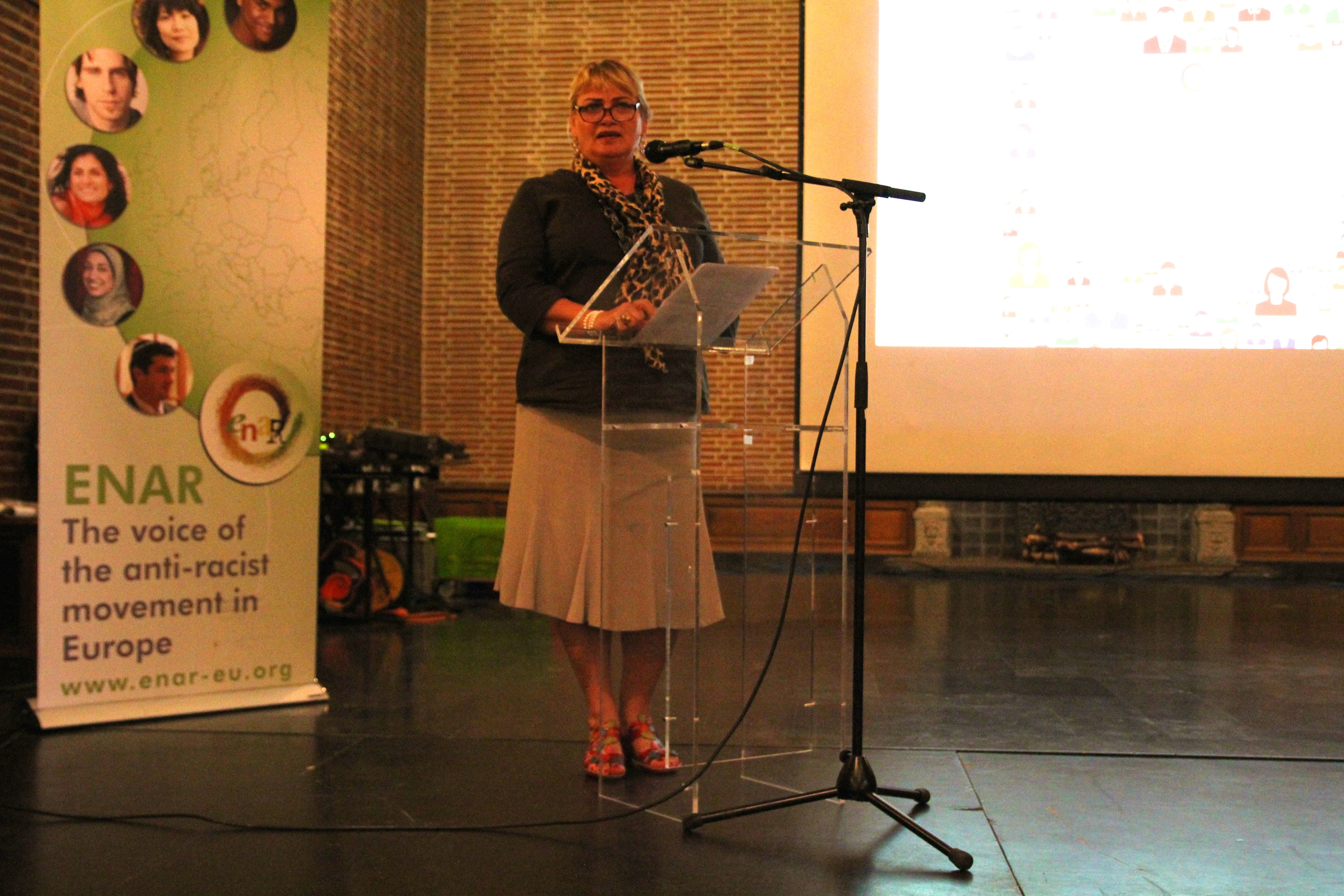
I had the opportunity in June to hear Swedish Feminist Initiative MEP Soraya Post speak at an European Network Against Racism assembly in Brussels. She said that the problem that minorities face in Europe is due to weak institutions that don’t defend their rights.

IMG_4098

Sweden’s Feminist Initiative MEP Soraya Post speaking at Enar’s general assembly in June. Photo by Enrique Tessieri.


Why are those institutions that Post speaks of so weak?

One of the most incredible matters about racism is its selective memory and that it denies, among many other matters, what we are by cooking new narratives and myths.

Every human being was once or has some relative that was a migrant. Since it is a fact that humankind has always been on the move and migrated to new lands, why is this important fact about ourselves conveniently forgotten?

One possible answer to the above question is that when we forget that we were migrants, or have relatives who were migrants, we are entitled, like white privilege, economic, social and political power to rule over others who are more recent migrants.

Time Wise defines white privilege in the following terms:

White privilege refers to any advantage, opportunity, benefit, head start, or general protection from negative societal mistreatment, which persons deemed white will typically enjoy, but which others will generally not enjoy.

In the 1920s and 1930s Finland forged a social construct like Finnish national identity, which was meant to be exclusive, not inclusive.

And it’s exactly that, the exclusive nature of national identity, that makes it so perverse and problematic today to create a socially just society where equal opportunity is the norm, not the exception.

How are we supposed to promote inclusive Nordic values to newcomers if our national identity is so exclusive? This exclusivity has been forged in a backdrop of over 1.2 million Finnish emigrants who left this country between 1860 and 1999.

One way of starting to challenge this exclusive national club, where being white and speaking perfect Finnish is one of the many requirements, is by biting the hand that feeds our racism.

* The Finnish name for the Finns Party is the Perussuomalaiset (PS). The names adopted by the PS, like True Finns or Finns Party, promote in our opinion nativist nationalism and xenophobia. We therefore prefer to use the Finnish name of the party on our postings.

Helsingin Sanomat poll reinforces why unfair hiring practices are probably widespread in Finland

Posted on July 28, 2014 by Migrant Tales

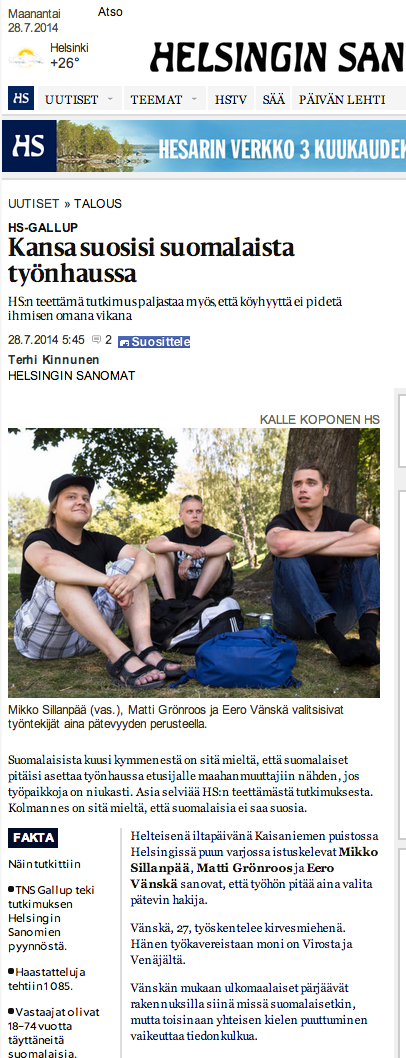
A survey commissioned by Helsingin Sanomat reveals what we’ve known all along about the causes of unfair hiring practices, high migrant unemployment and discrimination.  The survey revealed that six out of 10 people polled would hire a Finn over a migrant if jobs were scarce. 

Is scarcity the real factor? Even during good economic times, migrant unemployment has been 2-3 times higher than the national average.

The country’s largest daily didn’t have to commission an expensive poll to tell us something we already know. What is sad about the results and the Helsingin Sanomat story is that  no solutions are given on how to lessen unfair hiring practices and discrimination.

One high-profile alleged unfair hiring case that came in the public eye this month was Dr. Gareth Rice case at the University of Helsinki, which raised a wider issue that migrants face in this country.

According to educational background, the survey revealed that the majority (66%) of those with a comprehensive school backgrounds agreed that Finns should be hired over foreigners when jobs are scarce. That was followed by ‘other educational backgrounds’ (60%) and academic backgrounds (41%).

The poll will get little attention in Finland since it was published in July, when most Finns are on holiday.

Näyttökuva 2014-7-28 kello 8.27.37
Read full story (in Finnish) here. 


How the Finnish media gives anti-immigration parties like the PS space, inflated respectability and importance

Posted on July 27, 2014 by Migrant Tales

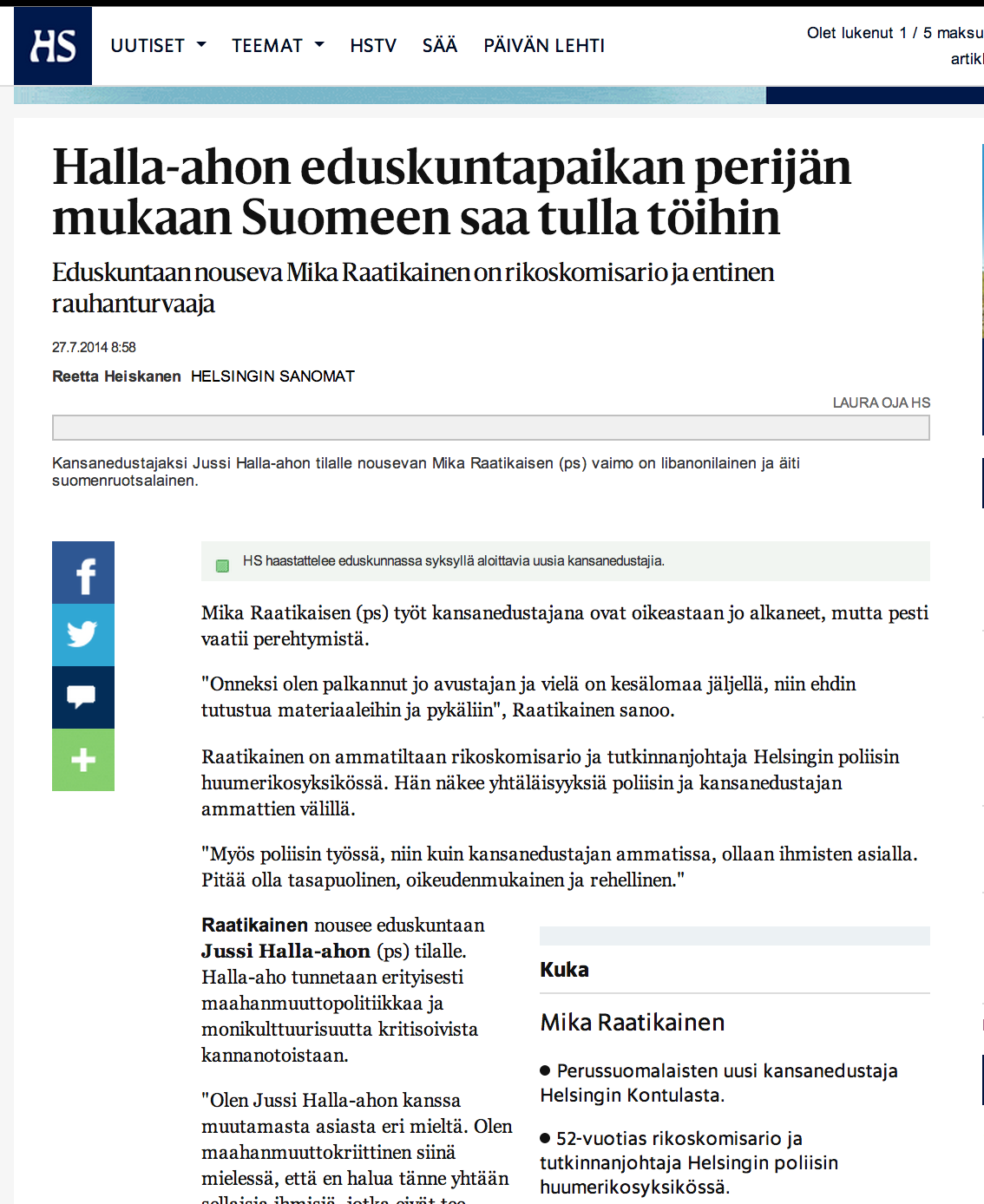
An article in Sunday’s Helsingin Sanomat about Perussuomalaiset (PS)* MP Mika Raatikainen, who will replace former PS MP Jussi Halla-aho’s after he was elected to the European parliament in May, reveals once again this country’s media fascination with racist double-talk and rhetoric that just don’t add up never mind make sense.

If there is a culprit in Finland that has made this country a more hostile place for migrants and minorities, it is the media.They are part of the problem.

An article published this week on migrant crime by Lahti-based Etelä-Suomen Sanomat is another case in point.

The Etelä-Suomen Sanomat journalist makes a disingenuous claim at the bottom of the online version of the story by stating that researchers of The National Research Institute of Legal Policy fear that studying migrant crime will label different national and ethnic groups.

This is exactly what the journalist does in the article.

Even so-called quality dailies like Helsingin Sanomat, which should know better, play into the anti-immigration rhetoric of parties like the PS, which are hostile to our Nordic democratic way of life, migrants, minorities and our ever-growing cultural diversity.

It’s clear that one of the aims of the PS after its historic election victory of 2011 is to become a ‘normal’ mainstream party.

Is this possible? How can a party that spreads ethnic hatred, victimizes certain ethnic and religious groups, polarizes society by stressing ‘us’ and ‘them,’ is homophobic and promotes nativist nationalism can ever become ‘normal.’

Certainly this is what the PS wants but it is quite another story if they can eat and have their populist cake at the same time. Näyttökuva 2014-7-27 kello 11.10.27

Read full story (in Finnish) here.

Why is there so much interest in the Finnish media with a party that openly promotes racism and has had MPs sentenced for ethnic agitation, like Halla-aho? Why does the Finnish media pay so much attention to a party that has had some of its members applied to becoming members of neo-Nazi groups like Kansallinen Vastarinta?

Why isn’t there any mention in the Helsingin Sanomat story about Halla-aho’s and the PS’ ties with the far-right extremist Suomen Sisu association?

The answer is simple: Finland’s media is white. Since it is white it doesn’t have to worry about becoming a victim or target of the PS that near-constantly fuels suspicion of migrants and minorities in this country.

The Helsingin Sanomat story offers us common anti-immigration slogans, such as our social welfare system should not serve the whole world, used by the PS.

I beg your pardon? Is the above possible? Who has made such a claim except for the PS?

If you are a politician and want to fear-monger in this country, a sure way is by stating that hordes of migrants will soon invade the country. Such fear-mongering has been used for decades in Finland.

In the Helsingin Sanomat story, Raatikainen claims that he disagrees with Halla-aho on a few points but but is quick to define himself as an ‘immigration critic’ who is in favor of tight immigration policy. He agrees with Halla-aho in that he doesn’t “want people [migrants to move here] who don’t do anything and are involved in crime.”

If I were the journalist interviewing Raatikainen, I’d ask him which groups in this country want migrants to move here who don’t do anything and commit crime? That question would open a whole new area of discussion that would shed light on his anti-immigration rhetoric.

Raatikainen confuses us with his double-talk, when he first claims that he’s against migrants who don’t want to work and commit crime but those that come here to study, work and do their best are welcome.

Don’t the majority of migrants fall into the latter category?

As in many stories about the PS written in the national media, Raatikainen’s interview reveals a generous pinch of political opportunism.

Parties like the PS don’t have a clear idea of how they’d improve immigration policy never mind how to turn newcomers into dynamic members of our society.

Even if they have no idea about many of the things they talk about, they are right on one matter: Anti-immigration rhetoric is sexy and it appeals to Finnish voters  as well as to the media.


* The Finnish name for the Finns Party is the Perussuomalaiset (PS). The English names of the party adopted by the PS, like True Finns or Finns Party, promote in our opinion nativist nationalism and xenophobia. We therefore prefer to use the Finnish name of the party on our postings.

Defining white Finnish privilege #8: Underrated and less intelligent

Posted on July 25, 2014 by Migrant Tales

In many respects white privilege, or specifically white Finnish privilege, is a good way to understand some of the challenges that migrants and especially non-white Finns face in this country. Migrant Tales invites readers to contribute their thoughts on the social ill.

Please get in touch with us and write to [email protected]. We’d love to hear from you. Your account can be published with your name or anonymously.

It’s your call. 

Näyttökuva 2014-7-25 kello 20.07.30

Read Anonymous’ two poems here.

________________

Definition #8

Anonymous has shared many of her poetry with us on Migrant Tales. Speaking to her for months on the phone, one senses that the only shield she has is her poetry. She wanted to succeed so hard in Finland and ended up in an asylum. Her only shield is her poetry.

Anonymous said that one problem about being a migrant in Finland is that you are usually underrated and considered less intelligent than Finns. You’ll be asking for trouble if you question a Finnish teacher’s knowledge and authority.

Despite everything that has happened, Anonymous still wants to succeed at school and make it in Finland. Studying, getting a profession and finding work is an uphill battle for many migrants but it is a task that must be taken unless you want to live on the periphery of society, according to her.

See also:

  • Defining white Finnish privilege #1: I have it and you don’t
  • Defining white Finnish privilege #2: Third culture children versus “pupil with immigrant background” 
  • Defining white Finnish privilege #3 No history, no doctrine, no heroes and no martyrs
  • Defining white Finnish privilege #4 Holding the short end of the stick
  • Defining white Finnish privilege #5 It’s ok to be a racist
  • Defining white Finnish privilege #6 Not having a voice and the media
  • Defining white Finnish privilege #7 A definitive guide

How the Finnish media continues to be part of the problem by reinforcing stereotypes and racist perceptions of migrants and minorities

Posted on July 25, 2014 by Migrant Tales

A news story about migrant crime was published by the Lahti-based Etelä-Suomen Sanomat with a provocative drawing of a black man’s arms handcuffed. Migrant Tales got in touch with the reporter that wrote the story and asked why it was considered news at the end of July if it was based on a study published by The National Research Institute of Legal Policy on June 2 and published by other newspapers in mid-June?

The journalist said that the reason why the daily published the story was to look at the problems that some migrants face in this country and how to find solutions to them.

Moreover, the study was given ample coverage last month in dailies like Turun Sanomat.

Näyttökuva 2014-7-25 kello 9.59.09

Read full story (in Finnish) here.

There is a big difference in the news angle if we compare the story published by the online version of Etelä-Suomen Sanomat and what others published last month.

The stories that were published in June claimed that not only was migrant crime higher per capita than that of so-called ethnic white Finns (kantaväestö), but made an important point: Even if crime statistics may show differences between migrant and ethnic Finns, you cannot group and generalize about nationalities when looking at crime.  

Labeling and victimizing migrants with crime statistics has been a favorite political pastime of parties like the Perussuomalaiset (PS)* and lazy journalists that regurgitate their rhetoric.

The journalist who wrote the Etelä-Suomen Sanomat story makes a disingenuous comment at the bottom of the online story stating that researchers of The National Research Institute of Legal Policy fear that studying migrant crime will label different national and ethnic groups.

Hmmm…isn’t that what the story written by the journalist is doing?

The Etelä-Suomen Sanomat story is yet another sad example of how the media is part of the problem and how it continues to spread stereotypes about migrants and minorities.

Read full study by The National Research Institute of Legal Policy (in Finnish) here.

* The Finnish name for the Finns Party is the Perussuomalaiset (PS). The names adopted by the PS, like True Finns or Finns Party, promote in our opinion nativist nationalism and xenophobia. We therefore prefer to use the Finnish name of the party on our postings. 

Why is there racism in Finland? The answer is right under your nose, stupid!

Posted on July 24, 2014 by Migrant Tales

It’s odd but whenever a newspaper publishes a story on migrant crime, migrants in general or politicians from parties like the Perussuomalaiset (PS)* and other ones make a case against cultural diversity, they conveniently forget the roots of their racism and prejudices. 

Since denial is an important ally of intolerance, it’s clear that racism enjoys near-immunity in many sectors of Finnish society.

Just like Malcolm X once said that “racism is like a Cadillac, they bring out a new model every year,” the same occurs in Finland. Racism may not appear like a new Cadillac in Finland but it may take the form of a new Sisu truck or Valmet tractor.

The message seems sadly to be pretty clear to some migrants that move here:

You are most welcome to our social welfare since this will keep you on a short leash and marginalized indefinitely.  If you are able to beat two- to three-fold higher unemployment when compared to the national average, good for you. You’ll still be making less money and don’t dream about getting permanent employment either.

There are many challenges that anti-racism groups and migrants face in Finland. One of the biggest is busting stereotypes. And there are many out there that should concern us…

  • Migrants don’t want to adapt
  • Migrants don’t want to learn Finnish or Swedish
  • Migrants are lazy
  • Migrants are criminals
  • Migrants come here to live off our welfare

Why so much hostility against migrants and why is the present system so unfair? A recent survey by think tank EVA showed that most Finns saw themselves as hard working, greedy and intolerant.

While we should take the results of such a survey with a pinch of salt, the last two qualities, greed and intolerance,  shed light on the challenges that some migrants face in Finland. If the prevailing attitude is that of greed and intolerance, according to EVA, is it a surprise why Finland is for some migrants a dead-end society with little opportunity?

Even if our country is a Nordic welfare state that promotes noble values such as social equality, our views of migrant adaption and issues like crime are conservative since they blame the newcomer, not society, for the problem. This is understandable considering the level of denial concerning intolerance.

It’s a fairly easy argument that white people, who have never experienced racism, make: If intolerance isn’t an issue in our country, then the migrant must be the problem.

What are those roots of racism that continue to distort our view of people who are different from us and, importantly, are supposed to be treated just like you with respect and equality? In order to answer this question, Migrant Tales apologizes for publishing the racist material below. They were uploaded to show that a great part of the problem lies in our upbringing and can be found right under our noses.


images

Learn your ABCs at elementary school in the 1970s. N-word washes his face but it doesn’t whiten…
7111645_uu
…but if you purchase Kronos Titanvalkoinen paint additive it will turn black kids into white ones.

Näyttökuva 2014-7-1 kello 13.59.59

This racist movie that came out in 1960 was aired on Finnish public television in June.


Racism is a social ill that we should be ashamed of because it makes fools out of you and me. There’s nothing “patriotic” about being a racist since such social ills are costly to tax payers and serve no other purpose but to keep you in a cage of your prejudices. Worse of all they will impoverish you and your community.


* The Finnish name for the Finns Party is the Perussuomalaiset (PS). The names adopted by the PS, like True Finns or Finns Party, promote in our opinion nativist nationalism and xenophobia. We therefore prefer to use the Finnish name of the party on our postings.

Racism, children and football in Finland

Posted on July 22, 2014 by Migrant Tales

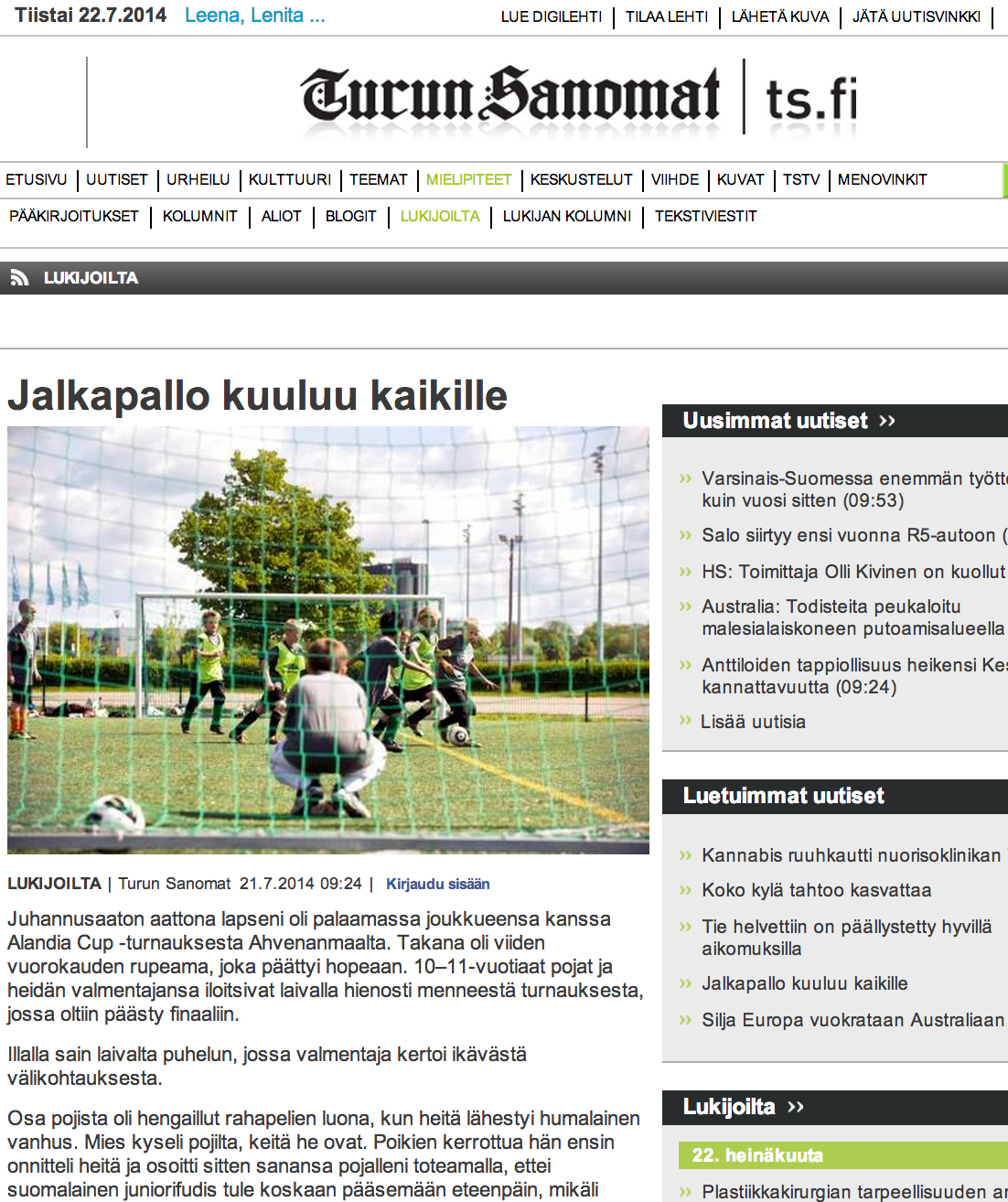
If you want to find a short cut into racism in Finland, read the anonymous comments after a news story on the topic. One such story, published Monday by Turku-based daily Turun Sanomat, is a perfect example.

The news story is about a group of 10-11-year-old boys who were returning by ship to the mainland from the Alandia football tournament in the Åland Islands. A drunk man approached a few of the boys by the slot machines and told them that Finnish junior football would never improve as long as foreigners played on teams.

One of the boys, whose father is from South America, told the man that he is a Finn. The drunk man scolded the boy.

“Are you a racist?” the boy asked.

The man responded in the affirmative.

At this point the boy’s  teammates got involved and asked the man if he ” was stupid.”

Näyttökuva 2014-7-22 kello 11.29.45


Read full story (in Finnish) here.


The whole affair ended when the boys’ coach turned up and spoke to the man.

“You’re an eighty-year-old man and that child is 10 years old,” he said. “Aren’t you ashamed [of your behavior]?”

On top of his racist and aggressive behavior, the man told the 10-year-old that he pays taxes and doesn’t like foreigners playing football in this country. The boys asked the man to leave, which he didn’t.

Apart from pushing a women on the breast, the man called the boy a mulato, a term that comes from the Spanish word mula, or mule.

The man was eventually escorted handcuffed by security personnel and locked up at port in a police cell.

Should it surprise us that some of the comments that followed the Turun Sanomat story defended the old man’s actions?

One in particular, who calls himself anonymously Faktoja, revealed in a comment the issue of racism and lack of inclusiveness in Finnish society.

 Writes Faktoja: “The boy [who claimed to be Finnish] lied because he was ethnically half a Finn. His nationality was of course ‘Finnish.'”

The boy “lied?” Are white Finns taught that a naturalized Finn is a second-class Finn because one of his parents is a white Finn?

Since when were Finns only white? Everyone in this country was once a migrant unless you believe in wise tales like that the Garden of Eden originated in Finland.

Faktoja’s narrative, then, is a pretty common perception that white Finns have of themselves and how they construct reality about themselves. The way Finns make sense of their identity in Finland is by forgetting that their relatives were once, a long or a short time ago, migrants as well.

Why have they forgotten such an important piece of information from their narrative? Because it gives them power over migrants and newcomers by reminding them that they are from somewhere else or Other.

Christian Thibault, chairman of Rasmus, a Finnish anti-racism NGO, said that the latest incident on the boat comes after two other ones recently involving premier league coaches, Juha Malinen and Mika Lehkosuo. 

“Where is the official reaction?” he was quoted as saying on Facebook. “How long can we leave the children, their coaches and parents alone with this [issue]??”

This important question made by Thibault could be expanded and asked why politicians, civil servants, teachers and most of Finnish society doesn’t say anything or very little about inclusion of newcomers?

Taking into account that the majority of foreigners in Finland live in poverty, according to Pekka Myrskylä of Statistics Finland, the Finnish dream should be much more than being an eternal outsider, collecting indefinitely less welfare than white Finns and looking at a dead-end.


(Migrant Tales July 22, 2014) Anders Breivik: Three years after the horror of 22/7 in Norway

Posted on July 22, 2014 by Migrant Tales

How many still remember 22/7, when mass-murderer Anders Breivik went on the rampage three years ago killing 77 innocent victims? Who wants to remember the man that carried out the worst attack on Norway since the Second World War?

What will the local papers write about that horrific day, today? What will their editorials say if they grant such attention to 22/7? Will they write about the important role that tolerance and respect play as our societies become ever-culturally and ethnically diverse?  Will they make a case for ethnic equality? Or will they sidetrack – as they have done in so many occasions – the issue altogether?

One of the most remarkable matters about the third anniversary of the mass killings in Norway is that the years feel like decades.

Certainly many of us don’t want to remember what happened on 22/7 because apart from writing a sinister narrative about ourselves, Breivik is also white.

How can a person who was brought up in one of the richest nations in the world, a Nordic welfare state that has social equality as an inalienable value, could not only house so much hatred but translate it into deadly violence?

Despite what forensic psychiatrists originally diagnosed Breivik, he wasn’t mentally insane when he carried out his acts.

The mass killer is an extreme example of why some find a home in racist and Islamophobic parties and groups: narcissism and opportunism, which offer a sense of purpose.

Näyttökuva 2014-7-21 kello 19.26.54

See BBC documentary on Anders Breivik here.


Even if anti-immigration and Islamophobic parties in Europe want to distance themselves from what happened on 22/7, there’s one matter that should be clear to them: no matter how many voters you lure to your party with racism, keeping such a social ill on a short leash is foolish and risky because it can bite back at its master, and hard.

We should never forget the victims of 22/7 but how intolerance can strike a crushing blow on our societies.

Despite what happened three years ago, it is ironic that far-right anti-immigration Progress Party (FrP) became a member of government last year for the first time since its founding in 1974.

Breivik was a member of the FrP between 1999 and 2006.

Aren’t the recent Euro elections a clear indication of our collective amnesia, especially in the Nordic region?

  • Why did the Islamophobic Danish People’s Party (DPP) win the Euro elections in that country by gaining the most MEP seats, or four from two previously?
  • Even the Sweden Democrats, whose historic roots spread into neo-Nazism, gained two MEPs?
  • In Finland, the Perussuomalaiset (PS),* an anti-EU, anti-immigration, homophobic and especially anti-Islam party with ties to extremist groups like Suomen Sisu, got elected two MEPs from one previously.
  • What about in other European countries like France, the United Kingdom and Greece, which saw a surge in support for far-right parties like the National Front, UKIP, and openly neo-Nazi ones like Golden Dawn?

Are we a more tolerant society today as then Norwegian Prime Minister Jens Stoltenberg hoped after the carnage committed by Breivik?

Even if the years feel like decades, that question will not go away anytime soon but hound us for a very, very long time.


See also:

  • Migrant Tales (July 22, 2012): What have we learned after Norway’s 22/7
  • Living in a post 22/7 Europe: The tide has turned

* The Finnish name for the Finns Party is the Perussuomalaiset (PS). The names adopted by the PS, like True Finns or Finns Party, promote in our opinion nativist nationalism and xenophobia. We therefore prefer to use the Finnish name of the party on our postings. 

Migrants’ Rights Network: ‘Too Many Immigrants?’, ‘Big Romanian Invasion’, or ‘Glasgow Girls’: Which got closer to the truth in telling the story of immigration?

Posted on July 21, 2014 by Migrant Tales

Don Flynn*

Don_web_0


You wait for weeks for a programme that allows migrants to tell the stories of their lives, and then three come along at once.

The media critic Ben Bagdikian once complained that trying to be a first class reporter on the average American newspaper is like trying to play Bach’s ‘St Matthew’s Passion’ on a ukulele. He must have had in mind the conscientious hack who was attempting to do justice to the rich and varied story of migration when he came out with that line.

It wasn’t American newspapers but the venerable old BBC that got me to mull over media coverage of immigration with its offerings last week of a whole suite of programmes dealing with the issue, which ranged from Nick Hewer and Margaret Mountford’s two-part Too Many Immigrants? through to the musical drama Glasgow Girls, taking in Tim Samuel’s The Great Big Romanian Invasion on the way.

Na?ytto?kuva 2014-7-21 kello 17.35.47

Brits v Migrants

Nick and Margaret’s effort contaminated the subject with the sleazy populism of ‘Benefit Street’. The programme’s protagonists – native Brits versus the newly arrived immigrants – were paired up in a series of confrontations purposely designed to bring mis-understanding and prejudice onto a collision course. The show acquired the element of compulsive viewing – such as it was – from the intially uncompromising extremism of those who were prepared to argue it out with their immigrant counterparts that they were a burden on the country. What sort of a slugfest could we expect or hope would come from that? Stayed tuned folks – the answer comes up after the breakdown in rationality……

What changed the dynamic however was the context in which the slapdown was setup in, provided by the ‘The Apprentice’ programme’s two former business stars. Nick and Margaret elbowed into the narrative often enough to signal where this stuff was intended to go. The not-so-gently nudged the whole thing towards a resignation of the fact that the modern world of aggressively competitive markets is the only way to go. From this point of view migrants were playing the useful role of showing the natives how to survive within its parameters and we should therefore have the good grace to agree that they were thus a benefit rather than a burden on the country.

It is a chronically limited point of view but one that shouldn’t be flatly contradicted as a general conclusion. But getting there across the span of these two programmes often felt like a process of hammering square pegs into round holes. Under tis pressure, Romford Michael was the first to buckle and concede that he’d learnt a lot from his French counterpart, Marilyn, about how you hunt down a job in a low-paid service economy. South London building workers Jaime and his dad Andy reluctantly agree that their Irish parents/grandparents did pretty the same thing as the Poles they now feel so bitter about. Even Kiran, the Hounslow-born British-Punjabi mother who was holding out against multiculturalism, at the same moment as proclaiming her devotion to Sikhism, came down to conceding that, once you’ve spent a couple of weeks hanging out with a Somali Muslim  family, it is difficult to pronounce them a burden on the country.

More enlightenment?

There is no doubting that many of the least enlightened viewpoints expressed by the participants deserved to be taken on and pulled apart, but it is a step too far that this should be done by brushing aside the anxieties and insecurity of people whose lives have been made worse by the triumph of the market over so many aspects of community life.  When push comes to shove Too Many Migrants?  came across as an unpleasant mocking of the people most pushed around as a consequence of being amongst the losers  in the society which British has become in these early years of the 21st century.

Tim Samuel’s documentary on the Romanian ‘invasion’ that never happened scored higher on the charm and ‘info-tainment’ index by being less patronising about its subject. The Romanian’s and the Brits they came into contact with seemed less like stripped-down caricatures of the prejudices they were supposed to represent than those who appeared in Nick and Margaret’s show. The amiable and disarmingly open Viktor, the only new Romanian to turn up at Heathrow on 1 January 2014 to take advantage of the freshly-granted access to the labour market, has become something of a national celebrity in both the UK and his native land. Further down the pecking order, Ion, the Roma man struggling to survive amongst the rag-pickers and pavement-dwellers offered up his own story, placed in the context of his abused and contemptuously-treated people which we would all do well to listen to.

In the end Samuel’s used the personal history of his family – Jewish-Romanian immigrants who arrived in Manchester in the 1890s – to offer up the disappointing cliché that it will all work out in the wash and our grandchildren will look at the issues which so concerned us with baffled amusement. Maybe, but that leaves out the important fact that even getting there will require something a great deal more that the complacent assurance that the nowadays favoured instrument of progress – the market – will teach us all to live together in peace and harmony.

When young people speak about migration…

Which brings us to Glasgow Girls. This television version of the splendid stage musical, which we mentioned in a blog back in February last year, slotted into this sequence as a timely reminder of the that that the resources which will be needed to move us towards the solidarity and effective action if we are ever going to build something that approximates to a decent society. This true story of working class school girls with homes in the tower block estates in central Glasgow gives us the best hint of what will be needed to get us to that happier place.

The experience of hardship is as likely to generate a powerful sense of social injustice as it is of deep, energy-consuming grievance. Whilst the latter can often promote the desire to lash out in anger at those nearest to your, the former is much more likely to generate the understanding that the world itself needs changing if there is ever to be progress. The Glasgow Girls took this route, and it is their example we should be working to emulate.

So, even if the business of getting the themes of migration considered by the audiences who engage through the mass media is like playing St Matthew’s Passion on a ukulele, last week’s offering suggest that even then some attempts are more successful than others. You make your choice as to which one you want to hum along to.

Read original story here.

This piece was reprinted by Migrant Tales with permission.

*Don Flynn, the MRN Director, leads the organisation’s strategic development and coordinates MRN’s policy and project work. He is a regular and sought-after speaker at conferences, seminars and lectures on behalf of MRN.

  • 1
  • 2
  • 3
  • Next
Read more about documentary film
Read more

Recent Posts

  • Finland’s tabloids Iltalehti and Ilta-Sanomat are the pits
  • Riikka Purra’s Dr Jekyll and Mr Hyde mask
  • Double standards
  • Perussuomalaiset: Uusi logo, sama vanha juttu
  • Taco Trump

Recent Comments

  1. Absolutely Socking: Racist Finnish Facebook group against human rights gets flooded with socks on Musta Barbaari’s mother and sister charged by the police in “ethnic profiling” case
  2. Ilkka Nuotio on Pekka Myrskylä: “Tilastot kertovat toista kuin poliittinen keskustelu”
  3. Genrih Soinkara on The war in Ukraine and the Russian-Finnish border crisis are showing Finland’s ugly side
  4. Ahti Tolvanen on Comment by Ahti Tolvanen on the Helsinki +50 conference
  5. Angel Barrientos on Angel Barrientos is one of the kind beacons of Finland’s Chilean community

Archives

  • June 2026
  • May 2026
  • April 2026
  • March 2026
  • February 2026
  • January 2026
  • December 2025
  • November 2025
  • October 2025
  • September 2025
  • August 2025
  • July 2025
  • June 2025
  • May 2025
  • April 2025
  • March 2025
  • February 2025
  • January 2025
  • December 2024
  • November 2024
  • October 2024
  • September 2024
  • August 2024
  • July 2024
  • June 2024
  • May 2024
  • April 2024
  • March 2024
  • February 2024
  • January 2024
  • December 2023
  • November 2023
  • October 2023
  • September 2023
  • August 2023
  • July 2023
  • June 2023
  • May 2023
  • April 2023
  • March 2023
  • February 2023
  • January 2023
  • December 2022
  • November 2022
  • October 2022
  • September 2022
  • August 2022
  • July 2022
  • June 2022
  • May 2022
  • April 2022
  • March 2022
  • February 2022
  • January 2022
  • December 2021
  • November 2021
  • October 2021
  • September 2021
  • August 2021
  • July 2021
  • June 2021
  • May 2021
  • April 2021
  • March 2021
  • February 2021
  • January 2021
  • December 2020
  • November 2020
  • October 2020
  • September 2020
  • August 2020
  • July 2020
  • June 2020
  • May 2020
  • April 2020
  • March 2020
  • February 2020
  • January 2020
  • December 2019
  • November 2019
  • October 2019
  • September 2019
  • August 2019
  • July 2019
  • June 2019
  • May 2019
  • April 2019
  • March 2019
  • February 2019
  • January 2019
  • December 2018
  • November 2018
  • October 2018
  • September 2018
  • August 2018
  • July 2018
  • June 2018
  • May 2018
  • April 2018
  • March 2018
  • February 2018
  • January 2018
  • December 2017
  • November 2017
  • October 2017
  • September 2017
  • August 2017
  • July 2017
  • June 2017
  • May 2017
  • April 2017
  • March 2017
  • February 2017
  • January 2017
  • December 2016
  • November 2016
  • October 2016
  • September 2016
  • August 2016
  • July 2016
  • June 2016
  • May 2016
  • April 2016
  • March 2016
  • February 2016
  • January 2016
  • December 2015
  • November 2015
  • October 2015
  • September 2015
  • August 2015
  • July 2015
  • June 2015
  • May 2015
  • April 2015
  • March 2015
  • February 2015
  • January 2015
  • December 2014
  • November 2014
  • October 2014
  • September 2014
  • August 2014
  • July 2014
  • June 2014
  • May 2014
  • April 2014
  • March 2014
  • February 2014
  • January 2014
  • December 2013
  • November 2013
  • October 2013
  • September 2013
  • August 2013
  • July 2013
  • June 2013
  • May 2013
  • April 2013
  • March 2013
  • February 2013
  • January 2013
  • December 2012
  • November 2012
  • October 2012
  • September 2012
  • August 2012
  • July 2012
  • June 2012
  • May 2012
  • April 2012
  • March 2012
  • February 2012
  • January 2012
  • December 2011
  • November 2011
  • October 2011
  • September 2011
  • August 2011
  • July 2011
  • June 2011
  • May 2011
  • April 2011
  • March 2011
  • February 2011
  • January 2011
  • December 2010
  • November 2010
  • October 2010
  • September 2010
  • August 2010
  • July 2010
  • June 2010
  • May 2010
  • April 2010
  • March 2010
  • February 2010
  • January 2010
  • December 2009
  • November 2009
  • October 2009
  • September 2009
  • August 2009
  • July 2009
  • December 2008
  • November 2008
  • October 2008
  • September 2008
  • August 2008
  • July 2008
  • June 2008
  • May 2008
  • April 2008
  • March 2008
  • February 2008
  • January 2008
  • November 2007
  • October 2007
  • September 2007
  • August 2007
  • July 2007
  • June 2007
  • May 2007

Categories

  • ?? Gia L?c
  • ????? ?????? ????? ???????? ?? ??????
  • ???????
  • @HerraAhmed
  • @mondepasrond
  • @nohatefinland
  • @oula_silver
  • @Varathas
  • A Pakistani family
  • äärioikeisto
  • Abbas Bahmanpour
  • Abdi Muhis
  • Abdirahim Hussein Mohamed
  • Abdirahim Husu Hussein
  • Abdirisak Mahamed
  • About Migrant Tales
  • activism
  • Adam Al-Sawad
  • Adel Abidin
  • Afrofinland
  • Ahmed IJ
  • Ahti Tolvanen
  • Aino Pennanen
  • Aisha Maniar
  • Alan Ali
  • Alan Anstead
  • Alejandro Díaz Ortiz
  • Alekey Bulavsev
  • Aleksander Hemon
  • Aleksanterinliitto
  • Aleksanterinliitto ry
  • Aleksanterinliitto ry:n hallitus
  • Alex Alex
  • Alex Mckie
  • Alexander Nix
  • Alexandra Ayse Albayrak
  • Alexis Neuberg
  • Ali Asaad Hasan Alzuhairi
  • Ali Hossein Mir Ali
  • Ali Rashid
  • Ali Sagal Abdikarim
  • Alina Tsui
  • Aline Müller
  • All categories
  • Aman Heidari
  • Amiirah Salleh-Hoddin & Jana Turk
  • Amin A. Alem
  • Amir Zuhairi
  • Amkelwa Mbekeni
  • Ana María Gutiérrez Sorainen
  • Anachoma
  • Anders Adlecreutz
  • Angeliina Koskinen
  • Anna De Mutiis
  • Anna María Gutiérrez Sorainen
  • Anna-Kaisa Kuusisto ja Jaakko Tuominen
  • Annastiina Kallius
  • Anneli Juise Friman Lindeman
  • Announcement
  • Anonymous
  • Antero Leitzinger
  • anti-black racism
  • Anti-Hate Crime Organisation Finland
  • Anudari Boldbaatar
  • Arshiya Nasser
  • Aspergers Syndrome
  • Asylum Corner
  • Asylum seeker 406
  • Athena Griffin and Joe Feagin
  • Autism
  • Avaaz.org
  • Awale Olad
  • Ayan Said Mohamed
  • AYY
  • Barachiel
  • Bashy Quraishy
  • Beatrice Kabutakapua
  • Beri Jamal
  • Beri Jamal and Enrique Tessieri
  • Bertolt Brecht
  • Boiata
  • Boodi Kabbani
  • Bruno Gronow
  • Carmen Pekkarinen
  • Çelen Oben and Sheila Riikonen
  • Chiara Costa-Virtanen
  • Chiara Costa-Virtanen
  • Chiara Sorbello
  • Christian Thibault
  • Christopher Wylie
  • Clara Dublanc
  • Dana
  • Daniel Malpica
  • Danilo Canguçu
  • David Papineau
  • David Schneider
  • Dexter He
  • Don Flynn
  • Dr Masoud Kamali
  • Dr. Faith Mkwesha
  • Dr. Theodoros Fouskas
  • Edna Chun
  • Eeva Kilpi
  • Emanuela Susheela
  • En castellano
  • ENAR
  • Enrique
  • Enrique Tessieri
  • Enrique Tessieri & Raghad Mchawh
  • Enrique Tessieri & Yahya Rouissi
  • Enrique Tessieri and Muhammed Shire
  • Enrique Tessieri and Sira Moksi
  • Enrique Tessieri and Tom Vandenbosch
  • Enrique Tessieri and Wael Che
  • Enrique Tessieri and Yahya Rouissi
  • Enrique Tessieri and Zimema Mhone
  • Epäluottamusmies
  • EU
  • Europe
  • European Islamophobia Report
  • European Islamophobia Report 2019,
  • European Union
  • Eve Kyntäjä
  • Ezequiel Caldeiro
  • Facebook
  • Fadumo Dayib
  • Faisa Kahiye
  • Farhad Manjoo
  • Fasismi
  • Finland
  • Fizza Qureshi
  • Flyktingar och asyl
  • Foreign Student
  • Fozia Mir-Ali
  • Frances Webber
  • Frida Selim
  • Gareth Rice
  • Ghyslain Vedeaux
  • Global Art Point
  • Great Replacement
  • Habiba Ali
  • Hami Bahadori
  • Hami Bahdori
  • Hamid
  • Hamid Alsaameere
  • Hamid Bahdori
  • Handshake
  • Harmit Athwal
  • Hassan Abdi Ali
  • Hassan Muhumud
  • Heikki Huttunen
  • Heikki Wilenius
  • Helsingin Sanomat
  • Henning van der Hoeven
  • Henrika Mälmsröm
  • Hser Hser
  • Hser Hser ja Mustafa Isman
  • Husein Muhammed
  • Hussain Kazemian
  • Hussain Kazmenian
  • Ibrahim Khan
  • Ida
  • Ignacio Pérez Pérez
  • Iise Ali Hassan
  • Ilari Kaila & Tuomas Kaila
  • Imam Ka
  • inside-an-airport
  • Institute of Race Relations
  • Iraqi asylum seeker
  • IRR European News Team
  • IRR News Team
  • Islamic Society of Norhern FInland
  • Islamic Society of Northern Finland
  • Islamophobia
  • Jacobinmag.com
  • Jallow Momodou
  • Jan Holmberg
  • Jane Elliott
  • Jani Mäkelä
  • Jari Luoto
  • Jari Taponen
  • Jegor Nazarov
  • Jenni Stammeier
  • Jenny Bourne
  • Jessie Daniels
  • Joe Davidow
  • Johannes Koski
  • John D. Foster
  • John Grayson
  • John Marriott
  • Jon Burnett
  • Jorma Härkönen
  • Jos Schuurmans
  • José León Toro Mejías
  • Josue Tumayine
  • Jouni Karnasaari
  • Juan Camilo
  • Jukka Eräkare
  • Julian Abagond
  • Julie Pascoet
  • Jussi Halla-aho
  • Jussi Hallla-aho
  • Jussi Jalonen
  • JusticeDemon
  • Kadar Gelle
  • Kaksoiskansalaisuus
  • Kansainvälinen Mikkeli
  • Kansainvälinen Mikkeli ry
  • Katherine Tonkiss
  • Kati Lepistö
  • Kati van der Hoeven-Lepistö
  • Katie Bell
  • Kättely
  • Kerstin Ögård
  • Keshia Fredua-Mensah & Jamie Schearer
  • Khadidiatou Sylla
  • Khadra Abdirazak Sugulle
  • Kiihotus kansanryhmää vastaan
  • Kirsi Crowley
  • Koko Hubara
  • Kristiina Toivikko
  • Kubra Amini
  • KuRI
  • La Colectiva
  • La incitación al odio
  • Laura Huhtasaari
  • Lauri Finér
  • Leif Hagert
  • Léo Custódio
  • Leo Honka
  • Leontios Christodoulou
  • Lessie Branch
  • Lex Gaudius
  • Leyes de Finlandia
  • Liikkukaa!
  • Linda Hyökki
  • Liz Fekete
  • M. Blanc
  • Maarit Snellman
  • Mahad Sheikh Musse
  • Maija Vilkkumaa
  • Malmin Kebab Pizzeria Port Arthur
  • Marcell Lorincz
  • Mari Aaltola
  • María Paz López
  • Maria Rittis Ikola
  • Maria Tjader
  • Marja-Liisa Tolvanen
  • Mark
  • Markku Heikkinen
  • Marshall Niles
  • Martin Al-Laji
  • Maryan Siyad
  • Matt Carr
  • Mauricio Farah Gebara
  • Media Monitoring Group of Finland
  • Micah J. Christian
  • Michael McEachrane
  • Michele Levoy
  • Michelle Kaila
  • Migrant Tales
  • Migrant Tales Literary
  • Migrantes News
  • Migrants' Rights Network
  • MigriLeaks
  • Mikko Kapanen
  • Miriam Attias and Camila Haavisto
  • Mohamed Adan
  • Mohammad Javid
  • Mohammad M.
  • Monikulttuurisuus
  • Monisha Bhatia and Victoria Canning
  • Mor Ndiaye
  • Muh'ed
  • Muhamed Abdimajed Murshid
  • Muhammed Shire
  • Muhammed Shire and Enrique Tessieri
  • Muhis Azizi
  • Musimenta Dansila
  • Muslimiviha
  • Musulmanes
  • Namir al-Azzawi
  • Natsismi
  • Neurodiversity
  • New Women Connectors
  • Nils Muižnieks
  • No Labels No Walls
  • Noel Dandes
  • Nuor Dawood
  • Omar Khan
  • Otavanmedia
  • Oula Silvennoinen
  • Paco Diop
  • Pakistani family
  • Pentti Stranius
  • Perussuomalaiset
  • perustuslaki
  • Petra Laiti
  • Petri Cederlöf
  • Pia Grochowski
  • Podcast-lukija Bea Bergholm
  • Pohjois – Suomen Islamilainen Yhdyskunta
  • Pohjois Suomen Islamilainen Yhyskunta
  • Polina Kopylova
  • Race Files
  • racism
  • Racism Review
  • Raghad Mchawh
  • Ranska
  • Rashid H. and Migrant Tales
  • Rasismi
  • Raul Perez
  • Rebecka Holm
  • Reem Abu-Hayyeh
  • Refugees
  • Reija Härkönen
  • Remiel
  • Reza Nasri
  • Richard Gresswell
  • Riikka Purra
  • Risto Laakkonen
  • Rita Chahda
  • Ritva Kondi
  • Robito Ibrahim
  • Roble Bashir
  • Rockhaya Sylla
  • Rodolfo Walsh
  • Roger Casale
  • Rostam Atai
  • Roxana Crisólogo Correa
  • Ruth Grove-White
  • Ruth Waweru-Folabit
  • S-worldview
  • Sadio Ali Nuur
  • Sami Rusanen
  • Sandhu Bhamra
  • Sara de Jong
  • Sarah Crowther
  • Sari Alhariri
  • Sarkawt Khalil
  • Sasu
  • Scot Nakagawa
  • Shabana Ahmadzai
  • Shada Islam
  • Sharon Chang blogs
  • Shenita Ann McLean
  • Shirlene Green Newball
  • Sini Savolainen
  • Sira Moksi
  • Sonia K.
  • Sonia Maria Koo
  • Steverp
  • Stop Deportations
  • Suldaan Said Ahmed
  • Suomen mediaseurantakollektiivi
  • Suomen Muslimifoorumi ry
  • Suomen viharikosvastainen yhdistys
  • Suomen viharikosvastainen yhdistys ry
  • Suomi
  • Supermen
  • Susannah
  • Suva
  • Syrjintä
  • Talous
  • Tapio Tuomala
  • Taw Reh
  • Teivo Teivainen
  • The Daily Show
  • The Heino
  • The Supermen
  • Thomas Elfgren
  • Thulfiqar Abdulkarim
  • Tim McGettigan
  • Tino Singh
  • Tito Moustafa Sliem
  • Tobias Hübinette and L. Janelle Dance
  • Transport
  • Trica Danielle Keaton
  • Trilce Garcia
  • Trish Pääkkönen
  • Trish Pääkkönen and Enrique Tessieri
  • Tuulia Reponen
  • Uncategorized
  • UNITED
  • University of Eastern Finland
  • Uyi Osazee
  • Väkivalta
  • Vapaa Liikkuvuus
  • Venla-Sofia Saariaho
  • Vieraskynä
  • W. Che
  • W. Che an Enrique Tessieri
  • Wael Ch.
  • Wan Wei
  • Women for Refugee Women
  • Xaan Kaafi Maxamed Xalane
  • Xassan Kaafi Maxamed Xalane
  • Xassan-Kaafi Mohamed Halane & Enrique Tessieri
  • Yahya Rouissi
  • Yasmin Yusuf
  • Yassen Ghaleb
  • Yle Puhe
  • Yuliet Tresa
  • Yve Shepherd
  • Zahra Khavari
  • Zaker
  • Zalina Ametova
  • Zamzam Ahmed Ali
  • Zeinab Amini ja Soheila Khavari
  • Zimema Mahone and Enrique Tessieri
  • Zimema Mhone
  • Zoila Forss Crespo Moreyra
  • ZT
  • Zulma Sierra
  • Zuzeeko Tegha Abeng
© 2026 Migrant tales | Powered by Minimalist Blog WordPress Theme