Migrant tales
Menu
  • #MakeRacismHistory “In Your Eyes”
  • About Migrant Tales
  • It’s all about Human Rights
  • Literary
  • Migrant Tales Media Monitoring
  • NoHateFinland.org
  • Tales from Europe
Menu

Month: April 2014

Migrants’ Rights Network: Refusal to face the realities of migration opens the door to racism

Posted on April 23, 2014 by Migrant Tales

Migrant Tales insight: This excellent piece by Don Flynn sounds very familar to what the anti-immigration Perussuomalaiset (PS) are doing in Finland to get people to vote for them in the MEP elections on May 25. PS chairman Timo Soini has spoken at Ukip gatherings on a number of occasions and are in many respects political and ideological soul mates.

__________

Don Flynn*

Don_web_0

To understand migration we have to get beyond the numbers and look at the political and economic realities which are driving it. A failure to give an adequate account of this bigger context will open the door to the new forms of racism peddled by the anti-immigration parties.

Two morning news items give a good idea of the way in which immigration continues to trawl across both the realities and mythologies of the British nation.

The first of these is the comment, from the Polish ambassador, Mr Witold Sobkow, on the news that the migration of citizens from his country to the UK is down from its peak of 88,000 in 2007 to 29,000 in 2012.

The second is the opening shot in UKIP’s election campaign for the European Parliament, which features a poster with the legend “There are 26 million people in Europe looking for work. And whose jobs are they after?” The answer seems to be a finger putting directly back at the reader.

Bl0QVu_IgAA_S47.png_largeNa?ytto?kuva 2014-4-23 kello 7.28.49

In stirring up these troubled waters we should say at the onset that numbers, big or small, have seldom served to clarify what is really going on as far as immigration is concerned. If an apparently large number of people arrive into the country in one particular year it is not because “they” have suddenly decided to come after “your” jobs.

We are making a big mistake if we are to assume that immigration is a prime factor in deciding the political and economic trends of the day. Levels of immigration, rather than leading, ought to be seen as following a consequence of the political and economic balance of forces shaping up our future.

Back in 2004 the eight states which had once been a part of what was called the “Soviet bloc” found themselves inducted into a club where the rules and terms of membership were tilted in favour of the long-established insiders.

One of the ways open to them to adjust to these new realities was through the free movement of their citizens. The initial impact of joining the single market had been a drastic reduction in the size of the public sector and the loss of large numbers of jobs as their economies had to adapt to the new realities of a single market. From the standpoint of Europe as a whole, the new right of Polish, Slovak, and other nationalities of the ‘EU8’ functioned as a safety valve which reduced some of the pressure and tension which existed during this period of adjustment.

The figures cited by the Polish ambassador should be read as evidence that the balances of power are shifting in Europe as the economy of his country at least has emerged as a fully functioning free market economy. Migration to the UK has fallen by two-thirds not because of any reduction of the predatory desire of Poles to come after our jobs, but because opportunities are so much better at home.

As far as the UKIP poster campaign is concerned, the big question seems to be whether it can be considered racist. Racism is usually taken to mean an ideology which ascribes certain attitudes or attributes, such as greed, laziness or stupidity to the innate qualities of a racial group, transmitted either by its genetic inheritance or its cultural milieux.

My view is that UKIP is fanning the flames of racism with this poster campaign by using an iconography, embedded in the visual impact of its text and the threatening, pointed finger, which associates ingrained selfishness with the ‘they’ who are after ‘your’ job.

No doubt the party leadership will feel that it has equipped itself with any number of get-out clauses which will allow it to claim that this is not the message truly embedded in the imagery of its campaign, but few will be fooled by this evasion.

The deliberate disconnection between the economic context of joblessness in Europe and its presentation as a matter of ‘you’ versus ‘them’ reaches out not towards rational appraisal, but the visceral sense of alien threat which nurtures deep-seated racist anxieties.

On the evidence of today’s news, political and economic reality goes in one direction, and the trumpeting of anti-immigrant ideologues goes in another. We will have to wait and see if the ordinary citizens who will be called upon to vote in the elections for the European Parliament next month decide to base their understanding of the world they live in on the one or the other. Whatever the outcome, a big part of our collective future rides on their collective decision.

Read original story here.

This piece was reprinted by Migrant Tales with permission.

* Don Flynn, the MRN Director, leads the organization’s strategic development and coordinates MRN’s policy and project work. he is a regular and sought-after speaker at conferences, seminars and lectures on behalf of MRN. 
Some migrants can be pretty racist, especially those who enjoyed ethnic privilege in their former homelands

Posted on April 21, 2014 by Migrant Tales

I am at a gathering at the British Council in Helsinki hearing a talk in 2013 by Eva Biaudet, the Ombudsman for Minorities, on discrimination and prejudice in Finland. After the talk, one of the participants, a white Englishman, says: “You speak just like a [U.S.] American.”

People who make such statements assume a lot of things about culture and person’s identity. When they assume, they make an ass out of u and me.

Not too far from this person, whom I suspect must be an English-language teacher since some explain their culture like grammar, or in simplistic terms that don’t take cultural diversity into account, is another person who continues to question if I am a Southern Californian. This was such a big issue for him that he actually asked and questioned who I am.

The questioning of  who I am, or my personal identity, is no different of how anti-immigration groups fight to keep their societies white in today’s Europe.

A while back, a good friend of mine told me about an Argentinean who claimed that I wasn’t an Argentinean because I was “a Yankee.”

IMG_8593
Something beautiful lies under the winter of our prejudices. One of the flowers you may find is yourself.

These three examples reveal how some migrants continue to see ethnic background, or background in general, as the most important matter about a person. It’s no different from those who house racist views and attitudes.

Why wouldn’t they have such prejudices? Weren’t they brought up in racist societies and part of the the system of racial oppression?

These types of comments by those three persons don’t worry me because I’ve heard them all my life. If I’d given in to such opinions about what others think I am and should be, I doubt I’d be sharing this opinion piece with you on Migrant Tales.

Contrarily, there are some in Finland who think that you’re not a “real” Finn if you’re not white and speak Finnish like Eino Leino. Those who house these types of prejudices have no idea what a “real” Finn is and I doubt that they have read Leino seriously.

One important matter to keep in mind in light of the above is that you are the owner of your identity.

Here’s what you should tell these people if they question who you are because you actually threaten who they are:

I am who I am and if you don’t like it, that’s your problem, not mine.

Selective hatred and racism know no master

Posted on April 19, 2014 by Migrant Tales

Migrant Tales has written on a number of occasions about how intolerance and discrimination are a direct threat to our society since such social ills eat away at our values and thereby undermine who we are. We have demonstrated how anti-immigration parties like the Perussuomalaiset (PS) use selective hatred to ensure their followers that they are strengthening not weakening our values and society.

How is this possible? How can one socially exclude others and uphold Nordic values like fairness, respect and social equality?

Selective hatred is one of the big political  sells that anti-immigration and far-right groups use to drive home their message of hate. In simple English it means that I can socially exclude and discriminate against any group I please and relegate it to third-class membership and keep my country and values simultaneously.

Any sensible person understands that selective hatred cannot work since it means living in a dilemma. It would be something like accepting and living with Dr Jekyll and Mr Hyde.

Some anti-immigration party politicians are such opportunists that they believe that you can keep racism on a short leash. To our horror, Anders Breivik proved to us on 22/7 that this was hogwash.

images
    Is it possible to live in harmony with Mr Hyde and Dr Jekyll if you master selective hatred?  Anti-immigration parties think so. Source: ENGLISHOŠACA.

Gunnar Myrdal (1898-1987), a Swedish sociologist and economist, highlighted this conflict in his famous study An American dilemma about race and equality of blacks during the Jim Crow era. The study was published in 1944, eleven years before Rosa Parks refused to give up her seat to a white passenger on a Montgomery bus on December 1, 1955.

Myrdal was asked in 1938 by the Carnegie Corporation to study the “Negro problem.” They wanted a scholar who was a foreigner and neutral to study the problem.

Here’s the question Myrdal posed:

How could a people who cherish freedom and fairness also create such a racially oppressed society?

One of the important points made in the groundbreaking study was the consequences of living in state of conflict with one’s values.

He wrote:

When people try to deny, to the outside world and to themselves, that they live in moral compromise and that they ceaselessly and habitually violate their own ideals, they are customarily brought to falsify their perception of reality in order to conceal this from themselves and others.

It’s clear that living in such a conflict creates a dilemma, which doesn’t strengthen but weakens your society.

Myrdal’s thesis is applicable to any country, even Finland, which are culturally and ethnically diverse.

Just like Myrdal, we can ask the same question of  Nordic politicians and parties who fuel the “dilemma” by compromising our values such as social equality, tolerance, fairness and respect.

When we hear anti-immigration politicians from Nordic parties like the PS, Danish People’s Party, Sweden Democrats and the Progress Party of Norway, the question is if they are weakening or strengthening our values as a society. It’s pretty clear that the former is the case.

Understanding the short- and long-term impact of our intolerance is crucial if we want to avoid undermining our successful Nordic way of life and values with “dilemmas” that Myrdal highlighted in his groundbreaking study.

One important point that Myrdal made was that all those who give simple remedies for complex problems like ethnic relations and cultural diversity “were not to be trusted.”

One of the problems with anti-immigration parties in the Nordic region and elsewhere in Europe is that they don’t even have simple remedies.

They only whine their broken-record sound bites.

Police ask Romanian Roma “to leave” Tampere

Posted on April 18, 2014 by Migrant Tales

A group of Romania Roma were woken up by the police in the middle of the night as they slept in their cars in a semi-abandoned parking lot of a match factory in Tampere, reports Aamulehti. According to the Romanian Roma, the police asked them to leave Tampere, which is a clear breach of their right to freedom of movement as EU citizens. 

Elviira Davidow, an artist and social activist, told Migrant Tales that while it’s not illegal to sleep in one’s car, the Roma are actively trying to get work in Tampere and have the support of some local activists and residents.

She compared the action of the police to that of a sheriff in a wild west movie, who asks the bandits to leave the town before sundown.

“What is incredible is that these people were pestered by the police in the middle of the night and told to leave Tampere,” she said. “As everyone knows, EU citizen have the right to freedom of  movement so what the police said is a breach of their civil rights.“

“We’re helping them in any way we can,” she continued. “The problem is that they can’t speak Finnish. They’re very interested in finding work and a few have in cleaning up the lot where they camped.“

Näyttökuva 2014-4-18 kello 14.56.26

Read full story (in Finnish) here.

Davidow said that the action of the police in singling out Romanian Roma is quite common in other Finnish cities like Helsinki.

Ethnic profiling doesn’t only happen to the Roma but to other migrants, according to complaints received by the Ombudsman for Minorities.

The Council of Europe expressed concern last year over ethnic profiling by the police in Finland.Davidow said that helping the Roma during these times, when anti-immigration and anti-Roma sentiment are on the rise, people should try to inform themselves and understand the issues and challenges that groups like the Roma face.

“For me this type of activism is the most natural thing to do,” she said.

Meanwhile, Timo Puuska, the real estate superintendent of the plant, told Migrant Tales Saturday that the matter has been cleared up with the police.

“[The police] don’t have the right to touch their things or ask them to leave the premises,” he said. “They can ask someone to leave if they get an order from the district court or somebody needs police help to vacate a property.”

Puuska said that next week the Romanian Roma will begin to work on the lot by sorting scrap metal and furniture.

“In my opinion, these Roma are one of the best sorters in the world,” he said. “Nothing will go to waste when they sort.”


Passage of draft bill to prohibit real estate purchases by non-EU citizens would expose Finland’s xenophobia of Russians

Posted on April 16, 2014 by Migrant Tales

Politicians that fuel nationalism and intolerance forget to tell you one important fact: They carry a high price tag in the form of lower economic growth and less jobs. If passed, a draft bill spearheaded by Social Democrat (SDP) MP Suna Kymäläinen would not only hit businesses in eastern Finland that depend on Russian tourists, but reveal our ever-growing xenophobia. 

The bill would be like putting up a huge sign for the world to see: Russians stay out!

Other MPs behind the bill are Perussuomalaiset party’s Reijo Tossavainen, Pertti Hemmilä of the National Coalition Party,  Markku Rossi and Aila Paloniemi both of the Center Party.

According to a news story in January, the draft bill had the backing of 101 of 200 MPs.

If the bill becomes law, non-European Economic Area (EEA) citizens would have to be residents of Finland for five years in order to purchase real estate.

The bill was criticized on YLE’s Russia debate show and which Kymäläinen took part.

Some of the participants saw the bill as a big mistake because it would hit businesses, which depend on Russian tourists.

Kymäläinen’s blamed Russians for driving up the price of land.

On her home page she cites money laundering and since Finns cannot buy land in a 100km buffer zone by the Finnish-Russian border as reasons why such a law is important.

Näyttökuva 2014-4-16 kello 19.13.49

Read full story here.

If the bill gets approved, it would continue to fuel our age-old suspicion of Russians, which influences how we see other migrants and visible minorities in this country.

That is something we don’t need.

Espoo city council votes against racism

Posted on April 15, 2014 by Migrant Tales

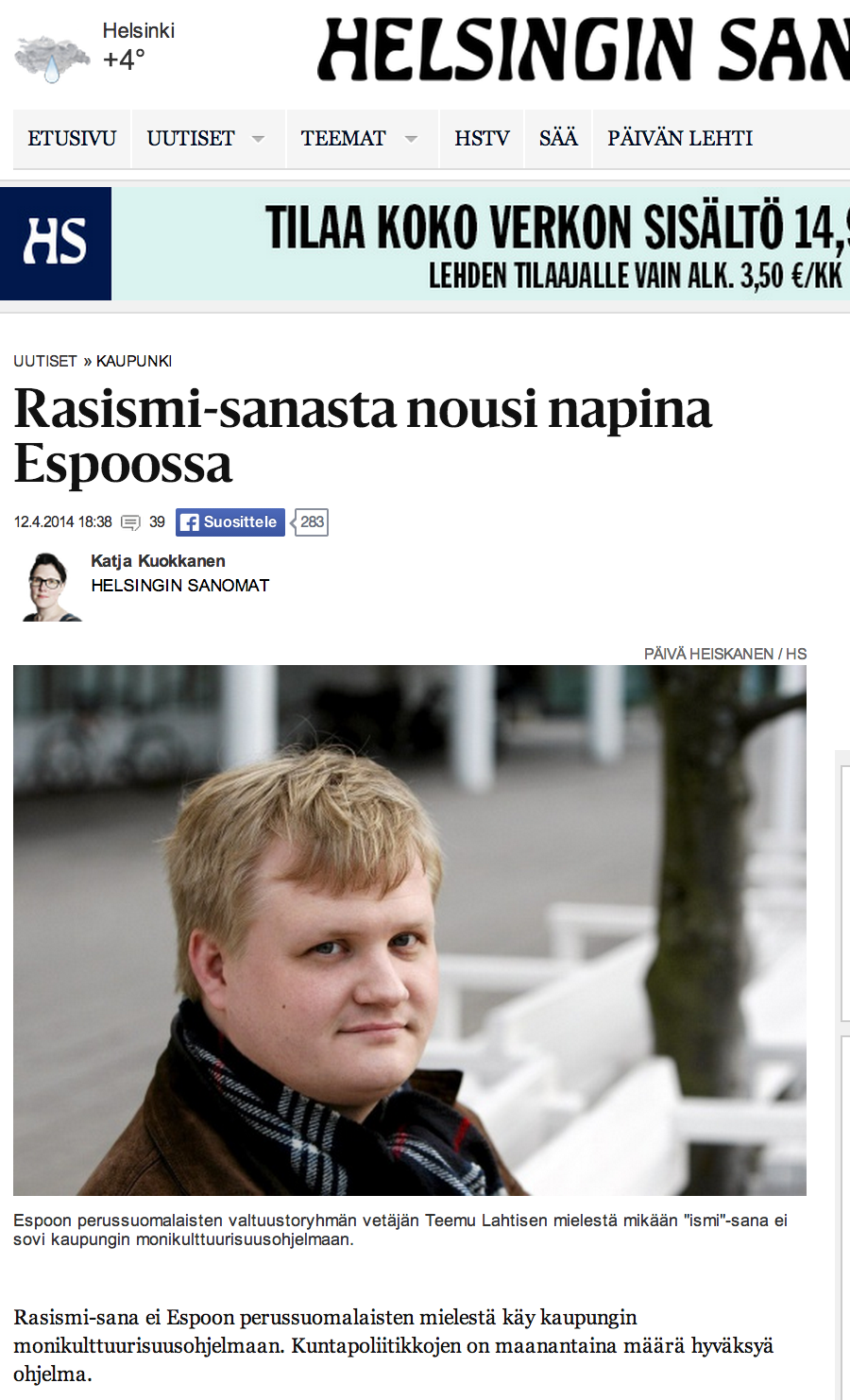
A proposal by the Perussuomalaiset (PS) to rewrite the City of Espoo’s multicultural programme because it stated that city residents “don’t tolerate racism” were voted down 64-10, reports Länsiväylä. 

Näyttökuva 2014-4-15 kello 12.28.26

Two PS councilmen, Simon Elo (left) and Teemu Lahtinen,  loathe Muslims and cultural diversity. Read full story (in Finnish) here.

If one reads closely the position of the PS, an anti-EU, anti-immigration and especially anti-Islam party, it reveals more ignorance about racism than anything else. In their narrow-minded world, everyone in Finland is equal. Sex and ethnicity aren’t factors that fuel discrimination.

PS Espoo city councilman, Teemu Lahtinen, criticized the multicultural program because it doesn’t take into account how some neighborhoods are becoming marginalized because of migrants. He was especially against affirmative action measures and the special treatment migrants get for cultural programs with tax payer’s money.

There’s one good matter happening in Finland albeit slowly: More Finns are becoming aware that intolerance is an issue we should address and not deny.

If we weigh Lahtinen’s and the PS’ message, what come in loud and clear is their opposition to cultural diversity. They are fighting tooth and nail to keep Finland white.

They never tell you this in plain Finnish but that it what they mean.

Migrant Tales Literary: Roxana Crisólogo Correa at kymmenen runoilijaa

Posted on April 15, 2014 by Migrant Tales

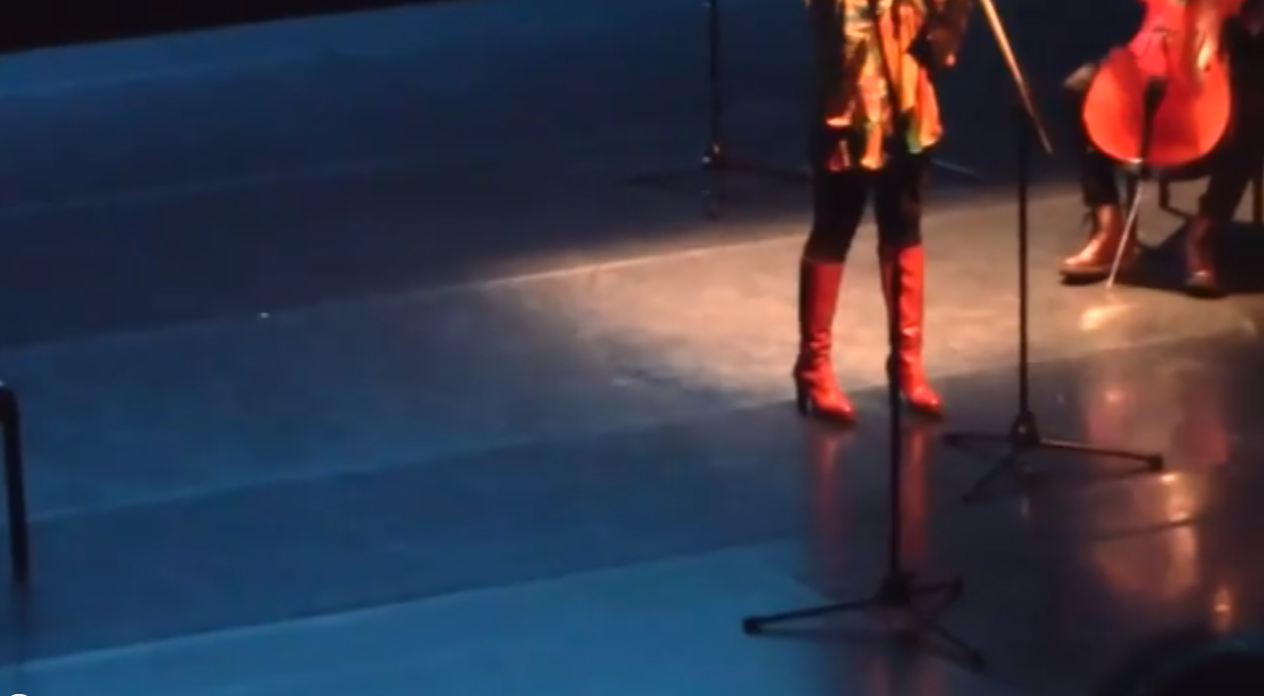
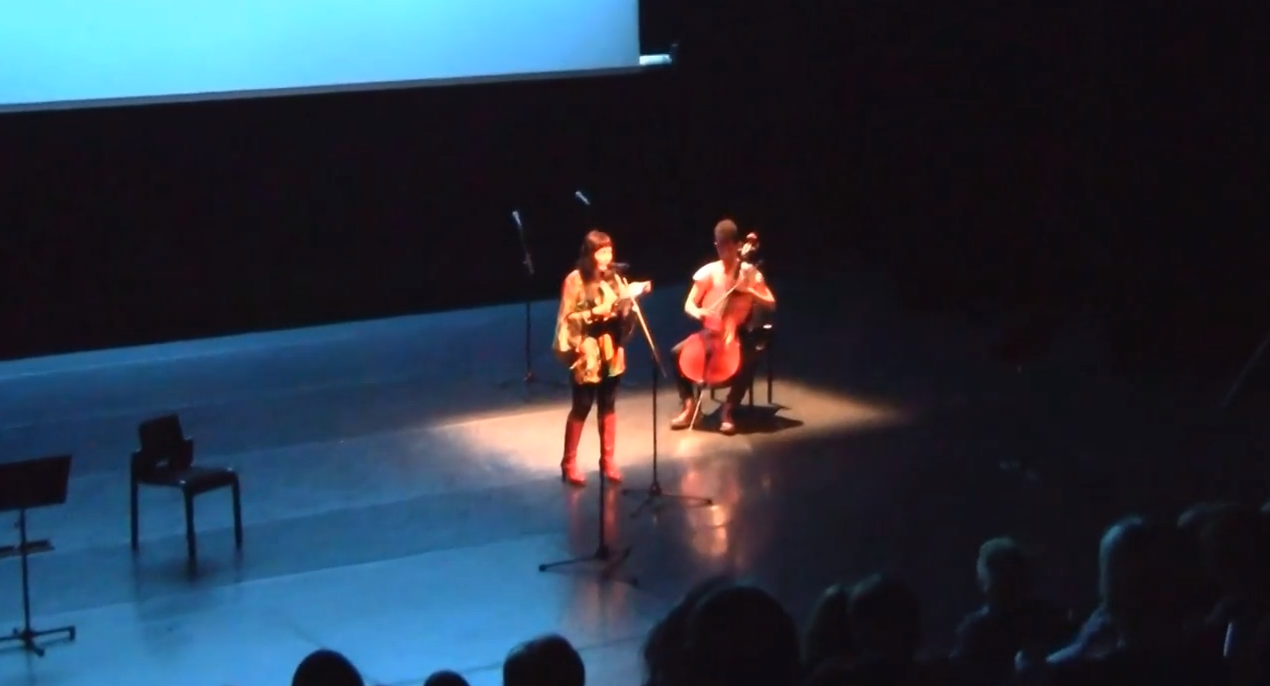
Migrant Tales readers have had the opportunity to read Roxana Crisólogo Correa’s poetry. The presentation below of “Kymmenen runoilijaa,” in Helsinki was part of a poetry concert with other poets like Anja Erämaja, Marcel Jaentschke, Hashim Matouq, Inger-Mari Aikio-Arianaick, Polina Kopylova, Diana Mistera, Nzar Kwestani and Signmark.

The concert included the participation of the musician Sergio Castrillón who accompanied Roxana Crisólogo Correa and Marcel Jaentschke, in their presentations.

“Kymmenen runoilijaa” poetry concert was a sublime and magical experience where the public could feel emotions in other languages, including sign language. Roxana Criólogo Correa’s poem is in Spanish.


Picture #1
Näyttökuva 2014-4-15 kello 10.41.15

Picture #2Näyttökuva 2014-4-15 kello 10.41.53Picture #3

Näyttökuva 2014-4-15 kello 10.42.25

Picture #4

Näyttökuva 2014-4-15 kello 10.51.32

Racism Review: Mixed or not, why are we still taking pictures of “race”?

Posted on April 14, 2014 by Migrant Tales

Sharon Chang*

Just days ago PolicyMic put up a piece entitled “National Geographic Concludes What Americans Will Look Like in 2050, and It’s Beautiful.” In it writer Zak Cheney-Rice attempts to address the so-called rise of multiracial peoples which has captured/enchanted the public eye and with which the media has become deeply enamored. He spotlights a retrospective and admiring look at National Geographic’s “The Changing Face of America” project of last year featuring a series of multiracial portraits by well-known German photographer Martin Schoeller, and also peripherally cites some statistics/graphs that demonstrate the explosion of the mixed-race population.

changing-faces-615

(Image source)

“In a matter of years,” Cheney-Rice writes, “We’ll have Tindered, OKCupid-ed and otherwise sexed ourselves into one giant amalgamated mega-race.” Despite admitting racial inequity persists, he still flirts with the idea of an “end” approaching (presumably to race and by association racism), and suggests while we’re waiting for things to get better, we might “…applaud these growing rates of intermixing for what they are: An encouraging symbol of a rapidly changing America. 2050 remains decades away, but if these images are any preview, it’s definitely a year worth waiting for.” We are then perhaps left with this rather unfortunate centerpiece of his statement, “Here’s how the ‘average American’ will look by the year 2050”:

Portrait


Not surprisingly, the Net erupted in controversy/debate; some standing by and championing the purported beauty of race-mixing as hope for a post-race future; many others pointing out the absurdity of a multiracial=postracial equation, angrily accusing the article of privileging light-skinned mixes thereby centering whiteness and upholding an age-old white dominant race hierarchy. NPR blogger Gene Demby @GeeDee215 tweeted, “Dunno what to do with the fact that the idea we’ll screw racism out of existence is considered a serious position.” A day later Jia Tolentino wrote a rebuttal on the hairpin in which she calls the piece “dumb,” “shallow,” “shortcut-minded,” and charges it with appearing “researched and progressive while actually eliding all of the underlying structural concerns that will always influence what race (and attendant opportunity) means in America far more than the distracting visual pleasure of a girl that looks like Rashida Jones.” She too also unfortunately comes to rest again on this particular portrait, “Look at this freckled, green-eyed future. Look at how beautiful it is to see everything diluted that we used to hate”:

I have been thinking a lot about this face which, thanks to National Geographic and PolicyMic, is now flying around the World Wide Web and has become the stage for much heated race-arguing. What is particularly striking to me, and what I have written on before, is that this person is an actual living, breathing human being — but she is not being treated as such. She is being wielded as a tool, a device, maybe even a weapon? Her physical body is used as a site for others to play out their racial theorizing while her own voice and story remain conspicuously absent.

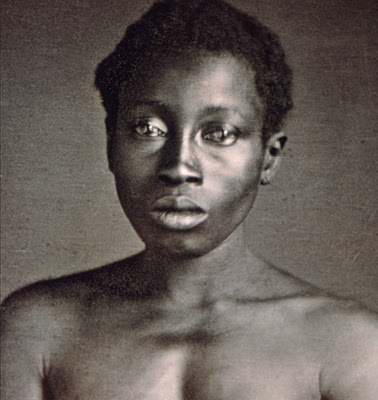
What I think is incredibly important here (and doesn’t seem to have come up in the ensuing disputes) is why portraits designed to quantify/quality racialized appearance were taken with such intent in the first place? Photography which captures a person’s image for the sole and express purpose of measuring then discussing their supposed race is not new and frankly, like pretty much everything race-related, has a long and insidious history. It’s known as racial-type photography and it was popularized in the late 19th century by white pseudo-scientists to “prove” the superiority of some races, and the inferiority of others. Anthropologists used photography to make anatomical comparisons, then racially classify and rank human subjects on an evolutionary scale “seeming to confirm that some peoples were less evolved than others and would therefore benefit from imperial control” (Picture Imperfect: Photography and Eugenics, 1879-1940 by Anne Maxwell, p.21). One of first scientists to use photography to record the anatomy of different races was Swiss-born zoologist and anthropologist Louis Agassiz who lived in America and in 1865 was the nation’s most celebrated naturalist. Agassiz, along with the help of portrait photographer Thomas Zealy, produced some of the earliest racial-type photographs of African slaves to appear in the US. He “wanted to see if the distinct traits of African-born slaves survived in American-born offspring. This would prove his theory that environmental factors wrought very few changes to the type, which by and large remained stable over time.” He staked his whole scientific career on the belief that the different races were created separately by God and in accordance with a divine, preordained plan (Maxwell, pp.23-24):

slave_girl_by_al_brazyly-d36n6gp


(1850) photograph of an enslaved woman in South Carolina by Thomas Zealy for Louis Agassiz

Other influential examples of racial-type photography include: those produced by “British anthropologists Thomas Henry Huxley and John Lanprey [who] developed guidelines for the anthropometrical photographing of native subjects” (Maxell, p.29), those produced in 1871 Germany by the Berlin Society for Anthropology, Ethnology and Prehistory which “set out to assemble anthropological images from around the world, with the eventual purpose of disseminating these to scientific institutions in Germany and Britain” (Maxwell, p.39), and those by Australian photographer Paul Foelsche, “among the best examples of photographs of colonized peoples taken under oppressive conditions” (Maxwell, p.35):

Foelsche

(1870) untitled portrait by Paul Foelsche

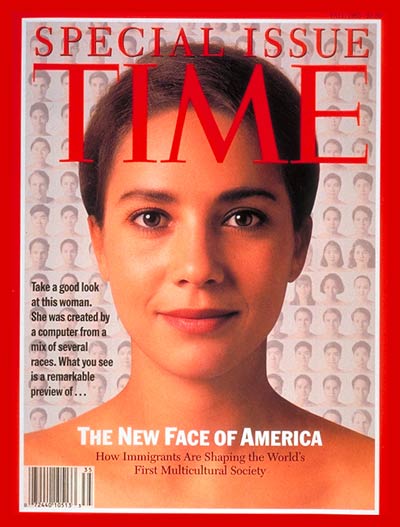
Of course the overt, blatant racism in this older practice of racial-type photography would not be acceptable today. But has the practice of “photographing race” then gone away completely? Has our need to scan and declare the racial appearance of others for the purpose of valuation diminished? Apparently not. We’ve now got National Geographic’s 2013 endeavor (photographed by a white man through a racialized lens no less). We also have Time Magazine’s infamous 1993 cover “The New Face of America: How Immigrants Are Shaping the World’s First Multicultural Society” which was the computer generated face of a mixed-race woman created by merging people from various racial/ethnic backgrounds and who I have read her creators subsequently sort of fell in love with Pygmalion-style:

1101931118_400

(1993) Time Magazine cover, “The New Face of America”

And we have Kip Fulbeck’s 2001 photo project of over 1200 volunteer subjects who self-identified as “Hapa” meant to promote awareness, recognition and give voice to the millions of multiracial/multiethnic individuals of Asian and Pacific Islander descent. Though Kip Fulbeck is aware of racial-type photographic history and acknowledges/challenges it in his book Half Asian 100% Hapa some feel his attempt to stand old forms on their heads, doesn’t work. He himself is a person of mixed-race Asian descent and certainly being a person of color behind the camera lends credence to the idea of reclamation and redefinition. Nevertheless at the end of the day, we are still left with a collection of photographs meant to capture race in some formation.

websample12

Apparently now we are comfortable shifting the practice of race-scanning and many of its same foundational values onto the ambiguous appearance of “different” looking people. Racism is incredibly adaptive and morphs to fit the times. I suggest that while modern race-photography believes itself to be celebrating the dismantling of race, it may actually be fooling us (and itself) with a fantastically complicated show of smoke and mirrors. What a critical mixed race view can offer at this juncture is something so crucial. We need to continually challenge and examine our desire to racially file people. We need to lift our eyes from the ground and take off the rose-colored glasses. We need to put away the headphones, turn off the music and turn on our ears. We need to make much, MUCH more space for something ultimately pretty simple — the stories of actual people themselves which in the end, will paint the real picture.

*Guest blogger Sharon Chang writes at the blog MultiAsian Families.

Read original blog entry here.

This piece was reprinted by Migrant Tales with permission.

Lahtinen and the PS of Espoo don’t like the term racism

Posted on April 13, 2014 by Migrant Tales

Perussuomalaiset (PS) Espoo city councilman, Teemu Lahtinen, said that the anti-immigration and anti-EU party would not vote for the city’s new multicultural program since it states that “Espoo residents don’t tolerate racism.”

Lahtinen, who is a member and has been president of the far-right association Suomalaisuuden liitto,  said he would like to replace the term “racism” with “we don’t accept discrimination.”

PS chairman Timo Soini is an Espoo city concilman. 

Why is this important for Lahtinen and the PS? Why doesn’t he like the term racism? 

Näyttökuva 2014-4-13 kello 13.21.43

Read full story here.

Lahtinen and the PS have a big problem. They have spread so many lies and racist views about migrants and visible minorities in Finland that it’s bound to hit them politically one day.

That day may come sooner than they expect.

Lahtinen’s knowledge of racism is just as bad as his ignorance about Muslims. For the 2011 parliamentary elections, he did a video with PS MP Jussi Halla-aho, who has been sentenced for ethnic agitation. Do Muslims use Sikh-like turbans?

 Lahtinen and Halla-aho think that Muslims use Sikh turbans.

Why is the PS the only party in Finland commissioning opinion polls about migrants?

Posted on April 11, 2014 by Migrant Tales

Here’s the question: Why is the Perussuomalaiset (PS) party the only one in Finland commissioning opinion polls about what Finns think about migration policy and migrants? They did this in 2010 with a no-brainer question that would give them the result they sought.

Näyttökuva 2014-4-11 kello 18.31.19

Read full story here.

The latest poll commissioned by the PS, an anti-immigration and especially anti-Islam party, doesn’t tell us anything new except that Timo Soini’s party wants immigration to be an election issue.

As Migrant Tales has written on a number of occasions, the anti-immigration stance of the PS hinges on two premises: immigration policy and cultural diversity.

By being against Finland’s immigration policy, one can limit Africans, Muslims and other visible migrants from moving here and thereby undermine cultural diversity. The main goal of the PS’ immigration policy is to keep Finland white. White for the PS doesn’t mean Russians.

Eighty-six percent of PS voters consider Finland’s immigration policy too liberal compared with 51% of all respondents, according to the poll. Even so, 8% of those polled compared with 19% of PS voters wanted stricter rules for migrants who planned to move to Finland.

While the poll shows PS followers to be less critical of migration policy and migrants when compared to 2010, the poll doesn’t offer us any valuable information except that immigration is an important campaign issue especially for the PS.

Why has Helsingin Sanomat’s  stopped commissioning these types of polls four years ago? Is it because they are biased and because one can load the questions in order to get the answer one wishes?

Imagine Helsingin Sanomat’s poll question in 2010: Do you want more migrants to move to Finland?

Seriously folks, how many countries in the world state that they want more immigrants?

So why did the PS commission the latest poll?

Because they are an anti-immigration and especially anti-Islam party that has built its popularity on xenophobia. Even if they claim not to be an anti-immigration party, they are loud and clear.

By ratcheting up their anti-EU was well as their anti-immigration and anti-Islam rhetoric, they hope to get a good election result in May and in the parliamentary elections of April 2015.  

That’s after they had disappointing results in the presidential and municipal elections.


  • Previous
  • 1
  • 2
  • 3
  • 4
  • Next
Read more about documentary film
Read more

Recent Posts

  • Finland’s tabloids Iltalehti and Ilta-Sanomat are the pits
  • Riikka Purra’s Dr Jekyll and Mr Hyde mask
  • Double standards
  • Perussuomalaiset: Uusi logo, sama vanha juttu
  • Taco Trump

Recent Comments

  1. Absolutely Socking: Racist Finnish Facebook group against human rights gets flooded with socks on Musta Barbaari’s mother and sister charged by the police in “ethnic profiling” case
  2. Ilkka Nuotio on Pekka Myrskylä: “Tilastot kertovat toista kuin poliittinen keskustelu”
  3. Genrih Soinkara on The war in Ukraine and the Russian-Finnish border crisis are showing Finland’s ugly side
  4. Ahti Tolvanen on Comment by Ahti Tolvanen on the Helsinki +50 conference
  5. Angel Barrientos on Angel Barrientos is one of the kind beacons of Finland’s Chilean community

Archives

  • June 2026
  • May 2026
  • April 2026
  • March 2026
  • February 2026
  • January 2026
  • December 2025
  • November 2025
  • October 2025
  • September 2025
  • August 2025
  • July 2025
  • June 2025
  • May 2025
  • April 2025
  • March 2025
  • February 2025
  • January 2025
  • December 2024
  • November 2024
  • October 2024
  • September 2024
  • August 2024
  • July 2024
  • June 2024
  • May 2024
  • April 2024
  • March 2024
  • February 2024
  • January 2024
  • December 2023
  • November 2023
  • October 2023
  • September 2023
  • August 2023
  • July 2023
  • June 2023
  • May 2023
  • April 2023
  • March 2023
  • February 2023
  • January 2023
  • December 2022
  • November 2022
  • October 2022
  • September 2022
  • August 2022
  • July 2022
  • June 2022
  • May 2022
  • April 2022
  • March 2022
  • February 2022
  • January 2022
  • December 2021
  • November 2021
  • October 2021
  • September 2021
  • August 2021
  • July 2021
  • June 2021
  • May 2021
  • April 2021
  • March 2021
  • February 2021
  • January 2021
  • December 2020
  • November 2020
  • October 2020
  • September 2020
  • August 2020
  • July 2020
  • June 2020
  • May 2020
  • April 2020
  • March 2020
  • February 2020
  • January 2020
  • December 2019
  • November 2019
  • October 2019
  • September 2019
  • August 2019
  • July 2019
  • June 2019
  • May 2019
  • April 2019
  • March 2019
  • February 2019
  • January 2019
  • December 2018
  • November 2018
  • October 2018
  • September 2018
  • August 2018
  • July 2018
  • June 2018
  • May 2018
  • April 2018
  • March 2018
  • February 2018
  • January 2018
  • December 2017
  • November 2017
  • October 2017
  • September 2017
  • August 2017
  • July 2017
  • June 2017
  • May 2017
  • April 2017
  • March 2017
  • February 2017
  • January 2017
  • December 2016
  • November 2016
  • October 2016
  • September 2016
  • August 2016
  • July 2016
  • June 2016
  • May 2016
  • April 2016
  • March 2016
  • February 2016
  • January 2016
  • December 2015
  • November 2015
  • October 2015
  • September 2015
  • August 2015
  • July 2015
  • June 2015
  • May 2015
  • April 2015
  • March 2015
  • February 2015
  • January 2015
  • December 2014
  • November 2014
  • October 2014
  • September 2014
  • August 2014
  • July 2014
  • June 2014
  • May 2014
  • April 2014
  • March 2014
  • February 2014
  • January 2014
  • December 2013
  • November 2013
  • October 2013
  • September 2013
  • August 2013
  • July 2013
  • June 2013
  • May 2013
  • April 2013
  • March 2013
  • February 2013
  • January 2013
  • December 2012
  • November 2012
  • October 2012
  • September 2012
  • August 2012
  • July 2012
  • June 2012
  • May 2012
  • April 2012
  • March 2012
  • February 2012
  • January 2012
  • December 2011
  • November 2011
  • October 2011
  • September 2011
  • August 2011
  • July 2011
  • June 2011
  • May 2011
  • April 2011
  • March 2011
  • February 2011
  • January 2011
  • December 2010
  • November 2010
  • October 2010
  • September 2010
  • August 2010
  • July 2010
  • June 2010
  • May 2010
  • April 2010
  • March 2010
  • February 2010
  • January 2010
  • December 2009
  • November 2009
  • October 2009
  • September 2009
  • August 2009
  • July 2009
  • December 2008
  • November 2008
  • October 2008
  • September 2008
  • August 2008
  • July 2008
  • June 2008
  • May 2008
  • April 2008
  • March 2008
  • February 2008
  • January 2008
  • November 2007
  • October 2007
  • September 2007
  • August 2007
  • July 2007
  • June 2007
  • May 2007

Categories

  • ?? Gia L?c
  • ????? ?????? ????? ???????? ?? ??????
  • ???????
  • @HerraAhmed
  • @mondepasrond
  • @nohatefinland
  • @oula_silver
  • @Varathas
  • A Pakistani family
  • äärioikeisto
  • Abbas Bahmanpour
  • Abdi Muhis
  • Abdirahim Hussein Mohamed
  • Abdirahim Husu Hussein
  • Abdirisak Mahamed
  • About Migrant Tales
  • activism
  • Adam Al-Sawad
  • Adel Abidin
  • Afrofinland
  • Ahmed IJ
  • Ahti Tolvanen
  • Aino Pennanen
  • Aisha Maniar
  • Alan Ali
  • Alan Anstead
  • Alejandro Díaz Ortiz
  • Alekey Bulavsev
  • Aleksander Hemon
  • Aleksanterinliitto
  • Aleksanterinliitto ry
  • Aleksanterinliitto ry:n hallitus
  • Alex Alex
  • Alex Mckie
  • Alexander Nix
  • Alexandra Ayse Albayrak
  • Alexis Neuberg
  • Ali Asaad Hasan Alzuhairi
  • Ali Hossein Mir Ali
  • Ali Rashid
  • Ali Sagal Abdikarim
  • Alina Tsui
  • Aline Müller
  • All categories
  • Aman Heidari
  • Amiirah Salleh-Hoddin & Jana Turk
  • Amin A. Alem
  • Amir Zuhairi
  • Amkelwa Mbekeni
  • Ana María Gutiérrez Sorainen
  • Anachoma
  • Anders Adlecreutz
  • Angeliina Koskinen
  • Anna De Mutiis
  • Anna María Gutiérrez Sorainen
  • Anna-Kaisa Kuusisto ja Jaakko Tuominen
  • Annastiina Kallius
  • Anneli Juise Friman Lindeman
  • Announcement
  • Anonymous
  • Antero Leitzinger
  • anti-black racism
  • Anti-Hate Crime Organisation Finland
  • Anudari Boldbaatar
  • Arshiya Nasser
  • Aspergers Syndrome
  • Asylum Corner
  • Asylum seeker 406
  • Athena Griffin and Joe Feagin
  • Autism
  • Avaaz.org
  • Awale Olad
  • Ayan Said Mohamed
  • AYY
  • Barachiel
  • Bashy Quraishy
  • Beatrice Kabutakapua
  • Beri Jamal
  • Beri Jamal and Enrique Tessieri
  • Bertolt Brecht
  • Boiata
  • Boodi Kabbani
  • Bruno Gronow
  • Carmen Pekkarinen
  • Çelen Oben and Sheila Riikonen
  • Chiara Costa-Virtanen
  • Chiara Costa-Virtanen
  • Chiara Sorbello
  • Christian Thibault
  • Christopher Wylie
  • Clara Dublanc
  • Dana
  • Daniel Malpica
  • Danilo Canguçu
  • David Papineau
  • David Schneider
  • Dexter He
  • Don Flynn
  • Dr Masoud Kamali
  • Dr. Faith Mkwesha
  • Dr. Theodoros Fouskas
  • Edna Chun
  • Eeva Kilpi
  • Emanuela Susheela
  • En castellano
  • ENAR
  • Enrique
  • Enrique Tessieri
  • Enrique Tessieri & Raghad Mchawh
  • Enrique Tessieri & Yahya Rouissi
  • Enrique Tessieri and Muhammed Shire
  • Enrique Tessieri and Sira Moksi
  • Enrique Tessieri and Tom Vandenbosch
  • Enrique Tessieri and Wael Che
  • Enrique Tessieri and Yahya Rouissi
  • Enrique Tessieri and Zimema Mhone
  • Epäluottamusmies
  • EU
  • Europe
  • European Islamophobia Report
  • European Islamophobia Report 2019,
  • European Union
  • Eve Kyntäjä
  • Ezequiel Caldeiro
  • Facebook
  • Fadumo Dayib
  • Faisa Kahiye
  • Farhad Manjoo
  • Fasismi
  • Finland
  • Fizza Qureshi
  • Flyktingar och asyl
  • Foreign Student
  • Fozia Mir-Ali
  • Frances Webber
  • Frida Selim
  • Gareth Rice
  • Ghyslain Vedeaux
  • Global Art Point
  • Great Replacement
  • Habiba Ali
  • Hami Bahadori
  • Hami Bahdori
  • Hamid
  • Hamid Alsaameere
  • Hamid Bahdori
  • Handshake
  • Harmit Athwal
  • Hassan Abdi Ali
  • Hassan Muhumud
  • Heikki Huttunen
  • Heikki Wilenius
  • Helsingin Sanomat
  • Henning van der Hoeven
  • Henrika Mälmsröm
  • Hser Hser
  • Hser Hser ja Mustafa Isman
  • Husein Muhammed
  • Hussain Kazemian
  • Hussain Kazmenian
  • Ibrahim Khan
  • Ida
  • Ignacio Pérez Pérez
  • Iise Ali Hassan
  • Ilari Kaila & Tuomas Kaila
  • Imam Ka
  • inside-an-airport
  • Institute of Race Relations
  • Iraqi asylum seeker
  • IRR European News Team
  • IRR News Team
  • Islamic Society of Norhern FInland
  • Islamic Society of Northern Finland
  • Islamophobia
  • Jacobinmag.com
  • Jallow Momodou
  • Jan Holmberg
  • Jane Elliott
  • Jani Mäkelä
  • Jari Luoto
  • Jari Taponen
  • Jegor Nazarov
  • Jenni Stammeier
  • Jenny Bourne
  • Jessie Daniels
  • Joe Davidow
  • Johannes Koski
  • John D. Foster
  • John Grayson
  • John Marriott
  • Jon Burnett
  • Jorma Härkönen
  • Jos Schuurmans
  • José León Toro Mejías
  • Josue Tumayine
  • Jouni Karnasaari
  • Juan Camilo
  • Jukka Eräkare
  • Julian Abagond
  • Julie Pascoet
  • Jussi Halla-aho
  • Jussi Hallla-aho
  • Jussi Jalonen
  • JusticeDemon
  • Kadar Gelle
  • Kaksoiskansalaisuus
  • Kansainvälinen Mikkeli
  • Kansainvälinen Mikkeli ry
  • Katherine Tonkiss
  • Kati Lepistö
  • Kati van der Hoeven-Lepistö
  • Katie Bell
  • Kättely
  • Kerstin Ögård
  • Keshia Fredua-Mensah & Jamie Schearer
  • Khadidiatou Sylla
  • Khadra Abdirazak Sugulle
  • Kiihotus kansanryhmää vastaan
  • Kirsi Crowley
  • Koko Hubara
  • Kristiina Toivikko
  • Kubra Amini
  • KuRI
  • La Colectiva
  • La incitación al odio
  • Laura Huhtasaari
  • Lauri Finér
  • Leif Hagert
  • Léo Custódio
  • Leo Honka
  • Leontios Christodoulou
  • Lessie Branch
  • Lex Gaudius
  • Leyes de Finlandia
  • Liikkukaa!
  • Linda Hyökki
  • Liz Fekete
  • M. Blanc
  • Maarit Snellman
  • Mahad Sheikh Musse
  • Maija Vilkkumaa
  • Malmin Kebab Pizzeria Port Arthur
  • Marcell Lorincz
  • Mari Aaltola
  • María Paz López
  • Maria Rittis Ikola
  • Maria Tjader
  • Marja-Liisa Tolvanen
  • Mark
  • Markku Heikkinen
  • Marshall Niles
  • Martin Al-Laji
  • Maryan Siyad
  • Matt Carr
  • Mauricio Farah Gebara
  • Media Monitoring Group of Finland
  • Micah J. Christian
  • Michael McEachrane
  • Michele Levoy
  • Michelle Kaila
  • Migrant Tales
  • Migrant Tales Literary
  • Migrantes News
  • Migrants' Rights Network
  • MigriLeaks
  • Mikko Kapanen
  • Miriam Attias and Camila Haavisto
  • Mohamed Adan
  • Mohammad Javid
  • Mohammad M.
  • Monikulttuurisuus
  • Monisha Bhatia and Victoria Canning
  • Mor Ndiaye
  • Muh'ed
  • Muhamed Abdimajed Murshid
  • Muhammed Shire
  • Muhammed Shire and Enrique Tessieri
  • Muhis Azizi
  • Musimenta Dansila
  • Muslimiviha
  • Musulmanes
  • Namir al-Azzawi
  • Natsismi
  • Neurodiversity
  • New Women Connectors
  • Nils Muižnieks
  • No Labels No Walls
  • Noel Dandes
  • Nuor Dawood
  • Omar Khan
  • Otavanmedia
  • Oula Silvennoinen
  • Paco Diop
  • Pakistani family
  • Pentti Stranius
  • Perussuomalaiset
  • perustuslaki
  • Petra Laiti
  • Petri Cederlöf
  • Pia Grochowski
  • Podcast-lukija Bea Bergholm
  • Pohjois – Suomen Islamilainen Yhdyskunta
  • Pohjois Suomen Islamilainen Yhyskunta
  • Polina Kopylova
  • Race Files
  • racism
  • Racism Review
  • Raghad Mchawh
  • Ranska
  • Rashid H. and Migrant Tales
  • Rasismi
  • Raul Perez
  • Rebecka Holm
  • Reem Abu-Hayyeh
  • Refugees
  • Reija Härkönen
  • Remiel
  • Reza Nasri
  • Richard Gresswell
  • Riikka Purra
  • Risto Laakkonen
  • Rita Chahda
  • Ritva Kondi
  • Robito Ibrahim
  • Roble Bashir
  • Rockhaya Sylla
  • Rodolfo Walsh
  • Roger Casale
  • Rostam Atai
  • Roxana Crisólogo Correa
  • Ruth Grove-White
  • Ruth Waweru-Folabit
  • S-worldview
  • Sadio Ali Nuur
  • Sami Rusanen
  • Sandhu Bhamra
  • Sara de Jong
  • Sarah Crowther
  • Sari Alhariri
  • Sarkawt Khalil
  • Sasu
  • Scot Nakagawa
  • Shabana Ahmadzai
  • Shada Islam
  • Sharon Chang blogs
  • Shenita Ann McLean
  • Shirlene Green Newball
  • Sini Savolainen
  • Sira Moksi
  • Sonia K.
  • Sonia Maria Koo
  • Steverp
  • Stop Deportations
  • Suldaan Said Ahmed
  • Suomen mediaseurantakollektiivi
  • Suomen Muslimifoorumi ry
  • Suomen viharikosvastainen yhdistys
  • Suomen viharikosvastainen yhdistys ry
  • Suomi
  • Supermen
  • Susannah
  • Suva
  • Syrjintä
  • Talous
  • Tapio Tuomala
  • Taw Reh
  • Teivo Teivainen
  • The Daily Show
  • The Heino
  • The Supermen
  • Thomas Elfgren
  • Thulfiqar Abdulkarim
  • Tim McGettigan
  • Tino Singh
  • Tito Moustafa Sliem
  • Tobias Hübinette and L. Janelle Dance
  • Transport
  • Trica Danielle Keaton
  • Trilce Garcia
  • Trish Pääkkönen
  • Trish Pääkkönen and Enrique Tessieri
  • Tuulia Reponen
  • Uncategorized
  • UNITED
  • University of Eastern Finland
  • Uyi Osazee
  • Väkivalta
  • Vapaa Liikkuvuus
  • Venla-Sofia Saariaho
  • Vieraskynä
  • W. Che
  • W. Che an Enrique Tessieri
  • Wael Ch.
  • Wan Wei
  • Women for Refugee Women
  • Xaan Kaafi Maxamed Xalane
  • Xassan Kaafi Maxamed Xalane
  • Xassan-Kaafi Mohamed Halane & Enrique Tessieri
  • Yahya Rouissi
  • Yasmin Yusuf
  • Yassen Ghaleb
  • Yle Puhe
  • Yuliet Tresa
  • Yve Shepherd
  • Zahra Khavari
  • Zaker
  • Zalina Ametova
  • Zamzam Ahmed Ali
  • Zeinab Amini ja Soheila Khavari
  • Zimema Mahone and Enrique Tessieri
  • Zimema Mhone
  • Zoila Forss Crespo Moreyra
  • ZT
  • Zulma Sierra
  • Zuzeeko Tegha Abeng
© 2026 Migrant tales | Powered by Minimalist Blog WordPress Theme