Migrant tales
Menu
  • #MakeRacismHistory “In Your Eyes”
  • About Migrant Tales
  • It’s all about Human Rights
  • Literary
  • Migrant Tales Media Monitoring
  • NoHateFinland.org
  • Tales from Europe
Menu

Month: December 2013

A letter of thanks to Hommaforum and Hannu of Scripta

Posted on December 15, 2013 by Migrant Tales

Hommaforum, a Finnish hate forum where people reveal their xenophobia and racism anonymously, tried to pull a fast one on Migrant Tales by making up a story about an Ethiopian victim called Dawit. The aim of the email and the story that was published and taken down was supposedly to discredit and shame one of Finland’s most outspoken blogs against racism. 

Did they succeed? Not by a long shot. Migrant Tales has published some 1,800 postings. We have many faithful visitors. We have as well some who dislike us so much that they lose sleep over this blog.

Apart from analysis about cultural diversity in Finland, comments by associate editors like JusticeDemon and Mark add value to our forum. Migrant Tales wouldn’t be anything without them.

After reading over 30,000 comments on our blog, I have learned an important lesson: It’s an utter waste of time to debate with those who are challenged on the tolerance front. We seek proactive answers, while the latter seek to be indifferent.

Apparently, Hommaforum is riling mad about a posting by Fadumo Dayib, Run Nigger, Run, which was published this week. 

Why did this Dayib’s account anger them? Because a Somali, a woman, had the guts to tell her experiences about racism in Finland. This was too much for the people of Hommaforum to take. For some men, Finnish machismo is manifested through racism. That’s why they feel especially threatened when a woman from Somalia can outdebate them.

Another matter that the perpetrators wanted to unsuccessfully show, or claim, is that we don’t check the reliability of our stories. This couldn’t be further from the truth. Everything I write on this blog I take responsibility with my real name. Contrary to many, I am not anonymous and do so because I believe in what I do. I take responsibility for what I write.

The grand majority of our stories are based on reliable sources like newspapers, NGOs and others. We do some investigative reporting with good results and sometimes, hardly ever, we publish directly.

Another factor you have to understand is the motive. The site is Hommaforum, who apart from spreading racism in this country, one of its aims is to deny racism, even if it sounds surreal.

The action taken against our blog is similar to a bogus Finland Democrat Party story in November 2012 published by Turun Sanomat in which former PS MP, James Hirvisaari, was supposed to be a founding member.

Turun Sanomat was chosen as a target because it help spread Helena Eronen’s racist blog entry about sleeve badges last year for different ethnic groups.

Dayib’s opinion piece that was published on Migrant Tales is the reason for Hommaforum’s actions.

In the face of the latest prank, I would like to personally thank them for showing how threatened they feel by our cyber presence.

Migrant Tales is no Turun Sanomat and neither do we have the backing of Finland’s third-largest party in parliament, the Perussuomalaiset (PS), never mind the symbol of ethnic intolerance in this country, Jussi Halla-aho, who was sentenced for ethnic agitation. We’re a small and humble forum that has grown out of nowhere thanks to our arguments and the support of our readers.

The question that interests Hommaforum is if we we’ll stop speaking out against racism in Finland. The answer is a flat no.

Back in 2008, I was about to throw in the Migrant Tales towel but one Scripta member thought he would strike us off the cyber map by calling a social-media lynching mob to our site. I was amazed and emboldened by the attack.

If that attack wouldn’t have happened, it’s doubtful that Migrant Tales would exist today. Thank you Hannu (Onkko for Hommaforumers  and Internetsi for others). If there is one person that boosted our blog from the beginning, that person has got to be Hannu.

The moral of this story? The more you hit us and the more you notice us, the stronger we grow and the weaker and more isolated you become.

I’m more than certain that in 20 years or sooner, Migrant Tales will be judged as a forum that had the courage to speak out against racism while your hate site, Hommaforum, will be studied as an example of how racism got a beachhead and spread in Finland.

In many respects reading what you write on your forum is like listening in 2013 to a white racist speaking in the 1950s in Alabama about blacks.

How come you don’t write your comments with real names? Why so much inflated bravado, anonymously? Are you afraid that your grandchildren and great-grandchildren will be shamed by what you write?

Yes, that must be the reason.

And hey, thank you Hommaforum and Hannu of Scripta for making us stronger today.


Migrant Tales 2008: Being an immigrant in Finland. A letter from Ida

Posted on December 15, 2013 by Migrant Tales

COMMENT: Migrant Tales has always been interested in publishing the experiences of Finns with multicultural backgrounds. The letter by “Ida” below is one of the first we ever published on this blog in September 2008.

There are others ones aboutSomali-Finn Abdulah, Living in no-man’s land, and Micah J. Christian, What being Finnish means to me.

While all of these people come from different backgrounds, their experiences in Finland are pretty much the same since all three of them have had to struggle with racism and rejection.

The question isn’t whether racism is alive and well in our society, but what must we do to challenge this social ill that threatens us.

__________

By “Ida”

I am an immigrant. Sometimes I feel so frustrated in Finland that I just wanted to ‘give it back to the society’. Hence the crime. People like me (hypothetically) acting out of frustration. If the mentality here is that no foreigners are good and only a tiny fraction of people like Juha, the social worker, understands and/or appreciates diversity it doesn’t help much because the general society isn’t open=minded. I would even call racist.

If a person like Juha comes to ask me how do I like it in Finland, I wouldn’t want to hurt his feelings. A guy who works so hard for us. What do you expect me to say? that I am so frustrated that I can leave this second to another place where I feel more comfortable?

I would reverse those numbers. 95% prejudiced and 4% nonchalant, 0.5% don’t care, 0.001% welcoming (and the rest 0.499% lost in statistics).

Good welfare system is like a double-edged sword for immigrants. We are taken care of but we are also blamed for using them. And so you have to be ever-thankful that you are here, Finland. Because you are given shelter and food, now you can take this mental abuse in the form of institutionalized racism.

Any CONSTRUCTIVE comments?

Timo Soini’s silence in the face of PS MP Olli Immonen’s proposal reveals that he has always been the wolf in sheep’s clothing

Posted on December 13, 2013 by Migrant Tales

Timo Soini, the chairman of the Perussuomalaiset (PS) party, was quoted as saying on YLE in English that PS MP Olli Immonen’s written question to parliament, that Finland should start classifying people according to ethnic background, doesn’t concern him. 

What do you think such a statement by the head of an an anti-immigration party reveals? What does it say say about the present state of this country about promoting mutual acceptance?

It shows all along that Soini is not only an opportunist who would sell out Finland to amass more political clout and power, but the wolf in sheep’s clothing.

Jussi Halla-aho, James Hirvisaari, Olli Immonen and others of the PS aren’t the so-called bad guys, Soini is by a mile.

Kuvankaappaus 2013-12-12 kello 23.53.00

Read full story (in Finnish) here.

While such an admission by Soini shouldn’t surprise us, it shows that Finland is still in deep denial and ignorance about racism. It shows that too many politicians in Finland would care less about immigrants and minorities.

Why are we still in the present stage where we deny racism as opposed to challenge it as we should? The answer is clear: We deny racism as a real problem in our society because intolerance gives some status and power over other groups.

We also deny it because the behavior of some shames us.

Immonen’s proposal is racist, but Soini’s silence  sends a dangerous message to the wrong people.


PS MP wants Finland to classify people according to ethnic background

Posted on December 12, 2013 by Migrant Tales

As the European Parliament elections near in May 2014, the attacks against immigrants and visible minorities in Finland by the Perussuomalaiset (PS) are getting stronger and more relentless. The latest one is by none other then PS MP Olli Immonen, who gave parliament Wednesday a written question that Finland should start registering people according to their ethnic background.

PS’ chairman Timo Soini was silent about Immonen’s plans when approached by the Finnish media.

Soini continues to deny that there are racists in the populist party even if some of its members like MP Jussi Halla-aho have been sentenced for ethnic agitation.

Kuvankaappaus 2013-12-12 kello 7.25.46

Read full story (in Finnish) here.

Even if we speak in Finland of a society that prizes education and Nordic values, MP’s like Immonen show that the education they received at school and at home on racism was too little and deficient.

The term “race” is generally used in the US while “ethnic group” is used in Europe to mean the same thing. In the US, blacks consider themselves “a race” while some Hispanics refer to themselves as la raza, or “the race.”

According to Immonen, who is chairman of the ultra-nationalist anti-immigration Suomen Sisu association, ethnic classification of people in Finland is necessary due to its ever-growing cultural and ethnic diversity.

I personally believe it’s none of Immonen’s or the general public’s right to pry and classify me into a group they think I should belong to.

Immonen said that Finland could copy the same ethnic-classification system used in Britain. Some ethnic groups that people could be classified into are Finnish Finns, Finnish Swedes, Saame, Roma, other European, African, Asian, diverse ethnic background and other ethnic group, according to the PS MP.

Finland does classify people according to their nationality, mother tongue and place of birth.

Taking into account that race or ethnicity is a social construct to begin with, classifying people into groups is difficult especially in an age when we move and travel with greater ease from country to country and where we adopt complex multicultural identities.

To show how difficult it would be to classify people along ethnic lines, the system we use presently in Finland is fraught with problems. Nationality, mother or father tongue, place of birth don’t shed light on a person’s ethnic identity since that it a personal choice.

US American sociologist Yehudi Webster at the California State University, Los Angeles, believes that classifying people by race actually worsens racial strife.

“It is not ‘race’ but a practice of racial classification that bedevils the society,” he writes.

Writes the American Anthropological Society:

“In the United States both scholars and the general public have been conditioned to viewing human races as natural and separate divisions within the human species based on visible physical differences. With the vast expansion of scientific knowledge in this century, however, it has become clear that human populations are not unambiguous, clearly demarcated, biologically distinct groups.”

Countries like England and the United States, which classify people into ethnic groups, have a questionable history since both practiced slavery and had oversea colonies. Ethnic classification played a crucial role in enabling whites in these countries to exploit other groups by classifying members of their population  into superior (whites) and inferiors (other groups).  


Why do we still hesitate to challenge intolerance in Finland?

Posted on December 11, 2013 by Migrant Tales

I had an interesting chat yesterday with an old friend about racism in Finland. One of the matters we agreed was that Finland hasn’t reached that stage where we accept that racism exists and that concrete steps must be taken to challenge it. This fact leads us to a second important question: Why? 

The answer is obvious and could be answered with the statement below I got from Ruth Rubin’s Facebook wall.

1504001_10202654076895766_2042479362_n

They give as a present fear so they can sell us security.

Wars will never end not because it is in our blood, but because it is big business. Why would the army, navy or air force of a country admit that we live in a safer world? If they did, they’d see their budgets slashed.

Since racism is hostile and a violent act like war, it’s clear that it has a role as well. The above-mentioned statement if applied to racism would read something like the following: We deny racism in order to remain in our historic, political and economic comfort zone.

There’s a lot of money riding on ensuring that we have an effective system that discriminates against different groups like immigrants and visible minorities.

Why not ask the Perussuomalaiset (PS) if they agree?  What would happen if they admitted that racism is an issue in this country that should be tackled. Making such an admission would be synonymous to commiting political hara-kiri.

Like some political parties, some institutions like the police, educational sector, Finnish Immigration Service, even some so-called anti-racist associations, don’t want to take the debate to the second level and admit that racism is an issue in this society because it would diminish their power and status.

So to answer my friend’s comment, why Finland still resists to recognize that racism is an issue in this society, is clear: We deny racism as a problem because intolerance gives some status and power at the cost of other groups.

My friend and I have lived in this country for many decades. Contrary to him, I have Finnish ancestry. I believe that we know a little about racism in Finland.

Even so, few are willing to discuss in earnest our view on the matter. 

Why?

Because we are still in the phase of denying rather than challenging racism.


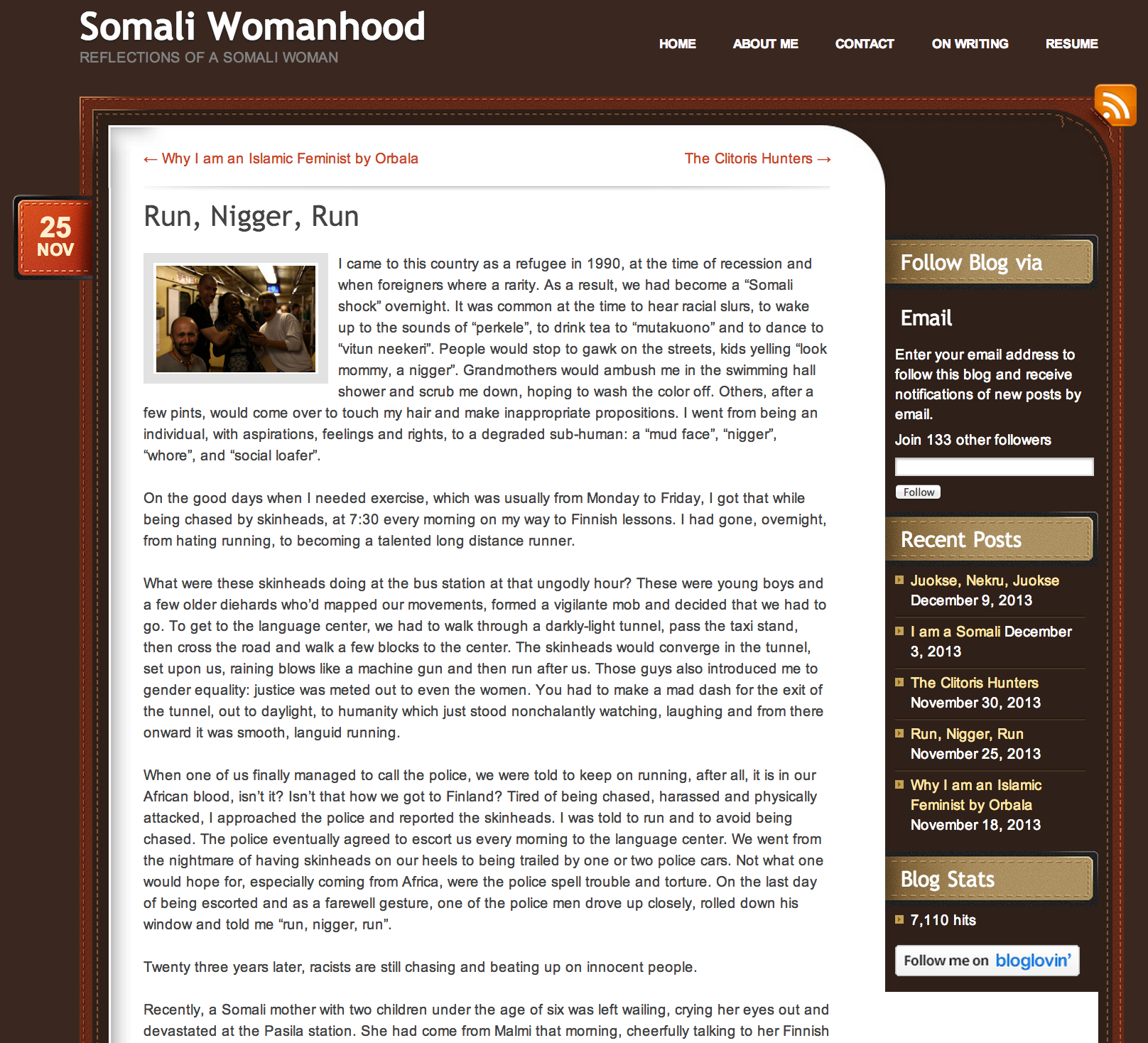
Fadumo Dayib: Run, Nigger, Run

Posted on December 9, 2013 by Migrant Tales

Fadumo Dayib

I came to this country as a refugee in 1990, at the time of recession and when foreigners where a rarity. As a result, we had become a “Somali shock” overnight. It was common at the time to hear racial slurs, to wake up to the sounds of “perkele”, to drink tea to “mutakuono” and to dance to “vitun neekeri”. People would stop to gawk on the streets, kids yelling “look mommy, a nigger”. Grandmothers would ambush me in the swimming hall shower and scrub me down, hoping to wash the color off. Others, after a few pints, would come over to touch my hair and make inappropriate propositions. I went from being an individual, with aspirations, feelings and rights, to a degraded sub-human: a “mud face”, “nigger”, “whore”, and “social loafer”.

Kuvankaappaus 2013-12-9 kello 19.59.28


On the good days when I needed exercise, which was usually from Monday to Friday, I got that while being chased by skinheads, at 7:30 every morning on my way to Finnish lessons. I had gone, overnight, from hating running, to becoming a talented long distance runner.

What were these skinheads doing at the bus station at that ungodly hour? These were young boys and a few older diehards who’d mapped our movements, formed a vigilante mob and decided that we had to go. To get to the language center, we had to walk through a darkly-light tunnel, pass the taxi stand, then cross the road and walk a few blocks to the center. The skinheads would converge in the tunnel, set upon us, raining blows like a machine gun and then run after us. Those guys also introduced me to gender equality: justice was meted out to even the women. You had to make a mad dash for the exit of the tunnel, out to daylight, to humanity which just stood nonchalantly watching, laughing and from there onward it was smooth, languid running.

When one of us finally managed to call the police, we were told to keep on running, after all, it is in our African blood, isn’t it? Isn’t that how we got to Finland? Tired of being chased, harassed and physically attacked, I approached the police and reported the skinheads. I was told to run and to avoid being chased. The police eventually agreed to escort us every morning to the language center. We went from the nightmare of having skinheads on our heels to being trailed by one or two police cars. Not what one would hope for, especially coming from Africa, were the police spell trouble and torture. On the last day of being escorted and as a farewell gesture, one of the police men drove up closely, rolled down his window and told me “run, nigger, run”.

Twenty three years later, racists are still chasing and beating up on innocent people.

Recently, a Somali mother with two children under the age of six was left wailing, crying her eyes out and devastated at the Pasila station. She had come from Malmi that morning, cheerfully talking to her Finnish children and looking forward to the day. A person behind her on the escalator violently pushed her three-year old baby out of the way and stood in front of her. She asked the person, a blond woman, why she pushed the child. The woman looked back, snickered and smacked the six-year old girl on the face, smashing her lips and nose wide open. The mother, shocked by the brutal act and the amount of blood spilling from the face of her daughter, yelled for the bystanders to stop the running woman. THEY JUST STOOD AND WATCHED, LIKE SPECTATORS IN A STADIUM. The mother could not run after the woman and leave her kids on the escalator.

When the police came, all the witnesses were slowly dispersing. They refused to step up and be responsible citizens. The mother implored the spectators, tried to appeal to their decency and humanity, but to no avail. Now the case has not gone far, the children are psychologically traumatized and the mother wrecked with feelings of hopelessness, anger and deep hatred. Why do Finnish people do this? Why did they choose to be passive, watching such a heinous act? This is a child, a child! I could understand if it were an adult being attacked. But a defenseless CHILD: that is just plain callousness. Please, if you were at Pasila that day, please go to the police and do your bit. That deranged woman needs to be brought to justice. The next child she attacks could be YOURS.

Times have changed, mostly for the better. The face of racism has changed from milky white to differing hues of yellow, red, chocolate and sometimes green. Racism is no longer exclusive to the Finns. No, we also have migrants doing that. It is okay to bash the Somalis, if only to score brownie points and curry favors. If you’re a frustrated migrant, with low self-esteem and disgruntled disposition, just walk up to a Finn and tell them how you despise those nasty Somalis, sit back and expect to be invited for coffee the next day. You’ll be sorely disappointed for your turn will come too one day. But as you attempt to do this, don’t forgot that you’re here, enjoying relative peace, because we did the running, bit the bullet, endured the worst and paved the way for you.

Why am I opening up old wounds if times are better, as I claim? Because I am tired of hearing that the Finns are racists. That we cannot integrate into this society because we are of a different color, religion and culture. That Finns want us to give up our culture and religion. If that were the case, why are our children learning, free of charge, their mother-tongue and religion in schools? Where else in the world do you have such endless and highly sought after educational opportunities, all paid for by the state?

I’m not denying that racism isn’t a problem in this country. Racism is a global phenomenon that can also be found in Somalis as well as in other migrant communities. Take the example of migrants running on the tickets of populist parties here. I am talking about the ones who glare at you, huge bucket loads of condescension dripping off them and whose mistreatment is even worse than the actual racists. God forbid you should run into them in the hospitals, the government offices and even on the streets.

However, I have a problem with generalizing it to the wider population. The majority of the Finns, often silent and in the background are tolerant, peace-loving and civilized people.

The racists, although vocal and visible, are a small minority in this country. How do you recognize them? They have one thing in common: hatred. It is targeted at people who are doing well, who have jobs, businesses, high salaries, education, good living standards and who speak languages other than just Finnish. They’re easily manipulated and gullible because of their low educational level. And so they take it out on people that they perceive to have led to their misfortune. They tend to live in denial and have a utopian outlook on life: like waking up one day to the sound of angels singing in harmony, violins playing and finding a colorless Finland.

If all Finns were racists, like some claim, then life here would be hellish. Imagine that for a moment, imagine it again for a little while longer, and let it sink in slowly.

Take the opportunities available in this country, learn the language, get an education, work hard and abide by the national laws/norms. If, despite all that, you still feel unwelcome and sick of it all. Don’t despair, there are other countries looking for competent workers and who will gladly take you in. Finland is fast becoming a country known for training and exporting highly skilled labor. But remember to come back. Running away is not the best and only solution. I write from experience here.

We need to engage the tolerant majority constructively, unite forces with them, find common goals and work towards an inclusive Finland. I believe that this is our country, no matter what, and we will be here long after the storm has died down. I love Finland and I love being a Somali-Finn. This is my country, my home, my mother is buried here and my children were born here. Stop being apologetic, stop complaining, roll back your sleeves and join us in finding a solution and building bridges.

Read original column here.

Kolumni voi lukea suomeksi tässä. 

This piece was reprinted by Migrant Tales with permission.

 Thank you Micah Christian for the heads-up!

Fadumo Dayib: Juokse, Nekru, Juokse

Posted on December 9, 2013 by Migrant Tales

Fadumo Dayib

Saavuin tähän maahan pakolaisena vuonna 1990, keskelle lamaa, aikana jolloin ulkomaalaiset olivat harvassa. Somalishokki toteutui yli yön. Tavan takaa kuulin rasistisia heittoja, heräsin ”perkele”-sointuihin, join teeni ”mutakuonona” ja tanssin ”vitun neekeri”-biisien tahtiin. Ihmiset pysähtyivät kadulla tuijottamaan, lapset kiljahtelivat ”kato äiti neekeri”. Isoäidit hyökkäsivät kimppuuni uimahallin suihkussa yrittäen pestä pois väriäni. Muutaman tuoppin rohkaisemina toiset tulivat koskettelamaan hiuksiani ja tekemään sopimattomia ehdotuksia. Muutuin tuntevasta, unelmoivasta ja oikeudellisesta yksilöstä alhaiseksi ali-ihmiseksi: mutakuonoksi, nekruksi, huoraksi ja sosiaalipummiksi.

Kuvankaappaus 2013-12-9 kello 20.13.03

Hyvinä päivinä jos satuin tarvitsemaan liikunta, sain sen maanantaista perjantaihin skinien jahdatessa minua aamuaikaan 07:30 matkallani suomenkielen tunneille. Yhdessä yössä minusta, juoksunvihaajasta, tuli kohtuullisen lahjakas pitkänmatkan juoksija. Mitä nuo skinit tekivät tuolla bussiasemalla tuohon aamuvarhaiseen aikaan? Siellä oli nuoria poikia ja pari ikääntyneempää jäärää, jotka olivat selvittäneet kulkureittimme – muodostaneet hyökkäysjoukkonsa ja päättäneet että meidän piti lähteä. Päästäksemme kielikeskukseen, meidän tuli kulkea erään varjoisan tunnelin kautta, ohittaa taksiasema ja kävellä pari korttelia keskukseen.

Skinit kokoontuivat tunneliin, hyökkäsivät kimppuumme, jakelivat iskuja kuin konekiväärin suusta ja lähtivät juosten peräämme. Samalla minut tutustutettiin sukupuoliseen tasa-arvoon; heidän oikeuttaan jaettiin niin naisille kuin miehillekin. Jouduin singahtamaan hullun lailla kohti tunnelin päätä, päivänvaloon, ihmiskunnan silmien alle, jotka seisoivat rennosti ihmettelemässä, naureskelemassa taksiasemalla. Ja sitten vain juostiin tasaisesti jolkottaen kohti kielikeskusta.

Kun vihdoin yksi meistä rohkaistui kutsumaan poliiseja apuun, meitä neuvottiin jatkamaan juoksua, sehän on kuulemma meillä afrikkalaisilla verissä? Silleenhän me Suomeenkin oltiin tultu? Väsyneinä jahdatuksi tulemiseen, pahoinpitelyyn ja nimittelyyn käännyin poliisin puoleen ja tein skineistä ilmoituksen. Minua kehoitettiin juoksemaan ja välttämään jahdatuksi tulemista. Lopulta poliisi suostui aamuisin saattamaan meitä kielikeskukseen. Siirryimme skinien jahdin painajaisesta poliisin seurannan alaisuuteen. Sekään ei ollut helppoa, sillä Afrikassa, jätetyssä kotimaassa poliisiviranomainen tarkoitti monasti ongelmia ja kidutusta. Viimeisenä päivänä, ilmeisesti jäähyväistervehdyksenä, poliisiauto ajoi lähellemme ja poliisi huikkasi minulle ”juokse, nekru, juokse”.

Nyt, kaksikymmentäkolme vuotta myöhemmin, rasistit edelleen ajavat takaa ja hakkaavat viattomia ihmisiä. Vastikään eräs kahden lapsen somaliäiti istui yksin, silmät päästään itkeneenä Pasilan poliisiasemalla. Hän oli samaisena aamuna matkustanut Malmilta iloisena suomalaisille lapsilleen jutellen, toiveikkaana päivää odottaen. Liukuportaissa heidään takanaan seissyt henkilö työnsi voimalla kolmevuotiaan pois edestään ja asettui äidin eteen. Tämä kysyi miksi hän oli tuuppinut pientä lasta. Vaaleatukkainen nainen tuijotti takaisin, hihitti ja läimäytti kuusivuotista kasvoihin halkaisten lapsen huulen ja nenä alkoi vuotamaan verta. Lasten äiti meni shokkiin yllättävästä väkivallasta ja huusi sivustakatsojia ottamaan juoksevaa naista kiinni. HE VAIN SEISOIVAT JA KATSOIVAT, STADIONIN YLEISÖN LAILLA. Äiti ei voinut lähteä pahoinpitelijän perään jättäen
lapsiaan liukuportaisiin.

Poliisin saapuessa, silminnäkijät hupenivat, kieltäytyivät kertomasta näkemäänsä vastuullisina kansalaisina. Äiti vetosi katsojiin, heidän oikeudentuntoonsa ja inhimillisyyteen, mutta turhaan. Nyt oikeutta ei saa, lapset ovat psyykkisesti traumatisoituneita ja äiti on voimattomuuden, vihan ja inhon tunteiden murtama. Miksi suomalaiset tekevät näin ? Miksi he päättivät olla auttamatta nähdessään tämän julman teon? Se oli lapsi, LAPSI! Olisin ehkä ymmärtänyt teon jos kohteena olisi ollut aikuinen, mutta puolustuskyvyttömän lapsen kimppuun hyökkääminen on puhdasta ilkeyttä.

Pyydän. Jos olit Pasilassa tuona päivänä ja näit tämän, mene poliisin puheilla ja tee velvollisuutesi jotta tämä mielenhäiriöinen hyökkääjä saadaan oikeuden eteen. Seuraavan hyökkäyksen kohde voi olla sinun lapsesi.

Ajat ovat muuttuneet, enimmäksen parempaan suuntaan. Rasismin kasvot ovat vaihtaneet värejään maidonvalkoisesta eri keltaisiin, punaisiin, ruskeisiin ja joskus vihreisiin säyvyihin. Rasismi ei enää ole mikään suomalaisten oikeus, vaan sitä harrastavat myös maahanmuuttajat keskuudessaan.Somaleja voi aina vetää turpaan vaikka ihan tonttupisteiden ja arvostuksen vuoksi. Turhautuneena maahanmuuttajana voit aina kävellä suomalaisen luokse ja kertoa miten halveksit noita tyhmiä somaleja ja jäädä odottamaan kutsua kahville seuraavana päivänä. Tulet pettymään sillä oma hetkesi tulee minä päivänä hyvänsä. Jos näin kuitenkin toimit, muista että nykyhetken suhteellinen rauha ansaittiin, kun me aikanaan juoksimme, otimme turpaan ja tasoitimme tiesi.

Miksi revin auki vanhoja haavoja, vaikka ajat ovat muuttuneet parempaan? Koska olen väsynyt kuulemaan miten rasistisia suomalaiset ovat. Että me emme voi integroitua yhteiskuntaan värimme, uskontomme tai ulttuurimme takia. Että suomalaiset vaativat meitä luopumaan kulttuuristamme ja uskonnostamme. Jos näin olisi, miksi lapsemme ovat opiskelemassa kieltä ja uskontoa kouluissa? Missä muualla maailmassa valtio tarjoaa parasta oppia ja koulutusta – loputtomia mahdollisuuksia?
En kiellä Suomen rasismiongelmaa. Kyseessä on maailmanlaajuisesta, niin Somaliassa kuin maahanmuuttajien joukossa kytevästä ilmiöstä. Esimerkkeinä populististen puolueiden listoille asettuvat siirtolaiset – juuri ne jotka häikäisevät ämpärikaupalla valuvilla alentavilla lausahduksillaan, joiden jälkeen olosi on paljon varsinaisten rasistien käsittelyn jälkeistä pahempi. Jumala varjelkoon törmäämästä heihin sairaaloissa, virastoissa tai edes kaduilla.
En kuitenkaan millään pysty yleistämään ongelmaa laajempaan väestöön. Enemmistö suomalaisista, hiljaisina ja taustalla, ovat maltillisa, rauhaa rakastavia ja sivistyneitä. Äänekkäät ja näkyvät rasistit ovat pieni vähemmistö tässä maassa. Mistä heidät tunnistaa? Yhteisenä tunnusmerkkinä heillä on viha. Se kohdistuu ihmisiin, jotka pärjäävät, ovat töissä, omistavat yrityksiä, nostavat korkeaa palkkaa, koulutettuihin, korkeaan elintasoon, kielitaitoisiin kansalaisiin. He ovat helposti manipuloitavissa ja purkavat pahan olonsa lähimpänä oleviin ihmsiin, jotka kokevat aiheuttaneen heidän tilansa. Yleensä elävät kieltäen kaiken ja uskovat utopiaan, että eräänä päivänä he heräävät harppua soittavien enkelien kuoroon värittömään Suomeen.

Jos kaikki suomalaiset olisivat rasisteja, kuten jotkut väittävät – elämä olisi helvettiä. Mieti asia hetken, ja vielä lisää, hitaasti.

Tartu tämän maan tarjoamiin mahdollisuuksiin, opi kieli, kouluttaudu, tee lujasti töitä ja tottele lakeja, noudata normeja. Jos et siitä huolimatta tunne itsesi tervetulleeksi, älä huolehdi – maailmassa on monia maita, jotka hamuavat pätevää ja koulutettua työväkeä. Suomesta on nopeasti tulossa maa, joka tunnetaan korkeatasoisesta koulutuksesta ja vinhasta aivoviennistä. Muista kuitenkin palata. Pakoon juokseminen on harvoin se ainoa ja paras ratkaisu. Usko minua, puhun kokemuksesta.

Meidän on yhteistuumin ryhdyttävä suvaitsevan enemmistön voimaannuttamiseen, löydettävä yhteisiä tavoitteita ja tehtävä töitä kaiken kattavan suomalaisuuden eteen. Uskon tämän olevan maamme, satoi tai paistoi, ja olemme täällä myös myrskyn laannuttua. Rakastan Suomea ja olla somali-suomalainen. Tämä on maani, kotini, paikka johon olen haudannut äitini ja johon olen synnyttänyt lapseni. Lakatkaa pahoittelemasta, valittamasta, käärikäämme hihat etsimään ratkaisuja ja rakentamaan siltoja.

Käännös Alexander Holthoer

Alkuperäisen blogikirjoituksen voi lukea tästä.

Read the column in English here. 

Tämä blogikirjoitus julkaistiin Migrant Talesissä luvalla.

Sikh bus driver in Finland plans to take employer to court over landmark turban case

Posted on December 9, 2013 by Migrant Tales

Busman Gill Sukhdarshan Singh told Migrant Tales that he plans to take his employer to court if no decision is reached with the Veolia bus company concerning a turban ban at work after the the Southern Finland Regional State Administrative Agency (Avi) makes a new ruling on the matter in about a week and a half. 

Sukhdarshan Singh was hopeful in the spring  that he’d be able to wear a turban to work from the end of September. Avi ruled that not allowing the busman to wear a turban at work was discriminatory.

The case has received wide coverage in the national media.

Avi ruled in June that a turban by the employer was discriminatory and gave the bus company until the end of September to redress the matter.

Kuvankaappaus 2013-12-8 kello 20.25.52

Read full story here.

“The employer didn’t say whether he was for or against me using a turban at work but at the end of September he told me that the ban was still in force,” the Sikh busman said. “I was very disappointed and felt very bad about the decision.”

Sukhdashan Singh said that he had been in touch with Sikh busmen in Germany, England, the United States and Sweden who had expressed their solidarity with his cause.

The problems that the busman faces at work is a good example of how far Finland lags behind other European countries concerning cultural diversity. Sikh bus drivers in England won such rights over forty years ago in 1969.

The story behind “Finland is a racist country” is in the comments

Posted on December 8, 2013 by Migrant Tales

There were quite strong reactions among some Finns and immigrants to Maryan Abdulkarim’s interview on Helsingin Sanomat. Those who strongly objected to the article, appear to want to deny Abdulkarim’s right to express herself on a touchy subject like racism. 

It’s ironic, but those who want to deny Abdulkarim her right to speak out are the very people who spread hate speech and claim there’s mass censorship in this country.

You can read Abdulkarim’s full interview in English here.

White Finns, which include some white immigrants as well, control and jealously guard the high ground over the debate in the media whether there is racism in Finland or not. Some cry murder when a black woman, who is a Finn born in Somalia and is a Muslim on top of it, speaks out against racism.

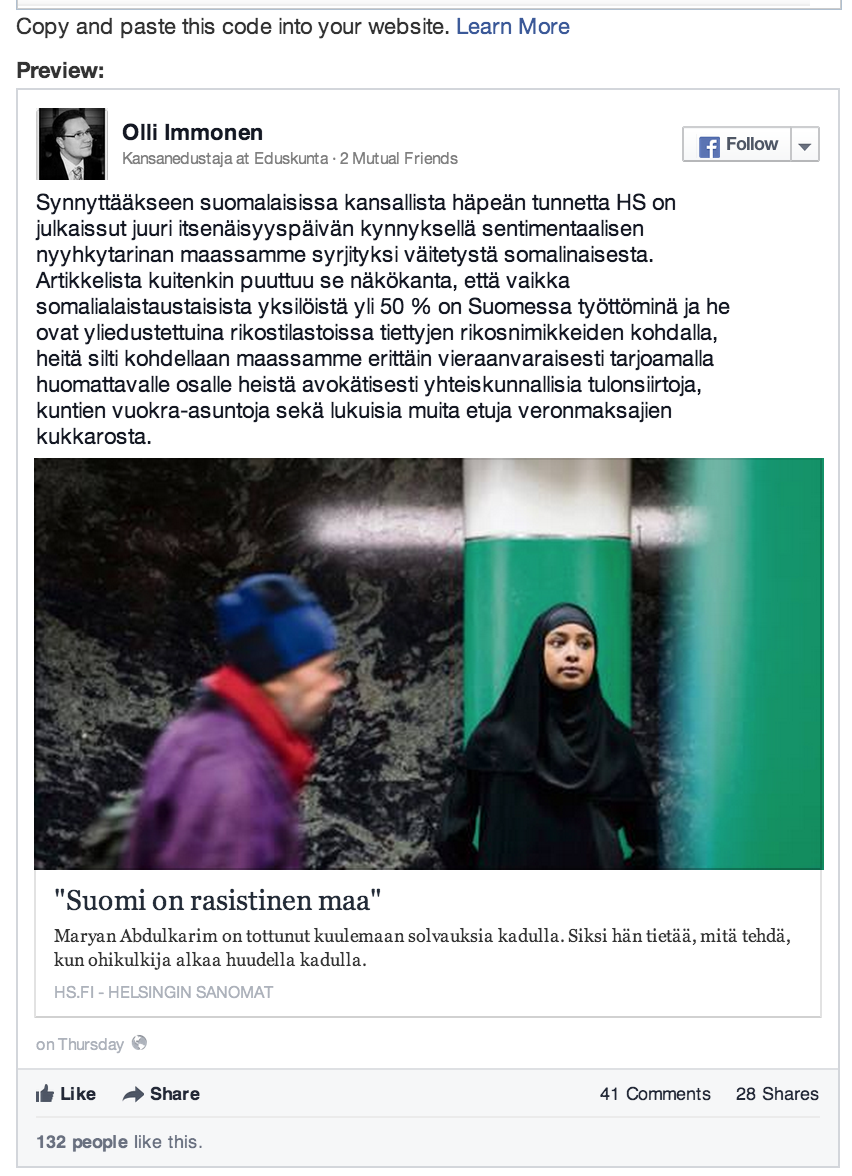
One of these is from the anti-immigration camp, Perussuomalaiset (PS) MP Olli Immonen, who is president of the ultra-nationalist and and anti-immigration  Suomen Sisu association. He wrote on his Facebook wall that as “a native-born Finnish citizen,” he is ashamed that the country’s largest daily published the story on Abdulkarim a day before independence day celebrations.

Note how he stresses “native-born Finnish citizen.” With such a lowly punch, Immonen tries to undermine Abdulkarim’s right to voice her narrative by trying to show that she’s not a so-called “real” Finn like him. Since she’s not a real Finn, her arguments aren’t as valid as his.

Immonen takes another punch at Abdulkarim on his Facebook wall: “The article forgets to mention the view that while over 50% of Somalis [in Finland] are unemployed and are overrepresented in crime statistics of a certain sort, they are still treated in our country in a very friendly manner and offered generous social assistance, municipal housing as well as a host of other benefits from taxpayers’ pockets.”

I get it. Abdulkarim’s arguments aren’t supposed to amount to much because she’s not a real Finn and because she belongs to a group where there is a high crime and unemployment rate, according to Immonen.

The PS MP recently blamed immigrants for Finland’s poor Pisa result.

Immonen claimed on Facebook: ”The long-term work of immigration and multicultural fanatics to make Finland more ‘diverse’ has bore fruit. Immigrants played a signifiant role in [the worse] Pisa results even if consensus politicians and officials claim the contrary. The differences in reading, science and math between immigrants and Finns in the Pisa test are mind-boggling.”

Kuvankaappaus 2013-12-8 kello 10.19.36

Anti-immigration politicians like Immonen, who enjoy bashing immigrants who can’t defend themselves because they aren’t white and don’t have the same political and ethnic clout as him, must be stunned and devastated by Abdulkarim.

Weren’t all those Somali women supposed to be exploited and docile servants of men?

Who should we be ashamed of? Immonen, who makes up Islamophobic tales and spreads them, which in turn fuel prejudice and social exclusion, or Abdulkarim who has the courage to speak out?

Immonen and the Finns he represents aren’t the only problem. There are white immigrants, and those who think they are white, in this country who feel the same way  about blacks, Muslims and other visible minorities.

Just because they are immigrants doesn’t mean they automatically have empathy for those who are victims of racism and discrimination. Just like Immonen capitalizes on the anti-Islam message, some immigrants seek to climb the social ladder by bashing other immigrants.

Shameful but true.

Abdulkarim’s interview on Helsingin Sanomat is one matter but the most revealing aspect of her story are the reactions to it on social media.

They confirm without a doubt that what she says is true.


Isolationism, petty provincialism and nationalism: social ills with far-reaching consequences

Posted on December 6, 2013 by Migrant Tales

In the backdrop of Finland’s independence day celebrations Friday and as the world mourns Nelson Mandela’s death yesterday, our country is at a major crossroads contesting whether it wants to be a closed or open society. The historic victory of the Perussuomalaiset (PS) party in 2011 is one example how this country has taken a perilous path that brought so much disaster and suffering to this country in the last century. 

For the price of cheap sound bites drenched in nationalism and intolerance of every imaginable kind, some Finns are willing to forfeit everything we gained and worked so hard for in the last century.

Nationalism and intolerance never comes cheap. It caused Europe to go down a ruinous path that brought World War 2 to our homes and where an estimated 60 million people perished. The same arguments that led us to such ruin are being used today by short-sighted and opportunistic politicians: generalizing, over-simplifying and harshly victimizing other groups.

Compare anti-Semitism in the 1930s with Islamophobia and xenophobia in the 2010s.

While the time frame and historical context are different, the discourse is the same.

Since intolerance is nothing more than an exaggerated lie, parties like the PS of Finland are constantly required to make up new arguments to hid their prejudice, stereotypes and racism.

If you believe that the PS has toned down its xenophobia and loathing towards refugees, check out what they are doing in the municipality of Kouvola. According to the local daily, Kouvolan Sanomat, the PS wants the city council to stop receiving asylum seekers and quota refugees by 2016.

While the PS blame the economic situation and cost-cutting measures by the municipality for their stance, the truth is that this is a long-term plan by the anti-immigration party to stop Finnish municipalities from receiving quota refugees.

There are two types of municipalities in Finland today: open and closed. Those municipalities that opt for the closed model will struggle in the face of ever-growing poverty, while those that are open stand a better chance of making it.

One small indicator of our openness is our ability to accept refugees in our municipality. Accepting them is an important gesture and message to others because it shows that we are open to the suffering of others.

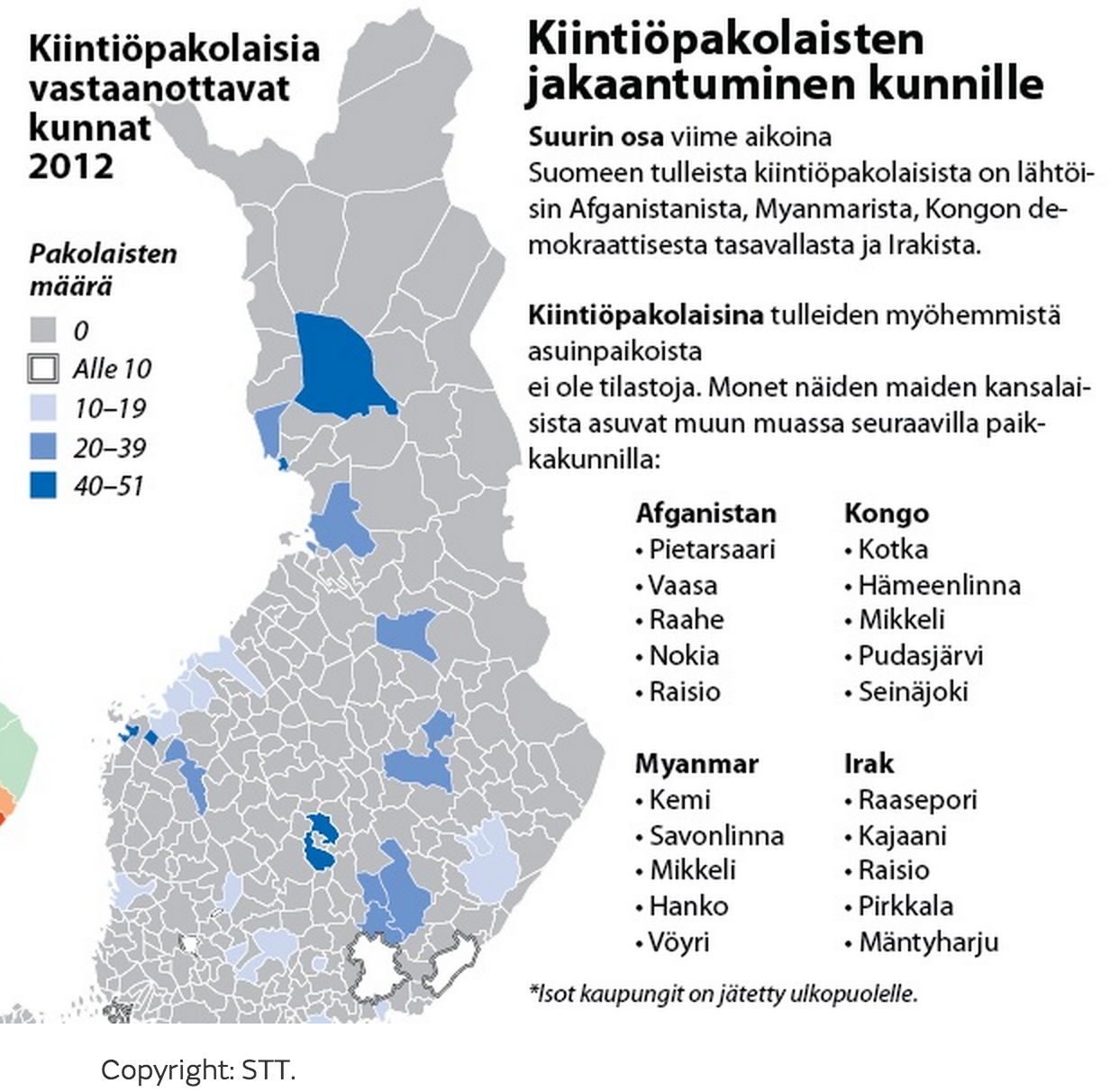
Kuvankaappaus 2013-11-28 kello 23.23.53

Finland’s map of shame. Only a handful of municipalities in Finland accept quota refugees last year.

Why would a company invest or a skilled immigrant move to a municipality that is hostile to other groups like refugees?

That is why those who claim to be patriotic while they spread hatred and racism are the real menace to our society. They are impoverishing our society economically, socially and robbing it off its greatest asset: the ability to help others in need.

Imagine that the third-largest political party in parliament in Finland is doing just that by inflating our nationalism to bash immigrants, the EU, and our ever-growing cultural diversity.

But the good news is that our ever-growing cultural diversity is here to stay no matter how much some try to exclude and make it invisible.

  • Previous
  • 1
  • 2
  • 3
  • 4
  • Next
Read more about documentary film
Read more

Recent Posts

  • Finland’s tabloids Iltalehti and Ilta-Sanomat are the pits
  • Riikka Purra’s Dr Jekyll and Mr Hyde mask
  • Double standards
  • Perussuomalaiset: Uusi logo, sama vanha juttu
  • Taco Trump

Recent Comments

  1. Absolutely Socking: Racist Finnish Facebook group against human rights gets flooded with socks on Musta Barbaari’s mother and sister charged by the police in “ethnic profiling” case
  2. Ilkka Nuotio on Pekka Myrskylä: “Tilastot kertovat toista kuin poliittinen keskustelu”
  3. Genrih Soinkara on The war in Ukraine and the Russian-Finnish border crisis are showing Finland’s ugly side
  4. Ahti Tolvanen on Comment by Ahti Tolvanen on the Helsinki +50 conference
  5. Angel Barrientos on Angel Barrientos is one of the kind beacons of Finland’s Chilean community

Archives

  • June 2026
  • May 2026
  • April 2026
  • March 2026
  • February 2026
  • January 2026
  • December 2025
  • November 2025
  • October 2025
  • September 2025
  • August 2025
  • July 2025
  • June 2025
  • May 2025
  • April 2025
  • March 2025
  • February 2025
  • January 2025
  • December 2024
  • November 2024
  • October 2024
  • September 2024
  • August 2024
  • July 2024
  • June 2024
  • May 2024
  • April 2024
  • March 2024
  • February 2024
  • January 2024
  • December 2023
  • November 2023
  • October 2023
  • September 2023
  • August 2023
  • July 2023
  • June 2023
  • May 2023
  • April 2023
  • March 2023
  • February 2023
  • January 2023
  • December 2022
  • November 2022
  • October 2022
  • September 2022
  • August 2022
  • July 2022
  • June 2022
  • May 2022
  • April 2022
  • March 2022
  • February 2022
  • January 2022
  • December 2021
  • November 2021
  • October 2021
  • September 2021
  • August 2021
  • July 2021
  • June 2021
  • May 2021
  • April 2021
  • March 2021
  • February 2021
  • January 2021
  • December 2020
  • November 2020
  • October 2020
  • September 2020
  • August 2020
  • July 2020
  • June 2020
  • May 2020
  • April 2020
  • March 2020
  • February 2020
  • January 2020
  • December 2019
  • November 2019
  • October 2019
  • September 2019
  • August 2019
  • July 2019
  • June 2019
  • May 2019
  • April 2019
  • March 2019
  • February 2019
  • January 2019
  • December 2018
  • November 2018
  • October 2018
  • September 2018
  • August 2018
  • July 2018
  • June 2018
  • May 2018
  • April 2018
  • March 2018
  • February 2018
  • January 2018
  • December 2017
  • November 2017
  • October 2017
  • September 2017
  • August 2017
  • July 2017
  • June 2017
  • May 2017
  • April 2017
  • March 2017
  • February 2017
  • January 2017
  • December 2016
  • November 2016
  • October 2016
  • September 2016
  • August 2016
  • July 2016
  • June 2016
  • May 2016
  • April 2016
  • March 2016
  • February 2016
  • January 2016
  • December 2015
  • November 2015
  • October 2015
  • September 2015
  • August 2015
  • July 2015
  • June 2015
  • May 2015
  • April 2015
  • March 2015
  • February 2015
  • January 2015
  • December 2014
  • November 2014
  • October 2014
  • September 2014
  • August 2014
  • July 2014
  • June 2014
  • May 2014
  • April 2014
  • March 2014
  • February 2014
  • January 2014
  • December 2013
  • November 2013
  • October 2013
  • September 2013
  • August 2013
  • July 2013
  • June 2013
  • May 2013
  • April 2013
  • March 2013
  • February 2013
  • January 2013
  • December 2012
  • November 2012
  • October 2012
  • September 2012
  • August 2012
  • July 2012
  • June 2012
  • May 2012
  • April 2012
  • March 2012
  • February 2012
  • January 2012
  • December 2011
  • November 2011
  • October 2011
  • September 2011
  • August 2011
  • July 2011
  • June 2011
  • May 2011
  • April 2011
  • March 2011
  • February 2011
  • January 2011
  • December 2010
  • November 2010
  • October 2010
  • September 2010
  • August 2010
  • July 2010
  • June 2010
  • May 2010
  • April 2010
  • March 2010
  • February 2010
  • January 2010
  • December 2009
  • November 2009
  • October 2009
  • September 2009
  • August 2009
  • July 2009
  • December 2008
  • November 2008
  • October 2008
  • September 2008
  • August 2008
  • July 2008
  • June 2008
  • May 2008
  • April 2008
  • March 2008
  • February 2008
  • January 2008
  • November 2007
  • October 2007
  • September 2007
  • August 2007
  • July 2007
  • June 2007
  • May 2007

Categories

  • ?? Gia L?c
  • ????? ?????? ????? ???????? ?? ??????
  • ???????
  • @HerraAhmed
  • @mondepasrond
  • @nohatefinland
  • @oula_silver
  • @Varathas
  • A Pakistani family
  • äärioikeisto
  • Abbas Bahmanpour
  • Abdi Muhis
  • Abdirahim Hussein Mohamed
  • Abdirahim Husu Hussein
  • Abdirisak Mahamed
  • About Migrant Tales
  • activism
  • Adam Al-Sawad
  • Adel Abidin
  • Afrofinland
  • Ahmed IJ
  • Ahti Tolvanen
  • Aino Pennanen
  • Aisha Maniar
  • Alan Ali
  • Alan Anstead
  • Alejandro Díaz Ortiz
  • Alekey Bulavsev
  • Aleksander Hemon
  • Aleksanterinliitto
  • Aleksanterinliitto ry
  • Aleksanterinliitto ry:n hallitus
  • Alex Alex
  • Alex Mckie
  • Alexander Nix
  • Alexandra Ayse Albayrak
  • Alexis Neuberg
  • Ali Asaad Hasan Alzuhairi
  • Ali Hossein Mir Ali
  • Ali Rashid
  • Ali Sagal Abdikarim
  • Alina Tsui
  • Aline Müller
  • All categories
  • Aman Heidari
  • Amiirah Salleh-Hoddin & Jana Turk
  • Amin A. Alem
  • Amir Zuhairi
  • Amkelwa Mbekeni
  • Ana María Gutiérrez Sorainen
  • Anachoma
  • Anders Adlecreutz
  • Angeliina Koskinen
  • Anna De Mutiis
  • Anna María Gutiérrez Sorainen
  • Anna-Kaisa Kuusisto ja Jaakko Tuominen
  • Annastiina Kallius
  • Anneli Juise Friman Lindeman
  • Announcement
  • Anonymous
  • Antero Leitzinger
  • anti-black racism
  • Anti-Hate Crime Organisation Finland
  • Anudari Boldbaatar
  • Arshiya Nasser
  • Aspergers Syndrome
  • Asylum Corner
  • Asylum seeker 406
  • Athena Griffin and Joe Feagin
  • Autism
  • Avaaz.org
  • Awale Olad
  • Ayan Said Mohamed
  • AYY
  • Barachiel
  • Bashy Quraishy
  • Beatrice Kabutakapua
  • Beri Jamal
  • Beri Jamal and Enrique Tessieri
  • Bertolt Brecht
  • Boiata
  • Boodi Kabbani
  • Bruno Gronow
  • Carmen Pekkarinen
  • Çelen Oben and Sheila Riikonen
  • Chiara Costa-Virtanen
  • Chiara Costa-Virtanen
  • Chiara Sorbello
  • Christian Thibault
  • Christopher Wylie
  • Clara Dublanc
  • Dana
  • Daniel Malpica
  • Danilo Canguçu
  • David Papineau
  • David Schneider
  • Dexter He
  • Don Flynn
  • Dr Masoud Kamali
  • Dr. Faith Mkwesha
  • Dr. Theodoros Fouskas
  • Edna Chun
  • Eeva Kilpi
  • Emanuela Susheela
  • En castellano
  • ENAR
  • Enrique
  • Enrique Tessieri
  • Enrique Tessieri & Raghad Mchawh
  • Enrique Tessieri & Yahya Rouissi
  • Enrique Tessieri and Muhammed Shire
  • Enrique Tessieri and Sira Moksi
  • Enrique Tessieri and Tom Vandenbosch
  • Enrique Tessieri and Wael Che
  • Enrique Tessieri and Yahya Rouissi
  • Enrique Tessieri and Zimema Mhone
  • Epäluottamusmies
  • EU
  • Europe
  • European Islamophobia Report
  • European Islamophobia Report 2019,
  • European Union
  • Eve Kyntäjä
  • Ezequiel Caldeiro
  • Facebook
  • Fadumo Dayib
  • Faisa Kahiye
  • Farhad Manjoo
  • Fasismi
  • Finland
  • Fizza Qureshi
  • Flyktingar och asyl
  • Foreign Student
  • Fozia Mir-Ali
  • Frances Webber
  • Frida Selim
  • Gareth Rice
  • Ghyslain Vedeaux
  • Global Art Point
  • Great Replacement
  • Habiba Ali
  • Hami Bahadori
  • Hami Bahdori
  • Hamid
  • Hamid Alsaameere
  • Hamid Bahdori
  • Handshake
  • Harmit Athwal
  • Hassan Abdi Ali
  • Hassan Muhumud
  • Heikki Huttunen
  • Heikki Wilenius
  • Helsingin Sanomat
  • Henning van der Hoeven
  • Henrika Mälmsröm
  • Hser Hser
  • Hser Hser ja Mustafa Isman
  • Husein Muhammed
  • Hussain Kazemian
  • Hussain Kazmenian
  • Ibrahim Khan
  • Ida
  • Ignacio Pérez Pérez
  • Iise Ali Hassan
  • Ilari Kaila & Tuomas Kaila
  • Imam Ka
  • inside-an-airport
  • Institute of Race Relations
  • Iraqi asylum seeker
  • IRR European News Team
  • IRR News Team
  • Islamic Society of Norhern FInland
  • Islamic Society of Northern Finland
  • Islamophobia
  • Jacobinmag.com
  • Jallow Momodou
  • Jan Holmberg
  • Jane Elliott
  • Jani Mäkelä
  • Jari Luoto
  • Jari Taponen
  • Jegor Nazarov
  • Jenni Stammeier
  • Jenny Bourne
  • Jessie Daniels
  • Joe Davidow
  • Johannes Koski
  • John D. Foster
  • John Grayson
  • John Marriott
  • Jon Burnett
  • Jorma Härkönen
  • Jos Schuurmans
  • José León Toro Mejías
  • Josue Tumayine
  • Jouni Karnasaari
  • Juan Camilo
  • Jukka Eräkare
  • Julian Abagond
  • Julie Pascoet
  • Jussi Halla-aho
  • Jussi Hallla-aho
  • Jussi Jalonen
  • JusticeDemon
  • Kadar Gelle
  • Kaksoiskansalaisuus
  • Kansainvälinen Mikkeli
  • Kansainvälinen Mikkeli ry
  • Katherine Tonkiss
  • Kati Lepistö
  • Kati van der Hoeven-Lepistö
  • Katie Bell
  • Kättely
  • Kerstin Ögård
  • Keshia Fredua-Mensah & Jamie Schearer
  • Khadidiatou Sylla
  • Khadra Abdirazak Sugulle
  • Kiihotus kansanryhmää vastaan
  • Kirsi Crowley
  • Koko Hubara
  • Kristiina Toivikko
  • Kubra Amini
  • KuRI
  • La Colectiva
  • La incitación al odio
  • Laura Huhtasaari
  • Lauri Finér
  • Leif Hagert
  • Léo Custódio
  • Leo Honka
  • Leontios Christodoulou
  • Lessie Branch
  • Lex Gaudius
  • Leyes de Finlandia
  • Liikkukaa!
  • Linda Hyökki
  • Liz Fekete
  • M. Blanc
  • Maarit Snellman
  • Mahad Sheikh Musse
  • Maija Vilkkumaa
  • Malmin Kebab Pizzeria Port Arthur
  • Marcell Lorincz
  • Mari Aaltola
  • María Paz López
  • Maria Rittis Ikola
  • Maria Tjader
  • Marja-Liisa Tolvanen
  • Mark
  • Markku Heikkinen
  • Marshall Niles
  • Martin Al-Laji
  • Maryan Siyad
  • Matt Carr
  • Mauricio Farah Gebara
  • Media Monitoring Group of Finland
  • Micah J. Christian
  • Michael McEachrane
  • Michele Levoy
  • Michelle Kaila
  • Migrant Tales
  • Migrant Tales Literary
  • Migrantes News
  • Migrants' Rights Network
  • MigriLeaks
  • Mikko Kapanen
  • Miriam Attias and Camila Haavisto
  • Mohamed Adan
  • Mohammad Javid
  • Mohammad M.
  • Monikulttuurisuus
  • Monisha Bhatia and Victoria Canning
  • Mor Ndiaye
  • Muh'ed
  • Muhamed Abdimajed Murshid
  • Muhammed Shire
  • Muhammed Shire and Enrique Tessieri
  • Muhis Azizi
  • Musimenta Dansila
  • Muslimiviha
  • Musulmanes
  • Namir al-Azzawi
  • Natsismi
  • Neurodiversity
  • New Women Connectors
  • Nils Muižnieks
  • No Labels No Walls
  • Noel Dandes
  • Nuor Dawood
  • Omar Khan
  • Otavanmedia
  • Oula Silvennoinen
  • Paco Diop
  • Pakistani family
  • Pentti Stranius
  • Perussuomalaiset
  • perustuslaki
  • Petra Laiti
  • Petri Cederlöf
  • Pia Grochowski
  • Podcast-lukija Bea Bergholm
  • Pohjois – Suomen Islamilainen Yhdyskunta
  • Pohjois Suomen Islamilainen Yhyskunta
  • Polina Kopylova
  • Race Files
  • racism
  • Racism Review
  • Raghad Mchawh
  • Ranska
  • Rashid H. and Migrant Tales
  • Rasismi
  • Raul Perez
  • Rebecka Holm
  • Reem Abu-Hayyeh
  • Refugees
  • Reija Härkönen
  • Remiel
  • Reza Nasri
  • Richard Gresswell
  • Riikka Purra
  • Risto Laakkonen
  • Rita Chahda
  • Ritva Kondi
  • Robito Ibrahim
  • Roble Bashir
  • Rockhaya Sylla
  • Rodolfo Walsh
  • Roger Casale
  • Rostam Atai
  • Roxana Crisólogo Correa
  • Ruth Grove-White
  • Ruth Waweru-Folabit
  • S-worldview
  • Sadio Ali Nuur
  • Sami Rusanen
  • Sandhu Bhamra
  • Sara de Jong
  • Sarah Crowther
  • Sari Alhariri
  • Sarkawt Khalil
  • Sasu
  • Scot Nakagawa
  • Shabana Ahmadzai
  • Shada Islam
  • Sharon Chang blogs
  • Shenita Ann McLean
  • Shirlene Green Newball
  • Sini Savolainen
  • Sira Moksi
  • Sonia K.
  • Sonia Maria Koo
  • Steverp
  • Stop Deportations
  • Suldaan Said Ahmed
  • Suomen mediaseurantakollektiivi
  • Suomen Muslimifoorumi ry
  • Suomen viharikosvastainen yhdistys
  • Suomen viharikosvastainen yhdistys ry
  • Suomi
  • Supermen
  • Susannah
  • Suva
  • Syrjintä
  • Talous
  • Tapio Tuomala
  • Taw Reh
  • Teivo Teivainen
  • The Daily Show
  • The Heino
  • The Supermen
  • Thomas Elfgren
  • Thulfiqar Abdulkarim
  • Tim McGettigan
  • Tino Singh
  • Tito Moustafa Sliem
  • Tobias Hübinette and L. Janelle Dance
  • Transport
  • Trica Danielle Keaton
  • Trilce Garcia
  • Trish Pääkkönen
  • Trish Pääkkönen and Enrique Tessieri
  • Tuulia Reponen
  • Uncategorized
  • UNITED
  • University of Eastern Finland
  • Uyi Osazee
  • Väkivalta
  • Vapaa Liikkuvuus
  • Venla-Sofia Saariaho
  • Vieraskynä
  • W. Che
  • W. Che an Enrique Tessieri
  • Wael Ch.
  • Wan Wei
  • Women for Refugee Women
  • Xaan Kaafi Maxamed Xalane
  • Xassan Kaafi Maxamed Xalane
  • Xassan-Kaafi Mohamed Halane & Enrique Tessieri
  • Yahya Rouissi
  • Yasmin Yusuf
  • Yassen Ghaleb
  • Yle Puhe
  • Yuliet Tresa
  • Yve Shepherd
  • Zahra Khavari
  • Zaker
  • Zalina Ametova
  • Zamzam Ahmed Ali
  • Zeinab Amini ja Soheila Khavari
  • Zimema Mahone and Enrique Tessieri
  • Zimema Mhone
  • Zoila Forss Crespo Moreyra
  • ZT
  • Zulma Sierra
  • Zuzeeko Tegha Abeng
© 2026 Migrant tales | Powered by Minimalist Blog WordPress Theme