There is good and bad news after Sunday’s parliamentary elections. The bad news is that the far-right Sweden Democrat saw its support rise by 4.7 percentage points to 17.6% compared with the elections in 2014, according to Svenska Dagbladet. The good news – if it can be considered as such – is that the result was well below expectations.
Writes The Local: “But the pre-election polls had clearly got into their [Sweden Democrats] heads: YouGov had them polling at 25 percent and becoming Sweden’s biggest party – the same YouGov that got the party right last time. Other pollsters said they’d adapted their methods and were better equipped this time to gauge the SD vote, with Ipsos and Demoskop for example putting them around the 18-19 percent mark. But who could really tell?”
Certainly, Sunday’s election result will make Social Democrat Prime Minister Stefan Löfven’s job difficult in forming a new government. The present situation may mean the Social Democrats forming a government with a right-wing party that would exclude the Sweden Democrats.
The fact that the Sweden Democrats became the country’s third-largest party – not second-largest, according to some polls – and that migration and crime took the front seat of the political debate, reveals something disturbing about the Nordic countries. Norway, Finland, and Denmark, whose far-right Danish People’s Party does not form government but supports it, all have seen the rise of the populist anti-immigration parties.
How is it possible that Nordic countries, which profess being the most liberal and which base their social policy on equality could be so xenophobic and Islamophobic?
In all of the Nordic region, we have seen far-right populist parties rise in this century with a hostile even vicious anti-immigration and anti-cultural diversity agenda. Of all the Nordic countries, you are the only one in the Nordic region where populist anti-immigration parties have not formed directly or indirectly a part of government.
A poll in November, however, showed a sharp rise of the far-right Sweden Democrats to 21.5% when compared with 12.9% it got in the 2014 parliamentary elections and not trailing too far behind the Social Democratic Party (25.7%) and Moderates (22%).
The Sweden Democrats are the third largest party today in the 349-seat Riksdagen (parliament) with 49 seats (12.9%) in 2014 compared with 20 seats (5.7%) they won in 2010.
In an analysis piece by Expo, an anti-racism and anti-fascism NGO in Sweden, they explained the rise of the Sweden Democrats in 2010 to the Riksdagen in the following words:
“The Sweden Democrats gain from presenting themselves as an alternative to the so-called establishment,” wrote Expo chairman Daniel Poohl. “The bloc politics that has marked the election campaign has turned the Sweden Democrats into a distinct third alternative, an underdog.”
Poohl continues to warn us in 2016 about the Sweden Democrats: “That’s where we come in. This is the white paper [stating that they aren’t a racist party and have no ties to fascism] that the Sweden Democrats would have to do, but will never be able to write. The racism found in the Sweden Democrats isn’t something that belongs to history but is a part of the party’s concept.”
Migrant Taleswrote the following letter to Sweden in june 2015 warning about the perils of playing ball with a populist party that loathes immigrants:
“Today, you, dear friend in Sweden, are the only country that can restore sanity to this part of Europe and effectively challenge this force that is undermining and threatening our Nordic values. We need you to hold out and show leadership, which has been shamefully lacking in the rest of our region.”
However, it looks like there is a tear in the cordon sanitaire that excluded the Sweden Democrats from Swedish mainstream politics. Anna Kingberg, the head of the Moderates, said that her right-wing conservative party would be ready to negotiate with the Sweden Democrats, according to Politico.
Sweden heads for the polls on Sunday to elect 349 seats to the Riksdag (parliament). Despite the good showing in the pollsof the far-right Sweden Democrats, which has roots in the neo-Nazi movement, is slated to capture 20% of the votes.
The rise in popularity of the Sweden Democrats has been fast and a reminder that Sweden continues to have serious unresolved issues with racism.
The Sweden Democrats entered the Riksdag in 2010 for the first time with 20 MPs (5.7%), and four years later they more than doubled the number of MPs to 49 (12.9%).
Contrary to other Nordic countries like Norway, Denmark, and Finland, Sweden has refused to cooperate with anti-immigration parties. There are some signs that this may change with parties like the conservative Moderates offering an olive branch last year to the Sweden Democrats.
Since Finland is a close neighbor to Sweden, a good showing by the Sweden Democrats in Sunday’s election could boost the populist anti-immigration Perussuomalaiset.* Finland has parliamentary elections in April 2019.
The parliamentary elections of September 9 are exposing Sweden’s dark side. Source: The Local.
The interesting question to ask with respect to the rising popularity of the Sweden Democrats, and ever-growing xenophobia in what is probably one of Europe’s liberal countries, why are we in this political bind?
Many factors are at play. One of these is Swedish exceptionalism, which portrays a myth of a white near-perfect society until migrants arrived and ruined it all.
What surprises me a lot is how migrants are being singled out as “the problem” and “cause” of Sweden’s problems. How many politicians are asking how the dismantling of the social welfare state, rising discrimination, social exclusion and the lack of political will to tackle these social ills are at the heart of the problem?
Scapegoating migrants for Sweden’s woes is punching below the belt and turning one’s back on the country’s more serious problems like social inequality.
Even if there are some troubling question marks of US President Barack Obama’s foreign policy and that his administration deported 2.5 million people, or more than any other president in US history, he does have a point in the following quote:
“Appealing to tribe, appealing to fear, pitting one group against another, telling people that order and security would be restored if it weren’t for those who don’t look like us, or don’t sound like us, or don’t pray like we do – that is an old playbook, it’s old as time.”
Sunday’s election result in Sweden will reveal a lot of ugly things about the country that we knew but which politicians rarely acknowledged. One of them is racism, social inequality, and exclusion.
Despite assurances by Nordic countries of social equality, each country in northern Europe has seen the rise of hostile anti-immigration parties that target migrants and minorities. Apart from Sweden, such parties share power in government in Norway (Progress Party), in Denmark (Danish People’s Party), and in Finland (Perussuomalaiset, today Blue Reform).
All of these populist parties miss the mark by a long shot because migrants and minorities are not the main cause of these countries’ woes.
* The Perussuomalaiset (PS) party imploded on June 13 into two factions, the PS and New Alternative, which is now called Blue Reform. Despite the name changes, we believe that it is the same party in different clothing. Both factions are hostile to cultural diversity. One is more open about it while the other is more diplomatic.
A direct translation of Perussuomalaiset in English would be something like “basic” or “fundamental Finn.” Official translations of the Finnish name of the party, such as Finns Party or True Finns, promote in our opinion nativist nationalism and racism. We, therefore, at Migrant Tales prefer to use in our postings the Finnish name of the party once and after that the acronym PS.
Conservative National Coalition Party speaker of parliament, Paula Risikko, was quoted as saying in Senäjoki-based daily Ilkkathat she is concerned about the role of Christians in Finland.
“Was it easier before to be religious,” she was quoted as asking in Keskisuomalainen. “For example, it’s not as easy today to bring one’s religious views at work. Christians are being pushed in a closet at the same time when other [religions] are coming out of the closet.”
Behind that smile and her Marimekko shirt, lies a sinister ideology that sees migrants, especially Muslims, as a threat to Finland. Read the full story (in Finnish) here.
Certainly one reason for Risikko’s latest comment is the parliamentary elections of April 14, 2019, and the EU elections the following month. Does Risikko believe that stoking the flames of “us” and “them” will give short-term political gains?
Do her comments target Muslims and other minorities? Does it reveal her white fragility? Or are they a glimpse of how politicians in Finland continue to lurch towards cheap nationalism with the help of “us” and “them?”
Conservative National Coalition Party Minister of the Interior Kai Mykkänen announced Friday that an independent inquiry of the Finnish Immigration Service (Migri) will be launched, according to YLE. The minister said, however, that the independent inquiry should not be seen as a lack of trust in Migri’s work, which has had to process some 45,000 residence permit applications.
Calls for an independent inquiry of Migri, which could be carried out by UNHCR, has the support of opposition parties like the Social Democrats, the Greens, and Swedish People’s Party as well as of NGOs like Amnesty International, Finnish Refugee Council, and the Non-Discrimination Ombudsman.
Frank Johnson, the director of Finland’s Amnesty International chapter, welcomed the announcement by Mykkänen. He said that the independent inquiry, called for by Amnesty International, Finnish Refugee Council, and the Non-Discrimination Ombudsman, was “a good decision.”
Even if Migri has processed 45,000 residence permits since 2015, when a record 32,477 asylum seekers mostly from Iraq, it does not let them off the hook and permit civil servants to make faulty decisions that impact people’s lives or their deaths in some cases.
Mykkäen said that “there is no evidence that suggests that Migri rejects asylum applications systematically.
Part of the of criticism of Migri is due to their interpretation that countries like Afghanistan, where the security situation has deteriorated, and Iraq are “safe” to deport asylum seekers.
Some believe that the large amount of rejections of asylum applications by Migri is politically influenced. Since 2015, the anti-immigration Perussuomalaiset (PS)*, which split into two factions in June 2017, was invited to form part of Prime Minister Juha Sipilä’s government. This has fuelled a hostile environment for migrants in Finland.
* The Perussuomalaiset (PS) party imploded on June 13 into two factions, the PS and New Alternative, which is now called Blue Reform. Despite the name changes, we believe that it is the same party in different clothing. Both factions are hostile to cultural diversity. One is more open about it while the other is more diplomatic.
A direct translation of Perussuomalaiset in English would be something like “basic” or “fundamental Finn.” Official translations of the Finnish name of the party, such as Finns Party or True Finns, promote in our opinion nativist nationalism and racism. We, therefore, at Migrant Tales prefer to use in our postings the Finnish name of the party once and after that the acronym PS.
Perussuomalaiset (PS)* vice president Laura Huhtasaari, a vocal Islamophobic anti-immigration politician, has been since January under scrutiny due to the plagiarism found in her Master’s thesis.
If you read the reaction of the Finnish media about the latest ruling by the University of Jyväskylä, one common theme is that the plagiarism scandal will not affect Huhtasaari never mind the PS.
The whole affair is a bit like Donald Trump, who hops from one scandal to the next. Scandals don’t appear to hurt the US president but strengthen his support base.
Is the Huhtasaari plagiarism scandal one good sign of the Trumpization of Finnish politics and how the anti-immigration party has poisoned politics in Finland since its historic election victory of 2011?
Laura Huhtasaari has made a name for herself with her Islamophobic statements and her support for US President Donald Trump and Hungarian Prime Minister Viktor Orbán. She has been called a number of things like the Islamophobe with the kindergarten teacher smile.
Huhtasaari, who is a teacher, got a damning report from the University of Jyväskylä this week concerning her master’s thesis. According to a statement by the University of Jyväskylä, Huhtasaari’s thesis “had a disregard for good scientific practice and dishonesty in the form of plagiarism, according to Helsinki Times.
The statement states the following about Huhtasaari’s thesis, which was approved in 2003: “For their part, the procedures have misled the scientific community of researchers and the authors of future theses. plagiarism nature and scope, the violations of good scientific practice are serious,” reads a press release from the University of Jyväskylä.
Huhtasaari’s thesis cannot be revoked by the university since there is a five-year statute of limitations.
* The Perussuomalaiset (PS) party imploded on June 13 into two factions, the PS and New Alternative, which is now called Blue Reform. Despite the name changes, we believe that it is the same party in different clothing. Both factions are hostile to cultural diversity. One is more open about it while the other is more diplomatic.
A direct translation of Perussuomalaiset in English would be something like “basic” or “fundamental Finn.” Official translations of the Finnish name of the party, such as Finns Party or True Finns, promote in our opinion nativist nationalism and racism. We, therefore, at Migrant Tales prefer to use in our postings the Finnish name of the party once and after that the acronym PS.
Even if the Blue Reform*, which is an offshoot of the Islamophobic Perussuomalaiset (PS), wants to change the constitution so that non-Finnish citizens would get paid less social welfare than Finnish citizens, the suggestion by MP Simon Elo exposes to the tee the racism of his party and hatred of migrants.
Blue Reform, like the PS, are not only a danger to our Nordic welfare state and democracy, but a threat to migrants and minorities living in Finland.
The fact that a party in government wants to officialize discrimination reveals the extent of racism in the government and why this social ill has worsened under Prime Minister Juha Sipilä.
Such discrimination that Elo proposes isn’t possible because it is unconstitutional. Section 6 of the Finnish constitution expressly states:
“Everyone is equal before the law. No one shall, without an acceptable reason, be treated differently from other persons on the ground of sex, age, origin, language, religion, conviction, opinion, health, disability or other reason that concerns his or her person.”
Finland will hold parliamentary election in April 2019, which explains why Blue Reform is so eager to take out its racism card in order to attract similar-minded voters.
Blue Reform’s support, according to various polls, is dismal, or under 1%.
* The Perussuomalaiset (PS) party imploded on June 13 into two factions, the PS and New Alternative, which is now called Blue Reform. Despite the name changes, we believe that it is the same party in different clothing. Both factions are hostile to cultural diversity. One is more open about it while the other is more diplomatic.
A direct translation of Perussuomalaiset in English would be something like “basic” or “fundamental Finn.” Official translations of the Finnish name of the party, such as Finns Party or True Finns, promote in our opinion nativist nationalism and racism. We, therefore, at Migrant Tales prefer to use in our postings the Finnish name of the party once and after that the acronym PS.
A year has elapsed after a Moroccan went on the rampage on August 18 and started attacking people indiscriminately with a knife in the southwestern city of Turku. Two people were killed and 10 were wounded.
On the anniversary of the stabbing, which is seen by the authorities as Finland’s first modern terrorist attack, three far-right and neo-Nazi groups organized a march to commemorate the anniversary. Another group called Turku Without Nazis (Turku ilman natseja) organized a countermarch to protest the presence of the three far-right groups: Nordic Resistance Movement(Pohjoismainen vastarintaliike, PVL), Soldiers of Odin, and “188” or Nationalist Alliance (Kansallismielisten liittouma).
What went largely unnoticed by most of the Finnish media was the participation of an anti-immigration Perussuomalaiset (PS)* MP, Kike Elomaa, and two members of her party. All three took part in the demonstration organized by the far-right and neo-Nazi groups.
Some may rightfully ask why far-right groups have grown in this country and elsewhere. The answer to that question is simple: Far-right- and neo-Nazi-leaning parties like the PS have allowed them in places like parliament.
PS MP Kike Elomaa and two party members taking part in the far-right and neo-Nazi demonstration in Turku on Saturday. Source: Ilta-Sanomat.
At the heart of the problem is also Finland’s difficulty in seeing and condemning far-right and neo-Nazi groups.
As US political scientists Steven Levisky and Daniel Ziblatt stated in their analysis of President Trump’s administration, “The erosion of democracy takes place piecemeal, often in baby steps.”
Our blindness to the threat posed by far-right and neo-Nazi groups in Finland is a good example of how the erosion of our democracy is happening before our eyes and in baby steps.
The silence of the politicians to such threats, especially that of the government of Prime Minister Juha Sipilä, is another problem promoting extremist groups.
Even if far-right groups like to talk about free speech, their aim could not be further from the truth. Their aim is not more democracy but less of it.
It is up to us to stand up and draw the line between us and far-right groups and neo-Nazis. If we do not do it, nobody else will do it for us.
* The Perussuomalaiset (PS) party imploded on June 13 into two factions, the PS and New Alternative, which is now called Blue Reform. Despite the name changes, we believe that it is the same party in different clothing. Both factions are hostile to cultural diversity. One is more open about it while the other is more diplomatic.
A direct translation of Perussuomalaiset in English would be something like “basic” or “fundamental Finn.” Official translations of the Finnish name of the party, such as Finns Party or True Finns, promote in our opinion nativist nationalism and racism. We, therefore, at Migrant Tales prefer to use in our postings the Finnish name of the party once and after that the acronym PS.
It would be wrong to conclude that Brexit is the cause of the racism we are witnessing today in the United Kingdom. Surprised? Not really. What would you expect from a country that has a dark history in global domination, exploitation, and genocide?
The common thinking of some people about the United Kingdom is that it was its divine right to colonize, enslave, exploit, pillage and commit genocide on a mass global scale. Britain is as much out of touch with its racism and bigotry as it is in acknowledging, apologizing and compensating its victims.
The racism we are seeing today in the United Kingdom, Europe, the United States, Australia and elsewhere is the same ogre that conquered and pillaged the world through the greed of colonization and slavery.
Below is a story in metro.co.uk that highlights the illness facing Brexit-inflicted United Kingdom, where even white Europeans are targets of racism and rage.
Ibrahim’s* case, the Iraqi asylum seeker who returned “voluntarily” to Iraq this week, is a case in point of how the Finnish Immigration Service (Migri) and politicians fail people. Here are some facts about Ibrahim, who moved to Finland in October 2015: he applied for 25-30 jobs a week; constantly did voluntary work; converted to Christianity; and found employment delivering newspapers during his last months at Posti.
From these facts, we can easily conclude that Ibrahim was an ideal asylum seeker who could adapt pretty rapidly to life in this country.
Juho Kusti Paasikivi, the main architect of Finland’s post-war foreign policy as prime minister (1944-46) and president [1946-56), used the following quote by nineteenth-century British politician Thomas Babington Macaulay: The beginning of all wisdom is acknowledgment of facts.
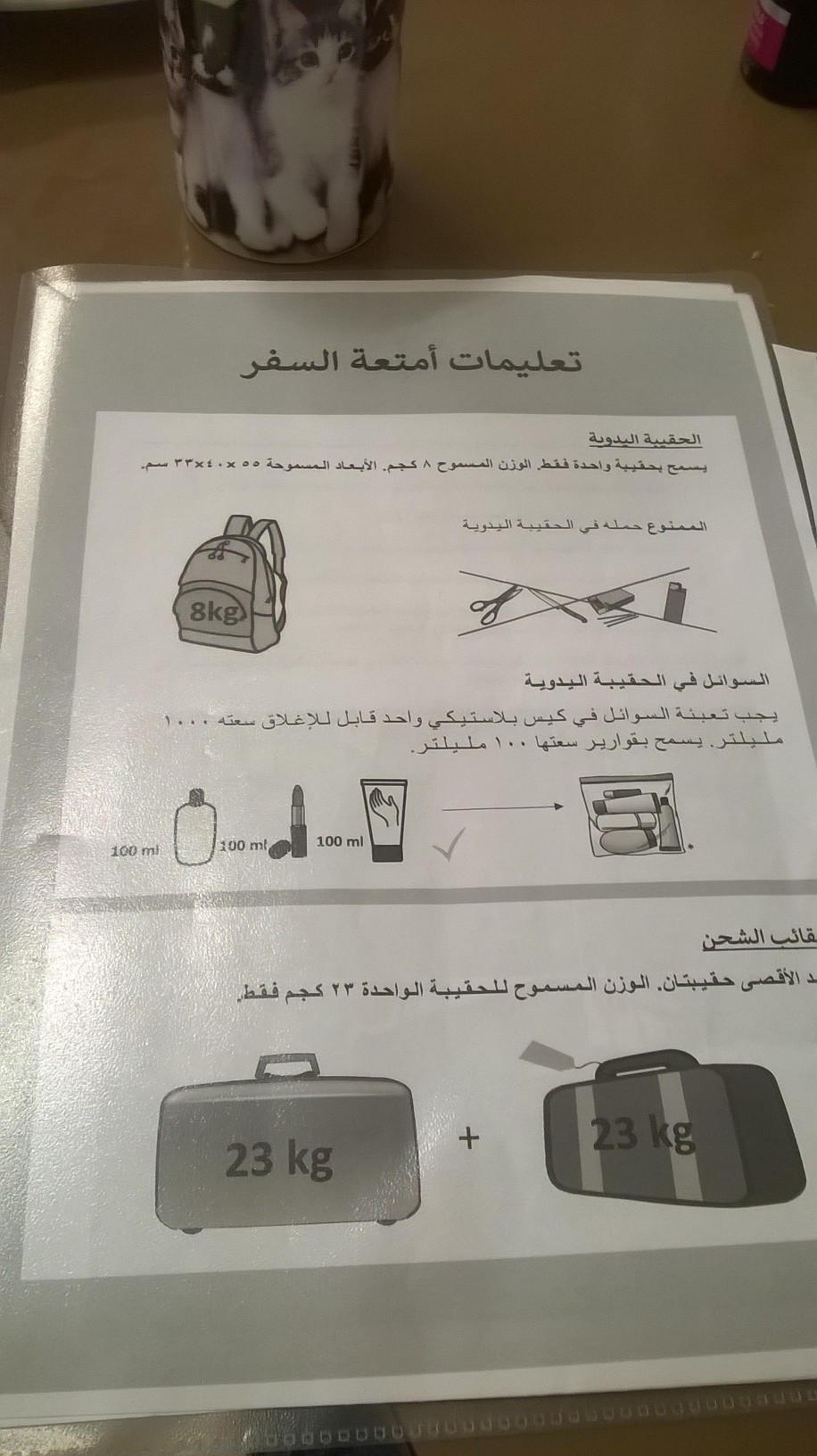
Instructions on what an asylum seeker can take back to Iraq. After almost three years, Ibrahim’s possessions must fit in two 23-kg pieces of luggage.
Paasikivi used this quote to understand Finland’s difficult geopolitical situation with the former Soviet Union.
Babington Macaulay’s quote sits well for the difficult situation that two-thirds of asylum seekers faced and continue to face in this country.