Tabloid Ilta-Sanomat, which has had a murky history for publishing and attacking Somalis and other migrants in the 1990s, publishes a story about two Romany women who shoplift 2,600 euros of merchandise.
Certainly, shoplifting is a crime, but what about when a tabloid publishes a story that reinforces stereotypes about a certain group? Considering that Ilta-Sanomat was responsible in the 1990s for fueling Finnish racism against groups like the Somalis, isn’t that “a crime” also?
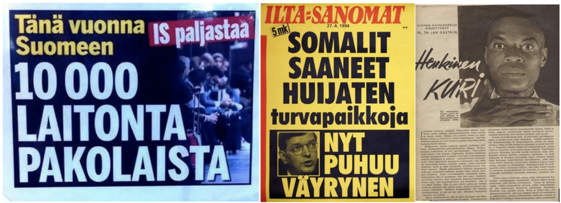
In the Finnish media, tabloids like Ilta-Sanomat have published racist stories. From left to right: This year, Finland will receive 10,000 illegal refugees (sic!); The Somalis coned the authorities to give them asylum; (right) Suomen Kuvalehti wrote in 1940 that the Finnish soldier did not run away, but an African tribe in the Indian Ocean does.
Apart from pointing out that the two women had hidden the merchandise in their Romany dresses, one of the suspects had yelled and acted aggressively against the security guard.
What would have happened if the shoplifters had been white Finns? If it were news, the tabloid would probably lead with the following headline: “A white Finns shoplifts.”
Who would be interested in reading such a story?
In our opinion, the story about the Romany women shoplifters has no other role than exposing the reporter’s prejudices and racist stereotypes of Romany women.
#Astudio host Marja Sannikka kicks off the next topic on the talk show on gang violence with the following words that sound like a thriller: “Knives, violence, revenge. Finnish youth gang crime grows at a worrying pace.”
In the talk show, does Sannikka gives us any facts about “the worrying [growth] pace” of gang violence in Finland? Instead, she speaks to four youths in the Vantaa neighborhood of Tikkurilla who give their views on the topic without any facts.
“I think matters have got worse in the past two years,” says one, “while another says that “people act more aggressively than before.” Knives and other weapons are more common, according to them.
While – again, without any statistical data – it takes about 10 minutes for Sannikka to mention that magic scapegoat word, “person of foreign background.” According to her, the police claim that 90% of the gang members are “people of foreign background.”
If you make such a claim, the host should back it up with facts. Moreover, how many so-called “people of migrant backgrounds” belong to gangs? 90%? 70%? 30%? 1%? 0.001%?
Most first- and second-generation Finns don’t belong to gangs and do something more useful with their time.
Why does Sannikka use #astudio to label and victimize all migrant youths?
Police officer Markku Heinikari has no answers about the roots of this problem and what to do about it. Mika Mehmet, the social worker who grew up in two cultures, mentioned that it had to do with belonging and a weak sense of identity.
What Mehmet said is correct but did not go far enough: What about the role of racism and the lack of adequate social services? How do talk shows like the one by #astudio contribute to the problem?
Helsingin Sanomat, Finland’s largest-circulation daily, writes in an editorial about why the country needs labor migrants to secure economic growth and services offered by the welfare state. We are at a critical crossroads: It is the first time in history that more people die than there are newborns.
While the editorial invites debate on Finland’s serious demographic woes, it is misleading because it only highlights the usual talking points by leaving out new arguments offered by brown and black Finn migrant researchers.
The reaction of some Finns can turn violent against migrants and minorities, as we saw after the Turku stabbings in 2017 by a Moroccan asylum seeker. Source: Migrant Tales
The editorial bases its call for more labor migrants on the pension insurance group Varma CEO Risto Murto’s book, Puuttuvat puoli miljoonaa, The missing half a million.
Murto’s book does not reveal anything new about Finland’s demographic woes. Over one-fourth of about 8% of Finland’s foreign population in 2020 lives in Helsinki; in 2035, it will rise to over a third; the low employment levels of people who came to Finland as refugees.
While Murto does not explain why the employment level of Afghans, Iraqis, Somalis, and other people of color is low in Finland, he and Helsingin Sanomat leave out the fact that their employment level rises the longer they live in Finland.
For some odd reason, the Helsingin Sanomat editorial and Murto forget to mention that refugees in Finland comprise about 10% of all foreigners. As we know and have seen, Finland’s hostile environment against visible migrants spread by parties like the far-right Perussuomalaiset (PS)*, National Coalition Party (Kokoomus), Christian Democrats, and others.
When they attack foreigners, such parties speak of this group as one group, “migrants.”
Finland has historically shunned immigrants, even if it is a country of emigrants. In the 1970s, when hundreds of thousands of Finns were moving to Sweden, the country decided against labor immigration to plug the economically active population deficit.
Several questions arise on how Finland could be a magnet for labor migrants. Less bureaucracy, family reunification, child education, Finnish- and Swedish-language lessons.
Of all of the factors Murto believes would attract labor migrants, the most important one is missing: a migrant and minority-friendly society that is inclusive.
The latter is easier said than done. Historically and politically today, Finland has shot itself in the demographic leg by allowing its suspicion of outsiders to overtake the better of them.
Any serious student of Finnish society should eventually grasp that institutional racism is one of the mothers of all social ills in the country. Institutional racism gives cover to racists and to the toxic white saviors who do irreparable harm to migrants and minorities.
You don’t need a lot of research to figure out the latter. Look at people who have the power to enforce and regulate it.
If the issue is institutional racism, why does Finlan do so little to challenge it? One of many examples of discrimination is the labor market. Why do we rarely read in the media about the authorities clamping down on this problem? It is, instead, a new study over an old one highlighting this problem.
The answer reveals a sad truth: there is no intention or political will to change matters. The situation is what it is because they are supposed to be that way.
US social thinker James Baldwin put it in the following words:
Without any intention of changing matters, rest assured that most projects with newcomers will miss the mark or fail outright. The integration authorities will feed newcomers the usual half-truths about Finnish social justice, which is highly selective.
Unfortunately, the latter will happen with some of the blessings of our culturally diverse communities.
Even so, I am confident the more Finland’s culturally diverse population grows, the more evident this social ill will be, and the need to change it permanently.
Migrant Tales understands that a Kanta-Häme district court ruling acquitted the police and security guards for forcibly removing the hijab of two women in 2017 will be appealed.
The present ruling, which allowed the police and security guards to use force, sends a disturbing message. It messages that the police can use force without considering your religion and rights..
Source: Google
Moreover, such forceful action by the police undermines Muslim’s already low confidence in the police.
The women applying for asylum at the time were forced to take off their hijabs for a picture. They argued that apart from religion, they were taken photos with their hijabs in Helsinki.
The September 30 district court ruling received little mention in the media. Helsingin Sanomat published a story on the matter in 2017. Iltalehti, Yle, and Hämeen Sanomat covered the recent court ruling in their publications.
Journalism is a tough job that forces one to stay on its toes. On Thursday on A-Talk we heard the opinions of four MPs of the Left Alliance, Social Democrats, National Coalition Party (Kokoomus), and the Perussuomalaiset (PS)* if Finland was heading towards a debt crisisand spending cutbacks.
There was nothing new from PS MP VIlle Tavio, who suggested the usual cuts in development aid, which is pictured as “money thrown down the drain,” and billions of euros from “migration,” which he labeled as a security threat.
No pushback, never mind an utter from the host Sakari Sirkkinen. The following comment by Tavio was a sad example of zzz or snooze journalism. Yle is supposed to represent migrants and minorities living in Finland, not permit their demonization.
Said Tavio: “Social welfare based on nationality would revolutionize the [existing] and make the system more dynamic and advantageous for us.”
Ville Tavio has expressed support for France’s Marine Le Pen and other autocrats like Hungary’s Viktor Orbán. Source: Yle
Again, an eerie silence came from the host, and none of the guests uttered a word.
With parliamentary elections in April, PS Chairperson Riikka Purra reiterated Thursday that social welfare benefits should hinge on nationality.
Here is an example of a discriminatory and spiteful message by the far-right Perussuomalaiset (PS)* party head, Riikka Purra. With parliamentary elections in April, she and the PS are ratcheting up their xenophobic message.
“A foreigner is entitled to social welfare when making 716 euros a month. Such a [benchmark] was given the green light by the social welfare act passed by the National Coalition Party, Center Party, and Blue Reform. During this period, one can calculate income requirements to see what a good deal this is for Finland and tax payers. Labor migration only works if it is based on nationality, as required by the PS. In this way, a migrant lives off his salary and not on social welfare.”
As the claim by Purra reveals, the only role of the PS is to poison the atmosphere, lie and keep migrants and minorities as second-class members of society. In other words – it is toxic and racist and unsubstantiated blah blah.
Eikö töihin tulevan maahanmuuttajan pitäisi elää palkallaan eikä sosiaaliturvalla? pic.twitter.com/yCOW2j3wXQ
Former President Donald Trump is a threat to USAmerican democracy, and Russian President Vladimir Putin a threat to world peace. While these leaders spread their toxicity and hatred on other people and nations for political gain, our Perussuomalaiset (PS)* party has nothing more than praise for them.
Well, that was before Trump and Putin became major embarrassments.
A word of advice: Don’t trust the PS with a 10-mile pole in Finland. They are a threat to our democracy. They are the ones who pose proudly with autocrats like Viktor Orbán of Hungary and pro-Putinists like Matteo Salvini.
It would be unfair, to blame only the PS for all the Islamophobia and hatred in Finland. The National Coalition Party (Kokoomus) is trying to use and flirt with the PS in the hope that they will gain more voters.
It is a dumb and perilous choice. In Sweden, their sister party, the Moderates, opened the door to the far-right Sweden Democrats, leaving them in second place in last month’s election after the far-right party.
A poll published in 2016 showed that only the Perussuomalaiset tested Trump and Putin the most. “Kyllä” means yes, ei no, and Eos, no opinion. Source: Iltalehti
Riikka Purra’s and Jussi Halla-aho’s party will first take away the civil rights of migrants and minorities and destroy our welfare state in the process.
From left to right: President Trump and Putin in a 2016 poster in Montenegro. Photo by Stevo Vasilijevic/Reuters. Upper center: PS MPs, Vilhelm Junnila and Veikko Vallin, ging the thumbs up with their MAGA caps. Source: Facebook and Migrant Tales. Lower center: Tweets Halla-aho in November: “Trump is the best thing that happened in a long time to the United States and the west. Tweets MP Mika Niikko: “Trump’s campaign is similar to what the PS does. Trump has spiritual superiority. And then Russian premier Vladimir Putin: “Trump is a very qualified leader. His vitality enables him to do away with viruses.” Source: Mannerheim-projekti.Right: MEP Laura Huhtasaari and Hungarian strongman Viktor Orbán. Source Twitter
Watching weekly Thursday’s question-and-answer session between the opposition and government can cause nausea. With parliamentary elections six months in April, expect opposition parties like the far-right Perussuomalaiset (PS)* and National Coalition Party (Kokoomus) to increase their attacks against ALL migrants.
The truth about the PS and Kokoomus, the biggest and second-biggest opposition party, respectively, is that they have declared hostile and open warfare against migrants and minorities in Finland.
Making up fear scenarios and copying the success of the Sweden Democrats in September’s elections in Sweden is what the PS and Kokoomus want to convey to their prospective voters.
The debate about youth gangs in Finland shows the social inequality that migrants and minority youths suffer in Finland. Read the full story here.
Mark my words, after the April parliamentary election, those xenophobic cries will simmer down. The ever-hostile rhetoric of the opposition has nothing to do with solving migration or gang violence. They are deceitful and an election stunt to lure voters.
Kokoomus must look a bit worried about the elections in Sweden. The open support of their sister party, the Moderates, enabled the Sweden Democrats to become the biggest right-wing party.
The lesson we learn repeatedly is that right-wing parties that support far-right ones lose support. Why would you vote for a party that is a lighter version of the real xenophobic thing?
Mahad Sheikh Musse* has worked in Helsinki as a youth worker in various roles and with various communities for the past 15 years. If there is somebody who understands minority youth issues, it is him. Migrant Tales had the opportunity to chat with Mahad during his busy schedule.
We all know how the elections in Sweden went. The far-right Sweden Democrats exploited and made gang violence their campaign message. Their rhetoric paid off, turning the Sweden Democrats into the biggest right-wing party and an opportunity to form part of government for the first time.
Even if in Finland, we are nowhere near Sweden regarding gang violence, politicians from the far-right Perussuomalaiset (PS)*, National Coalition Party (Kokoomus), and Christian Democrats are trying to exploit the same issue with parliamentary elections in April.
Expect accusations and finger-pointing by these parties and the media will get louder in the months ahead.
Contrary to what the media and certain politicians are spreading, Mahad does not believe that there are organized youth gangs in Finland like in Sweden. In other words, so-called gang violence is not an issue but spread by politicians with an agenda.
Even if violent crimes suspects under 15 has grown, it has gradually fallen throughout the 2010s for the 15 and 17 age group, according to Yle News.
Even so, Finland is still far ways off Sweden concerning suspected youth crime cases.
“Finland’s biggest daily with the main headlines of the day: Brown youths are dangerous. Source: a hunch.” Source: Twitter and Migrant Tales.
“In my opinion, the worst mistake our officials can make is to group all of our youth minorities into one group,” he said. “You are not interacting with youths as individuals but as a group. Apart from exaggerating the problem, it is a racist way of looking at the issue.”
Mahad said that one of the biggest problems concerning minority youths is that they don’t have access to services that should help them and that we talk about their problems without their presence.
“Some journalists have little idea about about the lives of minority youths,” he added and stressed once again: “If we want to improve the lives of minority youths, we must deal with them individually and not by putting them into one group.”
Mahad said that the problem boils down to how we debate the matter publicly. It is important to remember that the authorities must distinguish between those that commit crimes and those that don’t.
“The message from the #authorities to #youth must be clear: Everyone is an individual and responsible for their crimes,” he said.
“We create two groups when we say that minority youths are a threat: one of these is a threat to society, while the other isn’t. This is wrong,” he said.
The youth worker said that one big challenge is overcoming ignorance of such youths. Moreover, some migrants and minorities like to hide inside their groups and be part of a system that promotes institutional racism and social exclusion.
“You have people [like politicians and the media] talking about minorities without even knowing anything about such people,” he continued. “When it comes to minorities, everyone is automatically an expert.”
“Pretty incredible, no?”
*Mahad Sheikh Musse is a board member of Rasmus ry, an anti-racism association.